Background: Insomnia is highly prevalent among people with chronic pain conditions. Because insomnia has been shown to worsen pain, mood, and physical functioning, it could negatively impact the clinical outcomes of patients with chronic pain.
Objective: To determine the risk factors associated with clinical insomnia in chronic neck pain (CNP) patients.
Study Design: Retrospective analysis.
Setting: Outpatient department for interventional pain management at a university hospital. Methods: Data from 218 CNP patients were analyzed in this study. The Insomnia Severity Index (ISI) was used to determine the presence of clinical insomnia (ISI score ≥ 15). Patient demographics and pain-related factors were evaluated with logistic regression analysis to identify risk factors of clinical insomnia in CNP.
Results: In total, 53.7% of patients reported mild to severe insomnia after neck pain development; 22.9% of patients met the criteria for clinically significant insomnia (ISI score ≥ 15). In multivariate analysis, high pain intensity, the presence of comorbid musculoskeletal pain, and a high level of depression were strongly associated with clinical insomnia in patients with CNP. Among these factors, a greater level of depression was the strongest predictor of clinical insomnia, with the highest odds ratio of 3.689 (95% CI 1.570 – 8.667).
Limitations: This study was conducted in a single clinical setting including a selected study population with a homogeneous racial background. The ISI does not include several sleep-related variables, the roles of which are unknown in determining insomnia severity.
Conclusions: Insomnia should be addressed as an indispensable part of pain management in CNP patients with these risk factors, especially depression.
Key words: Chronic neck pain, insomnia, risk factors, pain severity, neuropathic pain, musculoskeletal pain, depression
Clinical Trial: This study is a retrospective analysis. IRB No: 4-2014-0801 Pain Physician 2015; 18:593-598
Retrospective Analysis
Factors Associated with Increased Risk for
Clinical Insomnia in Patients with Chronic
Neck Pain
From: Department of Anesthesiology and Pain Medicine, Anesthesia and Pain Research Institute, Yonsei University College of Medicine, Seoul, Republic of Korea Address Correspondence:
Duck Mi Yoon, MD, PhD Department of Anesthesiology
and Pain Medicine Anesthesia and Pain Research Institute, Yonsei University College of
Medicine, 50 Yonsei-ro, Seodaemun-gu, Seoul 120-752, Republic of Korea
E-mail: [email protected] Disclaimer: There was no external funding in the preparation of this manuscript. Conflict of interest: Each author
certifies that he or she, or a member of his or her immediate family, has no commercial association (i.e., consultancies, stock ownership, equity interest, patent/licensing arrangements, etc.) that might pose a conflict of interest in connection with the submitted manuscript. Manuscript received: 11-13-2014 Revised manuscript received:
05-20-2015 Accepted for publication:
06-02-2015 Free full manuscript: www.painphysicianjournal.com
Shin Hyung Kim, MD, Dong Hoon Lee, MD, Kyung Bong Yoon, MD, PhD, Jong Rin An, MD, and Duck Mi Yoon, MD, PhD
www.painphysicianjournal.com
C
hronic neck pain (CNP) is one of the mostcommonly reported complaints among people with chronic musculoskeletal pain, and has many negative effects on quality of life (1,2). Insomnia has long been associated with chronic pain, although the
nature of the insomnia described has varied by study and population. Insomnia is associated with reduced sleep duration and quality, a greater amount of time to fall asleep, poor daytime function, and greater sleep dissatisfaction and distress (3). A recent study reported
view. The ISI is comprised of 7 items assessing the sever-ity of sleep-onset and sleep-maintenance difficulties, satisfaction with the current sleep pattern, interference with daily functioning, noticeable impairment of abili-ties attributed to the sleep problem, and the degree of distress or concern caused by sleep problems. Each item is graded on a 5-point scale (0 to 4), so that the global score ranges from 0 to 28, with higher scores indicating more severe insomnia. According to the recommended score interpretation guidelines (6), a global score of 0 – 7 indicates “no clinically significant insomnia,” 8 – 14 indicates “sub-threshold insomnia,” 15 – 21 indicates “moderate clinical insomnia,” and 22 – 28 indicates “severe clinical insomnia.” For the purpose of this study, clinical insomnia was defined as an ISI score ≥ 15. Additional patient data were collected, including age, gender, body mass index (BMI), duration of pain, pain score measured on a 0 to 10 numeric rating scale (NRS), presence of shoulder and/or arm pain (radicular/re-ferred pain), cervical spine surgery history, presence of neck mobility problems (limited active range of motion of the neck), headaches, presence of myofascial pain components (presence of tender points on the neck or shoulder muscles), the presence of symptoms suggest-ing neuropathic pain beyond the neck and upper limbs (symptoms including dysesthesia or allodynia, burning or coldness, “pins and needles” sensations, numbness, and itching), comorbid musculoskeletal pain conditions (musculoskeletal pain in areas other than the neck and upper limbs, such as the lower back, lower limbs, and joints), and level of anxiety and depression assessed by the 14-item Hospital Anxiety and Depression Scale (HADS) (8). These 14 items, each scored on a 0 to 3 scale, are used to measure the degree of anxiety (7 items) and depression (7 items). Thus, the 2 subscales range from 0 to 21, with higher scores indicating increased likelihood of an anxiety or depressive disorder. The cut-off value for the identification of suspected cases is generally considered to be 8 of 21 points (8).
Statistical Analysis
Continuous variables are shown as mean ± SD, and categorical variables are shown as the number (percent-age). Pearson correlation analysis was used to examine the associations between the ISI score and continuous variables such as age, BMI, pain duration, and pain score. Logistic regression was used to compute crude odds ratios (ORs) with 95% confidence intervals (CIs) for variables associated with clinical insomnia (ISI score ≥ 15). The variables used for analysis included demo-that 41% of patients suffering from CNP experienced
sleep deprivation even when taking analgesics (4). Because insomnia has been shown to worsen pain, mood, and physical functioning (5), it could negatively impact the clinical outcomes of patients with CNP. Thus, it is clinically important to identify subgroups of CNP patients with a high risk for insomnia. However, pain clinics do not normally have the resources or expertise to provide detailed sleep assessment for CNP patients complaining of insomnia.
The Insomnia Severity Index (ISI) is a self-report instrument measuring patient perception of insomnia and its severity (6). The ISI is brief, easy to administer and score, and provides relevant information for di-agnosis and treatment. This information can be used to quantify insomnia severity and to provide a cut-off score to determine the clinical significance of subjective complaints. Also, the ISI has demonstrated good psy-chometric properties: convergent validity, discriminant validity, and test-retest reliability (6). The purpose of this retrospective study was to determine risk factors associated with clinical insomnia based on ISI scores in CNP patients.
M
ethodsThis study was approved by the Institutional Re-view Board and written informed consent was waived. The sample population in this study was defined as CNP patients who received treatment for their pain and completed the ISI between June 2012 and June 2013 at our outpatient clinic. CNP was defined as pain in the anatomical region of the neck with or without radia-tion to the head, trunk, and upper limbs (7). The ana-tomical region of the neck was defined as the posterior neck region from the superior nuchal line to the spine of the scapula, and the side region down to the supe-rior border of the clavicle and the suprasternal notch. Chronicity was established by the persistence of pain beyond 3 months of symptoms. We excluded patients with current infectious diseases, cancer, and psychiatric and neurologic disorders, which are known to affect sleep. Patients with major structural pathologies of the cervical spine including fractures, spinal cord injuries, infections, or neoplasms were also excluded. Patients were excluded if they reported that their insomnia pre-dated the onset of neck pain by more than one month, or were diagnosed with primary shoulder diseases, ob-structive sleep apnea, or peripheral neuropathy.
The prevalence and severity of insomnia were as-sessed using the ISI data recorded at the first-visit
inter-graphic data (age, gender, BMI), duration of pain (< one year or ≥ one year), pain score (NRS < 7 or ≥ 7), shoulder/ arm pain, spine surgery history, neck mobility problems, headache, myofascial pain, comorbid musculoskeletal pain, neuropathic pain components, and anxiety and depression (HADS < 8 or ≥ 8). Variables with a P-value < 0.05 were included in the multivariate logistic regres-sion analysis to estimate adjusted ORs with 95% CIs. Statistical analysis was performed with the Statistical Package for Social Sciences (SPSS, version 18.0; SPSS Inc., Chicago, Illinois, USA). Values of P < 0.05 were consid-ered statistically significant.
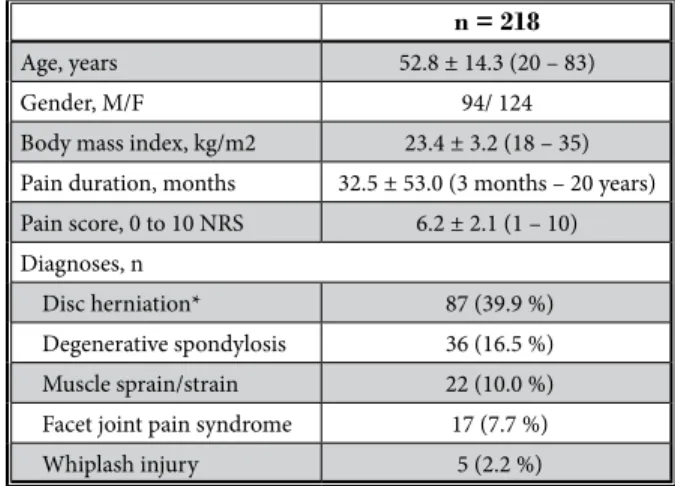
R
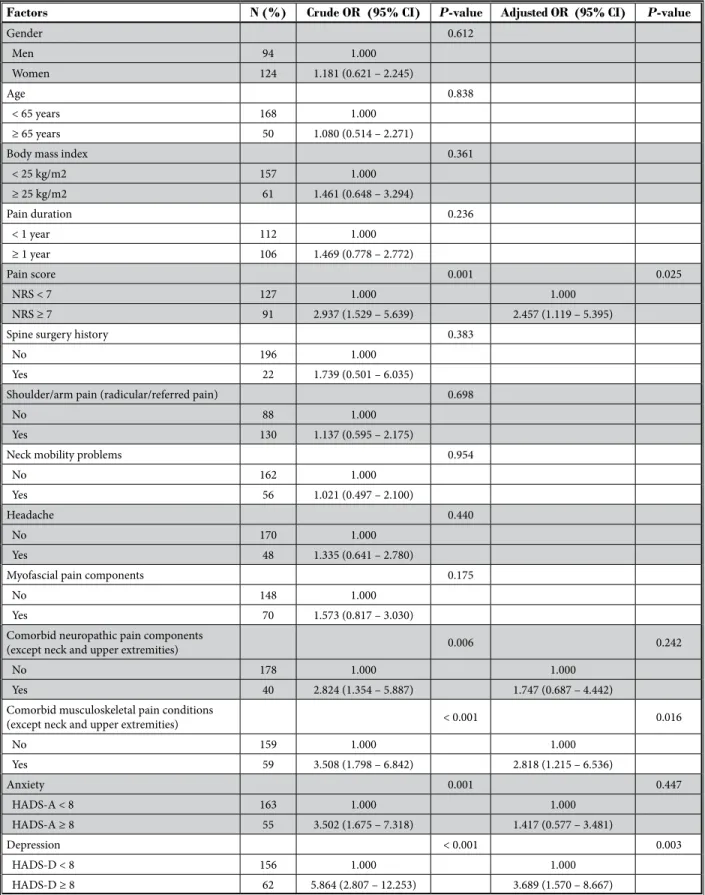
esultsA total of 218 patients with CNP satisfied the study inclusion criteria and were included in the analyses. Patient demographics and clinical characteristics are shown in Table 1. Most patients suffered from cervical disc herniation (39.9 %) and degenerative spondylosis (16.5%). The mean global score for the ISI was 8.8, with wide variation, and 53.7% of patients reported mild to severe insomnia symptoms (ISI score ≥ 8) after neck pain development. Clinical insomnia with moderate to severe severity (ISI score ≥ 15) was observed in 22.9% of patients (Table 2). There were no significant associations between the ISI score and age (R = 0.124, P = 0.078), BMI (R = 0.007, P = 0.933), or pain duration (R = 0.094, P = 0.094) in Pearson correlation analysis. However, a sta-tistically significant correlation was observed between the ISI score and the pain score (R = 0.350, P < 0.001). In univariate analysis, we found that high pain score (NRS ≥ 7), presence of neuropathic pain symptoms, presence of comorbid musculoskeletal pain, and a greater level of anxiety and depression (HADS ≥ 8) were significantly associated with clinical insomnia (Table 3). Multivari-ate logistic regression analysis revealed that high pain score (NRS ≥ 7), presence of comorbid musculoskeletal pain, and a greater level of depression (HADS ≥ 8) were significantly associated with clinical insomnia in our study population (Table 3). Among the aforementioned variables, a greater level of depression (HADS ≥ 8) was the strongest determinant predicting clinical insomnia, having the highest odds ratio of 3.689 (95% CI 1.570 – 8.667).
d
iscussionIn the present study, we found that severe pain in-tensity, the presence of comorbid musculoskeletal pain, and the level of depression were strongly associated with clinical insomnia in CNP patients.
In the general adult population, age and gender are the most clearly identified demographic risk factors for insomnia, with a greater prevalence in women and older adults (3). However, in chronic pain conditions, pain-related clinical characteristics seem to be more important than patient demographics in insomnia. Patient demographic factors did not predict clinical insomnia in patients with CNP in this study. In several studies dealing with insomnia in chronic pain, as well as our study, no relationship between insomnia and age, gender, or BMI was reported (4,9,10).
Similar to our study, most previous studies have reported that high pain intensity is significantly associ-ated with insomnia in chronic pain patients (4,9,10). In-somnia is often seen as a secondary symptom of chronic pain because pain and sleep have a bidirectional re-lationship (11). A disrupted sleep cycle can exacerbate pain, creating a vicious cycle in which insomnia caused by pain further aggravates pain. However, this point of view has shifted gradually as new evidence has Table 1. Demographics and clinical characteristics.
n = 218 Age, years 52.8 ± 14.3 (20 – 83)
Gender, M/F 94/ 124
Body mass index, kg/m2 23.4 ± 3.2 (18 – 35) Pain duration, months 32.5 ± 53.0 (3 months – 20 years) Pain score, 0 to 10 NRS 6.2 ± 2.1 (1 – 10) Diagnoses, n
Disc herniation* 87 (39.9 %) Degenerative spondylosis 36 (16.5 %) Muscle sprain/strain 22 (10.0 %) Facet joint pain syndrome 17 (7.7 %) Whiplash injury 5 (2.2 %)
Values are expressed as the mean ± SD (range) or number of patients (%). NRS = numeric rating scale. *diagnosed via MRI
Table 2. Insomnia Severity Index score data.
n = 218 Global score of the Insomnia Severity Index 8.81 ± 7.18 (0 – 28) Severity of insomnia
0 – 7: no insomnia 101 (46.3%) 8 – 14: sub-threshold insomnia 67 (30.7%) 15 – 21: clinical insomnia (moderate) 39 (17.9 %) 22 – 28: clinical insomnia (severe) 11 (5.0%) Values are expressed as the mean ± SD (range) or number of patients (%).
Table 3. Crude and adjusted odds ratios for factors associated with clinical insomnia (Insomnia Severity Index score ≥ 15) in chronic neck pain: Results of the logistic regression analysis.
Factors N (%) Crude OR (95% CI) P-value Adjusted OR (95% CI) P-value
Gender 0.612 Men 94 1.000 Women 124 1.181 (0.621 – 2.245) Age 0.838 < 65 years 168 1.000 ≥ 65 years 50 1.080 (0.514 – 2.271)
Body mass index 0.361
< 25 kg/m2 157 1.000 ≥ 25 kg/m2 61 1.461 (0.648 – 3.294) Pain duration 0.236 < 1 year 112 1.000 ≥ 1 year 106 1.469 (0.778 – 2.772) Pain score 0.001 0.025 NRS < 7 127 1.000 1.000 NRS ≥ 7 91 2.937 (1.529 – 5.639) 2.457 (1.119 – 5.395)
Spine surgery history 0.383
No 196 1.000
Yes 22 1.739 (0.501 – 6.035)
Shoulder/arm pain (radicular/referred pain) 0.698
No 88 1.000
Yes 130 1.137 (0.595 – 2.175)
Neck mobility problems 0.954
No 162 1.000
Yes 56 1.021 (0.497 – 2.100)
Headache 0.440
No 170 1.000
Yes 48 1.335 (0.641 – 2.780)
Myofascial pain components 0.175
No 148 1.000
Yes 70 1.573 (0.817 – 3.030)
Comorbid neuropathic pain components
(except neck and upper extremities) 0.006 0.242
No 178 1.000 1.000
Yes 40 2.824 (1.354 – 5.887) 1.747 (0.687 – 4.442)
Comorbid musculoskeletal pain conditions
(except neck and upper extremities) < 0.001 0.016
No 159 1.000 1.000 Yes 59 3.508 (1.798 – 6.842) 2.818 (1.215 – 6.536) Anxiety 0.001 0.447 HADS-A < 8 163 1.000 1.000 HADS-A ≥ 8 55 3.502 (1.675 – 7.318) 1.417 (0.577 – 3.481) Depression < 0.001 0.003 HADS-D < 8 156 1.000 1.000 HADS-D ≥ 8 62 5.864 (2.807 – 12.253) 3.689 (1.570 – 8.667)
nu-emerged, pointing toward insomnia as a primary dis-order for many chronic pain patients (12,13). Insomnia has been reported to be significantly associated with pain sensitivity. In a recent study using quantitative sen-sory tests, Schuh-Hofer et al (14) showed that a single night of total sleep deprivation can induce generalized hyperalgesia. Thus, in addition to pain management, insomnia may be considered a separate therapeutic target in CNP patients with severe pain intensity.
A significant number of CNP patients reported symptoms suggesting neuropathic pain in other bodily areas in this study. In patients with chronic lower back pain, similar results were observed (15). On the other hand, we found no significant relationship between insomnia and shoulder and/or arm pain suggesting neurologic involvements. This indicates that the central mechanism of neuropathic pain, rather than the pe-ripheral mechanism, may be more relevant to clinical insomnia. A recent animal study also demonstrated that neuropathic pain-like stimuli suppress GABAergic transmission with increased GABA (γ-aminobutyric acid) transporters located on activated astrocytes in the cin-gulate cortex related to insomnia (16).
In the present study, comorbid musculoskeletal pain conditions were significantly associated with in-somnia in CNP patients. Although all patients reported neck pain and related pain as a chief complaint in this study, nearly 27% of patients complained of comorbid musculoskeletal pain in sites such as the lower back, lower limbs, and joints, which may require medical attention. Initial single-site chronic pain may cause central sensitization, thereby increasing the risk of experiencing pain in other body regions. Artner et al (4) reported a higher prevalence of sleep deprivation in a patient subgroup with both chronic neck and back pain than in patients with each condition alone. Lob-bezoo et al (17) also demonstrated that sleep disorders occur more frequently in patients with chronic pain in both the craniomandibular and cervical spine regions, than in patients with pain in each region alone, as well as in patients with widespread pain. Thus, our results confirm that the likelihood of insomnia increases with the number of painful areas.
In this study, a greater level of depression was revealed to be the strongest risk factor for clinically significant insomnia in CNP patients. Wilson et al (18)
reported that patients with chronic pain with concur-rent major depression and insomnia displayed serious pain-related psychosocial impairment. Chiu et al (19) demonstrated that depression and sleep disturbance are independently associated with a reduced pain threshold. According to the criteria in the Diagnostic and Statistical Manual of Mental Disorders, insomnia is a defining symptom of major depressive disorder (18). Thus, insomnia has traditionally been assumed to be simply a comorbid symptom of depression, and has not been recognized as a separate disorder. Also, as mentioned above, insomnia is often seen as a second-ary symptom following pain in chronic pain patients. However, recent studies suggest that insomnia may be independent of pain and depression in chronic pain patients (18-20). Thus, CNP patients with depression are highly susceptible to insomnia, and insomnia may be considered a separate symptom when devising treat-ment strategies for this subgroup, which is more prone to poor clinical outcomes.
This study has some limitations. Firstly, the study was conducted in a single clinical setting including a selected study population with a homogeneous racial background. Secondly, the ISI does not include detailed parameters to measure the frequency or duration of insomnia and medication use, the roles of which are unknown in determining insomnia severity. Finally, this study was based on subjective assessment of insomnia. Although the ISI has obvious advantages over other available measurements of insomnia in busy clinical settings, it seems important to incorporate objective assessments of sleep from polysomnographic or acti-graphic evidence (21).
c
onclusionsIn conclusion, our findings confirmed that insom-nia is a pervasive problem in chronic pain conditions. We have demonstrated that high pain intensity, comor-bid musculoskeletal pain, and a high level of depression are strongly associated with clinical insomnia in CNP patients. Insomnia should be addressed as an indispens-able part of pain management in CNP patients with these risk factors, especially in patients suffering from CNP with comorbid depressive symptoms.
R
efeRences1. Bovim G, Schrader H, Sand T. Neck pain in the general population. Spine (Phila
Pa 1976) 1994; 19:1307-1309.
2. Strine TW, Hootman JM. US national prevalence and correlates of low back and neck pain among adults. Arthritis
Rheum 2007; 57:656-665.
3. Roth T. Insomnia: Definition, preva-lence, etiology, and consequences. J Clin
Sleep Med 2007; 3:S7-10.
4. Artner J, Cakir B, Spiekermann JA, Kurz S, Leucht F, Reichel H, Lattig F. Preva-lence of sleep deprivation in patients with chronic neck and back pain: A ret-rospective evaluation of 1016 patients. J
Pain Res 2013; 6:1-6.
5. Sayar K, Arikan M, Yontem T. Sleep qual-ity in chronic pain patients. Can J
Psy-chiatry 2002; 47:844-848.
6. Bastien CH, Vallières A, Morin CM. Vali-dation of the Insomnia Severity Index as an outcome measure for insomnia re-search. Sleep Med 2001; 2:297-307. 7. Guzman J, Hurwitz EL, Carroll LJ,
Hal-deman S, Côté P, Carragee EJ, Peloso PM, van der Velde G, Holm LW, Hogg-Johnson S, Nordin M, Cassidy JD; Bone and Joint Decade 2000-2010 Task Force on Neck Pain and Its Associated Disor-ders. A new conceptual model of neck pain: linking onset, course, and care: the Bone and Joint Decade 2000-2010 Task Force on Neck Pain and Its Associated Disorders. Spine (Phila Pa 1976) 2008; 33:S14-23.
8. Bjelland I, Dahl AA, Haug TT, Neck-elmannD. The validity of the Hospital Anxiety and Depression Scale. An up-dated literature review. J Psychosom Res
2002; 52:69-77.
9. Visscher CM, Lobbezoo F, de Boer W, van der Meulen M, Naeije M. Psycholog-ical distress in chronic craniomandibular and cervical spinal pain patients. Eur J
Oral Sci 2001; 109:165-171.
10. Marin R, Cyhan T, Miklos W. Sleep dis-turbance in patients with chronic low back pain. Am J Phys Med Rehabil 2006; 85:430-435.
11. O’Brien EM, Waxenberg LB, Atchison JW, Gremillion HA, Staud RM, McCrae CS, Robinson ME. Intraindividual vari-ability in daily sleep and pain ratings among chronic pain patients: Bidirec-tional association and the role of nega-tive mood. Clin J Pain 2011; 27:425-433. 12. Chung KF, Tso KC. Relationship between
insomnia and pain in major depressive disorder: A sleep diary and actigraphy study. Sleep Med 2010; 11:752-758. 13. Kelly GA, Blake C, Power CK, O’keeffe
D, Fullen BM. The association be-tween chronic low back pain and sleep: A systematic review. Clin J Pain 2011; 27:169-181.
14. Schuh-Hofer S, Wodarski R, Pfau DB, Caspani O, Magerl W, Kennedy JD, Treede RD. One night of total sleep de-privation promotes a state of generalized hyperalgesia: A surrogate pain model to study the relationship of insomnia and pain. Pain 2013; 154:1613-1621.
15. Gore M, Sadosky A, Stacey BR, Tai KS, Leslie D. The burden of chronic low back pain: Clinical comorbidities, treatment patterns, and health care costs in usual care settings. Spine (Phila Pa 1976) 2012; 37:E668-E677.
16. Narita M, Niikura K, Nanjo-Niikura K, Narita M, Furuya M, Yamashita A, Saeki M, Matsushima Y, Imai S, Shimizu T, Asato M, Kuzumaki N, Okutsu D, Miy-oshi K, Suzuki M, Tsukiyama Y, Konno M, Yomiya K, Matoba M, Suzuki T. Sleep disturbances in a neuropathic pain-like condition in the mouse are associ-ated with altered GABAergic transmis-sion in the cingulate cortex. Pain 2011; 152:1358-1372.
17. Lobbezoo F, Visscher CM, Naeije M. Impaired health status, sleep disorders, and pain in the craniomandibular and cervical spinal regions. Eur J Pain 2004; 8:23-30.
18. Wilson KG, Eriksson MY, D’Eon JL, Mi-kail SF, Emery PC. Major depression and insomnia in chronic pain. Clin J Pain 2002; 18:77-83.
19. Chiu YH, Silman AJ, Macfarlane GJ, Ray D, Gupta A, Dickens C, Morriss R, Mc-Beth J. Poor sleep and depression are in-dependently associated with a reduced pain threshold. Results of a population based study. Pain 2005; 115:316-321. 20. Asih S, Neblett R, Mayer TG, Brede E,
Gatchel RJ. Insomnia in a chronic mus-culoskeletal pain with disability popula-tion is independent of pain and depres-sion. Spine J 2014; 14:2000-2007. 21. O’Donoghue GM1, Fox N, Heneghan
C, Hurley DA. Objective and subjective assessment of sleep in chronic low back pain patients compared with healthy age and gender matched controls: A pilot study. BMC Musculoskelet Disord 2009; 10:122.