Notes Bull. Korean Chem. Soc. 2011, Vol. 32, No. 8 3101 DOI 10.5012/bkcs.2011.32.8.3101
Versatile Synthesis of Disubstituted Triazole Library for Dopamine and
Serotonin Receptor Ligands
†Kamalkishor P. Landge, Yong Wan Seo, Jumyung Kwak, Woo Kyu Park,‡ Jae Yang Gong,‡ Hee Yoon Lee,§ and Hun Yeong Koh*
Department of Chemistry, Inha University, Nam-gu, Incheon 402-751, Korea. *E-mail: [email protected]
‡Pharmaceutical Screening Research Team, Korea Research Institute of Chemical Technology, Daejon 305-343, Korea §Department of Chemistry, Korea Advanced Institute of Science and Technology, Daejeon 305-701, Korea
Received January 18, 2011, Accepted February 7, 2011
Key Words : Dopamine receptors, Serotonin receptors, Arylpiperazine, 1,2,3-Triazole, Click chemistry
In the field of medicinal chemistry an extensive efforts have been made to explore potent and selective ligands for dopamine D31or D42 receptor for the discovery of antipsychotic drugs.3 Heterocyclic compounds bearing 1, 2, 3-triazole have long been the focus of synthetic chemistry due to their broad spectrum of applications in biological, pharmaceutical, and material areas.4,5 The incorporation of ‘click’ chemistry,6,7 the Cu(I)-catalyzed Huisgen [2 + 3] dipolar cycloaddition reaction between an organic azide and an alkyne to form 1,4-disubstituted tirazoles with exclusive selectivity, has recently become a laboratorial preference toward the construction of compound libraries,8 along with applications in organic chemistry,9,10 drug discovery.11 Combinatorial chemistry often requires maximization of product distribution to achieve high diversity of the library generation. For the construction of substituted triazole libraries, we wanted to produce both isomeric triazoles at the same time. For this reason, classical [2+3] cycloaddition route to triazoles was chosen and studied for the construction of triazole libraries though the reaction condition is much harsher than the ‘click’ chemistry. In many instances, controlled microwave heating under sealed vessel conditions has been demonstrated to dramatically reduce reaction times, increase product yields, and enhance product purities by reducing unwanted side reactions compared to conventional synthetic methods.12,13 Also, spectacular rate-enhancing effect of water as the reaction medium is widely reported for numerous organic reactions.14 As a part of ongoing search for selective GPCR receptor ligands,15 we selected triazole library as a good candidate for identifying sub-type selective ligands for GPCRs.
Herein we wish to report a microwave assisted synthesis of triazole library by using water as a solvent or a solvent free synthesis of virtually equal amount of both isomeric triazoles with high yield and high purity (Scheme1, Table 1). Derivatives 3 were synthesized with 52% yield by carrying out a simple nucleophilic substitution reaction of piperazine derivatives with 1-bromo-2-chloroethane 2 using potassium
carbonate as a base in acetone at room temperature. Successive treatment of the products with sodium azide produced the derivatives 4 in 92% yield. Derivatives 4 were then treated with ethynylbenzene, methyl propiolate and ethyl propiolate under a microwave condition to obtain a mixture of 1,4- and 1,5-isomers (scheme1, Table 1) in 90-99% yield (yield of mixture of two isomers) by two different routes. To our delight, both 1,4- and 1,5-isomer were obtained in appreciable amount. With methyl propiolate, both isomers were obtained in similar amount. When methyl ester was replaced by ethyl ester, 1,4-isomer was obtained in larger amount than the 1,5-isomer though the ratio of two isomeric products was less than 2 in most cases. Size of the substituent does not appear to affect the isomeric ratio as phenylacetylene produced equal amount of isomers in most cases. Results from the entries 3, 4, 8, 9 and 11 strongly indicate that electronic environment, though remote, affects the product ratio. Both 1,4- and 1,5-isomers were easily separated and identity of the structures was confirmed by NOE experiment.16
For the route A, we used ethynylbenzene and azide derivatives for the synthesis of triazole in water and for route B, methyl propiolate and ethyl propiolate with azide derivatives without any solvent. The reaction condition does not appear to alter the ratio of products. This synthetic strategy of triazole derivatives provides good diversity in the library construction as both 1,4- and 1,5-isomers of triazoles would be produced. Table 1 summarizes the isolated yields and ratio of isomeric products through route A and route B.
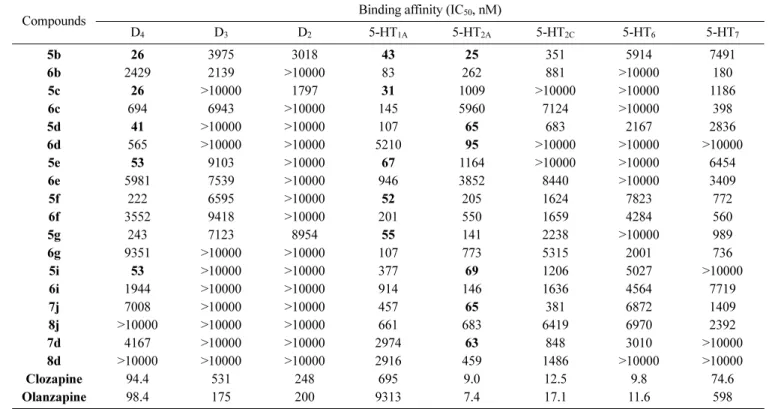
A library of 54 molecules as HCl salts was tested in vitro for dopamine and serotonin receptor binding (Table 2),17,18 even though the size of the linker between piperazine ring and triazole was not considered optimal for dopamine or serotonin binding. Among these 54 molecules some molecules showed relatively good binding affinity and selectivity for sub-type dopamine and serotonin receptors.
1,5-Isomers with 2,3-dimethyl, o-methoxy, 3,4-dichloro, o-fluoro and 3,4-dimethyl attached to phenyl piperazine ring (5b, 5c, 5d, 5e and 5i) show good binding affinities for dopamine D4 receptor. These compounds also show good binding affinities to 5-HT1A and 5-HT2A.
†
This paper is dedicated to Professor Eun Lee on the occasion of his ho-nourable retirement.
3102 Bull. Korean Chem. Soc. 2011, Vol. 32, No. 8 Notes
While the 1,5-isomers show selective binding activity to dopamine D4 and serotonins, the 1,4-isomers do not show any binding activities to dopamine or serotonin receptors.
When the phenyl substituent of the triazole ring was replaced by electron withdrawing ester group, the 1,isomers 7i and 7d show good binding affinity only to
5-Scheme 1. Reagents and reaction conditions: i. K2CO3, Acetone, rt, 15 hrs. 52%, ii. NaN3, DMF, 50 oC, 10 hrs. 92%, iii. Route A: ethynylbenzene, MW. 150 oC, 150 W, 2 h, Route B: Methyl propiolate/Ethyl propiolate, MW., 100 oC,100 W, 1 h.
Table 1.
Entry Ar Route A R Route B
5 Yield 6 Yield 7 Yield 8 Yield
01 5a 45.2 6a 53.8 CH3 7a 45.2 8a 52.3 CH2CH3 7a′ 18.4 8a′ 62.5 02 5b 42.7 6b 54.8 CH3 7b 45.2 8b 50.7 CH2CH3 7b′ 30.4 8b′ 54.3 03 5c 28.5 6c 70.2 CH3 7c 20.5 8c 72.3 CH2CH3 7c′ 14.7 8c′ 80.5 04 5d 21.4 6d 75.8 CH3 7d 23.7 8d 68.2 CH2CH3 7d′ 9.1 8d′ 65.6 05 5e 45.7 6e 52.1 CH3 7e 36.8 8e 51.4 CH2CH3 7e′ 19.4 8e′ 79.9 06 5f 43.3 6f 52.8 CH3 7f 40.5 8f 52.8 CH2CH3 7f′ 7.3 8f′ 41.5 07 5g 40.3 6g 52.3 CH3 7g 38.2 8g 54.2 CH2CH3 7g′ 14 8g′ 61.5 08 5h 40.7 6h 53.8 CH3 -a - -a -CH2CH3 -a - -a -09 5i 20.4 6i 76.4 CH3 -a -a CH2CH3 -a -a 10 5j 30.75 6j 68.3 CH3 7j 33 8j 53.3 CH2CH3 -a - -a 11 -a -a CH3 -a - -a CH2CH3 7k′ 19.8 8k′ 73 anot synthesized
Notes Bull. Korean Chem. Soc. 2011, Vol. 32, No. 8 3103
HT2A receptor. According to our whole binding data study, we come to conclusion that the 1,5-isomers fit better to the receptors than 1,4-isomers and electronic environment around the trizaole ring plays a big role in the selectivity among receptors.
In summary we developed a diverse synthetic method to produce triazoles with high yield and high purity by using microwave reactor. The structural uniqueness and substitution pattern will be a good guide to the development of selective ligands for many GPCR receptors.
Experimental Section
General Procedure for Synthesis of Chloroethyl Piperazine Derivatives (3). To a solution of compound 1 (when R1=Ph, 1 g, 6.16 mmol) and K2CO3 (1.27 g, 9.24 mmol) in acetone (10 mL), 1-bromo-2-chloroethane 2 (0.61 mL, 7.23 mmol) under nitrogen atmosphere was added dropwise at r.t. and stirred well at rt for 15 hrs. Reaction was monitored on T.L.C. Reaction mixture was filtered after 15 hrs. Filtrate removed solvent using by rotary evaporator. Product was washed with water and extracted with ethyl acetate (50 mL × 3). Product was isolated by column chromatography (E.A.:Hex. = 1:2) as a slight brown colored liquid with 52% yield.
¹H NMR derivative 3 when R1=Ph (200 MHz, CDCl3): δ 7.30-7.22 (m, 2H), 6.94-6.82 (m, 3H), 3.63 (t, 2H), 3.21 (t, 4H), 2.79 (t, 2H), 2.68 (m, 4H).
Other chloroethyl piperazine derivatives were synthesized analogously and identified with the 1H NMR.
General Procedure for Synthesis of Azidoethyl
Piperazine Derivatives (4). A solution of compound 3 (when R1=Ph, 710 mg, 3.16 mmol) and NaN3 (409.5 mg, 6.29 mmol) in DMF was stirred at 50 oC for 10 hrs. Reaction was monitored on T.L.C. After completion of reaction, reaction mixture was filtered out and DMF was degassed under rotary evaporator at 50 oC. Obtained gelly mass was washed with water and product was extracted with ethyl acetate (25 mL × 3). Product was purified by column chromatography (E.A.:Hex. = 4:6) to give liquid with 92% yield.
¹H NMR of derivative 4 when R1=Ph (200 MHz, CDCl3): δ 7.70-7.22 (m, 2H), 6.95-6.86 (m, 3H), 3.39 (t, 2H), 3.22 (t, 4H), 2.70-2.63 (overlap, m, 6H).
Other azidoethyl piperazine derivatives were synthesized analogously and identified with the 1H NMR.
General Procedure for Synthesis of Triazole-ethyl Piperazine Derivatives (5) and (6).
Route A: A solution of compound 4 (when R1=Ph, 90 mg, 0.389 mmol) and ethynylbenzene (0.128 mL, 1.15 mmol) in 2 mL of water was stirred in microwave reactor (CEM, Model No.-908005, Serial No.-DU8589) at 150 oC and 150 W for 2 hr. Water was removed from reaction mixture at 50 oC under high vacuum. Obtained jelly mass was purified by column chromatography (THF:CHCl3:Hex = 2:1:2). Syn isomer 5 was separated as a colorless liquid with 40-45% yield and anti isomer 6 was separated as a solid with 45-50% yield.
After carrying out a column chromatography, product was dissolved in 2 mL of diethyl ether and treated with 1 M HCl solution in diethyl ether. All HCl salts were prepared by the same method.
Table 2. In vitro binding affinity of some selective compounds
Compounds Binding affinity (IC50, nM)
D4 D3 D2 5-HT1A 5-HT2A 5-HT2C 5-HT6 5-HT7 5b 26 3975 3018 43 25 351 5914 7491 6b 2429 2139 >10000 83 262 881 >10000 180 5c 26 >10000 1797 31 1009 >10000 >10000 1186 6c 694 6943 >10000 145 5960 7124 >10000 398 5d 41 >10000 >10000 107 65 683 2167 2836 6d 565 >10000 >10000 5210 95 >10000 >10000 >10000 5e 53 9103 >10000 67 1164 >10000 >10000 6454 6e 5981 7539 >10000 946 3852 8440 >10000 3409 5f 222 6595 >10000 52 205 1624 7823 772 6f 3552 9418 >10000 201 550 1659 4284 560 5g 243 7123 8954 55 141 2238 >10000 989 6g 9351 >10000 >10000 107 773 5315 2001 736 5i 53 >10000 >10000 377 69 1206 5027 >10000 6i 1944 >10000 >10000 914 146 1636 4564 7719 7j 7008 >10000 >10000 457 65 381 6872 1409 8j >10000 >10000 >10000 661 683 6419 6970 2392 7d 4167 >10000 >10000 2974 63 848 3010 >10000 8d >10000 >10000 >10000 2916 459 1486 >10000 >10000 Clozapine 94.4 531 248 695 9.0 12.5 9.8 74.6 Olanzapine 98.4 175 200 9313 7.4 17.1 11.6 598
3104 Bull. Korean Chem. Soc. 2011, Vol. 32, No. 8 Notes
Other triazole ethyl piperazine derivatives were synthesized analogously and identified with the 1H NMR.
1H NMR Compound 5a (400 MHz, MeOH-d 4): δ 7.77(s, 1H), 7.75-7.753 (m, 5H), 7.20-7.18 (m, 2H),6.91-6.88 (m, 2H), 6.87 (m, 1H), 4.61 (t, 2H, J = 6.4 Hz), 2.30 (t, 4H, J = 5.2 Hz), 2.83 (t, 2H, J = 6.4 Hz), 2.49 (t, 4H, J = 5.2 Hz). ¹H NMR Compound 6a (400 MHz, CDCl3): δ 7.94 (s, 1H), 7.83 (d, 2H , J = 6.3 Hz), 7.41 (t, 2H), 7.33 (t, 1H), 7.29-7.26 (m, 2H), 6.93 (d, 2H), 6.87 (t, 1H), 4.55 (t, 2H), 3.21 (t, 4H), 2.93 (t, 2H), 2.69 (t, 4H).
General Procedure for Synthesis of Triazole Carboxylate Derivatives (7a) and (8a).
Route B: A solution of compound 4 (when R1=Ph, 92 mg, 0.397 mmol) and methyl propiolate (0.106 mL, 1.19 mmol) or ethyl propiolate (0.120 mL, 1.19 mmol) was stirred in microwave reactor (CEM, Model 908005, Serial No.-DU8589) at 100 oC and 100 W for 1 hr. Reaction mixture was purified by column chromatography (THF:CHCl3:Hex = 2:1:2). Syn isomer 7 was separated as a colorless liquid with 40-45% yield and anti isomer 8 was separated as a solid with 45-50% yield.
Compound 7a′ and 8a′ (when R1=Ph and R2=CH2CH3) were prepared by using the same procedure.
Other triazole carboxylate derivatives were synthesized analogously and identified with 1H NMR.
1H NMR Compound 7a (400 MHz, MeOH-d 4): δ 8.18 (s, 1H), 7.24-7.19 (m, 2H), 6.96-6.93 (m, 2H), 6.82 (t, 1H, J = 6.4 Hz), 4.95 (t, 2H, J = 6.4 Hz), 3.93 (s, 3H), 3.10 (t, 4H), 2.92 (t, 2H, J = 6.8 Hz), 2.69 (t, 4H, J = 5.2 Hz). ¹H NMR Compound 8a (400 MHz, CDCl3): δ 8.26 (s, 1H), 7.28-7.24 (m, 3H), 6.93-6.85 (m, 2H), 4.55 (t, 2H, J = 5.6 Hz), 3.95 (s, 3H), 3.19-3.17 (m, 4H), 2.90-2.88 (m, 2H), 2.67-2.65 (m, 4H). 1H NMR Compound 7a′ (400 MHz, MeOH-d 4): δ 8.18 (s, 1H), 7.24-7.20 (m, 2H), 6.95-6.93 (m, 2H), 6.85-6.80 (m, 1H), 4.9 (t, 2H, J = 6.8 Hz),4.41 (q, 2H, J = 4.2 Hz), 3.10 (t, 4H), 2.91 (t, 2H, J = 6.4 Hz), 2.68 (t, 4H), 1.39 (t, 3H, J = 7.2 Hz). 1H NMR Compound 8a′ (400 MHz, MeOH-d 4): δ 8.58 (s, 1H), 7.24-7.20 (m, 2H), 6.96-6.94 (m, 2H), 6.85-6.80 (m, 1H), 4.64 (t, 2H, J = 6.4 Hz), 4.39 (q, 2H, J = 6.8 Hz), 3.13 (t, 4H), 2.92 (t, 2H, J = 6.4 Hz), 2.69 (t, 4H), 1.37 (t, 3H, J = 8 Hz).
Acknowledgments. The research was partially supported by the Converging Research Center Program through the Ministry of Education, Science and Technology (2010K001201).
References
1. Sokoloff, P.; Giros, B.; Martres, M.-P.; Bouthenet, M.-L.; Schwartz, J.-C. Nature 1990, 347, 146-151.
2. Van Tol, H. M.; Bunzow, J. R.; Guan, H. C.; Sunahara, R. K.; Seeman, P.; Niznik, H. B.; Civelli, O. Nature 1991, 30, 610. 3. (a) Enguehard-Gueiffier, C.; Hübner, H.; El Hakmaoui, A.;
Allouchi, H.; Gmeiner, P.; Argiolas, A.; Melis, M. R.; Gueiffier, A. J. Med. Chem. 2006, 49, 3938-3947. (b) Löber, S.; Hübner, H.; Gmeiner, P. Bioorg. Med. Chem. Lett. 2006, 16, 2955-2959. (c)
Mohr, P.; Decker, M.; Enzensperger, C.; Lehmann, J. J. Med. Chem. 2006, 49, 2110-2116.
4. For reviewing: (a) Wamhoff, H. In Comprehensive Heterocyclic Chemistry; Katritzky, A. R., Rees, C. W., Eds.; Pergamon: Oxford, UK, 1984; Vol. 5, pp 669-732. (b) Katritzky, A. R.; Zhang, Y.; Singh, S. K. Heterocycles 2003, 60, 1225-1239. (c) Abu- Orabi, S. T.; Atfah, M. A.; Jibril, I.; Mari’i, F. M.; Ali, A. A.-S. J. Heterocycl. Chem. 1989, 26, 1461-1468. (d) Krivopalov, V. P.; Shkurko, O. P. Russ. Chem. Rev. 2005, 74, 339-379.
5. Chen, X.; Wang, W. Annu. Rep. Med. Chem. 2003, 38, 333-346. 6. (a) Kolb, H. C.; Finn, M. G.; Sharpless, K. B. Angew. Chem., Int.
Ed. 2001, 40, 2004-2021. (b) Rostovtsev, V. V.; Green, L. G.; Fokin, V. V.; Sharpless, K. B. Angew. Chem., Int. Ed. 2002, 41, 2596-2599.
7. Caddick, S.; Fitzmaurice, R. Tetrahedron 2009, 65, 3325-3355. 8. Kappe, C. O.; Van der Eycken, E. Chem. Soc. Rev. 2010, 39,
1280-1290.
9. (a) Reichardt, C. Solvents and Solvent Effects in Organic Chemistry; VCH: Weinheim, Germany, 2003. (b) Li, C. J. Chem. Rev. 1993, 93, 2023-2035. (c) Lindstro¨m, U. M. Chem. Rev. 2002, 102, 2751-2772. (d) Narayan, S.; Muldoon, J.; Finn, M. G.; Fokin, V. V.; Kolb, H. C.; Sharpless, K. B. Angew. Chem., Int. Ed. 2005, 44, 3275-3279.
10. (a) Katritzky, A. R.; Zhang, Y.; Singh, S. K. Heterocycles 2003, 60, 1225-1239. (b) Wang, Z.-X.; Qin, H.-L. Chem. Commun. 2003, 2450-2451. (c) Jin, T.; Kamijo, S.; Yamamoto, Y. Eur. J. Org. Chem. 2004, 3789-3791.
11. (a) Manetsch, R.; Krasiñski, A.; Radiæ, Z.; Raushel, J.; Taylor, P.; Sharpless, K. B.; Kolb, H. C. J. Am. Chem. Soc. 2004, 126, 12809. (b) Kolb, H. C.; Sharpless, K. B. Drug Discovery Today 2003, 8, 1128.
12. (a) Microwaves in Organic Synthesis, 2nd ed.; Loupy, A., Ed.; Wiley-VCH: Weinheim, Germany, 2006. (b) Kappe, C. O.; Stadler, A. Microwaves in Organic and Medicinal Chemistry; Wiley-VCH: Weinheim, Germany, 2005.
13. (a) Kappe, C. O. Angew. Chem., Int. Ed. 2004, 43, 6250-6284, and references cited therein. (b) Roberts, B. A.; Strauss, C. R. Acc. Chem. Res. 2005, 38, 653-661. (c) Kappe, C. O.; Dallinger, D. Nature Rev. Drug Discov. 2006, 5, 51-63.
14. (a) Li, C. J. Chem. Rev. 1993, 93, 2023. (b) Organic Synthesis in Water; Grieco, P. A., Ed.; Blackie: London, 1998. (c) Breslow, R. In Water as Solvent for Chemical Reactions; Anastas, P. T., Williamson, T. C., Eds.; Oxford University Press: Oxford, 1998. 15. (a) Jung, J. Y.; Jung, S. H.; Koh, H. Y.; Pae, A. N.; Park, W. K.;
and Kong, J. Y. Bull. Korean Chem. Soc. 2006, 27, 1861. (b) Youn, H. S.; Lee, E. J.; Lee, J. E.; Park, W. K.; Beak, D. J.; Cho, Y. S.; Koh, H. Y.; Choo, H. A.; Pae, A. N. Bull. Korean Chem. Soc. 2009, 30, 1873.
16. In the 1,5- isomers, after irradiation of triazole proton there is no enhancement of ethyl proton. On the other hand, after irradiation of triazole proton in the 1,4-isomers, there is clear enhancement of ethyl proton which comes near 4.6 ppm and 2.81 ppm.
17. (a) Pazos, A.; Hoyer, D.; Palacios, J. M. Eur. J. Pharmacol. 1985, 106, 539-546. (b) Park, W. K.; Jeong, D.; Cho, H.; Lee, S. J.; Cha, M. Y.; Pae, A. N.; Choi, K. I.; Koh, H. Y.; Kong, J. Y. Pharmacol. Biochem. Behav. 2005, 82, 361-372.
18. Compounds were evaluated in vitro for dopamine D2, D3, D4 receptors binding affinity by measuring their ability to displace radioligand ([3H]Methylspiperone for D2 and D3, [3 H]YM-09151-2 for D4) from the cloned human dopamine receptors D2Long, D3 and D4.2 which were stably expressed in CHO or Sf9 cells, respectively. For serotonin receptors, compounds were biologically evaluated against human recombinant 5-HT1A, 5-HT2A, 5-HT2C, 5-HT6 and 5-HT7 receptors stably expressed by CHO-K1 cell lines through [3H]8-OH-DPAT, [3H]Ketanserin, [3H]Mesulergine and [3H]LSD binding assay, respectively.