전자기웨이브에 의해 제어되는 무선형
그래핀-카본나노튜브 액츄에이터
Wireless Graphene Oxide-CNT Bilayer Actuator
Controlled with Electromagnetic Wave
Xu Liang, 오 일 권* Xu, Liang and Oh, Il-Kwon
1)
요 약
Based on graphene oxide and multi-walled carbon nanotube layers, a wireless bi-layer actuator that can be remotely controlled with an electromagnetic induction system has been developed. The graphene-based bi-layer actuator exhibits a large one-way bending deformation under eddy current stimuli due to asymmetrical responses originating from the temperature difference of the two different carbon layers. In order to validate one-way bending actuation, the coefficients of thermal expansion of carbon nanotube and graphene oxide are mathematically formulated in this study based on the atomic bonding energy related to the bonding length. The newly designed graphene-based bi-layer actuator is highly sensitive to electromagnetic wave irradiation thus it can trigger a new actuation mode for the realization of remotely controllable actuators and is expected to have potential applications in various wireless systems.
keywords : Graphene, Carbon nanotube, Wireless actuator, Electromagnetic wave
1. Introduction
As building blocks for carbon nanomaterials, graphene and graphene oxide that are two dimensional single atomic carbon nanosheets have recently attracted tremendous interests as advanced functional materials. Composed of sp2 carbons with one atom thickness, the graphene-based devices and systems have shown excellent performance in a wide range of applications such as sensors, solar cells, supercapacitors, field-effect transistors, polymer composites, and biomimetic devices due to its excellent thermal, electrical, and mechanical properties as well as its large surface-to-volume ratio. Moreover, on an account of its high surface-to-volume ratio, graphene would be highly sensitive to electromagnetic and ultrasonic waves in comparison with one dimensional carbon nano-materials such as carbon nanotubes and carbon nanofibers. Accordingly, it has strong potential applicability in the development of a new generation of remotely controllable actuators based on electromagnetic wave irradiation without
** 정회원∙KAIST 기계항공시스템공학부 해양시스템공학전공 교수 [email protected]
the wiring procedures required in electro-active materials and devices. Graphene-based actuators such as an electrochemical actuator composed of asymmetrically surface-modified graphene film and a graphene/nafion composite actuator were recently reported. Here, we have developed a newly designed graphene oxide-CNT bi-layer wireless actuator based on a large-area sequential self-assembly process of graphene oxide and multi-walled CNTs. The new rational hybrid structure has exhibited large one-way deformation under the stimuli of electromagnetic wave induction, through asymmetrical responses of two different carbon layers relative to the variation of temperature.
2. Results and Discussion
The detailed fabrication of the graphene oxide-CNT bi-layer actuator is described in the following Experimental Section. In brief, aqueous suspensions of graphene oxide nanoplatelets were produced by sonication of graphite oxide, via an oxidation of graphite process. The graphene oxide-CNT bi-layer actuator was fabricated through a sequential filtration of aqueous suspensions of graphene oxide and
CNT nanoparticles through an Anodisc membrane (47 mm in diameter, 0.02 m pore size Cat. No.
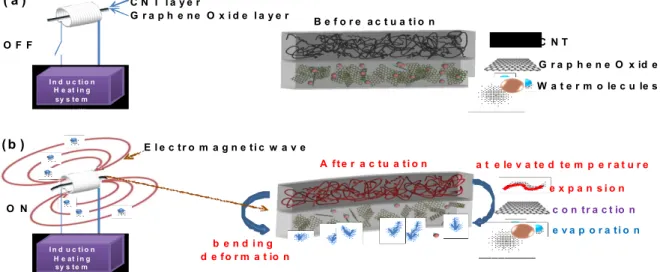
7402-004,Whatman). The length and width of the prepared bi-layer actuator are 25 mm and 10 mm, respectively, and the total thickness was selected as about 50 m in order to realize a mechanically flexible membrane with a bi-layer structure. Surface and cross-sectional morphologies of the as-prepared bi-layer actuator were observed by scanning electron microscopy (SEM), as shown in Figure 1. The bi-layer structure is found to be stable and flexible due to the physical bonding between the graphene oxide and CNT layers. The CNT layer has high hydrophobicity, and thermal and electrical conductivities, while the graphene oxide layer has high hydrophilicity, low thermal conductivity, and high electrical resistance. The asymmetric structure of the bi-layer actuator induces distinct electric, thermal, and humidity responses between the two different layers, resulting in one-way bending deformations under the eddy current stimuli of an electromagnetic induction system.
( a ) ( b ) C N T l a y e r G r a p h e n e O x i d e l a y e r O F F B e f o r e a c t u a t i o n C N T G r a p h e n e O x id e W a t e r m o le c u le s O N I n d u c ti o n H e at i n g sy s te m I n d u c ti o n H e at i n g sy s te m E l e c t r o m a g n e t i c w a v e A f t e r a c t u a t i o n c o n t r a c t io n e v a p o r a t i o n e x p a n s i o n a t e le v a t e d t e m p e r a t u r e b e n d i n g d e f o r m a t io n
Figure 1 Actuation mechanism of wireless GO/CNT bilayer actuator.
감사의 글
This work was supported by the Mid-career Researcher Program through a NRF grant funded by the MEST (No. 2010-0000300) and (No. 2010-0018423).