가시화기법을
이용한 룸 에어컨 내부의 유동 구조에 관한 연구
이수홍
†· 라선욱
**· 강 근
**· 고한서
*Study on Flow Structure inside Room Air Conditioner Using Visualization
Technique
Soo-Hong Lee
†, Seon-Uk Na
**, Geun Kang
**and Han Seo Ko
*†,
* School of Mechanical Engineering, Sungkunkwan University, 300 Cheoncheon-dong, Jangan-gu, Suwon,Gyeonggi-do, 440-746, Korea. (E-mail: [email protected], Tel : 031-290-7475 )
** Samsung Electronics Co., LTD, Suwon,Gyeonggi-do, 443-742, Korea.
Key Words : PIV(Particle Image Velocimetry), RAC(Room Air Conditioner), Crossflowfan(횡류팬) Abstract
Whole flow fields of a room air conditioner (RAC) have been visualized by a Particle Image Velocimetry (PIV) technique to analyze the flow structure with various inlet and outlet angles, and to control an eccentric vortex which affects an efficiency and noise of the RAC. A test model with 5 stages of a cross flow fan has been manufactured and a transparent acryl has been installed at the side of the test model for the PIV experiment. The inlet and outlet flows and the flow inside the cross flow fan have been analyzed by varying the inlet grill angles and outlet blade angles. The movement of the eccentric vortex has been investigated experimentally by developing the measurement technique for the inner flow field of the cross flow fan. From the visualization of the inner flows, the origins of the noise inside the RAC and the condensation points around the outlet parts of the cold air have been observed and the solution of the problems can be proposed in this study.
1. Introduction
A cross flow fan can neglect flows with an axial direction and can control flows by changing a length of the fan instead of changing a rpm and a diameter because it has flow characteristics which crosses inside the fan. The cross flow fan can also be used for a RAC (Room Air Conditioner) since small scale of the fan can be manufactured. Recently the cross flow fan is being developed to reduce noise and to increase efficiency. Thus, it is significant to study about the cross flow fan that can affect the efficiency and noise of the RAC.
The RAC is composed of the cross flow fan, a stabilizer, a rearguider, and a heat exchanger as shown in
Fig. 1, and a geometrical shape and a relative position of them can decide the efficiency and the noise. And, the cross flow fan is composed of the rib and the blade (Fig. 2).Thus, relative effect of them as well as the cross flow fan itself should be investigated to improve the efficiency and the noise problem.
Experimental analyses have been performed for the cross flow fan mainly since flow characteristics is complicated and design factors that affect the eccentric vortex are various although the control of the internal eccentric vortex is directly related to the efficiency. The inlet and outlet flows have been visualized and analyzed by the PIV in this study with various inlet and outlet angles for the household RAC to provide the basic design data of the RAC with high efficiency, low noise and condensation phenomena.
Fig. 1 Schematic of indoor unit of RAC.
Fig. 2 Schematic of Cross flow fan
2. Experimental Setup and Method
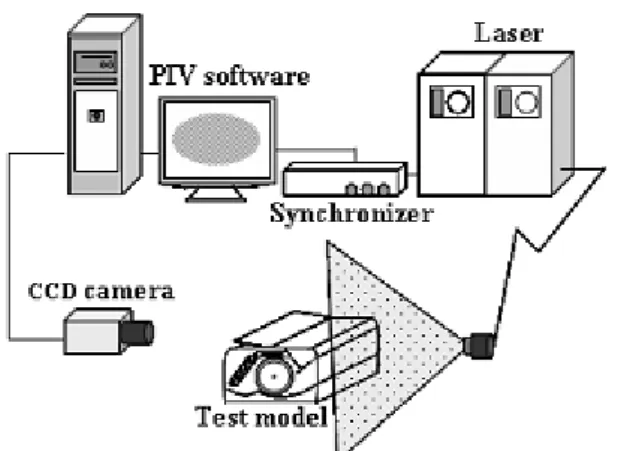
A PIV measures velocity vectors from particle movements using an image processing technique after recording the tracer particles within a time interval of Δt by a CCD camera. The PIV system is composed of a laser for a light source, a camera for capturing particle images, a synchronizer and a computer for image processing and calculation as shown in Fig.3. A 50mJ dual-head ND:YAG laser has been used and a time-interval for two laser pulses has been fixed to be 30~50μs according to the flow condition. 15 images for one second have been captured using the CCD camera with a 2k X 2k resolution, and the camera and the laser have been synchronized using a trigger signal. Olive oil has been used for tracer particles with a size of 2μm by an atomizer. Also, a distributor with many small holes has been used to mix the particles with surrounding air for the uniform distribution around the test model.
Fig.3 Schematic diagram of PIV system
The test model which has geometrical similarity with the real RAC has been manufactured. A front panel, an inlet grill, a heat exchanger, and an outlet blade have been installed inside the test model to analyze internal and external flows with various inlet and outlet angles during operation. Also, a transparent acryl has been attached to the side of the test model to capture the particle images. The side of the cross flow fan, the rear guider, and the stabilizer have been made by transparent acryls. And, a slot of 2mm with a transparent film has been installed at the center of the blade for the cross flow fan so that the laser beam can be transmitted.
(a) Inlet flow at 0° (b) Inlet flow at 10°
(c) Inlet flow at 20°, (d) Inlet flow at 180°
Fig.4 Velocity of inlet flow for 790 rpm with various inlet grill angles
(a) Internal flow at 0° (b) Internal flow at 10°
(c) Internal flow at 20° (d) Internal flow at 180°
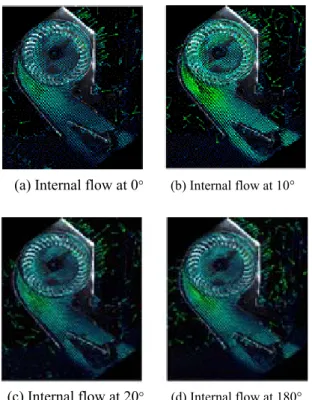
Fig.5 Velocity of internal flow for 790 rpm with various inlet grill angles
Initially the effect of the inlet angle has been investigated by various angles for 0° (closed), 10° (operating condition for the RAC), 20°, and 180° (open) with fixed outlet angle of 40° as shown in Figs. 4 and 5.
3. Condensation Phenomena
Condensation phenomena is very important factor for the RAC since complete comfort in a closed environment is highly affected by the control of the condensation problem at the outlet of the RAC.
The dewdrops have been observed uniformly at all outlets and the outlet flows have been visualized to analyze the cause of the condensation phenomena at the outlets and to propose the shape of the outlets with reduced condensation.
A wedge block has been installed at the end of the stabilizer (front part of the outlet) where the condensation occurs mainly and the experiments have been performed with various angles and lengths of the wedge block. In Fig. 6, a is the length of the wedge block,
b is the distance between the wedge block and the end of the stabilizer, and θ is the angle between the wedge block and the stabilizer. The flow structures have been measured with fixed a of 10mm and various b and θ parameters for 8 cases as shown in Table 1.
a
b 토출구 끝단End of θ
Outlet
Fig.6 Shape of wedge block
Table 1 Parameters of Wedge Block (Fixed a=10mm) b (mm) Θ (°) C Caassee11 4 0 C Caassee22 4 10 C Caassee33 4 20 C Caassee44 4 30 C Caassee55 2 0 C Caassee66 2 10 C Caassee77 2 20 C Caassee88 2 30
4. Results and Discussion
The objective of this experiment is to analyze the inlet and outlet flows inside and outside the cross flow fan by the flow visualization technique, and to design the RAC with high efficiency and low noise by controlling the eccentric vortex inside the cross flow fan. The variation of the inlet and outlet flows has been observed by the front inlet grill angles as shown in Figs. 4 and 5. The amount and velocity of the inlet flow at the front and upper part of the test model have been measured as shown in Fig. 4 (a), (b), (c) and (d). If the front inlet grill angle increases, the amount of the inlet flow of the front and upper parts become similar and the flow velocity decreases because the inlet area of the front part increases. Also, the noise problem is supposed to improve since the flow can be stabilized.
The flows inside the cross flow fan and the outlet flows have been observed with various front inlet grill angles as shown in Fig. 5 (a), (b), (c) and (d). The eccentric vortex has appeared at the lower part of the stabilizer and has been fixed without the effect of the angle. The difference of the amounts of the inlet flow rate between the front and upper parts of the inlet has been predicted to have an effect on the eccentric vortex since it can change the direction of the inlet air flow. However, the inner flow inside the cross flow fan and the outlet flow have shown the uniform tendency because the inlet air flows at the front and upper parts of the inlet have passed through the heat exchanger before the inside of the fan to be stabilized by the resistance of the heat exchanger.
The inlet velocity and the flow structure have shown uniformity with various outlet blade angles by measuring the inlet air velocity for the front and upper parts of the test model. The position of the eccentric vortex inside the cross flow fan and outlet flow structure have not been affected by the outlet angle because the outlet blade has an enough distance inside the cross flow fan. The outlet flow structure has been measured by the rpm after removing the blade to observe the flow in detail since the outlet flow has not been examined accurately with the blade. Although the velocity of the outlet flow increases by increasing the rpm, the whole structure of the outlet flow is uniform as shown in Fig. 7. Thus, there is a similarity for the outlet flow structure by the rpm.
(a) 790 rpm (b) 1070 rpm (c) 1210 rpm Fig.7 Discharge velocity distribution of RAC with
various speeds
The condensation phenomena have been observed at the interface of the outlet air with low temperature and the external air with high temperature by the PIV
experiment, and the parameters of the wedge block have been proposed to reduce the dewdrops. The condensation phenomena have occurred at the outlet by colliding between the external air and the outlet air directly without the block as shown in Fig. 8 (a) while the condensation has reduced by separating the interface from the wall of the outlet by the wedge block (Fig. 8 (b)). The case 7 in Table 1 has showed the least dewdrops at the outlet of the RAC.
(a) Case 1 (b) Case 7 Fig.8 Reduction of condensation by wedge block
5. Conclusion
The test model which has a similarity with the real RAC has been manufactured to visualize the flow inside the model. The experiment technique has been developed to measure the inner flow by the PIV. Then, the whole flow of the RAC has been analyzed with various inlet and outlet angles. If the front inlet grill angle increases, the whole inlet flow can be stabilized, and the inner and outlet flow structure of the cross flow fan and the position of the eccentric vortex are not affected by the angle. The similarity of various rpm has been verified by the uniform structure of the outlet flow. The relationship between other parts of the RAC and the eccentric vortex inside the cross flow fan is being studied by the PIV to obtain the basic data and to control the eccentric vortex for developing the RAC with high efficiency and low noise. Also, the flow structure has been investigated to analyze the flow condition and to reduce the condensation phenomena for the RAC.
Acknowledgement
This work was supported by Smart Future Appliances Research Center (SFARC) funded by Samsung Electronics (No. 2005-0750-000).
References
(1) J. W. Kim, T. Y. Hwang, (1999), Geometric shape of installation on flows by a cross flow fan, Proceedings of the SAREK 1999 summer annual conference, 1441~4481.
(2) Ji-seok Lee, Sang-Hwan Lee, Sang-Won Jung, (1999), Cross-flow fan flow simulation using V.E.M, Proceedings of the SAREK 1999 summer annual conference, 203~208.
(3) Jin Baek Kim, Weon Seok Choi, Jai Kwon Lee, (2004), The Influence of the intake regions of the cross-flow fan on the performance and fan noise, Proceedings of the fluid machinery, 77~82.
(4) H.-S. Kim, Youn-J. Kim, (2005), A study on the operational characteristic with the scale effect of the cross-flow fan, Journal of Fluid Machinery, v8n3s30 , pp.26-32.
(5) Sang Joon Lee, (2002), PIV velocity field measurement techniques and applications Postech.. 137~145.
(6) 구형모, 2000, “직교류 홴의 설계인자가 성능 및 소음 특성에 미치는 영향에 대한 실험적 연구”, 한국소음진동공학회지, Vol. 20, No. 3, pp. 430-436
(7) Seuraeg-Jung, Hyeongmo-Koo, Sangkyeong-Oh and Hongwon-Lee, 1992, "An Experimental Study for the Design of a Cross Flow Fan in Room Airconditiner", Proceedings of the 2nd JSME-KSME thermal engineering conference, No. 2, pp. 337-340.
(8) 진심원, 이진하, 서상호, 이내영, 임금식, 1995, “에어컨용 횡류홴의 고성능화에 대한 실험적 연구”, 공기조화 냉동공학회, 추계학술발표 논문집, pp. 234-231 (9) 조용, 문영준, 진심원, 1999, “횡류홴의 비정상 유동 전산해석에 의한 성능 및 소음 특성 예측”, 대한기계학회 1999 년도 춘계학술대회 논문집 B, pp. 417-422 (10) 조용, 문영준, 1999, “횡류홴 블레이드 피치 변화에 따른 비정상 유동 특성과 소음 변화에 관한 전산해석 연구”, 공기조화 냉동공학회, 1999 년도 하계학술대회 논문집, pp. 1406-1414 (11) 조용, 문영준, 2000, “횡류홴 블레이드의 이산 소음 분석에 관한 연구”, 공기조화 냉동공학회 2000 년도 하계학술대회논문집, pp. 417-423.