Chen
Toshihiko Ohara, Michael C. Fishbein, Hrayr S. Karagueuzian, Peng-Sheng Chen and Lan S.
Che-Ming Chang, Tsu-Juey Wu, Shengmei Zhou, Rahul N. Doshi, Moon-Hyoung Lee,
Fibrillation Produced by Prolonged Right Atrial Pacing
Nerve Sprouting and Sympathetic Hyperinnervation in a Canine Model of Atrial
Print ISSN: 0009-7322. Online ISSN: 1524-4539
Copyright © 2001 American Heart Association, Inc. All rights reserved.
is published by the American Heart Association, 7272 Greenville Avenue, Dallas, TX 75231
Circulation
doi: 10.1161/01.CIR.103.1.22
2001;103:22-25
Circulation.
http://circ.ahajournals.org/content/103/1/22
World Wide Web at:
The online version of this article, along with updated information and services, is located on the
http://circ.ahajournals.org//subscriptions/
is online at:
Circulation
Information about subscribing to
Subscriptions:
http://www.lww.com/reprints
Information about reprints can be found online at:
Reprints:
document.
Permissions and Rights Question and Answer
this process is available in the
click Request Permissions in the middle column of the Web page under Services. Further information about Office. Once the online version of the published article for which permission is being requested is located,
can be obtained via RightsLink, a service of the Copyright Clearance Center, not the Editorial
Circulation
in
Requests for permissions to reproduce figures, tables, or portions of articles originally published
Canine Model of Atrial Fibrillation Produced by Prolonged
Right Atrial Pacing
Che-Ming Chang, MD; Tsu-Juey Wu, MD; Shengmei Zhou, MD; Rahul N. Doshi, MD;
Moon-Hyoung Lee, MD; Toshihiko Ohara, MD; Michael C. Fishbein, MD;
Hrayr S. Karagueuzian, PhD; Peng-Sheng Chen, MD; Lan S. Chen, MD
Background—Long-term rapid atrial pacing may result in atrial fibrillation (AF) in dogs. Whether there is histological
evidence for neural remodeling is unclear.
Method and Results—We performed rapid right atrial pacing in 6 dogs for 111⫾76 days to induce sustained AF. Tissues
from 6 healthy dogs were used as controls. Immunocytochemical staining of cardiac nerves was performed using anti– growth-associated protein 43 (GAP43) and anti–tyrosine hydroxylase (TH) antibodies. In dogs with AF, the density of GAP43-positive and TH-positive nerves in the right atrium was 470⫾406 and 231⫾126 per mm2, respectively, which was significantly (P⬍0.001) higher than the nerve density in control tissues (25⫾32 and 88⫾40 per mm2, respectively). The density of GAP43-positive and TH-positive nerves in the atrial septum was 317⫾36 and 155⫾85 per mm2, respectively, and was significantly (P⬍0.001) higher than the nerve density in control tissues (9⫾13 and 30⫾7 per mm2, respectively). Similarly, the density of GAP43-positive and TH-positive nerves in the left atrium of dogs with AF was 119⫾61 and 91⫾40 per mm2, respectively, which was significantly (P⬍0.001) higher than the nerve density in control tissues (10⫾15 and 38⫾39 per mm2, respectively). Furthermore, in dogs with AF, the right atrium had a significantly higher nerve density than the left atrium. Microscopic examinations revealed an inhomogeneous distribution of cardiac nerves within each sampling site.
Conclusions—Significant nerve sprouting and sympathetic hyperinnervation are present in a canine model of sustained AF
produced by prolonged right atrial pacing. The magnitude of nerve sprouting and hyperinnervation was higher in the right atrium than in the left atrium. (Circulation. 2001;103:22-25.)
Key Words: remodeling 䡲 electrophysiology 䡲 nervous system, autonomic 䡲 tachyarrhythmias 䡲 catecholamines
L
ong-term rapid right atrial (RA) pacing causes sustained atrial fibrillation (AF), presumably due to pacing-induced electrical1–5and anatomical5,6remodeling. Jayachan-dran et al7recently demonstrated that prolonged rapid atrial pacing is associated with heterogeneous changes in atrial sympathetic innervation. [C-11]-Hydroxyephedrine retention was heterogeneous, and it was greater in the RA than in the left atrium (LA). These findings raised the possibility that neural remodeling might play an important role in the generation and maintenance of the AF induced by rapid pacing. However, no histological data were presented in that article to document the presence of increased sympathetic innervation. The purpose of the present study was to use immunocytochemical techniques to study atrial sympathetic nerve density in a canine model of sustained AF produced by long-term, rapid RA pacing. The results were used to test thehypothesis that prolonged, rapid RA pacing results in sym-pathetic nerve sprouting and heterogeneous atrial symsym-pathetic hyperinnervation.
Methods
This study protocol was approved by the Institutional Animal Care and Use Committee and followed the guidelines of the American Heart Association.
Pacing-Induced Sustained AF
Mongrel dogs of either sex, weighing 18 to 28 kg, were studied (n⫽6). Sustained AF was induced by prolonged, rapid RA pacing according to a protocol published elsewhere.8 Briefly, a bipolar
endocardial pacing lead was advanced to the RA appendage. It was connected to a Medtronic Itrel neurostimulator to deliver rapid RA pacing. Digoxin (0.25 mg per day) was given to control ventricular rate. The dogs were examined periodically for the presence of sustained AF by turning off the pacemaker. The dogs were
consid-Received August 15, 2000; revision received October 26, 2000; accepted October 27, 2000.
From the Division of Cardiology, Department of Medicine, Cedars-Sinai Medical Center, Los Angeles, Calif (C.-M.C., S.-M.Z., R.N.D, M.-H.L., T.O., H.S.K., P.-S.C.); Taichung Veterans General Hospital and National Yang-Ming University School of Medicine, Taiwan (T.-J.W.); the Department of Pathology and Laboratory Medicine at University of California at Los Angeles School of Medicine (M.C.F); and Children’s Hospital Los Angeles and University of Southern California Keck School of Medicine (L.S.C.), Los Angeles, Calif.
Correspondence to Lan S. Chen, MD, Division of Neurology #82, Children’s Hospital of Los Angeles, 4650 Sunset Blvd, Los Angeles, CA 90027. © 2001 American Heart Association, Inc.
ered to have developed sustained AF if AF persisted forⱖ48 hours without pacing. The dogs were killed when sustained AF was documented.
To compare nerve density, cardiac tissues from 6 healthy mongrel dogs were used as controls.
Immunocytochemical Studies
Tissues were obtained from the RA appendage, RA free wall, atrial septum, LA appendage, and LA free wall for immunocytochemical studies. Details of the staining techniques have been published elsewhere.9,10Briefly, we used anti– growth-associated protein 43
(GAP43) antibody and anti–tyrosine hydroxylase (TH) antibody for immunocytochemical staining. The tissues from dogs with AF and control dogs were stained in the same session. We determined nerve density by a computer-assisted image analysis system (Image-Pro Plus 4.0). The slides were coded so that the investigator (C.-M.C.) who counted the nerves was blinded to the dog identification at the time of nerve count. Each slide was examined under a microscope with 20⫻ objectives to select 3 fields with the highest density of nerves. The computer automatically detected the stained nerves in these fields by their brown color. It then applied a shape criterion to exclude round objects (such as the nuclei of muscle cells) and a size criterion to exclude any objects⬍2 pixels in size. The computer then calculated the number and area occupied by the nerves in the field. The nerve density was the nerve number or the nerve area divided by the total area examined. The mean density of nerves in these 3 selected fields was used to represent the nerve density of that slide.
Statistical Analysis
Data are presented as mean⫾SD. Because the SD was as large as the mean, we performed t tests using logarithmically transformed data. Non-paired t tests were used to compare the means of nerve density between dogs with AF and control dogs and among different locations. Because all data were used for 3 sets of comparisons,
Pⱕ0.017 was considered significant (Bonferroni correction).
Pear-son’s correlation was used to compare the duration of pacing and the
density of cardiac nerves. Pⱕ0.05 was considered significant for these comparisons.
Results
Sustained AF was induced in all dogs in the experimental group after an average of 111⫾76 days. There was no correlation between the duration of pacing and the density of cardiac nerves in either the RA or LA.
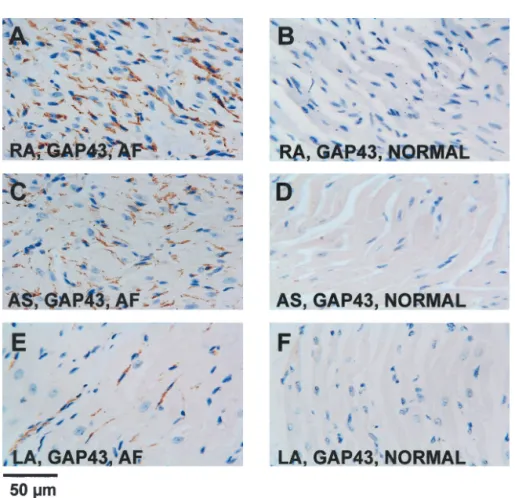
Because the nerve density between the 2 RA sites and between the 2 LA sites was not significantly different, we combined the sites (RA free wall and RA appendage repre-sented RA, and LA free wall and LA appendage reprerepre-sented LA). At all sites, nerves immunopositive to GAP43 and TH were more abundant in dogs with AF than in controls (Figures 1 and 2, Table). Among all sampling sites, the most robust increase was in GAP43-positive nerves in the RA; the least amount of nerves was found in the LA. The atrial septum usually had a nerve density between that of the RA and LA. In normal dogs, it seemed that the RA also tended to have a higher nerve density than the LA and septum. However, not all comparisons reached statistical significance. In addition to the asymmetry between the RA and LA, the distribution of nerves within the same microscopic field also showed significant inhomogeneity (Figures 1 and 2).
Discussion
This study showed significant nerve sprouting and sympa-thetic hyperinnervation in a canine model of sustained AF produced by prolonged RA pacing. The magnitude of nerve sprouting and hyperinnervation was higher in the RA than in the LA.
Figure 1. GAP43 staining of cardiac
nerves (brown twigs) in control dogs and dogs with AF. AS indicates atrial septum. Magnification, 40⫻.
Neural Remodeling and Pathogenesis of AF
The generation and maintenance of rapid, pacing-induced, chronic AF were usually attributed to the electrical or anatomical remodeling induced by pacing.2– 6,11 Recently, Olgin et al12reported that sympathetic atrial denervation by phenol creates heterogeneous autonomic innervation, facili-tating sustained AF. Jayachandran et al7 used positron-emission tomography imaging to document that dogs with AF had inhomogeneous changes of atrial sympathetic innerva-tion. The present study extended their observations by
docu-menting inhomogeneous sympathetic hyperinnervation in the atria using immunocytochemical techniques. GAP43, a pro-tein expressed in the growth cones of sprouting axons,13is a marker for nerve sprouting. A robust increase of GAP43-positive nerves in dogs with AF suggests that nerve sprouting is responsible for the sympathetic hyperinnervation in these dogs. We also found that the RA had a significantly higher density of sympathetic nerves than the LA. These findings are consistent with those reported by Jayachandran et al7 and suggest that there is a correlation between the results of
Figure 2. TH staining of cardiac nerves
in control dogs and dogs with AF. AS indicates atrial septum. Magnification, 40⫻.
Results of Immunocytochemical Studies at Different Atrial Regions
GAP 43 TH
AF Control P AF Control P
No. of nerves per mm2
RA 470⫾406 25⫾32 ⬍0.001 231⫾126 88⫾40 ⬍0.001 AS 317⫾36 9⫾13 ⬍0.001 155⫾85 30⫾7 0.001 LA 119⫾61 10⫾15 ⬍0.001 91⫾40 38⫾39 ⬍0.001 P ⬍0.001 (RA vs LA and AS vs LA) NS ⬍0.01 (RA vs LA) ⬍0.01 (RA vs AS and RA vs LA) Nerve area,m2/mm2 RA 12 534⫾18 290 650⫾1112 ⬍0.001 4480⫾2378 2017⫾1349 0.007 AS 7 106⫾1 538 232⫾392 0.004 4570⫾1979 1360⫾494 0.003 LA 2 354⫾1 921 170⫾267 ⬍0.001 2524⫾1274 1082⫾1171 0.009 P ⱕ0.01 (RA vs LA and AS vs LA) NS NS NS
positron-emission tomography imaging and immunocyto-chemical staining.
One possible cause of nerve sprouting in this model is the electrical current, which has been used to induce nerve sprouting in the brain and in the kindling model of seizure disorder.14However, we do not have sufficient data from this study to test that hypothesis. It is also unclear whether neural remodeling is causally related to the pathogenesis of AF. Adrenergic stimulation in the electrically remodeled myocar-dium increases significant electrophysiological changes15and may be proarrhythmic.8 –10Sympathetic nerve sprouting and hyperinnervation may strengthen this interaction and contrib-ute to the generation and maintenance of AF.
Study Limitations
There was a density discrepancy between GAP43-immunopositive nerves and TH-GAP43-immunopositive nerves in dogs with AF (Table). This discrepancy may be due either to a difference in the quantity between GAP43 and TH proteins or to a difference in the sensitivity to anti-GAP43 and anti-TH antibodies. A second possibility is that many GAP43-positive nerves may not yet be functional. A third possibility is that some of the GAP43-positive nerves were parasympathetic nerves. We attempted to stain with the anti-cholineacetyltransferase antibody. Although the para-sympathetic nerve ganglion was well stained, no parasympa-thetic nerve twigs were identified. The mechanism by which more GAP43-positive nerves than TH-positive nerves were found remains to be explained. This is a limitation of the study.
A second limitation is that we did not perform functional electrophysiological measurements. Therefore, the refractory period and the dispersion of refractoriness are not available for comparison with the magnitude of nerve sprouting.
Acknowledgments
This study was performed during the tenure of Fellowship grants from the Shin-Kong Wu Ho-Su Memorial Hospital, Taipei, Taiwan (Dr Chang); College of Medicine, Yonsei University, Seoul, Korea, and the Myung Sun Kim Memorial Foundation (Dr Lee); and a North American Society of Pacing and Electrophysiology (NASPE) Ken-neth M. Rosen Fellowship (Dr Doshi). It was supported in part by a Cedars-Sinai Electrocardiographic Heartbeat Organization (ECHO) Foundation Award (Dr Karagueuzian), a Pauline and Harold Price Endowment (Dr Chen), National Institutes of Health grants R01-HL66389 and P50-HL52319, American Heart Association grants 9750623N and 9950464N, a University of California
Tobacco-Related Diseases Research Program (UC-TRDRP) 9RT-0041, Guidant Corporation, and the Ralph M. Parsons Foundation, Los Angeles, Calif. We thank Dr Rahul Mehra and Medtronics, Inc, for providing the Itrel pacemakers used in the study. We also thank Ling-Tao Fan, Avile McCullen, Meiling Yuan, Lucas Huang, and Elaine Lebowitz for assistance.
References
1. Wijffels MC, Kirchhof CJ, Dorland R, et al. Atrial fibrillation begets atrial fibrillation: a study in awake chronically instrumented goats.
Cir-culation. 1995;92:1954 –1968.
2. Fareh S, Villemaire C, Nattel S. Importance of refractoriness hetero-geneity in the enhanced vulnerability to atrial fibrillation induction caused by tachycardia-induced atrial electrical remodeling. Circulation. 1998;98: 2202–2209.
3. Gaspo R, Bosch RF, Talajic M, et al. Functional mechanisms underlying tachycardia-induced sustained atrial fibrillation in a chronic dog model.
Circulation. 1997;96:4027– 4035.
4. Satoh T, Zipes DP. Unequal atrial stretch in dogs increases dispersion of refractoriness conducive to developing atrial fibrillation. J Cardiovasc
Electrophysiol. 1996;7:833– 842.
5. Morillo CA, Klein GJ, Jones DL, et al. Chronic rapid atrial pacing: structural, functional, and electrophysiological characteristics of a new model of sustained atrial fibrillation. Circulation. 1995;91:1588 –1595. 6. Ausma J, Wijffels M, Thone F, et al. Structural changes of atrial
myo-cardium due to sustained atrial fibrillation in the goat. Circulation. 1997; 96:3157–3163.
7. Jayachandran JV, Sih HJ, Winkle W, et al. Atrial fibrillation produced by prolonged rapid atrial pacing is associated with heterogeneous changes in atrial sympathetic innervation. Circulation. 2000;101:1185–1191. 8. Doshi RN, Wu T-J, Yashima M, et al. Relation between ligament of
Marshall and adrenergic atrial tachyarrhythmia. Circulation. 1999;100: 876 – 883.
9. Cao J-M, Fishbein MC, Han JB, et al. Relationship between regional cardiac hyperinnervation and ventricular arrhythmia. Circulation. 2000; 101:1960 –1969.
10. Cao J-M, Chen LS, Kenknight BH, et al. Nerve sprouting and sudden cardiac death. Circ Res. 2000;86:816 – 821.
11. Misier AR, Opthof T, van Hemel NM, et al. Increased dispersion of “refractoriness” in patients with idiopathic paroxysmal atrial fibrillation.
J Am Coll Cardiol. 1992;19:1531–1535.
12. Olgin JE, Sih HJ, Hanish S, et al. Heterogeneous atrial denervation creates substrate for sustained atrial fibrillation. Circulation. 1998;98: 2608 –2614.
13. Meiri KF, Pfenninger KH, Willard MB. Growth-associated protein, GAP-43, a polypeptide that is induced when neurons extend axons, is a component of growth cones and corresponds to pp46, a major polypeptide of a subcellular fraction enriched in growth cones. Proc Natl Acad Sci
U S A. 1986;83:3537–3541.
14. Sutula T, He X-X, Cavazos J, et al. Synaptic reorganization in the hippocampus induced by abnormal functional activity. Science. 1988; 239:1147–1150.
15. Shimizu W, Antzelevitch C. Cellular basis for the ECG features of the LQT1 form of the long-QT syndrome: effects of-adrenergic agonists and antagonists and sodium channel blockers on transmural dispersion of repolarization and torsade de pointes. Circulation. 1998;98:2314 –2322.