서
론
지구상의 생물은 일상생활 중에 자연적인 방사선에 노출되어 있다. 저선량의 방사선은 오히려 식물의 다양 한 생리활성을 촉진시킨다고 보고되며, 고선량의 방사선 은 식물의 생장 능력과 번식 능력에 심각한 피해를 주 고, DNA에 손상을 주어 돌연변이를 유발한다고 보고되 어 있다 (Kim et al. 1999; Kwan et al. 1999; Kovalchuk et al. 2004; Kwon et al. 2009). 방사선이 유전체에 미치는 영향에 관한 연구는 체르노빌 사건과 구소련 주변 국가 등지의 방사능 오염으로 인간, 동물, 식물에 대한 방사능 의 유전체 내 독성 영향 평가 (genotoxic effect)에 많은 ─ ─ 347 ──감마선 완∙급조사에 따른 애기장대의 유전적 유연관계 분석
고은정∙김진백∙하보근∙김상훈∙강시용∙김동섭* 한국원자력연구원 방사선육종연구팀Genetic Variation Analysis of Arabidopsis
(Arabidopsis thaliana L.) Plants Induced by Acute and
Chronic Gamma Irradiation
Eun Jeong Goh, Jin-Baek Kim, Bo-Keun Ha, Sang Hoon Kim, Si-Yong Kang and Dong Sub Kim*
Advanced Radiation Technology Institute, Korea Atomic Energy Research Institute, Jeongeup 580-185, Korea
Abstract -- In order to identify the genetic relationship analysis by acute and chronic gamma irra-diation, Arabidopsis (Arabidopsis thaliana L.) were irradiated with 200 Gy of gamma-rays using gamma-irradiator (3,000 Ci; Nordion, Canada) and gamma-phytotron (400 Ci; Nordion, Canada) for acute and chronic irradiation, respectively. Genetic relationship among two acute gamma- irra-diated plants (A1 and A24) and three chronic gamma-irradiated plants (C1W, C2W, C3W) were analyzed using the amplified fragment length polymorphism (AFLP) technique compared with each non-irradiated plant. A total of 28 EcoRI and MseI primer combinations were used to screen 8 treatments by the ABI3130 capillary electrophoresis system. Amplified products by 28 primer sets showed 1,679 bands with an average of 51 bands per primer combination. Out of the total bands scored, 1,164 fragments were polymorphic bands, with different alleles existing among the treat-ments. The cluster analysis was performed using the UPGMA (Unweighted Pair Group Method using Arithmetic) in the computer program NTSYS-pc. In clustery analysis, acute gamma- irra-diation showed higher genetic variation compared with chronic gamma-irradiation.
Key words : Acute and chronic gamma-irradiation, AFLP, Arabidopsis, Mutagenesis
* Corresponding author: Dong Sub Kim, Tel. +82-63-570-3311, Fax. +82-63-570-3319, E-mail. [email protected]
관심을 갖게 되었고, 근래에 일본 후쿠시마 원전 사고로 그 관심이 더욱 증대되었다. 모델 식물인 애기장대를 이 용한 식물체 내 방사선 영향에 관한 연구의 유용성이 증명되며 (Vizir and Mulligan 1999), 이 후 애기장대의 특 정 유전자 돌연변이를 이용하여 역으로 그 기능을 추정 함에 의해(reverse genetics) 이온화 에너지의 영향에 관 한 연구가 진행 중이고, 유전체 크기가 비교적 작고 (125 Mbp), 생육상이 짧은 애기장대를 이용한 연구가 진행되 고 있다. 방사선 조사에 의한 돌연변이 유기에 관한 연구는 식 물 유전체 연구와 실제적인 육종분야에 광범위하게 적 용되고 있다 (Shirley et al. 1992). 방사선은 에너지 준위 에 따라 감마선, X선, 중성자 등의 저 LET 선원과 이온 빔, 우주선 등의 고 LET 선원으로 나뉘며, 방사선에 조 사된 식물체는 그 에너지에 의하여 DNA에 손상을 입 혀 DNA 염기 변화, DNA 이중가닥이 끊어지거나, 역위, 전좌, 결손 등의 유전자 변이를 일으킨다 (Naito et al. 2005). 방사선 조사에 의한 식물체 변이에 관한 연구 중 에 감마선에 의한 식물돌연변이 육종에 관한 연구가 많 이 이루어지고 있다. 오늘날 돌연변이체 간의 유연관계를 밝히기 위해서는 전통적인 접근 방법인 형태적 또는 생태학적인 방법을 이용하기도 하지만 이 방법들은 확인할 수 있는 한계가 있기 때문에 분자생물학적 접근 방법인 RFLP
(Restric-tion Fragment Length Polymorphism), RAPD (Random Amplified Polymorphic DNA), AFLP (Amplified Fragment Length Polymorphism), SNP (Single Nucleotide Polymor-phism), SSR (Simple Sequence repeats) 및 EST (Expressed
Sequence Tags) 등 다양한 DNA 마커를 이용하여 품종분 류, 유전적 다양성 및 유연관계 분석 등 광범위하게 활 용되고 있다 (Gagnaire et al. 2009). AFLP는 RAPD의 간 편성과 RFLP의 재현성의 장점을 조합한 방식이다.
AFLP는 식물 전체 유전체에 고루 분포하지 못하는 단
점이 보고 되어 있으나, 유전적 유사도가 가까운 종이나 품종간에 고도의 유전적 변이와 다형화 현상이 높아 다수 의 마커를 개발 할 수 있는 장점이 있다 (Wu and
Tanks-ley 1993; Vos et al. 1995; Maughan et al. 1996; Panaud et
al. 1996; Kang et al. 1997; Keim et al. 1997; Cho et al.
1998; Garacia-Mas et al. 2000; Jeon 2001) 종속간의 유전 적 다양성 검정과 유연관계 추정에도 많이 이용되고 있 다. 또한 각 유전표식에 있어 PCR기반의 DNA 다형성 분석법으로 적용이 쉽고, 단시간에 다량의
polymorphi-sm을 얻을 수 있다(Jones et al. 1997; Blears et al. 1998).
본 연구에서는 감마선 완∙급조사에 따른 애기장대 식물체의 AFLP 분석을 통해 조사 방식 차이에 의한 유 전적인 변이 및 상호간 유연관계를 조사하여 방사선 조 사 방법에 따른 식물의 영향 평가를 확인하고자 하였다.
재료 및 방법
1. 감마선 완∙급조사에 따른 모델식물의 방사선 조사애기장대 (Landsberg erecta L.)를 24�C (18 hr, light; 6 hr, dark) 조절된 생물생장실에서 직경 15 cm pot 당 3개체의 식물을 키워 영양생장기에서 생식생장기로 전환되는 시 기에 완∙급조사량이 200 Gy가 되도록 조사하였다. 급조 사는 한국원자력연구원 방사선과학연구소 감마선 저준 위 조사시설 장치 (60Co gamma-irradiator, 150 TBq of
capacity; Nordion, Canada)를 이용하여 200 Gy 선량을 각
1시간 (A1)과 24시간 (A24) 동안 조사하였으며, 완조사는
한국원자력연구원 방사선과학연구소 감마파이토트론 시 설 (60Co source, 400 Ci of capacity; Nordion, Canada)을 이용하여 200 Gy 선량을 각각 1주일 (C1W), 2주일
(C2W), 3주일(C3W) 동안 조사하였다. 2. Genomic DNA 추출
200 Gy로 완∙급조사한 애기장대 식물체에서
geno-mic DNA를 분리하기 위하여 식물체 2 g을 액체질소를
이용하여 마쇄 한 후 extraction buffer (100 mM Tris-HCl,
1.4 M NaCl, 50 mM EDTA, 0.5% SDS, 2% β- Mercaptoe-thanol, 1% PVP powder)를 넣고 65�C에서 40분간 처리 하고 원심분리하였다. Phenol : choloroform : isoamylalchol
(25 : 24 : 1)를 동일량을 넣고 원심분리하여 상층액을 분
리한 후 50μg RNase를 넣고 37�C에 1시간 처리하였다.
동일량의 chloroform : isoamylalcohol (24 : 1)를 넣고 원심
분리 후 isopropanol를 넣고 -20�C에서 2시간 반응시
킨 다음 원심분리하여 남아있는 pellet을 70% EtOH로 washing하였다. 50μl의 TE buffer (2 M Tris-HCl pH 8.0, 0.5 M EDTA pH 8.0)를 첨가하여 용해시켰다. 분리된
geno-mic DNA는 1% agarose gel 전기영동을 통해서 DNA의 상태를 확인하였다.
3. AFLP 분석
AFLP 분석은 AFLPTMAnalysis system I (InvitrogenTM,
California, USA)에서 제공하는 protocol을 기반으로 하 여 수행하였다. Genomic DNA 250 ng을 EcoRI과 MseI으 로 절단하고 제한효소에 의해 생긴 sticky end에 T4
-Amp. Primer Mix I kit (InvitrogenTM, California, USA)을
이용하여 pre-amplification하여 PCR을 수행하였다. Pre
-amplified DNA는 selective amplification을 위한 template 으로 사용하며, 5가지의 fluorescent dyes (FAM, HEX,
NED, ROX, LIZ)로 라벨되어진 EcoRI (++3)과 MseI (++3) primer를 이용하여 28개 조합으로 selective amplification 을 수행하였다. ABI 3130 XL genetic analyzer (Applied Biosystems, CA, USA)를 이용하여 36 cm capillary elec-trophoresis를 통해 AFLP분석을 수행하였다. PCR 증폭 을 포함한 모든 반응 조건은 Analysis system I (Invitro-gen, Carlsbad, California)을 참조하여 실행하였다. NTSYS
pc 프로그램을 사용하여 각 개체간의 유사도 matrix를
UPGMA (Unweighted Pair-Group Method using
Artihme-tic)로 분석하여 dendrogram을 작성하고 유전적 유의성 을 확인하였다.
결과 및 논의
1. 완∙급조사에 따른 식물 생육 특성 급조사 처리는 한국원자력연구원 정읍 방사선과학연 구소 내 저준위 조사시설을 이용하여 감마선 200 Gy를 1시간 (A1), 24시간 (A24) 동안 조사한 애기장대 식물체 를 생장실에서 10일간 생육시킨 후에 특성을 조사하였다. 무처리 (A-con)와 비교하여 A1과 A24는 생육차이가
크게 있음을 확인할 수 있었다. 특히 초장의 경우 A1과 A24는 A-con과 비교하여 각 1/2, 1/3 정도 크기로 확인 되었다 (Table1). 꼬투리 수는 A-con에 비해서 1/10 수준 으로 큰 차이를 보였다. 분얼수는 A-con가 A24와 오차 범위 내에서 비슷하게 존재하였지만, A1은 분얼이 되지 않은 것을 확인하였다. 완조사는 정읍 방사선과학연구소 내 감마파이토트론 조사시설을 이용하였으며, 각 1주일 (C1W), 2주일 (C2W), 3주일 (C3W) 동안 총 200 Gy의 감 마선을 조사하여 생육을 조사하였다. 초장은 C1W, C2W 까지는 무처리구 (1W, 2W)와 비교하였을 때 오차범위 내에서 차이가 없었으나, C3W에서는 차이가 있음을 확 인할 수 있었다 (Table1). 꼬투리 수는 초장과 유사한 경 향의 결과를 보여 C3W에서 약 1.5배 증가한 수치를 보 였으나, 오히려 C1W와 C2W에서는 1W와 2W보다 적게 생성되는 경향을 보였다. 또한 완조사한 식물에서 C1W, C2W, C3W는 각각의 비조사 식물체와 비교하여 노화가 더디게 진행이 되는 것을 확인하였고, 2주차부터 식물체 내에 Anthocyanin이 축적되는 것을 관찰하였다. 저선량 의 감마선은 식물 생장에 영향을 주게 되는데 (Calabrese 2002), 고선량의 감마선을 조사한 식물의 경우는 형태적 변화를 유발시키고 세포벽, DNA 구조에 영향을 주게 된 다 (Casarett 1968; Nagata et al. 1999; Naito et al. 2005). 본 연구에 모델식물로 이용된 애기장대의 경우는 높은 선 량에서도 다른 식물에 비해 감수성이 높기 때문에 본 연구에 이용되었다(Sparrow and Christensen 1953). Table 1. Plant height of Arabidopsis irradiated with acute and chronic gamma irradiation
A-Con A1 A24 1W C1W 2W C2W 3W C3W
Plant
30.0±0.70 10.8±0.35 16.4±0.78 27.2±0.67 28.3±0.27 30.4±0.45 30.0±1.36 31.6±1.20 37.0±0.83 height
Table 2. Polymorphisms among acute and chronic irradiated Ara-bidopsis plants by using AFLP analysis
Primer pair No. of total No. of polymorphic Polymorphism bands (EA) bands (EA) (%) M-CAA/E-ACA 5 4 80.0 M-CAA/E-ACC 4 2 50.0 M-CAA/E-AGC 34 22 64.7 M-CAG/E-ACC 23 15 65.2 M-CAG/E-AGC 92 75 81.5 M-CAT/E-ACA 18 7 38.9 M-CAT/E-ACC 11 4 36.4 M-CAT/E-AGC 91 28 30.8 M-CTA/E-ACA 10 7 70.0 M-CTA/E-ACC 24 9 37.5 M-CTA/E-AGC 133 102 76.7 M-CAC/E-ACA 4 2 50.0 M-CAC/E-ACC 9 1 11.1 M-CAC/E-AGC 43 14 32.6 M-CCA/E-AGC 54 50 92.6 M-CGA/E-AGC 21 9 42.9 M-CAG/E-AAC 130 103 79.2 M-CAG/E-AGG 118 89 75.4 M-CAG/E-ACG 39 25 64.1 M-CAT/E-AAC 134 100 74.6 M-CAT/E-AGG 151 128 84.8 M-CAT/E-ACG 58 37 63.8 M-CAC/E-AAC 156 107 68.6 M-CAC/E-AGG 141 111 78.7 M-CAC/E-ACG 64 24 37.5 M-CCA/E-AAC 67 52 77.6 M-CCA/E-AGG 36 32 88.9 M-CCA/E-ACG 9 5 55.6 Total 1679 1164 Mean 50.9 35.3 61.1
2. AFLP를 통한 완∙급조사간 유전적 다양성 규명
DNA상의 차이를 확인하여 방사선 조사 식물체와 비
조사 식물체 간의 유연관계를 밝히기 위해 AFLP를 수 행하였다. AFLP 분석은 EcoRI과 MseI primer 28개 조합
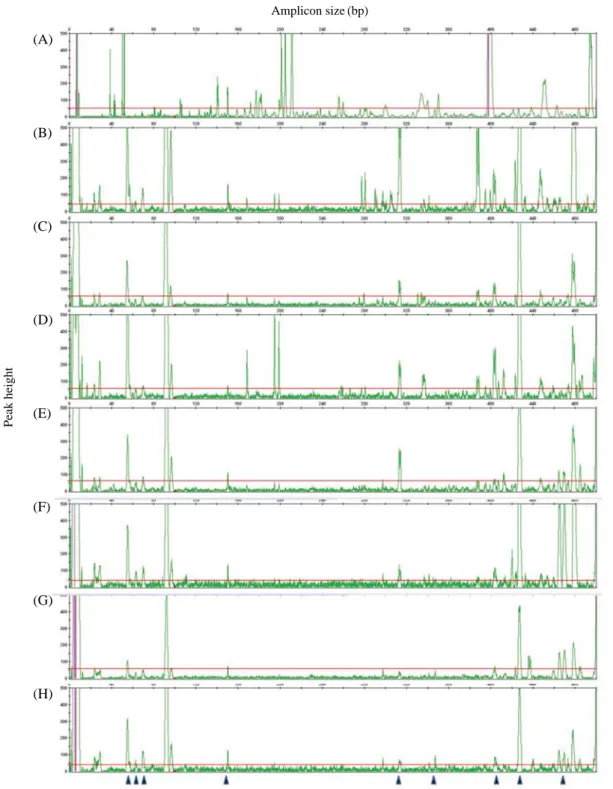
으로 8개의 sample을 분석한 결과 전체 1,679개, 평균
50.9개의 밴드가 확인되었고, 다형성 밴드는 총 1,164개
의 특이적 밴드가 확인되었다 (Table2). Primer M-CAC/
E-AAC조합에서 최대 156개의 전체 밴드와 107개의 다
형성 밴드가 확인되었고, M-CAG/E-AAC조합에서 130
Fig. 1. AFLP patterns of 8 treatments on capillary electrophoresis using M-CAC/E-AAC primer combination. A, A-Con; B, A1; C, A24; D,
C1W; E, 1W; F, C2W; G, 2W; H, C3W. The red lines and black triangles indicate threshold and polymorphic peaks, respectively. Amplicon size (bp) Peak height (A) (B) (C) (D) (E) (F) (G) (H)
개의 전체 밴드와 103개의 다형성 밴드가 확인되었다(Fig.
1). M-CAC/E-ACA조합에서 4개의 전체 밴드와 2개의 다형성 밴드가 확인되어 최소값을 나타났다. Primer 조합 별 polymorphism에 다양한 차이가 나타났는데 평균
61.1%를 보였다. Primer M-CCA/E-AGC조합에서 92.6%
로 가장 높은 polymorphism을 보였고, 그 밖에도 M
-CCA/E-AGG조합, M-CAT/E-AGG조합과 M-CAG/E
-AGC조합에서 각각 88.9%, 84.8%와 81.5%의 높은
poly-morphism을 보여주었다. 반면 M-CAC/E-ACC조합은
11.1%로 가장 낮은 polymorphism을 보여주었다. NTSYS
-pc program을 이용하여 similarity coefficient를 확인한 결과, 급조사간의 상관관계는 급조사 1시간 처리 (A1)와
24시간 처리 (A24)의 유연계수가 0.4로 비조사 식물체
(A-Con)와의 0.29보다 유전적으로 더 가까웠다(Fig.2A).
완조사 간의 비교에서는 ‘1W’와 ‘C2W’가 0.66으로 가 장 가까웠고 (Fig.2B), 급조사와 완조사를 모두 분석한 결과 ‘1W’와 ‘C2W’가 0.80으로 유연계수가 가장 높았 고 A-Con과 다른 그룹 간에 0.53의 유연계수를 나타내 었으며, 전체적인 유사도는 0.53~0.80의 범위였다 (Fig. 2C). 본 연구에서 가장 유연계수가 높았던 ‘1W’와 ‘C2W’는 감마선 조사에 의해 기존 비조사 식물체보다 노화가 지연이 되는 것을 육안으로 관찰 할 수 있었던 생육 조사 결과와 비교하여 유전적 변이율이 일치하는 결과를 보여주었다. 이는 Kim et al. (2010)은 방사선 조 사를 한 케나프 품종간의 유연관계 분석에 관한 연구에 서 잎의 모양이나 줄기색의 변화와 같은 형태적 변이를 보인 돌연변이 개체간의 유연관계를 분석한 결과 서로 다른 그룹을 형성하는 것을 보고한 바 있다. 또한 국화 에 감마선 40 Gy를 3주간 완조사한 개체로부터 4계통의 화색변이를 보이는 식물체간의 유연관계 분석을 통하여 조사된 품종간의 유연계수가 원품종과의 유연계수보다 높음이 보고되었다(Sung et al. 2010).
결
론
AFLP는 RAPD의 간편성과 RFLP의 재현성의 장점을 가진 방식으로 기타 다른 방법에 비하여 유전적 다양성 의 표현이 우수하기에 비교적 근연의 식물 평가에 효율 적이므로 최근에 많이 이용되고 있다. 방사선 조사 방법 에 따라 해당되는 선량을 단기간에 조사하는 급조사 (Acute)와 저선량으로 장기간 조사하는 완조사 (Chronic) 로 식물체에 감마선을 조사하여 유연관계 분석을 실시 하였다. 이온화 방사선은 일반적으로 저선량은 식물 생 장에 효과가 있으나 점차적으로 선량이 높아짐에 따라 식물 생장에 해를 끼치는 것으로 알려져 있는데 결과적 으로 완∙급조사 간의 비교에서는 완조사한 식물의 생 장이 더 우수함을 확인할 수 있었다. AFLP 분석에 유연 계수 또한 형태적, 생육적 분석 결과와 일치하는 것을 확인하였다. 향후 감마선 영향에 의한 돌연변이체의 특 이 발현 유전자에 대한 검정 또한 연구되어야 할 것으 로 보인다.참 고 문 헌
Blears MJ, Grandis SA, Lee H and Trevors JT. 1998. Amplifi-ed fragment length polymorphism (AFLP); a review of the procedure and its applications. J. Ind. Microbiol. Biotech-nol. 21:99-114.
Calabrese EJ. 2002. Hormesis; Changing view of the dose- res-ponse, a personal account of the history and current status. Mutat. Res-Rev. Mutat. Res. 511:181-189.
Casarett AP. 1968. Radiation chemistry and effects of gamma radiation on the cell. In: Radiation biology. Prentice-Hall, Fig. 2. Genetic relationship among acute and chronic irradiation
Arabidopsis plants analyzed by (UPGMA) Unweighted Pair Grouping Method of Averages cluster analysis using poly-morphic peak profiling generated from the AFLP analysis. A, Phylogenetic tree between acute gamma irradiated plants; B, phylogenetic tree between Chronic gamma irradiated plants; C, phylogenetic tree between acute and chronic gam-ma irradiated plants. A-con A1 A24 C1W 1W C2W 2W C3W A-Con A1 A24 C1W 1W C2W 2W C3W 0.29 0.32 0.36 0.39 0.43 Coefficient 0.48 0.52 0.57 0.62 0.66 Coefficient 0.53 0.59 0.66 0.73 0.80 Coefficient (A) (B) (C)
Englewood Cliffs, NJ.
Cho YS, Hong SK, Song MT, Moon HP, Lee JH and Kim NS. 1998. Comparison of genetic variation among rice varieties detected by RAPD, AFLP and SSRP. Kor. J. Genet. 20:117
-127.
Gagnaire PA, Albert V, Jonsson B and Bernatchez L. 2009. Natural selection influences AFLP intraspecific genetic variability and introgression patterns in Atlantic eels. Mol. Ecol. 18:1678-1691.
Garacia-Mas J, Oliver M, Gomez-Paniagua and Vicente MC. 2000. Comparing AFLP, RAPD and RFLP markers for mea-suring genetic diversity in melon. Theor. Appl. Genet. 101: 860-864.
Jeon JJ. 2001. Genetic diversity of Gibberella zeae from corn using AFLP. MS thesis Seoul National University. Jones N, Ougham H and Thomas H. 1997. Markers and
map-ping: we are all geneticists now. New Phytol. 137:165-177. Kang BC, Yu JW, Lee MH and Kim BD. 1997. Applicability of AFLP in hot pepper genetic analysis. J. Kor. Soc. Hort. Sci. 38(6):698-703.
Keim P, Schupp JM, Travis SE, Clayton K, Zhu T, Shi L, Fer-reire A and Webb DM. 1997. A high-density soybean gene-tic map based on AFLP markers. Crop Sci. 37:539-703. Kim JS, Lee YK, Song HS, Park HS and Kim JK. 1999. Effects
of low dose ionizing radiation on the growth and yield of soybean cultivars. Kor. J. Environ. Agricultur. 18:66-69. Kim WJ, Kim DS, Kim SH, Kim JB, Goh EJ and Kang SY.
2010. Analysis of genetic similarity detected by AFLP and PCoA among genotypes of Kenaf (Hibiscus cannabinus L.) J. Crop Sci. Biotech. 13(4):243-249.
Kovalchuk I, Abramov V, Pogribny I and Kovalchuk O. 2004. Molecular aspects of plant adaptation to life in the Cherno-byl zone. Plant Physiol. 135:357-363.
Kwan SJ, Ahn Sn, Hong HC, Kim YK, Hwang HG, Choi HC and Moon HP. 1999. Genetic diversity of Korean japonica rice cultivars. Korean J. Breed. 21:268-275.
Kwon ST, Kwun IS and Park YM. 2009. Effects of Yam (Dio-scorea batatas Dense) extracts on the growth and nucleus
-DNA damage of the plant cells treated with γ-radiation. Ko-rean. J. Plant Res. 22(5):461-466.
Maughan PJ, Saghai Maroof MA, Buss GR and Huestis GM.
1996. Amplified fragment length polymorphism (AFLP) in soybean: species diversity, inheritance and near-isogenic line analysis. Theor. Appl. Genet. 93:392-401.
Nagata T, Todoriski S, Hayashi T, Shibata Y, Mori M and Kanegae H. 1999. γ-Radiation induces leaf trichome forma-tion in Arabidopsis. Plant Physiol. 120:113-119.
Naito K, Kusaba M, Shikazono N, Takano T, Tanaka A and Tanisaka T. 2005. Transmissible and nontransmissible mu-tations induced by irradiating Arabidopsis thaliana pollen with γ-rays and carbon ions. Genetics 169:881-889. Panaud O, Chen X and McCouch SR. 1996. Development of
microsatellite markers and characterization of simple sequ-ence length polymorphism in rice (Oryza sativa L.). Mol. Gen. Genet. 252:597-607.
Shirley BW, Hanley S and Goodman HM. 1992. Effects of ionizing radiation on a plant genome: Analysis of two Arabidopsis transparent testa mutations. Plant Cell 4:333
-347.
Sparrow AH and Christensen E. 1953. Tolerance of certain higher plants to chronic exposure to gamma radiation from Cobalt-60. Science 118:697-698.
Sung SY, Chung SJ, Kim SH, Kim WJ, Lee JY, Kim DS, Kim JB, Kim HG and Kang SY. 2010. Analysis of genetic diver-sity among spray-type Chrysanthemum (Dendranthema grandiflorum) ‘Argus’ and its flower-colored mutants. J. Radiat Indus. 4(2):171-177.
Vizir IY and Mulligan BJ. 1999. Genetics of gamma-irradiation
-induced mutantions in Aravidopsis thaliana: large chro-mosomal deletions can be rescued through the fertilization of diploid eggs. Journal of Heredity 90(3):413-417. Vos P, Hogers R, Bleeker M, Reijans M, van de Lee T, Homes
M, Frijters A, Pot J, Peleman J, Kupier M and Zabeau M. 1995. AFLP: A new technique for DNA fingerprinting. Nucleic Acids Res. 23:4407-4414.
Wu KS and Tanksley SD. 1993. Abundance, polymorphism and genetic mapping of microsatellites in rice. Mol. Gen. Genet. 241:225-235.
Manuscript Received: November 7, 2011 Revised: November 18, 2011 Revision Accepted: November 30, 2011