34-3 / J. H. Seo
• IMID 2009 DIGEST Abstract
The Authors have demonstrated high efficiency hybrid white organic light-emitting diodes (HWOLED) for reduced efficiency roll-off and color stability. It was shown that HWOLED fabricated in this study have the maximum luminance of 46 420 cd/m2 at 8 V (turn-on
voltage of 2.7 V), external quantum efficiency of 13.18%, power efficiency of 28.75 lm/W at 1 000 cd/m2, and
reduced efficiency roll-off of 2.7 times than control white device. The HWOLED also showed the stable color shift with ∆Commission Internationale de I'Eclairage coordinates coordinates of ± (0.00, 0.00) from 100 to 10000 cd/m2.
1. Introduction
White organic light-emitting diodes (WOLED) have attracted increasing attention due to their potential use in a variety of applications such as the backlight of liquid crystal displays and full-color OLED and solid state lighting (SSL).[1]
One of the largest issues of WOLED as SSL is selection of phosphorescent WOLED (PHWOLED) using all phosphorescent emitters or hybrid WOLED (HWOLED) using fluorescent blue and phosphorescent red-green emitters. PHWOLED, despite of achieving 100% internal quantum efficiency, do not yet have proper phosphorescent blue emitter with long lifetime and high energy gap. Therefore, HWOLED have been extensively studied by many research groups.[2-4] One have demonstrated highly efficient HWOLED which were made up fluorescent blue and phosphorescent red-green emitters for using spacer of 4,4′-N,N′-dicarbazole-biphenyl which prevented singlet energy transfer from fluorescent blue emitter to phosphorescent red-green emitters and
minimized the exchange energy losses to increase the efficiency, brightness, and lifetime.[5] HWOLED separate two mechanism with energy transfer type which transfers triplet energy from fluorescent blue layer to phosphorescent red-green layers and direct recombination type which emits fluorescent blue and phosphorescent red-green layers, independently, in each emitting layers (EML).
We report high efficiency HWOLED for reduced efficiency roll-off and color stability using N-type blue host, (9,9-dimethyl-7-(10-(naphthalen-2-yl)anthracen-9-yl)-9H-fluoren-2-yl)triphenylsilane (ANFTPS) which showed better confinement of carriers in emitting layer than 2-methyl-9,10-di(2-naphthyl)anthracene (MADN) with ambipolar characteristic.
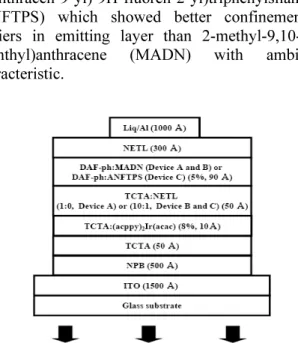
Fig. 1. The structure of white devices used in the experiment.
High Efficiency Hybrid White Organic Light-Emitting
Diodes for Reduced Efficiency Roll-Off and Color Stability
Ji Hoon Seo
1, Jung Sun Park
1, Jun Ho Kim
1, Ja Ryong Koo
1, Bo Min Seo
1,
Kum Hee Lee
2, Jeong Keun Park
2, Jong-Tae Je
3, Seung Soo Yoon
2,*, and
Young Kwan Kim
1,*
1Dept. of Information Display, Hongik University, Seoul, Korea
Tel.:82-2-3142-3750, E-mail:[email protected]
2Dept. of Chemistry, Sungkyunkwan University, Suwon, Gyungi-do, Korea
3SFC CO.,LTD. Ochang Techno Village 641-5, Cheongwon-kun, Chungbuk, Korea
Keywords: hybrid white organic light-emitting diodes, reduced efficiency roll-off, color stability
34-3 / J. H. Seo
IMID 2009 DIGEST •
Fig. 2. Luminance versus voltages characteristics of the white devices. Inset: Proposed energy level diagrams of the white devices.
The optimized HWOLED exhibited a low turn-on voltage (luminance of 1 cd/m2) of 2.7 V, maximum
luminance of 46 420 cd/m2 at 8 V, external quantum
efficiency (EQE) of 13.18%, power efficiency of 28.75 lm/W at 1 000 cd/m2, and reduced efficiency
roll-off of 2.7 times than control white device. The HWOLED also showed the stable color shift with ∆Commission Internationale de I'Eclairage (CIEx,y)
coordinates of ± (0.00, 0.00) from 100 to 10000 cd/m2.
2. Experimental
Indium tin oxide (ITO)-coated glass was cleaned in an ultrasonic bath by the following sequence: in acetone, methanol, distilled water and isopropyl alcohol. Thereafter, pre-cleaned ITO was treated by O2 plasma with the conditions of 2 ⅹ 10-2 Torr, 125
W for 2 min. HWOLED were fabricated using the high vacuum (5 x 10⁻⁷ Torr) thermal evaporation of
organic materials onto the surface of the ITO-coated glass substrate (10 Ω/sq, emitting area was 3 mm x 3 mm). The deposition rates were 1.0 ~ 1.1 Å/sec for
all organic materials and 0.1 Å/sec for lithium
quinolate (Liq), respectively. Without a vacuum break after the deposition of organic layers, the Al cathode was deposited at a rate of 5 Å/sec. With the DC
voltage bias, the optical and electrical properties of HWOLED such as the current density, luminance, and power efficiency were measured with Keithley 2400 and CHROMA METER CS-1000A instruments. The EQE and CIEx,y coordinates were also calculated with
Keithley 2400 and CHROMA METER CS-1000A instruments. All measurements were carried out under ambient conditions at room temperature.
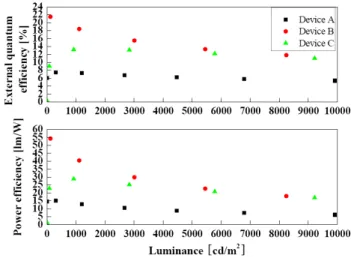
Fig. 3. The EQE and power efficiency versus luminance characteristics of the white devices.
3. Results and discussion
Figure 1 shows three device structures fabricated in this study as follows: ITO as anode/ N,N′-bis-(1-naphyl)-N,N′-diphenyl-1,1′-biphenyl-4,4′-diamine as the hole transporting layer/4,4',4''tris (N-carbazolyl) triphenylamine (TCTA) as electron blocking layer/iridium(III) bis(5-acetyl-2-phenylpyridinato-N,C2') acetylacetonate ((acppy)2Ir(III)(acac)):TCTA
as phosphorescent red EML/TCTA:new electron transporting layer (NETL) (1:0 device A, 10:1 device B and C) as spacer/1,4-Bis[2-(7-N-diphenyamino-2-(9,9-diethyl-9H-fluoren-2-yl)) vinyl] benzene (DAF-ph):MADN (device A and B) or DAF-ph:ANFTPS (device C) as fluorescent blue EML/NETL as electron transporting layer/Liq as electron injection layer/Al as cathode, respectively. The doping concentrations of DAF-ph in MADN and ANFTPS and (acppy)2Ir(III)(acac) in TCTA were optimized to 5 and
8%, respectively.
Figure 2 and inset Fig. 2 show luminance versus voltage characteristics of the white devices and proposed energy level diagram. They had a maximum luminance of 27 000, 44 000, and 46 200 cd/m2 at 8 V
and turn-on voltage (luminance of 1 cd/m2) of 2.9, 2.7,
and 2.7 V, respectively. All devices also showed luminance of 1 000 cd/m2 at 3.9, 3.5, and 3.5 V,
respectively, where these voltages were lower than those previously reported for WOLED including p-i-n
WOLED.
As shown in Fig. 3, devices A, B, and C had the maximum EQE of 7.45, 21.50, and 13.20% and power efficiency of 15.10, 54.30, and 28.80 lm/W at 304, 119, and 921 cd/m2, respectively. All devices also
34-3 / J. H. Seo
• IMID 2009 DIGEST
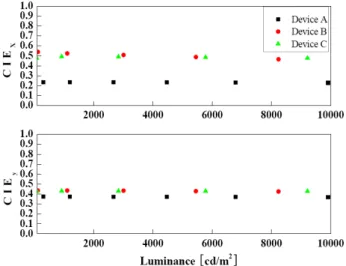
Fig. 4. CIEx,y coordinates of the white devices from
100 to 10 000 cd/m2.
41.87, and 28.75 lm/W at 1000 cd/m2 and 5.36, 11.15,
and 10.84% and 6.28, 16.40, and 16.40 lm/W at 10000 cd/m2, respectively. Figure 4 shows CIE
x,y coordinates
versus luminance characteristics from 100 to 10000 cd/m2 of the white devices. They had an emission of
CIEx,y coordinates from (0.23, 0.38), (0.54, 0.44), and
(0.48, 0.43) at 100 cd/m2 to (0.23, 0.37), (0.44, 0.42),
and (0.48, 0.43) at 10000 cd/m2, respectively. Device
C showed the smallest color shift with ∆CIEx,y of ±
(0.00, 0.00) from 100 to 10 000 cd/m2 among them.
Device A showed the lowest efficiency due to unipolar spacer of TCTA. Therefore, exciton zone was formed between spacer and blue EML and triplet excitons in red EML were not fully used. Device B showed the highest efficiency and had the potential for 100% internal quantum efficiency below 600 cd/m2 because
major exciton zone was formed between red EML and spacer but, at higher luminance, exciton zone moved toward cathode due to low highest occupied molecular orbital (HOMO) and ambipolar characteristics of MADN as shown in inset Fig. 2. Therefore, device B demonstrated color instability with ∆CIEx,y of ±
(0.10, 0.01) during the change from 100 to 10 000 cd/m2 and 48% of EQE decreased at 10 000 cd/m2.
Device C showed reduced efficiency roll-off of 18% at 10 000 cd/m2 and constant CIE
x,y coordinates,
which seemed to be due to the blue host of ANFTPS which had deeper HOMO of 5.9 eV than that of MADN (5.5 eV). Therefore, two exciton zones (red EML/spacer and spacer/blue EML) maintained even at the high operating voltage and confined triplet excitons of red EML and singlet excitons of blue EML.
4. Summary
We demonstrated high efficiency HWOLED for reduced efficiency roll-off and color stability using new blue host of ANFTPS which showed better confinement of carriers in emitting layer.
The optimized HWOLED exhibited a low turn-on voltage (luminance of 1 cd/m2) of 2.7 V, maximum
luminance of 46 420 cd/m2 at 8 V, maximum external
quantum efficiency of 13.18%, power efficiency of 28.75 lm/W at 1 000 cd/m2, and reduced efficiency
roll-off of 2.7 times than control white device. The HWOLED also showed the stable color shift with ∆CIEx,y coordinates of ± (0.00, 0.00) from 100 to
10000 cd/m2.
Acknowledgement
This work was spported by the ERC program of the Korea Science and Engineering Foundation (KOSEF) grant funded by the Korea Ministry of Education, Science and Technology (MEST) (No. R11-2007-045-03001-0).
5. References
1. S. J. Su, E. Gonmori, H. Sasabe, and J. Kido, Adv. Mater. 20, p.4189 (2008).
2. J. H. Seo, I. H. Park, G. Y. Kim, K. H. Lee, M. K. Kim, S. S. Yoon, and Y. K. Kim, Appl. Phys. Lett.
92, p.183303 (2008).
3. K. S. Yook, S. O. Jeon, C. W. Joo, and J. Y. Lee, Appl. Phys. Lett. 93, p.073302 (2008).
4. G. Schwartz, T. H. Ke, C. C. Wu, K. Walzer, and K. Leo, Appl. Phys. Lett. 93, p.073304 (2008).
5. Y. Sun, N. C. Giebink, H. Kanno, B. Ma, M. E. Thompson, and S. R. Forrest, Nature, 440, p.908 (2006).