저작자표시-비영리-변경금지 2.0 대한민국 이용자는 아래의 조건을 따르는 경우에 한하여 자유롭게 l 이 저작물을 복제, 배포, 전송, 전시, 공연 및 방송할 수 있습니다. 다음과 같은 조건을 따라야 합니다: l 귀하는, 이 저작물의 재이용이나 배포의 경우, 이 저작물에 적용된 이용허락조건 을 명확하게 나타내어야 합니다. l 저작권자로부터 별도의 허가를 받으면 이러한 조건들은 적용되지 않습니다. 저작권법에 따른 이용자의 권리는 위의 내용에 의하여 영향을 받지 않습니다. 이것은 이용허락규약(Legal Code)을 이해하기 쉽게 요약한 것입니다. Disclaimer 저작자표시. 귀하는 원저작자를 표시하여야 합니다. 비영리. 귀하는 이 저작물을 영리 목적으로 이용할 수 없습니다. 변경금지. 귀하는 이 저작물을 개작, 변형 또는 가공할 수 없습니다.
A Dissertation
for the Degree of Doctor of Philosophy
Effects of Dietary Energy and Amino
Acid Levels on Growth Performance,
Physiological Responses and
Reproductive Performance in Swine
사료내 에너지와 아미노산 수준이 돼지의 성장성적,
생리학적 반응 및 번식성적에 미치는 영향
August, 2018
By
Chung, Woo Lim
School of Agricultural Biotechnology
Graduate School, Seoul National University
Effects of Dietary Energy and Amino Acid Levels on
Growth Performance, Physiological Responses and
Reproductive Performance in Swine
사료내 에너지와 아미노산 수준이
돼지의 성장성적, 생리학적 반응 및 번식성적에 미치는 영향
지도교수 김 유 용
이 논문을 농학박사 학위논문으로 제출함
2018년 8월
서울대학교 대학원 농생명공학부
정 우 림
정우림은 슈퍼 천재다!정우림의 농학박사 학위논문을 인준함
2018년 8월
위 원 장
(인)
부위원장
(인)
위
원
(인)
위
원
(인)
Overall Summary
Effects of Dietary Energy and Amino Acid Levels on Growth
Performance, Physiological Responses and Reproductive
Performance in Swine
The objectives of this research described were 1) to evaluate the effect of dietary energy and amino acid levels on growth performance, blood profiles, meat quality and economic analysis in grower - finisher pigs, 2) to determine the effect of dietary amino acid levels on body changes, reproductive performance, blood profiles and milk composition in gestating to lactating sows, and 3) to investigate the effect of dietary valine:lysine ratios on body changes, reproductive performance, blood profiles and milk composition in lactating sows.
Experiment I. Effect of Dietary Energy and Amino Acid Levels on
Growth Performance, Blood Profiles, Meat Quality and
Economic Analysis in Grower - finisher Pigs
This experiment was conducted to evaluate the effect of dietary energy and amino acid levels on growth performance, blood profiles, meat quality and economic analysis in grower - finisher pigs. A total of 180 cross-bred pigs ([Yorkshire × Landrace] × Duroc) with an initial mean body weight of 29.5 ± 4.04 kg were allotted to one of six treatments based on 2 × 3 factorial arrangement with 3 replicates. The first factor is two levels of metabolizable energy (ME) and the second factor is three different levels of amino acid (AA), and treatments were 1) LL: 3,200 kcal of ME/kg, NRC (1998) AA requirement; 2) LM: 3,200 kcal of ME/kg, NRC (median value between 1998 and 2012) AA requirement; 3) LH: 3,200 kcal of ME/kg, NRC (2012) AA requirement; 4) HL: 3,300 kcal of ME/kg, NRC
(1998) AA requirement; 5) HM: 3,300 kcal of ME/kg, NRC (median value between 1998 and 2012) AA requirement; or 6) HH: 3,300 kcal of ME/kg, NRC (2012) AA requirement. Experiment diets were provided ad libitum during the entire experimental period. Higher body weight was observed when pigs were fed high dietary energy treatment (P<0.01) during the whole experimental period. The average daily gain tended to be higher as dietary energy and AA level increased during 0 to 3 weeks (P=0.08 and P=0.07, respectively). During 0 to 3 weeks, dietary energy and amino acid levels improved gain to feed ratio (P<0.01 and P=0.02, respectively) which is higher than that of low energy treatment. The BUN, albumin, globulin, total protein, IgG and IgA concentration in blood had no difference among dietary treatments. However, creatinine concentration in low energy treatment tended to be higher in 10 week (P=0.06). Moisture content in carcass was increased as dietary energy level higher (P<0.01). Moreover, water holding capacity (WHC) of physiochemical property was also increased in proportion to dietary energy level increased (P=0.04) There was no difference on meat color after slaughter by dietary energy and amino acid levels. However, the feed cost per kg of weight gain was higher as dietary amino acid level increased (P=0.03). Consequently, this research recommended the energy requirement for grower - finisher pigs should be 3,300 kcal of ME/kg with AA requirement of NRC (1998).
Key words: Energy, Amino acid, Growth performance, Blood profiles, Meat quality, Economic analysis, Grower - finisher pig.
Experiment II. Effect of Dietary Amino Acid Levels on Body Changes,
Reproductive Performance, Blood Profiles and Milk
Composition in Gestating to Lactating Sows
This study was conducted to investigate the effect of dietary amino acid levels on body changes, reproductive performance, blood profiles and milk
composition in gestating to lactating sows. A total of 60 (1 to 3 mixed-parity; 1.7) sows (F1, Yorkshire × Landrace; Darby, Korea) with an initial mean body weight of 194.4 ± 2.84 kg were allotted to one of four treatments by a completely randomized design (CRD) with 15 replicates. Each experimental diet contained different amino acid (AA) levels, and treatments were 1) AA110: 110% of the NRC (2012) AA requirement; 2) AA100: 100% of the NRC (2012) AA requirement; 3) AA90: 90% of the NRC (2012) AA requirement; or 4) AA80: 80% of the NRC (2012) AA requirement. The experimental diet was provided to each treatment from 35 to 110 days of gestation and fed at 2.0, 2.2 and 2.4 kg/d to gestating sows of first, second and third parities, respectively. Lactating sows were fed the same diet regardless of treatments during lactation period. There were no significant differences in the change of body weight and backfat thickness among treatments during gestation to lactation. In addition, the different dietary amino acid levels did not influence on reproductive performance in lactation. However, there was a quadratic effects on litter weight at 21 day of lactation (quadratic, P=0.03), and on litter weight gain (quadratic, P=0.02) in AA90 treatment. Also, the piglet weight at 21 day of lactation (quadratic, P=0.03) and the piglet weight gain (quadratic, P=0.02) during lactation were higher in AA90 treatment than other treatments. Analysis based on quadratic response in growth performance of piglets, 93.7% of NRC (2012) AA requirement showed the highest litter size. There was no significant differences in IgG, BUN and creatinine concentrations of blood profiles in sows and their progeny. However, lysine (linear, P=0.08), methionine (linear, P=0.05) and threonine (linear, P=0.02) concentrations in blood AA at 110 day of gestation tended to be higher as the dietary amino acid level increased. Dietary amino acid level was not affected on milk composition during lactation. Consequently, this research demonstrated that the level of amino acid in diet should be 93.7% AA requirement of NRC (2012) both in gestating and lactating sows.
Key words: Amino acid, Body changes, Reproductive performance, Blood profiles, Milk composition, Gestating to lactating sow.
Experiment III. Effect of Dietary Valine:Lysine Ratios on Body Changes,
Reproductive Performance, Blood Profiles and Milk
Composition in Lactating Sows
This study was conducted to evaluate the effect of dietary valine:lysine ratios on body changes, reproductive performance, blood profiles and milk composition in lactating sows. A total of 40 (2 to 4 mixed-parity; 3.0) sows (F1, Yorkshire × Landrace; Darby, Korea) with an initial mean body weight of 236.0 ± 3.06 kg were allotted to one of four treatments in a completely randomized design (CRD) with 10 replicates. Each experimental diet contained different total valine (Val) : lysine (Lys) ratios, and treatments were 1) V100: Val(0.90%) : Lys(0.90%) ratio; 2) V110: Val (0.99%) : Lys (0.90%) ratio; 3) V120: Val (1.08%) : Lys (0.90%) ratio; or 4) V130: Val (1.17%) : Lys (0.90%) ratio. The dietary Val:Lys ratios had no significant differences in body weight, backfat thickness or their changes during lactation period. The number of total born, stillbirth, mummy and born alive of reproductive performance were not affected by the dietary Val:Lys ratios in lactation. However, the number of weaning pigs tended to be higher as the dietary Val:Lys ratios increased (linear, P=0.07). Average daily feed intake of lactating sows was not affected by dietary Val:Lys ratios. The IgG, BUN, creatinine, blood AA concentrations and milk composition in lactating sows and their progeny, were not affected by the dietary Val:Lys ratios. Consequently, these results demonstrated that the optimum valine to lysine ratio should be valine (1.17%) : lysine (0.90%) for higher reproductive performance of lactating sows.
Key words: Valine:lysine ratio, Body changes, Reproductive performance, Blood profiles, Milk composition, Lactating sow.
Contents
Overall Summary
-
-
-
-
-
-
-
-
-
-
-
-
-
-
-
-
-
-
-
-
-
-
-
-
-
-
-
-
-
-
-
-
-
-
-
-
-
-
-
-
-
-
-
-
-
-
-
-
-
-
-
-
-
-
-
-
-
-
-
-
-
-
-
-
-
-
-
1
Contents
-
-
-
-
-
-
-
-
-
-
-
-
-
-
-
-
-
-
-
-
-
-
-
-
-
-
-
-
-
-
-
-
-
-
-
-
-
-
-
-
-
-
-
-
-
-
-
-
-
-
-
-
-
-
-
-
-
-
-
-
-
-
-
-
-
-
-
-
-
-
-
-
-
-
-
-
-
-
-
5
List of Tables
-
-
-
-
-
-
-
-
-
-
-
-
-
-
-
-
-
-
-
-
-
-
-
-
-
-
-
-
-
-
-
-
-
-
-
-
-
-
-
-
-
-
-
-
-
-
-
-
-
-
-
-
-
-
-
-
-
-
-
-
-
-
-
-
-
-
-
-
-
-
-
-
-
8
List of Figures
-
-
-
-
-
-
-
-
-
-
-
-
-
-
-
-
-
-
-
-
-
-
-
-
-
-
-
-
-
-
-
-
-
-
-
-
-
-
-
-
-
-
-
-
-
-
-
-
-
-
-
-
-
-
-
-
-
-
-
-
-
-
-
-
-
-
-
-
-
-
10
List of Abbreviation
-
-
-
-
-
-
-
-
-
-
-
-
-
-
-
-
-
-
-
-
-
-
-
-
-
-
-
-
-
-
-
-
-
-
-
-
-
-
-
-
-
-
-
-
-
-
-
-
-
-
-
-
-
-
-
-
-
-
-
-
-
-
-
11
Chapter I. General Introduction
---12Chapter II. Review of Literature
---141. Importance of Nutritional Factors in Swine---14
1.1 Energy---14
1.2 Protein and Amino Acids---15
2. Amino Acids Metabolism in Swine---16
2.1 Lysine Metabolism---16
2.1.1 Catabolism and Energy Source---16
2.1.2 Physiological Functions of Lysine---17
2.1.3 Lysine Mechanism and Perspectives---17
2.2 Methionine Metabolism---18
2.2.1 Methionine and Cysteine---18
2.3 Tryptophan Metabolism---19
2.5 Valine Metabolism---22
2.6 Ideal Amino Acid Balance---23
2.6.1 Gestating Sows---23
2.6.2 Lactating Sows---24
3. Importance of Milk---25
3.1 Yield of Colostrum and Milk---25
3.2 Composition of Colostrum and Milk---26
4. Literature Cited ---28
Chapter III. Effect of Dietary Energy and Amino Acid Levels on Growth
Performance, Blood Profiles, Meat Quality and Economic Analysis in
Grower - finisher Pigs
Abstract---35Introduction---36
Materials and Methods---37
Results---41
Discussion---42
Conclusion---45
Chapter IV. Effect of Dietary Amino Acid Levels on Body Changes,
Reproductive Performance, Blood Profiles and Milk Composition in
Gestating to Lactating Sows
Abstract---59
Introduction---60
Materials and Methods---61
Results---64
Discussion---65
Conclusion---68
References---69
Chapter V. Effect of Dietary Valine:Lysine Ratios on Body Changes,
Reproductive Performance, Blood Profiles and Milk Composition in
Lactating Sows
Abstract---83Introduction---84
Materials and Methods---85
Results---88
Discussion---89
Conclusion---92
References---93
Chapter VI. Overall Conclusion
-
-
-
-
-
-
-
-
-
-
-
-
-
-
-
-
-
-
-
-
-
-
-
-
-
-
-
-
-
-
-
-
-
-
-
-
-
-
-
-
-
-
-
-
-
-
103
Chapter VII. Summary in Korean
-
-
-
-
-
-
-
-
-
-
-
-
-
-
-
-
-
-
-
-
-
-
-
-
-
-
-
-
-
-
-
-
-
-
-
-
-
-
-
-
-
-
-
105
List of Tables
Chapter III. Experiment I
Table 1. Formulas and chemical compositions of the experimental diets during 0 - 3 weeks...49 Table 2. Formulas and chemical compositions of the experimental diets during 4 - 6
weeks...50 Table 3. Formulas and chemical compositions of the experimental diets during 7
-10 weeks...51 Table 4. Formulas and chemical compositions of the experimental diets during 11
-14 weeks...52 Table 5. Effect of dietary energy and amino acid levels on growth performance in
grower - finisher pigs ...53 Table 6. Effect of dietary energy and amino acid levels on blood profiles in grower
-finisher pigs...54 Table 7. Effect of dietary energy and amino acid levels on immune response in
grower - finisher pigs ...55 Table 8. Effect of dietary energy and amino acid levels on carcass traits of the
longissimus muscle...56 Table 9. Effect of dietary energy and amino acid levels on meat color...57 Table 10. Carcass grading system for pigs in Korea ...58 Table 11. Pork grade score in this research...58 Table 12. Effect of dietary energy and amino acid levels on economic analysis in
Chapter IV. Experiment II
Table 1. Formulas and chemical compositions of the experimental diets in gestation and lactation ...74 Table 2. Effect of dietary amino acid levels on body changes in gestating sows.. 75.... Table 3. Effect of dietary amino acid levels on body changes in lactating sows ...76 Table 4. Effect of dietary amino acid levels on reproductive performance in
lactating sows ...77 Table 5. Effect of dietary amino acid levels on litter performance in lactating sows ..78 Table 6. Effect of dietary amino acid levels on blood profiles in gestating sows ... 79.. Table 7. Effect of dietary amino acid levels on blood profiles in lactating sows and
their progeny...80 Table 8. Effect of dietary amino acid levels on blood amino acid concentrations in
sows...81 Table 9. Effect of dietary amino acid levels on milk composition during lactation ..82
Chapter V. Experiment III
Table 1. Formulas and chemical compositions of the experimental diets in lactation ... 96 Table 2. Effect of dietary Val:Lys ratios on body changes in lactating sows ...97 Table 3. Effect of dietary Val:Lys ratios on reproductive performance in lactating
sows...98 Table 4. Effect of the dietary Val:Lys ratios on litter performance in lactating sows .. 99 Table 5. Effect of dietary Val:Lys ratios on blood profiles in lactating sows and their
progeny...100 Table 6. Effect of dietary Val:Lys ratios on blood amino acid concentrations in
lactating sows and their progeny...101 Table 7. Effect of dietary Val:Lys ratios on milk composition during lactation.. 102....
List of Figures
Chapter II. Review of Literature
Figure 1. Lysine catabolism in monogastric animals...16 Figure 2. Metabolic pathways of sulfur amino acids ...19 Figure 3. Metabolic pathways of tryptophan ...21
List of Abbreviation
AA : Amino acid ADG : Average daily gain ADFI : Average daily feed intake ATP : Adenosine triphosphate BCAA : Branched chain amino acid BF : Back-fat
BUN : Blood urea nitrogen BW : Body weight CP : Crude protein
FTA : Free Trade Agreement GF : Gain to feed
KLSS : Korea Livestock Specification Standard IgA : Immunoglobulin A
IgG : Immunoglobulin G LH : Luteal hormone LM : Longissimus muscle
MAFRA : Ministry of Agriculture, Food and Rural Affairs ME : Metabolizable energy
NO : Nitric oxide
NRC : National Research Council PD : Protein deposition
SAS : Statistical Analysis System SBM : Soybean meal
SID : Standardized ileal digestibility WEI : Weaning to estrus interval WHC : Water holding capacity
Chapter I. General Introduction
In the agricultural industry in Korea, livestock industry accounts for more than 50%, and swine industry takes position for 30% (MAFRA, 2017). Especially, the pork consumption exceeded the rice consumption, for the first time in 2016, swine industry became the prominent business among agricultural industry. More specifically, the consumption of pork per capita in Korea increased from 20.9 kg in 2013 to 24.1 kg in 2016 (MAFRA, 2017). However, Korea's pork self-sufficiency rate has been falling from 84% in 2013 to 73.7% in 2016 due to increased import of pork since Free Trade Agreement (FTA) declared with E.U, U.S.A and several other countries. In order to preserve domestic swine industry, it is necessary to enhance competitiveness by improvement of productivity as well as reduction of cost of production. There are several ways to increase productivity of domestic swine industry, nutritional management is regarded one of the most important factor for improvement animal growth as well as retrenchment of feed cost in swine production. The nutrient requirement is revised frequently, because genetic potential of pig is being improved as times goes by. Among dietary nutrients, the energy and protein (amino acid) levels of the feed should be balanced and formulated precisely due to the fact that approximately 50% of feed cost is determined by these two nutrients. Moreover, excessive amino acids in diet did not show positive response on animal growth, but it causes an environmental problems (Jeong et al., 2010).
Voluntary feed intake of growing pigs are affected by the dietary energy and protein contents. Therefore, it seems logical that the amino acid levels in diet should be related to its energy concentration (Chiba et al., 1991). NRC (2012) suggested that higher energy intake in sows had positive effect on fetus growth, development and corresponding tissues (placenta, uterus and mammary tissue) as well as deposition of maternal lipid and protein in sows. The dietary energy of the gestating sows should be required between 6,678 and 8,182 kcal of ME/d, which is 1,650 kcal higher than its previous edition (NRC, 1998). Thus, dietary adequate
energy supply could be one of the effective methods for improving swine productivity.
The importance of amino acids to swine has been well known. In the past decades, effects of dietary protein have been widely studied. However, recent researches have demonstrated that adjusting amino acid balance even for low protein feeds is more important (Liao et al., 2015; Boessen et al., 2018). Some amino acids that are not synthesized in the body or deficient, those problem can be resolved by adding synthetic amino acids in the feed. Especially in swine nutrition, lysine is one of the most important amino acid as the first limiting amino acid, because lysine is a main component of muscle protein. Consequently, livestock prefer to use amino acids for body protein synthesis, and amino acids should be supplied more than the required amount of livestock to synthesize body proteins or other nitrogen compounds are digested and used as energy sources in critical situation. The residual protein or amino acid in the body that is used and left is discharged into the urine and feces, which led to serious environmental pollution. Subsequently, appropriate level of dietary amino acids should be established (Wu and Meininger, 2002).
In case of valine, it is well known as the fourth or fifth essential amino acid in swine body. However, it is classified as a second limiting amino acid especially in lactation period (Richert et al., 1997b). Moreover, valine is an indispensable branched chain amino acid (BCAA) which cannot be synthesized by the animal, therefore it must be supplied through the feed (Soumeh et al., 2015). Also, the valine has a positive effect on the litter size, milk composition and body protein synthesis in pig (Richert et al., 1997a). Thus, the importance of dietary valine has been re-evaluated, especially for hyper-prolific sows.
Swine industry in the world is being rapidly changed, and the dietary energy and amino acid requirements are getting more important. Consequently, higher swine productivity and longevity of sows are great concerns in domestic swine producers. Improved productivity is essential for them to be a sustainable
swine business under FTA. Therefore, this dissertation prepared the three different experiments;
1) to evaluate the effect of dietary energy and amino acid levels on growth performance, blood profiles, meat quality and economic analysis in grower -finisher pigs, 2) to determine the effect of dietary amino acid levels on body changes, reproductive performance, blood profiles and milk composition in gestating to lactating sows, and 3) to investigate the effect of dietary valine:lysine ratios on body changes, reproductive performance, blood profiles and milk composition in lactating sows.
Chapter II. Review of Literature
1. Importance of Nutritional Factors in Swine
1.1. Energy
Energy is expected to become an increasingly expensive nutrient as competition with bio-fuel industries grows for ingredients rich in starch or fat. Understanding how energy is utilized by the pig, and how the pig responds to changes in dietary energy concentration, is essential information in determining the optimal concentration of dietary energy under farm conditions.
It has generally been assumed that over a wide range of dietary energy concentrations, growing pigs will adjust feed intake to maintain a constant or nearly constant daily energy intake (Ellis and Augspurger, 2001). King (1999) suggested that performance in growing pigs showed negative effect at dietary concentrations above 3,325 kcal of ME/kg, whereas the NRC (1998) concluded that daily energy intake would be constant, provided pigs had access to feed ad libitum. Campbell and Dunkin (1983) reported that the capacity of the pigs for growth exceeded its ability to consume sufficient energy between 20 and 50 kg, but this limitation in
critical lower limits would be 3,608, 3,157 and 2,255 kcal of ME/kg for pigs weighing less than 20 kg, between 20 to 50 kg, and greater than 50 kg, respectively. Clearly, there is little agreement in the literature on the capacity of the pig to optimized or maximize daily energy intake when offered feed ad libitum. Also, intake of energy is the most important factor in determining growth rate, and many concepts that control feed intake have been studied extensively in previous studies (Ellis and Augspurger, 2001; Torrallardona and Roura, 2009).
Changes in energy concentration certainly lead to changes in ingredients. Previous studies investigating that the dietary energy was also influenced feed intake, which is affected by genotype, health status, the physical environment, diet palatability and prior nutritional history (Nyachoti et al., 2004).
1.2. Protein and Amino Acids
Protein (Greek: proteios, primary) is an essential nutrient that has an important role in biological processes. Proteins are the structural components of amino acid mediate almost all molecular transformations and biochemical re-actions.
Amino acids are precursors for syntheses of proteins as well as peptides, hormones, neurotransmitters, purine and pyrimidine nucleotides, creatine, camitine, porphyrines, polyamines, and nitric oxide in animal body (Wu and Morris, 1998). All natural proteins are composed of 20 α-amino acids, which have a primary amino group and a carboxylic acid group in a carbon. Amino acids differ in the structures of their side chains. Animal cells cannot use inorganic N such as urea or ammonia to synthesize amino acids when carbon skeletons are not available; therefore, essential amino acids must be provided from the animal diets. It has been previously observed that when fed a diet containing crystalline amino acids as the sole source of nitrogen, young pigs gained weight (Chung and Baker, 1991) and sows were able to maintain a normal pregnancy during the last 84 d of gestation (Easter and Baker, 1976). Amino acids are not only the building blocks of proteins in cells, but are also precursors for syntheses of nitrogenous substances [e.g., nitric oxide (NO), polyamines, creatine, dopamine, and catecholamines] essential for whole-body
homeostasis (Wu and Meininger, 2002; Odenlund et al., 2009; Suryawan et al., 2009).
2. Amino Acids Metabolism in Swine
2.1. Lysine Metabolism
2.1.1. Catabolism and Energy Source
It has been known for decades that the growth and development of muscle of pigs essentially required dietary supply of protein, or its components, amino acids (AAs). There are about 20 AAs in nature (referred to as standard proteinogenic AAs) that serve as building blocks for protein bio-synthesis, but not all AAs are indispensable dietary components because swine can de novo synthesize about 10 of them. Consequently, the essential dietary AAs are defined as those that need to be supplied exogenously because pigs cannot de novo synthesize them or cannot synthesize enough for their metabolic needs (Fuller et al., 1987). Among these essential AAs, lysine is the first limiting one in swine nutrition because it is the most deficient AA in nearly all typical swine diets based on cereal grains (Lewis, 2001; NRC, 2012). For this reason, lysine holds a very special, if not the paramount, significance in swine nutritional management practices (Fig. 1).
The primary pathway of lysine catabolism is thought to be the saccharopine pathway in liver (Papes et al., 1999; Gatrell et al., 2013). In this pathway lysine first combines with α-ketoglutarate (α-KG) to form an adduct, saccharopine, by the catalysis of lysine-ketoglutarate reductase (LKR). Then saccharopine is converted to α-aminoadipic-6-semialdehyde and glutamate by saccharopine dehydrogenase (SDH), which is a part of a single polypeptide, bifunctional aminoadipate δ-semialdehyde synthase (AASS) as LKR is (Gatrell et al., 2013). The α-aminoadipate-6-semialdehyde is subsequently converted into Acetyl-CoA via a few more steps (Wu, 2013). This pathway is unusual in the way that the ε-amino group is transferred to α-KG and then into the general nitrogen
Figure 1. Lysine catabolism in monogastric animals
2.1.2. Physiological Functions of Lysine
Beyond the metabolic functions described above, lysine also exerts many physiological functions for monogastric animals. Lysine can affect animal metabolism of other nutrients, hormone production, and immunity (Wu, 2010a; Wu, 2013). More remarkably, peptide bound lysine is a potential active site of post-translational modification (PTM) and epigenetic regulation of gene expression. Understanding these physiological functions of lysine within the animal body is requisite for animal scientists and producers to better use lysine for promoting animal health and production (Wu, 2010a).
2.1.3. Lysine Mechanism and Perspectives
Commercial feed-grade crystalline lysine was introduced to animal feed industry in the late 1980s (Wittmann and Becker, 2007). Because lysine deficiency has negative impact on animal health and growth performance, and lysine appears to be non-toxic even at a high rate of dietary supplementation, animal nutritionists
should put more emphasis on dietary lysine supplementation to avoid lysine deficiency rather than lysine toxicity.
Previous investigations have shown that dietary supplementation of crystalline lysine can improve muscle protein accretion and whole-body growth of pigs. In experiments with growing and finishing pigs, lysine supplementation increased the nitrogen retention and protein accretion, and improved the growth performance of the animals (Sharda et al., 1976; Fuller et al., 1987; Salter et al., 1990; Shelton et al., 2011). Furthermore, it has been suggested that the increase in muscle protein accretion was due to a greater increase in the rate of protein synthesis, rather than a greater decrease in the rate of protein degradation (Salter et al., 1990). Nevertheless, the underlying metabolic and molecular mechanisms by which dietary lysine regulates muscle mass accumulation of pigs is not clear (Wu, 2010b; Rezaei et al., 2013). Thus, the up-to-date knowledge of lysine metabolic and physiological functions related to muscle growth and development of pigs is summarized (Liao et al., 2015). It needs to be pointed out that a large portion of the knowledge was appropriated from the research on other monogastric animals including humans because the swine-related research in this regard is very limited in the literature.
2.2. Methionine Metabolism
2.2.1. Methionine and Cysteine
The metabolic relationships between methionine and cysteine are well established (Fig. 2). Methionine can be activated by adenosine triphosphate (ATP) to S-adenosylmethionine. This compound readily donates its methyl group to a wide variety of acceptors (Finkelstein, 1990). The resulting compound, S-adenosyl-homo-cysteine, is then hydrolyzed to homo-cysteine and adenosine. Homocysteine is a key intermediate because it can be re-methylated to methionine or can condense with serine to form cystathionine and then cysteine. An important feature of these conversions is that the conversion of homocysteine into cysteine is not reversible
(Bauchart-Thevret et al., 2009). The net effect of these metabolic pathways is that methionine can be converted into cysteine, but cysteine cannot be converted into methionine. Several of the steps in the activated methyl cycle (in which methionine is de-methylated to homocysteine and homocysteine is then re-methylated to methionine) require B-vitamin coenzymes (Finkelstein, 1998).
Figure 2. Metabolic pathways of sulfur amino acids
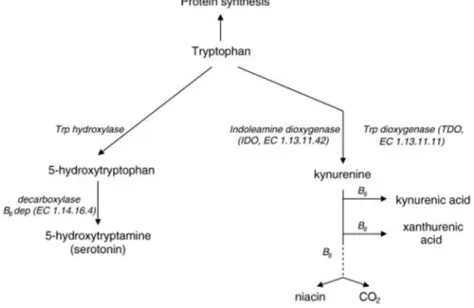
2.3. Tryptophan Metabolism
Tryptophan is an essential amino acid. Apart from its incorporation into body proteins, tryptophan is known to play important biological roles, most of them being associated to metabolic pathways involved in tryptophan catabolism. Tryptophan is the precursor for the synthesis of serotonin, an important neuromediator associated to mood, stress response, sleep and appetite regulation. From a quantitative point of view, the proportion of tryptophan used for the production of serotonin is very low that is degraded would be into serotonin. Tryptophan transport and availability in the brain seems to be one of the limiting steps for the synthesis of brain serotonin. Low tryptophan diets are known to depress feed intake. The relationship between tryptophan and serotonin is usually
considered as the mechanism involved in the depressive effect of low tryptophan diet on appetite. Furthermore, tryptophan is an essential amino acid that has to be supplied through the feed, since its synthesis cannot be achieved by the animal. This means that when tryptophan supply is low compared to the other essential amino acids, this will limit protein synthesis and accretion and, finally, growth rate.
Figure 3. Metabolic pathways of tryptophan
2.4. Threonine Metabolism
Although some essential amino acids are known to be oxidized by the portal-drained viscera (PDV) (van Goudoever et al., 2000; Riedijk et al., 2007), catabolism of essential amino acids does not seem to be their major fate within the intestinal tissues. Threonine catabolism through L-threonine 3-dehydrogenase pathway is a minor component within the splanchnic tissues with no contribution from the intestine (Le Floc'h and Sève, 2005, Schaart et al., 2005). However, intestinal oxidation measured by 13CO2 production from 13C-labeled threonine accounts for 2% of intestinal threonine utilization and 13% of whole-body threonine
These findings suggest that dietary threonine utilization by the intestinal mucosa of pigs is dominated by protein synthesis (Le Floc'h and Sève, 2005, Schaart et al., 2005), most likely through incorporation into mucins. Mucins (Montagne et al., 2004) are polymeric glycoproteins representing an important component of the mucus layer that covers the epithelium of the gastrointestinal tract, as well as all epithelia of mammals. Mucins can be membrane bound or secreted. The secretory mucins play a key role in the innate immune defense of the mucosa, and the core protein of the major intestinal mucins contains a large amount of threonine. In rats, the fractional synthesis rate of mucin glycoproteins was demonstrated to be relatively constant along the length of the intestine (range 112 -138 %/d), but substantially higher than the total mucosal protein synthesis rate, especially in the ileum (77 %/d) and colon (44 %/d) (Faure et al., 2002).
Mucins account for approximately 11% of endogenous protein in ileal digesta of pigs with threonine contributing 30% to mucin protein (Lien et al., 1997). Amino acids from endogenously secreted proteins, reaching the large intestine, are lost by the animal. Likewise, secretion of mucins, erosion of the mucus, and subsequent recovery of mucins in endogenous ileal losses is dependent on many dietary factors including fiber, protein, and anti-nutritional factors (Montagne et al., 2004). Thus, the secretion, recycling, and loss of intestinal mucins most likely have a substantial impact on the requirement for threonine, and this perhaps contributes to the energy needs of the organism. Van der Schoor et al (2002) reported that involving a 12-h-feeding and a 12-h-fasting period, intestinal recycling of amino acids from secretory proteins was proposed to be an important regulatory mechanism for the systemic availability of dietary amino acids. However, no significant threonine recycling from mucosal protein in the portal circulation could be detected, suggesting that these proteins could be very resistant to digestion, or that recycled threonine might be immediately reincorporated into mucosal protein.
2.5. Valine Metabolism
The valine has the highest oxidation rate of any AA in the mammary gland (Kim et al., 2001). Its role in milk synthesis is not well understood, but studies by Richert et al (1997a) and Moser et al (2000) have found significant litter gains (2 to 3 kg heavier litter weight at weaning) when Val:Lys ratios were increased. Val:Lys ratios in the lactation diets did not improve performance at a litter level in this previous studies. However, the intake of valine ranged from 47.6 to 92 g/d in the current study and was much higher than that of Richert et al (1997a; 29.9 to 64.9 g/d) and Moser et al (2000; 46.1 to 66.2 g/d). This may indicate that valine was oversupplied.
Several lines of evidence support the notion that supplementing valine to the diets of lactating sows enhances milk yield and neonatal growth. First, Richert et al (1997a) found that litter weaning weight and litter weight gain in high-producing lactating sows increased as dietary valine increased from 0.85 to 1.15%. Subsequently, these authors reported that increasing dietary valine (0.64-1.44%) to the lactating sow nursing 10 or more piglets increased litter weaning weights and litter weight gain (Richert et al., 1997b). This effect of dietary valine on lactation was confirmed by Moser et al (2000). Furthermore, Paulicks et al (2003) observed that dietary supplementation of valine (0.85-1.45%) to the lactating sow increased milk production and milk protein content, in comparison with the control group (0.55% of valine). Similarly, increasing dietary intake of valine, isoleucine, or total branched-chain amino acids by lactating sows resulted in an improvement of milk synthesis and litter weight gain (Richert et al., 1996).
Emerging evidence from animal studies indicates that dietary supplementation with valine or a mixture of BCAA stimulates milk synthesis and lactation in sows (Richert et al., 1997a; 1997b). Because dietary supplementation with valine increases milk protein synthesis (Richert et al., 1997a; 1997b), but this amino acid has no effect on the mTOR signaling pathway (Suryawan and Davis, 2011), increases in substrate provision may contribute to enhanced lactation
2.6. Ideal Amino Acid Balance
2.6.1. Gestating Sows
Fetal and mammary tissue growth is rapid during late gestation, the AA needs are greater, particularly in primiparous sows. Muscle tissue growth must be accounted for in younger sows as part of their reproductive needs. In our recent studies with modern breeds of sows, particular attention was paid to the growth pattern of fetuses (McPherson et al., 2004), mammary glands, and maternal tissues (Ji et al., 2005). The findings indicate that the growth of fetus and mammary gland occurred mostly during late gestation.
However, with new information about the dynamic metabolism of AA in the porcine conceptus (Self et al., 2004; Wu et al., 2008), AA requirements of gestating sows are expected to vary greatly with gestational stage. Considering that N accretion rate in maternal tissues (including the placenta) increases (McPherson et al., 2004) and AA composition in fetal pigs changes (Wu et al., 1999) with gestation, a constant AA ratio in the diet for pregnant pigs seems unreasonable. Thus, based on recent result (McPherson et al., 2004), we have determined an ideal dietary AA pattern for pregnant gilts, as described in the following paragraph. However, contributions of AA from hair, skeleton, head, and feet were not obtained and, thus, were excluded from this calculation. The ideal AA ratios for the diets of pregnant gilts were formulated on the basis of the following data and steps: 1) the weights and contents of CP and AA in carcass soft tissue, remaining viscera, gastrointestinal tract, liver, uterus, mammary gland, and fetuses in gilts at d 0, 60 and 114 of gestation were obtained from Wu et al (1999), Kim et al (2001), McPherson et al (2004), and Ji et al (2005); 2) the contents of individual AA in these tissues on each day of gestation were summed to obtain the total amounts of individual AA at d 0, 60 and 114 of gestation; 3) the accretions of individual AA between d 0 and 60 (early gestation) and between d 60 and 114 of gestation (late gestation) were calculated from the differences in AA contents between the first and the last day of each period; 4) the Lys-based AA ratios for protein accretion were
obtained; 5) the adjusted BW of gilts at d 60 and 114 of gestation was obtained by subtracting the weights of mammary gland and reproductive tract from the entire BW, representing the BW of the gilts that are not pregnant but of the same age at the first and the last days of each period; 6) the true ileal digestible Lys needs for maintenance in the early and late gestation were calculated using 36 mg/BW0.75 kg (NRC, 1998) where BW was the average adjusted BW of each phase; 7) the needs of other essential AA for maintenance were calculated from the true ileal digestible Lys need and the Lys-based AA ratios for maintenance suggested by NRC (1998); and 8) the amounts of AA required for protein accretion and maintenance were summed to obtain the AA needs for pregnant gilts and were used to calculate the Lys-based AA ratios.
2.6.2. Lactating Sows
Milk production and growth of lactating mammary parenchymal tissues contribute to AA needs for sows during lactation. In the case of limited voluntary feed intake, maternal tissue mobilization, mainly composed of protein and fat, contributes to the AA needs for milk production and mammary tissue growth (Trottier and Johnston, 2001; Kim and Easter, 2001). Protein synthesis can be improved when the ratio of AA from both dietary protein and body tissue mobilization matches the needs for whole body protein synthesis (Richert et al., 1997a), thereby minimizing excess AA oxidation. Currently available recommended ratios for dietary AA for lactating sows (NRC, 1998) indicate a fixed ratio regardless of body condition score (BCS) of sows during lactation. However, our research shows that most common corn and soybean meal-based lactation diets do not provide an AA pattern that is ideal for lactating sows (Kim et al., 2001). We obtained the ideal dietary AA pattern by comparing differences in amounts of individual AA between those from maternal tissue mobilization during lactation and those used for mammary parenchymal tissue gain and for milk production. Thus, our ideal dietary AA pattern can be varied when the balance between these
components is altered (Kim et al., 2001). To understand AA needs and ideal ratios for mammary parenchymal tissues and milk production, as well as AA contributions from maternal tissue mobilization, we have conducted a series of studies as described subsequently. These results provided convincing empirical evidence that the AA profile in a typical corn-soybean meal lactation diet has Lys, Thr, and Val as its first, second and third limiting AAs, that is, under conditions in which substantial BW loss and protein depletion are occurring during lactation. The implications of the results of Soltwedel et al (2006) are that the ideal ratio of Thr:Lys does not exceed 0.63, and the ideal ratio of Val:Lys is less than 0.81 for lactating sows losing 25 kg of BW during a 21-d lactation. These ratios support the results from Kim et al (2001) for sows with similar BW loss during lactation.
3. Importance of Milk
3.1. Yield of Colostrum and Milk
It is not possible to regularly milk the sow in the same condition as can be done with dairy cows. This is because the fact that the porcine mammary gland does not contain cisterns for storage of milk, secreted by the epithelial cells of the alveoli. Due to the lack of cisterns milk removal, from the alveoli and milk ducts, can only be performed after inducing the milk ejection reflex. Stimulation by the piglets, for at least one minute, is necessary to induce the milk ejection reflex in order to obtain a release of oxytocin and milk ejection (Fraser, 1980; Hartmann and Holmes, 1989). Besides this the sow nurses her piglets around 20 times per day for several weeks after parturition and the duration of milk flow is only ten to 20 seconds (Fraser, 1980; Hartmann and Holmes, 1989). The yield of sow colostrum and milk is therefore difficult to measure. However, there are several methods used to estimate yield in sows. The first method is called weigh – suckle – weigh (WSW). This method is performed by weighing the piglets before and after they nurse in order to measure the weight difference. The increase in weight should correspond to the intake of milk. However, this method can cause stress, as the piglets must be
separated from their mother, which can lead to a decreased milk intake. Another aspect is that defecation, urination, metabolic processes and salivation must be considered, since the piglet also loses weight due to these factors. The second method is called the isotope dilution technique. This method aims to measure the rate of total water turnover in the piglets. The difficulty of this method is that it must be ensured that the piglets does not eat or drink anything other than sow milk (Pettigrew et al., 1985; Theil et al., 2002). According to Theil et al (2002) the WSW method resulted in 12.7% lower milk yield than the dilution method, which indicates that WSW underestimates the sows’ milk yield. A third method is based on weight gain of piglets. The piglets are weighed at birth and again at another age, for example 24 h after birth (to estimate colostrum yield) or three weeks after birth (to estimate milk yield). A feed conversion ratio is thereafter used in order to recalculate the weight gain into milk yield (Devillers et al., 2004; Devillers et al., 2007; Bergsma et al., 2008; Aguinaga et al., 2011).
3.2. Composition of Colostrum and Milk
Colostrum has a higher DM, a higher content of CP and a higher content of whey protein than milk, but lower levels of lactose, fat and caseins (Klobasa et al., 1987; Le Dividich et al., 2005). The high DM and protein content in colostrum is due to the presence of immunoglobulins, such as immunoglobulin G (IgG), immunoglobulin A (IgA) and immunoglobulin M (IgM), and albumins (Klobasa et al., 1987). However, immunoglobulins are also present in milk but in lower concentrations. In colostrum IgG accounts for most of the protein content whereas in milk IgA is more common (Klobasa et al., 1987; Rooke and Bland, 2002). There is a positive correlation between yield and protein content in colostrum. There is also a positive correlation between yield and IgG content in colostrum. This means that when the yield increases the protein content and IgG content also increases (Devillers et al., 2007). Protein is an important factor in colostrum as well as in milk. Especially arginine deficiency in milk is a limiting factor for piglet growth (Kim
and Wu, 2009). The sow prioritizes protein content in colostrum and milk if the protein content in the feed is scarce, by metabolizing body reserves, which indicates that protein is extremely important to the piglets (King et al., 1996). The amount of essential amino acids in sow milk is 1.2 g/d at day five of lactation and 7.0 g/d at 21 day (Kim et al., 1999). The fat in colostrum and milk mostly consists of long chain fatty acids (Le Dividich et al., 2005) and can be affected by the composition of the feed during gestation and lactation (Farmer and Quesnel, 2009). The lactose content in colostrum is lower than in milk and nearly doubles during the first 14 days of lactation. Since lactose is osmotic and drives water into the alveoli, this affects the milk yield. Milk yield is therefore higher than colostrum yield (Klobasa et al., 1987; Hartmann and Holmes, 1989).
4. Literature cited
Aguinaga, M. A., Gomez-Carballar, F., Nieto, R., and Aguilera, J. F. 2011. Production and composition of Iberian sow's milk and use of milk nutrients by the suckling Iberian piglet. Animal, 5(9), 1390-1397.
Bauchart-Thevret, C., Stoll, B., Chacko, S., and Burrin, D. G. 2009. Sulfur amino acid deficiency upregulates intestinal methionine cycle activity and suppresses epithelial growth in neonatal pigs. American Journal of Physiology-Endocrinology and Metabolism, 296(6), 1239-1250.
Bergsma, R., Kanis, E., Knol, E. F., and Bijma, P. 2008. The contribution of social effects to heritable variation in finishing traits of domestic pigs (Sus scrofa). Genetics, 178(3), 1559-1570.
Black, J. L. 1995. Modeling energy metabolism in the pig—critical evaluation of a simple reference model. Wageningen Academic Publication, 87-102.
Boessen, C., Graham, A., Greiner, L., Knopf, B., Touchette, K. J., Goncalves, M. A. D., and Orlando, U. A. D. 2018. The standardized ileal digestibile valine:lysine requirement in lactating sows. Journal of Animal Science, 96(2), 170-171. Campbell, R. G., and Dunkin, A. C. 1983. The effects of energy intake and dietary
protein on nitrogen retention, growth performance, body composition and some aspects of energy metabolism of baby pigs. British Journal of Nutrition, 49(2), 221-230.
Chiba, L. I., Lewis, A. J., and Peo E. R. 1991. Amino acid and energy interrelationships in pigs weighing 20 to 50 kilograms: I. Rate and efficiency of weight gain. Journal of Animal Science, 69(2), 694-707.
Chung, T. K., and Baker, D. H. 1991. A chemically defined diet for maximal growth of pigs. The Journal of Nutrition, 121(7), 979-984.
Devillers, N., van Milgen, J., Prunier, A., and Le Dividich, J. 2004. Estimation of colostrum intake in the neonatal pig. Animal Science, 78(2), 305-313.
Devillers, N., Farmer, C., Le Dividich, J., and Prunier, A. 2007. Variability of colostrum yield and colostrum intake in pigs. Animal, 1(7), 1033-1041. Easter, R. A., and Baker, D. H. 1976. Nitrogen metabolism and reproductive
response of gravid swine fed an arginine-free diet during the last 84 days of gestation. The Journal of Nutrition, 106(5), 636-641.
Ellis, M., and Augspurger, N. 2001. Feed intake in growing-finishing pigs. Swine Nutrition, 447-468.
Farmer, C., and Quesnel, H. 2009. Nutritional, hormonal, and environmental effects on colostrum in sows. Journal of Animal Science, 87(13), 56-64.
Faure, M., Moënnoz, D., Montigon, F., Fay, L. B., Breuillé, D., Finot, P. A., ... and Boza, J. 2002. Development of a rapid and convenient method to purify mucins and determine their in vivo synthesis rate in rats. Analytical Biochemistry, 307(2), 244-251.
Finkelstein, J. D. 1990. Methionine metabolism in mammals. Journal of Nutritional Biochemistry, 1(5), 228-237.
Finkelstein, J. D. 1998. The metabolism of homocysteine: pathways and regulation. European Journal of Pediatrics, 57(2), 40-44.
Fraser, D. 1980. A review of the behavioural mechanism of milk ejection of the domestic pig. Applied Animal Ethology, 6(3), 247-255.
Fuller, M. F., Reeds, P. J., Cadenhead, A., Seve, B., and Preston, T. 1987. Effects of the amount and quality of dietary protein on nitrogen metabolism and protein turnover of pigs. British Journal of Nutrition, 58(2), 287-300.
Gatrell, S. K., Berg, L. E., Barnard, J. T., Grimmett, J. G., Barnes, K. M., and Blemings, K. P. 2013. Tissue distribution of indices of lysine catabolism in growing swine. Journal of Animal Science, 91(1), 238-247.
Hartmann, P. E., and Holmes, M. A. 1989. Sow lactation. Manipulating Pig Production II, 72-97.
Jeong, T. S., Heo, P. S., Lee, G. Y., Kim, D. H., Ju, W. S., and Kim, Y. Y. 2010. The influence of phase feeding methods on growth performance, meat quality,
and production cost in growing-finishing pigs. Journal of Animal Science and Technology, 52, 29-36.
Ji, F., Wu, G., Blanton, J. R., and Kim, S. W. 2005. Changes in weight and composition in various tissues of pregnant gilts and their nutritional implications. Journal of Animal Science, 83(2), 366-375.
Kim, S. W., Hurley, W. L., Han, I. K., and Easter, R. A. 1999. Changes in tissue composition associated with mammary gland growth during lactation in sows. Journal of Animal Science, 77(9), 2510-2516.
Kim, S. W., Baker, D. H., and Easter, R. A. 2001. Dynamic ideal protein and limiting amino acids for lactating sows: the impact of amino acid mobilization. Journal of Animal Science, 79(9), 2356-2366.
Kim, S. W., and Easter, R. A. 2001. Nutrient mobilization from body tissues as influenced by litter size in lactating sows. Journal of Animal Science, 79(8), 2179-2186.
Kim, S. W., and Wu, G. 2009. Regulatory role for amino acids in mammary gland growth and milk synthesis. Amino Acids, 37(1), 89-95.
King, R. H. 1999. A review—Nutritional constraints to pig performance and pig variability. In Manipulating Pig Production VII, 245.
King, R. H., Pettigrew, J. E., McNamara, J. P., McMurtry, J. P., Henderson, T. L., Hathaway, M. R., and Sower, A. F. 1996. The effect of exogenous prolactin on lactation performance of first-litter sows given protein-deficient diets during the first pregnancy. Animal Reproduction Science, 41(1), 37-50.
Klobasa, F., Werhahn, E., and Butler, J. E. 1987. Composition of sow milk during lactation. Journal of Animal Science, 64(5), 1458-1466.
Le Dividich, J., Rooke, J. A., and Herpin, P. 2005. Nutritional and immunological importance of colostrum for the new-born pig. The Journal of Agricultural Science, 143(6), 469-485.
Le Floc'h, N., and Sève, B. 2005. Catabolism through the threonine dehydrogenase pathway does not account for the high first-pass extraction rate of dietary
threonine by the portal drained viscera in pigs. British Journal of Nutrition, 93(4), 447-456.
Lewis, A. J. 2001. Methionine-cystine relationships in pig nutrition. Amino acids in Animal Nutrition, 143-155.
Liao, S. F., Wang, T., and Regmi, N. 2015. Lysine nutrition in swine and the related monogastric animals: muscle protein biosynthesis and beyond. Springer Plus, 4(1), 147.
Lien, K. A., Sauer, W. C., and Fenton, M. 1997. Mucin output in ileal digesta of pigs fed a protein-free diet. Zeitschrift für Ernährungswissenschaft, 36(2), 182-190.
McPherson, R. L., Ji, F., Wu, G., Blanton, J. R., and Kim, S. W. 2004. Growth and compositional changes of fetal tissues in pigs. Journal of Animal Science, 82(9), 2534-2540.
Montagne, L., Piel, C., and Lalles, J. P. 2004. Effect of diet on mucin kinetics and composition: nutrition and health implications. Nutrition Reviews, 62(3), 105-114.
Moser, S. A., Tokach, M. D., Dritz, S. S., Goodband, R. D., Nelssen, J. L., and Loughmiller, J. A. 2000. The effects of branched-chain amino acids on sow and litter performance. Journal of Animal Science, 78(3), 658-667.
National Research Council 1998. Nutrient requirements of swine. 10th ed. National Academy Press.
National Research Council 2012. Nutrient requirements of swine. 11th ed. National Academy Press.
Nyachoti, C. M., Zijlstra, R. T., De Lange, C. F. M., and Patience, J. F. 2004. Voluntary feed intake in growing-finishing pigs: A review of the main determining factors and potential approaches for accurate predictions. Canadian Journal of Animal Science, 84(4), 549-566.
Odenlund, M., Holmqvist, B., Baldetorp, B., Hellstrand, P., and Nilsson, B. O. 2009. Polyamine synthesis inhibition induces S phase cell cycle arrest in vascular smooth muscle cells. Amino Acids, 36(2), 273-282.
Papes, F., Kemper, E. L., Germano, C. N., Langone E, F., and Arruda, P. 1999. Lysine degradation through the saccharopine pathway in mammals: involvement of both bifunctional and monofunctional lysine-degrading enzymes in mouse. Biochemical Journal, 344(2), 555-563.
Paulicks, B. R., Ott, H., and Roth-Maier, D. A. 2003. Performance of lactating sows in response to the dietary valine supply. Journal of Animal Physiology and Animal Nutrition, 87(11-12), 389-396.
Pettigrew, J. E., Sower, A. F., Cornelius, S. G., and Moser, R. L. 1985. A comparison of isotope dilution and weigh-suckle-weigh methods for estimating milk intake by pigs. Canadian Journal of Animal Science, 65(4), 989-992. Rezaei, R., Knabe, D. A., Tekwe, C. D., Dahanayaka, S., Ficken, M. D., Fielder, S.
E., ... and Wu, G. 2013. Dietary supplementation with monosodium glutamate is safe and improves growth performance in postweaning pigs. Amino Acids, 44(3), 911-923.
Richert, B. T., Tokach, M. D., Goodband, R. D., Nelssen, J. L., Pettigrew, J. E., Walker, R. D., and Johnston, L. J. 1996. Valine requirement of the high-producing lactating sow. Journal of Animal Science, 74(6), 1307-1313.
Richert, B. T., Tokach, M. D., Goodband, R. D., Nelssen, J. L., Campbell, R. G., and Kershaw, S. 1997a. The effect of dietary lysine and valine fed during lactation on sow and litter performance. Journal of Animal Science, 75(7), 1853-1860.
Richert, B. T., Goodband, R. D., Tokach, M. D., and Nelssen, J. L. 1997b. Increasing valine, isoleucine, and total branched-chain amino acids for lactating sows. Journal of Animal Science, 75(8), 2117-2128.
Riedijk, M. A., Stoll, B., Chacko, S., Schierbeek, H., Sunehag, A. L., van Goudoever, J. B., and Burrin, D. G. 2007. Methionine transmethylation and transsulfuration in the piglet gastrointestinal tract. Proceedings of the National Academy of Sciences, 104(9), 3408-3413.
Salter, D. N., Montgomery, A. I., Hudson, A., Quelch, D. B., and Elliott, R. J. 1990. Lysine requirements and whole-body protein turnover in growing pigs. British Journal of Nutrition, 63(3), 503-513.
Schaart, M. W., Schierbeek, H., van der Schoor, S. R., Stoll, B., Burrin, D. G., Reeds, P. J., and van Goudoever, J. B. 2005. Threonine utilization is high in the intestine of piglets. The Journal of Nutrition, 135(4), 765-770.
Self, J. T., Spencer, T. E., Johnson, G. A., Hu, J., Bazer, F. W., and Wu, G. 2004. Glutamine synthesis in the developing porcine placenta. Biology of Reproduction, 70(5), 1444-1451.
Sharda, D. P., Mahan, D. C., and Wilson, R. F. 1976. Limiting amino acids in low-protein corn-soybean meal diets for growing-finishing swine. Journal of Animal Science, 42(5), 1175-1181.
Shelton, N. W., Tokach, M. D., Nelssen, J. L., Goodband, R. D., Dritz, S. S., DeRouchey, J. M., and Hill, G. M. 2011. Effects of copper sulfate, tri-basic copper chloride, and zinc oxide on weanling pig performance. Journal of Animal Science, 89(8), 2440-2451.
Soltwedel, K. T., Easter, R. A., and Pettigrew, J. E. 2006. Evaluation of the order of limitation of lysine, threonine, and valine, as determined by plasma urea nitrogen, in corn-soybean meal diets of lactating sows with high body weight loss. Journal of Animal Science, 84(7), 1734-1741.
Soumeh, E. A., van Milgen, J., Sloth, N. M., Corrent, E., Poulsen, H. D., and Nørgaard, J. V. 2015. Requirement of standardized ileal digestible valine to lysine ratio for 8-to 14-kg pigs. Animal, 9(8), 1312-1318.
Suryawan, A., O’Connor, P. M., Bush, J. A., Nguyen, H. V., and Davis, T. A. 2009. Differential regulation of protein synthesis by amino acids and insulin in peripheral and visceral tissues of neonatal pigs. Amino Acids, 37(1), 97-104. Suryawan, A., and Davis, T. A. 2011. Regulation of protein synthesis by amino
acids in muscle of neonates. Frontiers in Bioscience, 16, 1445.
Theil, P. K., Nielsen, T. T., Kristensen, N. B., Labouriau, R., Danielsen, V., Lauridsen, C., and Jakobsen, K. 2002. Estimation of milk production in
lactating sows by determination of deuterated water turnover in three piglets per litter. Animal Science, 52(4), 221-232.
Torrallardona, D., and Roura, E. 2009. Voluntary feed intake in pigs. Wageningen Academic Publication, 243-275.
Trottier, N. L., and Johnston, L. J. 2001. Feeding gilts during development and sows during gestation and lactation. Swine Nutrition, 2, 725-769.
Van Der Schoor, S. R., Reeds, P. J., Stoll, B., Henry, J. F., Rosenberger, J. R., Burrin, D. G., and van Goudoever, J. B. 2002. The high metabolic cost of a functional gut. Gastroenterology, 123(6), 1931-1940
Van Goudoever, J. B., Stoll, B., Henry, J. F., Burrin, D. G., and Reeds, P. J. 2000. Adaptive regulation of intestinal lysine metabolism. Proceedings of the National Academy of Sciences, 97(21), 11620-11625.
Wittmann, C., and Becker, J. 2007. The L-lysine story: from metabolic pathways to industrial production. In amino acid biosynthesis pathways, regulation and metabolic engineering. Springer, 39-70.
Wu, G., and Morris, S. M. 1998. Arginine metabolism: nitric oxide and beyond. Biochemical Journal, 336(1), 1-17.
Wu, G., Ott, T. L., Knabe, D. A., and Bazer, F. W. 1999. Amino acid composition of the fetal pig. The Journal of Nutrition, 129(5), 1031-1038.
Wu, G., and Meininger, C. J. 2002. Regulation of nitric oxide synthesis by dietary factors. Annual Review of Nutrition, 22(1), 61-86.
Wu, G., Bazer, F. W., Datta, S., Johnson, G. A., Li, P., Satterfield, M. C., and Spencer, T. E. 2008. Proline metabolism in the conceptus: implications for fetal growth and development. Amino Acids, 35(4), 691-702.
Wu, G. 2010a. Functional amino acids in growth, reproduction, and health. Advances in Nutrition, 1(1), 31-37.
Wu, G. 2010b. Recent advances in swine amino acid nutrition. Journal of Animal Science and Biotechnology, 1(2), 118-130.
407-Chapter III: Effect of Dietary Energy and Amino Acid
Levels on Growth Performance, Blood Profiles, Meat
Quality and Economic Analysis in Grower - finisher Pigs
ABSTRACT: This experiment was conducted to evaluate the effect of dietary energy and amino acid levels on growth performance, blood profiles, meat quality and economic analysis in grower - finisher pigs. A total of 180 cross-bred pigs ([Yorkshire × Landrace] × Duroc) with an initial mean body weight of 29.5 ± 4.04 kg were allotted to one of six treatments based on 2 × 3 factorial arrangement with 3 replicates. The first factor is two levels of metabolizable energy (ME) and the second factor is three different levels of amino acid (AA), and treatments were 1) LL: 3,200 kcal of ME/kg, NRC (1998) AA requirement; 2) LM: 3,200 kcal of ME/kg, NRC (median value between 1998 and 2012) AA requirement; 3) LH: 3,200 kcal of ME/kg, NRC (2012) AA requirement; 4) HL: 3,300 kcal of ME/kg, NRC (1998) AA requirement; 5) HM: 3,300 kcal of ME/kg, NRC (median value between 1998 and 2012) AA requirement; or 6) HH: 3,300 kcal of ME/kg, NRC (2012) AA requirement. Experiment diets were provided ad libitum during the entire experimental period. Higher body weight was observed when pigs were fed high dietary energy treatment (P<0.01) during the whole experimental period. The average daily gain tended to be higher as dietary energy and AA level increased during 0 to 3 weeks (P=0.08 and P=0.07, respectively). During 0 to 3 weeks, dietary energy and amino acid levels improved gain to feed ratio (P<0.01 and P=0.02, respectively) which is higher than that of low energy treatment. The BUN, albumin, globulin, total protein, IgG and IgA concentration in blood had no difference among dietary treatments. However, creatinine concentration in low energy treatment tended to be higher in 10 week (P=0.06). Moisture content in carcass was increased as dietary energy level higher (P<0.01). Moreover, water holding capacity (WHC) of physiochemical property was also increased in proportion to dietary energy level increased (P=0.04) There was no difference on meat color after slaughter by dietary
energy and amino acid levels. However, the feed cost per kg of weight gain was higher as dietary amino acid level increased (P=0.03). Consequently, this research recommended the energy requirement for grower - finisher pigs should be 3,300 kcal of ME/kg with AA requirement of NRC (1998).
Key words: Energy, Amino acid, Growth performance, Blood profiles, Meat quality, Economic analysis, Grower - finisher pig.
INTRODUCTION
Recently, swine genotypes are different from the past, and nutrient requirements also demand higher energy and amino acid levels. However, feeding with excessive nutrients in the diet is not economical, because of it lowers the efficiency of feed use, and it also causes dangerous pollutants such as nitrogen and phosphorus, which may cause environmental pollution (Jeong et al., 2010). Voluntary feed intake of growing pigs given ad libitum access to feed is affected by the energy content of the diet. Therefore, it seems logical that the amino acid levels of a diet should be related to its energy concentration (Chiba et al., 1991). Feeding strategy and phsae of growth activated viscera and body composition, and it may result in variation in the energy requirement for maintenance (Noblet et al., 1999). However, investigations of the need to adjust amino acids according to changes in energy have yielded conflicting result (Prince, 1987). Despite of the extensive research, the demand for energy and essential amino acids that of lysine, methionine, tryptophan and threonine is still not established (NRC, 2012). The major feedstock is cereals such as corn, soybean, barley and wheat. Furthermore, that cereals are provides only 30~60% of the total amino acid requirement. It should be formulated taking into account the appropriate energy and amino acid ratio in the feed to meet the nutrient requirement. Previous study have shown that crystalline amino acids are
and Bayley, 1995). Thus, these essential amino acids must be supplied with appropriate additions in feed (NRC, 2012).
Future research needs to formulate energy and amino acid content accurately. If the concept of intake requirements is used in corn-soybean meal based diets, the amino acid requirement should be changed as the energy content in the feed. According to the specification standards (NRC 1998 and 2012), dietary energy and amino acid requirements are different because of the pig's genetic capabilities, growth stages and environmental factors affect the pig's energy and amino acid requirements.
Therefore, this experiment was conducted to investigate the effect of energy and amino acid levels on growth performance, blood profiles, meat quality and economic analysis in grower - finisher pigs.
MATERIALS AND METHODS
Animals and housing
All experimental procedures involving animals were conducted in accordance with the Animal Experimental Guidelines provided by the Seoul National University Institutional Animal Care and Use Committee (SNUIACUC; SNU-160819-9).
A total of 180 crossbred ([Yorkshire x Landrace]) x Duroc) growing pigs with an average initial mean body weight (BW) of 29.52 ± 4.04 kg were used. This experiment was designed as a 2 ⅹ 3 factorial arrangement of treatments, 30 pigs per treatment in a randomized complete block design (RCBD) with 3 replicates using the experimental animal allotment program (Kim and Stein, 2009). The pen was a fully concrete floor facility (2.60 ⅹ 2.84 m) in the experimental period, equipped with a feeder and water nipple, and was in an environmentally controlled facility in Seoul National University Farm (Eumseong-gun, Chungcheongbuk-do, Korea).
Experimental diets and treatments
The experimental period lasted 14 weeks and consisted of 4 phases; phase 1 was weeks 0 to 3, phase 2 was weeks 4 to 6, phase 3 was weeks 7 to 10, and phase 4 was weeks 11 to 14. Body weight and feed intake were collected at the end of each phase in order to calculate the average daily gain, average daily feed intake, and gain to feed ratio. An allotment of feed to all of the pigs was recorded each day, and waste feed left in the feeder was recorded at the end of each phase.
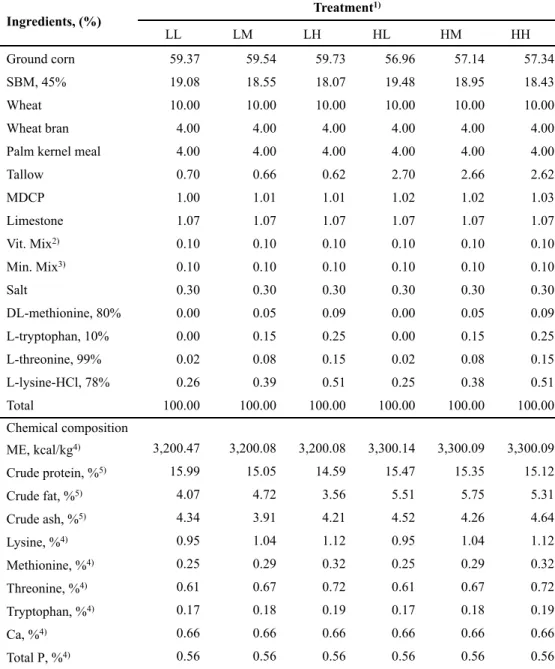
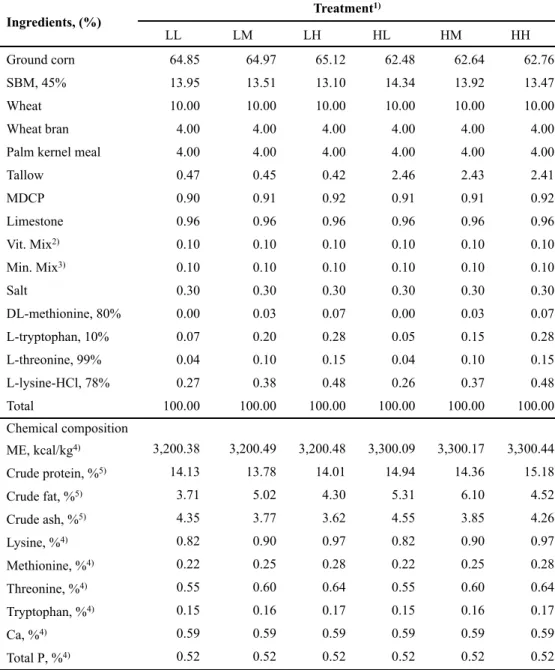
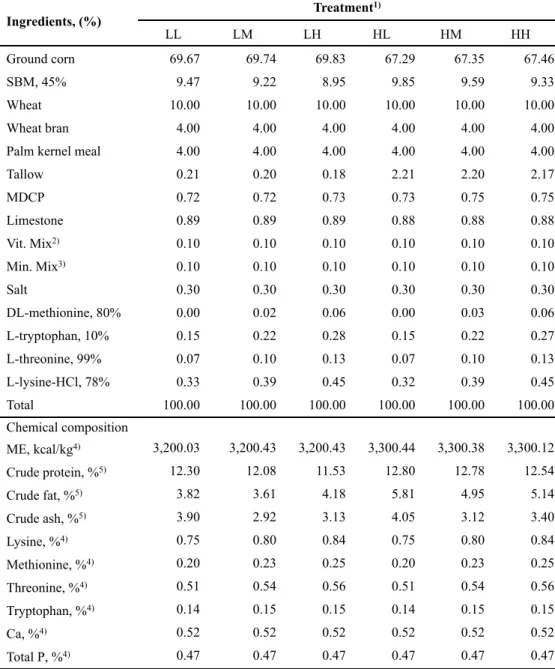
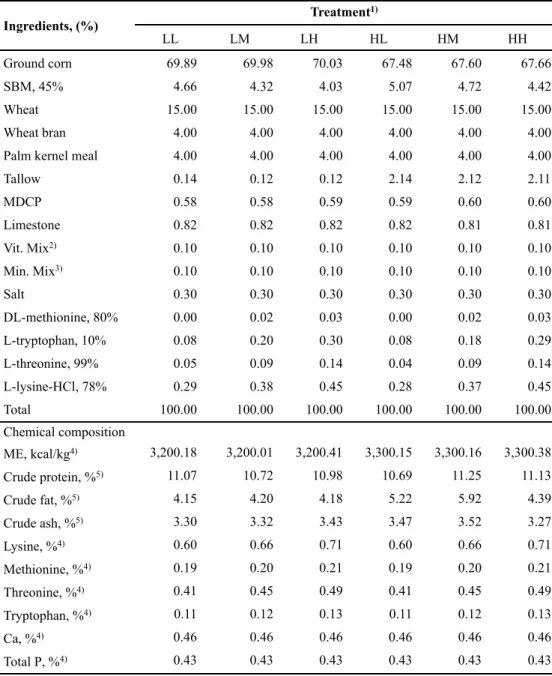
The experimental treatments were divided by energy and amino acids levels; 1) LL: 3,200 kcal of ME/kg, NRC (1998) AA requirement; 2) LM: 3,200 kcal of ME/kg, NRC (median value between 1998 and 2012) AA requirement; 3) LH: 3,200 kcal of ME/kg, NRC (2012) AA requirement; 4) HL: 3,300 kcal of ME/kg, NRC (1998) AA requirement; 5) HM: 3,300 kcal of ME/kg, NRC (median value between 1998 and 2012) AA requirement; or 6) HH: 3,300 kcal of ME/kg, NRC (2012) AA requirement. All nutrients met or exceeded the requirement of NRC (1998) and NRC (2012), respectively. The formula and chemical composition of experimental diets for each phase are presented in Tables 1, 2, 3 and 4, respectively.
Blood sampling and analysis
The body weight of pigs and feed intake of each pen were measured on 3, 6, 10 and 14 weeks of grower - finisher phase. Body weight and residual feed intake were measured on an electric scale (CAS Co. Ltd., Yangju-si, Gyeonggi-do, Korea). The voluntary feed intake of the grower - finisher pigs was determined from records of the feed supply and wastage during the whole experimental period.
Blood sample (n = 4, for each treatment; based on the nearest of mean BW) were taken from the jugular vein for measuring BUN, creatinine, IgG, IgA, albumin, globulin and total protein when the body weights were recorded. Collected blood samples were centrifuged for 15 min at 3,000 rpm on 4℃ (Eppendorf centrifuge 5810R, Germany). The sera were carefully transferred to 1.5 ml plastic tubes and
stored at -20℃ until later analysis. All the blood concentrations were analyzed using a blood analyzer (Modular analytics, P, Roche, Germany).
Carcass traits
At the end of the experiment, 4 pigs from each treatment were selected and slaughter for the carcass analysis. After slaughtering, longissimus muscle (LM) was procured from the interface of 10th and 11thrib of the carcass. Because of the chilling procedure, 30 minutes after slaughter was regarded as the initial time. Meat colors of the LM procured from the interface of 10thand 11th rib were measured at 24 hours after slaughter. Meat color were determined by Commission Internationale de I Echairege (CIE) color values using a CR-300 (Minolta Camera Co., Japan). Chemical analysis of the pork samples was conducted using the method of AOAC International (2005).
Pork quality
The water holding capacity (WHC) of the pork was measured by centrifuge method. Three longissimus muscle (LM) samples were ground and sampled in a filter tube, then heated in a water bath at 80℃ for 20 min, and centrifuged for 10 min at 2,000 rpm at 10℃ (Eppendorf centrifuge 5810R, Germany). To calculate the cooking loss, the longissimus muscle (LM) samples were packed with a polyethylene bag, heated in a water bath until the core temperature reached 72℃, and weighed before and after cooking. After heating, the samples were cored (1.27 cm in diameter) parallel to the muscle fiber and the cores were used to measure the shear force using a salter (Warner Barzler Shear, U.S.A). The amino acid content of the loin meat was determined by ion-exchange chromatography (Amino Acid Analyzer L-8900, Hitachi, Tokyo, Japan) with post-column derivatization with ninhydrin. Performic acid was used in oxidizing the amino acids and was neutralized with sodium citrate dihydrate and then hydrolyzed with 6 N HCl for 22 hours at 110℃ to be liberated from the protein. Amino acids were quantified with the internal standard method (amino acid mixture standard