76
2019 ⦽ǎႊᔍᖒ⠱ʑྜྷ⦺⫭⇹ĥ⦺ᚁݡ⫭םྙ᧞ḲCharacteristics of Vacuum Drying for Canister
Seung-hwan Yu*, Ju-chan Lee, Kyung-sik Bang, and Woo-seok Choi
Korea Atomic Energy Research Institute, 111, Daedeok-daero 989beon-gil, Yuseong-gu, Daejeon, Republic of Korea *
1. Introduction
Drying process of spent nuclear fuel must be required when spent nuclear fuel is transferred from wet storage to dry storage because oxidation composition could be bad effect of fuel cladding and long-term integrity of fuel cladding could not be guaranteed. Vacuum drying method is widely used in nuclear industry. In vacuum drying process, dryness criteria is that internal pressure is less than 3 Torr for 30 min without vacuum pump operation.
Characteristics of vacuum drying were analyzed. Analytic approach to simulate vacuum drying was performed. Simulation results are compared to characteristics of vacuum drying.
2. Concept of Analytic Calculation
2.1 Vacuum Drying Procedure
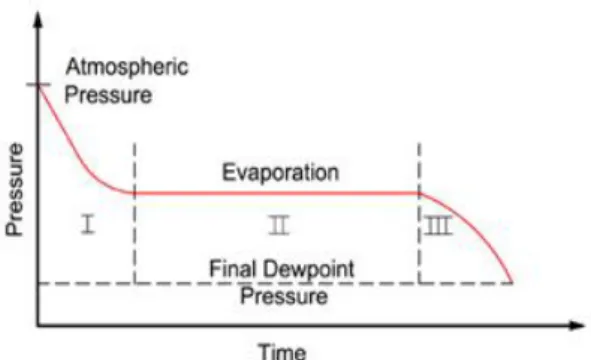
Vacuum drying process is divided into 3 steps. Fig. 1 shows pressure change during vacuum drying. First step is evacuation phase. Pressure decreases rapidly due to vacuum pump. Second step is evaporation phase. Generally pumping speed of vacuum pump is getting slower as the pressure decreases. In this phase, speed evacuation by vacuum pump is almost same as speed of evaporation of residual water. The duration of this phase is much longer than other phase. Almost residual water is eliminated in this phase. Last step is final drying phase. Only few water remained and speed of water evaporation is less than speed of
Fig. 1. Pressure change during vacuum drying.
vacuum pumping. Final drying process continues until dryness criteria is met.
3. Results and Discussion
Assumptions of calculation are below as
- Temperature inside canister was constant.
- Residual water only naturally evaporated.
- Initial pressure is 101.325 kPa.
- Initial residual water at bottom was 50 g.
3.1 Simple Drying Process
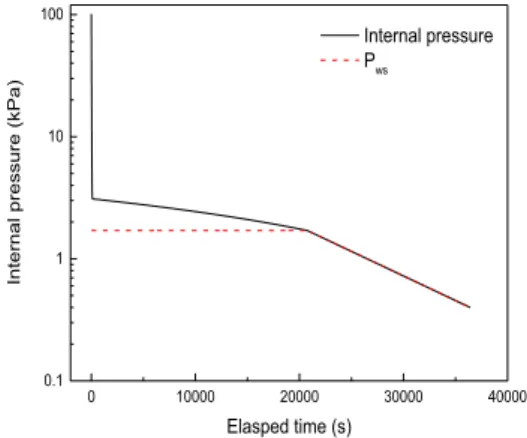
To check the effect of residual water, case with residual water and case without water were compared in Fig. 2, 3. Required time until pressure was less than 0.4 kPa (3 Torr) is 111 s for result without water and is 35907 s for result with water. It took much longer time for vacuum drying of case with residual water.
Three phases of vacuum drying were found in Fig. 3. Duration of evacuation phase is for 120 s. Pressure drops from 100 kPa to 3 kPa. Evaporation phase is
2019 ⦽ǎႊᔍᖒ⠱ʑྜྷ⦺⫭ ⇹ĥ⦺ᚁݡ⫭ םྙ᧞Ḳ
77
Fig. 2. Result of pressure change without residual water.
Fig. 3. Result of pressure change with residual water.
Fig. 4. Result of evaporation rate (kg/s).
from 121 s to 20250 s. Fig. 4 shows that evaporation rate increased in this phase. Pressure drops slowly from 3 kPa to 2 kPa. Most residual water is eliminated. Final drying phase is for 15657 s. Duration of final drying depends on dryness criteria.
4. Conclusion
The calculation program of vacuum drying was developed to analyze analytically vacuum drying process. The effect of residual water on vacuum drying was compared. Three vacuum drying phases were found in the simulation result.
ACKNOWLEDGEMENT
This work was supported by the Korean Ministry of Trade, Industry, and Energy (MOTIE) as a part of the Radioactive Waste Management Technology Development Project (20181720201020).
REFERENCES
[1] USNRC, 2010, Standard Review Plan for Spent Fuel Dry Storage Systems at a General License Facility, NUREG-1536. 0 50 100 0.1 1 10 100
Internal pressure (kPa)
Elasped time (s) 0 10000 20000 30000 40000 0.1 1 10 100
Internal pressure (kPa)
Elasped time (s) Internal pressure Pws 0 10000 20000 30000 40000 1E-9 1E-8 1E-7 1E-6 Evaporation per timestep (kg) Elasped time (s)