© Korean Powder Metallurgy Institute 794 -1. Introduction
In the field of electronics products, there is a continuing trend towards the use of IC (Integrated Circuit) having higher processing speed. The trend requires the driving power supply device operating in the state of higher frequency, lower voltage and higher current.
However, the increase of core loss will become a problem when applying dust core into such high frequency device. To reduce core loss under high frequency application, it is essential to control hysteresis loss and eddy current loss. This means that the magnetic powder for dust core should be finer in size, and have lower coercive force properties. Furthermore, the magnetic powder should be spherical to secure higher compressibility and particle insulation.
The authors prepared finer size soft magnetic powder by the original high-pressure water atomization process to obtain soft magnetic powder suitable for dust core having lower core loss properties.
2. Experimental
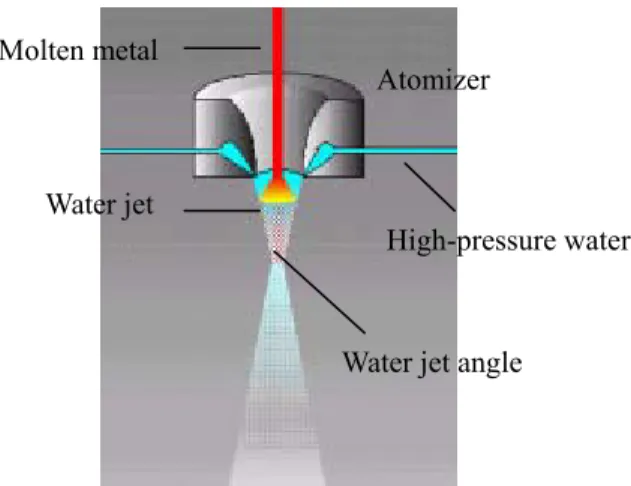
Firstly, iron and other raw materials were melted in high frequency melting furnace to obtain the melt of 3%Si-Fe composition. The melt was then atomized by the original high-pressure water atomization process. To control eddy current loss, average particle size(D50) of 10 μm was employed as aiming particle size in the atomizing. The atomization were carried out in following two conditions; one was Epson Atmix’s standard “F-method”, and the other is “improved R-method” (referred to as “R-method”). In R-method, vertical angle of water jet was adjusted to about two third of “F-method”. Water pressure of atomization was fixed to 100MPa, and other conditions except for vertical angle were adjusted properly. Resulting atomized powder
was then screened with 45μm screen to remove coarse particles and to obtain powder for evaluation. The powder was examined for size distribution, tap density, coercive force, microstructure and appearance. The powder was then processed into ring coil by adding epoxy resin of 2 wt% to powders, blending, pressing into size of φ27mm-outside, φ14mm-inside and 5mm-thick at the pressure of 196, 392, 586, and 785MPa, and then curing at 450K for 1800sec. The permeability and core loss were examined for the ring coil. For comparison, similar examination were carried out for carbonyl iron powder of 4μm diameter.
Fig. 1. Schematic of water atomization system. 3. Result
Table 1 shows some properties of powders obtained by “F-method” and “R-method”. In either case, the powder was fine in size and its mean size were around 11 to 12μm. VSM measurements showed that the coercivity Hc of “R-method” powder was 570A/m, 30% lower than 2006 POWDER METALLURGY
World Congress
C09-02-3
Ultra Fine Soft Magnetic Powders Produced by High Pressure
Water Atomization Process
Atsushi Watanabe1,a, Isamu Otsuka1, and Kimio Wada1 1
Epson Atmix Corporation, Japan
a
[email protected] Abstract
Metal powder for dust core application was developed. The powder can be produced improved high-pressure water atomization process. The process has produced powder of spherical shape and lower coercivity. The dust core obta ined shows lower core loss.
Keywords : Water atomization, Fine powder, Spherical powder, Dust core, Core loss
High-pressure water Atomizer
Molten metal
Water jet angle Water jet
© Korean Powder Metallurgy Institute 795
-“F-method” powder’s 805A/m. This is because the grain size of “R-method” powder is bigger than “F-method” powder as shown in Fig.2. SEM observation also showed that the “R-method” powder was more spherical than “F-method”.
Tap density of “R-method” powder was 4.7Mg/m3, higher
than “F-method” powder’s 4.2Mg/m3.
These facts suggested that the “R-method” powder have desirable properties for dust core application.
Table 1. Typical properties of powders Mean size (μm) Tap density (Mg/m3) Oxygen Content (ppm) Hc (A/m) 3%Si-Fe F-Method 11.4 4.2 2,300 810 3%Si-Fe R-Method 11.7 4.7 1,700 570 Carbonyl Iron 4.2 - - 730
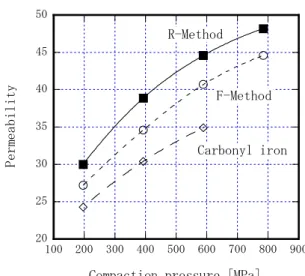
In Fig.3, the relation between compacting pressure and permeability are shown. Under the same compacting pressure, permeability have increase in following order: carbonyl iron, “F-method” powder, “R-method powder”. The reasons are considered to be, ① The permeability of 3%Si-Fe are higher than iron on its chemical com-position, and ② “R-method” powder is easy to rearrange and is not susceptible to strain in the stage of compaction because it have more spherical shape. Fig.4 shows the core loss. The core loss of “R-method” powder is lower about 10 to 15% than “F-method” powder. For example, at 100 KHz-100mT conditions, “R-method” powder shows 3,710kW/m3, improved
about 13% from “F-method” powder’s 4,240kW/m3. The
reason is considered that “R-method” powder have lower coercive force and is not susceptible to strain in compaction.
Fig. 2. Microstructure of 3%Si-Fe powder.
20 25 30 35 40 45 50 100 200 300 400 500 600 700 800 900 Pe rm ea bi li ty
Compaction pressure [MPa] Carbonyl iron
F-Method R-Method
Fig. 3. Relationship between Compaction pressure and
Permeability. 102 103 104 103 104 105 106 Cor e los s [ kW/ m 3] Frequency [Hz] Epoxy resin 2wt.%
Compaction pressure 785MPa Bm=100mT
R-Method F-Method
Fig. 4. Core loss of 3%Si-Fe dust core.
4. Summary
The experiment shows that “R-method” 3%Si-Fe powder has various excellent properties; that is, spherical, fine, low coercive force and core loss. Therefore “R-method” powder is suitable for making dust core having low core loss property. It is confirmed that the dust core prepared from “R-method” powder have low core loss values.
50μm