© Korean Powder Metallurgy Institute 1004 -1. Introduction
Antón et al. [1] studied the influence of alloying elements on tribological behaviour of sintered steels with high manganese-nickel content. They showed that when the Ni content was increased in the prealloyed PM steel, the friction coefficient tended to reduce. On the other hand, Ni addition causes volume shrinkage during sintering and thus the porosity amount decreases while the density increases [2]. Phases such as Ni-rich ferrite and martensite, which are observed in the microstructures of Ni added PM steels, contribute to the improvement of the mechanical properties of PM steels [3,4].
In the present study, the influence of tempering temperature and microstructure on the wear properties of low alloy PM steel with 1-2 % Ni was investigated.
2. Experimental and Results
Low alloy PM steels were prepared using atomized iron (Ancorsteel 1000), natural graphite (Alfa Aesar, Germany) and Ni (Alfa Aesar, Germany) powders. Natural graphite powders were admixed to iron powder as a carbon source. Mixed powders were compacted at 700 MPa and sintered at 1200°C for 30 min under a pure argon atmosphere. The sintered specimens were quenched from 890°C and tempered at 200°C and 600°C for 1 hr. To reveal the microstructures, specimens were grounded, polished and etched with 2 % Nital solution. A scanning electron microscope (JEOL 6060) was used to characterize the microstructure of the specimens. Hardness measurements were made by a Vickers tester (Instron Wolpert) using a 30 kg load.
The wear behavior of the specimens was evaluated using a pin on disc wear machine. The hardness of the disc material was 55 HRc. The wear tests were performed under 25 N loads and at 125 m.min-1. The total sliding distance
was 3000 m. Measurements were carried out at every 1000 m to find out the weight loss of the specimens. The wear coefficient was calculated by dividing the volume of the worn out material by the sliding distance and applied load.
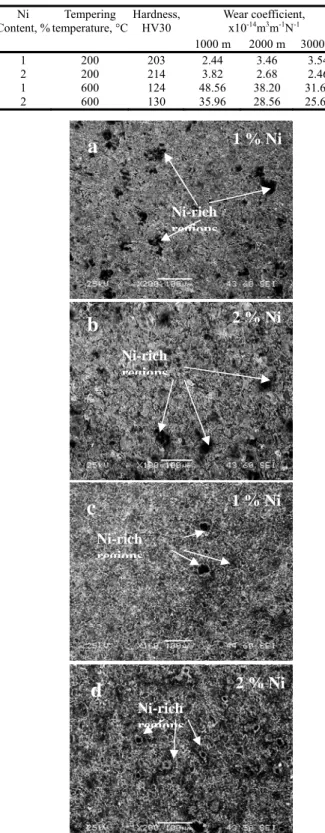
Fig. 1 shows the microstructures of the tempered martensite structure quenched from 890°C and tempered at 200°C and 600°C, respectively. A typical tempered martensite structure was obtained at 200°C (Fig. 1a-b), whereas an over-tempered martensite structure was observed at 600°C (Fig. 1c-d). The precipitation of very small cementite particles in the martensite structure can also be seen in the over-tempered specimens. The Ni-rich austenitic areas in the martensite matrix were observed in all specimens. The Ni-rich areas were detected by a qualitative X-ray element dispersion analysis of Ni by using an energy dispersive spectrometer (EDS). These EDS results were presented earlier by the present authors [5].
The wear coefficients of the specimens at each 1000 m, after the dry sliding wear tests, are given in Table 1. The wear coefficient was lower for the specimens tempered at 200°C than the specimens tempered at 600°C. The wear coefficient of the specimens was also influenced by the Ni content. As seen in Table 1, the wear coefficient decreased with the increase of Ni content at all sliding distances, except the specimen with 2 % Ni tempered at 200°C for the first 1000 m. Therefore, the wear coefficient of the specimens can be expected to increase by the presence of Ni-rich austenite phase. As the total sliding distance exceeded 1000 m, the wear coefficient decreased in the specimens with 2 % Ni. The wear coefficient increased with
2006 POWDER METALLURGY World Congress
PB07-W-02
Influence of Tempering Temperature and Microstructure on Wear Properties of
Low Alloy PM Steel with 1-2% Ni Addition
Süleyman Tekeli1,a, Ahmet Güral1,b and Metin Gürü2,c 1
Gazi University, Tech. Educ. Fac., Mater. Div., 06500, Teknikokullar-Ankara/Turkey
2
Gazi University, Eng.&Arch. Fac., Chem. Eng. Dep., 06570, Maltepe-Ankara/Turkey
a
[email protected], [email protected], [email protected] Abstract
The effect of tempering temperature and microstructure on dry sliding wear behavior of quenched and tempered PM with 0.3% graphite and 1-2% Ni steels was investigated. The sintered specimens were quenched from 890°C and then tempered at 200°C and 600°C for 1 hr. Wear tests were carried out on the quenched+tempered specimens under dry sliding wear conditions using a pin-on-disk type machine at constant load and speed. The experimental results showed that the wear coefficient effectively increased with increasing tempering temperature and decreased with increasing Ni content.
© Korean Powder Metallurgy Institute 1005
-the increase of -the sliding distance in -the specimen with 1 % Ni tempered at 200°C. The increase in the wear coefficient could be due to martensite cracking.
Table 1. Hardness and wear properties of specimens. Wear coefficient, x10-14m3m-1N-1 Ni Content, % Tempering temperature, °C Hardness, HV30 1000 m 2000 m 3000 m 1 200 203 2.44 3.46 3.54 2 200 214 3.82 2.68 2.46 1 600 124 48.56 38.20 31.64 2 600 130 35.96 28.56 25.64
Fig. 1. Microstructure of the specimens tempered at 200°C(a-b) and at 600°C(c-d).
3. Summary
The Ni-rich areas were found in all specimens after heat treatments. These areas affected both hardness and the wear coefficient values. Martensitic structure completely disappeared in the specimens tempered at 600°C and thus, the wear coefficient increased. The wear coefficient decreased with increasing hardness of the specimens.
4. Acknowledgements
This work has been supported by DPT (the State Planning Organization of Turkey) (under project number 2001K120590) and by the Scientific Research Project program (BAP) of Gazi University (under project number 07/2005-24).
5. References
1. N, Antón, J.L. Delgado, F, Velasko, and J.M. Torralba J.Mater.Proc.Tech., 143, 475(2003).
2. H. Zhang, and R.M. German, Metal Powder Report, 18(2001).
3. K.S. Narasimhan, Mater. Chem. Phys., 67, 56(2001). 4. B.A. Gething, D.F. Heaney, D.A. Koss, and T.J. Mueller, Mater.Sci.Eng.A, 390, 19(2005).
5. A. Güral, S. Tekeliand M. Gürü, EURO PM2005, Conf. Proc., 1, p. (2005). Ni-rich regions