저작자표시-비영리-동일조건변경허락 2.0 대한민국 이용자는 아래의 조건을 따르는 경우에 한하여 자유롭게 l 이 저작물을 복제, 배포, 전송, 전시, 공연 및 방송할 수 있습니다. l 이차적 저작물을 작성할 수 있습니다. 다음과 같은 조건을 따라야 합니다: l 귀하는, 이 저작물의 재이용이나 배포의 경우, 이 저작물에 적용된 이용허락조건 을 명확하게 나타내어야 합니다. l 저작권자로부터 별도의 허가를 받으면 이러한 조건들은 적용되지 않습니다. 저작권법에 따른 이용자의 권리는 위의 내용에 의하여 영향을 받지 않습니다. 이것은 이용허락규약(Legal Code)을 이해하기 쉽게 요약한 것입니다. Disclaimer 저작자표시. 귀하는 원저작자를 표시하여야 합니다. 비영리. 귀하는 이 저작물을 영리 목적으로 이용할 수 없습니다. 동일조건변경허락. 귀하가 이 저작물을 개작, 변형 또는 가공했을 경우 에는, 이 저작물과 동일한 이용허락조건하에서만 배포할 수 있습니다.
The Effect of Atropine on the Bispectral Index
Response to Endotracheal Intubation during
Propofol and Remifentanil Anesthesia
by
Kye Sook Kim
Major in Medicine
Department of Medical Sciences
The Graduate School, Ajou University
The Effect of Atropine on the Bispectral Index
Response to Endotrachal Intubation during
Propofol and Remifentanil Anesthesia
by
Kye Sook Kim
A Dissertation Submitted to The Graduate School of
Ajou University in Partial Fulfillment of the Requirements
for the Degree of
Master of Medicine
Supervised by
Jong Yeop Kim, M.D., Ph.D.
Major in Medicine
Department of Medical Sciences
The Graduate School, Ajou University
This certifies that the dissertation
of Kye Sook Kim is approved.
SUPERVISORY COMMITTEE
Jong Yeop Kim
Sook Young Lee
Sang Ki Min
The Graduate School, Ajou University
December, 23rd, 2010
i -ABSTRACT-
The Effect of Atropine on the Bispectral Index Response to
Endotracheal Intubation during Propofol and Remifentanil Anesthesia
Introduction: Atropine has been reported to increase the propofol requirements for the
induction of anesthesia during continuous infusion of propofol. Activation of the peripheral nerve system by endotracheal intubation is accompanied by an increase in bispectral index (BIS). The purpose of this study was to evaluate the effect of atropine on the BIS response to endotracheal intubation during anaesthetic induction with propofol and remifentanil target controlled infusion (TCI).
Method: Fifty-six patients, ASA I or II, aged 18-50 years, undergoing general anesthesia,
were enrolled. Anesthesia was induced with propofol TCI at an effect-site concentration of 4.0 μg/ml. Two minutes later, remifentanil was started at an effect-site concentration of 4.0 ng/ml. Four minutes after the start of propofol TCI, patients received either atropine 10 μg/kg or an equal volume of normal saline. Tracheal intubation was performed 10 min after anesthetic induction. MAP, HR, SpO2, and BIS were recorded during the 15 min study period
Result: From 2 min to 5 min after tracheal intubation, BIS was significantly higher in the
atropine group than in the control group (P = 0.043, 0.033, 0.049, and 0.001, respectively). When compared with baseline values (immediately before intubation), BIS showed a significant
ii
increase at 1 min after intubation in both groups, without intergroup differences, whereas it decreased significantly from 4 and 5 min after intubation only in the control group.
Conclusions: This study demonstrated that atropine maintained BIS increases in response to
laryngoscopy and endotracheal intubation during anesthetic induction with propofol and remifentanil TCI. However, it had no significant effect on BIS before intubation.
iii
TABLE OF CONTENTS
ABSTRACT ... i
TABLE OF CONTENTS ... iii
LIST OF FIGURES ... iv LIST OF TABLES ... v I. INTRODUCTION ... 1 II. METHODS ... 2 III. RESULTS ... 5 IV. DISCUSSION ... 9 V. CONCLUSION ... 12 REFERENCES ... 13 국문요약 ... 16
iv
LIST OF FIGURES
Fig. 1. Details of the study ... 2
Fig. 2. Changes in bispectral index (BIS), mean arterial pressure (MAP), and heart rate (HR) before and after tracheal intubation in the control group and the atropine group ... 6
v
LIST OF TABLES
1
I. INTRODUCTION
Atropine is commonly used to treat bradycardia or avoid vagal reflex during anaesthesia, and could produce the increase of cardiac output during propofol anesthesia (Takizawa et al, 2006). The inverse relationship between cardiac output and propofol concentration during constant rate infusions of propofol has been reported (Kurita et al, 2002). And therefore, the induction dose or the concentration of propofol may be influenced by the administration of atropine. Previous study showed that atropine decreased propofol concentrations during continuous infusion (Takizawa, et al. 2006). And they suggested the possibility of inadequate anesthetic depth following the administration of atropine (Takizawa et al, 2006).
The bispectral index (BIS) monitoring is an electroencephalogram (EEG)-derived tool to assess depth of anesthesia and prevent the risk of awareness (Myles et al, 2004). And
activation of the peripheral nerve system by noxious stimuli, such as laryngoscopy and endotracheal intubation, is accompanied by a central sympathetic adrenergic response, resulting in an increase in BIS (Guignard et al, 2000). To date, there have been no reports on the effect of atropine on the BIS response to endotracheal intubation during anesthesia induction. Therefore, the purpose of this study was to evaluate the effect of atropine on the BIS response to endotracheal intubation during anesthetic induction with propofol and remifentanil TCI.
2
II. METHODS
This study was approved by the institutional review board, and written informed consent for the study was obtained from all patients. Fifty-six patients, ASA I or II, aged 18-50 years, undergoing general anesthesia, were enrolled. Exclusion criteria included a history of hypertension, glaucoma, prostate hyperplasia, and neurological disorder. No premedication was administered prior to surgery. For drug injection, a 20-gauge cannula was inserted into the forearm or dorsum of the hand, and connected to a T-connector prior to arrival in the operating theatre. Upon arrival in the operating room, all patients were monitored with electrocardiogram, pulse oximeter, and noninvasive blood pressure. BIS monitoring (BIS vista monitor Revision 3.0, Aspect Medical Systems, Norwood, MA, USA) was applied prior to induction of anesthesia, and a four-electrode sensor (Quatro SensorTM,
Aspect Medical Systems) was placed on the forehead according to the manufacturer's instructions after alcohol cleaning to reduce skin-electrode impedance.
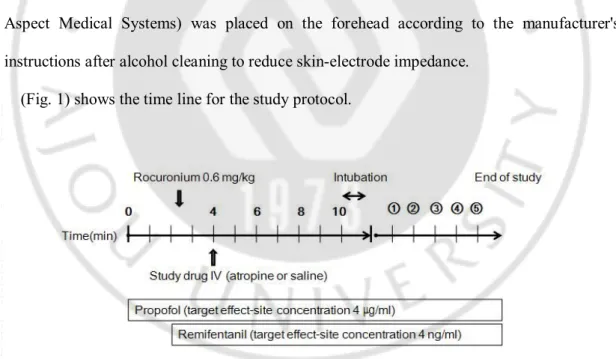
(Fig. 1) shows the time line for the study protocol.
3
Anesthesia was induced with propofol TCI at an effect-site concentration of 4.0 μg/ml. Two minutes later (i.e. when the intended target effect-site concentration of propofol had been reached), remifentanil was started at an effect-site concentration of 4.0 ng/ml. A commercially available two-channel TCI pump (Orchestra®, Fresenius Vial, Brezins, France)
was used for effect-site TCI of propofol and remifentanil. The pharmacokinetic sets used to calculate target effect-site concentrations for propofol and remifentanil were Marsh (Marsh et al, 1991) and Minto (Minto et al, 1997) models, respectively. The ke0 value used for
propofol was 1.21/min (Struys et al, 2000). Infusions of propofol and remifentanil were prepared in 50 ml syringes using 2% propofol and remifentanil 2 mg (diluted with normal saline to make 40 μg/ml solution). Rocuronium 0.6 mg/kg was administrated after loss of consciousness (LOC). Four minutes after the start of propofol TCI, patients received either atropine 10 μg/kg or an equal volume of normal saline in a random, double-blind manner. Random allocations were made according to a computer generated randomization table. Tracheal intubation was performed 10 min after anesthetic induction. Patients’ lungs were ventilated manually before tracheal intubation, and ventilation was then assisted mechanically in order to maintain end-tidal CO2 at 30-35 mmHg.
Time to LOC was also measured. The target effect-site concentrations of propofol and remifentanil were maintained at the initial target effect-site concentrations (4.0 μg/ml and 4.0 ng/ml, respectively) for 15 min in the absence of any surgical stimulation until the end of the study period. Clinically significant hypotension and bradycardia were defined as a mean arterial pressure (MAP) of < 55 mmHg, or systolic blood pressure (SBP) of < 80 mmHg, and a heart rate (HR) of < 45 beats/min, respectively. These conditions were treated with phenylephrine or glycopyrrolate where appropriate.
4
anesthesia (awake), from 6 min to 2 min before intubation at 2 min intervals (time point -6 to -2), immediately before intubation (time point 0, baseline), and 5 min after intubation at 1 min intervals (time point 1 to 5). Change in BIS with orotracheal intubation (ΔBIS) was defined as the difference between the baseline value (time point 0) and the maximal value within the first 5 min after intubation.
Power analyses based on a previous study (Coste et al, 2000) suggested that 25 patients per group would result in detection of 15% difference in BIS between the atropine and control group (α = 0.05, β = 0.2). Assuming a 10% dropout rate, the sample size was increased to 28 patients per group.
Statistical analyses were performed using SPSS 13.0 for windows (SPSS Inc, Chicago, IL, USA). Normal distribution was determined using the Kolmogorov-Smirnov test. Data are expressed as mean ± SD or number of patients. Categorical data were analyzed using the chi-square test, and other data between the groups were analysed using an independent t-test. Changes between time points within the group were analyzed using univariate analysis of variance (ANOVA) followed by Fisher's least significant difference (LSD) post hoc testing. Baseline values were taken as those values measured immediately before intubation (time point 0). A P value < 0.05 was considered statistically significant.
5
III. RESULTS
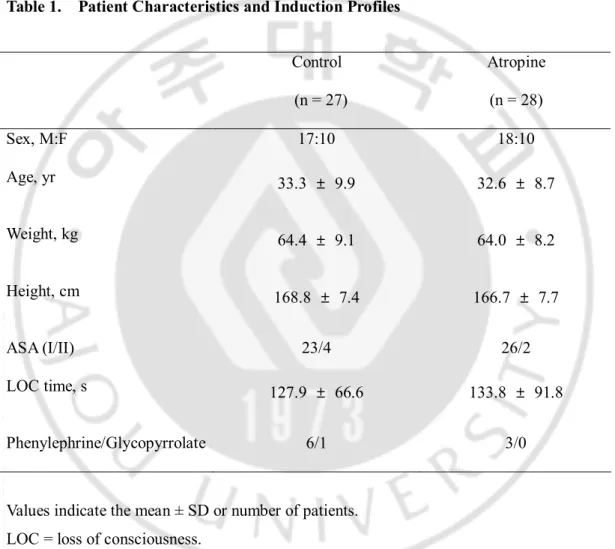
Fifty-five patients completed the study. One patient in the control group was excluded from the analyses due to absence of LOC during a period of 9 min. No significant differences in patient characteristics and LOC time were observed between the two groups (Table 1).
Table 1. Patient Characteristics and Induction Profiles
Values indicate the mean ± SD or number of patients. LOC = loss of consciousness.
No significant differences were observed between the groups. Control (n = 27) Atropine (n = 28) Sex, M:F 17:10 18:10 Age, yr 33.3 ± 9.9 32.6 ± 8.7 Weight, kg 64.4 ± 9.1 64.0 ± 8.2 Height, cm 168.8 ± 7.4 166.7 ± 7.7 ASA (I/II) 23/4 26/2 LOC time, s 127.9 ± 66.6 133.8 ± 91.8 Phenylephrine/Glycopyrrolate 6/1 3/0
6
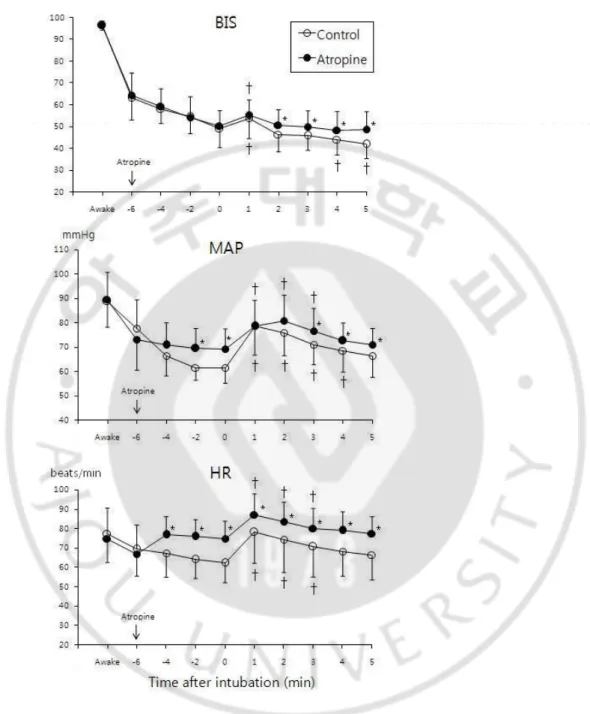
Changes in BIS, MAP, and HR values during induction of anesthesia are shown in (Fig. 2)
Fig. 2. Changes in bispectral index (BIS), mean arterial pressure (MAP), and heart rate (HR) before and after tracheal intubation in the control group and the atropine
7
group. Error bar indicates SD. * P < 0.05 compared with the control group. † P < 0.05
compared with baseline values within the group. Time point -6 to -2 = 6 to 2 minutes before intubation; 0 = immediately before intubation (baseline); 1 to 5 = 1 to 5 minutes after intubation.
8
From 2 min to 5 min after tracheal intubation, BIS was significantly higher in the atropine group than in the control group (P = 0.043, 0.033, 0.049, and 0.001, respectively). When compared with baseline values (immediately before intubation), BIS increased significantly at 1 min after intubation in both groups, without intergroup differences, whereas it decreased significantly from 4 and 5 min after intubation only in the control group. Mean value ± SD of ΔBIS was 9.8 ± 12.1% and 10.6 ± 9.5% in the control group and the atropine group, respectively, without intergroup differences (P = 0.798).
MAP was significantly higher in the atropine group than in the control group from 2 min to immediately before intubation, and from 3 to 5 min after intubation (P < 0.05). When compared with baseline values, MAP increased significantly from 1 to 4 min after intubation in the control group, and from 1 to 3 min after intubation in the atropine group.
HR was significantly higher in the atropine group than in the control group from 4 min before intubation to 5 min after intubation (P < 0.05). When compared with baseline values, MAP increased significantly from 1 to 3 min after intubation in both groups.
9
IV. DISCUSSION
This study demonstrated that a single dose of atropine (10 μg/kg) could potentiate the BIS response to endotracheal intubation during anesthesia induction with propofol and remifentanil TCI.
Atropine is a widely used anticholinergic agent to treat bradycardia during induction of general anesthesia. Since the administration of atropine could increase the cardiac output during propofol anesthesia,1 and the cardiac output has been reported to influence the
pharmacokinetics of propofol (Kurita et al, 2002), we hypothesized that atropine might have some effects on BIS during anesthesia induction. And this study showed that atropine maintained the BIS increase in response to endotracheal intubation during anaesthesia induction with propofol and remifentanil TCI, although the maximal response did not differ between the groups. A previous study comparing propofol concentrations before and after administration of atropine during constant rate infusion of propofol in healthy patients reported that before administration, propofol concentrations achieved predicted concentrations, and after administration of atropine, propofol concentrations were decreased along with an increase of cardiac output (Takizawa et al, 2006). Findings from the study demonstrated that propofol concentrations became lower following administration of atropine (Takizawa et al, 2006). In this study, although cardiac output was not measured during anesthesia induction, MAP and HR were higher in the atropine group than in the control group at 2 min after administration of atropine. Therefore, in this study, atropine, by potentiating the hemodynamic responses to laryngoscopy and endotracheal intubation, may have induced the increase in cardiac output, with a resultant decline in the effect-site
10
concentration of propofol and an increase in BIS. In this study, we did not measure the plasma propofol and remifentanil concentrations, which is one of the limitations of this study. The measurement of these concentrations may have provided better understanding of the influence of atropine on the pharmacokinetics of these agents.
Another explanation may be an alteration of the balance of the autonomic nervous system by atropine during induction of propofol-remifentanil anesthesia. Since propofol has a centrally mediated sympatholytic effect and remifentanil has centrally mediated vagotonic and/or sympatholytic action (Fukuda et al, 2010; Bailey et al, 1997; Reves et al, 2010), propofol–remifentanil anesthesia may produce a parasympathetic dominant status. In this study, atropine blocked the muscarinic tone of a parasympathetically dominated heart, which may have caused an unopposed tone-up in the sympathetic system. Thus, it seems likely that in this study, atropine not only blocked the parasympathetic system, but also potentiated activation of the sympathetic system by noxious stimulation of laryngoscopy and endotracheal intubation. In previous studies, arousal reactions that may be detected by an increase in BIS, such as an infusion of isoprenaline (Johnson et al, 1999)or epinephrine (Andrzejowski et al, 2000), were associatedwith activation of the sympathetic nervous system. In addition, BIS levels have shown significant correlation with plasma norepinephrine concentrations after premedication with oraldiazepam (Hirota et al, 1999). Meanwhile, it seems unlikely that atropine has a direct CNS effect per se, because anticholinergics, such as atropine, which cross the blood-brain barrier, have been reported to delay arousal from general anesthesia (Baraka et al, 1980).
In this study, addition of atropine to general anesthesia with propofol and remifentanil did not affect BIS before laryngoscopy. This result suggests that atropine does not modify BIS during induction of general anesthesia when substantial activation of the autonomic nervous
11
system is unlikely. These results are consistent with those of a recent study reporting that the BIS value was unaltered by atropine (10 μg/kg) in propofol-anaesthetized patients without noxious stimulation (Höcker et al, 2010). In addition, even administration of scopolamine, which can exert more CNS effects than atropine, has been reported to have no effect on the BIS value and auditory steady state response during propofol anesthesia without noxious stimulation (Meuret et al, 2000).
12
V. CONCLUSION
In conclusion, atropine maintained BIS increases in response to laryngoscopy and endotracheal intubation during anesthetic induction with propofol and remifentanil TCI. However, it had no significant effect on BIS before intubation.
13
REFERENCES
1. Andrzejowski J, Sleigh JW, Johnson IAT, Sikiotis L: The effect of intravenous epinephrine on the bispectral index and sedation. Anaesthesia 55: 761–3, 2000
2. Bailey P, Egan T: Fentanyl and congreners, Textbook of intravenous anesthesia. Edited by White PF. Baltimore, Williams & Wilkins Publishers, pp 213–45, 1997
3. Baraka A, Yared JP, Karam AM, Winnie A: Glycopyrrolate-neostigmine and atropine- neostigmine mixtures affect postanesthetic arousal times differently. Anesth Analg 59: 431-4,1980
4. Coste C, Guignard B, Menigaux C, Chauvin M: Nitrous oxide prevents movement during orotracheal intubation without affecting BIS value. Anesth Analg 91: 130-5, 2000
5. Fukuda K: Opioids, Miller’s Anesthesia, 7th edition. Edited by Miller RD. Philadelphia, Churchill Livingstone Publishers , pp 769-824, 2010
6. Guignard B, Menigaux C, Dupont X, Fletcher D, Chauvin M: The effect of remifentanil on the bispectral index change and hemodynamic responses after orotracheal intubation.
Anesth Analg 90: 161–7, 2000
7. Hirota K, Matsunami K, Kudo T, Ishihara H, Matsuki A: Relation between bispectral index and plasma catecholamines after oral diazepam premedication. Eur J Anaesthesiol 16: 516–8, 1999
14
8. Höcker J, Broch O, Gräsner JT, Gruenewald M, Ilies C, Steinfath M, Bein B: Surgical stress index in response to pacemaker stimulation or atropine. Br J Anaesth 105: 150-4,
2010
9. Johnson IA, Andrzejowski J, Sikiotis L: Arousal following isoprenaline. Anaesth
intensive Care 27: 221, 1999
10. Kurita T, Morita K, Kazama T, Sato S: Influence of cardiac output on plasma propofol concentrations during constant infusion in swine. Anesthesiology 96: 1498-503, 2002
11. Marsh B, White M, Morton N, Kenny GN: Pharmacokinetic model driven infusion of propofol in children. Br J Anaesth 67: 41-8, 1991
12. Meuret P, Backman SB, Bonhomme V, Plourde G, Fiset P: Physostigmine reverses propofol-induced unconsciousness and attenuation of the auditory steady state response and bispectral index in human volunteers. Anesthesiology 93: 708-17, 2000
13. Minto CF, Schnider TW, Egan TD, Youngs E, Lemmens HJ, Gambus PL, Billard V, Hoke JF, Moore KH, Hermann DJ, Muir KT, Mandema JW, Shafer SL: Influence of age and gender on the pharmacokinetics and pharmacodynamics of remifentanil. I. Model development. Anesthesiology 86: 10-23, 1997
14. Myles PS, Leslie K, McNeil J, Forbes A, Chan MT: Bispectral index monitoring to prevent awareness during anaesthesia: the B-Aware randomised controlled trial. Lancet 363: 1757-63, 2004
15. Reves JG, Glass PSA, Lubarsky DA, McEvoy MD, Martinez-Ruiz R: Intravenous anesthetics, Miller’s Anesthesia, 7th edition. Edited by Miller RD. Philadelphia, Churchill
15 Livingstone Publishers, pp 719-68, 2010
16. Struys MM, De Smet T, Depoorter B, Versichelen LF, Mortier EP, Dumortier FJ, Shafer SL, Rolly G: Comparison of plasma compartment versus two methods for effect compartment--controlled target-controlled infusion for propofol. Anesthesiology 92: 399-406, 2000
17. Takizawa E, Takizawa D, Al-Jahdari WS, Miyazaki M, Nakamura K, Yamamoto K, Horiuchi R, Hiraoka H: Influence of atropine on the dose requirements of propofol in humans. Drug Metab Pharmacokinet 21: 384-8, 2006
16 -국문요약-
Propofol과 Remifentanil을 이용한 마취에서 기도 내 삽관 시
Bispectral Index에 대한 Atropine의 효과
아주대학교 대학원 의학과 김 계 숙
(지도교수: 김 종 엽)
서론: Atropine은 propofol의 지속적 주입방법으로 마취 유도 시 propofol요구량을
증가시키는 것으로 알려져 있다. 기도 내 삽관에 의한 말초신경계의 활성화는 Bispectral index의 증가를 수반한다. 이 연구의 목적은 propofol과 remifentanil의 목표처 조절 주입을 이용한 마취 유도 시 기관 내 삽관에 대한 atropine의 효과를 평가하는 것이다.
방법: ASA class I 또는 II, 18~50세의 56명의 전신 마취를 받는 환자를 대상으로
하였다. 마취는 propofol의 목표처 농도 4.0 μg/ml로 유도하였고 2분 뒤 remifentanil을 목표처 농도 4.0ng/ml로 시작하였다. Propofol 주입 시작 4분 뒤 환자에게 atropine 10 μg/kg 또는 동량의 생리식염수를 투여하였다. 마취 유도 10분 뒤 기관 삽관을 시행하였고 평균 동맥압, 심박수, 산소 포화도와 BIS를 15분 동안 기록하였다. 결과: 기관 삽관 후 2~5분 동안 대조군에 비해 atropine군에서 BIS가 유의하게 높게 나타났다. 기관 삽관 직후의 baseline값과 비교하였을 때 BIS는 양 군에서 차이 없이 모두 증가하였으나 반면에 삽관 후 4~5분 후 대조군에서만 다시 유의하게 감소하였다.
17
결론: 이 연구는 propofol과 remifentanil을 이용하여 마취하고 삽관할 때
atropine에 의해 증가된 BIS가 유지된다는 결과를 보였다. 그러나 기관 삽관 전에는 유의한 효과를 보이지 않았다.