© Korean Powder Metallurgy Institute 1061
-1. Introduction
Manual thresholding is the most prevalent image analysis method. Selecting the threshold to detect only gray levels or RGB values within specific ranges enables selective detection of features. Detection or segmentation is the process which extracts a simplified, binary image from the original image. There are many algorithms described to automatically calculate the threshold. An evaluation of over 40 of them can be found elsewhere [1].
Modern materials with complex microstructures, like Al-SiCp composites, have been developed and fabricated using the latest technology [2, 3, 4, 5]. Analysis of such materials requires efficient computer-based algorithms [6, 7]. Development of new image analysis software has been motivated by the fact that conventional methods (e.g. gray level thresholding) are not capable of analyzing the microstructure of the modern materials, or having the analyzing ability, but with a lot of steps. These methods have two drawbacks: (i) the result cannot be displayed immediately, and (ii) the methods cannot ensure good reproducibility.
It is difficult to determine the relationship between structure and mechanical properties of composites. There are various methods for this purpose however these methods have some difficulties with anisotropy, i.e., directional dependence, of the properties.
In microstructure analysis of the particle reinforced metal matrix composites, the phases cannot be separated from each other using conventional methods like gray level thresholding or color detection. The gray levels of the particles and the matrix are equivalent even for excellent quality of images. Therefore, gray level thresholding is not
a sufficient method. On the other hand, these materials have two important properties: (i) the gray levels of phases vary within specific ranges, and (ii) the gray levels of the two phases are different near the interfaces. Therefore, two possibilities exist: trying to find (i) the interfaces which could have different colors in each direction and fill the objects, or (ii) the contiguous regions and fill it at the same time.
Finding the interfaces is rather difficult, and demands for longer computing time. Thus, finding the contiguous regions seems to be a better choice although it might be less efficient.
2. Experimental and Results
The proposed algorithm consists of two parts: (i) a conventional gray level thresholding (may determine pixels which are definitely part of the objects) (ii) finding the contiguous regions (semi-automatic method, may find pixels which are also part of the objects, but it is impossible to detect these pixels without detecting background). This part of the algorithm uses non-recursive scan line search method.
Fig.1 shows the differences between the conventional method and the new method of detecting process. The conventional method searches for pixels in all area (Fig. 1a), but the post process of the new method searches only around of selected pixels (Fig 1b). That is why the new method is more efficient for detecting the objects.
The conventional algorithms rotate an image at many different angles with scan line measure. However, the new algorithm developed for anisotropy measurement, i.e. the
2006 POWDER METALLURGY World Congress
PC03-W-08
Microstructure Characterization of SiC
p-reinforced Aluminum Matrix Composites
by Newly Developed Computer-based Algorithms
Ferenc Kretz1,a, Zoltan Gacsi2,b, and C. Hakan Gur3,c1
Physical Metallurgy and Metalforming Department, University of Miskolc, Hungary 2
Physical Metallurgy and Metalforming Department, University of Miskolc, Hungary 3
Metallurgical and Materials Engineering Dept., Middle East Technical University, Ankara, Turkey a
[email protected], [email protected], [email protected] Abstract
This paper presents a new approach for analyzing the microstructure of SiCp-reinforced aluminum matrix composites
from digital images. Various samples of aluminum matrix composite were fabricated by hot pressing the powder mixtures with certain volume and size combinations of pure Al and SiC particles. Microstructures of the samples were analyzed by computer-based image processing methods. Since the conventional methods are not suitable for separating phases of such complex microstructures, some new algorithms have been developed for the improved recognition and characterization of the particles in the metal matrix composites.
© Korean Powder Metallurgy Institute 1062 -human method, uses one image and different measurement directions. Curiously, in several instances (especially with complex images) the proposed method is quicker than the algorithms of previous concepts. Another advantage is the ability to conduct the measurements on the original (“lossless”) images. It is an unused advantage, yet; because normally, the digital point cannot appear in two or more pixel at one time. That is why the slant line cannot be continual, and will be divided into many points and vertical or horizontal lines. However, better results may be obtained when the algorithm considers all pixels or a part of pixels instead of choosing only some of these pixels.
Fig. 1. Process of detecting: (a) conventional method, (b) new method.
The powder mixtures contain various volume and size combinations of pure Al and SiC particles. Two groups of pure aluminum powder with 100 and 180 µm average particle size, and two groups of SiC powder characterized by the average particle sizes of 10 and 40 µm were used to prepare the powder mixtures. Aluminum powder was mixed with 5, 10 and 20 wt. % SiC particles. All composites were fabricated by hot pressing [8].
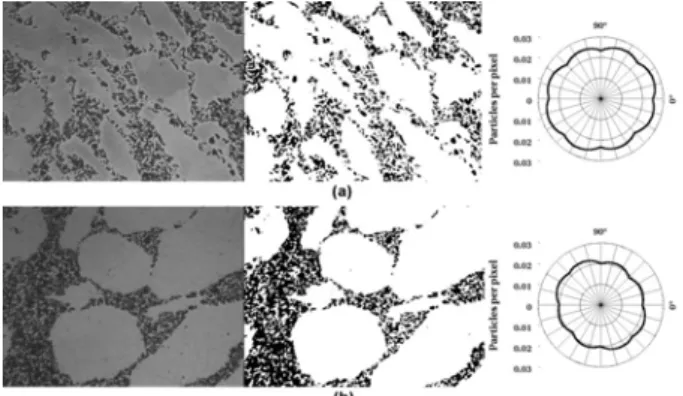
Fig. 2. Structure, detected images, anisotropy rose diagram of Al-SiC composites: (a) SiC-20 %, Al-100 µm, SiC-10 µm, (b) SiC-20 %, Al-180 µm, SiC-10 µm.
Fig. 2. shows structure, detected images and anisotropy diagrams of Al-SiC composites. Image detection was
executed on original images. The original gray level thresholding frequently required pre- or post-process (e.g. convolution, erosion, dilatation) to reach suitably results in the contrast to the new segmentation method. The new method can search for contiguous regions, using non-recursive scan line search method to find pixels which are also part of the objects. That is why the new method is more efficient for detecting objects.
The new segmentation and anisotropy algorithms are high-performance methods for image analysis. The rose diagrams in Fig.2 clearly show the effect of changing volume of SiC particles on the isotropy, i.e. macroscopic distribution of the particles. The microstructure seen in Fig. 2a is clearly isotropic while the 2b is anisotropic.
3. Summary
Microstructural anisotropy of Al-SiCp composites was analyzed by new computer-based image processing methods.
(i) The new image segmentation algorithm has two parts: a conventional gray level manual thresholding process and a non-recursive scan line search method.
(ii) The semi-automatic segmentation method suitable for separating phases of complex materials, such as particle reinforced metal matrix composites.
(iii) The new anisotropy measurement method is quicker than the conventional approaches; it uses one image and different measurement directions. In terms of performance, there is no significant difference between the new and conventional methods; however, the proposed method allows further development.
4. References
1. M. Sezgin, B. Sankur: Journal of Electronic Imaging Vol.13 (2004), p.146
2. C. P. Ling, M. B. Bush, D. S. Perera: Journal of Materials Processing Technology Vol.48 (1995), p.325 3. A.M. Davidson, D. Regener: Composites Science and
Technology Vol.60 (2000), p.865
4. B. Ogel, R. Gurbuz: Materials Science and Engineering A301 (2001), p.213
5. G. O’Donnell, L. Looney: Materials Science and Engineering A303 (2001), p.292
6. Z. Gácsi, J. Kovács, T. Pieczonka: Powder Metallurgy Progress. Journal of Science and Technology of Particle Materials Vol. 3 (2003), p.30
7. Z. Gácsi: The Application of Digital Image Processing to Materials Science. Materials Science, Testing and Informatics, edited by J. Gyulai, Vol. 414-415 of Materials Science Forum (2002), p. 213
8. C.H. Gur: Materials Science and Engineering A361 (2003), p.29