Study on the Acoustic Modes of a Short, Thick, Asymmetric Cylinder
비대칭 특성을 가진 짧은 후판 실린더의 음향 방사 모드에 관한 연구
Hyeongill Lee
†이 형 일
(Received January 12, 2017 ; Revised February 23, 2017 ; Accepted February 23, 2017)
Key Words : Asymmetry(비대칭성), Thick Cylinder(후판 실린더), Narrow Slot(좁은 슬롯), Acoustic Mode(음향모
드), Modal Vibration(모드 진동)
ABSTRACT
This study investigates vibro-acoustic characteristics of a short, thick cylinder containing a slot given a pined-free boundaries. Using the finite element analysis results, structural modes of the asymmetric cylinder (with a slot) are expressed as the linear combinations of modes of the sym-metric cylinder made of same material with identical geometry except the slot. Based on synthesized modal vibrations, acoustic modes of the asymmetric cylinder are obtained with two approaches, i.e., Rayleigh integral calculation and modal expansion of the acoustic modes of the symmetric cylinder. Also, acoustic powers, max. sound pressure and directivity pattern are obtained from acoustic modes and verified with the boundary element analyses. Based on these results, the accuracy of proposed approaches in calculating the vibro-acoustic properties of a short, thick, asymmetric cylinder has been confirmed. The procedure can be applied to the similar cylinders with other boundaries or asym-metric properties. Also, attenuation of vibration and/or sound radiation of the cylinder type practical components can be studied using these approaches.
요 약 단순지지-자유 경계조건과 좁은 슬롯을 포함한 짧은 후판 실린더의 음향방사 특성을 검토하였다. 유한 요소 해석을 통해 얻어진 샘플 실린더(슬롯 포함)의 진동 모드를 동일한 치수의 슬롯이 없는 균일 실린더 의 진동 모드들의 선형 합으로 근사화하였다. 이렇게 얻어진 근사적인 진동 모드를 기준으로 (1) 레일리 적분을 이용한 직접 계산, (2) 균일 실린더의 음향 모드들을 이용한 모드전개법 등 두 방법을 적용하여 샘플 실린더의 음향 모드들을 정의하였다. 이 결과를 이용하여 음향파워, 최대음압, 지향성 선도 등 부가 적인 특성을 계산한 다음, 전체 결과를 경계요소법을 이용한 수치해석 결과와 비교하여 검증하였다. 이 결과를 바탕으로, 제시된 두 가지 방법을 이용하여 짧은 비대칭 후판 실린더의 음향방사 특성을 비교적 정확하게 예측할 수 있음을 알 수 있다. 이 방법들은 다른 형태의 비대칭성 및 경계조건을 가진 실린더에 도 확대 적용 가능할 것으로 판단되며 이를 통해 실린더 형태의 실제 부품들에서 방사되는 소음을 저감 방안 도출도 가능할 것으로 기대된다. *
Corresponding Author; Member, School of Automotive Engineering, Kyung-pook National University
E-mail: [email protected] ‡ Recommended by Editor Jae Hung Han
1. Introduction
Short cylinders are being widely used in many industrial areas such as electrical and mechanical engineering. Considerable vibration and corresponding acoustic radiation are generated from these cylinders given a proper excitation. Accordingly, it is neces-sary to introduce a proper method to reduce vi-bro-acoustic responses of the cylinders. According to the previous studies, unstable vibration due to the axis-symmetric characteristics of cylinders and associated severe noise are the main sources of the responses in many cases(1~7). Recently, the sep-arating repeated natural frequencies by introducing asymmetries is proven as an efficient way to re-duce vibration and corresponding sound radiation of the axis-symmetric structures. So, it is worth-while to clarify the vibro-acoustic properties of the cylinders containing asymmetric characteristics.
There were many investigations on the vibration of cylinders using finite element analysis (FEA)(8,9)
and analytical approaches(10~15). In addition, many
engineers studied sound radiation from cylindrical radiators thus far(16~21). The influences of
asymme-tries on the vibro-acoustic properties of the ax-is-symmetric structures are also investigated in many studies. For example, Mote(1) used FEA to
investigate the dynamic stability of annular discs having narrow slots. Honda et al.(2) studied
vi-bratory responses of a asymmetric circular disc to a harmonic force moving around the disc using the modal expansion technique. Yu and Mote(3)
found that asymmetries in the axis-symmetric structure split some structural eigenvalues, but not all. Shen and Mote(4) studied the bending vibration
of a disc having several radial slots finding out that they separate some of repeated natural frequencies. Also, they represented structural modes of the asymmetric disc as the linear com-binations of the structural modes of the symmetric disc. Rim and Mote(5) used two kinds of stability
analyses to study the unstable vibration of a cir-cular saw having radial slots. The author(6) studied
structural vibration of an annular disc having radi-al slots figuring out that modradi-al vibration were se-riously affected by the slots longer than a specific limit. The author(7) approximated structural and acoustic modes of a thin, asymmetric annular disc as the linear combinations of structural and acous-tic modes for the corresponding symmetric disc. But, vibro-acoustic characteristics of a short, thick asymmetric cylinder have not been properly stud-ied until now.
This article studies the vibro-acoustic properties of a short, thick cylinder containing a narrow, ax-ial slot given pinned-free boundaries. Structural ei-gensolutions of the slotted cylinder are defined us-ing finite element analysis. Then structural modes of the cylinder are represented as the linear com-binations of modal vibrations of the corresponding symmetric cylinder. Acoustic radiations due to the vibration modes of the asymmetric cylinder are obtained with two approaches, i.e. Rayleigh in-tegral and modal expansion of the acoustic modes of the symmetric cylinder. Based on these acous-tic modes, additional properties such as acousacous-tic powers are also calculated. Boundary element analyses are used to verify the analytical calculations.
The following objectives are included in this study. (1) Study the modal vibration of a short, thick, asymmetric cylinder with pined-free bounda-ries using FEA. (2) Propose two semi-analytical approaches for the vibro-acoustic characteristics of the asymmetric cylinders. (3) Confirm the pro-posed procedure with the boundary element calculations.
Following assumptions are set for this study. (1) Cylinders are stationary with the pinned-free boundary condition. (2) Only the outer surface of the cylinder generates sound pressure. (3) Structural and acoustic characteristics of the cylin-ders are linear and time-invariant.
2. Structural Characteristics
Vibration characteristics of the short, thick, cyl-inder having asymmetries such as a crack or slot have not been analytically defined and any appro-priate closed form solution is not available so far. So, as explained above, eigensolutions for the
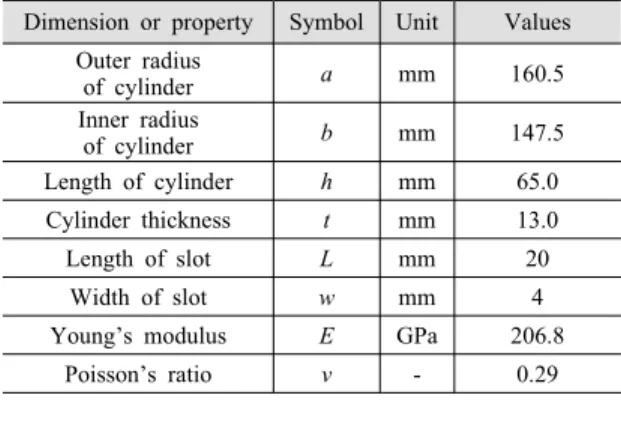
Fig. 1 A short, thick cylinder with a narrow slot Table 1 Dimensions and material properties of the
cylinder
Dimension or property Symbol Unit Values Outer radius of cylinder a mm 160.5 Inner radius of cylinder b mm 147.5 Length of cylinder h mm 65.0 Cylinder thickness t mm 13.0 Length of slot L mm 20 Width of slot w mm 4
Young’s modulus E GPa 206.8
Poisson’s ratio v - 0.29
Fig. 2 Finite element models for the asymmetric cyl-inder
asymmetric cylinder given in Fig. 1 and Table 1 are investigated using the FEA. The natural fre-quencies and mode shapes of the first 10 modes of the cylinder are identified with a FE model consisting of 3388 nodes and 1570 solid brick el-ements(22). FE model is shown in Fig. 2 with pined-free boundary condition at the inner nodes at the edge without slot.
2.1 Structural Eigensloutions
The numerical data for the asymmetric cylinder and corresponding symmetric cylinder are given in Table 2. In the table, index q represents the num-ber of nodal lines in the mode shape and index l represents the location of the slot relative to the nodal lines. For instants, the slot coincides with one of the anti-nodal lines when l = c and co-incides with one of the nodal lines when l = s. As shown in the table, asymmetric cylinder has two eigenvalues q,c and q,s for the modes with q no-dal line(s), whereas symmetric cylinder has one repeated eigenvalues q. Further, all q,c and q,s
Table 2 Modal vibration characteristics of the asym-metric cylinder with pinned–free boundaries
Indices Eigensolutions (/)
q l Cylinder with a slot Symmetric cylinder
2 c 2988.0 3029.0 2 s 3027.0 1 c 4144.0 4253.0 1 s 4253.0
are less than q but the differences are mode dependent.
According to the previous study, the mode shape of the symmetric cylinder with pined-free boundaries have a ramp type variation along the z coordinate and a pure sinusoidal variation along the coordinates(21). Thus, modal displacements
on the outer surface of the symmetric cylinder can be idealized as follows:
cos ) , ( q h z z q (1)
As one can imagine from Fig. 1 and Eq. (1), the center of pinned edge of the cylinder is the origin of the z coordinate.
Modal displacements at the free edge of the asymmetric cylinder obtained by FEA are com-pared with those of the symmetric cylinder in Fig. 3. As shown in the figure, the circumferential var-iations of the displacements for the l = c modes deviate from those of symmetric cylinder due to the effect of the slot. On the other hand, the var-iations of the l = s modes are almost identical to those of the symmetric cylinder which can be rep-resented by a perfect sinusoid.
(a) (2,c) mode (b) (2,s) mode
(c) (1,c) mode (d) (1,s) mode Fig. 3 Comparison of modal displacements at the
free edge. Key: ◦ ◦ ◦, Asymmetric cylinder; - - -, Symmetric cylinder
2.2 Synthesis of Normal Modes
As one can imagine from Table 2 and Fig. 3, normal modes of the asymmetric cylinder can't be expressed as simple, exact mathematical equations such as Eq. (1). But, it is necessary to express those modes precisely for further analyses such as acoustic radiation or harmonic analysis. In the previous studies, the normal modes of thin annular discs having slot(s) have been accurately synthe-sized using the vibration modes of the correspond-ing symmetric disc havcorrespond-ing the identical geome-try(6,7). By utilizing the same method in the
cur-rent study, the vibration modes of the asymmetric cylinder (q,l) are synthesized using the vibration modes of the symmetric cylinder (j) as Eq. (2).
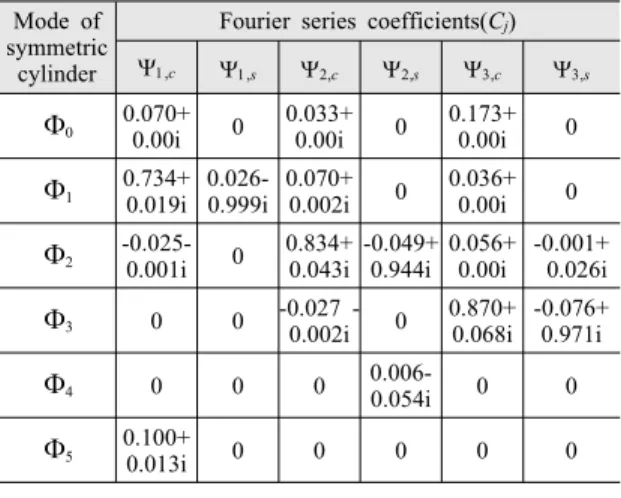
j j j l q,(a ), C (2)Contributions of each mode of the symmetric cyl-inder are obtained by the Fourier series repre-sentations of the displacements at the free edge of the asymmetric cylinder. The coefficients Cj for selected q,l are summarized in Table 3. As shown in the table, q,s can be represented by q only with very little contributions from other modes. This result has good correlations with the data given in Fig. 3 and Table 2 in which q,s are al-most same as q except small area nearby the slot. Whereas, q,c distorted by the slot must be expressed as linear combinations of many j. For instants, 1,s can be represented by 1 only but
1,c must be expressed as linear combination of
0, 1, 2 and 5.
The accuracy of this expansion is verified with the comparison of the synthesized q,l with origi-nal q,l from numerical analysis. The synthesized q,l for several modes are given in Fig. 4. As shown in the figure, the displacements on the out-er surface are quite similar to the numout-erical re-sults given in Table 2. Also, displacements at the free edge are compared with corresponding numer-ical data in Fig. 5. As shown in the figures, the
Table 3 Fourier series coefficients for the selected q,l Mode of
symmetric cylinder
Fourier series coefficients(Cj)
,c ,s ,c ,s ,c ,s
0 0.070+0.00i 0 0.033+0.00i 0 0.173+0.00i 0
1 0.734+ 0.019i 0.026- 0.999i 0.070+ 0.002i 0 0.036+ 0.00i 0
2 -0.025- 0.001i 0 0.834+ 0.043i -0.049+ 0.944i 0.056+ 0.00i -0.001+ 0.026i
3 0 0 -0.027 - 0.002i 0 0.870+ 0.068i -0.076+ 0.971i
4 0 0 0 0.006- 0.054i 0 0
5 0.100+ 0.013i 0 0 0 0 0
(a) (3,c) mode (b) (4,c) mode
(c) (2,c) mode (d) (1,c) mode Fig. 4 Synthesized q,l of the asymmetric cylinder
(a) 3,c (b) 4,c
(c) 2,c (d) 1,c
Fig. 5 Comparison of modal displacements at the free edge. Key: - - -, Numerical; ◦ ◦ ◦, Synthesized
synthesized displacements show good agreements with corresponding original data in all cases. Therefore, it can be concluded that the linear combinations given in Eq. (4) approximate q,l quite accurately. So, acoustic radiations generated by the modal vibrations of the asymmetric cylin-der will be defined based on the synthesized q,l.
3. Acoustic Radiation Characteristics
As explained in Section 2, some of the modal displacements of the asymmetric cylinder are glob-ally distorted by the slot and any closed form sol-ution for the normal vibration of the cylinder is not available. Therefore, there is no direct, ana-lytical solution for acoustic radiation due to these modes. In this study, the acoustic modes for dis-torted modes are defined with two roundabout methods based on the structural and acoustic modes of the symmetric cylinder.
3.1 Sound Radiation from the Symmetric Cylinder
According to the previous study(21), sound radia-tion due to the modal vibraradia-tions of the symmetric cylinder can be defined using the analytical sol-ution as follows:
2 0 2 0 0 1 ( , , ) 4 cos (1 cos )2cos cos sin cos sin sin sin
q ik R h q q q ck e z P R R h q adzd
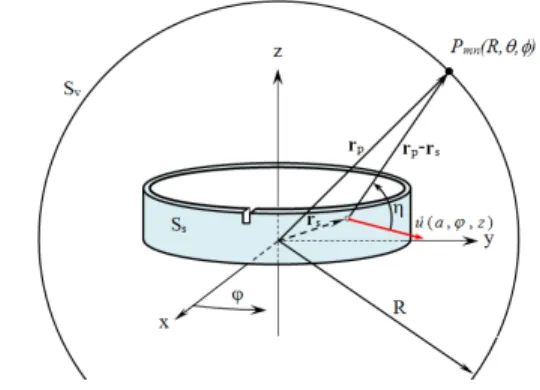
(3a,b)Here, 0 is the density of air, kq is the sound wave number of the qth mode and Hq is the qth order Hankel function, respectively. The acoustic mode for the qth mode, q is defined as the sound pressure distribution on a big sphere Sv surrounding the cylinder, as shown in Fig. 6. Also, using the far-field approximation, the sound power q due to the qth structural mode is calculated from Pq(R,,) obtained by Eq. (4)(7,21).
d d p c R S Iq V s q q sin 2 2 0 0 2 0 0 2
(4)Here, Iq is the sound intensity on Sv on which the acoustic mode is defined.
The results of this calculation are confirmed with the pure numerical data using boundary ele-ment analysis (BEA) as shown in Table 4(23). As one can see in the table, analytical calculation show relatively good correlations with numerical analysis and acoustic radiation from the asym-metric cylinder will be calculated based on these results in the following section.
3.2 Acoustic Modes of the Asymmetric Cylinder
The sound radiations from the modal vibrations of the asymmetric cylinder can be obtained by two different approaches. In the 1st approach, the acoustic modes of the asymmetric cylinder q,l de-fined from the acoustic pressure distribution on Sv calculated using Rayleigh integral. In the other ap-proach, each q,l is synthesized using q for sym-metric cylinder. Finally, q,l defined by two ap-proaches above are verified with numerical data from BE analyses.
(1) Direct Calculation
In this approach, the sound pressure at every receiver position on Sv is calculated by the Rayleigh integral given in Eqs. (3a) and (3b) based on the velocity distributions on the outer surface of the asymmetric cylinder synthesized us-ing Eq. (2). The results of the calculation are de-fined as the acoustic modes q,l of the cylinder. Additional acoustic radiation properties such as maximum sound pressure (Pmax) on Sv, modal sound power (q,l) and directivity patterns are also defined from the sound pressure distributions.
(2) Synthesis of Acoustic Modes
In this approach, the q,l of the asymmetric
cyl-inder are approximated as the linear combinations of j of the symmetric cylinder. The similar ap-proach was applied to asymmetric annular discs
Fig. 6 Schematic diagram for sound radiation from the asymmetric cylinder
Table 4 Acoustic characteristics of the symmetric cylin-der
Mode Property Numerical Analytical
q = 3 l = c Pmax(dB) 204.5 203.0 P(dB) 207.3 206.1 q = 4 l = c Pmax(dB) 206.3 205.1 P(dB) 208.9 208.3 q = 2 l = c Pmax(dB) 206.8 207.8 P(dB) 208.9 209.0 q = 1 l = c Pmax(dB) 209.9 209.3 P(dB) 212.3 211.8
getting accurate acoustic modes for vibration modes distorted by the slots(7). Contributions from
each j are assumed to be Cj which are derived for q,l and summarized in Table 2.
j j j l q,(R,,) C (5)For instance, 1,c from 1,C that is linear
combi-nation of 0, 1, 2, and 5 can be
approxi-mated as Eq. (6) based on Eq. (5) and Table 3.
5 2 1 0 , 1 ) 0.013i + 0.100 ( ) 0.001i --0.025 ( ) 0.019i + 0.734 ( 070 . 0 ) , , ( c R (6)
On the contrary, 1,s from 1,s can be assumed to
be almost identical to 1.
(3) Numerical Validation
The acoustic radiation properties of the asym-metric cylinder defined in this section are verified using BEA based on the surface vibration data from FEA. Acoustic radiation characteristics such as q,l, q,l and Pmax are calculated with the BEA(23). Field point mesh for BEA includes 6144 elements and 6146 field points defined on Sv. The excitations to these BEA are the velocity dis-tributions on the outer surface of the cylinder,
) , ,
(a z
u obtained in Section 2.
Selected q,l, q,l and Pmax of the asymmetric cylinder defined using Eqs. (3a), (3b) or (5) are given in Table 5 with the numerical data. As one can see from the table, analytical data for the asymmetric cylinder match the numerical data quite well. Also, q,c for l = c modes are quite different from q whereas q,s are almost same as q. This result show good correlation with the structural data given in Table 2, in which q,s are almost same as q but q,c are distorted by the slot. Also, compared to the numerical data, Pmax and q,l from the analytical calculations seem to be quite accurate.
Also, directivity patterns obtained by two ap-proaches for several q,l are summarized in Figs. 7
Table 5 Sound radiation properties of the asymmetric cylinder with pinned–free boundaries.
Mode Property BEA Rayleigh Synthesis
q = 3 l = c (dB) 206.2 204.7 204.6 Pmax(dB) 203.8 202.1 201.7 q = 4 l = c (dB) 208.2 207.3 207.2 Pmax(dB) 205.9 204.2 204.3 q = 2 l = c (dB) 208.5 208.1 207.4 Pmax(dB) 206.3 205.6 204.6 q = 1 l = c (dB) 210.5 210.1 209.0 Pmax(dB) 208.7 208.6 207.5 (a) 3,c (b) 4,c (c) 2,c (d) 1,c
Fig. 7 Comparison of directivity patterns for acoustic modes of the asymmetric cylinder (Rayleigh vs. BEA). Key: - - -: Rayleigh; ◦ ◦ ◦: BEA.
and 8. The analytical patterns match the numerical data relatively well. So, it can be concluded that the solutions given in Eqs. (3a) and (3b) or (5)
(a) 3,c (b) 4,c
(c) 2,c (d) 1,c
Fig. 8 Comparison of directivity patterns for acoustic modes of the asymmetric cylinder (Synthesis vs. BEA). Key: - - -: Synthesis; ◦ ◦ ◦: BEA.
have sufficient accuracy in calculating the acoustic pressure from the asymmetric cylinder with the pined-free boundaries.
4. Concluding Remarks
The acoustic radiations due to the modal vi-brations of a short, thick cylinder containing a narrow slot have been investigated using two approaches. The modal vibrations of the cylinder given pinned-free boundaries have been obtained using FEA. The vibration modes of the cylinder were idealized as the linear combinations of the modes of corresponding symmetric cylinder. Acoustic modes of the asymmetric cylinder have been defined with two approaches. In the first ap-proach the sound pressure at the every receiver position on a big sphere surrounding the cylinder is obtained using the Rayleigh integral based on the synthesized vibratory velocities. In the other approach, acoustic modes of the asymmetric cylin-der are defined using the mode expansions of acoustic modes of the symmetric cylinder. Further, acoustic powers from the modal vibration and acoustic directivity patterns have been defined
based on the acoustic modes.
The proposed approaches were validated numeri-cally through the comparisons of the acoustic modes and associated acoustic powers with corre-sponding data from BEA. Based on the validation, it is clear that the approaches proposed in this study are able to predict acoustic radiation from a short, thick and asymmetric cylinder accurately.
The parametric study on the asymmetries and boundary conditions of the cylinder and applica-tions of proposed approaches to practical compo-nents could be included in the future study.
Acknowledgement
This research was supported by Kyungpook National University Bokhyeon Research Fund, 2015.
References
(1) Mote, C. D. Jr., 1972, Stability Control Analysis of Rotating Plates by Finite Element: Emphasis on Slots and Holes, Journal of Dynamic Systems, Measurement, and Control, March, Vol. 94, No. 1, pp. 64~70.
(2) Honda, Y., Matsuhisa, H. and Sato, S., 1985, Modal Response of a Disc to A Moving Concentrated Harmonic Force, Journal of Sound and Vibration, Vol. 102, No. 4, pp. 457~472.
(3) Yu, R. C. and Mote, C. D. Jr., 1987, Vibration and Parametric Excitation in Asymmetric Circular Plates under Moving Load, Journal of Vibration and Acoustics, Vol. 119, No. 3, pp. 409~427.
(4) Shen, I. Y. and Mote, C. D. Jr., 1992, Dynamic Analysis of Finite Linear Elastic Solids Containing Small Elastic Imperfections: Theory with Application to Asymmetric Circular Plates, Journal of Sound and Vibration, Vol. 155, No. 3, pp. 443~465.
(5) Rim, K. H. and Mote, C. D. Jr., 1999, Unstable Phenomenon for High-speed Rotating Circular Saws, Transactions of the Korean Society for Noise and Vibration Engineering, Vol. 9, No. 6, pp. 1210~1217.
an Annular Disc Containing Evenly Spaced Narrow Radial Slots, Transactions of the Korean Society for Noise and Vibration Engineering, Vol. 19, No. 6, pp. 560~568.
(7) Lee, H., 2009, Vibro-Acoustic Characteristics of An Annular Disc with Narrow Radial Slots, International Journal of Precision Engineering and Manufacturing, Vol. 19, No. 6, pp. 560~568.
(8) Gladwell, G. M. and Vijay, D. K., 1975, Natural Frequencies of Free Finite Length Circular Cylinders, Journal of Sound and Vibration, Vol. 42, No. 3, pp. 387~397.
(9) So, J. and Leissa, A. W., 1997, Free Vibration of Thick Hollow Circular Cylinders from Three-dimensional Analysis, Journal of Vibration and Acoustics, Vol. 119, No. 1, pp. 89~95.
(10) Hutchinson, J. R. and El-Azhari, 1986, Vibrations of free hollow circular cylinders, Journal of Applied Mechanics, Vol. 53, No. 3, pp. 641~646.
(11) Singal, K. and Williams, K., 1988, A Theoretical and Experimental Study of Vibrations of Thick Circular Cylindrical Shell and Rings, Journal of Vibration, Acoustics, Stress and Reliability in Design, Vol. 110, No. 4, pp. 533~537.
(12) Wang, H. and Williams, K., 1996, Vibrational Modes of Tthick Cylinders of Finite Length, Journal of Sound and Vibration, Vol. 191, No. 5, pp. 955~971.
(13) Zhou, D., Cheung, Y. K., Lo, S. H. and Au, F. T. K., 2003, 3D Vibration Analysis of Solid and Hollow Circular Cylinders via Chebyshev-Ritz Method, Computer Methods in Applied Mechanics and Engineering, Vol. 192, No. 13-14, pp. 1575~1589.
(14) Mofakhami, M. R., Toudeshky, H. H. and Hashemi, S. H., 2006, Finite Cylinder Vibrations with Different End Boundary Conditions, Journal of Sound and Vibration, Vol. 297, No. 1-2, pp. 293~314.
(15) Sohn, J. W., Kwon, O. C. and Choi, S. B., 2009, Modal Characteristics and Vibration Control of Cylindrical Shell Structure : Experimental Results Comparison in the Air and Water, Transactions of Korean Society for Noise and Vibration Engineering,
Vol. 19, No. 9, pp. 899~906.
(16) Sandman, B. E., 1976, Fluid Loading Influence Coefficients for A Finite Cylindrical Shell, Journal of the Acoustical Society of America, Vol. 60, No. 6, pp. 1256~1264.
(17) Junger, M. C. and Feit, D., 1985, Sound, Structures, and Their Interactions, MIT Press, New York.
(18) Hong, J. S. and Lee, J. M., 1990, A Study on the Analysis of Acoustic Radiation of Axisymmetric Shells, Transactions of Korean Society for Mechanical Engineering, Vol. 14, No. 4, pp. 797~802.
(19) Lin, T. R., Mechefske, C. and O'Shea, P., 2011, Characteristics of Modal Sound Radiation of Finite Cylindrical Shells, Journal of Vibration and Acoustics, Vol. 133, No. 5, pp. 95~100.
(20) Lee, H., 2005, Acoustic Radiation from Radial Vibration Modes of a Thick Annular Disc, Transactions of the Korean Society for Noise and Vibration Engineering, Vol. 15, No. 4, pp. 225~239.
(21) Lee, H., 2013, Acoustic Radiation from the Modal Vibrations of a Thick, Finite Cylinder with Various Boundary Conditions, Transactions of the Korean Society for Noise and Vibration Engineering, Vol. 23, No. 7, pp. 585~596.
(22) UGS Corp., 2006, I-DEAS User's Manual Version 11.
(23) NIT, 2005, SYSNOISE User's Manual Revision 5.6.
Hyeong-Ill Lee : Ph.D. in
me-chanical engineering and Assistant Professor in the School of Automotive Engineering, Kyung-pook National University. Prof. Lee teaches Dynamics, Automatic Control, Mechanical Vibrations, and other topics. He has academic interests in automotive NVH, brake squeal and sound radiation from vibrating structures, etc.