학 술 논 문
197
스마트올인원 심폐순환보조장치의 안전성 및 성능평가에 관한 연구
박준현
1· 호예지
1· 이예림
1· 이덕희
1· 최재순
1,2*
1서울아산병원 아산생명과학연구원 의공학연구소, 2울산대학교 의과대학
A Study on Safety and Performance Evaluation of Smart All-in-one Cardiopulmonary Assist Device
Junhyun Park
1, YeJi Ho
1, Yerim Lee
1, Duck Hee Lee
1and Jaesoon Choi
1,2*
1
Medical Engineering R&D Center, Asan Institute for Life Sciences, Asan Medical Center
2
College of Medicine, University of Ulsan
(Manuscript received 17 July 2019 ; revised 29 August 2019 ; accepted 14 October 2019)
Abstract: The existing Extracorporeal membrane oxygenation(ECMO) and Cardiopulmonary bypass system(CPB) have been developed and applied to various devices according to their respective indications. However, due to the complicated configuration and difficult usage method, it causes inconvenience to users and there is a risk of an acci- dent. Therefore, smart all-in-one cardiopulmonary circulation device is being developed recently. The smart all-in- one cardiopulmonary assist device consists of a blood pump for cardiopulmonary bypass, a blood oxidizer for car- diopulmonary bypass, a blood circuit for cardiopulmonary bypass, and an artificial cardiopulmonary device. It is an integrated cardiopulmonary bypass device that can be used for a variety of purposes such as emergency, intraop- erative, post-operative intensive care, and long-term cardiopulmonary assist, combined with CPB used in open heart surgery and ECMO used when patient's cardiopulmonary function does not work normally. The smart all-in-one car- diopulmonary assist device does not exist as a standard and international standard applicable to advanced medical devices. Therefore, in this study, we will refer to the International Standard for Blood Components, the International Standard for Blood, the Guideline for Blood Products, and prepare applicable performance and safety guidelines to help quality control of medical devices, and contribute to the improvement of the health of people. The guideline, which is the result of conducted a survey of the method of safety and performance test, is based on the principle of all-in-one cardiopulmonary aiding device, related domestic foreign standards, the status of domestic and foreign patents, related literature, blood pump(ISO 18242), blood oxygenator (ISO 7199), and blood circuit (ISO 15676) for cardiopulmonary bypass.The items on blood safety are as follows: American Society for Testing and Materials ASTM F1841-97R17), and in the 2010 Food and Drug Administration's Safety Assessment Guidelines for Medical Assisted Circulatory Devices. In addition, after reviewing the guidelines drawn up through expert consultation bodies includ- ing manufacturers / importers, testing inspectors, academia, etc. the final guideline was established through revision and supplementation process. Therefore, we propose guidelines for evaluating the safety and performance of smart all-in-one cardiopulmonary assist devices in line with growing technology.
Key words: Advanced medical devices, Smart all-in-one cardiopulmonary assist device, ECMO, CPB
I. 서 론
현재 환자의 심폐순환보조를 위하여 사용되는 장치는 대 표적으로 체외막산소화장치, 인공심폐장치와 같은 장치가 있 다. 이러한 장치들은 적응증에 따라 각각 다양한 형태로 개 Corresponding Author : Jaesoon Choi
88, Olympic-ro 43-gil, Songpa-gu, Seoul, Republic of Korea Tel : +82-2-3010-2092
E-mail : [email protected]
본 연구는 2019년도 식품의약품안전처의 연구개발비(17172의평연
370) 로 수행되었으며 이에 감사드립니다.
198
발되어 적용되었으며, 복잡한 구성과 어려운 사용방법으로 인해 불편함과 사고의 위험성이 존재한다[1]. 인공심폐장치는 개심술을 안전하고 효율적으로 시행하기 위해 수술 중 심장과 폐의 기능을 기계장치로 일시적으로 우회시켜 주는 운용기 법이다[1-2]. 개심술을 시행하기 위해서는 수술 중 심장의 정상 기능을 일시적으로 중지시켜야만 한다. 그렇지 않으면 혈액으로 충만되어 쉴 새 없이 박동하는 심장의 내부를 안 전하고도 효율적으로 수술한다는 것 자체가 대부분의 병변 에서 불가능하기 때문이다. 그런데 수술을 위해 심장의 역 할을 일시적으로 중단시켜 주기 위해서는 수술 중 심장의 역할을 대신해 줄 장치의 필요성이 생기게 되는데 몸에서 심장의 역할은 너무나 중요해서 만일 정상 체온 하에서 심 장으로부터 뇌로 공급되는 혈류가 불과 4∼5분만 중단되어 도 비가역적인 뇌 손상이 생기기 때문이다. 심장은 전신순 환을 유지하는 일 외에도 폐에 정맥혈을 보내서 동맥혈액으 로 산화시키는 중요한 역할을 하기 때문에 수술 중 심장의 기능을 대신해 줄 장치의 필요성이란 심장의 펌프기능과 폐의 가스교환 기능도 같이 대신해 줄 장치의 필요성을 의미한다. 체 외막산소화장치는 ECLS(extracorporeal life support) 또 는 ECMO(Extracorporeal membrane oxygenation)라고 불려지기도 한다[3]. 환자의 심폐기능이 정상적이지 않은 경 우 부착하여 환자의 순환기기능을 보조하기 위해 사용한다. 체 외막산소화장치는 이산화탄소를 걸러 산소를 주입하는 기능 을 하며 일반적으로 심폐바이패스 후 심폐기능이 온전하지 못한 사람에게 사용되고 있다. 체외막산소화장치의 모드로는 VA(Venoarterial ECMO - 좌심실 기능 부전에 의한 쇼크가 주인 경우), VV(Venovenous ECMO - 폐기능 저하에 의한 급 성 호흡부전 환자의 경우), ECLA(Extracorporal lung assist) 또는 ECCO2R(Extracorporeal CO
2removal - 호흡 부전 환 자 중 선택적으로 CO
2만 제거), E-CPR(Extracorporeal cardiopulmonary resuscitation - ECMO 를 이용한 심폐 소생술)이 있다. 최근에는 더욱 안전하고 효율적으로 심폐 순환을 보조하기 위하여 국내외에서 스마트올인원 심폐순환 장치에 대한 개발 및 연구가 진행되고 있다. 스마트올인원 심폐순환장치란 체외막산소화장치(Extracorporeal membrane oxygenation, ECMO) 와 인공심폐장치(Cardiopulmonary bypass system, CPB) 가 통합된 장비로, 심폐용 혈액회로, 심 폐용 산화기, 심폐용 혈액펌프로 구성되어 있다. 이 장치는 응급 상황, 수술 중, 수술 후 집중 치료 및 장기간 심폐보조 등 다양 한 용도로 사용이 가능하다. 따라서 본 연구에서는 기존 두 장치의 기능이 통합된 새로운 형태의 심폐순환보조장치인 스마트올인원 심폐순환보조장치에 적용할 수 있는 성능 및 안전성 가이드라인을 조사·분석하고자 하며, 사용목적 및 대 상에 따라 명확한 품목분류 기준을 제시하고 해당 품목에 대한 안전성 및 성능평가 가이드라인을 마련하여 의료기기
의 품질관리에 도움을 주고자 한다.
II. 연구 방법
1. 스마트올인원 심폐순환장치의 국내·외 품목 분류 및 제조·
수입업체 현황, 허가 현황 조사
스마트올인원 심폐순환보조장치의 품목 분류 현황을 조사 하기 위하여 식품의약품안전처 고시 제 2018-15호 “의료기 기 품목 및 품목별 등급에 관한 규정”을 분석하였다. 또한 미국, 유럽, 중국, 일본을 조사하여 스마트올인원 심폐순환 보조장치의 국내·외 등급 및 품목분류 현황을 비교 분석하 였다. 품목 분류 이외에도 제조 및 수입업체의 신고, 허가 및 인증 현황을 품목별로 조사하였다.
2. 국내·외 스마트올인원 심폐순환장치의 안전성 및 성능평가 관련 기준규격 조사
스마트올인원 심폐순환보조장치의 안전성 및 성능평가에 적용 가능한 평가 항목을 도출하기 위하여 국내·외 규격을 분석하였다. 안전성과 성능평가에 적용 가능한 평가 항목 조 사하기 위해 식품의약품안처 고시 가이드라인, 국제표준화 기구(International Organization for Standardization, ISO), 미국재료시범학회(American Society for Testing and Materials, ASTM), 국제전기기술위원회(International Electrotechnical Commission, IEC) 의 규격을 분석하 였다.
3. 스마트올인원 심폐순환장치에 적용 가능한 안전성 및 성능 평가 시험항목 조사
스마트올인원 심폐순환보조장치에 적용될 시험방법을 선 정하여 정확성 및 명확성을 고찰하였다. 또한 관련 전문가 들의 의견을 반영하여 안전성 및 성능평가를 위한 항목과 평가방법을 검증하였다. TS410(Transonic, USA), 스마트 올인원 심폐순환보조장치 시료((주)세비카, Korea), Mockup system 을 사용하여 시험항목 검증을 실시하였다.
III. 연구 결과
1. 스마트올인원 심폐순환장치의 국내·외 품목 분류 현황 1.1 국내 분류체계 현황
스마트올인원 심폐순환보조장치는 「의료기기 품목 및 품
목별 등급에 관한 규정」에 의해 A09000 내장 기능 대용기
(Artificial internal organ apparatus) 로 분류되어 있으며 중
사용대상, 사용되는 장소 및 용도에 따라 인공심폐장치(4등급),
심폐용혈액회로(3등급), 심폐용산화기(3등급), 심폐용혈액회
로(4등급)으로 구성되어 있다.
199 1.2 국외 분류체계 현황
미국은 FDA(Food and Drug Adminstration) 분류체계 인 21 CFR(Code of Federal Regulations)에 따라 심폐순 환보조장치에 대해 다음과 같이 Class II로 분류하였다.
870.4100(Extracorporeal circuit and accessories for long-term respiratory/cardiopulmonary failure) 와 870.4350 (Cardiopulmonary bypass oxygenator) 의 경우 Class II(special controls) 로 관리하고 있다.
유럽은 MDR(Medical Devices Regulation) 부속서 8 (ANNEX VIII), 분류 체계에 따르며 심폐순환관련 기기는 인체에 주입을 위해 여타 액체나 여타 체액 또는 혈액의 생 물학적, 화학적 성분의 변경을 하도록 의도하는 모든 비삽입 기기는 Class IIb이다. 그 처리방법이 여과, 원심분리 혹은 가스, 열의 교환으로 구성되어 있는 경우 그 기기는 Class IIa 로 분류하고 있으며 그 외의 경우 Class I으로 분류하고 있다.
일본 PMDA(Pharmaceuticals and Medical Devices Agency) 는 스마트올인원 심폐순환보조장치 관련 기기 등 급 및 적용 규격은 사용목적에 따라 ClassII와 ClassIII으로 분류하고 있으며, 체외막산소화장치의 경우 JIS( Japanese
Industrial Standards) 등 규격은 따로 제시되어 있지 않고
“ 인공 폐 승인”에 관련된 가이드라인을 제공하고 있다.
2. 스마트올인원 심폐순환장치 관련 규격 및 평가 시험 항목 선정 스마트올인원 심폐순환보조장치의 구성품인 혈액산화기, 혈액펌프, 혈액회로에 대한 IEC 규격(Particular standard)은 없는 것으로 파악되며, 관련 ISO 규격 및 대응되는 KS (Korean Industrial Standards) 규격을 통하여 안전성 및 성능평가 항목을 제시하였다. 성능 및 안전성 시험항목을 도 출하기 위한 국내 및 국외 표준규격은 다음과 같다:
2.1 안전성 관련 규격
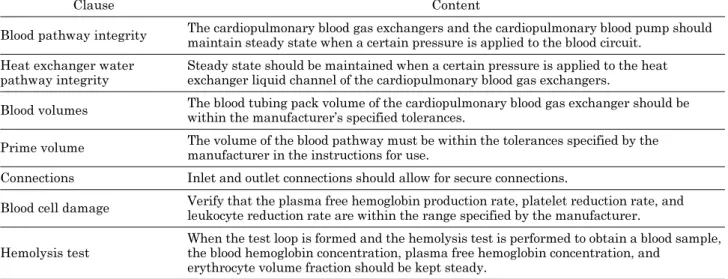
스마트올인원 심폐순환보조장치의 안전에 관한 평가 항목은 식품의약품안전처 고시 「의료기기 공통기준규격」과 「의 료기기의 전자파안전에 관한 공통기준규격」에 따르는 것 외 에, 다양한 국제 규격 및 국제 규제현황 및「ISO 7199」, 「ISO 15676」, 「ISO 18242」를 참고하여 스마트올인원 심폐순 환보조장치의 특성상 추가적으로 적용해야 하는 안전에 관 한 요구사항을 도출하였다(표 2).
표 1. 스마트올인원 심폐순환보조장치의 시험항목 도출을 위한 참고규격
Table 1. Reference standards for derivation of test for Smart all-in-one cardiopulmonary assist device Referenced national and international standards
「Medical assist device Evaluation Guidelines (2010. 07) - KFDA」
「ISO 7199:2016, Cardiovascular implants and artificial organs - Blood-gas exchangers (oxygenators)」
「ISO 18242:2016, Cardiovascular implants and extracorporeal systems - Centrifugal blood pumps」
「ISO 15676:2016, Cardiovascular implants and artificial organs - Requirements for single-use tubing packs for cardiopulmonary bypass and extracorporeal membrane oxygenation (ECMO)」
「ASTM F1841-97(2017), Standard Practice for Assessment of Hemolysis in Continuous Flow Blood Pumps」
표 2. 스마트올인원 심폐순환보조장치의 안전성 평가항목
Table 2. Safety evaluation lists of Smart all-in-one cardiopulmonary assist device
Clause Content
Blood pathway integrity The cardiopulmonary blood gas exchangers and the cardiopulmonary blood pump should maintain steady state when a certain pressure is applied to the blood circuit.
Heat exchanger water pathway integrity
Steady state should be maintained when a certain pressure is applied to the heat exchanger liquid channel of the cardiopulmonary blood gas exchangers.
Blood volumes The blood tubing pack volume of the cardiopulmonary blood gas exchanger should be within the manufacturer’s specified tolerances.
Prime volume The volume of the blood pathway must be within the tolerances specified by the manufacturer in the instructions for use.
Connections Inlet and outlet connections should allow for secure connections.
Blood cell damage Verify that the plasma free hemoglobin production rate, platelet reduction rate, and leukocyte reduction rate are within the range specified by the manufacturer.
Hemolysis test
When the test loop is formed and the hemolysis test is performed to obtain a blood sample, the blood hemoglobin concentration, plasma free hemoglobin concentration, and
erythrocyte volume fraction should be kept steady.
200
2.2 성능평가 관련 규격
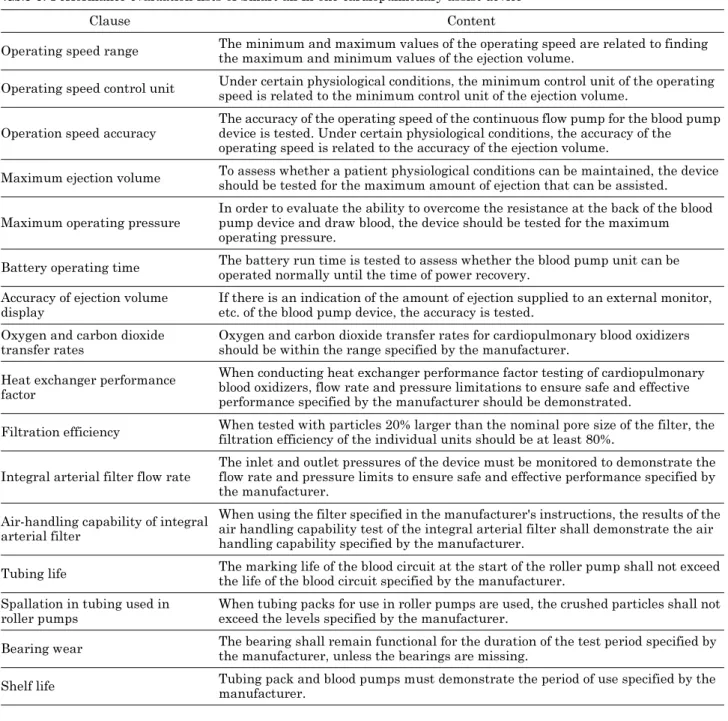
스마트올인원 심폐순환보조장치의 성능에 관한 평가 항목은 각각의 개별규격을 분석하여 도출하였으며, 스마트올인원 심 폐순환보조장치의 특성에 따른 성능평가 항목은 심폐용 혈 액산화기 「ISO 7199」, 심폐용 혈액펌프 「ISO 18242」, 심폐용 혈액회로 「ISO 15676」, 의료용보조순환장치 가 이드라인을 통하여 항목을 도출하였다(표3).
3. 스마트올인원 심폐순환장치의 안전성 및 성능평가 시험항목 스마트올인원 심폐순환보조장치는 현재 적용할 수 있는 국제규격이 존재하지 않는 것으로 파악되고 그 구성품(심폐
용 혈액회로, 심폐용 혈액펌프, 심폐용 혈액산화기)에 대한 각각의 개별규격과 혈액에 대한 시험내용을 적용할 수 있다.
따라서 각각에 개별규격에 대한 중복되는 항목을 제외하고 시험항목을 도출하였다.
3.1 스마트올인원 심폐순환장치의 안전성 시험항목 스마트올인원 심폐순환보조장치에 적용되는 규격에서 요 구하는 안전성은「IEC 60601-1」에 따른 시험환경을 구축 하여 시험평가하는 것으로 파악되고, 대부분 위험관리파일 (Risk management file) 및 부속서류 등을 이용하여 적합 성을 확인하는 항목이다. 따라서 도출된 시험항목 중 시험
표 3. 스마트올인원 심폐순환보조장치의 성능 평가항목Table 3. Performance evaluation lists of Smart all-in-one cardiopulmonary assist device
Clause Content
Operating speed range The minimum and maximum values of the operating speed are related to finding the maximum and minimum values of the ejection volume.
Operating speed control unit Under certain physiological conditions, the minimum control unit of the operating speed is related to the minimum control unit of the ejection volume.
Operation speed accuracy
The accuracy of the operating speed of the continuous flow pump for the blood pump device is tested. Under certain physiological conditions, the accuracy of the operating speed is related to the accuracy of the ejection volume.
Maximum ejection volume To assess whether a patient physiological conditions can be maintained, the device should be tested for the maximum amount of ejection that can be assisted.
Maximum operating pressure
In order to evaluate the ability to overcome the resistance at the back of the blood pump device and draw blood, the device should be tested for the maximum operating pressure.
Battery operating time The battery run time is tested to assess whether the blood pump unit can be operated normally until the time of power recovery.
Accuracy of ejection volume display
If there is an indication of the amount of ejection supplied to an external monitor, etc. of the blood pump device, the accuracy is tested.
Oxygen and carbon dioxide transfer rates
Oxygen and carbon dioxide transfer rates for cardiopulmonary blood oxidizers should be within the range specified by the manufacturer.
Heat exchanger performance factor
When conducting heat exchanger performance factor testing of cardiopulmonary blood oxidizers, flow rate and pressure limitations to ensure safe and effective performance specified by the manufacturer should be demonstrated.
Filtration efficiency When tested with particles 20% larger than the nominal pore size of the filter, the filtration efficiency of the individual units should be at least 80%.
Integral arterial filter flow rate
The inlet and outlet pressures of the device must be monitored to demonstrate the flow rate and pressure limits to ensure safe and effective performance specified by the manufacturer.
Air-handling capability of integral arterial filter
When using the filter specified in the manufacturer's instructions, the results of the air handling capability test of the integral arterial filter shall demonstrate the air handling capability specified by the manufacturer.
Tubing life The marking life of the blood circuit at the start of the roller pump shall not exceed the life of the blood circuit specified by the manufacturer.
Spallation in tubing used in roller pumps
When tubing packs for use in roller pumps are used, the crushed particles shall not exceed the levels specified by the manufacturer.
Bearing wear The bearing shall remain functional for the duration of the test period specified by the manufacturer, unless the bearings are missing.
Shelf life Tubing pack and blood pumps must demonstrate the period of use specified by the manufacturer.
201 평가 검증에 사용되는 TS410(Transonic, USA), 스마트올
인원 심폐순환보조장치 시료((주)세비카, Korea), Mockup system(( 주)세비카, Korea) 으로 적용할 수 있는 항목만을 시험을 진행하였다.
3.2 스마트올인원 심폐순환장치의 성능평가 시험항목 스마트올인원 심폐순환보조장치에 적용되는 규격에서 요 구되는 성능항목을 도출하였으며, 중복되는 내용을 제외하 였다. 도출된 시험항목 중 스마트올인원 심폐순환보조장치 장비에 적용할 수 있는 항목만 도출하여 시험평가를 진행하 였으며, 그림 2과 같이 실험환경을 구성하였다.
3.2.1 센서 동작시험
경보 신호가 발생하여야 하는 모의상황을 재현하고, 경보 신호의 발생 유무를 확인하였다. 설정된 기능에 한하여 시 험을 진행하였으며 세부 항목은 공급전원의 분리&낮은 배 터리, 너무 낮거나 높은 유량, 혈액회로의 꼬임, 공기방울의 발생이다.
3.2.1.1 공급전원의 분리 & 낮은 배터리
그림 2와같이 시스템을 구성하고 공급전원 및 시스템의 주 전원(main power)을 임의로 분리하여 경보신호가 발생함을 확 인한다. 전원선이 분리되거나 배터리 잔량이 낮은 경우 경보신호 발생 유무를 확인하고, 전원선 분리 후 경보신호가 발생하지 않아, 배터리가 몇 %에서 경보가 발생하는지 확인하여 작동 여부를 확인하였다. 그림 3에서 확인한 것과 같이 배터리가 20% 아래일 때 청각적 경보만 발생하였다.
3.2.1.2 너무 낮거나 높은 유량
그림 5와 같이 구성하고 경보 설정 화면에서 유량 정보(예.
5, 6 L/min) 를 변경하며 실험하였다(그림 6). 설정 후 유량을
그림 1. 스마트올인원 심폐순환보조장치Fig. 1. Smart all-in-one cardiopulmonary assist device
그림 2. 스마트올인원 심폐순환보조장치 실험환경 Set-up Fig. 2. Set-up the test environment of Smart all-in-one cardiopulmonary assist device
202
RPM(Revolutions per minute) 조절 또는 클랭크를 이용 하여 낮춰주었다. 설정된 정상 유량범위를 벗어난 경우 경보가 발생하는 것을 확인한다. 청각경보는 발생하였으나 제조사 에서 제시한 기능인 시각경보는 발생하지 않았다.
3.2.1.3 혈액회로의 꼬임
클램프 등을 이용하여 혈액회로의 꺽임을 모의적으로 발 생시키고, 기기의 시각적, 청각적 경보를 확인한다(그림 7).
클램프나 손으로 혈액회로를 꺾자 시각적, 청각적 경보가 정
그림 3. 공급 전원의 분리 & 낮은 배터리 (1)Fig. 3. Supply power separation & Low battery (1)
그림 4. 공급 전원의 분리 & 낮은 배터리 (2)
Fig. 4. Supply power separation & Low battery (2)
그림 5. 너무 낮거나 높은 유량 (1) Fig. 5. Too low or high flow (1)
그림 6. 너무 낮거나 높은 유량 (2) Fig. 6. Too low or high flow (2)
그림 7. 혈액회로의 꼬임 (1)
Fig. 7. Kinking of blood circuit (1)
203
상적으로 작동하였다(그림 8).
3.2.1.4 공기방울의 발생
혈액회로 중간에 실린지를 이용하여 공기방울을 주입시키 고 센서가 공기방울을 감지하여 경보가 발생하는지 확인한 다(그림 9, 그림 10). 수차례 공기방울을 발생시켰으나 기
기에서 감지하지 못하였다.
3.2.2 동작속도 조절범위 및 속도 정확도 시험
제조사에서 제시한 동작속도의 조절범위만큼 조절이 가능 한지 확인하고, 최소, 최대, 단계별(1,000 rpm 단위)로 설 정된 동작속도에 따라 펌프 엑츄에이터의 회전을 회전속도 계(Tachometer)를 이용하여 측정하여 정확도를 확인한다.
시스템은 그림 10과 같이 구성한다. 혈액 회로는 유체가 흐 르지 않도록 조치한 상태에서 기기의 후면에 위치한 펌프를 빼고, 펌프 장착부에 위치한 회전부를 광회전 속도계를 이 용하여 측정하였다(그림 12). 이 시험의 한계점은 광회전속 도계를 이용하여 회전부를 완전히 멈추게(설정 RPM값에 일 치하도록)하는 것이다. 실험의 결과는 표 4와 같다. 광회전 속도계는 다이얼로 값을 설정가능하기에 설정값의 근사치에 가깝게 설정하여 진행하였다.
그림 8. 혈액회로의 꼬임 (2)
Fig. 8. Kinking of blood circuit (2)
그림 9. 공기 방울의 발생 (1) Fig. 9. Air bubble generation (1)
그림 10. 공기 방울의 발생 (2) Fig. 10. Air bubble generation (2)
그림 11. 동작속도 조절범위 및 속도 정확도 시험 (1)
Fig. 11. Operation speed adjustment range and speed accuracy test (1)
그림 12. 동작속도 조절범위 및 속도 정확도 시험 (2)
Fig. 12. Operation speed adjustment range and speed accuracy test (2)
204
3.2.3 유량의 정확도
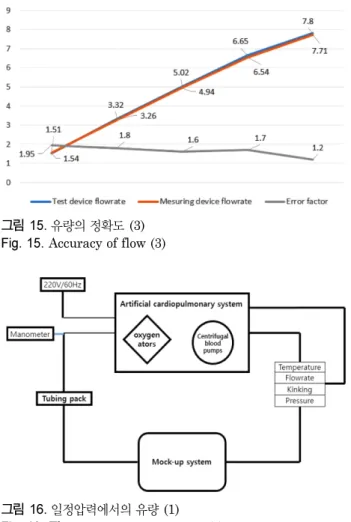
제조사에서 제시한 체외실험장치를 구성하고 혈액펌프를 연결하여 장비를 구동시킨다. 시스템은 그림 13과 같이 구성한 다. 펌프 동작 속도를 설정하고 각각의 속도에서 표시되는 유량 ( 표시치)을 기록하고, 실제 출구 튜브를 통해 30초 동안 채워진 물의 무게를 측정(측정치)한다. 분당 유량을 계산하여 표시치와 실제 유량의 정확도를 확인한다. 스마트올인원 심폐순환보 조장치 시료((주)세비카)에 디스플레이 되는 유량과 TS410 (Transonic) 를 통해 측정되는 유량을 각자 비교하였다(그림 14).
RPM 은 1000, 2000, 3000, 4000, 5000으로 조절하면서 유량을 측정하고, 유량의 정확도(%) = (표시치-측정치)/표시치 * 100로 계산하였다. 오차율은 2%를 넘지 않았다(그림 15).
3.2.4 일정압력에서의 유량
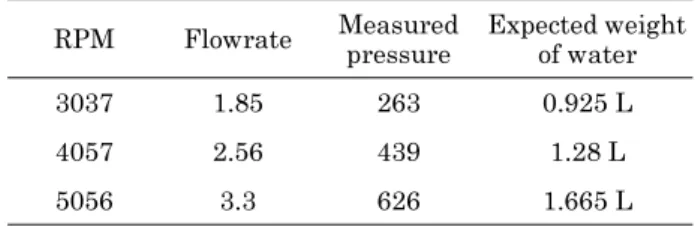
그림 16과 같이 제조사에서 제시한 체외실험장치를 구성 하고 혈액펌프를 연결하여 장비를 구동시킨다. 펌프를 최대 RPM 에서 구동시키고 일정부하(ex. 800 mmHg) 상태일 때 의 유량을 실제 출구 튜브를 통해 30초 동안 채워진 물의 무게를 측정함으로 계산한다. 압력계(Manometer)를 혈액 산화기 후단에 연결하여 3000, 4000, 5000 RPM으로 값을 변
경시키며 각 값에 대한 압력의 값을 측정하였다(그림 17).
표 5와 같이 측정 값들은 선형적으로 증가하며, 예상되는 물의 무게를 30초(0.5)로 계산 하였다. 해당 시험의 경우 최대 RPM 으로 구동하고 일정부하(800 mmHg)일 때 유량을 측정하는 시 험이였으나 일정 압력 이상(760 mmHg)이 발생하자 혈액 회로가 분리되는 현상을 보였다.
표 4. 동작속도 조절범위 및 속도 정확도 시험 (3)
Table 4. Operation speed adjustment range and speed accuracy test (3)
Display RPM Measure RPM Accuracy (%)
1014 998 1.5
2060 2028 1.5
3061 3001 1.9
4028 3960 1.6
5015 4924 1.8
그림 13. 유량의 정확도 (1) Fig. 13. Accuracy of flow (1)
그림 14. 유량의 정확도 (2) Fig. 14. Accuracy of flow (2)
그림 15. 유량의 정확도 (3) Fig. 15. Accuracy of flow (3)
그림 16. 일정압력에서의 유량 (1) Fig. 16. Flow at constant pressure (1)
205 3.3 시험 결과 분석
스마트올인원 심폐순환장치의 안전성 및 성능평가 시험항 목의 타당성을 검증하기 위하여 시험 항목 중 스마트올인원 심폐순환보조장치 장비에 적용할 수 있는 항목들을 도출하 여 시험평가를 진행하였다. ‘혈액 회로의 꼬임’, ‘공기방울의 발생’과 같은 센서 동작시험 평가항목들의 경우, 각 항목에 서 경보가 발생하는 상황을 모의하여 실제 시험기기의 경보 신호의 발생 유무를 확인할 수 있었다. 또한 ‘유량의 정확도’
및 ‘동작속도 조절범위 및 속도 정확도’ 시험에서, 설정된 1000, 2000, 3000, 4000, 5000 RPM 에 대해 두 시험의 정 확도 오차율이 2%가 넘지 않는 것을 확인하였다. 마지막으로
‘ 일정압력에서의 유량’ 시험에서는 일정압력으로 설정한 800 mmHg 에 도달하기 전, 760 mmHg이상의 압력에서 기 기의 혈액회로가 분리되는 현상을 보였고, 따라서 그 이하 압력까지의 유량을 측정하고 결과를 기록했다.
이러한 시험들을 통해, 도출된 각 시험항목 및 방법이 모두 큰 무리 없이 스마트올인원 심폐순환보조장치에 적용가능하 다는 사실을 확인하였다.
IV. 결 론
본 연구는 스마트올인원 심폐순환보조장치의 의미와 역할, 그리고 적용될 수 있는 개별규격을 조사 분석하고자 하였으며,
사용목적 및 대상에 따라 명확한 품목분류 기준을 제시하고 해당 품목에 대한 안전성 및 성능평가 가이드라인을 제시하 였다. 스마트올인원 심폐순환보조장치의 구성품 중 심폐용 혈액산화기 「ISO 7199」, 심폐용 혈액펌프 「ISO 18242」, 심폐용 혈액회로 「ISO 15676」, 용혈시험 규격인 「ASTM F1841-97 」에서 제시한 안전성 및 성능평가 항목을 도출 하였을 때 스마트올인원 심폐순환보조장치에 대하여 적용할 수 있음을 확인 가능하였다. 공급전원의 분리 & 낮은 배터 리 시험과 너무 낮거나 높은 유량 시험의 경우 사람의 생명 과 직결되는 장비이므로 추가적인 경보기능을 추가해야할 것으로 생각된다. 스마트올인원 심폐순환보조장치에 대한 개 별 기준규격이 존재하지 않아 개별규격이 적용된다면 그에 따른 추가적인 가이드라인을 작성해야 할 것으로 생각된다.
위의 연구결과와 같이 본 연구에서 마련한 가이드라인은 스마트올인원 심폐순환보조장치에 대하여 국제규격을 통한 기준을 제시하여 의료기기개발사 및 허가·심사자가 정확한 업무를 수행할 수 있을 것이라 예상한다.
References
[1] Eugene A, Hessel II. History of cardiopulmonary bypass (CPB): Best Practice & Research Clinical Anaesthesiology.
2015; 29(2):99-111.
[2] Andréia Cristina Passaroni, Marcos Augusto de Moraes Silva, Winston Bonetti Yoshida. Cardiopulmonary bypass: devel- opment of John Gibbon’s heart-lung machine: Rev Bras Cir Cardiovasc. 2015;30(2):235-45.
[3] David Zonies. ECLS in Trauma: Practical Application and a Review of Current Status: World Journal of Surgery. 2017;
41(5):1159-64.
[4] ISO 7199:2016. Cardiovascular implants and artificial organs – Blood-gas exchangers (oxygenators).
[5] ISO 15676:2016. Cardiovascular implants and artificial organs – Requirements for single-use tubing packs for cardiopulmo- nary bypass and extracorporeal membrane oxygenation (ECMO).
[6] ISO 18242:2016. Cardiovascular implants and extracorpo- real systems – Centrifugal blood pumps.
[7] ASTM F1841 – 97(2017). Standard Practice for Assessment of Hemolysis in Continuous Flow Blood Pumps.
[8] Medical assist device Evaluation Guidelines. 2010.
[9] Assessment Guidelines extracorporeal stationary continuous flow ventricular assist system. 2016.
그림 17. 일정압력에서의 유량 (2) Fig. 17. Flow at constant pressure (2)
표 5. 일정압력에서의 유량 (3)
Table 5. Flow at constant pressure (3) RPM Flowrate Measured
pressure
Expected weight of water
3037 1.85 263 0.925 L
4057 2.56 439 1.28 L
5056 3.3 626 1.665 L