• 검색 결과가 없습니다.

The research on changes in turnover intention due to the degree of occupational stress and the mediating parameters in fire-officerse Mice

N/A
N/A
Protected

Academic year: 2021

Share "The research on changes in turnover intention due to the degree of occupational stress and the mediating parameters in fire-officerse Mice"

Copied!
7
0
0

로드 중.... (전체 텍스트 보기)

전체 글

(1)

The research on changes in turnover intention due to the degree of occupational stress and the mediating parameters in fire-officerse Mice

1)

Kwang Soon kang*, Dong Ha Ji**

Abstract

This study was performed to investigate the changes in turnover intention according to the level of occupational stress and to find the mediating factor that reducing the turnover intention among fire officer. To compare change of turnover intention according to the degree of occupational stress, statistical analyses were done by using the logistic regression model.

In logistic regression analysis, the possibility of high turnover intention in a group with high occupational stress was hjgher by 4.11 times than a group with low occupational stress. The results of analyzing the degree of change in turnover intention after applying the mediating parameters(physical condition, emotional labor, burn out), turnover intention decreased by about 50.6%(from 4.11 times to 2.03 times) at the high level of occupational stress.

As a result, it was found that the occupational stress experienced by the fire-officers had a positive effect on the turnover intention. In order to reduce the turnover intention due to the occupational stress of the fire-officers, it is necessary to manage factors such as work environmental factors(emotional labor, burn out) and individual factor(physical condition).

▸Keyword: Turnover intention, Occupational stress, Emotional labor, Mediating factor

I. Introduction

소방공무원은 화재를 예방·경계하거나 진압하고 화재, 재난·

재해, 그 밖의 위급한 상황에서 구조·구급 활동 등을 통하여 국 민의 생명·신체 및 재산을 보호함으로써 공공의 안녕 및 질서 유지와 복리증진에 이바지함을 목적으로 한다. 소방공무원은 업무의 성격에 따라 화재의 예방 및 화재 현장에 출동하여 화 재를 진압하는 119화재진압대원, 재난현장에서 탐색 및 구조활 동에 필요한 장비를 갖추고 인명구조를 최우선으로 하는 119 구조대원, 응급환자에 대하여 상담, 응급처치 및 이송 등의 활 동을 업무를 수행하는 119구급대원, 소방헬기를 이용하여 인명 구조, 화재진압, 항공수색 등의 업무를 수행하는 항공구조구급

대원 등으로 구분할 수 있는데 각 업무를 중추적으로 수행하는 소방 공무원은 국민들이 인간다운 삶을 영위하는데 필요한 기 초적이며 필수적인 자원으로서 그 역할이 날로 중요하게 여겨 지고 있다.[1-2]

화재 및 재난·재해 현장 등 위급한 상황에서 화재진압·구 조·구급 활동을 수행하는 소방공무원은 고도의 집중력과 강인 한 체력을 요구받게 되며 이러한 업무특성으로 인하여 다양한 위험에 노출되어 있을 뿐만 아니라 그로 인하여 직무스트레스 에 시달리게 된다[3-4]

소방공무원이 직무를 수행하는 과정에서 받게 되는 스트레 스는 양질의 구급활동 제공에 장애요소로 작용할 뿐 만 아니

∙First Author: kwang Soon kang, Corresponding Author: Dong Ha Ji

*Kwang Soon kang ([email protected]), Dept. of Emergency Medical Technology, Daejeon Health Institute of Technology

**Dong Ha Ji ([email protected]), Dept. of Environmental Health, Daejeon Health Institute of Technology

∙Received: 2017. 05. 10, Revised: 2017. 05. 25, Accepted: 2017. 06. 28.

∙This research was supported by the Daejeon Health Institute of Technology

(2)

라[5] 직무를 수행하는 소방공무원 자신에게도 육체적, 정신 적으로 악영향을 끼치게 되어 직무만족도를 감소시켜 [6-7], 결국 원활한 직무수행이 곤란하게 할 뿐만 아니라 이직을 생 각하거나 이직을 실행하는 계기가 되기도 한다.[8-9] 국가인 권위원회에서 발표한 “2015 소방공무원 인권상황 실태조사 연구용역보고서(3쪽)”에 의하면 퇴직한 소방공무원 1,830명 중 372명(20.3%)이 임용 이후 5년 안에 스스로 사표를 낸 경우인 것으로 조사되어 같은 기간 퇴직한 서울시 교육공무원 의 임용 5년 이내 자진 퇴직한 비율 2.72%에 비하여 이직률 이 높은 것으로 나타났다.[10]

이에 본 연구는 소방공무원의 개인적 요소 및 근무환경요 소에 따른 이직의도, 직무스트레스, 소진 및 감정노동의 차이 정도를 파악하고 직무스트레스와 이직의도의 관계를 규명하고 직무스트레스에 따른 이직의도를 저감할 수 있는 매개변수를 파악함으로써 이직의도를 최소화 할 수 있는 기초자료를 제공 하고자 실시하였다.

Ⅱ. The Proposed Scheme

1. Object of study

본 연구는 2016년 11월 15일부터 2016년 12월 20일 까지 00지역에 근무하는 소방공무원을 대상으로 직무스트레스, 감정 노동, 이직의도, 소진에 대한 수준을 조사하고 직무스트레스에 따른 이직의도와의 관계를 분석하기 위하여 표준화된 자기기입 식 설문지(self-administered questionnaire)를 사용하였다.

총 응답자는 236명 이었으며, 이중 부실하게 응답을 한 36명을 제외한 총 200명을 대상으로 하여 연구를 실시하였다.

2. Research tool

본 연구에 사용된 설문지는 대상자의 인구사회학적 특성을 파악하기 위한 개인적 요소(10문항), 근무환경 요소(6문항)와 직무스트레스(Korean Occupational Stress Scales-24, KOSS), 24문항), 감정노동(12문항), 이직의도(4문항), 소진(22 문항) 등 주요변수로 구성되었으며 각 주요변수 항목의 응답은

「전혀 그렇지 않다」 1점, 「그렇지 않은 편이다」 2점, 「반 반이다」 3점「그런 편이다」 4점, 「매우 그렇다」 5점 등 리 커드 5점 척도로 하였으며 각 구성 항목의 점수가 높을수록 각 항목의 수준이 높음을 의미하며 각 항목 별 평균수준 및 내적 신뢰도는 <Table 1>과 같다.

Factors Min. Max. Mean±SD Cronbach’s

α

EL 1.33 4.33 2.75±0.54 0.788

TI 1.00 5.00 2.59±0.99 0.900

OS 1.17 3.91 2.81±0.48 0.873

BO 1.45 3.41 2.62±0.41 0.843

※ EL ;Emotional Labor, TI; Turnover Intention, OS;

Occupational Stress, BO; Burn Out Table 1. Information of factors

3. Statistical analysis

본 연구에 사용된 통계분석 프로그램은 SPSS 19.0을 이용 하였으며 t 검정(t-test)과 분산분석(one-way ANOVA analysis)을 통하여 개인적 특성 및 근무환경에 따른 이직의도, 직무스트레스, 소진, 감정노동의 차이를 분석하였다. 개인적 요 소 및 근무환경요소에 따른 근무형태 및 이직의도 수준의(Low, Middle, High)차이를 살펴보기 위하여 교차분석(Crosstabs)을 실시하였다.

직무스트레스 수준별로 이직의도에 어느 정도 관련되어 있 는지를 검증하고 개인적 요소(인구·사회학적 특성)와 근무환경 등의 요소에 대한 매개효과 검증을 통하여 직무스트레스 수준 에 따른 이직의도의 OR값을 변화 정도를 비교하기 위하여 로 지스틱 회귀분석을 실시하였다.

Ⅲ. Results

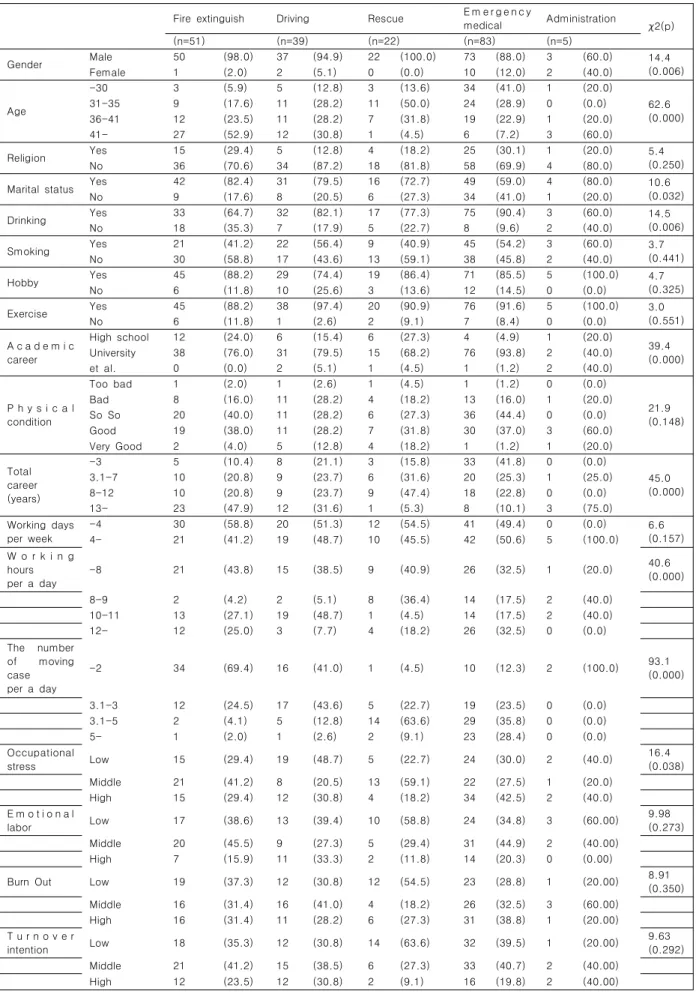
1. The characteristics of study participants 본 연구 대상자에 대한 근무형태는 화재진압 51명(25.5%), 운전 39명(19.5%), 구조대 22명(11.0%), 구급대 83명(41.5%), 행정대원 5명(2.5%)인 것으로 조사되었으며 대부분이 대졸학 력으로 평균 나이는 36.8세이며 일주일 중 근무일수는 4.4일, 근속년수는 8.9년, 하루 평균 근무시간 9.6시간, 근무 중 출동 건수는 3.5회인 것으로 분석 되었다.

나이 및 근무경력이 많은 군은 화재 진압대원 군이었으며 출

동건수가 많으며 직무스트레스와 소진이 높은 군은 응급 구급

대원이었으며 감정노동 및 이직의도가 높은 군은 운전 요원인

것으로 나타났다<table 2>.

(3)

Fire extinguish Driving Rescue E m e r g e n c y

medical Administration

χ2(p)

(n=51) (n=39) (n=22) (n=83) (n=5)

Gender Male 50 (98.0) 37 (94.9) 22 (100.0) 73 (88.0) 3 (60.0) 14.4

(0.006)

Female 1 (2.0) 2 (5.1) 0 (0.0) 10 (12.0) 2 (40.0)

Age

-30 3 (5.9) 5 (12.8) 3 (13.6) 34 (41.0) 1 (20.0)

62.6 (0.000)

31-35 9 (17.6) 11 (28.2) 11 (50.0) 24 (28.9) 0 (0.0)

36-41 12 (23.5) 11 (28.2) 7 (31.8) 19 (22.9) 1 (20.0)

41- 27 (52.9) 12 (30.8) 1 (4.5) 6 (7.2) 3 (60.0)

Religion Yes 15 (29.4) 5 (12.8) 4 (18.2) 25 (30.1) 1 (20.0) 5.4

(0.250)

No 36 (70.6) 34 (87.2) 18 (81.8) 58 (69.9) 4 (80.0)

Marital status Yes 42 (82.4) 31 (79.5) 16 (72.7) 49 (59.0) 4 (80.0) 10.6

(0.032)

No 9 (17.6) 8 (20.5) 6 (27.3) 34 (41.0) 1 (20.0)

Drinking Yes 33 (64.7) 32 (82.1) 17 (77.3) 75 (90.4) 3 (60.0) 14.5

(0.006)

No 18 (35.3) 7 (17.9) 5 (22.7) 8 (9.6) 2 (40.0)

Smoking Yes 21 (41.2) 22 (56.4) 9 (40.9) 45 (54.2) 3 (60.0) 3.7

(0.441)

No 30 (58.8) 17 (43.6) 13 (59.1) 38 (45.8) 2 (40.0)

Hobby Yes 45 (88.2) 29 (74.4) 19 (86.4) 71 (85.5) 5 (100.0) 4.7

(0.325)

No 6 (11.8) 10 (25.6) 3 (13.6) 12 (14.5) 0 (0.0)

Exercise Yes 45 (88.2) 38 (97.4) 20 (90.9) 76 (91.6) 5 (100.0) 3.0

(0.551)

No 6 (11.8) 1 (2.6) 2 (9.1) 7 (8.4) 0 (0.0)

A c a d e m i c career

High school 12 (24.0) 6 (15.4) 6 (27.3) 4 (4.9) 1 (20.0)

39.4 (0.000)

University 38 (76.0) 31 (79.5) 15 (68.2) 76 (93.8) 2 (40.0)

et al. 0 (0.0) 2 (5.1) 1 (4.5) 1 (1.2) 2 (40.0)

P h y s i c a l condition

Too bad 1 (2.0) 1 (2.6) 1 (4.5) 1 (1.2) 0 (0.0)

21.9 (0.148)

Bad 8 (16.0) 11 (28.2) 4 (18.2) 13 (16.0) 1 (20.0)

So So 20 (40.0) 11 (28.2) 6 (27.3) 36 (44.4) 0 (0.0)

Good 19 (38.0) 11 (28.2) 7 (31.8) 30 (37.0) 3 (60.0)

Very Good 2 (4.0) 5 (12.8) 4 (18.2) 1 (1.2) 1 (20.0)

Total career (years)

-3 5 (10.4) 8 (21.1) 3 (15.8) 33 (41.8) 0 (0.0)

45.0 (0.000)

3.1-7 10 (20.8) 9 (23.7) 6 (31.6) 20 (25.3) 1 (25.0)

8-12 10 (20.8) 9 (23.7) 9 (47.4) 18 (22.8) 0 (0.0)

13- 23 (47.9) 12 (31.6) 1 (5.3) 8 (10.1) 3 (75.0)

Working days per week

-4 30 (58.8) 20 (51.3) 12 (54.5) 41 (49.4) 0 (0.0) 6.6

(0.157)

4- 21 (41.2) 19 (48.7) 10 (45.5) 42 (50.6) 5 (100.0)

W o r k i n g hours per a day

-8 21 (43.8) 15 (38.5) 9 (40.9) 26 (32.5) 1 (20.0) 40.6

(0.000)

8-9 2 (4.2) 2 (5.1) 8 (36.4) 14 (17.5) 2 (40.0)

10-11 13 (27.1) 19 (48.7) 1 (4.5) 14 (17.5) 2 (40.0)

12- 12 (25.0) 3 (7.7) 4 (18.2) 26 (32.5) 0 (0.0)

The number of moving case per a day

-2 34 (69.4) 16 (41.0) 1 (4.5) 10 (12.3) 2 (100.0) 93.1

(0.000)

3.1-3 12 (24.5) 17 (43.6) 5 (22.7) 19 (23.5) 0 (0.0)

3.1-5 2 (4.1) 5 (12.8) 14 (63.6) 29 (35.8) 0 (0.0)

5- 1 (2.0) 1 (2.6) 2 (9.1) 23 (28.4) 0 (0.0)

Occupational

stress Low 15 (29.4) 19 (48.7) 5 (22.7) 24 (30.0) 2 (40.0) 16.4

(0.038)

Middle 21 (41.2) 8 (20.5) 13 (59.1) 22 (27.5) 1 (20.0)

High 15 (29.4) 12 (30.8) 4 (18.2) 34 (42.5) 2 (40.0)

E m o t i o n a l

labor Low 17 (38.6) 13 (39.4) 10 (58.8) 24 (34.8) 3 (60.00) 9.98

(0.273)

Middle 20 (45.5) 9 (27.3) 5 (29.4) 31 (44.9) 2 (40.00)

High 7 (15.9) 11 (33.3) 2 (11.8) 14 (20.3) 0 (0.00)

Burn Out Low 19 (37.3) 12 (30.8) 12 (54.5) 23 (28.8) 1 (20.00) 8.91

(0.350)

Middle 16 (31.4) 16 (41.0) 4 (18.2) 26 (32.5) 3 (60.00)

High 16 (31.4) 11 (28.2) 6 (27.3) 31 (38.8) 1 (20.00)

T u r n o v e r

intention Low 18 (35.3) 12 (30.8) 14 (63.6) 32 (39.5) 1 (20.00) 9.63

(0.292)

Middle 21 (41.2) 15 (38.5) 6 (27.3) 33 (40.7) 2 (40.00)

High 12 (23.5) 12 (30.8) 2 (9.1) 16 (19.8) 2 (40.00)

Table 2. The characteristics of socio-demographic characteristics, working environment by types of work

(4)

2.Comparison of turnover intention, occupational stress according to personal characteristics, working environment

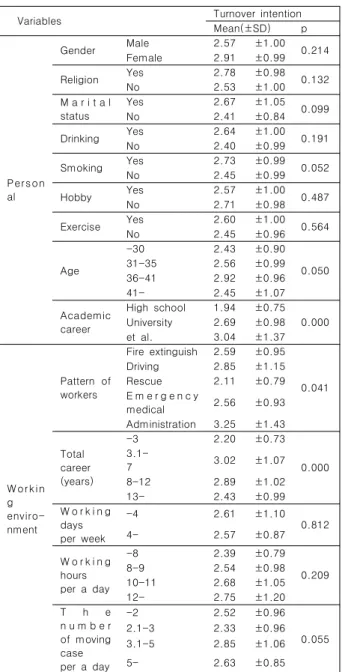
개인적 요소 및 근무환경요소에 따른 이직의도 및 직무스트 레스에 대한 평균값의 차이를 분석한 결과는 <Table 3>과 같 다. 흡연자, 36세에서 41세, 대학이상의 학력, 소방공무원으로 서의 근무경력이 3년에서 7년, 하루 근무 중 출동하는 건수가 3회에서 5회인 경우에서 이직의도가 높은 것으로 판단되며 흡 연, 나이, 학력, 근무형태, 근속년수, 출동 건 수 등의 항목에서 유의하게 차이가 나는 것으로 나타났다(p<0.05).

 Variables Turnover intention

Mean(±SD) p

Person al

Gender Male 2.57 ±1.00

0.214

Female 2.91 ±0.99

Religion Yes 2.78 ±0.98

0.132

No 2.53 ±1.00

M a r i t a l status

Yes 2.67 ±1.05

0.099

No 2.41 ±0.84

Drinking Yes 2.64 ±1.00

0.191

No 2.40 ±0.99

Smoking Yes 2.73 ±0.99

0.052

No 2.45 ±0.99

Hobby Yes 2.57 ±1.00

0.487

No 2.71 ±0.98

Exercise Yes 2.60 ±1.00

0.564

No 2.45 ±0.96

Age

-30 2.43 ±0.90

0.050

31-35 2.56 ±0.99

36-41 2.92 ±0.96

41- 2.45 ±1.07

Academic career

High school 1.94 ±0.75 0.000 University 2.69 ±0.98

et al. 3.04 ±1.37

W or k in g enviro- nment

Pattern of workers

Fire extinguish 2.59 ±0.95

0.041

Driving 2.85 ±1.15

Rescue 2.11 ±0.79

E m e r g e n c y

medical 2.56 ±0.93

Administration 3.25 ±1.43

Total career (years)

-3 2.20 ±0.73

0.000 3.1-

7 3.02 ±1.07

8-12 2.89 ±1.02

13- 2.43 ±0.99

W o r k i n g days per week

-4 2.61 ±1.10

0.812

4- 2.57 ±0.87

W o r k i n g hours per a day

-8 2.39 ±0.79

0.209

8-9 2.54 ±0.98

10-11 2.68 ±1.05

12- 2.75 ±1.20

T h e

n u m b e r of moving case per a day

-2 2.52 ±0.96

0.055

2.1-3 2.33 ±0.96

3.1-5 2.85 ±1.06

5- 2.63 ±0.85

Table 3. Turnover intention, occupational stress according to personal characteristics, working environment

3. Level of Occupational stress according to socio-demographic characteristics and working environment

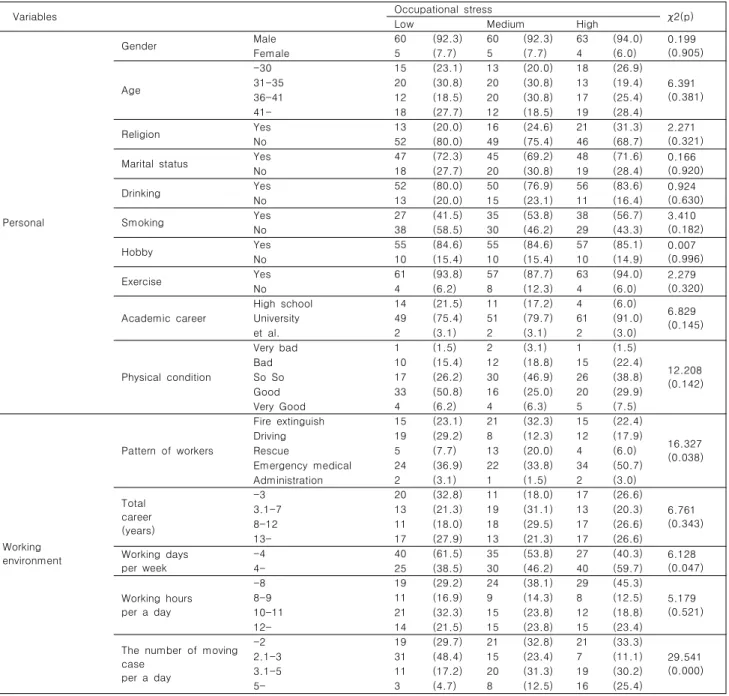
본 연구대상자의 개인적 요소 및 근무환경요소에 따라 연구 대상자의 직무스트레스 수준을 세 그룹(Low, Medium, High) 으로 분류하여 χ2검증통계량을 이용하여 교차분석을 실시하였 으며 그 결과는 <Table 4>와 같다. 직무스트레스 수준이 높다 고 응답한 분포는 응급구급팀 소속으로 일주일에 4일 이상근무 하며 근무 중 출동건수가 3회 이상 인 경우에서 높게 나타났으 며 “근무형태”, “일주일 동안의 근무일수”, “근무 중 출동건수”

등의 항목에서 유의한 차이를 보이고 있다(p<0.05).

4.The turnover intention by job stress level considering the mediating factors

소방공무원의 직무스트레스 수준에 따른 이직의도에 대한 정도를 비교하고 매개변수를 적용 한 후 이직의도의 변화 정도 를 비교하기 위하여 실시한 로지스틱 회귀분석 결과를 <Table 5>에 제시하였으며 분석결과 직무스트레스 수준이 가장 낮은 부류(Low)보다 가장 높은 부류(High)에서 이직의도가 높을 가 능성이 4.11배 높은 것으로 나타났다. 직무스트레스 수준에 따 른 이직의도가 변화하는 정도를 분석하기 위하여 건강상태, 감 정노동, 소진 등의 매개변수로 적용하여 분석한 결과 건강상태 를 매개변수로 적용한 결과 3.86배로 약 6.0%, 감정노동을 매 개변수로 적용한 결과 2.52배로 약 38.6%, 소진을 매개변수로 적용한 결과 2.38배로 약 42.1% 정도 각각 감소하는 것으로 분석 되었다. 적용된 매개변수를 동시에 고려한 결과 직무스트 레스 수준이 낮은 부류(Low) 보다 직무스트레스 수준이 높은 부류(High) 에서 이직의도가 높을 가능성이 4.11배에서 2.03배 로 약 50.6%정도 감소하는 것으로 분석 되었다.

Ⅳ. Conclusions

본 연구는 00 지역에 근무하는 소방공무원을 대상으로 직무 스트레스 수준이 이직의도에 미치는 영향 정도를 파악하고 개 인적 요소(인구·사회학적 특성), 근무환경 요소, 소진, 감정노동 을 매개변수로 적용하여 직무스트레스에 따른 이직의도의 변화 정도를 파악하여 소방공무원의 이직의도를 완화시킬 수 있는 방안을 제시하고자 실시하였다.

응답자의 근무형태 별 분포는 화재진압 51명(25.5%), 운전 39명(19.5%), 구조대 22명(11.0%), 구급대 83명(41.5%)이었 으며 나이는 평균 36.8세, 소방공무원으로서의 경력이 평균 8.9년, 기혼자, 음주를 즐기고 대졸학력인 경우가 많았으며 화 재 진압대원의 경우 나이 및 근무경력이 많았다.

직무스트레스를 수준별(Low, Middle, High)로 구분하여 개

(5)

 Variables Occupational stress

χ2(p)

Low Medium High

Personal

Gender Male 60 (92.3) 60 (92.3) 63 (94.0) 0.199

(0.905)

Female 5 (7.7) 5 (7.7) 4 (6.0)

Age

-30 15 (23.1) 13 (20.0) 18 (26.9)

6.391 (0.381)

31-35 20 (30.8) 20 (30.8) 13 (19.4)

36-41 12 (18.5) 20 (30.8) 17 (25.4)

41- 18 (27.7) 12 (18.5) 19 (28.4)

Religion Yes 13 (20.0) 16 (24.6) 21 (31.3) 2.271

(0.321)

No 52 (80.0) 49 (75.4) 46 (68.7)

Marital status Yes 47 (72.3) 45 (69.2) 48 (71.6) 0.166

(0.920)

No 18 (27.7) 20 (30.8) 19 (28.4)

Drinking Yes 52 (80.0) 50 (76.9) 56 (83.6) 0.924

(0.630)

No 13 (20.0) 15 (23.1) 11 (16.4)

Smoking Yes 27 (41.5) 35 (53.8) 38 (56.7) 3.410

(0.182)

No 38 (58.5) 30 (46.2) 29 (43.3)

Hobby Yes 55 (84.6) 55 (84.6) 57 (85.1) 0.007

(0.996)

No 10 (15.4) 10 (15.4) 10 (14.9)

Exercise Yes 61 (93.8) 57 (87.7) 63 (94.0) 2.279

(0.320)

No 4 (6.2) 8 (12.3) 4 (6.0)

Academic career

High school 14 (21.5) 11 (17.2) 4 (6.0)

6.829 (0.145)

University 49 (75.4) 51 (79.7) 61 (91.0)

et al. 2 (3.1) 2 (3.1) 2 (3.0)

Physical condition

Very bad 1 (1.5) 2 (3.1) 1 (1.5)

12.208 (0.142)

Bad 10 (15.4) 12 (18.8) 15 (22.4)

So So 17 (26.2) 30 (46.9) 26 (38.8)

Good 33 (50.8) 16 (25.0) 20 (29.9)

Very Good 4 (6.2) 4 (6.3) 5 (7.5)

Working environment

Pattern of workers

Fire extinguish 15 (23.1) 21 (32.3) 15 (22.4)

16.327 (0.038)

Driving 19 (29.2) 8 (12.3) 12 (17.9)

Rescue 5 (7.7) 13 (20.0) 4 (6.0)

Emergency medical 24 (36.9) 22 (33.8) 34 (50.7)

Administration 2 (3.1) 1 (1.5) 2 (3.0)

Total career (years)

-3 20 (32.8) 11 (18.0) 17 (26.6)

6.761 (0.343)

3.1-7 13 (21.3) 19 (31.1) 13 (20.3)

8-12 11 (18.0) 18 (29.5) 17 (26.6)

13- 17 (27.9) 13 (21.3) 17 (26.6)

Working days per week

-4 40 (61.5) 35 (53.8) 27 (40.3) 6.128

(0.047)

4- 25 (38.5) 30 (46.2) 40 (59.7)

Working hours per a day

-8 19 (29.2) 24 (38.1) 29 (45.3)

5.179 (0.521)

8-9 11 (16.9) 9 (14.3) 8 (12.5)

10-11 21 (32.3) 15 (23.8) 12 (18.8)

12- 14 (21.5) 15 (23.8) 15 (23.4)

The number of moving case

per a day

-2 19 (29.7) 21 (32.8) 21 (33.3)

29.541 (0.000)

2.1-3 31 (48.4) 15 (23.4) 7 (11.1)

3.1-5 11 (17.2) 20 (31.3) 19 (30.2)

5- 3 (4.7) 8 (12.5) 16 (25.4)

Table 4. Level of Occupational stress according to socio-demographic characteristics, working environment

Variables OR 95% CI OR‡ 95% CI

(adjustment) OR‡‡ 95% CI (adjustment)

OR‡‡

95% CI (adjustment)

OR‡‡‡

95% CI (adjustment)

OS Low

Medium 3.23 1.52-6.87 2.82 1.30-6.11 2.26 1.01-5.07 2.21 0.99-4.93 1.83 0.79-4.25 High 4.11 1.94-8.72 3.86 1.80-8.28 2.52 1.12-5.67 2.38 1.04-5.48 2.03 0.86-4.82 OS : Occupational stress

‡: Adjustment for Physical condition

‡‡: Adjustment for Emotional Labor

‡‡‡: Adjustment for Burn Out

‡‡‡‡: Adjustment for Physical condition, Emotional Labor, Burn Out Table 5. Odds ratio and 95 confidence intervals for Turnover intention

인적 요소, 근무환경요소에 따른 차이를 비교하기 위하여 χ2검 증통계량을 이용하여 교차분석을 실시한 결과 “근무형태”, “일 주일 동안의 근무일수”, “근무 중 출동건수” 등의 항목에서 통 계적으로 유의한 차이를 보이고 있다(p<0.05). 근무형태에 따

른 분포의 경우 응급 구급대원의 경우에서 직무스트레스가 높

다고 응답한 경우가 많은 것으로 분석되었으며 화재진압, 운전,

구조, 행정 순으로 높게 나타나 기존의 연구와[11-13] 유사한

결과를 나타냈다.

(6)

근무여건과 관련한 요소의 경우 인 일주일에 4일 이상 근무 하며 근무 중 출동건수가 2회에서 5회인 경우에서 직무스트레 스가 높다고 응답한 분포가 많은 것으로 나타났다. 소방공무원 의 직무스트레스 수준에 따른 이직의도에 대한 정도를 비교하 기 위하여 로지스틱 회귀분석을 실시한 결과 직무스트레스 수 준이 낮은 부류(Low)보다 높은 부류(High)에서 이직의도가 높 을 가능성이 4.11(OR=4.11, 95% CI=1.94-8.72)배 높은 것으 로 나타났다.

직무스트레스로 인한 이직의도를 저감시킬 수 있는 요인을 파악하고자 매개변수를 적용 한 후 이직의도의 변화 정도를 분 석한 결과 건강상태를 매개변수로 적용한 경우 약 6.0%(OR=3.86, 95% CI=1.80-8.28), 감정노동을 매개변수로 적용한 경우 약38.6%(OR=2.52, 95% CI=1.12-5.67), 소진을 매개변수로 적용한 경우 약 42.1%(OR=2.38, 95%

CI=1.04-5.48) 정도 각각 감소하는 것으로 분석 되었으며 3개 의 매개변수를 동시에 고려한 결과 직무스트레스 수준이 높은 부류(High) 에서 이직의도가 높을 가능성이 4.11배에서 2.03배 로 약 50.6%정도 감소하는 것으로 분석 되었다.

이번 연구에서는 소방공무원을 대상으로 직무스트레스 수준 에 따른 이직의도와의 관련성을 알아보고 이직의도를 저감시킬 수 있는 방안을 도출하고자 실시하였으나 일부지역의 소방공무 원을 대상으로 실시하였기 때문에 전체 소방공무원으로 확대 적용하여 해석하기에는 무리가 있으며 추후 대상자 확대 등 소 방공무원의 직무스트레스와 이직의도와의 관계를 파악할 수 있 는 연구가 필요할 것으로 생각된다.

연구결과 소방공무원이 업무를 수행하면서 경험하게 되는 직무스트레스는 이직의도에 긍정적인 영향을 미치고 있음을 알 수 있었으며 소방공무원의 직무스트레스에 따른 이직의도를 감 소시키기 위해서는 감정노동, 소진과 같은 근무환경과 관련된 요소와 개인의 건강상태와 같은 요소를 잘 관리할 필요가 있다 고 사료된다.

REFERENCES

[1] Framework ACT On Fire-Fighting Services, http://www.law.go.kr

[2] Enforcement Decree Of The ACT On 119 Rescue And Emergency Medical Services, http://www.law.go.kr [3] T. W. Kim, K. S. Kim, Y. S. Ahn, “Relationship between

Job Stress and Depressive Symptoms among Field Firefighters,” Korean J of Occupational And Environmental Medicine, Vol. 22, No. 4, pp. 378-387, Dec. 2010.

[4] J. H. Ha, D. I. Kim, B. S. Seo, W. S. Kim, S. H. Ryu, S. G. Kim, “Job Stress and Psychosocial Stress among firefighters,” Korean J Occup Environ Med, Vol. 20, No.

2, pp. 104-111, Jun. 2008.

[5] D. S. Park, S. S. Park, “Influence of Job Stress on Fatigue and Job Satisfaction - with Some 119 Emergency Medical Technician in Gyeonggido -,” The Journal of the Korean Society of Emergency Medical Technology, Vol. 12, No.

3, pp 71 ~ 86, Dec. 2008.

[6] D. S. Park, “A Study on Job Stress, Fatigue and Job Satisfaction of 119 Emergency Medical Technician,”The Journal of the Korean Society of Emergency Medical Technology, Vol. 8, No. 1, pp 71 ~ 86, Dec. 2004.

[7] H. J. Jeon, S. J. Park, D. H. Shin, I. S. Chung, M. Y. Lee,

“The Relationship between the Korean Occupational Stress Scale and Pulse Wave Velocity among Male Firefighters, ” Korean J Occup Environ Med, Vol. 23, No. 4, pp 450 ~ 462, Sep, 2011.

[8] H. J. Kim, H. S. Baek, “A study on job satisfaction and the turnover intention of fire fighters,” Korean J of Emerg Med Ser, Vol. 18, No. 1, pp. 96-106, Apr. 2014.

[9] Y. K. Chung, H. R. Kim, S. Y. Park, J. Y. Hong, S. B.

Koh, S. J. Chang, “The Effect of Job Stress on Umemployment,” Korean J Occup Environ Med, Vol. 19, No. 2, pp 115 ~ 124, Jun, 2007.

[10] http://library.humanrights.go.kr/hermes /imgview/15-40.pdf.

[11] K. H. Kang, K. S. Lee, S. I. Kim, K. H. Meng, H. S.

Hong, C. H. Jeong, “The relationship between alcohol use and job stress among firemen,” Korean J Occup Environ Med, Vol. 13, No. 4, pp. 401-412, Dec. 2001.

[12] K. H. Kim, T. W. Kim, S. H. Kim, “Influences of job stressors on psychosocial well-being, fatigue and sleep sufficiency among fire fighters,” Korean J Occup Environ Med, Vol. 18, No. 3, pp. 232-245, Sep. 2006.

[13] K. J. Lee, H. T. Heo, D. W. Kim, I. A. Kim, S. Y. Kim,

J. R. Rho, S. Y. Jung, J. Y. Mun, “ The Factors Related

to Health-related Quality of Life(HRQOL), and

Correlation between Occupational Stress and HRQOL

among Municipal Fire Officers in Incheon,” Korean J

Occup Environ Med, Vol. 21, No. 3, pp 267 ~ 275, Sep,

2009.

(7)

Dong Ha Ji received the Ph,D.

degree in Environmental Health from Soonchunhyang university, in 2010. He is currently a Professor in the Dept.

Environmental Health,

Daejeon Health Institute of Technology. He is interested in Indoor air quality and occupational stress

Kwang Soon kang received the Ph,D. degree in Doctor of medicine from Geimyung university, korea, in 2015. He is currently a assistant Professor in the Department of emergency medical technology,

daejeon health institute of technology. He is interested in health science and emergency medical.

Authors

수치

Table  2.  The  characteristics  of  socio-demographic  characteristics,  working  environment  by  types  of  work
Table  3.  Turnover  intention,  occupational  stress  according  to  personal  characteristics,  working  environment
Table  4.  Level  of  Occupational  stress  according  to  socio-demographic  characteristics,  working  environment

참조

관련 문서

In this regard, this study analyzes the effect of the job characteristics and work environment of workers with physical disabilities on job satisfaction

Objectives: The present study was conducted to determine the relationship between degree of work performance and job satisfaction in NICU nurses.. Methods: The subjects of

Objectives: This study aimed to investigate the relationship between job stress and turnover intention of employed opticians and to investigate the mediating effect of burnout

The academic journals used at the time were ‘The Mathematical Education’ of The Korean Society of Mathematical Education, ‘Journal of Educational Research

  Investigation of turnover comes from the job itself and in this study worked in a care facility for the elderly, Caregiver Stress, Burnout comes from

The index is calculated with the latest 5-year auction data of 400 selected Classic, Modern, and Contemporary Chinese painting artists from major auction houses..

1 John Owen, Justification by Faith Alone, in The Works of John Owen, ed. John Bolt, trans. Scott Clark, &#34;Do This and Live: Christ's Active Obedience as the

Objectives: This study was performed to find the association of job stress with geriatric nursing, coping methods and work environment with turnover intention among nursing