ABSTRACT
Objectives: The purpose of the study is to investigate and analyzed the current status of a dental hygiene curriculum according to the dental hygienist competency.
Methods: The study subjects were 59 courses in the department of dental hygiene in G University from April 1 to May 30, 2015. Except for liberal arts, 51 courses were finally selected and analyzed for the relationship between the curriculum and competency. For each course, systematic reviews were made by subject name, core competency, achievement goals, lecture hours, weekly themes, and learning goals. Three experts in the dental hygiene evaluated and analyzed the association of competency and goals.
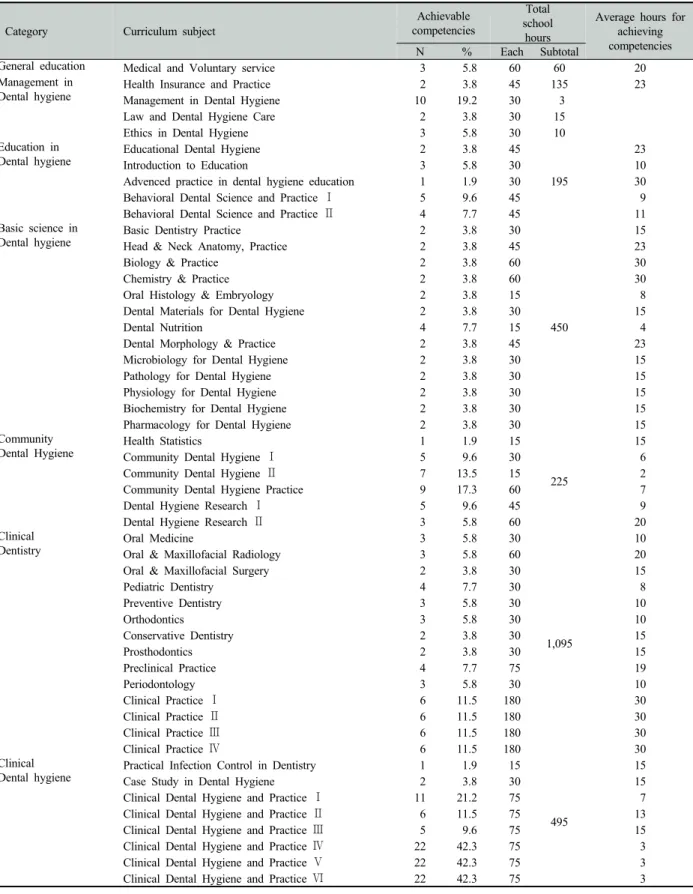
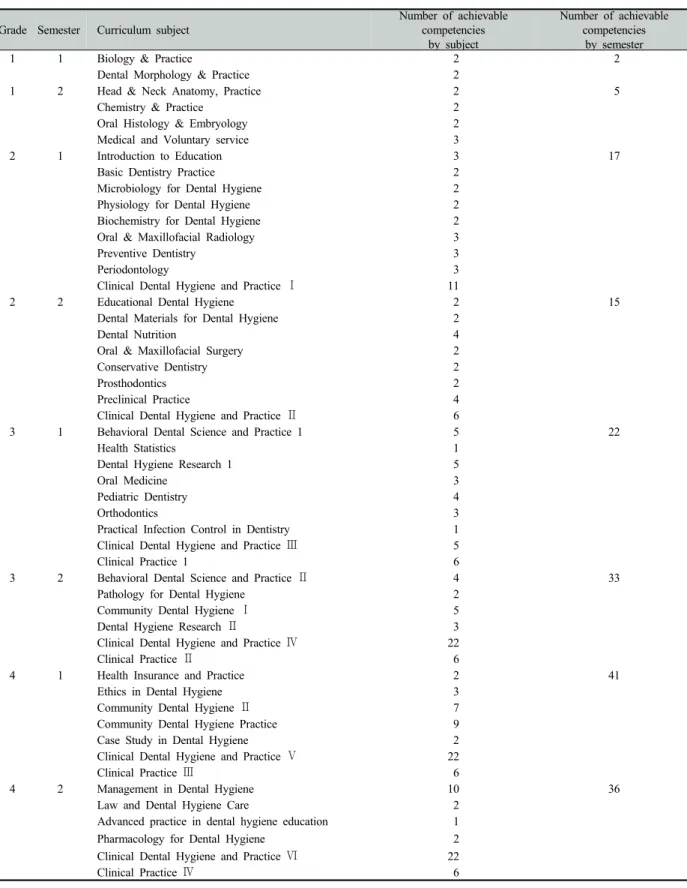
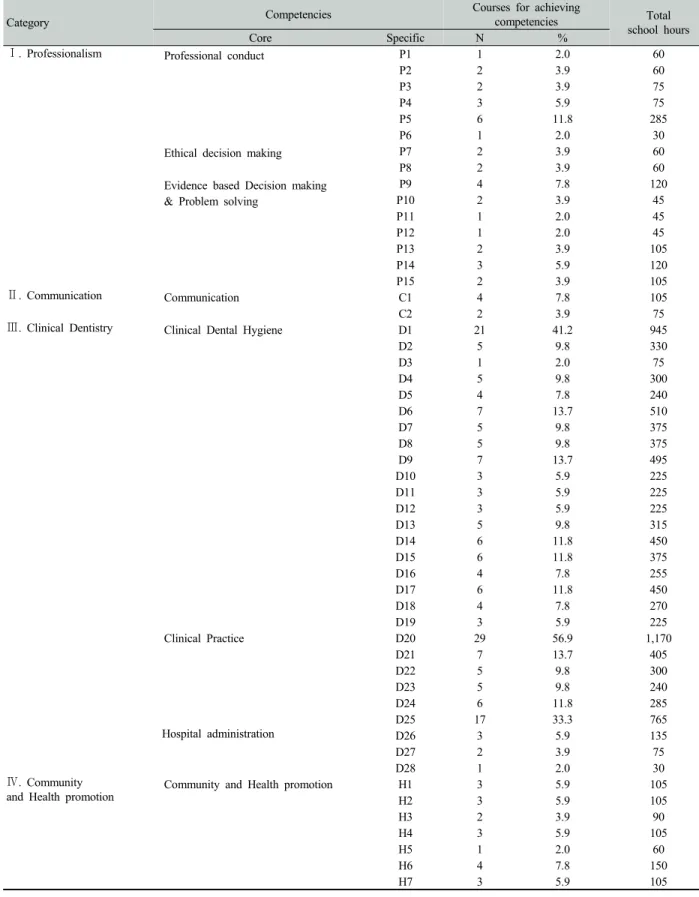
Results: Each course was operated by the goal from one to twenty two competencies of dental hygiene. Achieving one item of competency in a course required 13 hours on the average from minimum 2 hours to maximum 30 hours. More than 20 courses were operated and more than 900 hours were necessary for achieving the competency. The competency included the contents of ‘Be able to utilize basic medical and dental knowledge in dental hygiene care and patient care’ among the dental hygiene competencies.
Conclusions: Competency based dental hygiene education will provide theoretical background for defining the identity of dental hygienist as a health care worker and to encourage professionals who contribute to the recognition of healthy society. Further research should be continued for improving the competency‐based dental hygiene curriculum and education methods for implementing the curriculum within the paradigm of health care services.
Key Words: competency, competency-based curriculum, integrated curriculum, dental hygiene
색인: 역량, 역량기반 교육과정, 치위생학, 통합교육과정3)
▶ 본 연구는 2014년도 대한치위생(학)과교수협의회 학술연구비 지원 을 받아 수행되었음.
Copyrightⓒ2016 by Journal of Korean Society of Dental Hygiene
This is an open-access article distributed under the terms of the Creative Commons Attribution Non-Commercial License (http://creativecommons.org/ licenses/
by-nc/3.0/), which permits unrestricted non-commercial use, distribution, and reproduction in medium, provided the original work is properly cited.
Original Article
Journal of Korean Society of Dental Hygiene 2016; 16(2): 173-83 ISSN 2287-1705(Print)
http://dx.doi.org/10.13065/jksdh.2016.16.02.173 ISSN 2288-2294(Online)
J KSDH
치과위생사 역량에 따른 교육과정 현황 분석: G 대학 치위생학과 교육과정을 중심으로
배수명⋅신선정⋅장종화
1⋅정원균
2⋅신보미
강릉원주대학교 치과대학 치위생학과⋅강릉원주대학교 구강과학연구소⋅1한서대학교 치위생학과⋅2연세대학교 원주 의과대학 치위생학과
Analysis of current status of a dental hygiene science curriculum according to the dental hygienist competency
Soo-Myoung Bae⋅Sun-Jung Shin⋅Jong-Hwa Jang
1⋅Won-Gyun Chung
2⋅Bo-Mi Shin
Department of Dental Hygiene, College of Dentistry, Gangneung-Wonju National University⋅Research Institute of Oral Science, Gangneung-Wonju National University⋅1Department of Dental Hygiene, Hanseo University⋅2Department of Dental Hygiene, Wonju College of Medicine, Yonsei University
*Corresponding Author: Bo-Mi Shin, Department of Dental Hygiene, Gangneung-Wonju National University, 7, Jukheon-gil, Gangneung-si, Gangwon-do 210-702, Korea, Tel: +82-10-6378-3206, Fax: +82-33-642-6410, E-mail: [email protected]
Received: 29 December 2015; Revised: 4 April 2016; Accepted: 5 April 2016
한국치위생학회
174
•J Korean Soc Dent Hyg 2016; 16(2): 173-83서론
현대사회가 정보화 시대로 접어들고 빠른 속도로 변하면 서 필요한 지식에 접근하는 방법이 매우 다양해짐에 따라 교육에서는 수많은 지식을 주입하는 것은 더 이상 의미가 없게 되었다. 이러한 현대사회에 적응하기 위해서는 학문적 지식을 넘어서는 의사소통 능력, 분석적 사고, 문제해결 능 력, 창의적 사고, 대인관계 능력, 자기관리 능력 등을 포함 하는 고차원적이고 포괄적인 능력의 습득이 요구된다[1].
이에 따라 대학교육에서도 역량교육이 강조되고 있는데, 과 거에는 역량을 숙달하고자 하는 직무나 업무를 성공적으로 수행해내는 것과 관련된 개념으로 이해하였으나[2], 역량의 개념이 교육과 연결되면서 이론적이고 실천적인 지식을 획 득하고, 실제 업무수행능력을 강화하는 방향으로 변화되었 다. ‘역량기반 교육과정’은 현대사회의 실제적인 역할에 대 한 분석을 통해 교육과정을 설계하여, 실제로 무엇을 할 수 있는 능력을 갖출 수 있는가에 초점을 맞추어 운영하는 교 육과정이다[3].
이와 같은 맥락에서 최근 의학교육에서도 많은 지식을 갖춘 의사보다는 수행할 수 있는 능력과 자질을 갖춘 전문인 을 요구하고 있다. 진료현장에서 지식을 활용하여 실제 수행 을 할 수 있는 의사를 양성하기 위해서는 의학교육과정에 역 량 교육에 초점을 두는 학습 성과의 개념이 반영될 수 있도 록 하는 것이 중요하다[4]. 국내외 의학교육 기관에서는 학 습 성과와 관련된 연구가 진행되었는데, 1984년 ‘General Professional Education of Physician(GPEP)’ 보고서에서는 그동안의 의학교육이 지식 위주의 주입식 교육이었음을 비 판하면서 의사 양성을 위한 교육에서는 의학지식에 준하는 술기와 태도를 모두 갖춘 역량 있는 의사를 양성해야 한다고 강조하였다[5]. ‘Medical School Objective Project(MSOP)’
보고서에서는 의과대학생이 갖추어야 할 구체적인 학습목표 를 성과의 개념으로 제시함으로써 의과대학 교육과정의 개 발 및 개선에 반영할 수 있도록 지침을 제공하였다[6]. 이에 우리나라에서도 최근 의학교육과 치의학 교육에서 실제로 수행할 수 있는 의사 양성을 위해 기존의 지식 위주의 학습 목표에서 과업 중심의 학습성과, 즉, 역량을 개발할 필요가 제기되었으며, 역량을 기반으로 교육목표를 설정하고 역량 이 학습성과(learning outcomes)로 산출될 수 있는 교육과 정을 개발하여 운영하는 노력들이 이루어지고 있다[7,8]. 간 호 교육에서도 이에 대한 관심이 증가하고 있는데, 한국간 호교육평가원는 간호사의 역량을 강화하고, 간호 교육의 질 적 수준을 향상시키기 위하여 역량기반 교육과정의 운영을 강조하고 있으며, 이를 2주기 인증평가의 중요한 틀로 제시 하고 있다[9].
치과위생사는 보건전문인으로서 국민의 구강건강을 담 당하고 그들이 맡은 직업적 책무가 사회적으로 영향력을 가 지는 만큼, 보건전문인의 정체성을 정의 내리고 그들이 지
녀야 할 역량이 무엇인가를 규정하고 이를 위한 교육을 실 현하는 것이 사회구성원 전체의 삶의 질에도 매우 중요한 기반이 된다. 그러나 현행 치위생 교육과정을 살펴본 연구 [10]에서는 교육과 치과위생사의 실제 실무의 연계성이 부 족하고, 교과목이 지나치게 세분화되었으며, 교과목 사이에 중복된 교육내용이 많고, 과목 간 연계성과 통합성이 부족 하다고 지적하면서 치위생(학)과의 교육과정이 시대적 요구 를 충족시키지 못하고 있으며 근본적인 재검토가 필요하다 고 비판하였다. 이는 치과위생사로서 기대되는 수준의 수행 을 가능하게 하는 능력을 정의하고, 이러한 능력을 개발시 킬 수 있는 역량에 기반 한 성과중심의 교육과정(CBC:
Competency-based Curriculum) 개발은 이미 치위생 교육 에서도 더 이상 간과할 수 없게 되었음을 시사한다. 이에 따 라 최근 치위생 교육계에서도 교육의 질적 수준을 향상시키 기 위하여 교육목표로서의 치과위생사의 핵심역량 및 세부 역량을 도출하고, 도출된 핵심역량을 기반으로 평가체계를 개발한 바 있으나 [11] 치과위생사의 역량이 학습 성과로 산 출 될 수 있는 교육과정 개발은 아직 미비한 실정이다.
이에 본 연구에서는 ‘역량기반 치위생학 교육 평가체계 개발 연구[11]’와 연계하여 일부 치위생학과에서 운영 중인 교과목을 선행연구[11]에서 개발된 치과위생사의 핵심역량 및 세부역량에 따라 연관성 및 분포 등의 현황을 분석하여 향후 치위생 (학)과 역량기반 교육과정 체계화 방안을 모색 하기 위한 기초자료로 활용하고자 한다 .
연구방법
1. 연구설계
본 연구는 G대학 교육과정을 중심으로 치위생 교육과정 과 치위생 역량 간의 연관성을 평가하기 위한 서술적 조사 연구이다.
2. 연구도구 및 자료수집
2015년 4월 1일부터 5월 30일까지 4년제 G 대학 치위 생학과에서 현재 운영 중인 59개 교과목을 분석대상으로 정 하였다. 이중에서 인문사회치위생 및 교양 관련 교과목의 경우 학교 학사규정에 의해 학생 개별 전공 선택에 의해 수 강이 가능함에 따라 모든 학생이 필수로 수강하지 않는 교 과목이므로 해당 교과목을 제외한 총 51개 교과목을 교육과 정과 역량 간 연관성 분석의 최종 분석대상으로 하였다.
분석 교과목을 선행연구[11]에서 개발된 치과위생사의
핵심역량 및 세부역량을 중심으로 하여 교과목 별로 과목
명, 핵심역량, 세부역량, 달성목표, 강의시간, 주차별 수업주
제 및 학습목표 등에 따라 체계적으로 정리하였다. 이에 따
라 각 교과목의 주차별 강의주제, 학습목표 및 교육내용과
배수명⋅신선정⋅장종화⋅정원균⋅신보미 / 치과위생사 역량에 따른 교육과정 현황 분석: G 대학 치위생학과 교육과정을 중심으로•
175
CategoryCourse Competencies
Number of targeted- competen cies ProfessionalismCom muni- cationClinical dentistryCommunity and Health Promotion Professional conduct
Ethical decision making Evidence based Decision making & Problem solving
Com muni- cationClinical dental hygieneClinical practiceHospital administr ation
Community and Health Promotion P1P2P3P4P5P6P7P8P9P10P11P12P13P14P15C1C2D1D2D3D4D5D6D7D8D9D10D11D12D13D14D15D16D17D18D19D20D21D22D23D24D25D26D27D28H1H2H3H4H5H6H7 General educationMedical and Voluntary service3 Management in Dental hygiene
Health Insurance and Practice2 Management in Dental Hygiene10 Law and Dental Hygiene Care2 Ethics in Dental Hygiene3 Education in Dental hygiene
Educational Dental Hygiene2 Introduction to Education3 Advanced practice in dental hygiene education1 Behavioral Dental Science and Practice Ⅰ5 Behavioral Dental Science and Practice Ⅱ4 Basic Science in Dental hygiene
Basic Dentistry Practice2 Head & Neck Anatomy, Practice 2 Biology & Practice2 Chemistry & Practice2 Oral Histology & Embryology2 Dental Materials for Dental Hygiene2 Dental Nutrition4 Dental Morphology & Practice2 Microbiology for Dental Hygiene2 Pathology for Dental Hygiene 2 Physiology for Dental Hygiene2 Biochemistry for Dental Hygiene2 Pharmacology for Dental Hygiene2 Community Dental hygiene
Health Statistics1 Community Dental Hygiene Ⅰ5 Community Dental Hygiene Ⅱ7 Community Dental Hygiene Practice9 Dental Hygiene Research Ⅰ5 Dental Hygiene Research Ⅱ3 Clinical Dentistry
Oral Medicine3 Oral & Maxillofacial Radiology3 Oral & Maxillofacial Surgery2 Pediatric Dentistry4 Preventive Dentistry3 Orthodontics3 Conservative Dentistry2 Prosthodontics2 Preclinical Practice4 Periodontology3 Clinical Practice Ⅰ6 Clinical Practice Ⅱ6 Clinical Practice Ⅲ6 Clinical Practice Ⅳ6 Clinical Dental hygiene
Practical Infection Control in Dentistry1 Case Study in Dental Hygiene2 Clinical Dental Hygiene and Practice Ⅰ11 Clinical Dental Hygiene and Practice Ⅱ6 Clinical Dental Hygiene and Practice Ⅲ5 Clinical Dental Hygiene and Practice Ⅳ22 Clinical Dental Hygiene and Practice Ⅴ22 Clinical Dental Hygiene and Practice Ⅵ22 Number of courses for achieving specific competencies122 3 6 1 2 2 4 2 1 12 32 4 2 21 5 4 5 4 7 5 5 7 3 3 3 5 6 6 4 6 4 3 29 7 5 5 6 173 21 3 3 2 3 1 4 3
Fi g. 1 . D is tri bu tio n of c urri cu lu m s ub je ct a nd re la te d de nt al h yg ie ne c om pe te nc ie s*
176
•J Korean Soc Dent Hyg 2016; 16(2): 173-83 CompetenciesNo.Contents CoreSpecific Professio -nalism Professional behaviorP1Be able to commit and serve for protecting the dignity of human lives and promoting the health of mankind. P2Be able to continue public health activities as an expert, and accumulate related evidence. P3Have critical thinking on the general situation of the public health/medical circle and be able to apply evidence‐based problem solving methods to the situation P4Be able to acquire and utilize the latest information through critical and scientific thinking. P5Be able to show professional character and behavior in the field of dental services. P6Be able to perform adequate self‐evaluation for life‐long education on the job. Ethical decision making
P7Be able to know and apply ethical principles related to dental services and research. P8Be able to keep patients’ rights and secrets, to explain dental treatment and dental hygiene care, and to get prior consent. P9Have knowledge about judicial, legislative, and administrative procedures and policies related to dental services. P10Know concepts related to laws and regulations when executing an oral health program. Evidence‐based decision making and problem solving
P11Be able to select subjects of dental hygiene research based on the research paradigm of the public health/medical circle. P12Be able to search and review relevant literature for surveying the latest clinical knowledge and the current state of public health. P13Be able to select and apply adequate tools for research. P14Be able to analyze and interpret the results of research statistically. P15Be able to derive the clinical and policy implications of research results, and to present the results officially to the public. Communi -cationCommuni -cationC1Have knowledge about the psychological development of patients/clients. C2Be able to interact with patients and their families, colleagues, superiors, and other public health professionals through communication skills. Clinical Dentistry
Clinical dental hygiene
D1Be able to have basic medical knowledge and dental clinical knowledge, and utilize the knowledge in dental hygiene care processes. D2Be able to collect general, environmental, cultural and social information with the consent of patients/clients to the collection of personal information, and find factors influencing oral health. D3Be able to collect information on patients’/clients’ systemic disease history, dental care history, and family history, and find factors influencing oral health. D4Be able to assess the level of psychological anxiety and dental fear in patients/clients. D5Be able to identify the risk factors of oral disease by investigating patients’/clients’ oral health‐related knowledge, attitude, and behavior. D6Be able to conduct comprehensive examinations including extraoral and intraoral clinical, oral hygiene, periodontal, radiographic assessment, and assessment of dentition, record the results in a proper way, and identify the risk factors of oral disease. D7Be able to find patients’/clients’ needs related to oral health based on collected information, and make a dental hygiene judgment. D8Be able to assess the current health status and potential problems, and make dental hygiene plans together with patients/clients and set priority of the plans. D9Be able to distinguish between items for professional care and for self care based on dental hygiene assessment and judgment, and make plans of dental hygiene care and education. D10Be able to explain the plans of dental hygiene care and education to patients/clients and finalize the plans by obtaining their consent. D11Be able to refer oral health problems beyond the dental hygiene care process to experts under the patients’/clients’ consent. D12Be able to control patients’/clients’ pain and fear during dental hygiene care. D13Be able to know and implement the scientific principles of disinfection/sterilization for the prevention of cross‐infection during dental hygiene care. D14Be able to perform dental hygiene interventions for preventing oral diseases. D15Be able to perform customized oral health education based on professional knowledge and techniques. D16Be able to execute emergency care on the occurrence of a medical emergency situation in patients/clients. D17Be able to measure and interpret changes in patients’/clients’ oral health status using right indexes and tools for evaluating oral health status. D18Be able to evaluate the outcome of a dental hygiene intervention and patients’/clients’ satisfaction with the outcome based on the patients’/clients’ statements and behavioral changes. D19Be able to execute care plans, care requests, and continuous care programs steadily based on the contents of dental hygiene evaluation. Clinical practice
D20Be able to have basic medical knowledge and dental clinical knowledge, and utilize the knowledge in patient care processes. D21Be able to know and implement the scientific principles of disinfection/sterilization for the prevention of cross‐infection during patient care processes. D22Be able to assess the level of anxiety and dental fear in patients, and lower the level of anxiety and fear during patient care processes. D23Be able to understand the basic principles of dental radiography, and take and develop radiographic images for oral diagnosis. D24Be able to perform tasks for effective dental services such as impression taking, installation and removal of temporary attachments, temporary filling and removal, ligation and removal of orthodontic wires. D25Be able to perform patient management and oral health education related to dental services. Hospital management
D26Be able to utilize various media including Hangeul Word Processor(HWP), Excel, and PowerPoint. D27Be able to claim dental health insurance. D28Be able to establish a relationship of trust and exercise leadership among the members of the organization. Community and health promotion
Community and health promotion H1Be able to have and apply principles of dental public health and theoretical knowledge of oral epidemiology. H2Be able to approach health and oral health problems of community through collecting various types of data. H3Be able to evaluate the oral health needs of community, available resources, and the quality and accessibility of services. H4Be able to plan the details (purposes, goals, strategies, etc.) of community‐based oral health promotion programs. H5Be able to execute a community‐based oral health promotion program systematically based on evidence‐based strategic contents. H6Be able to execute community oral health education in consideration of clients’ characteristics according to life cycle. H7Be able to select and apply indexes and methods for evaluating community‐based oral health promotion programs.
* D ent al H yg ie ne C om pe te nc ie s
배수명⋅신선정⋅장종화⋅정원균⋅신보미 / 치과위생사 역량에 따른 교육과정 현황 분석: G 대학 치위생학과 교육과정을 중심으로•
177
Category Curriculum subject
Achievable competencies
Total school
hours
Average hours for achieving competencies
N % Each Subtotal
General education Medical and Voluntary service 3 5.8 60 60 20
Management in
Dental hygiene Health Insurance and Practice 2 3.8 45 135 23
Management in Dental Hygiene 10 19.2 30 3
Law and Dental Hygiene Care 2 3.8 30 15
Ethics in Dental Hygiene 3 5.8 30 10
Education in
Dental hygiene Educational Dental Hygiene 2 3.8 45
195
23
Introduction to Education 3 5.8 30 10
Advenced practice in dental hygiene education 1 1.9 30 30
Behavioral Dental Science and Practice Ⅰ 5 9.6 45 9
Behavioral Dental Science and Practice Ⅱ 4 7.7 45 11
Basic science in
Dental hygiene Basic Dentistry Practice 2 3.8 30
450
15
Head & Neck Anatomy, Practice 2 3.8 45 23
Biology & Practice 2 3.8 60 30
Chemistry & Practice 2 3.8 60 30
Oral Histology & Embryology 2 3.8 15 8
Dental Materials for Dental Hygiene 2 3.8 30 15
Dental Nutrition 4 7.7 15 4
Dental Morphology & Practice 2 3.8 45 23
Microbiology for Dental Hygiene 2 3.8 30 15
Pathology for Dental Hygiene 2 3.8 30 15
Physiology for Dental Hygiene 2 3.8 30 15
Biochemistry for Dental Hygiene 2 3.8 30 15
Pharmacology for Dental Hygiene 2 3.8 30 15
Community
Dental Hygiene Health Statistics 1 1.9 15
225
15
Community Dental Hygiene Ⅰ 5 9.6 30 6
Community Dental Hygiene Ⅱ 7 13.5 15 2
Community Dental Hygiene Practice 9 17.3 60 7
Dental Hygiene Research Ⅰ 5 9.6 45 9
Dental Hygiene Research Ⅱ 3 5.8 60 20
Clinical
Dentistry Oral Medicine 3 5.8 30
1,095
10
Oral & Maxillofacial Radiology 3 5.8 60 20
Oral & Maxillofacial Surgery 2 3.8 30 15
Pediatric Dentistry 4 7.7 30 8
Preventive Dentistry 3 5.8 30 10
Orthodontics 3 5.8 30 10
Conservative Dentistry 2 3.8 30 15
Prosthodontics 2 3.8 30 15
Preclinical Practice 4 7.7 75 19
Periodontology 3 5.8 30 10
Clinical Practice Ⅰ 6 11.5 180 30
Clinical Practice Ⅱ 6 11.5 180 30
Clinical Practice Ⅲ 6 11.5 180 30
Clinical Practice Ⅳ 6 11.5 180 30
Clinical
Dental hygiene Practical Infection Control in Dentistry 1 1.9 15
495
15
Case Study in Dental Hygiene 2 3.8 30 15
Clinical Dental Hygiene and Practice Ⅰ 11 21.2 75 7
Clinical Dental Hygiene and Practice Ⅱ 6 11.5 75 13
Clinical Dental Hygiene and Practice Ⅲ 5 9.6 75 15
Clinical Dental Hygiene and Practice Ⅳ 22 42.3 75 3
Clinical Dental Hygiene and Practice Ⅴ 22 42.3 75 3
Clinical Dental Hygiene and Practice Ⅵ 22 42.3 75 3