ABSTRACT
Objectives: The purpose of this study was to know instructors' needs of integrated curriculum in dental hygiene practice..
Methods: A self-reported questionnaire was completed by 112 instructors in Korea from June to July, 2015. The statistical analyses include frequency, percentage and Mann-Whitney' U test using SPSS 12.0 program. The questionnaire comprised needs of curriculum(5 items), integrated curriculum(10 items).
Results: Need of integrated curriculum in practice course was statistically significant in school system(p=0.048) and number of students(p=0.041). The enhancement of clinical competence was high in teaching experience(11≤)(p=0.009) and perceptions of problems was high in experience of teaching(10≥)(p=0.047). In integrated curriculum, enhancement of clinical competence was statistically significant in school system(p=0.035) and number of students(p=0.011). Increase of professionalism was high in University(p=0.021), number of students(p=0.006) and teaching experience(10≥)(p=0.062).
Conclusions: In order to improve curriculum in each institutions, it is necessary to measure in the view of representative institutions dimensions.
Key Words: dental hygiene, instructor, integrated curriculum, needs 색인: 교수자, 요구도, 치위생학, 통합교육과정
서론19)
우리나라 치위생 교육은 50여년의 역사를 가지고 있으며, 전국 82개 대학(28개 4년제, 54개 3년제)에서 매년 5,000여 명의 치과위생사를 배출하고 있다. 이러한 교육기관의 양적 증가는 전문적인 업무를 수행할 수 있는 교육이 적절히 이 루어지고 있는가에 대한 질적 문제를 제기하였고[1], 교육
Copyrightⓒ2016 by Journal of Korean Society of Dental Hygiene
This is an open-access article distributed under the terms of the Creative Commons Attribution Non-Commercial License (http://creativecommons.org/
licenses/by-nc/3.0/), which permits unrestricted non-commercial use, distribution, and reproduction in medium, provided the original work is properly cited.
과정의 변화와 발전을 이끌었다[2].
치위생학이 하나의 학문으로서의 정체성을 확립하기 위해 서는 학문 고유의 이론체계를 정립하는 것이 중요하다[3]. 미 국치과위생사협회(ADHA)는 1989년에 치위생학의 학문을 체계화하여 치위생과정을 교육과정에 도입하였고, 세계치과 위생사연맹(International Federation of Dental Hygienist, IFDH)은 치위생과정에 따른 교육을 수행할 것을 권고하고 있 다[4]. 현재와 같이 치과위생사에게 다양하고 새로운 역할을 요구하는 시대에서는 지식위주의 교과목을 나열하는 전통적 교육과정으로는 그 역할을 원활하게 수행할 수 없다[5]. 대학 에서 치위생과정을 교육하는 것은 세계적인 추세이고[4], 치
http://dx.doi.org/10.13065/jksdh.2016.16.05.799 ISSN 2288-2294(Online) J
치위생학 통합교육과정에 대한 교수자의 요구도
문상은⋅김윤정⋅김선영⋅조혜은⋅이보람
광주여자대학교 치위생학과
Instructors’ needs of integrated curriculum in dental hygiene practice
Sang-Eun Moon⋅Yun-Jeong Kim⋅Seon-Young Kim⋅Hye-Eun Cho⋅Bo-Ram Lee
Department of Dental Hygiene, Kwangju Women's University
*Corresponding Author: Sang-Eun Moon, Department of Dental Hygiene, Kwangju Women's University, 201 Yeodai-gil, Gwangsan-gu, Gwangju, Korea, 62396, Tel: +82-62-950-3840, Fax: +82-62-950-3841, E-mail: [email protected]
Received: 6 August 2016; Revised: 27 September 2016; Accepted: 27 September 2016
한국치위생학회
과위생사의 전문성 제고와 업무영역 확대에 기여하기 위해서 는 시대적인 요구를 반영하는 새로운 교육목표의 정립과 교육 과정의 표준화가 필요하다[6]. 또한 치위생학의 정체성을 확 립하고, 질적으로 향상된 전문직 치과위생사의 배출을 위해서 는 치위생과정에 기초한 제반 교육체계를 정립해야 한다[7].
임상에서 주체적으로 업무를 수행하기 위해서 과목 중심의 교 육보다는 지식중심의 전문가모형에 따르는 통합적이고 포괄 적인 교육으로 개편되어야 할 것이다[8].
통합교육과정은 학생들의 자율학습능력에 중점을 두고 교과목의 경계를 없애며 서로 관련 있는 것끼리 묶어, 같은 시기에 단편적인 지식이 아닌 의미 있는 전체를 이해하도록 이론과 실무를 통합하는 교육과정이다[9]. 따라서 교육과정 을 통합하기 위해서는 공통적인 특성을 갖는 교과목을 일정 한 분류기준에 따라 몇 개의 과목 군으로 분류해야 하며, 실 무중심의 통합교육과정을 개발하기 위하여 치과위생사의 역 할과 활동분야를 기준으로 한 과목 군 분류가 필요하다[10].
통합교육과정에 대한 선행연구로는 교육과정 표준화 [11], 통합교육과정 개발[2,12], 실무 중심의 통합교육과정 개발 및 표준화[6], 통합교과목 구축[13], 실습 통합교육과 정 모형제안[14,15] 등의 연구가 진행되었다. 또한 치위생 교육과정의 현안들로 교과목의 지나친 세분화, 중복된 교육 내용, 단편적 지식과 수기 위주의 교육, 교육과 실무 간의 연계성 부족, 학문의 정체성과 전문성 부재 등에 대해 보고 된 바 있으나[2,5,13] 교육기관은 이를 수용하지 못하고 있 다. 또한 현재까지 치위생학 교육과정으로 통합교육과정에 대한 구체적인 개발 사례가 없고, 관련 연구가 부족한 실정 이어서 통합교육과정에 대한 접근은 쉽지 않다[16]. 이에 본 연구는 수년에 걸쳐, 임상과 교육 분야에 종사하는 치과 위생사들의 전문성을 확립하고자 교수자들의 통합교육 적용 의 요구도를 파악하여 치위생학 통합교육과정의 모형 제안 에 기초자료를 제공하기 위해 시도되었다.
연구방법
1. 연구 설계
본 연구는 치위생(학)과 전임 교수자의 통합교육과정에 대한 요구도를 파악하기 위한 서술적 조사연구이다.
2. 연구대상 및 방법
본 연구는 2015년 대한치위생(학)과 교수협의회에 소속 되어 있고 전국 치위생(학)과 교육기관에 재직 중인 교수자 를 대상으로 선정하였다. 자료수집기간은 K대학교 IRB의 승인(IRB 1041485-201506-HR-001-01)을 받은 후 2015년 6월부터 7월까지이었다. 82개 대학의 전임교원 376명을 대 상으로 교수수첩에 있는 이메일 주소로 이메일을 발송하여
본 연구에 동의한 경우에만 응답하게 하였고, 회신해 준 112부를 최종 분석 대상으로 하였다(응답률 29.8%).
3. 연구도구
본 연구에 사용된 연구도구는 자기기입식 설문으로 기존 연구[4]를 참조하여 연구의 목적에 맞게 수정 보완하였으며, 치위생학과 전임 교수 11명을 대상으로 예비조사를 실시하 여 추가 보완 후 사용하였다. 조사내용은 현행 교육과정 관 련(5문항), 통합교육과정 관련(10문항)으로 구성되었다. 각 문항은 ‘전혀 아니다’ 1점부터 ‘매우 그렇다’ 5점까지의 5점 척도로 측정되었다. 대상자의 특성(4문항)으로는 학제(3년제, 4년제), 학생 정원(50명 이하, 51명 이상), 강의경력(10년 이 하, 11년 이상), 치위생학(예방치학) 강의담당여부로 구성하 였다. 현행 교육과정에 대한 인지도의 cronbach's α=0.725, 통합 교육과정 인지도의 cronbach's α=0.812이었다.
4. 자료 분석
수집된 자료는 SPSS/WIN 12.0(SPSS Ims., Chicago, IL, USA) 통계 프로그램을 이용하여 전산 처리하였으며, 본 연구의 변수를 Kolmogorov-Smironov test로 정규성 검 정을 시행한 결과 정규성가정을 만족하지 않아서 비모수 통 계를 이용하였다. 구체적인 분석방법은 대상자 특성은 빈도 와 백분율로, 대상자 특성에 따른 교육과정 관련 문항들의 비교는 Mann Whitney U test로 분석하였다.
연구결과
1. 대상자 특성에 따른 치위생학 교과목간의 통합필요성 비교
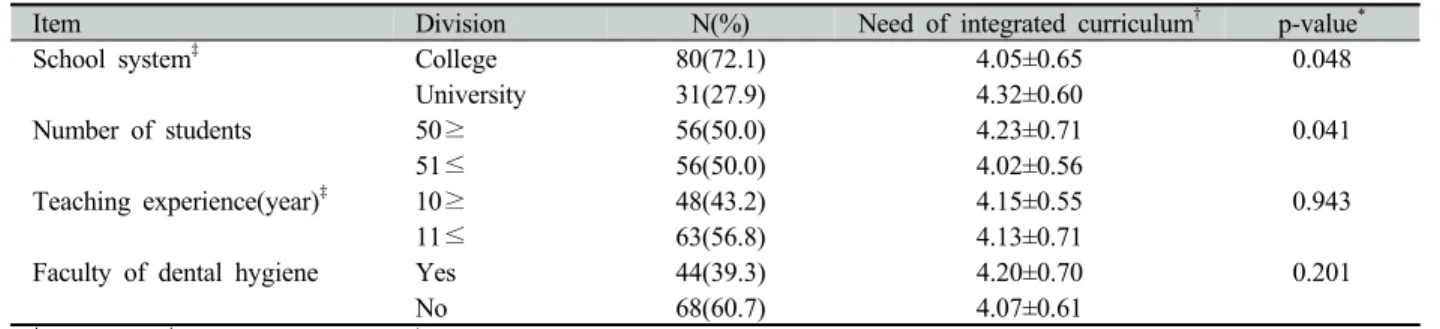
대상자 특성에 따른 구강병 예방 업무의 전문성 향상을 위한 치위생학 교과목간의 통합필요성 비교 결과, 4년제인 경우(4.32±0.60), 학생 정원이 50명 이하인 경우(4.23±0.71) 에서 높게 나타났다(p<0.05). 강의경력이 10년 이하인 경우 (4.15±0.55)와 치위생학을 담당하고 있는 경우(4.20±0.70) 에서 치위생학 교과목간의 통합필요성이 높게 나타났으나 통계적으로 유의한 차이는 없었다(p>0.05)<Table 1>.
2. 대상자 특성에 따른 현행 교육과정에 대한 인지도 비교 대상자 특성에 따른 현행 교육과정에 대한 인지도 비교 결과, 전공 교과목 학점의 적정성은 3년제인 경우 (3.76±0.77)와 학생정원이 51명 이상인 경우(3.84±0.65)에 서 높게 나타났고(p<0.05), 총 강의경력 11년 이상인 경우 (3.71±0.77), 치위생학 강의를 담당하고 있지 않은 경우 (3.63±0.88)에서 높게 나타났다(p>0.05). 구강병 예방을 위
한 임상적용 능력향상 기여는 총 강의경력 11년 이상 (4.03±0.62)에서 높게 나타났고, 전문성 증대는 3년제인 경 우(3.89±0.64), 학생정원이 51명 이상인 경우(3.88±0.66), 총 강의경력이 11년 이상인 경우(3.94±0.67), 치위생학 강 의를 담당하고 있는 경우(3.98±0.63)에서 높게 나타났으나 유의한 차이는 없었다(p>0.05). 현행 교육과정의 문제점 인 지는 총 강의경력 10년 이하(3.17±0.93)에서 높게 나타났다 (p<0.05)<Table 2>.
3. 학제에 따른 통합교육과정 인지도 비교
학제에 따른 통합교육과정의 인지도 비교 결과, 4년제인 경우 통합교육과정에 대한 인식(4.10±0.54), 통합교육과정 적용 시 교육과정개발의 참여도(4.42±0.62), 통합교육과정 적용 시 학생의 지지도(3.90±0.65), 통합교육과정 적용 시 임상적용능력향상 기여도(4.35±0.61), 통합교육과정 적용 시 전문성향상 기여도(4.39±0.62), 통합교육과정의 실행 가 능성(3.84±0.58)에서 높게 나타났다(p<0.05). 반면, 통합교 육과정 적용의 필요성(4.23±0.56), 통합교육과정 관련 교수 요원의 연수 필요성(4.45±0.72), 통합교육과정 적용시 동료
교수의 지지도(3.73±0.83), 통합교육과정 적용시 학교의 지 지도(3.45±0.89)에서도 높았으나 통계적으로 유의한 차이는 없었다(p>0.05)<Table 3>.
4. 학생정원에 따른 통합교육과정 인지도 비교 학생정원에 따른 통합교육과정의 인지도 비교결과, 학생 정원이 50명 이하인 경우 통합교육과정 교육개발의 참여도 (4.30±0.63), 통합교육과정 관련 교수요원의 연수 필요성 (4.48±0.63), 통합교육과정 적용 시 임상적용능력향상 기여 도(4.30±0.63), 통합교육과정 적용 시 전문성향상 기여도 (4.34±0.64)에서 높게 나타났다(p<0.05)<Table 4>.
5. 총 강의경력에 따른 통합교육과정 인지도 비교
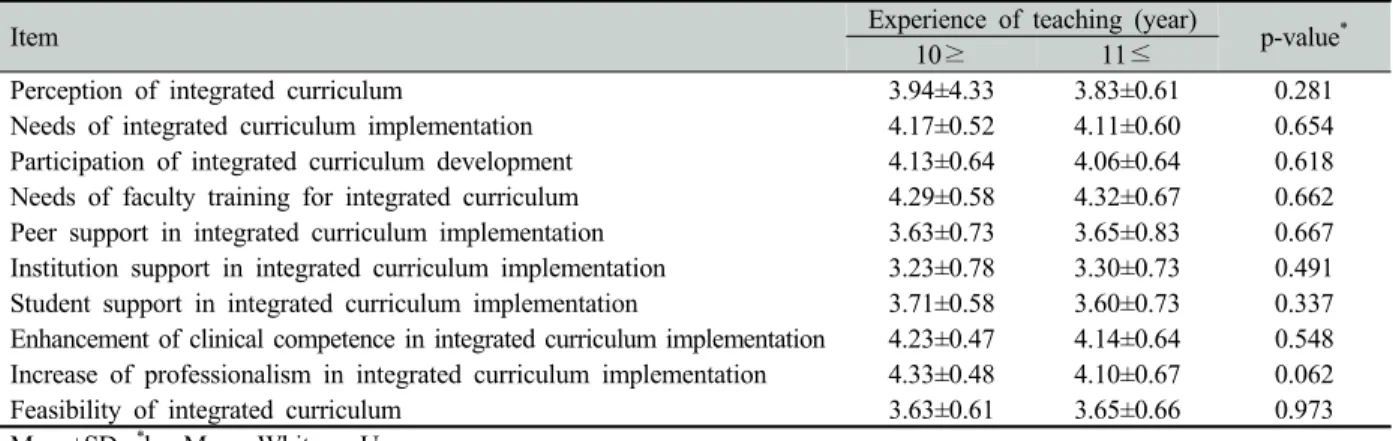
총 강의경력에 따른 통합교육과정의 인지도 비교 결과, 총 강의 경력 10년 이하인 경우는 통합교육과정의 인지도 통합교육과정 적용 시 전문성향상 기여도(4.33±0.48)와 임 상적용능력향상 기여도(4.23±0.47)에서 높았다(p>0.05). 총 강의 경력 10년 이상인 경우는 통합교육과정 관련 교수요원
Item Division
Adequacy in credit of
major
Enhancement of clinical competence
Increase of professionalism
Perceptions of problems in curriculum
Need of curriculum development
School system‡ College 3.76±0.77 3.91±0.62 3.89±0.64 2.94±0.85 3.54±0.71
University 3.10±0.91 3.87±0.67 3.77±0.67 3.06±0.96 3.84±0.58
p-value* <0.001 0.831 0.387 0.558 0.067
Number of students 50≥ 3.32±0.96 3.88±0.60 3.84±0.63 3.05±0.90 3.71±0.59
51≤ 3.84±0.65 3.93±0.66 3.88±0.66 2.88±0.85 3.51±0.76
p-value* 0.002 0.649 0.664 0.313 0.238
Teaching experience (year)‡
10≥ 3.40±0.94 3.73±0.61 3.75±0.60 3.17±0.93 3.73±0.61
11≤ 3.71±0.77 4.03±0.62 3.94±0.67 2.83±0.81 3.54±0.74
p-value* 0.052 0.009 0.094 0.047 0.147
Faculty of dental hygiene
Yes 3.50±0.82 4.00±0.61 3.98±0.63 2.89±0.78 3.55±0.66
No 3.63±0.88 3.84±0.64 3.78±0.64 3.01±0.94 3.66±0.70
p-value* 0.337 0.230 0.162 0.445 0.322
Mean±SD, ‡except missing data, *by Mann Whitney U Table 2. Needs of curriculum by general characteristics
Item Division N(%) Need of integrated curriculum† p-value*
School system‡ College 80(72.1) 4.05±0.65 0.048
University 31(27.9) 4.32±0.60
Number of students 50≥ 56(50.0) 4.23±0.71 0.041
51≤ 56(50.0) 4.02±0.56
Teaching experience(year)‡ 10≥ 48(43.2) 4.15±0.55 0.943
11≤ 63(56.8) 4.13±0.71
Faculty of dental hygiene Yes 44(39.3) 4.20±0.70 0.201
No 68(60.7) 4.07±0.61
†Mean±SD, ‡except missing data, *by Mann Whitney U
Table 1. Needs of integrated curriculum in practice course by general characteristics
의 연수 필요성(4.32±0.67)과 통합교육과정 적용시 학교의 지지도(3.30±0.73)에서 높았으나 통계적으로 유의한 차이는 없었다(p>0.05)<Table 5>.
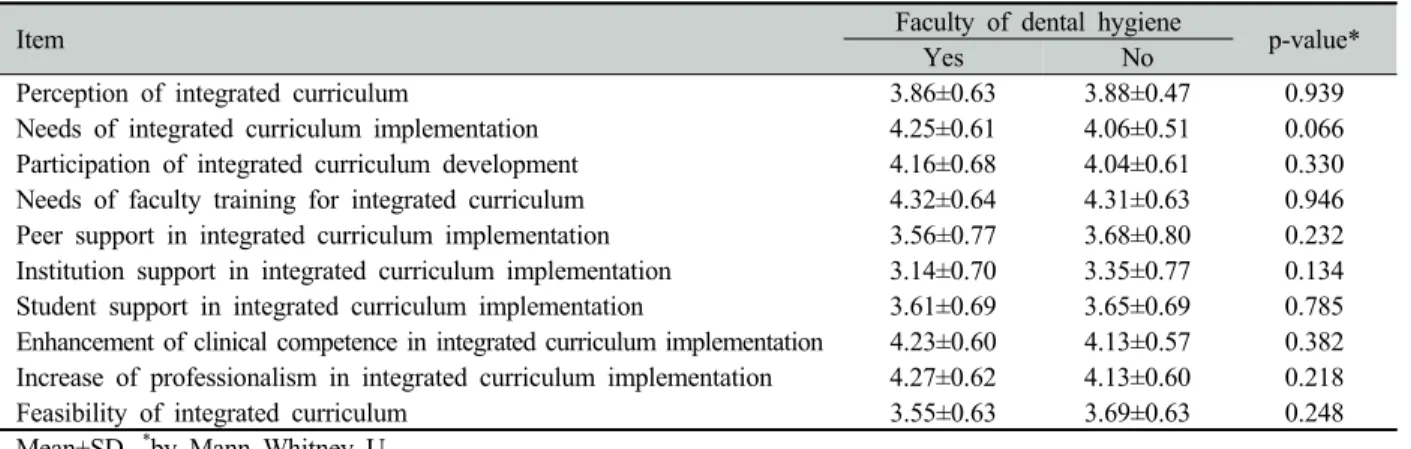
6. 치위생학 강의담당에 따른 통합교육과정 인지도 비교 치위생학 강의담당에 따른 통합교육과정의 인지도 비교 결과, 치위생학 강의를 담당하고 있는 경우 통합교육과정 적용의 필요성이 높았고(4.25±0.61), 통합교육과정 적용 시 전문성향상 기여도(4.27±0.62)와 임상적용능력향상 기여도
Item School system
p-value* College University
Perception of integrated curriculum 3.79±0.52 4.10±0.54 0.008
Needs of integrated curriculum implementation 4.10±0.56 4.23±0.56 0.294
Participation of integrated curriculum development 3.96±0.60 4.42±0.62 0.001 Needs of faculty training for integrated curriculum 4.25±0.58 4.45±0.72 0.052 Peer support in integrated curriculum implementation 3.59±0.77 3.73±0.83 0.409 Institution support in integrated curriculum implementation 3.20±0.68 3.45±0.89 0.109 Student support in integrated curriculum implementation 3.54±0.67 3.90±0.65 0.008 Enhancement of clinical competence in integrated curriculum implementation 4.10±0.56 4.35±0.61 0.035 Increase of professionalism in integrated curriculum implementation 4.10±0.59 4.39±0.62 0.021
Feasibility of integrated curriculum 3.56±0.64 3.84±0.58 0.035
Mean±SD, *by Mann Whitney U
Table 4. Needs of integrated curriculum by number of students
Item Number of students
p-value*
50≥ 51≤
Perception of integrated curriculum 3.91±0.58 3.84±0.50 0.619
Needs of integrated curriculum implementation 4.23±0.60 4.04±0.50 0.054
Participation of integrated curriculum development 4.30±0.63 3.88±0.57 <0.001 Needs of faculty training for integrated curriculum 4.48±0.63 4.14±0.59 0.002 Peer support in integrated curriculum implementation 3.73±0.80 3.54±0.76 0.268 Institution support in integrated curriculum implementation 3.27±0.84 3.27±0.65 0.929 Student support in integrated curriculum implementation 3.66±0.77 3.61±0.59 0.583 Enhancement of clinical competence in integrated curriculum implementation 4.30±0.63 4.04±0.50 0.011 Increase of professionalism in integrated curriculum implementation 4.34±0.64 4.04±0.54 0.006
Feasibility of integrated curriculum 3.71±0.62 3.55±0.63 0.128
Mean±SD, *by Mann Whitney U
Table 3. Needs of integrated curriculum by school system
Item Experience of teaching (year)
p-value*
10≥ 11≤
Perception of integrated curriculum 3.94±4.33 3.83±0.61 0.281
Needs of integrated curriculum implementation 4.17±0.52 4.11±0.60 0.654
Participation of integrated curriculum development 4.13±0.64 4.06±0.64 0.618 Needs of faculty training for integrated curriculum 4.29±0.58 4.32±0.67 0.662 Peer support in integrated curriculum implementation 3.63±0.73 3.65±0.83 0.667 Institution support in integrated curriculum implementation 3.23±0.78 3.30±0.73 0.491 Student support in integrated curriculum implementation 3.71±0.58 3.60±0.73 0.337 Enhancement of clinical competence in integrated curriculum implementation 4.23±0.47 4.14±0.64 0.548 Increase of professionalism in integrated curriculum implementation 4.33±0.48 4.10±0.67 0.062
Feasibility of integrated curriculum 3.63±0.61 3.65±0.66 0.973
Mean±SD, *by Mann Whitney U
Table 5. Understandings about integrated curriculum by experience of teaching
(4.23±0.60)에서 높게 나타났으나 통계적으로 유의한 차이 는 없었다(p>0.05)<Table 6>.
총괄 및 고안
본 연구는 교수자들을 대상으로 통합교육적용의 요구도 를 파악하여 치위생학 통합교육과정 제안에 기초자료를 제 공하고자 하였다.
주요 연구내용은 전국 치위생(학)과 교수자를 대상으로 통합교육과정에 대한 요구도를 단면 조사하였고, 치과위생 사의 전문성 향상에 대한 시대적인 흐름에 따라 학제, 학생 정원, 강의경력, 치위생학 강의담당여부에 따른 통합교육과 정의 요구도를 비교⋅분석하였다. 그 결과, 구강병 예방 업 무의 전문성 향상을 위한 치위생학 교과목간의 통합필요성 은 치위생학 강의 담당자인 경우에서 높게 나타났으나 유의 한 차이는 없었다. 한 등[8]의 연구에서 치위생과정 이론 숙 지자에서 그 필요성이 높게 나타난 것과 비슷한 결과이다.
따라서 다양한 형태로 표출되고 있는 통합교육과정에 대한 교수자들의 공감대를 형성할 있는 방안을 다각적으로 모색 해야 하고, 표준화된 교육과정의 산출을 위하여 중요한 요 인들을 도출해 내야 할 것이다[17].
현행 교육과정에 대한 교수자의 인지도는 총 강의경력이 10년 이하인 경우에 문제점 인지가 높았다(p<0.05). 다른 전공분야이긴 하나, 사범대학 교수자를 대상으로 한 한[18]
의 연구에서도 현행 교육과정에 대하여 교수자들의 만족도 가 가장 낮았다. 치위생학 관련 선행 연구[19]에서도 현행 교육과정의 문제점을 지적하였고, 치위생 교육의 목적과 목 표의 정립 없이 교과중심으로 확대된 교육과정으로 인하여 현행 교육과정의 개편이 필요하다고 하였다.
따라서 구강병 예방과 구강건강증진을 책임지는 구강보 건의료 전문가로서 갖추어야 할 직무수행능력의 배양을 위 해서 치과위생사를 처음 양성한 미국이나 유럽과 같이 전문
성을 갖춘 통합교육과정의 개편과 시행이 필요하다[12,19].
대학교육을 전담하고 있는 교수자들의 통합교육과정에 대한 인지도 비교결과, 4년제와 학생정원이 50명 이하인 대 학에서 임상적용능력과 전문성향상에 기여할 것이라는 응답 이 높았다(p<0.05). 한[8]의 연구에서는 치위생과정의 시행 이 4년제 치위생학과에서 3년제 치위생과보다 많았고, 학생 정원이 40명 이하인 대학에서 평가단계를 많이 교육하는 것 으로 보고한 바 있다. 이는 통합교육과정 개발에서 치위생 과정을 기초로 했을 때 포괄치위생과정을 효율적으로 교육 할 수 있다는 필요성 제기[10]와 2000년대부터 교육과정의 질적 향상과 치과위생사의 전문적인 역량을 키울 수 있는 교육과정을 도모하고 지향한 결과로서 통합교육과정에 대하 여 교수자들이 긍정적인 기대를 한 것으로 사료된다.
또한 교과목간의 통합필요성과 현행 교육과정을 비교결 과, 4년제인 경우와 학생정원이 50명 이하인 경우에서 치위 생학 교과목 간의 통합필요성, 현행 교육과정의 문제점 인 지와 개선에 대한 필요성이 높게 나타났다(p<0.05). 이는 학제와 학생정원을 포함한 다양한 교육환경을 고려하여 통 합교육과정은 개발이 되어야 함을 알 수 있었다.
통합교육과정의 인지도는 치위생학 강의담당 여부와 관 계없이 통합교육과정 관련 연수의 필요성이 통합교육과정에 대한 인식에서 가장 높게 나타났다. 이는 한[8]의 연구와 비 슷한 결과이나 통계적인 유의성은 없었다. Chichester 등 [20]이 교수자의 준비 부족, 시간 부족, 재정지원 부족, 기술 지원 부족 등의 문제로 실제로 운영상의 어려움이 있다고 보고한 바와 같이 통합교육과정의 준비를 교수자 개개인이 전담하기에는 무리가 있을 것이다.
본 연구는 통합교육과정의 요구도 관련 연구가 부족한 실정에서 통합교육과정의 요구도를 입증한 의미 있는 연구 라고 생각되나 치위생학 통합교육과정의 요구도에 대한 선 행연구의 부족으로 관련문헌고찰에 상당부분 제약이 있었 다. 또한 본 연구는 일부 치위생(학)과 전임 교수자를 대상 으로 한 횡단적 조사연구로서 본 연구 결과를 일반화하거나
Item Faculty of dental hygiene
p-value*
Yes No
Perception of integrated curriculum 3.86±0.63 3.88±0.47 0.939
Needs of integrated curriculum implementation 4.25±0.61 4.06±0.51 0.066
Participation of integrated curriculum development 4.16±0.68 4.04±0.61 0.330 Needs of faculty training for integrated curriculum 4.32±0.64 4.31±0.63 0.946 Peer support in integrated curriculum implementation 3.56±0.77 3.68±0.80 0.232 Institution support in integrated curriculum implementation 3.14±0.70 3.35±0.77 0.134 Student support in integrated curriculum implementation 3.61±0.69 3.65±0.69 0.785 Enhancement of clinical competence in integrated curriculum implementation 4.23±0.60 4.13±0.57 0.382 Increase of professionalism in integrated curriculum implementation 4.27±0.62 4.13±0.60 0.218
Feasibility of integrated curriculum 3.55±0.63 3.69±0.63 0.248
Mean±SD, *by Mann Whitney U
Table 6. Understandings about integrated curriculum by faculty of dental hygiene
전체 치위생(학)과 전임 교수자의 의견으로 그대로 적용하 는데 한계점이 있다.
따라서 추후 연구에서는 본 연구에서 제시된 통합교육과 정의 요구도를 바탕으로 질적 연구를 설계하여 교수자에게 도움이 될 수 있는 통합교육과정에 대한 포괄적인 연구와 임상치과위생사의 직무역할 수행의 변화를 가져올 수 있는 통합교육과정 관련 프로그램에 대한 연구가 실시되어야 할 것이다. 이로써 대학 교육이 치과위생사의 전문성 향상에 기여할 수 있을 것으로 사료된다.
결론
본 연구는 치위생(학)과 전임 교수자를 대상으로 치위생 학 통합교육과정에 대하여 그 요구도를 파악하고 치위생학 통합교육과정의 모형 제안을 위한 시사점을 얻고자 분석한 결과는 다음과 같다.
1. 구강병 예방 업무의 전문성 향상을 위한 치위생학 교 과목간의 통합필요성은 학제와 학생정원에 따라서 통 계적으로 유의한 차이가 있었다.
2. 현행 교육과정의 구강병 예방을 위한 임상적용 능력 향상 기여는 총 강의경력 11년 이상(p=0.009)에서 높 았고, 문제점인지는 총 강의경력 10년 이하(p=0.047) 에서 높았다.
3. 통합교육과정의 임상적용능력향상 기여도는 학제(p=
0.035), 학생정원(p=0.011)에 따라 통계적으로 유의한 차이가 있었다.
4. 통합교육과정의 전문성향상 기여도는 4년제(p=0.021) 와 학생정원이 50명 이하인 경우(p=0.006), 총 강의경 력이 10년 이하인 경우(p=0.062)에서 높게 나타났다.
이상의 결과를 종합해 볼 때 통합교육과정의 필요성을 교수자들이 인식하고 있었고, 통합교육과정의 임상적용능력 과 전문성 향상의 기여도가 높음을 알 수 있었다. 따라서 각 대학의 교육과정이 통합적이고 포괄적인 교육으로 개편되기 위해서는 교수자 개별적인 노력보다는 치위생 인증 평가원 차원에서의 효율적인 대책 마련이 필요할 것으로 사료된다.
References
1. Won BY, Jang GW, Hwang MY, Kim SA, Jang JH.
Development of Korean standard dental hygiene curriculum proposal. J Korean Soc Dent Hyg 2013; 13(1): 1-12.
2. Won BY, Hwang MY, Chun SY. The actual condition of operating dental hygiene curriculum between Korea and
America. J Korean Soc Dent Hyg 2010; 10(6): 1061-71.
3. Bowen DM. Dental hygiene: A developing discipline? Dent Hygiene 1988; 62: 23-5.
4. Han SY. A study on the actual condition and recognition of dental hygiene curriculum based on dental hygiene process of care[Master's thesis]. Seoul; Univ. of Yeonsei, 2008.
5. Hwang MY. The development of an intergrated curriculum model for dental hygienist[Doctoral dissertation]. Seoul; Univ.
of Sungshin women's, 2002.
6. Cho YS. Comparison of curriculums of dental hygiene education programs for B. S degree. J Dent Hyg Sci 2005;
5(4): 251-8.
7. Kim NH, Jang SO, Jun HS, Kim YN, Chung WG. Comparison of ideas of dental hygiene education programs between Korea and America. J Dent Hyg Sci 2006; 6(3): 193-9.
8. Han SY, Kim NH, Yoo JH, Kim CS, Chung WG. Current status of clinical dental hygiene education based on dental hygiene process of care. J Dent Hyg Sci 2009; 9(3): 271-8.
9. Yoon J. A study on the critical thinking disposition of nursing students - focusing on a school applying integrated nursing curriculum. J Korean Acad Nurs Admin 2008; 14(2): 159-66.
10. Cho YS, Lee SY. Developing a integrated curriculum for a clinical dental hygiene. J Dent Hyg Sci 2005; 5(1): 33-8.
11. Kwun HS. Development of a standard curriculum model for dental hygienist education[Doctoral dissertation].
Changwon; Univ. of Kyungnam, 1999.
12. Kim SH. A study on dental hygiene education curriculum model development focusing on the roles of dental hygienists[Doctoral dissertation]. Seoul; Univ. of Dankook, 1997.
13. Kim EK, Kim YJ, Kim JH, Park MS, An GS, Yun MS, et al. Dental hygiene standard education and development.
Seoul: Korean Dental Hygiene Association⋅Korean Development Dental Hygiene Professional Association;
2005.
14. Moon SE, Kim YJ, Kim SY, Cho HE, Lee BR, Lee BY.
Study on the integrated curriculum model of clinical dental hygiene practice to establish professionalism of dental hygienist. Korean Association Dental Hygiene Professors;
2015: 1-64.
15. Chae MA. Curriculum seminar for KWU's CDHC.
2013.07.19
16. Han HJ. A case study on the integrated approach for the improvement of dental hygienics curriculum and instruction [Doctoral dissertation]. Seoul; Univ. of Konkuk, 2011.
17. Choi GY, Choi BY, Choe HS. A study of curriculum changes in dental hygiene department of colleges. J Vocat Educ
Res 2010; 29(3): 85-106.
18. Han SL. The difference of curriculum needs analysis between professors, students and teachers for improving college of education curriculum. J Learner-Centered Curriculum Instruc 2007; 7(2): 375-99.
19. Cho YS. Developing a competency-based curriculum for dental hygiene program. J Namseoul Univ 2004; 10: 409-47.
20. Chichester SR, Wilder RS, Mann GB, Neal Ed. Utilization of evidence-based teaching in U.S. dental hygiene curricula.
J Dent Hygiene 2001; 75(2): 156-64.