Camelina oil transesterification using mixed catalyst of tetra methyl amonium hydroxide and potassium
hydroxide on the tubular reactor
Young-Jin Hyun
✝✝Department of Chemical Engineering and Life Science, College of Engineering, Cheju National University,
Jeju-Shi, 690-756, Korea.
(Received April 14, 2011 ; Accepted April 26, 2011)
Abstract : The analysis of reaction kinetics provided that the reaction order was the 1st of triglyceride and the rate constant was 0.067 min-1. The transesterification of camelina oil using 0.6 wt% mixed catalyst which consists of 40 v/v% of potassium hydroxide (1 wt%) and 60 v/v% of tetra methyl ammonium hydroxide (0.8 wt%), was carried out at 65 ℃ on the tubular reactor packed with static mixer. The conversion was shown to be 95.5% at the 6:1 molar ratio of methanol to oil, flow rate of feed of 3.0 mL/min and 24 of element of static mixer. The volume of washing water emitted by 0.6 wt% mixed catalyst was the half of the volume emitted by 1 wt% potassium hydroxide.
Keywords : Camelina oil, rate constant, 0.6 wt% mixed catalyst, tubular reactor, static mixer, volume of washing water.
1. Introduction
The supply of fossil fuels is being limited, but the energy demand is increasing rapidly to now. The world pays attention to the alternative renewable fuels. One of them is biodiesel, and it is a promising fuel in the consideration of the depletion of fossil fuels because of its biodegradability, biorenewable nature, low toxic emission, good transportation and storage properties [1,2,3].
Biodiesel consists of long chain fatty acid methyl ester (FAME) produced by transesterification with methanol or ethanol.
✝Corresponding author
(E-mail : [email protected])
Methanol is so frequently used due to its suitable chemical properties and low cost.
The alkali metal-catalyzed transesterification proceeds with the fast rate at the mild conditions. KOH, NaOH and NaOCH3 are typical alkali metal catalysts for transesterification. But the major disadvantage of these alkali-metal catalysts is the saponification of metal ions with biodiesel and di or triglyceride [4,5].
Therefore, an additional step is needed to remove metal ions dissolved in the products, which demands more costs to purify products. To get over the purification difficulties, heterogeneous catalysts like CaO, MgO, ZnO and SrO have been proposed as an alternative to homogeneous alkali-metal
catalysts. It takes long time to prepare the heterogeneous catalysts due to calcination of them [6,7,8]. Also they have trouble converting oil into biodiesel in short time.
An another alternative way to resolve such drawbacks as purification and long reaction or preparation time is the utilization of amine-based catalysts like tertiary methyl ammonium hydroxide (TMAH) and benzyl tri methyl ammonium hydroxide (BTAH) to cope with the environmental defects of the traditional process [9,10]. TMAH makes the conversion of oil into biodiesel fast and the biodiesel is free of alkali - metal ions. The utilization of liquid amine catalysts brings an avoidance of the washing step of products.
Hence, this is why TMAH is called an environmental-friendly catalyst. But its price is too expensive. To minimize the cost of TMAH, an amount of used TMAH should be small. Therefore, the mixed catalyst was proposed, which consists of alkali-metal and TMAH catalysts [11]. In the present work the conversion of camelina oil into biodiesel was studied at 65 ℃ under the operating variables on the plug flow reactor. The pH of biodiesel using 0.6 wt% mixed catalyst, 0.8 wt% KOH and 1 wt% NaOH was measured. The volume of water to wash biodiesel was estimated. The main goal of this work was to determine the optimal operating conditions to maximize the conversion and minimize amounts of washing water.
2. Materials and Methods
2.1 Chemicals
Tertiary methyl ammonium hydroxide (25 wt% in methanol, Acros organics Co., N. J.) and camaelina oil (Bio Chemical International, FL.) were purchased from US. And tricaprin, pyridine and Bi-(tri methyl silyl) trifluro acetamide were purchased from Cole Parmer Co. (Vermon Hills, Illinois, US.)
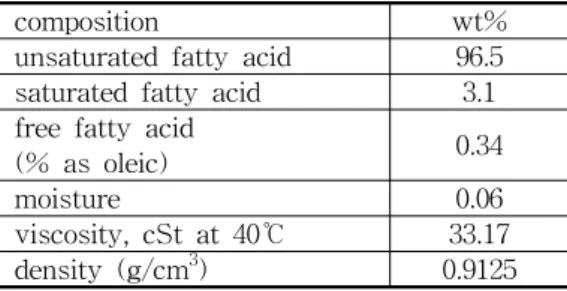
The properties of camelina oil were shown as Table 1.
Table1. The properties of camelina oil
composition wt%
unsaturated fatty acid 96.5
saturated fatty acid 3.1
free fatty acid
(% as oleic) 0.34
moisture 0.06
viscosity, cSt at 40℃ 33.17
density (g/cm3) 0.9125
2.2 Transesterification
The reacting system on Fig. 1 consisted of the feed vessel (200 mL), micro pump (Stepdos OS3, CH-6210 series, Switzerland) and tubular reactor (ID:1.2 cm, length 31 cm, volume 35 cm3) packed with static mixer (PE, Cole Parmer Instrument, USA) ranging from 12, 24 and 36 of elements. The oil and the catalyst-dissolved methanol were mixed at the feed vessel preheated to 30℃. Then, the transesterification was conducted on the tubular reactor at 65 ℃. The mixed catalyst was prepared by 60 v/v% TMAH (0.8 wt%
based on the oil) and 40 v/v% KOH (1 wt%). We have the operating variables as the molar ratios of methanol to oil (3:1, 6:1 and 9:1), amount of catalyst (1 wt% KOH,
Ⅰ: feed vessel, Ⅱ: hot plate, Ⅲ, Ⅵ: pump,
Ⅳ: tubular reactor packed with static mixer,
Ⅴ: thermostat, Ⅶ: collector
Fig. 1. Schematic apparatus of transesterifi- cation on tubular reactor.
Time(min)
0 20 40 60 80 100 120 140
ln(1-XA)
-3.5 -3.0 -2.5 -2.0 -1.5 -1.0 -0.5 0.0
0.6wt% mixed catalyst 1wt% KOH 0.8wt% TMAH
0.6 wt% mixed catalyst and 0.8 wt%
TMAH), the flow rates of feed (0.25, 0.30 and 0.35 mL/min). The product stream was recycled to the feed for the increase of conversion. The concentration of K+dissolved in the biodiesel and the glycerine was measured respectively to determine amounts of water needed to wash the biodiesel. And the amount of water to wash the biodiesel was estimated under the changes of biodiesel pH.
2.3 Analysis
Gas chromatography equipped with FID detector and HP-5 column (19091J-012, Agilent Technologies Inc., Wilmington, Delaware) was used to analyze the biodiesel sample. The FID detector is operated at 350
℃ with injector temperature 325 ℃, and uses a helium makeup flow of 25 mL/min.
The oven was elevated from initial 80 ℃ to 180 ℃ at 15.5 ℃ / min, to 250 ℃ at 5.0 ℃ / min, and to 325 ℃ at 8.0 ℃/ min. The total run time is 53.0min. After centrifuging the sample (5mL), 50μL of biodiesel taken was mixed with internal standard (8.0 mg tricaprin / mL pyridine) and the reaction of its mixture with BSTFA (200μL) was done at 70 ℃ in 20 min to convert free fatty acid into biodiesel. This product was diluted to 1200μL with n-hexane. 1μL of sample was injected into HP-5 column. The quality and quantity analysis was performed using the peaks and areas of compounds, their retention time and calibration line.
Biodiesel conversion was calculated by the ratio of actual fatty acid ester to thoretical fatty acid ester.
3. Results and Discussion
3.1 Rate constant determination with the reaction time
When the higher molar ratio drives the reaction forward, the disappearing rate (-rA)
of triglyceride depends nearly on the concentration (CA gmol/cm3) of triglyceride under the assumption of 1st order of it like Eq.(1).
-rA = -dCA/dt = kCA (1)
Where CA (g/mL) is concentration of triglyceride, and k (min-1) is rate constant.
The integration of Eq.(1) yields the relation of conversion (XA) and time (t) in Eq.(2).
ln (1-XA) = kt (2)
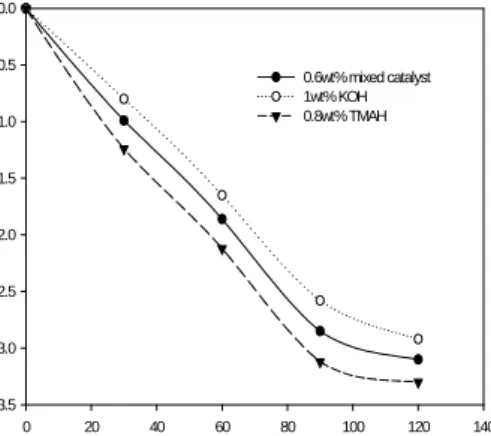
The transesterification using 1 wt% KOH, mixed catalyst and 0.8 wt% TMAH was done on the batch reactor in 120 min. A plot of ln (1-XA) vs time (min) was presented on Fig. 2.
Fig. 2. Plot of ln (1-XA) vs time(min) (molar ratio of methanol to oil 6/1, 65
℃, 120min).
The relation of ln(1-XA) vs time (min) appeared nearly to be the declining line having some slopes without the respects of catalyst amount. The average reaction constant (k) is 0.067 min-1 from the slope of Fig. 2.
3.2 Effects of molar ratio of methanol to oil and flow rate on conversion
The molar ratio of methanol to oil and the flow rates of feed are main operating factors for biodiesel production. As the case studied for the molar ratio, D. Darnoko et al did the continuous transesterification of palm oil using 1 wt% KOH at the 6: 1 molar ratio and 65 ℃ in 60min and presented 97.3% of conversion[12]. H. Noureddini et al performed the continuous transesterification of soybean oil using 0.4 wt% NaOH at the 8:1 molar ratio and 80 ℃, and showed 98% of the conversion [13]. The conventional molar ratio for the alkali metal – catalyzed transesterification is from 6:1 to 8:1.
The mass balance for triglyceride (A) in the length difference (△x) of tubular reactor is expressed as Eq. (3).
(3)
where S is area (cm2) of reactor, and G is volume flow rate (mL/min) of reactants.
The combination of Eq. (1) and Eq. (3) yields Eq. (4).
(4)The volume flow rate (G) is expressed as Eq. (5).
G = R(mol MeOH/mol A) NA MMeOH / ρ
MeOH + NMeOH MA / [R(mol MeOH/mol
MeOH)
ρA] (5)
Where N is molar flow rate (gmol/min), M is molecular weight (g/gmol), R is molar ratio of methanol to oil mol MeOH/mol A) and ρ is density (g/cm3).
Integrating Eq. (4), the conversion of triglyceride is derived as Eq. (6).
XA = 1-exp(-k tR) (6)
Where tR (min) is retention time of reactants.
The transesterification of camelina oil using 0.6 wt% mixed catalyst was conducted on the tubular reactor under the changes of molar ratio of methanol to oil and flow rate.
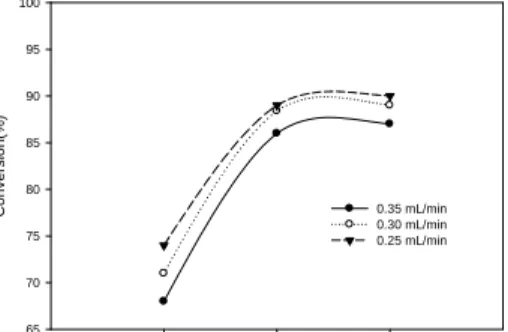
The effects of molar ratio of methanol to oil and flow rate on the conversion were illustrated on Fig.3. You can see that the conversion depends on molar ratio of methanol to oil and flow rates of feed on Fig. 2.
Molar ratio of methanol to oil
3 6 9
Conversion(%)
65 70 75 80 85 90 95 100
0.35 mL/min 0.30 mL/min 0.25 mL/min
Fig. 3. Effects of molar ratio of methanol to oil and flow rates of feed on conversion (element of static mixer 12, 65 ℃).
As the molar ratio of methanol to oil goes up, the volume flow rate goes down in Eq.
(6). The conversion using 0.6wt% mixed catalyst appeared to be 88% at the 6:1molar ratio of methanol to oil, 12 of element of static mixer and 3.0 mL/min. Above the 6:1molar ratio, the conversion was near the constant without regards of flow rates because the transesterification approached the equilibrium. On the other hand, increasing the flow rate, the retention time of reactants in the reactor goes down, and the conversion is low as you see in Eq. 6. The conversions at flow rates of 2.5 mL/min and 3.0 mL/min were nearly the same at the 6:1 molar ratio
of methanol to oil. This is attributed to small difference of retention time from 0.25 mL/min to 0.30 mL/min. The optimum values of molar ratio of methanol to oil and flow rate appeared to be 6:1 and 0.30 mL/min respectively.
3.3 Effects of the number of elements of static mixer on conversion
The static mixer is a good mixer. The first fixed helical element divides the stream and then recombines these portions. So the streams have a 180° twist. The next and successive elements are placed at 90° and split the flows into two streams. Each split in flow creates more interfacial area between layers. The concentration difference in thin layer will be nearly eliminated by molecular diffusion [14]. When each element divides the flow into two flow channels, the divisions called the ratio of the diameter (D) of reactor to maximum striation thickness (d), which enhances the rate of diffusion of methanol to oil, are expressed as the Eq. 7.
D/d = 2n (7)
Where n is the number of elements in static mixer.
The transesterification of camelina oil was conducted on the tubular reactor under the changes of number of element of static mixer. The effects of element of static mixer on the conversion were illustrated on Fig. 4.
We can know that the conversion depends on the number of element of static mixer. As the number of element in static mixer was 24, the divisions were calculated as about 1.7x10⁷, which brought more interfacial area.
And the conversion increased to 95.5% using 0.6 wt% mixed catalyst. Above the 24 of element of static mixer, the transesterification using 0.6 wt% TMAH reached the equilibrium, and the conversion showed the constant value. Hence, the optimum number of element of static mixed proved to be 24.
Elements of static mixer
10 15 20 25 30 35 40
Conversion(%)
84 86 88 90 92 94 96 98 100
0.6wt% mixed catalyst 1wt% KOH 0.8wt% TMAH
Fig. 4. Effects of element of static mixer on conversion (molar ratio of methanol to oil 6/1, flow rate, 3.0 mL/min, 65
℃).
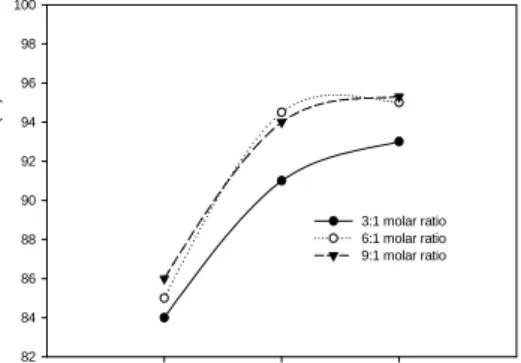
3.4 Effects of catalyst on conversion Mixed catalyst was suggested to meet the optimization of the costs of removing alkali - metal ions and the prices of liquid amines [15]. The transesterification of camelina oil was performed under the changes of the elements of static mixer and amount of catalysts. The effects of the amount of catalyst on the conversion were shown on Fig. 5.
1wt% KOH 0.6wt% Mixed Catalyst 0.8wt TMAH
Overall Conversion(%)
82 84 86 88 90 92 94 96 98 100
3:1 molar ratio 6:1 molar ratio 9:1 molar ratio
Fig. 5. Effects of the amount of catalyst on the conversion (elements of static mixed 24, 0.30 mL/min, 65 ℃).
Fig. 5. indicates that the conversion increases with the intensity of basicity of
catalysts. The conversion using 0.6 wt%
mixed catalyst at 24 of element of static mixer, increased to 95.5%. This value approaches nearly the conversion using 0.8 wt% TMAH. This is due to the formation of strong base catalyst from the 60 v/v%
addition of TMAH (0.8 wt%) to 1 wt%
KOH. Therefore, it is concluded that 0.6 wt%
mixed catalyst was appropriate for the transesterification, considering the separation of metal ion dissolved in biodiesel and the cost of TMAH.
3.5 Effects of catalyst on the pHs of biodiesel and amounts of washing water
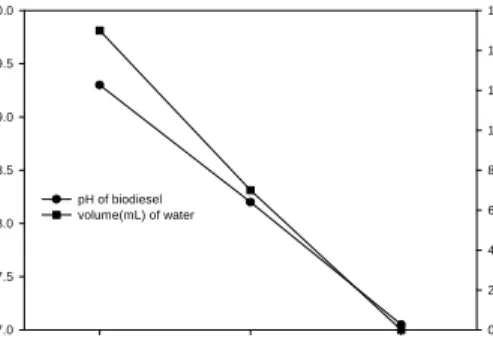
The metal ion transfers to the biodiesel and the glycerine during the transesterification [16,17]. The separation of biodiesel and glycerine from saponificated product demands a larger amount of water to remove the metal ion and long time. Before quantifying the volume of added water, the weight percents of K+ion in biodiesel and glycerine were observed as 48% based on the biodiesel and 52% based on the glycerine. 5 mL of biodiesel produced at optimum conditions was sampled, and the pH of it was measured. Then, the volume of added water was checked until the pH of the biodiesel was 7.0. The pHs of biodiesel and the volume of added water with the amounts of catalysts were shown on Fig. 6.
The pH of biodiesel using 1 wt% KOH was 9.3 mL, and the volume of added water was 15.3 mL. Those values using mixed catalyst are 8.2 and 7.5 mL respectively.
From the results, 0.6 wt% mixed catalyst saved about more 50% of the adding water needed to separate biodiesel than 1 wt%
KOH. Hence, the mixed catalyst, is good to be applied to the transesterification.
Amounts of catalyst
1% KOH 0.6% Mixed Catalyst 0.8% TMAH
pH
7.0 7.5 8.0 8.5 9.0 9.5 10.0
Volume(mL)
0 2 4 6 8 10 12 14 16
pH of biodiesel volume(mL) of water
Fig. 6. Effects of catalyst on pH of biodiesel and volume of added water (molar ratio of methanol to oil 6/1, 3.0 mL/min, elements 24, 65 ℃).
4. Conclusion
The analysis of reaction kinetics provided that the reaction order was the 1storder of triglyceride and the rate constant was 0.067 min-1. The conversion of camelina oil using the mixed catalyst which consists of 40 v/v% of KOH (1 wt%) and 60 v/v % of TMAH (0.8 wt%) was carried out at 65℃ on the tubular reactor. The conversions were predicted by Eq. (6) and shown to be 95.5%
at the 6:1 molar ratio of methanol to oil, 3.0 mL/min and 24 of numbers of static mixer.
As the 24 of elements of static mixer gave 1.7 x10⁷ of the divisions, which created more interfacial area. The volume of washing water lowered by mixed catalyst was half the volume which 1 wt% KOH emitted.
Therefore, 0.6 wt% mixed catalyst was proved to lower outflow of alkali wastewater.
References
1. Ejaz M. Shahid, Y. Jamal, A reviews as vehicle fuel, Renewable and Sustainable Energy Reviews, 12, 2484 (2008).
2. A. Strivastiva, R. Prasad, Triglyceride - based diesel fuels, Renewable and Sustainable Energy Review, 4, 111 (2000).
3. F. Ma, M. A. Hanna, Biodiesel production: a review, Bioresources Technology, 70, 1 (1999).
4. Fukuda H., Kondo A., Novada A., Biosiesel fuel production by transesterification of oils, J. Biosci.
Bioeng., 92, 405 (2011).
5. S. Baroutian, M. K. Aroua, N. M.
Sulamian, Potassium hydroxide catalyst supported on palm shell activated carbon for transesterification of palm oil, Fuel Processing Technology, 91, 1378 (2010).
6. Vlada B. Veljkovic, Zoran B. Todorovic, Dejan U. Skala, Kinetics of sunflower oil methanolysis catalyzed by calcium oxide, Fuel, 88, 1554 (2009).
7. X. Liu, X. Piao, Y. Wang, Calcium methoxide as a solid base catalyst for the transesterification of soybean oil with methanol, Fuel, 87, 1076 (2008).
8. X. Liu, H. He, Y. Wang, X. Piano, Transesterification of CaO as a solid base catalyst, Fuel, 87, 216 (2008).
9. T. Cereve, S. Peter, E. Weidner, Biodiesel transesterification of biological oils with liquid catalysis : thermodynamic properties of oil-methanol amine mixture, Ind. Eng. Chem. Res., 44, 9535 (2005).
10. Georgios Karavalakis, Georgios Anastopoulos, Dimitrios Karanonis, Stamos Stourna, Biodiesel production
using tetra methyl and benzyl trimethyl ammonium hydroxides as strong base catalyst, Fuel Processing Technology, 91, 1555 (2010).
11. F. E. Kiss, M. Jovanovic, G. C. Boskovic, Economic and ecological as 2010pects of biodiesel production over homogeneous and heterogeneous catalysts, Fuel Processing Technology, 91, 1316 (2010).
12. D. Darnoko, Munir Cheryan, Continuous production of palm methyl esters, J. Am.
Oil Chem.Soc., 12, 1269 (2000).
13. Noureddini, H., D. Harkey, V.
Medikonduru, A continuous process for the conversion of vegetable oils into methyl esters of fatty acids, J. Am. Oil Chem. Soc., 75, 1775 (1998).
14. C. J. Giankoplis, Transport Processes and Separation Process Principles, 4th ed., Prentice Hall, 166 (2003).
15. F. E. Kiss, M. Jovanovic, G. C.
Boskovic, Economic and ecological aspects of biodiesel production over homogenuous and heterogenous catalysts, Fuel Processing Technology, 91, 1316 (2010).
16. D. Y. C. Leung, X. Wu, M. K. H.
Leung, A review on biodiesel production using catalyzed transesterification, Applied Energy, 87, 1083 (2010).
17. G. Vicente, M. Martinez, J. Aracil, Integrated biodiesel production : a comparison of different homogeneous catalysts systems, Bioresource Technology, 92, 297 (2004).