Ex Vivo Assay of Trace Nicotine Using a Voltammetric Modified Biosensor
Suw Young Ly
✝․ Myung-Ho Jang
*․ Jae-Min Cha
*․ Min-Young Kim
*Hyun-Seok Oh
*․ Dong-Hyeon Jo
*․ Seong-Sik Choi
*✝
Biosensor Research Institute, Seoul National University of Science & Technology, Address: 172, gongreung 2 ‐ dong Nowon ‐ gu, Seoul,139 ‐ 743,Korea
*
Advenced Scientific Experiment Group in Daejin High School, Seoul, Korea (Received January 22, 2012 ; Revised March 24, 2012 ; Accepted March 26, 2012)
Abstract : In vivo nicotine is associated with Alzheimer’s, Parkinson’s and lung cancer.
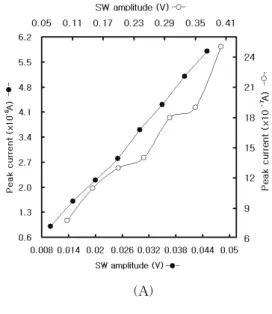
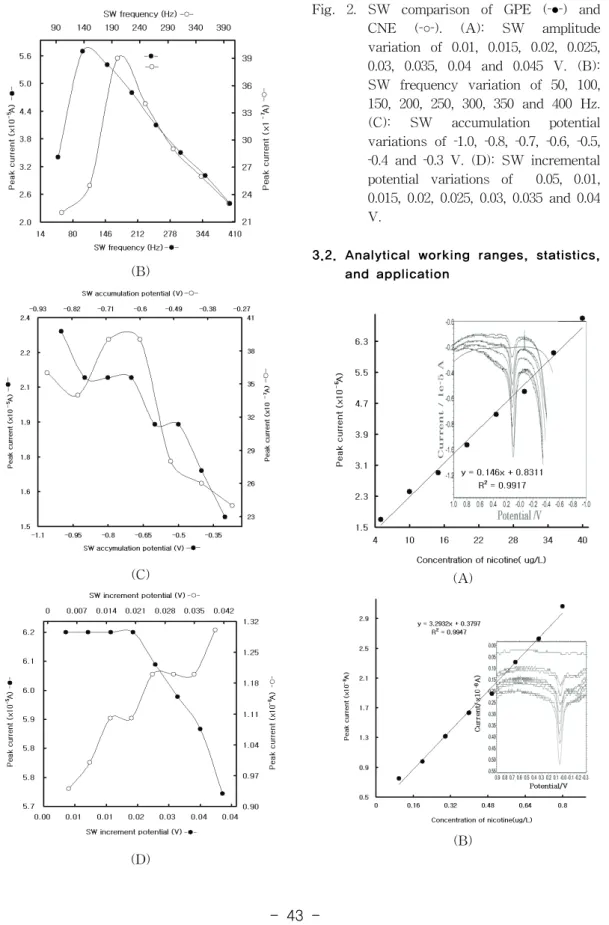
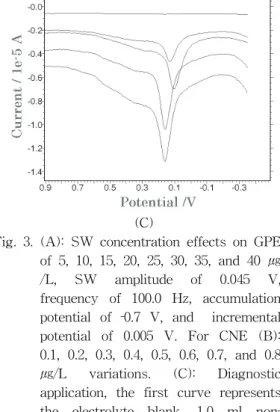
Diagnostic assays of these diseases depend on very low analytical detection limits. In this study, a sensitive analytical method was examined using a voltammetric graphite pencil electrode (GPE) and a modified carbon nanotube paste electrode (CNE). The optimum analytical conditions for both electrodes were compared using square wave anodic stripping voltammetry (SW) and cyclic voltammetry (CV) obtaining 400 sec accumulation time and oxidation peak. Under optimum parameters, the stripping working range of GPE was 5.0 ‐ 40.0 ㎍ /L, CNE: 0.1 ‐ 0.8 and 5 ‐ 50 ㎍ /L. Quantification limits were 5.0 ㎍ /L for GPE and 0.1 ㎍ /L for CNE, while detection limits were 0.6 ㎍ /L for GPE and 0.07 ㎍ /L for CNE. A standard deviation of 10.0 ㎍ /L was observed for 0.064 GPE and 0.095 CNE (n = 12) using 400 sec accumulation time. The results obtained can be applied to non ‐ treated urine and ex vivo biological diagnostics.
Keywords : nicotine ion, diagnosis, in vivo, stripping,
1. INTRODUCTION
Plant tobacco smoking is efficiently absorbed into the lungs and brain [1]. Major component of nicotine is responsible for an enormous number of premature deaths worldwide per year [2]. In vivo conditions, trace nicotine are associated with Alzheimer’s disease, Parkinson’s disease [3], memory malfunction [4], lung cancer [5], genotoxic
✝