ISSN 2288-1069 (Online)
http://dx.doi.org/10.12925/jkocs.2014.31.2.203
Candelilla Wax Nanoemulsions Prepared by Phase Inversion Composition (PIC) Method
Eun-Hee Kim․Wan-Goo Cho
✝Basic Medicine Department, College of Medical Sciences, Jeonju University, 303 Cheonjam-ro, Wansan-gu, Jeonju 560-759, Korea
(Received May 1, 2014; Revised June 24, 2014; Accepted June 25, 2014)
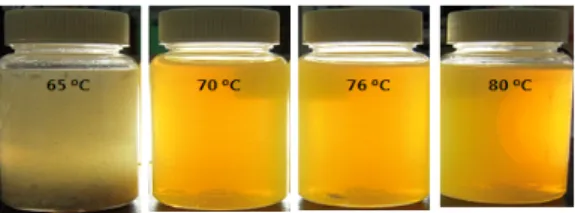
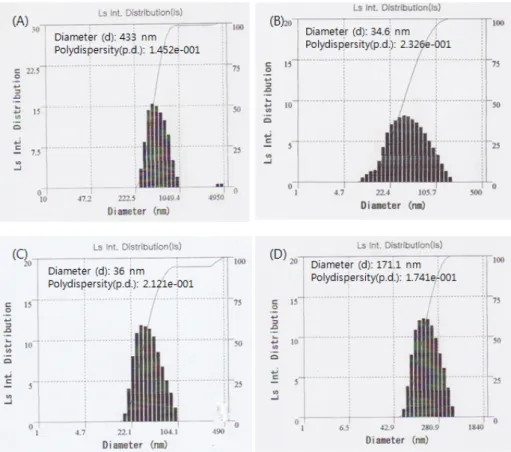
Abstract : Candelilla wax-in-water nanoemulsions stabilized by Span 80/Tween 80 were prepared by the phase inversion composition (PIC) method. Stable nanoemulsions with droplet diameters below 50 nm could be formed when the hydrophilic–lipophilic balance (HLB) values were between 13.5 and 14.5, surfactant concentration was 5.0 wt%, and the surfactant-wax ratio was 1:1. Increased emulsification temperature and cooling rate were found to improve the emulsion properties. Process of PIC (adding aqueous phase to the wax phase) produced smaller droplet size nanoemulsion compared to the process of adding wax phase to the aqueous phase.
The stability of these nanoemulsions was assessed by following the change in droplet diameters with time of storage at room temperature (∼25 °C). The size remained constant during 2 months storage time.
Keywords : candelilla wax, nanoemulsion, PIC, stability, cosmetics
1. Introduction
The potential benefits of cosmetic nanoemulsions include optical clarity, good stability to gravitational separation, flocculation and coalescence, and improved absorption and bioavailability of functional components [1]. A deeper understanding of the basic physiochemical properties of nanoemulsions would, therefore, provide key information to better guide formulation and application of nanoemulsion to cosmetics.
Nanoemulsions can be prepared by high or low energy emulsification methods [2–4]. High
✝
Corresponding author (E-mail: [email protected])
energy emulsification methods require large mechanical energy generated by high pressure homogenizers or ultrasound generators to produce fine droplets. In contrast, low energy emulsification methods can take advantage of the chemical energy stored in the ingredients and produce the nanoemulsions almost spontaneously, thus have great attraction both in theoretical study and practical application.
The change in the spontaneous curvature of
surfactants during the emulsifying process has
been recognized to be a key factor for the
formation of nanoemulsions, which can be
achieved either by changing the temperature
(phase inversion temperature, PIT method) or
by changing the volume fraction of water or
oil (phase inversion composition method, PIC
method)[2-4].
Although there have been many studies on nanoemulsions with liquid oil as dispersed phase, few systematic studies have been done on emulsions with dispersed crystals, wax, a crystallizable oil phase. The distribution of the titanium dioxide inside the carnauba wax phase of the nanosuspensions was more effective to reach higher SPFs than that at the aqueous phase [5]. Traditionally, nanoemulsion containing carnauba wax was used as fruit coating agent [6,7]. Paraffin wax has several advantages, including its relatively large latent heat, low vapor pressure and chemical inertness. When paraffin is dispersed in aqueous medium, a paraffin/water emulsion is formed which is more suitable for many applications, due to its greatly accelerated heat-exchange and negligible thermal resistance [8]. Leal-Calderon and co-workers have investigated paraffin wax emulsions stabilized by different stabilizers [9,10].
In the present work, we prepared candelilla wax-in-water nanoemulsions using the low-energy PIC method, and investigated the effects of HLB value, surfactant concentration, emulsification temperature and emulsification route.
2. Materials and Methods
2.1. Materials
The candelilla wax(Kahl GmbH & Co. KG) had a narrow range of melting point from 68.5-72.5
oC. The component of this candelilla wax were odd-numbered n-alkanes (C29 to C33), together with esters of acids and alcohols with even-numbered carbon chains (C28 to C34). Water was deionized and Milli-Q filtered. Sorbitan monooleate (Span 80, c.p.), polyoxyethylene (20) sorbitan monooleate (Tween 80, c.p.), were obtained from Ilshin wells Co. Ltd. and Croda Chem., respectively. All reagents were used as received without further purification.
2.2. Preparation of emulsions
Emulsions were prepared from a mixture of candelilla wax and surfactants by slowly adding EDTA-2Na aqueous solution with gentle agitation using a magnetic stirrer. The addition rate of aqueous solution was kept constant at approximately 1.0 mL/min. The emulsification temperatures were kept at 65–80
o