DAEHAN HWAHAK HWOEJEE (Journal of the Korean Chemical Society) Vol.34, No. 1, 1990
Printedin the Republic of Korea
Cholesteryl Pentyl Carbonate 결정 및 분자구조
徐惠蘭 •朴英子七 •
B.M. Craven *숙명여자대학교 이과대학 화학과
요
약.
Cholesteryl pentyl carbonate(C33H5Q3)의 분자 및 결정구조를
X-선 회절법으로 연구하였 다. 이 결정은 단사정계에 속하며 공간군은
P%이며, 단위세포 상수는
”=12.484(3), 5 = 9.043(3), c=14.053(3) A,戶二
94.12(2)°이다.
Four-circle automatic diffractometer로 회절 강도들을 얻었으
며, 구조는
cholesteryl octanoate의 원자좌표를 시행구조로 이용 결정하였고 최소자승법으로 정밀화하
였다. 최종 신뢰도
R값은
1164개의 반점들에 대하여
0.12이었다.
Cholesteryl부분의 결합길이와 결합 각은 정상적이나
pentyl기는 이 영역에서의 '열적 진동 때문에 결합길이가 짧았다.
b-축을 따르는
2】
screw symmetry에 의해 관련된 인접한 분자들은 서로 반대로 나란히 놓여 있으며
monolayer를 형성 하고 있다.
Monolayer내에서 산
icdesteryl군들이 서로 촘촘히 쌓인 구조를 만들어
Monolayer Type II packing mode에 해당하며 ,
cholesteryl hexanoate, octonoate, hexyl carbonate, oleate등의 결정 구조들과 비슷한 구조로 되어 있다,
ABSTRACT. Cholesteryl pentyl carbonate (C33H56O3) is monoclinic, space group P2b with
a= 12.484(3), b = 9.043(3), c= 14.053(3) A, fl =94.12(2) 0 and 2 = 2. The intensity data were measured for the 2969 reflections within sin 3 / A = 0.52 A-1, using an automatic f
이正-
cir이
e diffractometer and graphite monochromated Mo-Ka radiation. The atomic coordinates from cholesteryl octanoate were used in an initial trial structure and the structure was refined by full-matrix least squares methods. The final R-factor was 0.12 for 1164 observed reflections. The pentyl group has용
hortened bond lengths due to the high thermal vibrations in this region. Adjacent molecules are related by screw axis so that they are arranged in an antiparallel array, corresponding to the Monolayer Type II packing mode. There are close packings of cholesteryl groups within the monolayers. This packing type is similar to those of cholesteryl hexanoate, octanoate, hexyl carbonate and oleate.*D&partmmt of Crystallography, University of Pittsburgh, Pittsburgh, Pa. 15260, U.S.A.
(1989. 9. 4
접수)
Structure of Cholesteryl Pentyl Carbonate
Hye Ran Seo, Young Ja Park', and B.M. Craven*
Departrnent of Chemistry, Sook Myung Women's University, Seoul 11^0-7^2, Korea
^Department of Crystallography, University of Pittsburgh, Pittsburgh, Pa. 15260, U.S.A.
(Received September 4, 1989) * II
INTRODUCTION
We have undertaken a series of crystal struc
tures of the fatty acids esters and carbonates of cholesterol.1*16
까
he crystal structures ofcholesteryl pentyl (amyl) and hexyl carbonates,2 cholesteryl formate,3 cholesteryl chloroformate, cholesteryl isobutyrate,5 saturated esters with chain lengths C
广
and a number of longer chain cholesteryl alkenoates have the same crystal 2930
徐惠蘭•朴英子-
B.M. CravenTable 1. Crystal data for monolayer type II cholesterol derivatives
Compound Space Group Unit cell Parameters
* Cholesteryl formate3 P2] a = 15.757(1), /? = 6.073 (1),
顷 %
6。
2 4=2 13.592⑵ A, 8 = 94.1(1)°* Cholesteryl chloroformate4 P2i
々 =
12.836⑵ 题 =
9.417⑵,
c 28 h 45 cio 2 z 그
2 ( 、=
12.327⑵ A, g = 113.5(1)°
*Cholesteryl isobutyrate5 P2]
々 =
15.115(8), b = 9.636(5),C31H52O2 z
그
4 c = 20.224(9) A, g = 93.15⑸ 。
* + Cholesteryl hexanoate6 P2i a - 12.162(3),
力
= 9.314(3),^33^5602 z = 2 c= 13.643⑸ A, p =93.55
⑶ 。
+ Cholesteryl heptanoate7 P2i a = 12.54, b = 9.23,
C34H58& z = 2 c= 14.02 R, B = 92.0°
* + Cholesteryl octanoate8 P2i a = 12.80(3), b = 9.20(2)
C35H&Q2 z = 2 r= 14.12⑶ A, g = 93.81
⑶ 。
* + Cholesteryl oleate9 P2] ff = 12.65(3),9.13(3),
。
4나町
8。
2 z = 2(、 =
1&79⑸ A, g =93.3(3)。
* + Cholesteryl-/raMs-9-/raM.s -12- P2] a = 13.03(3), b = 8.76(2),
octadecadienoate (linolelaidate)10 z = 2 17.904) A,
们 =
89.7(2)。
C45H76O2
+ Cholesteryl Zraws-9-octadecenoate P2i a = 12.9(3), /,= 9.2(1),
(elaidate)11 2=2 r= 18.7(4) A, B =93
⑴ 。
C45H78O2
+ Cholesteryl cis -11-eicosenoate11 P2i a= 12.6(2), Z> = 9.1(1),
。
4阳
82。
2 z = 2 c= 19.8(4) A, B =92⑴ 。
+ Cholesteryl(75-13-docosenoate P2i a = 13.0(3),
力=
9.2(1),(erucate)11 z = 2 c = 20.9(3) A, B =92(1)
。
C49H8Q2
* + Cholesteryl pentyl carbonate P2i a = 12.484(3), b = 9.043(3),
。
3사 〔
56。
3 z그
2 c= 14.053(3) A, 8 =94.17⑵ 。
* + Cholesteryl hexyl carbonate2 P2i a= 12.728(2), b = 9,184(1),
C 34^58^3 2 = 2 c= 13.991 ⑵ A, B =92.93(1)°
Structure determinations are complete for those m
打
ked(*); isostructural with that of어]
olesteryl octanoate is mar- ked( + ).structure type, which have been designated Type II monolayer in order to distinguish it from other structure types.12-16 The crystal data for these molecules are tabulated in Table 1.
These structures are remarkable in forming layer structures in which the central region of the layers, composed largely of semi-rigid cholesteryl groups, is
이
osely packed and the packing of the flexible fatty acid or carbonate chains and the isoprenoid substituents at cholesterol C(17) form나
le interface region between layers. Within the monolayers of Type II, there is little change from one crystal structure to another.We have determined the crystal structuxe of
cholesteryl pentyl carbonates in order to make detailed comparisons with other type II structures.
EXPERIMENTAL
Cholesteryl pentyl carbonate from Tokyo Kasei Kogyo Co., Ltd., was crystallized by slow evapora
tion of an acetone solution at room temperature in the form of needles. Accurate cell parameters were determined by least-squares fit of 23 reflec
tions with 27 °<2 5v35 ° using a diffractometer.
X-ray data collection was carried out using a Nonius CAD-4 diffractometer and graphite- monochromated Mo-Ka radiation (A =0.7107 A)
Jgm읺of the Korean Chemical Society
Cholesteryl Pentyl Carbonate
결정 및 분자구조
31by the(n/20 scan techniques. Three standard reflections were monitored, no significant loss of intensities being observed throughout data collec
tion. The 2969 independent reflections were measured in range of hkl:
0 m 力
M14, 0-16MZM16, within (sinQ)1 A <0.52 A-1.
All of the crystal data are as follows: CH3 (CH2)4OCOOC27H45; Mol. Wt. 500.8; Space Group P21; a= 12.484(3), 6 = 9.043(3)t c= 14.053(3) A, g = 94.17(2); 2 = 2;
々 (
Mo-Ka): 0.34 cm-1; De = 1.06 g/cm3; £)m = 1.03 g/cm3 by the floatation method using a KI aqueous solution.Since the cell parameters for cholesteryl pen
tyl carbonate are similar to those for cholesteryl octanoate, the atomic positional parameters of tetracyclic ring part of latter molecule were used as a starting model in Fourier refinements. The ini
tial R-factor was 0.33, where R =Z |/Z | Fobs|and
厶
-|Fc|.The atomic paramters of tail and alkyl carbonate chain of the molecule were located in the difference Fourier maps. But several atomic peaks were poorly resolved, and a용
a result, the calculated bond distances and angles involving atoms of a carbonate chain and C(17) side tail were unsatisfactory.The Fourier syntheses were calculated, which indicated the revised configurations for atoms of C(24)...C(27) and C(31)...C(33).
After several cycles of refinements, the R- factor dropped to 0.20. At this stage, anisotropic thermal parameters were introduced for the car
bon and oxygen atoms, and after 10 cycles of full matrix least-suares refinements, K-factor decreas
ed to 0.13. Hydrogen atomic positions were also calculated from the carbon framework assuming standard geometry (C-H distance is 1.08 A).
Hydrogen atoms were included in the refinement with fixed parameters, including a uniform ther
mal parameter of 0.05 A2. After final cycle of refinement, R-value was 0.12 for the 1165 observ
ed reflections greater than F0>2a(F0). The wei
아
ited R-value Rw = 2; (w |FO-FC| /ZwF0) wasVol. 34,
N o .
1,1990Table 2. Fractional atomic coordinates (x 103) and equi
valent isotropic temperature factors (A2x 103)of the non hydrogen atoms with e.s.d.'s in parentheses
Atom x y z 1"牛*
}/
、—,
it/
i/
}/
、’,
\i//
、・,,
、、,,、^,
}/
、、,,
、、,,
) ) ) ) ) ) ) ) ) 0 1 2 3 4 5 6 7 8 9 0 1 2 3 4 5 6 7 8 9 0 1 2 3 0
8 1 2 3 4 5 6 7 8 9 1 1 1 1 1 1 1 1 1 1 2 2 2 2 2 2 2 2 2 2 3 3 3 3 3
2 //y /I、
/IV
,,l、
/I. /( X
‘I<
/I X/IX
/(•/l<
/(<
/IV/IV /I/IX t/tr
V/ f IL JJX
/ 、
c c c c c c c c c c c c c c c c c c c c c c c c c c c c c c c c c o o o
461(2) 853(3) 784(1) 89
371(2) 826(3) 853(1) 91
263(2) 821(3) 797(2) 85
263(1) 706(3) 711⑵ 93
352(1) 724(3) 651(2) 69
338(1) 729(3) 557(1) 64
425(1) 744(3) 493(1) 77
536(1) 717(3) 544(2) 69
551(1) 798(3) 635(1) 71
464(2) 734(0) 709(1) 69
665(1) 80(X3) 68(X1) 72
748(1) 848(3) 61H1) 67
741(1) 755(3) 516(1) 57
624(1) 772(3) 475(1) 49
626⑴ 713(3) 377(1) 70
738(1) 756⑶ 343(1) 57
799⑴ 814(3) 437⑴ 65
768⑴ 59(X3) 536(1) 72
500(1) 584(3) 746(1) 77
924(1) 779(3) 431(1) 76
986(1) 837(3) 523(1) 98
966(2) 847(3) 342(2) 94
1073(2) 779(3) 315(1) 86
1113(2) 852(4) 23(X1) 119 1218(3) 806(5) 194(2) 187
1280(3) 7()1⑹ 230⑶ 233
1243(2) 881⑸ 108(2) 188
96(2) 849(5) 851(2) 180
-기⑶ 831⑺ 910(2) 285
-136(2) 803(4) 986(2) 158
-244⑶ 824(6) 997(2) 261
-302(2) 767(6) 1066(3) 238 -404(3) 784(5) 107(X2) 190 182(1) 782(3) 858(1) 124 33(1) 783(4) 913(1) 183
61⑵ 919(4) 784(1) 202
•Equivalent isotropic U defined as one third of the trace of the orthogonalized Uq tensor.
0.13, where w = 1.232/(a 2(F+ 0.001 (Fo)). Max
imum final shift to e.s.d. ratio was 0.98 and 1.31 for positional and thermal parameters, respectively. Fi
nal differenc Fourier map showed maximum and mi
nimum peaks of 0.31 and 0.30 e A-3, respectively.
The final atomic coordinates and thermal parameters of the nohydrogen atoms are given in
32
徐惠蘭 •朴英子 •
B.M. CravenTable 2. All calculations were performed with SHELX-76 program17 on a IBM 3083 computer, and scattering factors taken from International Tables for X-ray Crystallography.18
RESULTS AND DISCUSSION
The molecular conformation of cholesteryl pen
tyl carbonate, which is drawn by the ORTEP pro
gram,19 is depicted in Fig. 1. The bond distances and angles of cholesteryl pentyl carbonate are listed in Table 3. These are in agreement, within experimental error, with those found in other cholesterol derivatives. The bond distances in the tail and the pentyl carbonate show the apparent shortening which is characteristic of cholesterol derivatives, and is caused by the high thermal vibrations in these regions. In this case, it is especially pronounced in the C(25)-C(26) bond (1.31 A) and C(32)-C(33) bond (1.29 A).
The intramolecular distance C(3)…C(16) which is useful for comparing the length of the tetracyclic system has value of 9.00 (3)A, which is close of the limits of range of 8.8 to 9.01 A observed in related molecules. The torsion angle C(19)-C(10)...C(13)- C(18) which is a measure of the twist within the tetracyclic system, is 13.1 °. This torsion angle ranges between 7.9 and 18.0 ° in other related structures.
The mirror plane
( 厶
Cs) and the two-fold( 厶
Cj asymmetry parameters of the ring are defined by Duax and Norton.20***ACs: mirror plane asymmetry parameter
* 1
4C,=
〔
E (0,+也尸/戶
i=i厶
C/ twofold asymmetry parameterWhere 4Cs(n) is a measure of the deviations from mir
ror symmetry about a plane passing through atom n and the diametrically opposed atom o, and 4 C2 (n-o) is a measure of the derviations from twofold symmetry about an axis bisecting bond (n-o). The symipetry related torsion angles are and 0;, and m is the number of such pairs.
C (26);
C (21) C (1
기
C (18) C (12) C (11)
C (9) C (19)
C (1) C (22)
C (27)
□ (28)
C (29)
C (31) C 13
C 10 C (25)
C (24) C (23)
C (20) C (16)
C(15) C (14) C (0)
C
⑺
C (6]
C (5) C (4) C (2)
C (31 O O,
C (2B) O
C (30)
C (3
리
他
C (33)Fig. 1. Molecular conformation with atomic numbering.
The asymmetry parameters of non-ideal systems measure the degree of departure from ideal symmetry at any of the possible symmetry locations. Ring A and C assume a chair conforma
tion: for ring A, <zlCs> =4.6 and
v 厶
C?그
= 5.8; for ring C,
v 厶
Cs>=4.4 andv 厶
C2그
=6.6. Ring B assumes a half산}
air and ring D the expected 13g , 14a -half chair conformations.
The torsion angle C(2)-C(3)-O(3)-C(28) which is important for determining the overall structure of the molecule is 133; so that the carbonyl bond is parallel to the C(3)-H bond. The corresponding
Journal of the Korean Chemical Society
Cholesteryl Pentyl Carbonate
의 결정 및 분자구조
33Table 3. Bond lengths (A) and angles (°) for Cholesteryl Pentyl Carbonate. The e.s.d.'s are in parentheses
C(l)-C(2) 1.56 (3)
c ⑴-c(io)
1.51 (3)C(2)-C(3) 1.50 (3) C(3)-C(4) 1.60 (4) C(3)-C(3) 1.42 (3) C(4) - C(5) 1.45(3)
C(5)-C(6) 1.32 (3) C(5)-C(10) 1.57 (3)
C(6)-C(7) 1.47(3) C⑺-C(8) 1.54 (2)
C(8)-C(9) 1.47(3) C(8)- C(14) 1.59 (2)
C(9)-C(10) 1.67(2) C(9)-C(ll) 1.51⑵
C(10)-C(19) 1.51 (3) C(ll)-C(12) 1.53 (2) C(12)-C(13) 1.57 (3) C(13)-C(14) 1.54 (2) C(13)-C(17) 1.47 (3) C(13)-C(18) 1.55 (4)
C(14)-C(15) 1.48 ⑶ C(15}-C(16) 1.56(2)
C(16)-C(17) 1.56 (3) C(17)-C(20) 1.60 (2) C(20)-C(21) 1.54 (3) C(20)-C(22) 1.52 (3) C(22)-C(23) 1.55 (3) C(23)-C(24) 1.48(3) C(24)-C(25) 1.50(4) C(25)-C(26) 1.31 (6) C(25)-C(27) 1.43(5) C(28)-O(3) 1.23 (4)
C(28)-O 1.35(4) C(28)-O(28) 1.19 (4)
C(29)-C(30) 1.41 (4) C(29)-O 1.36 (4)
C(30)-C(31) 1.39 (4) C(31}-C(32) 1.34 (5) C(32)-C(33) 1.29(5)
C ⑴一 C(2)-C(3) 110(2) C(2)-C(3)-C⑷ 112 (2) C(3)-C(4)-C ⑸ 114⑵ C(1卜 C(10)-C(5) 110(2) C(4)-C(5)-C⑹ 122 (2) C(5)-C(6)-C(7) 125 (2) C(6)-C(7>C(8) 112 (2) C(7)-C(8)- C(9) 112(2) C(l)-C(10)-C(9) 104(1) C(5)-C(10)-C(9) 107 (1) C(2)-C(l)-C(10) 112 (2) C(4)-C(5)-C(10) 113 (2) C(6)-C(5)-C(10) 124(2) C(8*C(9) - C(10) 109(2) C(8)-C(9)-C(ll) 115 (2) C(10)-C(9)-C(ll) 112(1) C(9AC(11)—C(12) 113(1) C(ll)-C(12)-C(13) 113 (2) C(8)-C(14)-C(13) 115(1) C(7)-C(8)-C(14) 108 (2) C(9)-C(8)-C(14) 109 (2) C(12)- C(13)-C(14) 105⑴ C(8)-C(14)-C(15) 121(2) C(13)-C(14)-C(15) 104(1) C(14)-C(15)-C(16) 106 (1) C(13)-C(17)-C(16) 107 (2) C(12)-C(13)-C(17) 117 (2) C(14)-C(13)-C(17) 101 (1) C(15)-C(16)-C(17) 102 (1) C(12)-C(13)-C(18) Hl(2) C(14)-C(13)-C(18) 110 (2) C(17)-C(13)-C(18) 112 (2) C(l)-C(10)-C(19) 115 (2) C(5*C(10) - C(19) 111(1) C(9)-C(10)-C(19) no⑴ C(13)-C(17)-C(20) 120 (2) C(16)-C(17)-C(20) 108 (2) C(17)-C(20)-C(21) 109 (2) C(17)-C(20)-C(22) 111(2) C(21)-C(20}-C(22) 111 (2) C(20)-C(22)-C(23) 114 (2) C(22)-C(23)-C(24) 112(2) C(23)-C(24)-C(25) 120 (3) C(24)—C(25)—C(26) 125 (3) C(24)-C(25)-C(27) 114 (2) C(26)-C(25)- C(27) 121⑶ C(3)-O(3)-C(28) 119 (2) C(23)-O-C(29) 116 (3) C(29 卜C(3야-C(31) 133 (3) C(30)- C(31卜 C(32) 127 (4) C(31)-C(32>-C(33) 124 (4) C(2)-C(3)-C(32) 127 (4) 0(3)-C(3)« ⑷ 110 (2) O-C(28)-O(3) 106 (3) O-C(29)-C(30) 121 (3) 0(3)-C(28)-0(28) 126(3) O(28)-C(28)-O 124 (2)
Table 4. Selected torsion angles (°) in Cholesteryl Pentyl Carbonate. The e.s.d/s are in parentheses
C(l)-C(2)-C(3)-O(3) 175 (3)
C(3)-C(3)-C(4)-C(5) -173 (3)
C(2)-C(3)-O(3)-C(28) 137 (3)
C ⑷-C(3
卜
0(3) - 0(28) -100 (3)O-C(28)-O(3)-C(3) 176 (4)
O(28)-C(28)-O(3)-C(3) 19 (3)
。⑶ —
C(28) - O-C(29) -174 (4)O(28)-C(28)-O-C(29) -16⑷
O-C(29)-C(30)-C(31) -172 (7)
C(30)-C(29)-O-C(28) -162 (5)
C(29)-C(30)-C(31)-C(32) 166 (7)
C(30)-C(31)-C(32)-C(33) -176 (7)
C(13)-C(17)-C(20)-C(21) -59 (2)
C(13)-C(17)-C(20>C(22) 179 (3)
C(16)-C(17)-C(20)-C(21) 179 (2)
C(16)-C(17)-C(20)-C(22) 56 (2)
C(17)-C(20)-C(22)-C(23) -162 (3)
C(21)-C(20)-C(22)-C(23) 77 (2)
C(20)-C(22)-C(23)-C(24) -178 (3)
C(22)-C(23)-C(24)-C(25) 178 (3)
C(23)-C(24)-C(25)-C(26) 2(3)
C(23)—C(24)—C(25) - C(27) 177 (4)
torsion angles are 121 0 in cholesteryl octanoate, 137 ° in cholesteryl oleate, 114 ° in cholesteryl hex
anoate and 112 ° in cholesteryln-hexyl carbonate.
The C(17) side chain has all trans conformation.
The C(17)...C(25) distance of 6.52 A is taken as a measure of the extension of the tail, this structure is almost fully extended. The seven atom C(17), C(20), C(22)
二
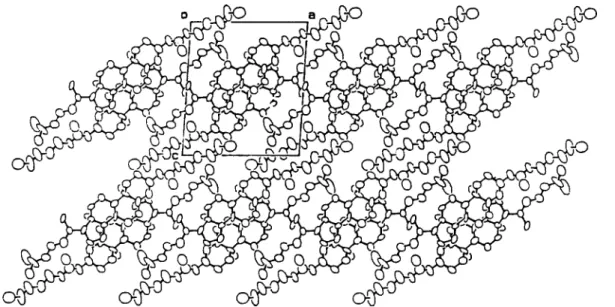
C(25), C(27) are in a zigzag planar chain and C(21) and C(26) are out of the plane. The conformation of the n-pentyl group also has all- trans form.The packing dis^rams are shown in Fig. 2 and 3. The planes of the cholesteryl group are parallel to ac plane with the entire molecular long axes be
ing nearly parallel to the [201] direction. The crystal structure consists of antiparallel molecules arranged to form monolayers with a thickness of one unit cell (do0i = 14.05 A). There is an efficient packing of cholesterol ring systems within the stacks of molecules which are related by two-fold
Vol. 34t No.1, 1990
34
徐惠蘭 • 朴英子 •
B.M, CravenFig. 2. The crystal structure of
가
i이
esteryl pentyl carbonate in projection down나】
e b axis. Atoms are아
iown as 50%probability ellipsoids.-
of the Korean Chemical Society
Cholesteryl Pentyl Carbonate
의 결 정 및 분자구조
35Fig. 3. The crystallographic (010) projections of the cholesterol tetracyclic ring systems of cholesteryl pentyl carbon- ate(a), cholesteryl hexyl carbonate(b), cholesteryl hexanoate(c), cholesteryl octanoate(d), cholesteryl oleate(e), choles
teryl linolelaidate(f), cholesteryl chloroformate(g), cholesteryl formate(h), cholesteryl isobutyrate(i).
Vol. 34, No. 1, 1990
36
徐惠蘭•朴英子•
B.M. Cravenscrew axes. In directions more or less parallel to the crystal 6-axis there are multiple intermolecular C...C distances less than 4.5 A, of which the shortest (3.72 A) is C(6)...C(18).
Similar structures of cholesteryl chloroformate, cholesteryl octanoate, hexanoate, oleate, linoledaidate and hexyl carbonate. Those are all isostructural with the others. In the six crystal structures, the arrangement within the central region of the monolayers is very similar. The dif
ference in monolayer thickness (13.64-18.79 A) is associated primarily with structural differences in the interlayer region. The atoms in this region con
sist of the alkanoate or alkyl carbonate chains of the molecules.
Crystal Structures of cholesteryl chloroformate, formate and isobutyrate also belong to monolayer type IL Those three structures are not isostruc* tural with one another. In the cholesteryl chlorofor- mate, there is some overlap of the B, C and D rings in a manner similar to the cholesteryl octanoate while in the formate, there is no overlap of the steroid rings viewed down the screw axis. In the structure of isobutyrate, the two distinct molecules form separated stacks with differing degrees of steroid overlap; efficient cholesteryl packing of the molecules in (A) and no overlap in molecule (B).
These monolayer type II are compared as shown in Fig. 3.
ACKNOWLEDGEMENT
We are very grateful for the financial support by the Ministry of Education as a Free Research Pro- ejct in 1987. This research has been performed us
ing the SEC computer system of the joint project between SEC and IBM, Korea.
REFERENCES
1. B. M. Craven, “The Physic
이
Chemistry of Lipids","Handbook of Lipid Research", Vol.4„ Chapter 6 Edit., D. M. Small, Plenum Press, New York (1986).
2. I. -H. Suh, T. -S. Ko, Y. J. Park, Y. K. Yoon and W. Saenger, Acta Cryst., C44, 2163 (1988).
3. B. K. Kang, M. J. Chung, and Y. J. Park, Bulletin of the Korean Chem. Soc., 6, 333 (1985).
4. R. J. Chandross and J. Bordner, Acta Cryst., B34, 2872 (1978).
5. M. H. Kim, Y. J. Park and C. T. Ahn, Bulletin of the Korean Chem. Soc., 10, 177 (1989).
6. Y. J. Park and B. M. Craven, J. Korean Chem. Soc., 25, 131 (1981).
7. J. A. W. Barnard and J. E. Lydon, Mol. Cryst. Liq.
Cry st., 16, 285 (1974).
8. B. M. Craven and N. G. Guerina, Chem. Phys. Lipids, 24, 157 (1979).
9. B. M. Craven and N. G. Guerina, Chem. Phys. Lipids, 29, 91 (1979).
10. B. M. Craven and P. Sawzik, J. Lipid Res., 24, 784 (1983).
11. P. Sawzik and B. M. Craven, J. Appli. Cryst., 14, 351 (1981).
12. N. G. Guerina and B. M. Craven, J. Chem. Soc.
Perkin Transactions II, 1414 (1979).
13. P. Sawzik and B. M. Craven, Acta Cryst., B36, 3027 (1980).
14. B. M. Craven and G. T. Detitta, J. Chem. Soc., Perkin Transactions II, 814 (1976).
15. P. Sawzik and B. M. Craven, Acta Cryst., B35, 895 (1979).
16. B. M. Craven and P. Sawzik, J. Lipid.Res., 25, 851 (1984).
17. G. M. Sheldrick, SHELX-76; Program for Crystal Structure Determination., Univ, of Cambridge, En
gland (1976).
18. ^International Tables for X-ray Crystallogrphy", Vol. IV, Kynoch Press, Birmingham, England (1974).
19. C. K. Johnson, ORTEP, Report-3794, Oak Ridge Na
tional Lab. Tennessee, U.S.A. (1975).
20. W. L. Duax and D. A. Norton, "Atlas of Steroid Structure", Vol.l, Plenum Press, New York, U.S.A (1975).
Journal of the Korean Chemical Society