<연구논문>
233
황색계 천연염료의 화학구조 및 염색성
차민경1)·이문수2)·박주혁3)·권윤정1) 1) 건국대학교섬유공학과
2) 배재대학교의류패션학과 3) 세종대학교기계항공우주공학부
The Chemical Structure and the Dyeability of Yellow Natural Dyestuff
Min-Kyoung Cha1), Mun-Soo Lee2), Joo-Hyuk Park3) and Yoon-Jung Kwon1) 1) Dept. of Textile Engineering, Konkuk University, Seoul, Korea
2) Dept. of Clothing & Textiles, Paichai University, Daejeon, Korea 3) Dept. of Mech. & Aero Engineering, Sejong University, Seoul, Korea
Abstract : This research confirmed the chemical structure of Curcumine and Carthamin pigments whose pigments were separated and refined from theCurcuma longa and Carthamus Tinctoriouswhich were natural dye using FT-IR, HPLC and so on. The cotton and the silk fabrics were dyed using a main pigment and then this research obtained the conclusion as it follows. The curcumine, the main pigment of Curcuma longa extracted from the mixed solvent of acetic anhydride and methanol (CH3OH), had the maximum absorption wavelength at 504.0 nm and was confirmed as yellow natural pig- ment. The Carthamin, the main pigment of Carthamus Tinctorious extracted from the mixed solvent of dichloromethane and methanol, had the maximum absorption wavelength at 420.0nm. This pigment was confirmed as yellow natural pig- ment. The dyeing property of the main pigment about the silk fabrics was superior to that about the cotton in both the Curcuma longa and Carthamus Tinctorious, and the dyeing property of Carthamus Tinctorious was superior to that of Curcuma longa.
Key words : yellow natural dyestuff, extract, chemical structure, dyeability
1. 서 론
천연염료를이용한 염색은색소 추출과염색공정이복잡할 뿐만아니라염색을하는데많은시간이소요되며원료구입과 보관이어렵기때문에일부기증보유자및공예염색가에의 해서만명맥이이루어지고있다. 또한역사가오래된것에비 해전해내려오는문헌이거의없다는아쉬운점이있지만, 합 성염료가가지고있는인체에대한유해성과공해및폐수문제 를해결할수있는염료이기때문에, 현대첨단기술과접목시 켜신기술로개발한다면염색에서뿐만아니라천연색소와향 료, 의약품개발및환경보호에도큰몫을할수있을것으로 기대된다(Hwang et al., 1998; Lim et al., 1997; Chu et al., 2001).
이렇게천연염료의응용이대두되는가운데본실험에서사 용한울금(Curcuma longa L., Zingiberaceae)은생강과에속하 며, 특유한향기를지니고있고 진한황색을띤다. 꽃은녹백
색의수상화가나와서매포엽의끝에방추형의괴근이달려있 고, 단면은선황황색을띠고있다. 잎은 4~5개가두방향으로 나있으며, 위경을형성하고, 엽신은길며끝은뾰족하게되어
있다. 기원전 600년전부터의기록이담겨진아시리아식물지 에는착색성의물질로서울금이기재되어있고, 인도동남아중
부에서는옛날부터견, 면의염색과식품의착색에이용되어왔 다. 한방에서는뿌리줄기를강황, 덩이뿌리를울금이라하여약 용으로 이담, 건위, 황달, 강폐, 산후어혈복통, 질타손상등의 치료제로쓰인다. 열대아시아원산으로우리나라, 인도, 인도네 시아. 중국, 대만, 일본등에 분포하며, 가을부터괴근을채취 하여 염색용은 5-7일간일광에서건조시키고, 약재는쪄서일 광에 건조시켜 사용한다(Lee et al., 1997; Chu et al., 1996;
Kang et al., 1998).
‘잇꽃’이라고도 불리는 홍화(Carthamus tinctorius L., Compositae)는국화과에속하는일년생초목으로, 줄기의길이
가 1 m 정도이고꽃은 7~8월에 피며 붉은빛이 도는 황색을
띄고 있다. 원산지는아프가니스탄의산악지대또는 에티오피 아이며중국, 티베트등지에서재배되었다. 인류의문화사상가
장오랜역사를지닌염료식물중하나라고전해지며, 이집트 Corresponding author; Yoon-Jung Kwon
Tel. +82-2-450-3521, Fax. +82-2-457-8895 E-mail: [email protected]
료가사용된역사가오래된것임을밝혔다. 꽃잎은홍화로불 리어색소및약용으로이용되어, 고혈압, 동맥경화치료및예
방에 쓰이며, 의류특히 비단등의염색에 사용되고있다. 홍 화의적색소는물에녹지않으나알칼리에용해되기때문에전 통적으로알칼리성잿물로추출하고오미자추출액으로산성화 하여 색소를 침전시킴으로써 제조해왔다(Cho et al., 1997;
Han et al., 1998; Kim et al., 1995).
본연구에서는칼럼 크로마토그래피를통해 천연염재인울 금과홍화를분리정제하여얻은주색소를가지고, 자외-가시광
선흡수스펙트럼, 적외선흡수스펙트럼및고성능액체크로 마토그래피등을측정하여화학구조를분석하였으며, 면과견
에염색함으로써주색소의염색성을비교, 분석하였다.
2. 실 험
2.1. 시료
천연염재인울금과홍화는시중약재상에서구입한것을사
용하였다. 시험포는 KS K0905에규정된첨부백포인견및면
직물을사용하였으며실험에사용한시료의특성은 Table 1와 같다.
2.2. 시약
Acetone (Matsunoen Chemicals LTD), Methyl Alcohol (CARIO ERBA Reacenti), O-Dichloro-benzene (TEDIA), Acetic anhydride (Junsei Chemical Co., LTD), Chloroform (SHOWA) Benzen (SHOWA Chemical Co., LTD), Dichloromethane (TEDIA Co., Inc) 등의특급및 1급시약을사용하였다.
2.3. 주색소 추출
울금및홍화를각각 100 g씩메탄올 1500 ml에침지시켜 3
일간상온에서방치시켰다. 이를감압여과하여울금 1430 ml,
홍화 1350 ml의추출물을얻고, Evaporator를사용하여 70oC에 서 용매를 제거함으로써 울금 5.02 g, 홍화 8.3 g의 추출물을
얻었다. 다시진공펌프로감압, 추출물내의소량의메탄올을 제거하여순수한시료를채취한후, 디클로로메탄(CH2Cl2) : 메
전개액은각각디클로로메탄과메탄올의혼합용매와아세틱안 하이드라이드과 메탄올의 혼합용매이다(Han et al., 1998;
Walczak et al., 1996; Kim et al.,2000).
2.4. 자외-가시광선 흡수 스펙트럼 측정
울금및홍화로부터분리정제한주색소의흡광도비교를위
해서 자외-가시광선 분광 분석기(HEλIOS, UNICAM)를사용
하여 흡수 스펙트럼을 측정하였다. scan type은 standard로, speed는 3800m/min로 하였으며, Data int는 4.0 nm이고, Bandwidth는 2.0 nm이며 Lamp change는 325 nm로 setting하
여작동시킨후, 200~800 nm의파장에서자외-가시광선흡수
스펙트럼을측정하였다.
2.5. 적외선 흡수 스펙트럼 측정
울금및홍화로부터추출한주색소를각각적외선분광장치
(FT-IR 300E, JASCO)를사용하여적외선흡수스펙트럼을측
정하였다. 이때해상도는 4 cm-1로하고적외선주사수는 30으 로하였다.
2.6. 고성능 액체 크로마토그래피 측정
고성능 액체 크로마토그래피(HPLC, High Performance Liquid Chromatograph System)와가변파장 모니터를 사용하
여 480 nm에서울금 및홍화의주색소의성분을 분석하였다.
주색소를혼합용매에 1:100의액비로용해시킨후, 각각의용
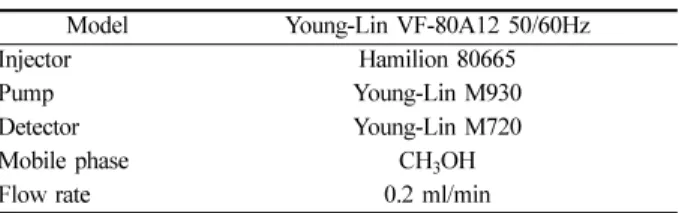
액 30µl를사용하여, Table 2에나타난조건으로 HPLC를측 정하였다. 이때사용한혼합용매는울금의경우디클로로메탄 과메탄올의혼합용매이고, 홍화의 경우아세틱안하이드라이 드과 메탄올의 혼합용매이다(Park et al., 1987; Kim et al., 1995).
2.7. 염색과정
울금및홍화로부터추출한주색소의염색성을비교하기위 해다음과같이염색을행하였다. 울금은아세틱안하이드라이
드를, 홍화는디클로로벤젠과메탄올을 1:1로섞은혼합용매를
Table 1. Characteristics of fabrics
Fabric Weave Yarn Number Fabric counts
(thread/5 cm) Weight Thickness(mm) Warp Weft Warp Weft
silk Plain 21D 21D/2 276 192 25 0.08
cotton Plain 30'S 36'S 141 135 100 0.20
Table 2. Analytical Condition of HPLC
Model Young-Lin VF-80A12 50/60Hz
Injector Hamilion 80665
Pump Young-Lin M930
Detector Young-Lin M720
Mobile phase CH3OH
Flow rate 0.2 ml/min
용매로사용하여 1:50의액비가되도록염액을준비한후, 50
oC에서 30분동안면과견에 직접염색(무매염염색)을행하였
다. 염착량의증대를위해 2회반복염색하였으며, 염색공정은
Fig. 1와 같다(Kim et al., 2001; Kim, 2001; Chang et al., 2001; Park et al., 2000).
2.8. 염착량 측정
염색한 직물의 염착량을 알아보기 위해, 색차계(Color-Eye
3100)를사용하여분광반사율을측정하여 Kubelka-Munk 식을
이용함으로써염착량을나타내는 K/S값은구했으며, 이때광 원은 D65, 관측시야는 10o의조건으로하였다.
Kubelka-Munk 식:
여기서, K : 흡수계수
S : 산란계수
R : 분광반사율 (0<R≤1) 3. 결과 및 고찰
3.1. 자외-가시광선 흡수 스펙트럼
칼럼크로마토그래피를 통해 울금 및홍화의 추출물로부터 주색소를분리한후, 주색소의자외-가시광선흡수스펙트럼을 측정하여분석하였다.
Fig. 2는울금의추출물로부터분리정제한주색소의자외-가
시광선흡수스펙트럼을나타낸것으로, 울금의주색소는 504
nm에서최대흡수파장을나타내었으며, 220~350 nm의영역에
서 흡수대를 가지고 있음을 알 수 있었다. 그러나 220~350
nm의흡수대는색을나타내는가시광선영역대가아니므로주
색소의최대흡수파장이 504 nm라는것을통해울금은황색계 열의색깔을나타내는염료임을알수있었다.
Fig. 3은 홍화의 추출물에서 분리정제한 주색소의 UV-Vis
Spectrum을나타낸것으로, 측정 결과 480 nm에서 최대흡수 파장을나타내었으며, 404 nm, 464 nm에서도흡수파장을나타
내었다. 따라서홍화의주색소는 400 nm 후반의최대흡수파장
을갖는붉은 오렌지계열의 색깔을나타내는염료임을확인 할수있었다.
3.2. 적외선 흡수 스펙트럼
Fig. 4는울금주색소의적외선흡수스펙트럼측정 결과이
다. 3407 cm-1부근에서넓은흡수 피크를보이는데이것은울
금의색소구조에존재하는페놀성 OH기의신축진동으로인한
것이며, 2931 cm-1부근의다중흡수피크는지방족 C-H기의신축
진동에 의한것이다. 1722 cm-1부근의흡수피크는울금의색
소구조내의 C=O기에의한신축진동에의해나타난것임을알
K S⁄ (1 R– )2 ---2R
=
Fig. 1. Dyeing process.
Fig. 2. UV-Visible spectrum of Curcumine.
Fig. 3. UV-Visible spectrum of carthamin.
Fig. 4. FT-IR spectrum of Curcumine.
수있었다.
Fig. 5는홍화주색소의적외선흡수스펙트럼측정결과이
다. 3370 cm-1의넓은영역에서 hydroxy기(-OH)의신축진동에
의한흡수피크가형성되었고, 2919 cm-1부근에서방향족 C-H
기의신축진동에의한흡수피크및 1724 cm-1부근에서 C=O기 에의한흡수피크가형성되었으며, 1724 cm-1와 1573cm-1 부 근에서는방향족과 지방족의 C=C기에의한 흡수피크가형성 되었음을알수있었다. 또한 1450 cm-1부근에서 CH2기의강 한흡수피크가형성되었으며, 1132 cm-1에서는 C-O기의흡수 피크가형성되었고, 748 cm-1부근에서는방향족의 C-H기에의
한흡수피크를확인할수있다. 따라서주색소는기본구조로
Phenol 구조를가지고있으며, methaquinoid 골격에여러치환
체를가짐으로써 H원자의부재가가장큰특징으로나타남을 알수있었다.
3.3. HPLC 성분분석
울금 주색소의 HPLC 분석에서 분석 파장은 UV-Visible
Detector로 분석 시울금 주색소의 최대흡수파장인 504 nm로
하여성분분석을행하였다. Fig. 6은울금주색소의 HPLC 결
과를 나타낸 것이다. 504 nm에서 주색소의 HPLC의 결과는
retention time(Rt) 2.110분과 4.223분에서 피크가 나타났으며,
2.110분에나타난피크가최대값을가지는것으로보아이시
간대에나타난피크가울금의주색소임을알수있었다.
홍화의주색소의 HPLC 분석에서도분석파장은 UV-Visible
Detector로분석시최대흡수파장인 480 nm로고정하여성분
분석을행하였다. Fig. 7은홍화주색소의 HPLC 결과를나타
낸것이다. 홍화주색소는 Rt 2.065분과 2.712에서굉장히큰 피크를나타내었으므로이부분이홍화의주색소임을확인할 수있었다.
3.4. 염색성
Fig. 8은면과 견을울금의 주색소로염색한 후에 K/S값을
비교한 그래프이다. 견과 면이 400 nm에서 각각 3.0313과 3.1136의최대 K/S값을나타냈으나 400 nm에서 500 nm까지의 그래프상의기울기를비교해보면면보다견의염착량이더우 수하다는것을알수있다. 그이유는견의피브로인이일반적 으로아미노기와카르복실기등과같이염료와결합을이룰수 있는활성기를많이함유하고있기때문인것으로사료된다. 따 라서디케톤화합물인울금에대한친화력은면섬유보다견섬 유가 더우수하다고볼수있다(Cho et al., 2000; Rhie et al., 1999).
Fig. 9는홍화의주색소로염색한면과견의 K/S 값을비교
Fig. 5. FT-IR spectrum of Carthamin.
Fig. 6. High performance liquid chromatography of Curcumine.
Fig. 7. High performance liquid chromatography of Carthamin.
Fig. 8. K/S values of silk fabric and cotton fabric dyed with Curcumine.
한 것으로, 견에서더좋은염색성을나타내고있다. 울금에서 와마찬가지로견의염착좌석이면보다더많기때문에, 홍화 또한면섬유보다는견섬유에더우수한친화력이있다고할수 있다. 이는홍화의황색소는견, 양모에는직접염색성을갖고 있으나면에대해서는염색성이낮다는이전연구결과와유사 하였다(Yong et al., 1999; Lee et al., 1998).
Fig. 10과 11은각각견섬유와면섬유에대한울금및홍화
의염색성을비교한그래프이다. 그래프를통해두직물모두 에대해울금보다는홍화의염색성이더우수한것으로나타났 다. 이것은울금과비교하여홍화가견섬유및면섬유와결합 을할수있는활성기를더많이함유하고있으며, 섬유에대
한직접성이더우수하기때문이라고사료된다.
4. 결 론
본연구는천연염료인울금과홍화로부터분리정제하여얻 은 주색소의 화학구조를 UV-Visible, FT-IR 및 HPLC 등을 이용하여확인하고, 면과견직물에대한염색성을비교하여다 음과같은결론을얻었다.
1. 울금은 Curcumine을주색소로하는 황색계통의 색소이
며, 홍화는 Carthamin을주색소로하는 붉은오렌지색계통의
색소임을알수있었다.
2. 울금과홍화의염색성은면보다견에대한염색성이우수
하였으며, 면및견에대한염색성은울금과비교하여홍화가 더우수하였다.
감사의 글 :본연구는 2004년한국과학재단특정기초연구 (과제번호 R01-2003-000-10-72-0)의연구비지원에의하여수행 되었음.
참고문헌
Cho K.R. and Kang M.J. (2000) Studies on the natural dyes(12)- dyeing properties of amur cork tree colors for silk. Journal of the Korean Society of Dyers and Finishers, 12(4), 13-21.
Cho S.S., Song H.S. and Kim B.G. (1997) The dyeiability properties of some yellow natural dyes(Part II). Journal of the Korean Society of Clothing and Textiles, 21(6), 1051-1059.
Chu Y.J. and Soh H.O. (1996) The study of curcuma longa L, dyeing.
Journal of the Korean Society of Clothing and Textiles, 20(3), 429- Chu Y.J. and Soh H.O. (2001) The study on the mordanting and dyeing437.
properties of polygenetic natural dyes(part I). Journal of the Korean Society of Clothing and Textiles, 25(8), 1484-1492.
Han B.S., Kim K.H. and Jung Y.S. (1998) Supercritical fluid extraction of safflower yellow pigments from carthamus tinctorius L.
Agricultural Chemistry and Biotechnology, 41(5), 363- 366.
Hwang E.K., Kim M.S., Lee D.S. and Kim K.B. (1998) Color development of natural dyes with some mordants. Journal of the Korean Fiber Society, 35(8).
Kang W.S., Kim J.H., Park E.J. and Yoon K.R.(1998) Antioxidative property of turmeric(curcumae rhizoma) ethanol ectract. Korean J.
Food Sci. Technol, 30(2), 266-271.
Kim A.S. and Chang C.C. (2001) A study on the dyeing properties of silk cotton fabrics with chestnut bur extract(2). Journal of the Korean Society of Clothing and Textiles, 13(2), 7-17.
Kim B.H. and Song W.S. (2000) The dyeability and antimicrobial activity of silk and cotton fabries with saururus chinensis extract.
Journal of the Korean Society of Clothing and Textiles, 2(3), 215- Kim M.H. and Park S.B. (1987) Studies on the content of pueraria219.
radix in the tea by HPLC. Kor. J. Food Hyglene, 2(3), 89-95.
Kim M.N. and Kim H.H. (1995) Analysis of safflower by high-
Fig. 9.K/S values of silk fabric and cotton fabric dyed with Carthamin.
Fig. 10.K/S values of silk fabric dyed with Carthamin and Curcumine.
Fig. 11.K/S values of cotton fabric dyed with Carthamin and Curcumine.
cotton with clove extract. Journal of the Korean Society of Dyers and Finishers, 10(3), 29-35.
Lee S.H., Choi W.J., Lim Y.S. and Kim S.H. (1997) Antimicrobial effect of ethanol extract from curcuma aromatica S.. J. Food Sci.
and Technol., 9, 161-165.
Lim M.E., Yoo H.J and Lee H.Y. (1997) The study on natural dyeing with artemisia. Journal of the Korean Society of Clothing and
Walczak B., Dreux M., Chretien J. and Doucet J.P. (1996) 50. Journal of Chromatography, 353, 109-121.
Yong K.J., Kim I.H. and Nam S.W. (1999) Antibacterial and deodorization activities of cotton fabrics dyed with amur cork tree extracts. Journal of the Korean Society of Dyers and Finishers, 11(1), 9-15.
(2004년 11월 5일접수)