*Corresponding author: Kwang-Min Choi, Tel: +82-31-209-1206, E-mail: [email protected]
Samsung Health Research Institute(SHRI), 95, Samsung 2-Ro, Giheung-Gu, Yongin-Si, Gyeonggi-Do, 446-811, Korea Received: July 2, 2015, Revised: August 21, 2015, Accepted: August 31, 2015
This is an Open-Access article distributed under the terms of the Creative Commons Attribution Non-Commercial
License(http://creativecommons.org/licenses/by-nc/3.0) which permits unrestricted non-commercial use, distribution, and reproduction in any medium, provided the original work is properly cited.
http://dx.doi.org/10.15269/JKSOEH.2015.25.3.294
반도체 메탈공정 및 1차 스크러버에서 생성되는 파우더 부산물의 물리화학적 특성분석
최광민*ㆍ정명구ㆍ안희철
삼성전자 건강연구소
Physicochemical Characterization of Powder Byproducts Generated from a Metallization Process and Its 1st Scrubber in the Semiconductor Industry
Kwang-Min Choi*·Myung-Koo Jung·Hee-Chul An
Samsung Health Research Institute, Samsung Electronics Co. Ltd.
ABSTRACT
Objectives: The aim of this study is to identify physicochemical properties such as chemical composition, size, shape and crystal structure of powder byproducts generated from a metallization process and its 1st scrubber in the semiconductor industry.
Methods: Powder samples were collected from inner chambers during maintenance of the W-plug process equipment (using tungsten hexafluoride as a precursor material) and its 1st scrubber. The chemical composition, size and shape of the powder particles were determined by field emission scanning electron microscopy (SEM) and transmission electron microscopy (TEM) equipped with an energy dispersive spectroscope (EDS). The crystal structure of the powders was analyzed by X-ray diffraction (XRD).
Results: From the SEM-EDS and TEM-EDS analyses, O and W were mainly detected, which indicates the powder byproducts are tungsten trioxide (WO
3), whereas Al, F and Ti were detected as low peaks. The powder particles were spherical and nearly spherical, and the particle size collected from the process equipment and its 1st scrubber showed 10-20 nm (agglomerates: 55-90 nm) and 16-20 nm (agglomerates: 80-120 nm) as primary particles, respectively. The XRD patterns of the yellow powder byproducts exhibit five peaks at 23.8゚, 33.9゚, 41.74゚, 48.86゚ and 54.78゚, which correspond to the (200), (220), (222), (400), and (420) planes of cubic WO
3.
Conclusions: We elucidated the physicochemical characteristics of the powder byproducts collected from W-plug process equipment and its 1st scrubber. This study should provide useful information for the development of alternative strategies to improve the working environment and workers' health.
Key words: metallization process, physicochemical properties, powder by-product, semiconductor, tungsten oxide
I. 서 론
반도체 제조 산업은 제품 미세화에 따른 신공정 개발로 인해 다양한 금속 및 유기물을 포함하는 화 학물질이 지속적으로 도입되고 있으며, 사용하는 화 학물질은 점차적으로 증가하고 복잡해지고 있는 추
세이다(Levinshtein et al., 2001). 이러한 화학물질(또 는 제품)이 반도체 공정에 사용되는 과정에서 반응 챔버 내 잔류한 물질 및 화학물질간의 반응에 의해 생성 된 다양한 부산물이 반도체 제품불량을 유발할 수 있기 때문에 사전 예방을 위해 설비 내 배기시스템 가동, 반 응 챔버 내 밀폐상태에서의 세정, 정기적인 생산설비 및
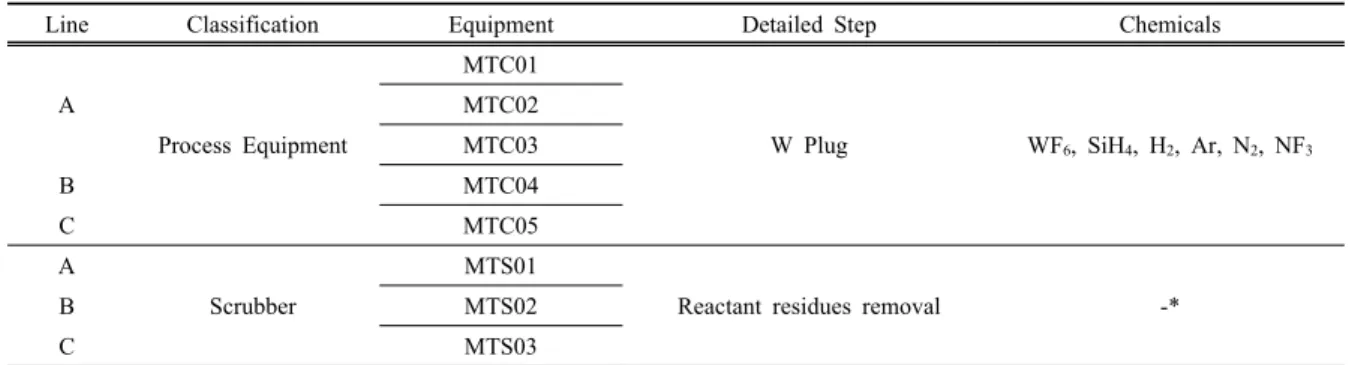
Line Classification Equipment Detailed Step Chemicals
A
Process Equipment
MTC01
W Plug WF
6, SiH
4, H
2, Ar, N
2, NF
3MTC02 MTC03
B MTC04
C MTC05
A
Scrubber
MTS01
Reactant residues removal -*
B MTS02
C MTS03
* Chemicals are not used.
Table 1. Chemicals used in metal process equipment for 200 mm wafer manufacturing facilities
1차 스크러버와 같은 부대설비의 유지보수를 진행하고 있다. 여기서 1차 스크러버는 공정에 사용된 후 배기되 는 각종 화학물질을 인체 및 환경에 유해하지 않도록 처 리하는 설비이다. 하지만, 이러한 오염제거 시스템에도 불구하고, 공정 잔류 화학물질 및 부산물을 설비 내부로 부터 완전히 제거하는 것은 불가능하기 때문에, 반응 챔 버를 열어서 진행하는 설비 유지보수 작업 시에 반응 잔 여물 또는 부산물의 공기 중 노출 및 작업자 흡입 영향 성을 고려해야 한다(Park et al., 2011a; 2012b; 2014c). 따 라서 작업환경 내에서의 작업자 건강유지 및 증진을 위 한 사전예방적 원칙에 기초하여 설비 유비보수 작업 시 설비 챔버 내부 및 주변 공기 중에 존재하는 부산물의 화학적 조성, 크기, 형상, 결정구조 등의 특성분석 및 부 산물의 노출평가 등에 대한 연구가 중요하다(Choi et al., 2013; 2015a; 2015b; 2015c).
기존 연구로부터 확산(Diffusion), 화학기상증착 (Chemical Vapor Deposition), 화학적기계적연마 (Chemical Mechanical Polishing), 식각(Etch) 공정 등 의 반도체 주요 공정 및 1차 스크러버 유지 보수 작 업 시에 SiO2 금속산화물이 대표적인 파우더 부산물 로 생성 또는 존재하고, 1차 및 응집입자 기준 입경 분포는 0.1-50 µm 이며, 형상은 대부분 구형으로 비 정질 결정구조를 나타내고 있음이 확인되었다(Choi et al., 2013; 2015a). 그 외에도 공정에 따라 TiO2, Al2O3 및 WO3 등의 파우더 부산물도 생성됨을 추정 할 수 있었다. 그러나 SiO2 파우더 부산물에 대해서 는 에너지분산분광기 장착 주사형 및 투과형 전자현 미경, X선 회절분석기 등의 다양한 분석기를 활용하 여 조성, 크기, 형상, 결정구조 등에 대한 물리화학적 특성분석 연구가 수행된 반면, TiO2, Al2O3 및 WO3
등의 금속산화물 형태의 파우더 부산물에 대해서는 깊이 있는 특성분석이 수행되지 않았기 때문에 이들 부산물에 대한 연구의 필요성이 있다. 메탈 공정은 Al, W, Cu, Au 등의 금속을 사용하여 금속 배선 (Metal Line)을 만드는 공정으로, 칩 외부에서 흘러들 어오는 전기적 신호를 칩 내부의 각 소자로 전달시 켜 주기도 하고 반대로 칩 내부의 전기적 신호를 외 부로 전달해 주는 전달자 역할도 동시에 한다. 본 연 구의 대상이 되는 메탈 공정 중 W plug 공정은 WF6, SiH4, H2를 이용하여 W을 증착하고 contact 외부의 W을 CMP 공정으로 제거하는 기술인데 디바이스가 고집적화됨에 따라 금속배선의 접촉 감소 등으로 기 존의 Al으로는 성능 구현이 불가능해져 디바이스의 신뢰성 향상 및 공정 단순화를 위해 도입한 화학기 상증착방법으로 진행되는 초고집적 디바이스 배선기 술 중 하나이다. 본 연구에서는 W 포함 물질을 사용 하여 WO3 입자가 부산물로 생성 가능한 반도체 메 탈 공정 설비 및 1차 스크러버에서 확인되는 파우더 부산물을 수집하여 화학적 조성, 크기, 형상 및 결정 구조를 분석함으로써 사전 예방적 원칙에 기초한 작 업환경 내 미지의 유해인자에 대한 불확실성을 감소 시켜 작업환경 개선은 물론 작업자 건강유지 및 증 진에 필요한 정보를 제공하고자 하였다.
Ⅱ. 연구 대상 및 방법
1. 연구대상 라인 및 공정
본 연구는 경기도 용인시 기흥에 위치한 시스템 LSI(Large Scale Integrated) 200 mm 웨이퍼를 제조하는 3개 라인 내 텅스텐(W) 배선을 위해 공급가스로 WF6를
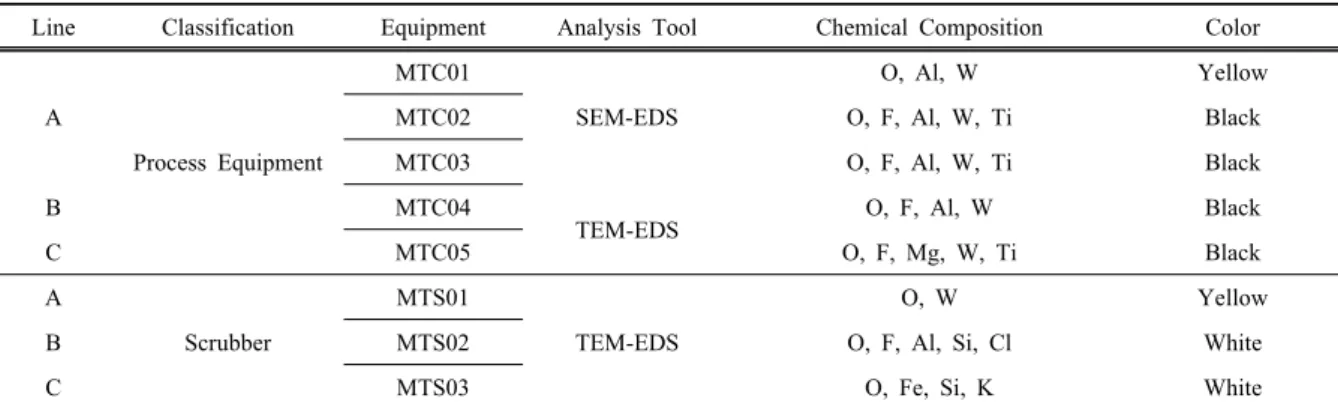
Line Classification Equipment Analysis Tool Chemical Composition Color
A
Process Equipment
MTC01
SEM-EDS
O, Al, W Yellow
MTC02 O, F, Al, W, Ti Black
MTC03 O, F, Al, W, Ti Black
B MTC04
TEM-EDS O, F, Al, W Black
C MTC05 O, F, Mg, W, Ti Black
A
Scrubber
MTS01
TEM-EDS
O, W Yellow
B MTS02 O, F, Al, Si, Cl White
C MTS03 O, Fe, Si, K White
* Carbon or copper among element compositions was omitted because carbon tape or copper grid as a background was used for SEM-EDS or TEM-EDS analysis
Table 2. Chemical composition and color of the powder by-products generated from metallization process including W plug by scanning electron microscopy and transmission electron microscopy equipped with energy dispersive x-ray spectroscopy*
사용하며 파우더 부산물의 생성이 확인되는 메탈 공정 중 W Plug 공정 진행 설비 5대 및 1차 스크러버 (Burn-wet type) 3대를 대상으로 하였다.
2. 샘플 수집 및 설비 별 사용 화학물질
파우더 시료(8개)는 공정설비의 경우 설비 정지, 챔버 덮게를 개방한 후 약 1시간 챔버 내부를 배기 시킨 다음 챔버 내부에서 채취하였다. 한편 스크러버 의 경우는 스크러버 가동 후 챔버를 분리한 다음 공 정설비와 동일하게 챔버 내부에서 채취하였다. 반도 체 공정용 Clean wiper 및 50 mL polypropylene 코니 칼 원심관(Conical Centrifuge Tube, 352098, Falcon, USA)을 사용하여 직접 수집하였으며, 해당설비에서 사용되는 화학물질을 Table 1에 표기하였다.
3. 분석
샘플 파우더 입자의 구성성분, 입자크기, 형상 및 결 정구조 분석을 위해 에너지분산분광기(Energy Dispersive Spectroscopy; EDS: INCA 200, Oxford Instruments, Abingdon, Oxfordshire, UK) 장착 주사전자현미경 (Scanning Electron Microscopy; SEM: JSM 7001F, JEOL, Tokyo, Japan) 또는 투과전자현미경(Transmission Electron Microscopy; TEM: TITAN 30-800, FEI, Hillsboro, USA)을 사용하여 분석(가속전압: 20kV, 분 석배율: x 2,000-300,000, 관찰 Field 수: 5)하였다. 또한 파우더 샘플의 결정구조 확인을 위해 X선 회절분석기 (X-ray Spectroscopy; XRD: M18XHF22, Bruker AXS
GmbH, Karlsruhe, Germany)를 사용하여 분석(2Theta:
10-60℃, Step Size: 0.02°, 가속전압: 40 kV)하였다.
Ⅲ. 연구결과
1. 화학적 조성
W plug 공정 설비 유지 보수 작업 시 설비 내 파 우더가 확인되는 2개 설비군 5대 및 부대설비인 1차 스크러버(Burn-wet type) 설비 3대에서 수집한 파우 더 부산물의 SEM-EDS 분석 결과를 Table 2에 나타 내었다. MTC01-05는 모두 W 배선을 만드는 생산설 비로서 사용하는 화학물질은 동일하다(Table 1). 하 지만 MTC01호기에서 수집한 파우더에서는 주 성분 으로 O와 W, 그리고 부 성분으로 Al이 검출되었다.
한편, MTC02-05호기에서의 파우더에는 O, Al, W 외 에 F, Ti, Mg 성분이 함유되어 있는 것으로 확인되었 다. 각 공정설비 별 수집한 파우더의 색깔은 MTC01 호기에서의 파우더가 밝은 노란색을 나타낸 반면, MTC02-05호기에서의 파우더는 모두 검은색을 나타 내었다. 공정에 사용된 반응 잔여물을 처리하는 1차 스크러버 설비에서 수집한 파우더의 성분분석 결과, MTS01에서 수집한 파우더는 O와 W으로만 구성되 어 있었으나, MTS02, MTS03호기에서 수집한 파우 더에서는 주요 성분일 것으로 예상된 W은 검출되지 않았다. 파우더 색깔에서는 O와 W만으로 구성된 MTS01호기에서의 파우더는 노란색을 나타내었고, MTS02 및 03호기에서의 파우더는 흰색계열의 색깔
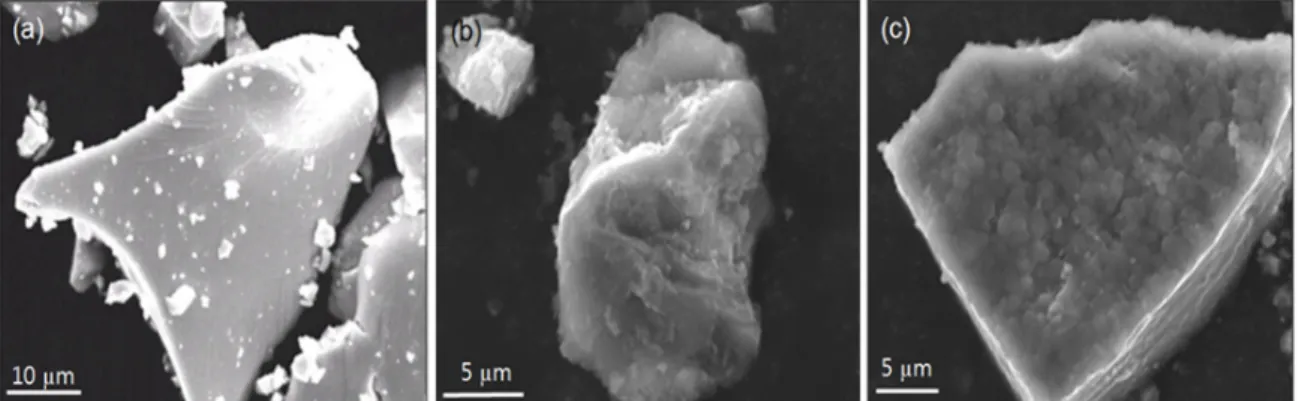
Figure 1. Scanning electron microscopy images of powder by-products collected from process equipment: (a) MTC01, (b) MTC02, and (c) MTC03
Figure 2. Transmission electron microscopy images of powder by-products collected from process equipment (MTC04): (a) marker 0.2 µm, (b) marker 100 nm, (c) marker 10 nm
Figure 3. Transmission electron microscopy images of powder by-products collected from 1st scrubber equipment (MTS01): (a) marker 200 nm, (b) marker 100 nm, (c) marker 20 nm
을 나타내는 것으로 확인되었다.
2. 크기 및 형상
Figure 1은 Line A의 MTC01-03호기 유비보수 작업 시에 챔버 내부에서 수집한 파우더 부산물의 SEM
images를 나타낸 것이다. 전자현미경 배율은 2,000- 4,000배 정도의 저배율로 관찰하였으며, 대부분 응집 상을 나타내고 있고 응집상 표면에 약 100 nm에서 수 µm 수준의 미세한 구형의 1차 입자(Primary particle) 가 존재하고 있음을 확인할 수 있었다. 한편 MTC01
호기 파우더 샘플의 TEM 분석을 수행하였으나 입자 가 관찰되지 않아 크기 및 형상은 확인할 수 없었다.
Figure 2는 Line B의 생산설비인 MTC04호기 유지보 수 작업 시에 챔버 내부에서 수집한 파우더 부산물의 TEM images를 나타낸 것이다. 1차 입자 기준 10-20 nm 의 구형 입자가 응집(입경: 55-90 nm)되어 있음을 알 수 있다. 한편 1차 스크러버 MTS01호기 챔버 내에서 수집 한 파우더 부산물의 경우, 1차 입자 기준 16-60 nm의 구 형 입자가 응집(입경: 80-120 nm)되어 있는 것으로 확인 되었다(Figure 3).
3. 결정구조
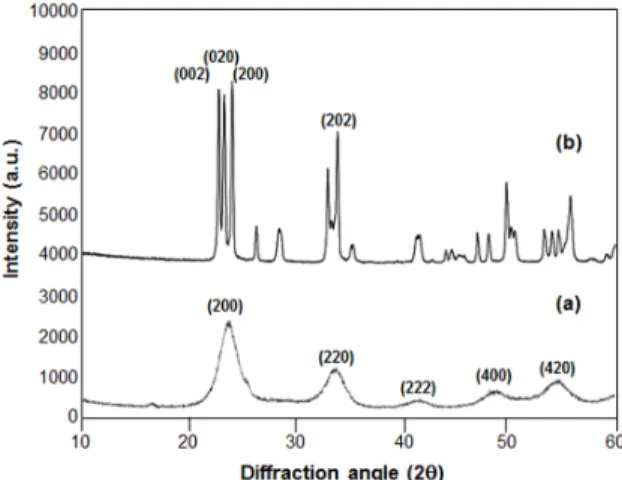
생산설비 MTC01호기에서 수집한 파우더 부산물의 결정구조를 규명하기 위한 XRD 분석 결과, 2 theta 23.80°, 33.90°, 41.74°, 48.86°, 54.78°에서 회절 Peak을 나타내는 것으로 확인되었다(Figure 4a). 한편, 결정구 조 비교를 위해 순수한 단사정계(Monoclinic) WO3 입 자의 X선 회절 패턴과 비교 시동일하지 않음을 확인할 수 있었다(Figure 4b).
Figure 4. X-ray diffraction patterns of (a) the powder particles collected in MTC01 and (b) pure crystalline WO
3particles as a comparison sample
Ⅳ. 고 찰
1. 생성경로
MTC02,03,05 호기에서 수집한 파우더의 경우 MTC01 호기에서의 파우더와는 달리 F 및 Ti 성분이 추가적으로 검출되었다. F 성분은 밀폐상태에서의
챔버 세정 가스로 사용되는 NF3 및 전구체인 WF6
분해에 의한 것으로 추정되며, Ti 성분은 해당 공정 을 진행하는 웨이퍼 표면 막질(Ti/TiN)에 기인된 것 으로 추측된다. 두 설비는 제조사가 다르며 공정 후 챔버 세정 방법도 상이한데, MTC01호기의 경우는 Remote plasma generator로 챔버 세정을 하기 때문에 microwave로 세정하는 MTC02-05호기 대비 챔버 세 정효율이 뛰어난 것으로 확인되었다. 따라서 세정 효 율이 떨어지는 MTC02-05호기에서는 대체적으로 Ti 성분이 남게 되며 설비 유지보수 시 챔버 덮게를 열 때에 공기 중 수분(산소)과 반응하여 추가적인 부산 물이 생성된 것으로 추측된다. 지금까지 수행된 반도 체 공정 부산물 연구결과에서도 본 연구결과와 동일 하게 공정설비군, 공정조건 및 공정사용 화학물질이 같아도 SEM-EDS 및 TEM-EDS 분석에서 검출되는 부산물의 화학적 조성(성분)이 조금씩 상이함이 확인 되었으며, 명확한 원인은 규명되지 않았다(Choi et al., 2015a; 2015b).
메탈 공정설비에서 발생하는 파우더 부산물의 성 분분석 결과로부터 각 파우더 부산물에는 WO3, TiO2, Al2O3 등의 물질이 단독 또는 복합적으로 포함되어 있는 것으로 보여 지며, 막질 생성 반응식으로부터 다 음과 같은 식(eq.1-4)에 의해 부산물이 생성된 것으로 추측된다. 먼저 WO3의 경우, eq. 1,2과 같은 공정 반 응식에 의해 W 막질이 만들어지게 되며, 이 때 부생 되는 SiF4 등은 배기된다. 본 공정에 전구체로 사용되 는 WF6 및 분해된 W은 챔버 내에서 미량의 수분 및 산소와 반응할 경우, eq. 3,4에 나타낸 것처럼 WO3가 생성 가능하게 된다(Lassner & Schubert, 1999).
MTC01 호기 파우더에서 확인된 Al 성분은 반응 챔 버 구성 성분으로 NF3에 의한 챔버 세정 시에 챔버 표면 식각으로부터 발생된 것으로 추정할 수 있다. 파우더가 주로 O, W 성분으로 구성되며 파우더 색깔이 노란색을 나타냄에 따라 삼산화텅스텐(Tungten trioxide, WO3) 입 자일 것으로 추측하였으며, XRD 분석 결과 전형적인
WO3 입자임이 확인되었다.
2. 결정구조
결정성 WO3는 입방정계(Cubic), 단사정계(Monoclinic), 사방정계(Orthorhombic) 등의 결정구조를 가지며, 단 사정계가 가장 일반적인 결정 구조이다(Lassner &
Schubert, 1999). Cubic WO3는 2 theta 23.66°, 33.85°, 41.16°에서 전형적인 격자면 (200), (220), (222)를 각각 나타내며(Xie et al., 2012), Moniclinic WO3는 23.12°, 23.59°, 24.38°, 34.16°에서 전형적인 격자면 (002), (020), (200), (202)를 각각 나타낸다(Kuzmin&Purans, 1998;
Ramana et al., 2006). 또한 Orthorhombic WO3는 23.71°, 33.72°, 41.48°, 49.26°, 55.01°에서 전형적인 격자면을 갖 는 Peak을 나타내는 것으로 알려져 있다(Balazsi et al., 2001). MTC01 호기에서 확인된 파우더 입자는 순수 Monoclinic WO3의 X선 회절 패턴과 비교 결과 그 차이를 확인할 수 있었으며, (200), (220), (222)의 격자면을 나타 내고 있기 때문에 Cubic WO3입자인 것으로 밝혀졌다.
WO3 입자의 결정구조는 온도에 따라 달라지는 것으로 알려져 있으며, Cubic WO3 입자의 경우 300℃에서 준안 정적이며 Orthorhombic WO3로 변환되기 쉽다고 보고되 고 있다. Cubic WO3 입자는 200-310℃에서 생성되며, 350-500℃의 온도조건에서는 Orthorhombic WO3 입자 가 생성 또는 변환된다고 보고하고 있다(Balazsi et al., 2001; Yamaguchi et al, 1987). 한편 WO3 파우더 부산물은 각 격자면에서 나타내는 회절 Peak이 전형적인 Cubic WO3 입자에 비해 Sharp 하거나 강하지 않기 때문에 비정 질 WO3가 일부 포함되어 있음이 추측되어 진다(Balazsi et al, 2001; Ozkan et al., 2003; Yang et al., 2007; Xie et al., 2012). 본 연구에서 확인된 결과와 같이 반도체 공정 중 부산물로 생성되는 입자는 구성성분은 동일하나 결정구 조가 상이할 수 있기 때문에 작업환경 내에서 부산물로 생성되는 입자의 결정구조를 확인하는 것은 작업환경 내 유해인자에 대한 불확실성을 감소시키는데 중요하다고 할 수 있다.
Ⅴ. 결 론
본 연구에서는 반도체 메탈공정 중 W 전구체를 사용하는 공정에서 기인된 파우더 부산물의 화학적 조성, 크기, 형상, 결정구조 등의 물리화학적 특성분
석을 수행함으로써 다음과 같은 결과를 확인할 수 있었다.
1. SEM-EDS 및 TEM-EDS 분석결과, 파우더 부산 물의 주요 구성성분은 O와 W이며, 부 성분으로 Al, F, Mg, Ti 성분 등이 함유되어 있었다.
2. TEM 분석결과, 생산설비에서 확인된 파우더는 1차 입자 기준 10-20 nm의 구형 입자가 응집(입경:
55-90 nm)되어 있었으며, 부대설비에서 확인된 파우 더의 경우 1차 입자 기준 16-20 nm의 구형 입자가 응집(입경: 80-120 nm)되어 있는 것으로 확인되었다.
3. XRD 분석결과, 파우더 부산물은 입방정계(Cu bic)의 결정성을 갖는 WO3 입자인 것으로 규명되었다.
본 연구는 반도체 메탈 공정에서 생성되는 파우더 부산물의 물리화학적 특성을 규명함으로써 작업환경 내에서의 유해인자에 대한 불확실성을 감소시켰다는 점에서 의의가 있다고 할 수 있다.
한편, 산업보건 분야에서는 작업자의 공정 부산물 노출 확인 및 예방이 중요하기 때문에 아직까지 많 은 연구가 이루어지지 않은 반도체 1차 스크러버가 가동되고 있는 작업환경에서 부산물의 공기 중 노출 특성 및 독성(유해성), 그리고 작업자 건강보호 관점 에서의 연구를 수행해 나가고자 한다.
References