• 검색 결과가 없습니다.

Pulmonary epithelioid hemangioendothelioma misconceived as pulmonary metastasis of other malignancies

N/A
N/A
Protected

Academic year: 2021

Share "Pulmonary epithelioid hemangioendothelioma misconceived as pulmonary metastasis of other malignancies"

Copied!
4
0
0

로드 중.... (전체 텍스트 보기)

전체 글

(1)

CASE REPORT eISSN 2384-0293 http://dx.doi.org/10.12701/yujm.2016.33.1.72

Yeungnam Univ J Med 2016;33(1):72-75

72 YUJM VOLUME 33, NUMBER 1, JUNE 2016

Pulmonary epithelioid hemangioendothelioma misconceived as pulmonary metastasis of other malignancies

Gi Tark Noh

1

, Kyoung Ju Lee

1

, Hee Jung Sohn

1

, Kyung Han Lee

1

, Won Seok Heo

1

, Byung Sung Koh

1

, Un Mi Han

2

, Young A Bae

3

Departments of

1

Internal Medicine,

2

Pathology, and

3

Radiology, Bundang Jesaeng General Hospital, Seongnam, Korea Pulmonary epithelioid hemangioendothelioma (PEH) is a rare, low-to-intermediate malignant tumor of endo- thelial origin. Computed tomography (CT) findings of PEH demonstrate multiple small bilateral nodules; how- ever, to the best of our knowledge, there were no reports on PEH coexisting with other malignancies. Here, we reported on a case involving PEH in a patient with colon cancer and breast cancer which was miscon- ceived as pulmonary meta- stasis. A 63-year-old woman who suffered from constipation for 2 weeks visited our hospital. Colonoscopy showed a large mass with obstruction on hepatic flexure. The histological diagnosis was adenocarcinoma of the ascending colon. Multiple nodules in both lungs and breast were observed on a chest CT scan. A core biopsy of a breast nodule was performed and a diagnosis of invasive ductal carci- noma of the left breast was made. Pulmonary nodules observed on the chest CT scan was considered as pulmonary metastasis from colon or breast cancer. Laparoscopic right hemicolectomy was performed.

At the same time, wedge resection of the lung was performed and pathological diagnosis was PEH. Radiologic features of PEH were difficult to distinguish from lung metastasis. Therefore the author reported a rare case involving PEH in a patient with primary malignancy of colon and breast.

Keywords: Hemangioendothelioma; Epithelioid; Metastasis

Received: June 30, 2015, Revised: August 18, 2015 Accepted: August 28, 2015

Corresponding Author: Kyoung Ju Lee, Department of Internal Medicine, BundangJesaeng General Hospital, 20 Seohyeon-ro 180 beon-gil, Bundang-gu, Seongnam 13590, Korea

Tel: +82-31-779-0200, Fax: +82-31-779-0727 E-mail: [email protected]

INTRODUCTION

Pulmonary epithelioid hemangioendothelioma (PEH) is a rare, low-to-intermediate malignant tumor of endothelial origin [1]. The prevalence of epithelioid hemangioendothe- lioma is less than one in 1 million [2]. PEH was originally reported by Dail and Liebow in 1975 as an “intravascular bronchoalveolar tumor” [3]. The term “epithelioid hemangio- endothelioma” was first described by Weiss and Enzingeras a soft tissue vascular tumor of borderline malignancy and fea- tures between those of hemangioma and angiosarcoma [4].

Epithelioid hemangioendothelioma can be primary in the

lung, pleura, liver, soft tissue, or bone, although other presen- tations have been reported [1].

Computed tomography (CT) scans of PEH characteristi- cally demonstrate multiple small bilateral nodules measuring 1-2 cm in size. The occurrence of a solitary lung mass is un- common [1]. The radiographic pattern in PEH may mimic pul- monary metastasis. We report here on a case involving PEH in a patient with colon cancer and breast cancer, which was misidentified as pulmonary metastasis.

CASE

A 63-year-old woman, who had been suffering from con- stipation for 2 weeks, visited our hospital in 2013. She was a never-smoker and had no notable past history of disease.

A colonoscopy showed a large mass with obstruction of the

hepatic flexure. The histological diagnosis of the ascending

colon mass was adenocarcinoma. Most of the laboratory data

were normal. A chest radiograph showed multiple nodular

opacities in both lungs (Fig. 1A). A chest CT scan showed

(2)

PEH misidentified as pulmonary metastasis

YUJM VOLUME 33, NUMBER 1, JUNE 2016 73

Fig. 1. The initial chest radiography (A) and a chest computed tomography scan (B) showing multiple small bilateral intrapul- monary nodules (arrow).

Fig. 3. Histologic findings of the pulmonary nodule. (A) The tu- mor cells have round to ovoid nuclei and abundant eosinophilic cytoplasm and intracytoplasmic vacuoles. The stroma is sclerotic (H&E stain, ×400). (B) The tumor cells are positive for CD34 (immunohistochemical stain, ×400).

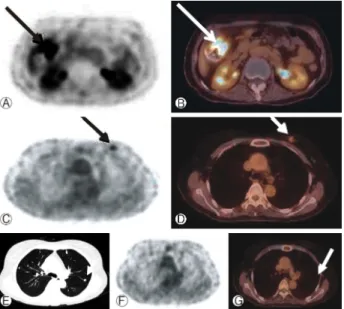
Fig. 2. The fluorodeoxyglucose positron emission tomography (FDG-PET) scan showed an hypermetabolic lesion in the right ascending colon (A, B) and a left breast nodule (C, D), but there was no abnormal FDG uptake in the small pulmonary nodules (E-G).

multiple pulmonary nodules, ranging from 1-8 mm in diame- ter, scattered throughout both lungs without hilar and media- stinal lymphadenopathy or pleural effusion (Fig. 1B). In addi- tion, the CT scan showed small enhancing nodular lesions in both breasts and a 3-cm irregular mass in the right breast.

A fluorodeoxyglucose positron emission tomography (FDG- PET) scan was performed for evaluation of distant metastasis.

The FDG-PET scan showed a hypermetabolic lesion in the right ascending colon mass (Fig. 2A, 2B) and a left breast no- dule (Fig. 2C, 2D). There was no abnormal FDG uptake in the small pulmonary nodules (Fig. 2E-2G).

A core biopsy of the left breast nodule was performed, and a diagnosis of invasive ductal carcinoma was made. There- fore, the pulmonary nodules observed on the chest CT scan were considered to be pulmonary metastasis from the colon

or breast cancer. A laparoscopic right hemicolectomy was performed. At the same time, wedge resection of the lung was performed for diagnosis and staging workup for colon cancer and breast cancer.

Pathologic examination of the pulmonary nodule revealed sclerosis and hypocellularity. The tumor cells were round with abundant eosinophilic cytoplasm and intracytoplasmic vacuo- lization and mild nuclear atypia (Fig. 3A). In immunohisto- chemical analysis, the tumor cells were positive for endothe- lial markers (CD31, CD34) (Fig. 3B) and negative for cytoke- ratin, smooth muscle actin, and S-100 protein. Based on the examination, the patient was diagnosed with PEH .

Because the patient was diagnosed with stage IIIB colon cancer, she was referred to the oncologic department for ad- juvant chemotherapy. A biopsy confirmed that surgery was indicated for the left breast cancer. However, the patient wanted to delay the operation.

We planned a medical follow-up on the PEH and post- operative adjuvant chemotherapy was scheduled for treat- ment of colon cancer.

Follow-up chest CT scan after chemotherapy showed no significant change in the tumor size and number, thus indicat- ing that PEH was not aggressive. The patient refused further chemotherapy against colon cancer, and we continued medi- cal follow-up for PEH without specific treatment. She still has no symptoms and has survived for 17 months following the initial diagnosis.

DISCUSSION

According to the literature, approximately 248 cases of

PEH have been reported [5] and some cases have been diag-

nosed based on findings of a solitary lung mass or multiple

(3)

Gi Tark Noh et al.

74 YUJM VOLUME 33, NUMBER 1, JUNE 2016

pulmonary nodules with no other primary malignancy [6,7].

This is the first report of multiple pulmonary nodules found in a patient diagnosed with both colon cancer and breast cancer, which were misidentified as metastasis. However, the final results of the histological analysis concluded that the lesions were PEH, which differed from the existing cases.

In general, chest CT scans of PEH show the presence of multiple small bilateral pulmonary nodules. These findings make PEH difficult to distinguish from metastatic cancer, old granulomatous disease, hemangioma, lymphangioma, sarcoi- dosis, vasculitis, or malignant conditions such as mesothelioma, primary adenocarcinoma, and angiosarcoma [1]. One study re- ported unusual radiologic findings of PEH. Ground-glass opac- ities and irregular interstitial thickening were the predominant findings, mimicking the appearance of diffuse interstitial lung disease [6]. In this case, the patient was diagnosed with PEH, colon cancer, and breast cancer at the same time, as it was not easy to distinguish the PEH from metastatic lesions.

The FDG-PET scan has become an important imaging tool for PEH diagnosis. One study showed that a FDG-PET scan sometimes fails to detect a malignant lesion of less than 6 mm in diameter. However, FDG uptake may reflect the activation of PEH tumor cells, which is a sign of a poorer prognosis [7].

A previous study reviewed FDG-PET scan findings of eight cases of PEH [8]. Among the eight cases, five cases showed increased FDG uptake, however, three cases were negative for FDG uptake, suggesting that a negative FDG-PET scan cannot completely exclude PEH. In our case, the FDG-PET scan did not show any pathological FDG uptake in the pulmonary nodules. This outcome is thought to be caused by small nod- ules, little FDG activity in the tumor, or low cellular density.

The histological characteristics of the previously mentioned case are common cytomorphologic features – abundant eosino- philic cytoplasm and intracytoplasmic vacuolization-also found in primary adenocarcinoma, mesothelioma, and large-cell lym- phoma. Therefore, immunohistochemical studies such as those for the endothelial markers CD31, CD34, and factor VIII are necessary for final diagnosis.

Similar to most PEH cases, this case was histologically con- firmed by surgical biopsy. To date, only a few reports on fine needle aspiration (FNA) findings of PEH have been pub- lished. Nevertheless, there has been some research reporting that when FNA is performed, a large rosettoid pattern with a central hyalinized core may be a key cytologic feature in

PEH diagnosis, suggesting possible findings for PEH diagnosis in the future [9].

No standard therapy for PEH has been established. Surgery is the approach of choice, and is indicated by the presence of a single pulmonary nodule, or multiple unilateral nodules when the number of lesions is limited [10]. Various chemo- therapies have been reported and certain patients with bilateral multiple nodules may benefit from chemotherapy and immu- notherapy [5,8]. Because PEH is a vascular tumor, the use of antiangiogenic therapy may be suggested. Several studies have shown that a partial remission could be achieved with carbo- platin, paclitaxel, and bevacizumab, a monoclonal antibody that blocks human vascular endothelial growth factor-A [11].

A partial response of the pulmonary lesions was obtained with interferon α-2a, probably due to its antiangiogenic activity [12].

Follow-up chest CT scan after chemotherapy showed no significant change in the tumor size and number. The reason may be that the disease entity was stable, not that chemo- therapy had an effect.

The prognosis of PEH is uncertain. Some studies have re- ported a 5-year survival probability of 60% (range, 47-71%) [13] and median survival of asymptomatic PEH patients was 180 months [5]. The prognostic factors of PEH have not yet been established either. Several studies have reported various prognostic factors. Some prognostic factors of PEH such as hemorrhagic symptoms (pleural effusion, alveolar hemorrhage, anemia, and hemoptysis) can reveal markers of vascular aggre- ssiveness [5,12].

In our case, the patient had no pleural effusion or chest symptoms. Several studies reported that lack of these symp- toms was associated with a lower risk for cancer progression [5,12].

Diagnosis of PEH is difficult. Given that the radiological features of PEH are similar to those of pulmonary metastasis, diagnosis of cases involving coexistence of a solid tumor and pulmonary nodules can be difficult. In general, when the pa- tient has a single malignant disease, physicians do not confirm the pathology of the multiple lung nodules coexisting with malignancy. Our patient was 63 years old, and she had double primary malignancies. Therefore we considered the possi- bility of metastasis of the multiple lung lesions from either colon or breast cancer.

To the best of our knowledge, the current case report is

the first to describe PEH coexisting with other primary solid

(4)

PEH misidentified as pulmonary metastasis

YUJM VOLUME 33, NUMBER 1, JUNE 2016 75

tumors. We report our experience with a case involving a PEH misconceived for pulmonary metastasis in a 63-year-old female patient diagnosed with colon cancer and breast cancer concurrently, along with a review of the relevant literature.

REFERENCES

1. Travis WD, Tazelaar HD, Miettinen M. Epithelioid hae- mangioendothelioma/angiosarcoma. In: Travis WD, Brambilla E, Konrad Müller-Hermelink H, Harris CC, editors. World health organization classification of tumours: pathology and genetics of tumours of lung, pleura, thymus and heart. Lyon:

IARC Press; 2004. p. 97-8.

2. Amin RM, Hiroshima K, Kokubo T, Nishikawa M, Narita M, Kuroki M, et al. Risk factors and independent predictors of survival in patients with pulmonary epithelioid haemangio- endothelioma. Review of the literature and a case report.

Respirology 2006;11:818-25.

3. Dail D, Liebow A. Intravascular bronchioloalveolar tumor.

Am J Pathol 1975;78:6a-7a.

4. Weiss SW, Ishak KG, Dail DH, Sweet DE, Enzinger FM.

Epithelioid hemangioendothelioma and related lesions. Semin Diagn Pathol 1986;3:259-87.

5. Sardaro A, Bardoscia L, Petruzzelli MF, Portaluri M. Epithe- lioid hemangioendothelioma: an overview and update on a rare vascular tumor. Oncol Rev 2014;8:259.

6. Mukundan G, Urban BA, Askin FB, Fishman EK. Pulmonary epithelioid hemangioendothelioma: atypical radiologic find-

ings of a rare tumor with pathologic correlation. J Comput Assist Tomogr 2000;24:719-20.

7. Okamura K, Ohshima T, Nakano R, Ouchi H, Takayama K, Nakanishi Y. A case of pulmonary epithelioid hemangioendo- thelioma surviving 10 years without treatment. Ann Thorac Cardiovasc Surg 2010;16:432-5.

8. Yi L, Cheng D, Shi H, Zhang K, Liao Y, Ao Q, et al. Pulmonary epithelioid hemangioendothelioma coexisting with pulmo- nary nodular amyloidosis: case discussion and review of the literature. Int J Clin Exp Med 2014;7:1891-7.

9. QHan KM, Kim DH, Myong NH. Fine needle aspiration cy- tology of pulmonary epithelioid hemangioendothelioma with prominent hyaline degeneration: a case report. Korean J Pathol 2010;44:554-7.

10. Ye B, Li W, Feng J, Shi JX, Chen Y, Han BH. Treatment of pulmonary epithelioid hemangioendothelioma with combi- nation chemotherapy: report of three cases and review of the literature. Oncol Lett 2013;5:1491-6.

11. Radzikowska E, Szczepulska-Wójcik E, Chabowski M, Oniszh K, Langfort R, Roszkowski K. Pulmonary epithelioid haeman- gioendothelioma--interferon 2-alpha treatment--case report.

Pneumonol Alergol Pol 2008;76:281-5.

12. Bagan P, Hassan M, Le Pimpec Barthes F, Peyrard S, Souilamas R, Danel C, et al. Prognostic factors and surgical indications of pulmonary epithelioid hemangioendothelioma:

a review of the literature. Ann Thorac Surg 2006;82:2010-3.

13. Ye B, Li W, Liu XY, Sun KL, Yang LH, Ma K, et al. Multiple organ metastases of pulmonary epithelioid haemangioendo- thelioma and a review of the literature. Med Oncol 2010;27:

49-54.

수치

Fig. 2. The fluorodeoxyglucose positron emission tomography (FDG-PET) scan showed an hypermetabolic lesion in the right  ascending colon (A, B) and a left breast nodule (C, D), but there  was no abnormal FDG uptake in the small pulmonary nodules (E-G).

참조

관련 문서

Often models uncertainty about specific pa- rameters is reflected as uncertainty in specific entries of the state space matrices A, B, C, D.. Let p = (p 1 , ..., p n )

In the change of physical strength, The exercise group showed statistically significant differences in muscle strength(right), muscle strength(left),

As a result of performing a compound exercise of spinning and Zumba for 8 weeks, the change in α-amylase showed a significant difference in the exercise group (p<.01), and

A) Clinical view of the recession defects B) Tunnel preparation with VISTA C) Deepithelialization using a high-speed handpiece at the hard palate. D)

There was no significant difference between the groups in problems of eating habits, but the obesity group considered overeating as a problem while the normal

Pilot Confirm runway 09 left for landing. ATC gives you further instructions to turn right heading 310. On the radar display, there was an area to avoid which requires a

In the lower extremity balance, the change in left unilateral clerk showed a statistically significant difference as the exercise group increased post-test

In the change of active oxygen, As a result of the active oxygen change between the two groups, there was a statistically significant difference according