하중 트레이닝을 통한 형상기억합금의 특성 실험과 거동 전산 모사
김상헌† · 조맹효*
Experimental Test and Numerical Simulation on the SMA Characteristics and Behaviors through the Load-Training
Sanghaun Kim and Maenghyo Cho
Key Words : Shape Memory Alloy(형상기억합금), Behavior Stabilization(거동안정화), Training Effect(트레이닝 효과), SMA Constitutive Equation(형상기억합금 구성방정식)
Abstract
In this study, we observe the application of shape memory alloy(SMA) into smart structures for repeatable actuation, because SMA changes its material properties and characteristics progressively under cyclic loading conditions and finally reaches stable path(state) after a certain number of stress/temperature loading- unloading cycles, so called 'training'. In this paper, SMA wires that have been in a stable state through the training are used. Stress-strain curve of the SMA wire at different temperature levels are measured. In addition, we observe other important effects such as the rate effect according to strain rates for rapid actuation response. The current work presents the experimental test using SMA wire after training completion by mechanical cycling. Through these tests, we measure the characteristics of SMA. With the estimated SMA properties and effects, we compare the experimental results with the simulation results based on the SMA constitutive equations.
1. 서 론
형상기억합금(Shape Memory Alloy : SMA)은 오스 테나이트(Austenite)와 마르텐사이트(Martensite)의 상변이(Phase transformation)에 의한 열과 기계적인 우수한 특성 때문에 작동기로 많이 이용되어진다.
특히 본 연구에서 사용된 형상기억합금은 니켈 (Nickel)과 티타늄(Titanium)으로 이루어진 합금으 로 다른 형상기억합금에 비하여 온도와 응력에 따 라 큰 상변이 변형(Large transformation deformation) 과 큰 회복력(Large recovery force)을 가지며, 전류 에 의해 열을 가하기 쉬우며, 니켈(Ni)과 티타늄 (Ti)의 합금 성분비에 의해서 상변이 온도 (Transformation temperature)를 조절할 수 있으며, 비중(Specific weight)이 작기 때문에 작동기
(Actuator)의 구조를 단순화하고 보다 효율적인 작 동기를 제작하는데 유리하다.(1,2) 또한 생물학적 적 합성(Bio compatibility)으로 생체의 열을 이용하는 의학용 작동기에 적용되고 있다.
그러나 형상기억합금의 초탄성 효과(Pseudo- elasticity effect), 형상기억 효과(Shape memory effect : SME) 그리고 양방향 효과(Two-way effect)는 온도, 잔류응력(Residual stress), 하중 또는 온도 트 레이닝(Mechanical / Thermal training), 열처리 (Annealing) 조건 등에 따라 특성(Characteristics)과 물성치(Material properties)가 매우 다르게 나타난다.
자세히 말하면, 하중 또는 온도 트레이닝 동안 전 위(Dislocation) 또는 복원되지 않는 마르텐사이트 상(Irreversible martensite variants)에 의한 영구변형 (Permanent deformation) 때문에 형상기억합금 재료 의 특성 곡선을 이동시킨다. 이러한 반복적인 작 용에 의한 형상기억합금의 영구변형(Permanent deformation)의 발생과 거동 양상의 변화는 작동기 설계 시 반드시 해결해야 할 문제이다. 따라서 작
† 회원, 서울대학교 기계항공공학부 E-mail : [email protected]
TEL : (02)880-1695 FAX : (02)886-1693 * 서울대학교 기계항공공학부
2 동기 설계에 앞서 형상기억합금 재료의 반복적인 작동에서 구성 거동(Constitutive behavior)에서 똑같 은 경로(Trajectory)를 따라가도록 형상기억합금의 재료 거동(SMA material behavior)의 안정화 (Stabilization)가 필요하며, 광범위한 실험을 통하여 안정화된 형상기억합금의 특성과 재료상수를 미리 결정해야 한다.(3)
본 연구에서는 온도와 응력에 따른 하중트레이 닝이 완료된 형상기억합금의 특성에 초점을 맞추 어, 다양한 인장실험 및 변형률 시간증분(Strain rate)에 따른 인장 특성들을 파악하였다. 앞서 언 급한 특성 실험과 물성치를 바탕으로 현재 가장 많이 사용되고 있는 형상기억합금의 구성방정식인 현상학적인 모델(Brinson model(4,5) : Phenomeno- logical model)과 열-기계적인 모델(Lagoudas model(6,7,8) ; Thermo-mechanical model)을 이용하여 형상기억합금의 거동을 예측하여 실험결과와 비교 하였다.
2. 형상기억합금 인장 특성실험
2.1 실험방법
형상기억합금의 거동은 온도와 응력에 매우 민 감하게 의존하으로 특성 및 물성치 파악을 위하여 다양한 온도 하에서 인장실험을 수행하여야 한다.
본 실험에서는 지름이 0.361mm 이고 상변이 온도 가 낮으며 작동기 사용에 적합한 와이어를 사용하 였다. 실험에 앞서 시차주사열량계(Differential Scanning Calorimeter : DSC)를 통하여 비응력 하에 서의 대략적인 상변이 온도를 측정하였으며 21℃
에서 초탄성 거동이 시작됨을 알 수 있었고 결과 는 Table 1 과 같다. INSTRON5565TM와 자제 제작 한 열-냉 챔버(Heat-cool chamber)를 이용하여 인장 시험을 수행하였다. 우선 표준치(Standard values)를 파악하기 위해서 초기 재료(As-received material)에 대하여 상온(25℃)에서 재료가 파단 될 때까지 변 형률 속도(Strain rate)를 달리하여 인장 시험을 수 행하였으며 또한 반복적인 하중(Cyclic loading)에 의한 형상기억합금 거동이 동일성을 갖는지를 확 인하였다. 이를 바탕으로 -20 50∼ ℃의 범위에서 5℃ 간격으로 각각의 응력-변형률 관계 실험을 수 행하였다.
Table 1 Transformation Temperatures from DSC
Mof Mos Aos A of
-2.3 10.1 7.2 21.0
2.2 실험결과
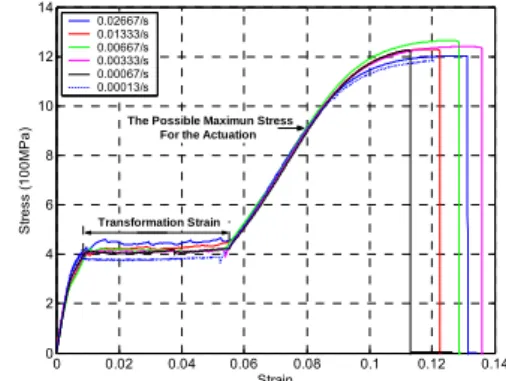
초기 재료(As-received material)에 대하여 상온 (25℃)에서 재료가 파단 될 때까지 변형률 속도를 달리하여 인장 시험을 수행한 결과 작동기에 사용 가능한 최대 응력은 약 900MPa 이며 상변이 변형
률은 약 4%로 나타났다(Fig.1). 또한 변형률 속도 를 크게 할수록 상변이 시작응력이 커짐을 알 수
있다. 이는 재료의 상변이 응력이 온도에 민감한 특성과 전방향 상변이 (Forward transformation) 동
안의 형상기억합금의 발열반응(Exothermic response)에 의해서 재료 자체의 온도가 상승하기
0 0.02 0.04 0.06 0.08 0.1 0.12 0.14
0 2 4 6 8 10 12 14
Strain
Stress (100MPa)
0.02667/s 0.01333/s 0.00667/s 0.00333/s 0.00067/s 0.00013/s
The Possible Maximun Stress For the Actuation
Transformation Strain
Fig. 1 The tension test until the as-received SMA wire is failed
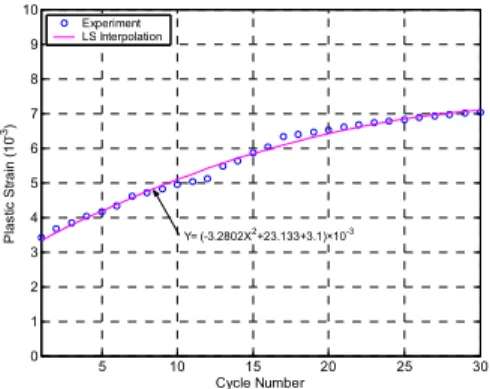
때문에 이러한 현상이 발생하며 점탄성(Visco- elasticity)의 효과와는 다르다(9,10). 그러고 Fig.2 와 같이 반복적인 하중에 의해서 형상기억합금의 거 동이 변하게 됨을 볼 수 있다. 30 회의 반복적인 초탄성 거동 동안에 Fig.3 과 같이 전위 (Dislocation)에 의한 영구변형률이 0.7%이내에서 축척됨을 볼 수 있으며, Fig.4 와 같이 상변이 응력 이 점점 작아지며 약 25 회 이상에서 임의의 값에 수렴됨을 볼 수 있다. 특히 전방향 상변이 응력이 후방향 상변이(Reverse transformation) 응력값에 비 하여 초기치와 그게 차이를 보이며 수렴함을 알 수 있다. 한편 이 그래프에서 곡선과 수식은 3 차 최소 자승 보간법(Least Square Interpolation : LSI)을 이용하여 구해졌다.
이러듯 제작사에서 제공한(As-received) 형상기억 합금을 작동기에 적용하여 사용하게 되면 작동기 의 성능이 점차적으로 떨어지며 작동기 거동 양상 도 변화게 될 것이다. 따라서 형상기억합금을 작 동기에 적용하기 위해서, 또한 보다 정확한 작동 기 거동 예측을 위해서는 형상기억합금의 재료 거 동의 안정화가 필요하다. 따라서 본 연구에서는 제작사에서 제공한 형상기억합금 재료에 대하여 상온에서 50 회의 반복적인 하중을 주어 재료의
3 거동을 안정화시켰다. 이를 ‘하중 트레이닝 ’또는
‘기계적 트레이닝’(Load / Mechanical training)이라고 하며 이는 인장 거동을 안정화시켜 반복적인 작동 기 사용에 적합하게 하기 위하여 필요하다.
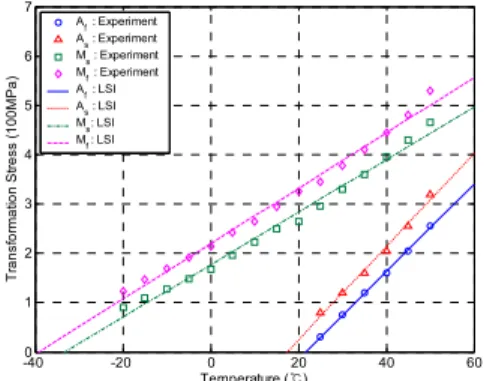
형상기억합금은 온도에 민감하게 반응하여 거동 하는 재료이므로 Fig.2 와 같이 트레이닝 완료 후 -20∼ ℃의 범위에서 5 50 ℃ 간격으로 각각의 응력- 변형률 관계 실험을 수행한 결과 Fig.5,6 과 같이 초탄성 거동과 형상기억효과 거동을 얻을 수 있었 다. 이들 그래프를 통하여 기계적 트레이닝이 완 료된 형상기억합금 와이어의 비응력 하의 상변이 변형률은 약 4%, 오스테나이트 상에서 영률 (Young’s modulus)은 약 70GPa, 완전하게 상변이된 상태인 마르텐사이트 상(Detwinned martensite phase) 에서의 영률은 약 35GPa 임을 확인하였다. 그리고 이들 그래프를 이용하여 네개의 상변이 응력과 온 도와의 관계를 그래프로 나타내면 Fig.7 과 같이 나타나며 이를 이용하여 형상기억합금의 거동을 수치해석하게 된다. Fig.7 의 그래프에서 각각의 상 변이 응력-온도의 기울기와 비응력 하의 상변이 온도는 실험치를 바탕으로 1 차 최소 자승 보간법 을 이용하여 구하였으며 이들 값들은 Table 2 에 명 기되어 있다. 한편 DSC 에 의해 측정된 값과 차이 가 나는 이유는 하중 트레이닝 동안 재료 내부가
0 0.01 0.02 0.03 0.04 0.05 0.06 0.07
0 1 2 3 4 5 6 7
Strain Stress (100MPa) σ
Ms Line
σAs Line
Fig. 2 The load / mechanical training at 25℃
5 10 15 20 25 30
0 1 2 3 4 5 6 7 8 9 10
Cycle Number Plastic Strain (10-3)
Experiment LS Interpolation
Y= (-3.2802X2+23.133+3.1)×10-3
Fig. 3 The plastic strain accumulation during load
training
5 10 15 20 25 30
0 0.5 1 1.5 2 2.5 3 3.5 4 4.5 5
Cycle Number
Transformation Starting Stress (100MPa)
σMs : Experiment σMs : LS Interpolation σAs : Experiment σAs : LS Interpolation
σMs= -4821.8X3+333040X2-9.1427×10⁶X+3.9933×10⁸
σAs= -1420.6X3+96984X2-2.4804×10⁶X+1.0161×10⁸
Fig. 4 The decrease (evolution) of transformation starting stresses during load training
구조적으로 변화하여 상변이 응력이 변화했기 때 문이며 특히 전방향 상변이 응력의 변화가 크기 때문에 마르텐사이트 상변이 시작과 끝온도가 크 게 차이가 나게 된다.
Table 2 The slopes of transformation stress-temp. &
transformation temps. about load trained SMA wire CMf CMs CAs CAf
Slop
( MPa / ℃ ) 5.61 5.33 9.43 8.89
Mof Mos Aos A of Trans. Temp.
( ℃ ) -39.14 -33.19 17.35 21.65
3. 거동 전산 모사
3.1 구성방정식
본 연구에서는 상온에서 기계적 트레이닝이 완 료 되어진 즉, 안정화된 형상기억합금의 거동을 전산 모사하기 위해서 현재 가장 많이 쓰이고 있 는 형상기억합금 구성방정식 모델인 Brinson 모델 과 Lagoudas 모델을 이용하여 수치해석을 수행하 였다. 두 모델의 자세한 수식 전개와 물리적 의미 는 참고문헌을 참고하기 바란다.
두 모델을 간단하게 설명하면 다음과 같다. 두 모델 모두 상변이 응력의 Clausius-Clapeyron 거동 을 나타내기 위해 온도에 의존하는 항복곡면(Yield Surface)을 사용하였다.
Brinson 모델(4,5)은 Tanaka(11)와 Liang-Rogers(12,13) 두 모델을 이용하여 시간적 증분형태의 구성방정 식으로 도출되었다. 여기서 다른 모델과 구별되는 것은 마르텐사이트 체적비(Martensite volume fraction : ξ)를 온도증분(TIM)에 의한 것(ξT)과 응 력증분(SIM)에 의한 것(ξS )으로 분리시켰다는 것 이다. 즉, 재료매개변수(Material parameter)는 등가
4 변형률(Equivalent strain), 절대온도, 마르텐사이트 체적비를 사용하지만 등온과정에 응력-변형률 선 도는 응력증분에 따른 상변이 방정식만으로 결정 되어진다는 것이다. 이 모델은 거동의 피팅(fitting) 에 주력한 모델이다.
0 0.01 0.02 0.03 0.04 0.05 0.06
0 1 2 3 4 5 6 7
Strain
Stress (100MPa)
45℃
40℃ 35℃
30℃
25℃
EA E
M
Fig. 5 The experimental result of isothermal tension behavior above 25℃ (Pseudo-elastic behavior)
0 0.01 0.02 0.03 0.04 0.05 0.06
0 1 2 3 4 5 6 7
Strain
Stress (100MPa)
20℃
10℃
0℃
-10℃
Fig. 6 The experimental result of isothermal tension behavior below 25℃ (Shape memory effect behavior)
-40 -20 0 20 40 60
0 1 2 3 4 5 6 7
Temperature ( )℃
Transformation Stress (100MPa)
Af : Experiment As : Experiment Ms : Experiment Mf : Experiment Af : LSI As : LSI Ms: LSI Mf : LSI
Fig. 7 The Transformation stresses - temperature curve from the experimental results
Lagoudas 모델(6,7,8)은 Tanaka 와 Liang-Rogers 모 델을 수정보완하여 3 차원을 해석할 수 있도록 하 였다. 이 모델은 Liang-Rogers 가 제안한 모델과 운 동학적 상변이 가정이 유사하지만 상변이 구간에
서 에너지 발산을 담당하는 경화함수(Hardening function)를 지수함수가 아닌 변곡점을 가진 다항 식으로 표현하였다. 또한 탄성영역과 상변이 영역 을 구분하여 해당온도에서 임계응력 전에는 탄성 구간으로 거동하다가 임계응력을 넘어서면 상변이 영역에서 거동하도록 모델링하였다. 이는 재료의 소성거동과 매우 유사한 이론이다. 이때 상변이 구간의 재료의 물성치는 혼합법칙(Rule of mixtures) 에 의해 오스테나이트상, 마르텐사이트상의 물성 치와 마르텐사이트 체적비로 표현하였다. 이와 더 불어 에너지 발산(Clausius-Duhem Inequality)을 이 용하여 탄성영역과 상변이 영역사이의 일관성을 표시하였다. 이 모델은 재료 거동의 열-기계적인 관점에 주력한 모델이다.
3.2 거동 모사 결과
Brinson 모델을 이용하여 거동을 예측하기 위해 서 Fig.7 과 같이 1 차 최소 자승 보간법에 의해 구해진 상변이 응력-온도의 기울기와 비응력하의 상변이 온도들을 이용하여 수치해석을 수행하였다.
이 때 모델에서 각 상의 시작과 끝의 기울기는 같 아야 하기 때문에 실험에서 구해진 기울기의 평균 값을 이용하였으며 비응력하의 상변이 온도를 약 간 조정하여 전범위 온도에 대한 거동의 오차를 줄였다(Fig.8). 이 때 Brinson 모델의 특징인 마르 텐사이트 시작온도(Mos)에서 응력에 의한 전방향 상변이 시작응력(σcrs )과 끝응력(σcrf )을 조절하여 전방향 상변이 구간의 응력-변형률 기울기를 조절 하였다. 본 연구에서 Brinson 모델을 이용하여 상 기 재료의 거동을 예측하기 위한 재료상수는 Table 3 에 명기되어 있다.
Fig.7 를 자세히 관찰하면 Aof 온도 이상에서 마 르텐사이트 상변이 시작과 끝 응력-온도의 기울기 가 급해짐을 볼 수 있다. 이는 초탄성 거동과 형 상기억효과 거동의 경계에서 약간의 재료적 성질 이 달라지기 때문으로 설명할 수 있으며 인장시험 결과(Fig.6)에서도 이를 확인할 수 있다. Lagoudas 모델에서는 이러한 효과를 포함하여 거동을 예측 해 보았다. 만약 Lagoudas 모델에서 Fig.8 과 같이 상변이 응력-온도와의 관계을 이용한다면 Brinson 모델과 똑같은 결과를 보이게 된다. 다만 이 모델 에서는 σscr,σcrf 와 같은 피팅(Fitting) 요소 없이 거 동을 예측하게 된다.
Fig.9 와 같은 상변이 응력-온도 관계식을 만들기 위해서 식(1)을 이용하고, Aof 를 경계로 하여 초기 엔트로피 차(Δso )와 비응력하의 상변이 온도들을
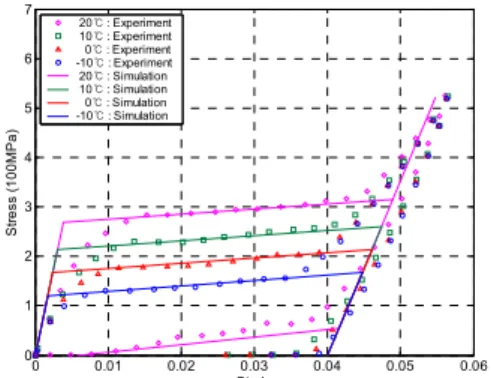
5 Table 4 와 같이 구간에 대하여 다르게 가정하여 형상기억합금의 거동을 예측해 보았다. (단, 여기 서 Δ =α 0 (αA=αM) 로 가정하였다.) 결과적으로 Lagoudas 모델에서 보다 정확한 결과를 얻어졌음 을 Fig.10~13 을 통하여 알 수 있다. 그러나 두 모 델 모두 거동을 비교적 정확하게 수치해석함을 확 인할 수 있다. 공통된 형상기억합금의 재료상수는 Table 5 에 명기되어있다.
( )o A or M1 or2 A or M
d s
C dT H S T
ρ ασ
σ
σ α
Δ + Δ
= − + Δ + Δ Δ
∼ (1)
-20 -10 0 10 20 30 40 50
0 1 2 3 4 5 6 7
Temperature ( )℃
Transformation Stress (100MPa)
Af : Experiment As : Experiment Ms : Experiment Mf : Experiment Af : Simulation As : Simulation Ms : Simulation Mf : Simulation
Fig. 8 The transformation stresses - temperature curve for Brinson model
-20 -10 0 10 20 30 40 50
0 1 2 3 4 5 6 7
Temperature ( )℃
Transformation Stress (100MPa)
Af : Experiment As : Experiment Ms : Experiment Mf : Experiment Af : Simulation As : Simulation Ms : Simulation Mf : Simulation
Fig. 9 The transformation stresses – temperature curve for Lagoudas model
0 0.01 0.02 0.03 0.04 0.05 0.06
0 1 2 3 4 5 6 7
Strain
Stress (100MPa)
45 : Experiment℃ 35 : Experiment℃ 25 : Experiment℃ 45 : Simulation℃ 35 : Simulation℃ 25 : Simulation℃
Fig. 10 The simulation result of pseudo-elasticity by Brinson model
0 0.01 0.02 0.03 0.04 0.05 0.06
0 1 2 3 4 5 6 7
Strain
Stress (100MPa)
20 : Experiment ℃ 10 : Experiment ℃ 0 : Experiment℃ -10 : Experiment℃ 20 : Simulation℃ 10 : Simulation℃ 0 : Simulation℃ -10 : Simulation℃
Fig. 11 The simulation result of SME by Brinson model
Table 3 The Clausius-Clapeyron constants and transformation temps. for Brinson model CM CA σcrs σcrf
5.47e+6 9.16e+6 0 70e+6
Mof Mos Aos A of
-42℃ -31℃ 16℃ 22℃
Table 4 The difference of entropy and transformation temps. for Lagoudas model
( )Δso M1 Mof1 Mos1
-31 -46℃ -36℃
( )Δso M2 Mof2 Mos2
-53 -14.3℃ -8.5℃
( )Δso A Aos A of
-56 16℃ 23℃
Table 5 The SMA material constants for both models
ρ EA EM ν α H, εL
6450 70e+9 35e+9 0.33 1.1e-5 0.04
0 0.01 0.02 0.03 0.04 0.05 0.06
0 1 2 3 4 5 6 7
Strain
Stress (100MPa)
45 : Experimental℃ 35 : Experimental℃ 25 : Experimental℃ 45 : Simulation℃ 35 : Simulation℃ 25 : Simulation℃
Fig. 12 The simulation result of pseudo-elasticity by Lagoudas Model
6
0 0.01 0.02 0.03 0.04 0.05 0.06
0 1 2 3 4 5 6 7
Strain
Stress (100MPa)
20 : Experiment ℃ 10 : Experiment ℃ 0 : Experiment℃ -10 : Experiment℃ 20 : Simulation℃ 10 : Simulation℃ 0 : Simulation℃ -10 : Simulation℃
Fig. 13 The simulation result of SME by Lagoudas model
4. 결 론
본 연구에서는 형상기억합금을 이용한 작동기를 설계함에 있어서 반복적인 작동에도 성능과 작동 거동이 변하지 않도록 형상기억합금의 하중 트레 이닝 특성을 보여주었다. 또한 트레이닝이 완료된 형상기억합금 선에 대해서 다양한 온도하에서 인 장 시험을 수행하였으며 이를 통하여 얻은 특성과 재료상수를 이용하여 현재 가장 많이 사용되고 있 는 현상학적인 형상기억합금 구성 모델인 Brinson 모델과 열-기계적인 구성 모델인 Lagoudas 모델을 이용하여 거동을 전산 모사하였다. 또한 모델의 상변이 응력-온도의 기울기를 조정하여 더욱 정확 하게 거동을 모사하도록 해 보았으며 이를 통하여 두 모델 모두 정확한 거동을 예측함을 알 수 있었 다.
후 기
본 연구는 2007 년도 두뇌한국 21 사업과 국방과 학연구소의 기초연구과제(ADD-07-05-03)의 지원으 로 수행되었습니다.
참고문헌
(1) Otsuka, K. and Wayman, C.M., 1999, “Shape Memory Materials”, Cambridge University Press.
(2) Birman, V., 1997, “Review of mechanics of shape memory alloy structures”, Appl. Mech. Rev., Vol. 11, pp. 629-645.
(3) Kim, S., Choi, H., Yoon, M. and Cho, M., 2006,
“Experimental test for numerical simulation SMA characteristics and its simulation, in: Smart Structures and Materials, Proc. of SPIE, Vol. 6170, San Diego,
USA.
(4). Brinson L. C., 1993, "One-dimensional constitutive behavior of shape memory alloys : thermomechanical derivation with non-constant material functions and redefined martensite internal variable", J. Intelligent Mat. Syst. Struct ,Vol. 4, pp. 229-242.
(5) Brinson L. C. and Lammering R., 1993, "Finite element analysis of the behavior of shape memory alloys and their application", Int. J. Solids and Structures, Vol. 30, pp. 3261-3280.
(6) Boyd, J. G. and Lagoudas, D. C., 1996, "A thermodynamic constitutive model for the shape memory alloy materials Part Ⅰ, the monolithic shape memory alloy", Inter. J. Plasticity, Vol. 12, pp. 805- 842.
(7) Lagoudas, D. C., Bo, Z. and Qidwai, M. A., 1996, "A unified thermodynamic constitutive model for SMA and finite element analysis of active metal matrix composite", Mechanics of Composite Materials and Structures, Vol. 3, pp. 153-179.
(8) Cho, M. and Kim, S., 2005, “ Structural morphing using two-way shape memory effect of SMA” , Inter.
J. Solids and Structures, Vol. 42, pp.1759-1776.
(9) Shaw, J. A., 2000, “Simulations of localized thermo- mechanical behavior in a NiTi shape memory alloy”, International Journal of Plasticity, Vol. 16, pp. 541- 562.
(10) Iadicola, M. A. and Shaw, J. A., 2004, “Rate and thermal sensitivities of unstable transformation behavior in a shape memory alloy”, Inter. J. Plasticity, Vol. 20, pp. 577-605.
(11) Tanaka, K., Kobayashi, S. and Sato, Y., 1986,
"Thermomechanics of transformation pseudoe- lasticity and shape memory effecct in alloys", Int. J Plasticity, Vol. 2, pp. 59-72.
(12) Liang, C. and Rogers, C. A., 1990, "One- Dimensional thermomechanical constitutive relations for shape memory materials", J. Inteligent Mat. Syst.
Struct., Vol. 1, pp. 207-234.
(13) Liang, C. and Rogers, C. A., 1992, "Design of shape memory alloy actuators", J. Mech. Design, Vol. 114, pp. 223-230.