1. Introduction
PND (Portable Navigation Device)‐type CNS (Car Navigation System), which have been distributed rapidly and used widely in the market, collect coordinate data from a GPS(Global Positioning System) receiver and display the current position of a car on a mapon the device’s screen (Ga et al.
2011). However, the difference between the definition time of the GPS position data and actual display time of the car position on the map could reduce the accuracy of the car position displayed. Because of the delayed processing, the car position that users see is no longer current by the time the GPS position has been determined. This is called the late processing problem and includes issues such as positional accuracy error and untimely navigation routing service. Because the positional difference due to the late processing problem could be tens of meters and
could include deviation from the driving course, an improved method to fix these problems is required for driving safety. It is expected that a method that uses predicted future positionsto compensate for the delay time caused by processing and displaying of received GPS signals, could mitigate these problems.
The inaccuracy of car positions on the CNS screen caused by delay in GPS signal processing and associated problems, has been a common issue dealt with by general navigation users and developers.
There have been numerous related studies to improve inaccuracy caused by late processing problems using Kalman filters. This is an effective technique for prediction of time series data including noise such as GPS receiver data.
In cases with no cars, Singer (1970) modeled a Kalman filter to use for the tracking of a manned maneuverable vehicle in a weapon system, and Friedland(1973) estimated positions and velocities of
Received: 2016.05.17, revised: 2016.06.22, accepted: 2016.06.24
* Deputy Manager, Energy & Chemical Business Team II, SK Holdings C&C, [email protected]
** Corresponding AuthorㆍMemberㆍAssistantProfessor, School of Convergence & Fusion System Engineering, Kyungpook National University, [email protected]
*** MemberㆍProfessor, Dept. of Civil & Environmental Engineering, Seoul National University, [email protected]
Reduction of GPS Latency Using RTK GPS/GNSS Correction and Map Matching in a Car NavigationSystem
1)
Kim, Hyo Joong*ㆍLee, Won Hee**ㆍYu, Ki Yun***
Abstract
The difference between definition time of GPS (Global Positioning System) position data and actual display time of car positions on a map could reduce the accuracy of car positions displayed in PND (Portable Navigation Device)‐
type CNS (Car Navigation System). Due to the time difference, the position of the car displayed on the map is not its current position, so an improved method to fix these problems is required. It is expected that a method that uses predicted future positionsto compensate for the delay caused by processing and display of the received GPS signals could mitigate these problems. Therefore, in this study an analysis was conducted tocorrect late processing problems of map positions by mapmatching using a Kalman filter with only GPS position data anda RRF (Road Reduction Filter) technique in a light‐weight CNS. The effects on routing services are examined by analyzing differences that are decomposed into along and across the road elements relative to the direction of advancing car. The results indicate that it is possible to improve the positional accuracy in the along‐the‐road direction of a light‐weight CNS device that uses only GPS position data, by applying a Kalman filter and RRF.
Keywords : Car Navigation System (CNS), Kalman Filter, Map Matching, Road Reduction Filter (RRF), Real‐
Time Kinematic (RTK), Global Positioning System (GPS)
37 Vol.24 No.2 June 2016 pp.37-46
Research Paper
ISSN: 2287-6693(Online) http://dx.doi.org/10.7319/kogsis.2016.24.2.037
moving objects when measuring position coordinates with a fixed time interval, including noise. In addition, related studies have been made in diverse fields such as prediction of human movements in computer vision (Kohler 1997), position tracking in wireless sensor and cellular networks (Yick et al.
2005; Takenga et al. 2007), and position tracking of storms (Manfredi et al. 2005). In the field of defining a robot system’s position, future positions of moving objects were predicted with a Kalman filter for time delay in the acquisition and processing of images during visual servicing (Gortcheva et al. 2001). As with cases including cars, Bonnifait et al. (2007) matched the resulting positions (corrected for GPS delay using a Kalman filter and with DR(Dead Reckoning) sensor data) to roads on a GIS (Geographic Information System)‐based map in the process of realizing a real‐time vehicle position estimation system. Tessier et al. (2006) predicted positions to compensate for GPS time delay in the process of integrating delayed observations from each sensor on a vehicle equipped with various sensors.
Tradisauskas et al.(2007) addressed the possibility of estimating the positions of a car on a roadmap several seconds ahead, considering the occurrence of delays caused by acquisition time of data from GPS/DR devices and processing time of map matching, but without describing the process or presenting experimental results.
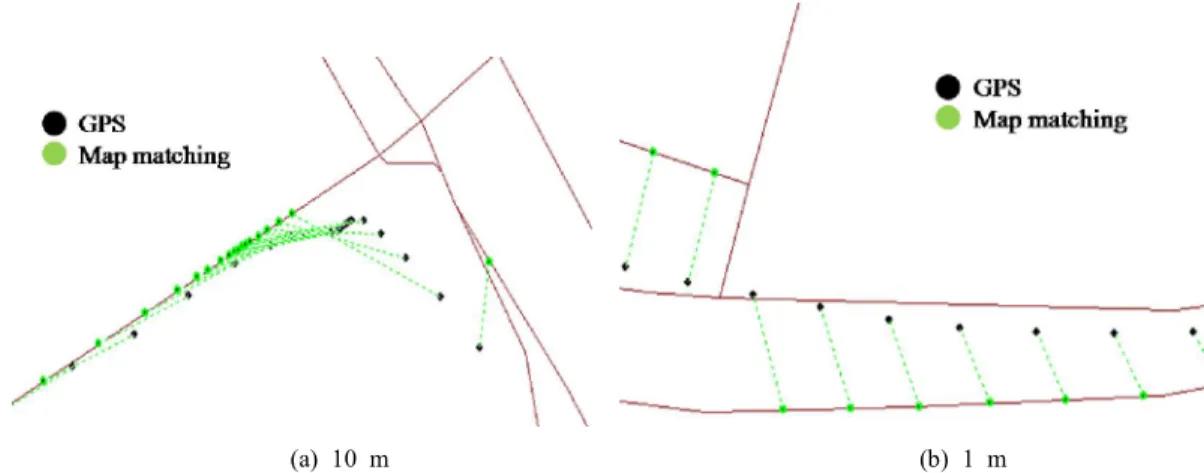
From the studies mentioned above, most studies seem to be aimed at improving positional accuracy not only using GPS position data, but also by integratingit with data from other sensors for light weight hardware like PND. Map matching is a technique that determines approximate car positions on the roadmaps using GPS position data, including errors(Bernstein et al., 1996). RRF (road reduction filter), one of the commonly used map matching techniques, determines position by virtual differential GPS correction and eliminates improper candidate roads (Taylor et al. 2001). Similarly, there has been research regarding calculations of corrections from past matching results (Ahnet al. 2005; Xu et al.
2007). Quddus et al.(2003) analyzed the general map matching algorithms used in telematics
2. Method of prediction and processing of signals
2.1 Prediction using Kalman filter
A Kalmanfilter is an effective recursive filter that predicts the state of a dynamic system from measurements, including series of noise.A Kalman filter is essentially a set of mathematical equations that implement a predictor‐corrector type estimator that is optimal, in the sense that it minimizes the estimate error covariance. A Kalman filter model is described as an equation that represents the state at time step k by changes from the state at the previous time step as shown in Eq. (1).
1
1 -
-
+ +
=
k k kk
Ax Bu w
x (1)
whereA is the state transition matrix that relates the previous state and the current state. B is the control input matrix applied to the control vector. Here, u .
kw is the process noise and is assumed to have
knormal distribution with average ‘0’ and covariance Q ( p ( w ) ~ N ( 0 , Q )) .
The measurement z
kof the state x
kat the time step K is represented as Eq. (2).
k k
k
Hx v
z = + (2)
H is the measurement matrix that relates the state x and the measurement
kz .
kv is the measurement
knoise. It is assumed to have normal distribution with
average ‘0’ and covariance ( p ( v ) ~ N ( 0 , Q )) . A
Kalman filter estimates a process using a form of
feedback control. That is, the filter estimates the
process state at some time and then obtains feedback
in the form of noisy measurements.It consists of two
stages, time update (predict) and measurement update
(correct).The time update equations are responsible
for projecting forward (in time) the current state and
error covariance estimates to obtain a priori estimates
for the next time step.The measurement update
equations are responsible for the feedback that is
used to incorporate a new measurement into the a
priori estimate to obtain an improved a posteriori estimate.To apply a Kalman filter to the estimation of the position coordinate of a moving car, a dynamic model of the car has to be established.According to Newton’s law, tracking the position and the velocity of a moving target, can be done with a two‐state dynamic model as in Eq. (3) (Friedland, 1973).
k k
k
Ax Ga
x =
-1+ (3)
When the measurement is taken at time period t D , it is assumed that the target is moving constantly with an arbitrary acceleration a
kin the time between
- 1
k and k . The state transition matrix A and the matrix G that relates random noise is as Eq. (4).
ú ú ú ú
û ù
ê ê ê ê
ë é
D D
D D
= ú ú ú ú
û ù
ê ê ê ê
ë é
D D
=
t t
t t
t t
A / 2
2 / G 1 0 0 0
1 0 0
0 0 1 0
0 0 1
2
(4)
The acceleration added is assumed to be white noise and the covariance of it is given by Eq. (5).
ú ú ú ú ú
û ù
ê ê ê ê ê
ë é
D D
D D
D D
D D
=
=
2 2 3 2
3 2 4 2 2 2 3 2
3 2 4 2 2
2 / 0
0
2 / 4 / 0
0
0 0
2 /
0 0
2 / 4 /
t t
t t
t t
t t
GG Q
a a
a a
a a
a a
T a