ABSTRACT
This study proposed that a relationship exists between individual emotions and knowledge sharing (KS) intentions in competitive online advice communities. Through statistical analysis of 220 valid questionnaires collected from qualified community members, we found that individuals’ intentions to contribute knowledge were enhanced by playfulness and reciprocity, while their intention to seek knowledge from others was facilitated significantly by needs fulfillment, sense of competition, and playfulness. In addition, we found that playfulness was a common factor that affected the intention to seek, as well as to contribute, knowledge. Specifically, playfulness was a highly significant individual emotion that affected both individuals’ intention to contribute and seek knowledge, while reciprocity was significant primarily in individuals’ intentions to contribute knowledge. Needs fulfillment and sense of competition were significant emotions that affected primarily individuals’
intentions to seek knowledge. Interestingly, the factors that affected the intention to seek knowledge were consistent both in all participants and in the high-level fear group. However, in the low-level fear group, playfulness influenced KS intentions.
Keywords: knowledge management, knowledge sharing intentions, individual emotions, competitive online advice community, sense of competition, fear
1 논문접수일: 2017년 2월 20일; 1차 수정: 2017년 3월 14일; 게재확정일: 2017년 3월 18일
2 Author, Research Professor, SKK Business School, Sungkyunkwan University, Seoul, Korea([email protected])
3 Corresponding Author, Professor, SKK Business School/SAIHST, Sungkyunkwan University, Seoul, Korea([email protected])
Influence of individual emotions on intention to share knowledge in competitive online advice communities
1SKK Business School, Sungkyunkwan University, Seoul, Korea2
SKK Business School/SAIHST(Samsung Advanced Institute for Health Sciences & Technology), Sungkyunkwan University, Seoul, Korea3
전 현 규 (Hyeon Gyu Jeon)
이 건 창 (Kun Chang Lee)
1. Introduction
Online advice communities have recently b e c o m e p o p u l a r c h a n n e l s fo r s h a r i n g information and knowledge on a wide range of topics and contexts (Kimmerle and Cress 2013).
However, emotions tend to influence people’
s intentions to share knowledge with others in these communities. Thus, verifying the relationship between emotions and knowledge sharing (KS) intentions may be a very interesting subject of research. Nonetheless, studies of individual emotions and KS intentions in online advice communities have been rare to date. In the existing literature, researchers have studied individual KS mostly from the perspective of organizational context, interpersonal and team characteristics, cultural and individual characteristics, and motivational factors (Wang and Noe 2010). Although individual emotion can be a significant facilitator or inhibitor of individuals’ KS behavior and intentions, it has not been investigated sufficiently. This study was designed to fill this gap by determining the theoretical relevance of emotions and KS intentions, and by conducting an empirical analysis of the relationship between these two concepts.
Online advice communities usually function to facilitate interpersonal sharing of knowledge and advice. Many people visit these communities when they need others’ help in solving problems (Chen et al. 2013). In these communities, individuals with knowledge or expertise critical
to address others’ problems offer consultation voluntarily to the nameless and faceless individuals who need help resolving various issues. When others’ knowledge or expertise proves helpful in solving individuals’ problems and enhancing their work performance, people conclude that the online advice communities are efficient means to obtain valuable resources in problem-solving and improving business performance (Sparrowe et al. 2001).
W hen p e ople p rep a re for i mp or t a nt examinations, such as job recruitment exams, they often seek useful advice. On the other hand, they also are aware that they are competing with each other. Therefore, these online advice communities are basically competitive. A number of such communities in South Korea offer good examples of this phenomenon. Due to the recent unprecedented increase in unemployment rates among youth, many young people have f looded the job market seeking stable employment in state- run firms or government, which employ few, and require successful applicants to pass very difficult recruitment exams. Most of these young people join and participate in specific online advice communities to seek expertise f rom ot hers who have ex p er ience w it h recruitment exams, as well as a few successful applicants who offer advice related to preparing for the examinations. Regardless of the quality or quantity of information, members in the online advice communities who believe they have information or expertise about the exams
can consult and share their knowledge with those in need. During the process of helping others, those members experience both positive and negative emotions, because they target the same or similar exams, and thus, it is unsurprising that most members compete with each other implicitly. They nonetheless share valuable knowledge with their rivals voluntarily.
In this sense, those online advice communities related to recruitment exams are considered extraordinary and valuable cases to understand the influence that individual emotions have on interpersonal KS in a competitive context.
Fear is defined as anxiety about loss from victimization or mutual noncooperation from the perspective of a social dilemma (Renzl 2008). KS may constitute a disincentive to sharers because the shared knowledge can be used for the common good. As a result, indiv idua ls lose t heir uniqueness in a n organization when compared with others (Wang and Noe 2010). When individuals anticipate losing value in such a situation, they are unwilling to share knowledge. Thus, perceived fear should be a barrier to KS (Renzl 2008;
Pfeffer and Sutton 2013).
Fear may inhibit individuals’ KS in two situations: collaborative relationships and competitive contexts. An individual’s fear of losing his/her unique value impedes KS in collaborative relationships. The fear of losing one’s unique value includes individual fears of being betrayed, deceived, or being easy to replace after sharing one’s valuable knowledge
(Renzl 2008). In describing fear of exploitation, Renzl (2008) argued that fear of losing one’
s unique value serves as a significant variable that hinders individuals’ willingness to share knowledge.
Further, the fear of being defeated by a rival will also hinder KS in a competitive context. Competition always produces winners and losers. Thus, an individual is likely to be nervous that a rival will defeat him/her. This fear will also inhibit cooperation such as that in KS (Pfeffer and Sutton 2013). Thus, the inhibition of KS due to competition may lead to the loss of a competitive advantage in a given context (Chong and Besharati 2014).
Accordingly, we expected that fear would either hinder or promote individuals’ KS i ntent ion s , a nd t he fac tor s t hat a f fe c t individuals’ KS intentions would differ between those in groups with a high vs. a low level of perceived fear. A similar phenomenon should occur among members in competitive online advice communities, where individuals can contribute, seek, and build competitively on specific domain knowledge.
Types of emotions that individual members who participate in these competitive advice communities might experience include positive emotions, such as playfulness and a sense of reciprocity, negative emotions, such as fear and anxiety, or complex emotions, such as a sense of competition, when they share their own valuable intellectual property with rivals.
However, very few studies have explored
the issue of the inf luence emotions may have on individual’s KS intentions in such communities. Therefore, this study attempted to determine which emotions facilitate or hinder individuals’ KS intention in this context. Specifically, we were interested in the effect of the sense of competition, which is considered a facilitator for a knowledge seeker, but an inhibitor for a knowledge contributor (Schepers and Van den Berg 2007). In addition, considering that knowledge is likely to be shared asymmetrically between the majority of knowledge seekers and minority of knowledge contributors in the online communities (Bock et al. 2005; Stenius et al. 2015), we also wished to investigate the influence of individual emotions on the two dimensions of KS intentions, the intention to contribute knowledge and the intention to seek it.
The research questions we sought to answer in this study are as follows: (1) What kind of emotions influence individuals’ KS intentions in competitive online advice communities?
(2) Is a sense of competition significant in promoting or inhibiting individuals’ KS intentions in these communities? (3) How do individual emotions that affect KS intentions differ depending upon whether one has the intention to contribute or to seek knowledge?
(4) Does the effect of perceived fear of KS on individual KS intentions in these communities differ between groups with a high vs. a low level of fear?
2. Individual emotions and KS intentions
The literature includes a variety of definitions of emotion. The term is defined primarily in relationship to anger, disgust, fear, joy, sadness, and surprise (Cabanac 2002). Although there exist a variety of definitions on emotion in the literature, there is no singular or even preferred definition of emotion (Cabanac, 2002).
Kleinginna and Kleinginna (1981) listed over 100 different definitions of emotion from the literature on emotion. Even the world-famous dictionaries such as Oxford English Dictionary, The Dictionary of Cognitive Psychology, etc.
defines emotions differently. For this reason, Lazarus (1991) argued that research on emotion is difficult. Universally, emotion is defined primarily in relation to anger, disgust, fear, joy, sadness, and surprise. However, emotions can not be explained by these limited emotional factors. Emotion is taken for granted in itself (Cabanac, 2002). Bagozzi et al. explained that emotion is “a mental state of readiness that arises from cognitive appraisals of events or thoughts.” (Bagozzi et al. 1999, p. 184).
In the existing literature, individuals’ decision- making has relevance to emotional processes, and derives from forward-looking emotional responses (Cabanac 2002). These emotional responses are called anticipated emotions, because they have a prospective orientation and are associated with the anticipation of discrete
emotions. Anticipated emotions describe the way in which emotions function when decision makers determine how and about what to make choices (Bagozzi et al. 2003). Thus, anticipated emotions are expected to influence individuals’
decision-making processes in various ways.
As implied above, individuals’ decision making processes, including KS behavior, are expected to be affected by anticipated emotions.
Prior research also has suggested that decision makers’ willingness to take risks is influenced by anticipated emotions, such as anxiety, fear, stimulation, and joy. In recent studies on KS in online advice communities, the influences of emotional antecedents, including enjoyment, interest, empat hy, a ltr uism, reciprocit y, obligation, loyalty, needs, membership, and emotional connection, etc., were investigated.
These revealed that emotions influence various cognitive processes that are associated with the acquisition and transfer of knowledge and skills.
Further, emotions also influence the ways in which knowledge and information are identified and perceived, how they are interpreted, and the ways in which individuals use them in the contexts of learning and practice (McConnell and Eva 2012).
Accordingly, we posited that emotions either would promote or inhibit individuals’
KS intentions in competitive online advice communities (Rhodes et al. 2008); therefore, we explored which emotions might affect individuals’ KS intentions in these communities signif icantly. We adopted the individual
emotions of playfulness, reciprocity, needs f u l f i l l ment , a nd s en s e of comp et it ion , considering the fact that participants who experience those emotions govern most of these communities.
Sense of competition
The sense of competition is defined as a desire to achieve performance better than one’s rivals.
Excessive internal competition is associated with individuals’ needs to outperform others within an organization (He et al. 2014), and it may be stimulated by the presence of rewards (Connelly et al. 2014). Quigley et al. (2007) suggested that incentives lead people to share knowledge if there are social norms that support such behaviors. However, Bock et al.
(2005) suggested that the presence of extrinsic rewards may have a significantly negative effect on KS, perhaps because the presence of such rewards may have a negative effect on internal motivations to behave in a certain manner.
In contrast, Ko et al. (2005) suggested that extrinsic rewards have no effect on knowledge transfer, while Wasko and Faraj (2005) also found that the possibility of reciprocity (i.e., another form of reward) had no effect on KS.
As such, although prior research has addressed different perspectives of competition, i.e., the positive and negative aspects, and others with respect to KS, in terms of personal benefits, the competition that individuals perceive may have more negative than positive effects on KS.
In a compet it ive env ironment , people
regard each other as rivals and use different strategies to accomplish their own goals at the expense of others. In the context of negative interdependence, it is customary that most people must fail in order for one individual to succeed (Siciliano 2015). Further, in the context of KS in competitive online advice communities, if the knowledge provides its holders with benefits in competition among teams or furthers career prospects, knowledge holders will be reluctant to share it.
As such, KS intention in such communities is expected to decrease due to individuals’
career goals and desire to maximize their own performance (Connelly et al. 2014). These communities enable individuals to contribute, seek, and build collectively on domain specific knowledge (Hsu et al. 2007). Thus, members who perceive higher levels of competition will be less likely to contribute their knowledge to others, while they will be more likely to seek knowledge. Therefore, we proposed the following hypotheses:
H1a . S e n s e o f c o m p e ti ti o n i s a s s o c ia te d negatively with individuals’ intentions to contribute knowledge.
H1b. Sense of competition is associated positively with individuals’ intentions to seek knowledge.
Playfulness
Playfulness is defined as the degree to which individuals perceive that participation in a certain activity is personally enjoyable (Chiu
et al. 2011). In the literature on information systems, playfulness is similar to flow, which refers to an individual’s salient beliefs that explain his/her intrinsically motivated behaviors (Huang and Shiau 2015). Therefore, the positive percept ion of pleasure in online adv ice communities would enhance an individual’
s positive feelings about sharing knowledge in these communities. Prior studies also have indicated that individuals participate in many kinds of online advice communities and help others because such participation is enjoyable and satisfying (Wasko and Faraj 2000). These individuals also are more likely to sustain their participation in KS activities. Previous studies have demonstrated that playfulness is one of the primary motivators to use information systems such as knowledge management systems (Davis et al. 1992).
Thus, based on the brief literature review above, we expected that playfulness would have a positive effect not only on members’
willingness to contribute their knowledge to others, but also their intention to seek knowledge in competitive online advice communities. We postulated that members with higher perceived playfulness would be more willing to participate voluntarily in both contributing and seeking knowledge in the communities. Therefore, we developed the following hypotheses:
H2a. Playfulness is associated positively with individuals’ intentions to contribute knowledge.
H2b. Playfulness is associated positively with individuals’ intentions to seek knowledge.
Reciprocity
Reciprocit y is desc r ibed a s a t y p e of conditional gain when people engage in certain behaviors. Individuals expect some future return for their KS behaviors (Hung et al. 2015), in which reciprocity can therefore be specified as mutual and fair exchange of information and knowledge (Sánchez-Franco and Roldán 2015). This implies that KS is not always a one- way exchange. Studies on resource exchange regard reciprocity as an essential concept.
Reciprocity is a major determinant of people’
s participation in KS activities. It encourages members to contribute their knowledge to others in online advice communities, which is important in sustaining them (Chen et al.
2013). The norm of reciprocity also expedites KS behaviors by emphasizing voluntary KS and cooperation, and by preventing free riders from exploiting the resources and knowledge available in the communities (Sánchez-Franco and Roldán 2015). In addition, considering that people want to share their knowledge as well as to learn from others (Sánchez-Franco and Roldán 2015), the concept of reciprocity is important for those who are willing to share their knowledge with others, and expect others to contribute as well. Once individuals have participated in online advice communities for some time, they have experienced both seeking and contributing knowledge. Therefore, we
expected that reciprocity would have a positive effect on members’ willingness to contribute their knowledge to others, and a negative effect on members’ intentions to seek knowledge from others, in view of the fairness of reciprocity (Huang and Shiau 2015; Sánchez-Franco and Roldán 2015). Therefore, we proposed the following hypotheses:
H3a. Reciprocity is associated positively with individuals’ intentions to contribute knowledge.
H3b. Reciprocity is associated negatively with individuals’ intentions to seek knowledge.
Needs fulfillment
People have interpersonal needs to belong to a group and to have relationships with others, so they communicate, interact, and seek to establish such relationships to fulfill those interpersonal needs. Thus, individuals’
participation in sharing valuable knowledge is considered to derive from their interpersonal needs. From a social exchange perspective, individuals’ KS in online communities is influenced positively by the useful knowledge they acquire through participation (Ye et al.
2015). Therefore, individuals’ desire to fulfill their interpersonal needs may be relevant in KS among members who participate in competitive online advice communities.
Individuals’ KS in these communities is designed to fulfill such interpersonal needs as the need for information (McMillan and Chavis 1986). This is defined as individuals’
desire to seek and obtain information and knowledge to satisfy their needs (Ye et al. 2015), and needs fulfillment suggests that members believe that the resources in the communities will meet their needs in the course of cooperating with other members (McMillan and Chavis 1986). When individuals perceive that their information need is fulfilled, they will be satisfied, and willing to share their own knowledge with other members. Henceforth, individuals’
needs f u lf i llment w i ll a f fec t t heir K S intentions significantly and positively (Ye et al. 2015).
As individuals with a strong desire for information needs fulfillment are willing to participate voluntarily in interpersonal KS, they are more likely to contribute their knowledge to others, and are more likely to seek knowledge in the online advice communities as well. Therefore, we posited the following hypotheses:
H4a. Needs fulfillment is associated positively with individuals’ intentions to contribute knowledge.
H4b. Needs fulfillment is associated positively with individuals’ intentions to seek knowledge.
Moderating effect of fear
A s discussed above, we adopted t he i n d i v i d u a l e m o t i o n s o f p l a y f u l n e s s , reciprocity, needs fulfillment, and sense
of competition, considering the fact that participants who experience those emotions govern most of these communities. However, we expect that the communities show idiosyncratic features of KS behavior due to the sense of competition participants perceive, thus, fear would play a significant role a s a mo der at i ng va r iable i n t he relationships between individuals’ perceived emotions and KS intentions, i.e., intention to contribute and to seek knowledge. Therefore, we proposed the following hypotheses:
H5. Fear will moderate the relationships between antecedents and knowledge contribution/seeking intention.
3. Methodology
Data collection and participants
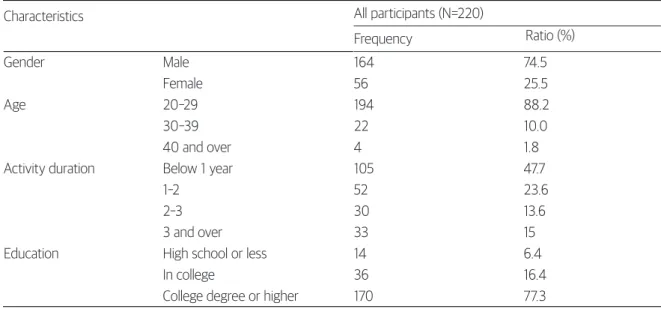
We ga r nered quest ion na i re data f rom competitive online advice communities in South Korea, in which members exchange their knowledge about becoming government officials or employees of state-run firms. 310 members were surveyed and 302 responses were collected. We eliminated two cases, one in which the individual had been a member of the community for less than 6 months, and one with fewer than an average of 6 visits per week. We also eliminated inconsistent or incomplete questionnaires. Ultimately, 220 valid surveys were collected, which is acceptable to
produce statistically reliable estimates among constructs (Hsu et al. 2007). The response rate
was approximately 97%.
Table 1. Demographic characteristics of sample
Characteristics All participants (N=220)
Frequency Ratio (%)
Gender Male 164 74.5
Female 56 25.5
Age 20-29 194 88.2
30-39 22 10.0
40 and over 4 1.8
Activity duration Below 1 year 105 47.7
1-2 52 23.6
2-3 30 13.6
3 and over 33 15
Education High school or less 14 6.4
In college 36 16.4
College degree or higher 170 77.3
Measures and procedure
The proposed research model is depicted in Figure 1, where individual anticipated emotions include four constructs, sense of competition, playfulness, reciprocity, and needs fulfillment. KS intentions encompassed two constructs, the intention to contribute, and the intention to seek knowledge. Items for each construct were measured on a seven-point Likert scale ranging from (1)
‘‘strongly disagree’’ to (7)‘‘strongly agree.’’
We adopted most items in the questionnaire from existing measures validated previously by other researchers.
To guarantee content validity, we refined the original version of the questionnaire by
conducting two pilot tests before the formal FIG 1. Research model
survey. The final questionnaire was prepared after the measurement items were corrected and modified based on the pilot results to ensure that all questions were unambiguous.
Because our proposed research model in- cluded multiple latent constructs and we had a comparatively small sample size, Partial Least Squares analyses were conducted using SmartPLS 3 v.3.1.9 (Ringle et al. 2015) to as- sess the research model.
To investigate the moderating effects of individuals’ perceived fear, we divided our sample into two groups based on the median value of 3.38. The group with a high level of perceived fear (>3.38) included 110 respon- dents, with a mean level of fear of 4.44, and a standard deviation of 0.79. The group with a low level of perceived fear (<3.38) also includ- ed 110 respondents, with a mean level of fear of 2.38, and a standard deviation of 0.69.
Table 2. Reliability and convergent validity
Construct Items F/L Cronbach’s α Adjusted R2 CR AVE
Sense of Competition competition 1 0.903 0.947 - 0.959 0.824
competition 2 0.939 competition 3 0.927 competition 4 0.880 competition 5 0.888
Needs fulfillment needs 1 0.843 0.803 - 0.884 0.718
needs 2 0.865
needs 3 0.833
Playfulness playfulness 1 0.913 0.930 - 0.956 0.878
playfulness 2 0.965 playfulness 3 0.932
Reciprocity reciprocity 1 0.892 0.936 - 0.960 0.888
reciprocity 2 0.966 reciprocity 3 0.967
Contribution Intention contribution 1 0.949 0.946 0.421 0.965 0.903
contribution 2 0.948 contribution 3 0.953
Seeking Intention seeking 1 0.908 0.899 0.184 0.937 0.832
seeking 2 0.915
seeking 3 0.913
4. Results
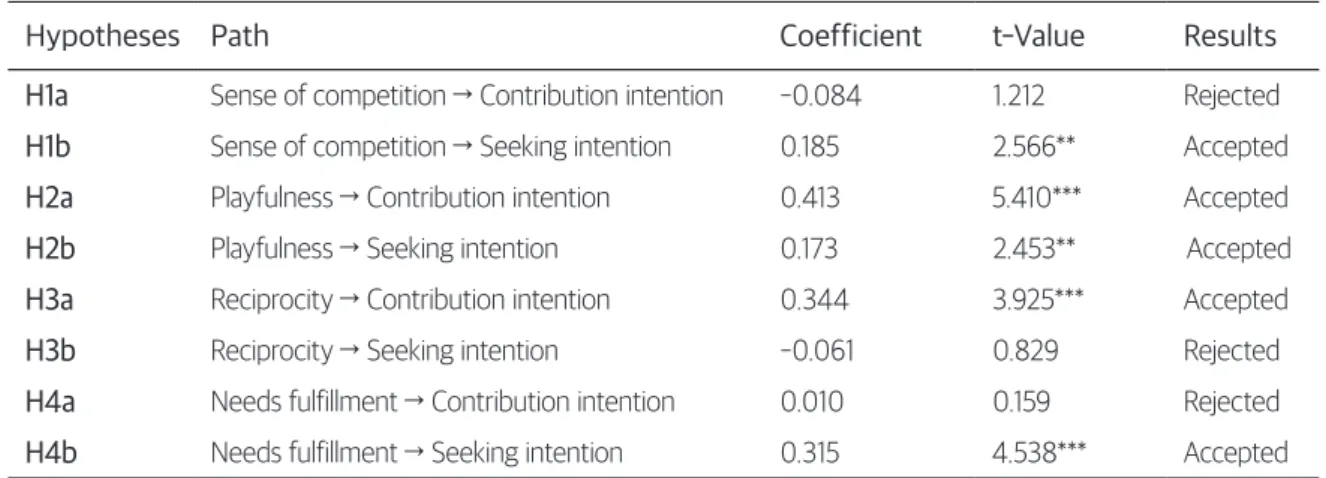
With reference to all participants (n=220), all of the hypotheses proposed were supported, with the exception of H1a (Sense of competi- tion→Contribution intention), H3b (Reciproc- ity→Knowledge seeking intention), and H4a (Needs fulfillment→Contribution intention).
From the perspective of intention to contrib- ute knowledge, we demonstrated that the
two positive emotions, playfulness (β=0.41, p<0.001) and reciprocity (β=0.34, p<0.001) af- fected the intention to contribute knowledge significantly. In contrast, from the perspec- tive of intention to seek knowledge, we found that three emotions, sense of competition (β
=0.19, p<0.05), playfulness (β=0.17, p<0.05), and needs fulfillment (β=0.32, p<0.001) had significant effects on the intention to seek knowledge (Table 3).
TABLE 3. Results of hypothesis testing (N=220)
Hypotheses Path Coefficient t-Value Results
H1a Sense of competition → Contribution intention -0.084 1.212 Rejected
H1b Sense of competition → Seeking intention 0.185 2.566** Accepted
H2a Playfulness → Contribution intention 0.413 5.410*** Accepted
H2b Playfulness → Seeking intention 0.173 2.453** Accepted
H3a Reciprocity → Contribution intention 0.344 3.925*** Accepted
H3b Reciprocity → Seeking intention -0.061 0.829 Rejected
H4a Needs fulfillment → Contribution intention 0.010 0.159 Rejected
H4b Needs fulfillment → Seeking intention 0.315 4.538*** Accepted
* p<0.05, ** p<0.01, *** p<0.001
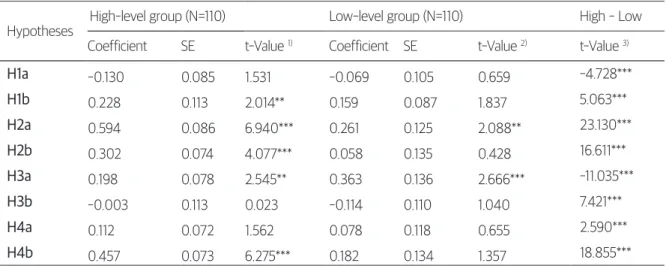
In the group with a high level of perceived f e a r, a l l o f t h e p r o p o s e d h y p o t h e s e s were supported, except for H1a (Sense of competition→Contribution intention), H3b (Reciprocity→Seeking intention), and H4a (Needs fulfillment→Contribution intention). In the group with a low level of perceived fear, except for H2a (Playfulness→Contribution intention) and H3a (Reciprocity→Contribution intention), all of the other hypotheses were rejected.
In addition, in order to address research
question 4 related to the effect of individual fear, we compared path coefficients between the two groups with high and low levels of fear using the formula proposed by Chin (2000). The results verif ied the effect of individual fear on KS intentions, as the path coefficients for each hypothesis between the two groups were all statistically significant.
t-values were positive overall, except for H1a (Sense of competition→Contribution intention) and H3a (Reciprocity→Contribution intention), which indicated that the relative
effects on the relationship between the two constructs were greater in the high-level fear group than in the low-level fear group. Thus, individuals with higher fear were likely to have a stronger intention to share their knowledge.
However, in the case of the effects of sense of
competition and reciprocity on contribution intention, our results were contrary to our expectation, in that individuals with lower fear were likely to have a stronger intention to contribute their knowledge to others (Table 4).
TABLE 4. Comparison between high-level fear group and low-level fear group
Hypotheses High-level group (N=110) Low-level group (N=110) High - Low
Coefficient SE t-Value 1) Coefficient SE t-Value 2) t-Value 3)
H1a -0.130 0.085 1.531 -0.069 0.105 0.659 -4.728***
H1b 0.228 0.113 2.014** 0.159 0.087 1.837 5.063***
H2a 0.594 0.086 6.940*** 0.261 0.125 2.088** 23.130***
H2b 0.302 0.074 4.077*** 0.058 0.135 0.428 16.611***
H3a 0.198 0.078 2.545** 0.363 0.136 2.666*** -11.035***
H3b -0.003 0.113 0.023 -0.114 0.110 1.040 7.421***
H4a 0.112 0.072 1.562 0.078 0.118 0.655 2.590***
H4b 0.457 0.073 6.275*** 0.182 0.134 1.357 18.855***
* p<0.05, ** p<0.01, *** p<0.001
1) & 2) t-Value is the results of hypothesis testing for high- & low-level fear group.
3) t-Value is the results of analyzing path coefficients between high- & low-level fear groups by Chin (2000).
5. Discussion
The primary goal of this study was to test hypotheses that revealed the relationship b et we en i nd iv idua l emot ion s a nd K S intentions in competitive online advice communities. For this purpose, we collected 220 valid questionnaires from members in such communities. Our significant findings were as follows.
With respect to our first research question, we demonst rate d t hat i n comp et it ive
online advice communities, four individual emotions, including playfulness, reciprocity, needs fulfillment, and a sense of competition, pl aye d si g n i f ic a nt role s i n a f fe c t i n g individual’s KS intentions. For example, play fulness af fected bot h indiv idua ls’
intention to contribute and seek knowledge significantly, and reciprocity played a crucial role in individuals’ intention to contribute knowledge. Needs fulfillment and a sense of competition had significant effects on individuals’ intentions to seek knowledge.
With respect to research question 2, we
found that a sense of competition did not inhibit, but rather promoted, individuals’
KS intention in the competitive context of these online advice communities. Therefore, individual emotions need to be regarded as antecedents that affect KS intentions.
With respect to research question 3, we expected initially that a sense of competition might hinder the intention to contribute, and reciprocity might inhibit the intention to seek knowledge as well. However, the results revealed that individuals’ intentions to contribute knowledge were enhanced by playfulness and reciprocity, while their intention to seek knowledge from others was facilitated significantly by needs fulfillment, sense of competition, and play fulness.
Interestingly, playfulness emerged as a common emotion that affected the intention to seek knowledge and contribute knowledge simultaneously.
These results showed that the emotions we measured demonstrated different patterns depending upon whether one contributes or seeks knowledge in the communities, as well as the fact that individuals have different needs and motivations related to contributing and seeking behavior in online advice communities (Kankanhalli et al. 2005).
Finally, with respect to research question 4, the empirical results showed that individuals have a significantly strong fear of losing their unique value (Renzl 2008) or being defeated by a rival (Pfeffer and Sutton 2013)
in competitive online advice communities.
Nonetheless, regardless of the degree of fear, both playfulness and reciprocity were critical factors that affected the intention to contribute knowledge in these communities.
However, interestingly, in the high-level fear group, playfulness had a stronger influence on the intention to contribute knowledge than did reciprocity, while the group with a low level of fear showed the opposite results.
Further, the empirical results of the effect on KS intentions of individual fear between the high- and low-level fear groups showed that, on the whole, individuals with higher fear had a stronger intention to share their knowledge, while in those individuals with higher fear, combined with a higher sense of competition or reciprocity, fear inhibited their intentions to contribute knowledge.
We interpreted these results to indicate that individual fear would either promote or hinder individuals’ KS intentions. Therefore, individual fear can be a significant emotion in individuals’ KS intentions.
In conclusion, playfulness and reciprocity enhanced members’ intentions to contribute knowledge, and needs fulfillment, sense of competition, and playfulness facilitated their intentions to seek knowledge. In addition, the degree of members’ intentions to contribute and seek information differed according to their level of perceived fear.
This study makes several contributions to the literature. First, we observed the effects
of two respective intentions (contributing and seeking) in a single integrated knowledge sharing context, in that knowledge can be shared asymmetrically among a minority of contributors and a majority of recipients.
Therefore, this study will contribute to the theoretical literature on the knowledge sharing in VCs, and provide a framework for future studies. Second, we focused on fear emotion perceived by individuals in an implicitly competitive context such as knowledge sharing in an organization. The emotion of fear can be a critical factor to consider in knowledge sharing within organization.
This study makes several contributions for practitioners as well. First, to ensure successf u l a nd susta inable knowledge management system, managers must supply different intrinsic or extrinsic motivational conditions depending on the situation, i.e., supporting contributing or seeking knowledge. Second, to motivate employees’
knowledge sharing intentions in knowledge management system, managers should control the negative emotions such as fear, anger, anxiety, etc.
This study has several limitations. First, the data were collected from the members of particular online communities that have the specific purpose of recruitment in Korea.
Therefore, replications of the study with other virtual communities would be necessary.
Second, to clarify the influence of emotional
factors on knowledge sharing intentions, we considered only limited individual affectivity.
Therefore, further studies are needed to consider more various affective factors related to organizational variables other than cooperation and competition.
* Acknowledgment: This paper extends upon a previous publication (Jun & Lee, 2015) to include new constructs, and suggest a new research model with rigorous validations, new finding and enriched implications for both scholars and practitioners. Biblical information for the previous publication is as follows:
Jun, H. G. & Lee, K. C. (2015). An Empirical Analysis Approach to Exploring the Influence of Positive and Negative Emotions on Individual’
s Knowledge Sharing and Utilization Intentions.
Knowledge Management Research, 16(1), 21-54.
References
1. Bagozzi, R. P., Dholakia, U. M., and Ba su roy, S . 20 03. “How ef for t f u l decisions get enacted: The motivating role of decision processes, desires, and anticipated emotions,” Journal of Behavioral Decision Making (16:4), pp.
273-295.
2. Bagozzi, R. P., Gopinath, M., & Nyer, P. U. 1999. “The role of emotions in marketing,” Journal of the Academy of Marketing Science (27:2), pp. 184-206.
3. Bock, G. W., Zmud, R. W., Kim, Y.
G., and Lee, J. N. 2005. “Behavioral intention formation in knowledge s h a r i n g : E x a m i n i n g t h e r o l e s o f e x t r i n s i c m o t i v a t o r s , s o c i a l- psychological forces, and organizational climate,” MIS Quarterly (29:1), pp. 87-111.
4. Cabanac, M. 2002. “What is emotion?,”
Behavioural Processes (60:2), pp. 69-83.
5. Chai, S., Das, S., and Rao, H. R. 2011.
“Behavioral intention formation in knowledge sharing: Examining the rolegender.,” Journal of Management Information Systems (28:3), pp. 309-342.
6. Chao-Min, C., Wang, E. T., Shih, F.
J., and Yi-Wen, F. 2011. ing the on in knowledge sharing: Examining tcommunit ies,” Online Information Review (35:1), pp. 134-153.
7. Chen, G. L., Yang, S. C., and Tang, S.
M. 2013. “Sense of virtual community and knowledge contribution in a P3 virtual community: Motivation and experience,” Internet Research (23:1), pp.
4-26.
8. Chin, W. W., 2000. Frequently Asked Questions – Partial Least Squares & PLS- Graph, Home Page.[On-line]. Available:
http://disc-nt.cba.uh.edu/chin/plsfaq.
htm
9. Chiu, C. M., Wang, E. T., Shih, F. J., and Fan, Y. W. 2011. “Understanding k n o w l e d g e s h a r i n g i n v i r t u a l c o m m u n i t i e s : a n i n t e g r a t i o n o f expectancy disconfirmation and justice theories,” Online Information Review (35:1), pp. 134-153.
10. Chong, C. W., and Besharati, J. 2014.
“Challenges of knowledge sharing in the petrochemical industry,” Knowledge M a n a g e m e n t & E - L e a r n i n g : A n International Journal (KM&EL); 6: pp. 171- 187.
11. Connelly, C. E., Ford, D. P., Turel, O., Gallupe, B., and Zweig, D. 2014. “‘I’m busy (and competitive)!’ Antecedents of knowledge sharing under pressure,”
Knowledge Management Research &
Practice (12:1), pp. 74-85.
12. D av i s , F. D. , B a go z z i , R . P. , a nd Warshaw, P. R. 1992. “Extrinsic and intrinsic motivation to use computers in the workplace1,” Journal of Applied Social Psychology (22:14), pp. 1111-1132.
13. He, H., Baruch, Y., and Lin, C. P. 2014.
“Modeling team knowledge sharing and team flexibility: The role of within- team competition,” Human Relations; 0018726713508797.
14. He, W., and Wei, K. K. 2009. “What drives continued knowledge sharing? An investigation of knowledge-contribution and-seeking beliefs,” Decision Support Systems (46:4), pp. 826-838.
15. Hsu, M. H., Ju, T. L., Yen, C. H., and Chang, C. M. 2007. “Knowledge sharing behavior in virtual communities: The relationship between trust, self-efficacy, and outcome expectations,” International Journal of Human-Computer Studies
(65:2), pp. 153-169.
16. Huang, L. C., and Shiau, W. L. 2015.
“Why do people use Microblogs? An empirical study of Plurk,” Information Technology & People (28:2), pp. 281-303.
17. Hung, S. Y., Lai, H. M., and Chou, Y.
C. 2015. “Knowledge‐sharing intention in professional virtual communities:
A comparison between posters and lurkers,” Journal of the Association for Information Science and Technology; wileyonlinelibrary.com DOI: 10.1002/
asi.23339
18. Kankanhalli, A., Tan, B. C., and Wei, K.
K. 2005. “Contributing knowledge to electronic knowledge repositories: an empirical investigation,” MIS Quarterly (29:1), pp. 113-143.
19. K immerle, J., a nd Cress, U. 2013.
“ The impact of cognitive anchors on information-sharing behavior,”
Cyberpsychology, Behavior, and Social Networking (16:1), pp. 45-49.
20. Kleinginna Jr, P. R., & Kleinginna, A.
M. 1981. “A categorized list of emotion def initions, with suggestions for a consensual definition,” Motivation and Emotion (5:4), pp. 345-379.
21. Ko, D. G., Kirsch, L. J., and King, W.
R. 2005. “Antecedents of knowledge transfer from consultants to clients in enterprise system implementations,”
MIS Quarterly (29:1), pp. 59-85.
22. L a z a r u s , R . S . 19 91 . Emotion and Adaptation. Oxford University Press, Oxford.
23. McConnell, M. M., and Eva, K. W. 2012.
“The role of emotion in the learning and transfer of clinical skills and knowledge,” Academic Medicine (87:10), pp. 1316-1322.
24. McMillan, D. W., and Chavis, D. M.
1986. “Sense of community: A definition and theor y,” Journal of Community Psychology (14:1), pp. 6-23.
25. Pfeffer, J., and Sutton, R. I. 2013. The knowing-doing gap: How smart companies turn knowledge into action, Har vard Business Press.
26. Quigley, N. R., Tesluk, P. E., Locke, E.
A., and Bartol, K. M. 2007. “A multilevel i nvest igat ion of t he mot ivat iona l
mechanisms underlying knowledge sharing and performance,” Organization Science (18:1), pp. 71-88.
27. Renzl, B. 2008. “Trust in management and knowledge sharing: The mediating e f f e c t s o f f e a r a n d k n o w l e d g e documentation,” Omega (36:2), pp. 206- 220.
28. Rhodes, J., Hung, R., Lok, P., Lien, B. Y. H., and Wu, C. M. 2008. “Factors influencing organizational knowledge transfer:
implication for corporate performance,”
Journal of Knowledge Management (12:3), pp. 84-100.
29. Ringle, C.M., Wende, S., and Becker, J.M. 2015. “Smart PLS 3. Boenningstedt:
SmartPLS GmbH,” http://www.smartpls.
com
30. Sánchez-Franco, M. J., and Roldán, J.
L. 2015. “The influence of familiarity, trust and norms of reciprocity on an experienced sense of community: an empirical analysis based on social online services,” Behaviour & Information Technology (34:4), pp. 392-412.
31. Schepers, P., and Van den Berg, P.
T. 20 07. “ S o c ia l fac tors of work- environment creativity,” Journal of Business and Psychology (21:3), pp. 407-
428.
32. Siciliano, M. D. 2015. “Advice Networks in Public Organizations: The Role of Structure, Internal Competition, a nd Indiv idua l At t r ibutes,” Public
Administration Review (75:4), pp. 548-559.
33. Sparrowe, R. T., Liden, R. C., Wayne, S. J., and Kraimer, M. L. 2001. “Social net works and the per formance of individuals and groups,” Academy of Management Journal (44:2), pp. 316-325.
34. Stenius, M., Hankonen, N., Haukkala, A., and Ravaja, N. 2015. “Understanding knowledge sharing in the work context by applying a belief elicitation study,”
Journal of Knowledge Management (19:3), pp. 497-513.
35. Wa n g , S . , a n d N o e , R . A . 2 0 10 .
“Knowledge sharing: A review and directions for future research,” Human Resource Management Review (20:2), pp.
115-131.
36. Wasko, M. M., and Faraj, S. 2000 . ““It is what one does”: why people participate and help others in electronic communities of practice,” The Journal of Strategic Information Systems (9:2), pp. 155-173.
37. Wasko, M. M., and Faraj, S. 2005. “Why should I share? Examining socia l capital and knowledge contribution in electronic networks of practice,” MIS Quarterly (29:1), pp. 35-57.
38. Ye, H. J., Feng, Y., and Choi, B. C. 2015.
“Understanding knowledge contribution in online knowledge communities:
A model of community support and for u m leader suppor t ,” Electronic Commerce Research and Applications (14:1), pp. 34-45.
Appendix A. Constructs and related literature
Variables Measure Operationalization Source
Sense of Competition
1. Members have a ‘win–lose’ relationship.
2. Members’ goals are incompatible with each other.
3. Members are competitive to prepare for the recruitment exam.
4. Members are competitive in trying to get the highest score.
5. Members are trying to outperform others for the exam.
Desire to achieve a better outcome than a comparator other
He et al.
(2014) Connelly et al.
(2014)
Needs fulfillment
1. I can obtain necessary information from this online com- munity.
2. I can learn how to do things from this online community.
3. I can generate ideas with the help of this online commu- nity
The extent to which the online knowledge community helps individual members to get information, to learn how to do things, and to gener- ate ideas
Ye et al.
(2015)
Playfulness 1. I enjoy participating in and sharing knowledge with the virtual community.
2. I feel good when participating in and sharing knowledge with the virtual community.
3. It is fun to participate in and share knowledge with the virtual community.
The extent to which participation and sharing knowledge is perceived to be per- sonally enjoyable and fun
Chiu et al.
(2011)
Reciprocity 1. When I share information through communities, I believe that my questions will be answered in the future.
2. I believe that other members I interact with would help me if I was in need.
3. When I share my knowledge and information through my community, I expect some other members to respond when I am in need.
Individual perception of fairness to share content mutually in a virtual community
Chai et al.
(2011)
Fear 1. If I provide everybody with my entire know-how, I am afraid of failing in the exam.
2. I don’t gain anything if I share my know-how.
3. If I share my know-how, I will lose my knowledge advan- tage.
4. Knowledge sharing means failing in the exam.
Members’ anxiety about giving away valuable knowledge while being offered little in return
Renzl (2008)
Contribution Intention
1. I intend to contribute my knowledge in the future.
2. My intentions are to contribute my knowledge in the next month.
3. If I could, I would like to contribute my knowledge.
The degree to which members intend to contribute their knowledge to others in the community
He and Wei (2009)
Seeking Intention
1. I intend to seek knowledge in the future.
2. My intentions are to seek knowledge in the next month.
The degree to which members intend to seek other’s knowl- edge in the communi-
He and Wei (2009)
저 자 소 개
이 건 창 (Kun Chang Lee)
현재 성균관대학교 경영대학 글로벌경영학과 및 삼성융합의과학원(SAIHST) 교수로 재직중 이다. 성균관대학교 경영대학에서 학사, 카이스트 경영과학과에서 인공지능/의사결정지원분 야로 석사 및 박사학위를 취득하였다. 최근 주요 연구분야는 뉴로 사이언스 기반 의사결정, 지능형 의사결정, HRI, 창의성 과학, 감성과학, 헬스 인포매틱스 등이다.
전 현 규 (Hyeon Gyu Jeon)
현재 성균관대학교 경영대학 연구교수로 재직중이다. 경희대학교에서 e비즈니스 분야로 석사, 경영정보(지식경영 분야)로 박사학위를 취득하였다. 최근 주요 연구분야는 헬스인포매틱스, 지식경영, 데이터마이닝, 전자상거래, 창의성과학, 감성과 의사결정 등이다.