This is an Open Access ar ticle distributed under the terms of the Creative Commons Attribution Non-Commercial License (http:
//creativecommons.org/licenses/by-nc/4.0/) which permits unrestricted non-commercial use, distribution, and reproduction in any medium, provided the original work is properly cited.
© 2021 THE KOREAN SOCIETY OF MYCOLOGY.
Accepted: August 24, 2021 Revised: August 18, 2021 Received: June 12, 2021 https://doi.org/10.4489/KJM.20210025 Kor. J. Mycol. 2021 September, 49(3): 285-294
OPEN ACCESS pISSN : 0253-651X eISSN : 2383-5249
RESEARCH ARTICLE
Detection of RNA Mycoviruses in Wild Strains of Lentinula edodes in Korea
Eunjin Kim, Mi-Jeong Park, Yeongseon Jang*, Rhim Ryoo, and Kang-Hyeon Ka
Forest Microbiology Division, Forest Bioresources Department, National Institute of Forest Science, Suwon, 16631, Korea
*Corresponding author: [email protected]
ABSTRACT
In general, mycoviruses remain latent and rarely cause visible symptoms in fungal hosts;
however, some viral infections have demonstrated abnormal mycelial growth and fruiting body development in commercial macrofungi, including Lentinula edodes. Compared to other cultivated mushrooms, L. edodes is more vulnerable to viral infections as it is still widely cultivated under near-natural conditions. In this study, we investigated whether Korean wild strains of L. edodes were infected by RNA mycoviruses that have previously been reported in other parts of the world (LeSV, LePV1, LeV-HKB, LeNSRV1, and LeNSRV2).
Using specific primer sets that target the RNA-dependent RNA polymerase genes of each of the RNA mycovirus, reverse transcription-polymerase chain reaction (RT-PCR) was used to detect viral infection. Viral infection was detected in about 90% of the 112 wild strains that were collected in Korea between 1983 and 2020. Moreover, multiple infections with RNA mycoviruses were detected in strains that had normal fruiting bodies. This work contributes to our understanding of the distribution of RNA mycoviruses in Korea and the impact of multiple viral infections in a single strain of L. edodes.
Keywords: Lentinula edodes, Multiple infection, Mushroom, Mycovirus, RT-PCR (reverse transcription-polymerase chain reaction)
INTRODUCTION
Environmental changes and mutations in specific genes can lead to the emergence of mycoviral infections [1]. Viral infections in mushrooms are caused by mycelium fusion, which also transmits the virus to healthy mycelium by spores [2]. Similar to mushroom spores, mycelium remaining in the mushroom cultivator can be a viral infection medium [3].
Lentinula edodes is a commercially important, edible mushroom that is cultivated throughout Korea.
Compared to Flammulina velutipes and Pleurotus ostratus, L. edodes has a relatively long cultivation period, with fruiting bodies that can be harvested more than five times on the same growth medium. The cultivation of L. edodes in farms is often exposed to the surrounding environment, which can increase the risk of viral infections [4,5].
the 1970s [7], and viruses associated with L. edodes have also been found in Korea in more recent studies [4,8]. LeV-HKB was the first mycovirus that was identified to have a dsRNA genome, and it shares a high degree of similarity with the genomes of LeSV and LeV-HKB [8,10]. LePV1 and LeV-HKB can coinfect L.
edodes, and studies have also been performed to evaluate how these infections affect each other [9].
It is essential to screen strains that are not infected with a virus as viral infections have a significant impact on mushroom quality and productivity [11]. Since infection of the mycovirus is difficult to eradicate and it is necessary to use virus-free strains to prevent damage caused by the mycovirus [12,13].
The cultivation conditions of some mushrooms can help to prevent the impact of viral infections, even if they are strains that contain viral particles [14-16]. If viral particles are found but no disease appears, the viral infection may be overlooked; however, the same strain can cause problems under different conditions. Therefore, viral detection is strains used for breeding is paramount to the successful cultivation of mushrooms.
In this study, we use reverse transcription-polymerase chain reaction (RT-PCR) to detect RNA mycoviral infection in wild strains of L. edodes that can be used as a breeding resource in the future. The presence of five RNA mycoviruses (LePV1, LeSV, LeV-HKB, LeNSRV1, and LeNSRV2) were tested in the wild strains of L. edodes, and we observed the occurrence of single and multiple viral infections within a single wild strain.
MATERIALS AND METHODS
Fungal strains
One hundred and twelve wild strains of L. edodes were examined in this study (Table 1). They were isolated from samples that were collected from various locations across Korea from 1983 to 2020 and maintained at 4℃ through successive subcultures by the National Institute of Forest Science. The strains were cultured on potato dextrose agar (PDA, Difco, MD, USA) media at 25℃ for two weeks under dark conditions before use.
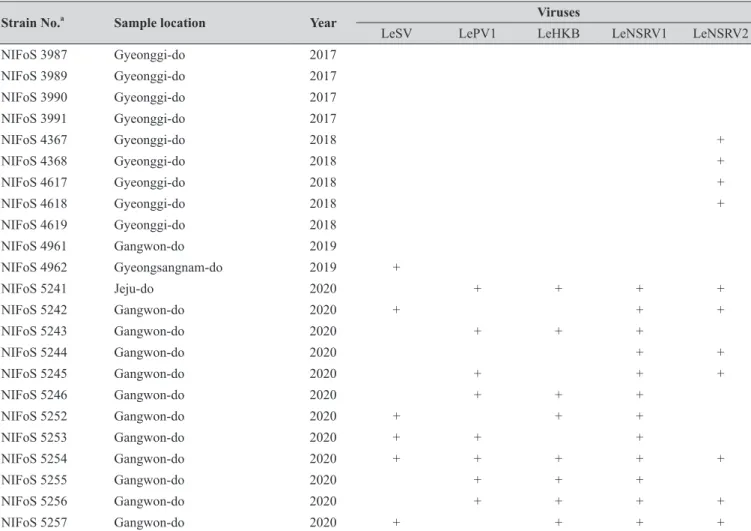
Table 1. The sampling information and RT-PCR analysis of the occurrence of RNA mycoviruses in wild strains of Lentinula edodes in Korea.
Strain No.a Sample location Year Viruses
LeSV LePV1 LeHKB LeNSRV1 LeNSRV2
NIFoS 36 Gyeongsangnam-do 1983 + +
NIFoS 37 Gyeongsangnam-do 1983 +
NIFoS 38 Gyeongsangnam-do 1983 +
NIFoS 39 Gyeongsangnam-do 1983
NIFoS 40 Gyeongsangnam-do 1983
Strain No.a Sample location Year Viruses
LeSV LePV1 LeHKB LeNSRV1 LeNSRV2
NIFoS 41 Gangwon-do 1983 +
NIFoS 42 Jeju-do 1983 + + +
NIFoS 43 Jeju-do 1983
NIFoS 45 Gangwon-do 1984 + +
NIFoS 46 Gangwon-do 1984 + +
NIFoS 47 Gangwon-do 1984 + +
NIFoS 48 Gangwon-do 1984 +
NIFoS 49 Gangwon-do 1984 + +
NIFoS 50 Gangwon-do 1984 + + +
NIFoS 51 Gangwon-do 1984 + + + + +
NIFoS 52 Gangwon-do 1984 + + +
NIFoS 53 Gangwon-do 1984 + +
NIFoS 55 Gyeongsangnam-do 1984 + + +
NIFoS 56 Gyeongsangnam-do 1984 +
NIFoS 57 Gyeongsangnam-do 1984 +
NIFoS 58 Gyeongsangnam-do 1984 + + +
NIFoS 59 Gyeongsangnam-do 1984 + +
NIFoS 60 Gyeongsangnam-do 1984 + +
NIFoS 62 Gangwon-do 1985 + + +
NIFoS 63 Gangwon-do 1985 + + + + +
NIFoS 64 Gangwon-do 1985 + +
NIFoS 65 Gangwon-do 1985 + +
NIFoS 66 Gangwon-do 1985 + + +
NIFoS 67 Gangwon-do 1985 + + + +
NIFoS 68 Gangwon-do 1985 +
NIFoS 128 Jeollabuk-do 1986 + + +
NIFoS 129 Chungcheongbuk-do 1986 + +
NIFoS 130 Chungcheongbuk-do 1986 + +
NIFoS 135 Gyeongsangnam-do 1986 +
NIFoS 136 Gyeongsangnam-do 1986 + +
NIFoS 177 Jeju-do 1989 +
NIFoS 188 Gangwon-do 1989
NIFoS 221 Gangwon-do 1991
NIFoS 299 Gangwon-do 1995 +
NIFoS 351 Gangwon-do 1996 +
NIFoS 352 Gangwon-do 1996 + + +
NIFoS 353 Gangwon-do 1996 + + + +
NIFoS 354 Gangwon-do 1996 + +
NIFoS 369 Gangwon-do 1998 + + +
NIFoS 370 Gangwon-do 1998 + +
NIFoS 411 Gangwon-do 1999 + +
NIFoS 663 Gangwon-do 2004 +
Table 1. Continued
Strain No. Sample location Year
LeSV LePV1 LeHKB LeNSRV1 LeNSRV2
NIFoS 665 Gangwon-do 2004 + +
NIFoS 666 Gangwon-do 2004 + +
NIFoS 667 Gangwon-do 2004 +
NIFoS 668 Gangwon-do 2004 + + + +
NIFoS 669 Gangwon-do 2004 +
NIFoS 670 Gangwon-do 2004 + + +
NIFoS 672 Gangwon-do 2004 + + +
NIFoS 673 Gangwon-do 2004 + + +
NIFoS 674 Gangwon-do 2004 + + +
NIFoS 675 Gangwon-do 2004 + +
NIFoS 676 Gangwon-do 2004 + + +
NIFoS 1520 Gangwon-do 2011 + + + +
NIFoS 1522 Gangwon-do 2011 + + + +
NIFoS 1651 Jeollanam-do 2011 + + +
NIFoS 1652 Jeollanam-do 2011 + +
NIFoS 2063 Gangwon-do 2013 + + +
NIFoS 2064 Gangwon-do 2013 +
NIFoS 2101 Gangwon-do 2013 + + + +
NIFoS 2290 Gangwon-do 2013 + +
NIFoS 2497 Gangwon-do 2014 +
NIFoS 2498 Gangwon-do 2014 +
NIFoS 2521 Gangwon-do 2014 + +
NIFoS 2783 Gangwon-do 2014 + +
NIFoS 3010 Gangwon-do 2015 + + + +
NIFoS 3125 Jeollanam-do 2015 + + +
NIFoS 3166 Gangwon-do 2016 + +
NIFoS 3168 Gangwon-do 2016 +
NIFoS 3169 Gangwon-do 2016 + +
NIFoS 3170 Gangwon-do 2016 +
NIFoS 3172 Gangwon-do 2016 + +
NIFoS 3173 Jeju-do 2016 + + +
NIFoS 3175 Gangwon-do 2016 + +
NIFoS 3177 Gangwon-do 2016 + +
NIFoS 3198 Gangwon-do 2016 + + +
NIFoS 3199 Gangwon-do 2016 + +
NIFoS 3201 Gangwon-do 2016 + + + +
NIFoS 3202 Gangwon-do 2016 + + +
NIFoS 3203 Gangwon-do 2016 + + +
NIFoS 3983 Gyeonggi-do 2017 +
NIFoS 3984 Gyeonggi-do 2017
NIFoS 3986 Gyeonggi-do 2017 +
RNA extraction and cDNA synthesis
The mycelium grown on each PDA medium was collected by a cell scraper and frozen in liquid nitrogen.
Total RNA was extracted using the RNeasy Mini Kit (Qiagen, CA, USA), following the manufacturer’s instructions. The quantity and quality of the RNA were examined using an Epoch Multi-volume Spectrophotometer (BioTek, VT, USA). Single strand cDNA synthesis was carried out using Moloney murine leukemia virus reverse transcriptase (New England Biolabs).
RT-PCR
To confirm viral infection, RT-PCR was conducted with specific primers to amplify the RNA-dependent RNA polymerase (RdRp) genes of each mycovirus (Table 2). Amplification of the β-tubulin gene was used as a positive control to confirm successful RNA extraction and cDNA synthesis. All the primers used for RT-PCR are listed in Table 2. RT-PCR for β-tubulin and LeSV were performed under the following conditions: 95℃ for 5 min; 25 cycles of 95℃ for 30 s, 55℃ for 30 s, and 72℃ for 1 min; 72℃ for 5 min. RT-PCR for LePV1, LeV-HKB, LeNSRV1, and LeNSRV2 were performed under the following
Strain No.a Sample location Year Viruses
LeSV LePV1 LeHKB LeNSRV1 LeNSRV2
NIFoS 3987 Gyeonggi-do 2017
NIFoS 3989 Gyeonggi-do 2017
NIFoS 3990 Gyeonggi-do 2017
NIFoS 3991 Gyeonggi-do 2017
NIFoS 4367 Gyeonggi-do 2018 +
NIFoS 4368 Gyeonggi-do 2018 +
NIFoS 4617 Gyeonggi-do 2018 +
NIFoS 4618 Gyeonggi-do 2018 +
NIFoS 4619 Gyeonggi-do 2018
NIFoS 4961 Gangwon-do 2019
NIFoS 4962 Gyeongsangnam-do 2019 +
NIFoS 5241 Jeju-do 2020 + + + +
NIFoS 5242 Gangwon-do 2020 + + +
NIFoS 5243 Gangwon-do 2020 + + +
NIFoS 5244 Gangwon-do 2020 + +
NIFoS 5245 Gangwon-do 2020 + + +
NIFoS 5246 Gangwon-do 2020 + + +
NIFoS 5252 Gangwon-do 2020 + + +
NIFoS 5253 Gangwon-do 2020 + + +
NIFoS 5254 Gangwon-do 2020 + + + + +
NIFoS 5255 Gangwon-do 2020 + + +
NIFoS 5256 Gangwon-do 2020 + + + +
NIFoS 5257 Gangwon-do 2020 + + + +
aNIFoS, National Institute of Forest Science.
Table 1. Continued
conditions: 95℃ for 5 min; 35 cycles of 95℃ for 30 s, 60℃ for 30 s, and 72℃ for 1 min; 72℃ for 5 min.
The PCR products were confirmed using 1.5% (w/v) agarose gel electrophoresis.
RESULTS AND DISCUSSION
We isolated 112 wild strains of L. edodes from different times and locations in Korea (Table 1); there were 75 strains from Gangwon province, 14 strains from Gyeongsangnam province, 12 strains from Gyeonggi province, 5 strains from Jeju province, 3 strains from Jeollanam province, 2 strains from Chungcheongbuk province, and 1 strain from Jeollabuk province.
Specific primer sets (LeSV, LePV1, LeV-HKB, LeNSRV1, and LeNSRV2) were used (Table 2) to detect viral infection. According to the RT-PCR analysis, products of 328 to 394 bp in length were amplified from the wild strains when infected with the viruses (LeSV 386 bp, LePV1 389 bp, LeV-HKB 394 bp, LeNSRV1 377 bp, and LeNSRV2 328 bp) (Fig. 1).
Approximately half of the strains were infected with LeSV (50.9%, 57/112), LeV-HKB (50.9%, 57/112), LeNSRV1 (45.5%, 51/112), or LePV1 (42.9%, 48/112) viruses. The LeNSRV2 virus had a lesser infection than the other viruses (20.5%, 23/112) (Fig. 2A).
Most of the infected strains were co-infected with different viruses (Fig. 2B). Among them, 30 strains (26.8%) were infected with two different viruses and 29 strains (25.9%) were infected with three different viruses. One viral infection was observed in 26 (23.2%) strains. Only three strains, NIFoS 51, 63, and 5254, that were collected from Gangwon province had five mycoviruses. On the other hand, 12 strains (10.7% of the total wild strains) were not infected by the viruses.
In this study, we observed multiple infections in which two or more types of virus were present in a single strain. Although multiple viral infections are often found in plants and fungi, much research is still needed on the consequences of multiple infections [17,18]. For example, the African cassava mosaic virus (ACMV) and East African cassava mosaic virus (EACMV) are commonly found to co-infect cassava plants with cassava mosaic disease (CMD) symptoms [19]; viral symptoms were more severe when ACMV and EACMV were present in Nicotiana benthamiana plants [19]. These results indicate that the two viruses have synergistic interactions [19]. The single infection of sweet potato feathery mottle virus (SPFMV, genus Potyvirus) and sweet potato chlorotic stunt virus (SPCSV, genus Crinivirus) in sweet potato do not show
LeSV GCGATGATGACATACAGTAGGC CGACGTCGGATAACATTGCGTC This study
LePV1 AGCCTTTGACGATGTATCCGACTAC GGGTTATGATTGCGAGAGGCATT [9]
LeV-HKB TGTTGTATAAGACAGGCGGTGTGGG GGGTATATCTCAGCAAGCCTATGC [9]
LeNSRV1 CGAGACATCCTCGCGGCTGTAGAGG CCGAGGTTACCAGCTCCGATTGTC [9]
LeNSRV2 AAGTATGGGGTAGTGATGATAGTGG GAGGCTCCACCTTCCAATGTCTGAG [9]
significant symptoms [20]. In contrast, coinfection with the two viruses is caused by the sweet potato virus disease (SPVD), with severe symptoms evident in plants [20]. With the discovery of LePV1 and LeV-HKB coinfection in L. edodes, studies have also been conducted to assess their influence on each other [9]. When Fig. 1. Reverse transcription-polymerase chain reaction (RT-PCR) detection of viral infection from 112 wild strains of Lentinula edodes. Specific primer sets targeting RNA- dependent RNA polymerase genes of each RNA mycovirus were adopted for RT-PCR.
Numbers represent each of the wild strains. Amplification of the β-tubulin gene was used as the positive control to confirm the RNA extraction.
the LePV1 virus is coinfected with LeV-HKB, the RdRp gene expression has been reported to be higher than that of a single infection [9].
Furthermore, how multiple infections of the virus found in L. edodes affect a viral disease should be Fig. 2. Analysis of viral infections of Lentinula edodes. (A) Infection rate of each RNA mycovirus in the 112 wild strains used in this study. (B) Rate of viral multiple infection from 112 wild strains. The number on the horizontal axis represent the number of infected viruses.
(B)
further studied. Despite the difficulty in evaluating the effects of each virus when several viruses infect one strain, a virus-cured strain can be used as an important control to investigate the individual effects. It is also necessary to further analyze whether a virus is present in the fruiting body by single spore isolation in the event of hybridization.
Although the number of strains collected from provinces other than Gangwon province was small, it is interesting to note that geographically LeSV, LePV1, LeV-HKB, and LeNSRV1 were not present in the strains collected from Gyeongsangnam province. Further, only the LeNSRV2 virus was detected in the samples collected from Gyeonggi province. These phenomena suggest the possibility that the infection of each virus is related to regional characteristics. To increase the diversity of wild strains of L. edodes in the future, we must investigate forest areas throughout the country, and the confirmation of viral infection in these collected strains will be essential.
ACKNOWLEDGEMENT
This study was supported by a grant from the Golden Seed Project of ‘Breeding of new strains of shiitake for cultivar protection and substitution of import (213007-05-5-SBH10)’ of the National Institute of Forest Science, Republic of Korea.
REFERENCES
1. Ridley SP, Sommer SS, Wickner RB. Superkiller mutations in Saccharomyces cerevisiae suppress exclusion of M2 double-stranded RNA by L-A-HN and confer cold sensitivity in the presence of M and L-A-HN. Mol Cell Biol 1984;4:761-70.
2. Ghabrial SA. Origin, adaptation and evolutionary pathways of fungal viruses. Virus Genes 1998;16:119-31.
3. Magae Y. Characterization of a novel mycovirus in the cultivated mushroom, Lentinula edodes.
Virol. J 2012;9:1-6.
4. Kim J, Yun S, Ko H, Kim D. Occurrence of dsRNA mycovirus (LeV-FMRI0339) in the edible mushroom Lentinula edodes and meiotic stability of LeV-FMRI0339 among monokaryotic progeny. Plant Pathol J 2013;29:460-4.
5. Rytter, JL, Royse DJ, Romaine CP. Incidence and diversity of double stranded RNA in Lentinula edodes. Mycologia 1991;83:506-510.
6. Hollings, M. Viruses associated with a die-back disease of cultivated mushroom. Nature 1962;196:962-5.
7. Inouye T, Furuya K, Nisikado Y. Virus-like particles found in shiitake. Ann Phytopathol Soc Japan 1970;36:356.
8. Lin YH, Fujita M, Chiba S, Hyodo K, Andika IB, Suzuki N, Kondo H. Two novel fungal negative-strand RNA viruses related to mymonaviruses and phenuiviruses in the shiitake mushroom (Lentinula edodes). Virol 2019;533:125-36.
9. Guo M, Bian Y, Wang J, Wang G, Ma X, Xu Z. Biological and molecular characteristics of a novel partitivirus infecting the edible fungus Lentinula edodes. Plant Dise 2017;101:726-33.
Isolation and characterization of mycovirus in Lentinula edodes. Micro J 2013;51:118-22.
12. Sahin E, Akata I. Viruses infecting macrofungi. Virus Disease 2018;29:1-18.
13. Wang JJ, Guo MP, Sun YJ, Bian YB, Zhou Y, Xu ZY. Genetic variation and phylogenetic analyses reveal transmission clues of Lentinula edodes partitivirus 1(LePV1) from the Chinese L. edodes core collection. Virus Res 2018;255:127-32.
14. Ro HS, Kang EJ, Yu JS, Lee CW, Lee HS. Isolation and characterization of a novel mycovirus, PeSV, in Pleurotus eryngii and development of a diagnostic system for it. Biotechnol Lett 2007;29:129-35.
15. Wang L, He H, Wang SC, Chen XG, Qiu DW, Kondo H, Guo LH. Evidence for a novel negative-stranded RNA mycovirus isolated from the plant pathogenic fungus Fusarium graminearum. Virol 2018;518:232-40.
16. Ghabrial SA, Caston JR, Jiang DH, Nibert ML, Suzuki N. 50-plus years of fungal viruses.
Virol 2015;479:356-68.
17. Harrison BD, Zhou X, Otim-Nape GW, Liu Y, Robinson DJ. Role of a novel type of double infection in the geminivirus-induced epidemic of severe cassava mosaic in Uganda. Ann Appl Biol 1997;131:437-48.
18. Wang L, Jiang Y, Hong N, Zhang F, Xu W, Wang G. Hypovirulence of the phytopathogenic fungus Botryosphaeria dothidea: Association with a coinfecting chrysovirus and partitivirus. J Virol 2014;88:7517-27.
19. Fondog VN, Pita JS, Rey MEC, de Kochko A, Beachy RN, Fauquet CM. Evidence of synergism between African cassava mosaic virus and a new double-recombinant geminivirus infecting cassava in Cameroon. J Gen Virol 2000;81:287-97.
20. Karyeija RF, Kreuze JF, Gibson RW, Valkonen JPT. Synergistic interactions of a potyvirus and a phloem-limited crinivirus in sweet potato plants. Virology 2000;269:26-36.