ISSN 2234-3806 • eISSN 2234-3814
http://dx.doi.org/10.3343/alm.2016.36.6.529
Prevalence and Molecular Characteristics of
Carbapenemase-Producing
Enterobacteriaceae From
Five Hospitals in Korea
Seok Hoon Jeong, M.D.1, Han-Sung Kim, M.D.2, Jae-Seok Kim, M.D.2, Dong Hoon Shin, M.D.2, Hyun Soo Kim, M.D.2, Min-Jeong Park, M.D.2, Saeam Shin, M.D.2, Jun Sung Hong, B.S.3, Seung Soon Lee, M.D.4, and Wonkeun Song, M.D.2
Department of Laboratory Medicine and Research Institute for Antimicrobial Resistance1, Yonsei University College of Medicine, Seoul; Departments of
Laboratory Medicine2 and Internal Medicine4, Hallym University College of Medicine, Chuncheon; Brain Korea 21 PLUS Project for Medical Science3, Yonsei
University College of Medicine, Seoul, Korea
Background: The emergence of carbapenemase-producing Enterobacteriaceae (CPE)
represents a major clinical problem because these bacteria are resistant to most antibiot-ics. CPE remain relatively uncommon in Korea. We report the prevalence, clinical charac-teristics, and molecular epidemiology of CPE isolates collected from five university hospi-tals in Korea.
Methods: Between January and December 2015, 393 non-duplicated isolates that were
nonsusceptible to ertapenem were analyzed. Production of carbapenemase, extended-spectrum β-lactamase, and AmpC β-lactamase was determined by genotypic tests. Antimi-crobial susceptibility profiles were determined by using an Etest. Clonality of Klebsiella pneumoniae carbapenemase (KPC)-2-producing and oxacillinase (OXA)-232-producing Klebsiella pneumoniae isolates was determined by pulsed-field gel electrophoresis (PFGE).
Results: Of the 393 isolates tested, 79 (20.1%) were CPE. Of these 79 isolates, 47
(59.5%) harbored the blaOXA-232 gene while the remaining isolates carried genes blaKPC-2
(n=27), blaIMP-1 (n=4), and blaNDM-1 (n=1). Among the 24 KPC-2 K. pneumoniae isolates
from hospital B, 100% were resistant to carbapenems, 8% to colistin, and 0% to tigecy-cline. Among the 45 OXA-232 K. pneumoniae at hospital C, 95% were resistant to ertape-nem, 68% to imipeertape-nem, 95% to meropeertape-nem, 10% to colistin, and 24% to tigecycline. PFGE analysis revealed a unique pattern for KPC-2 K. pneumoniae and identified 30 iso-lates belonging to the dominant pulsotypes (PT)1 and PT2 among 41 OXA-232 K. pneu-moniae isolates.
Conclusions: CPE strains are present in Korea, with the majority of K. pneumoniae
iso-lates producing OXA-232 and KPC-2. The prevalence and predominant genotypes of CPE show hospital-specific differences.
Key Words: Enterobacteriaceae, Klebsiella pneumoniae, KPC-2, OXA-232, Korea
Received: April 26, 2016 Revision received: May 19, 2016 Accepted: June 28, 2016
Corresponding author: Wonkeun Song
Department of Laboratory Medicine, Hallym University College of Medicine, Kangnam Sacred Heart Hospital, 1 Shingil-ro, Youngdeungpo-gu, Seoul 07441, Korea Tel: +82-2-829-5259
Fax: +82-2-847-2403 E-mail: [email protected]
© The Korean Society for Laboratory Medicine
This is an Open Access article distributed under the terms of the Creative Commons Attribution Non-Commercial License (http://creativecom-mons.org/licenses/by-nc/4.0) which permits unrestricted non-commercial use, distribution, and reproduction in any medium, provided the original work is properly cited.
INTRODUCTION
The emergence of carbapenemase-producing Enterobacteria-ceae (CPE) is a major clinical concern because these bacteria are
resistant to multiple classes of antibiotics, which can lead to ther-apeutic failure [1]. CPE produce enzymes that fall into three classes according to the Ambler classification: class A β-lactamases (Kleb-siella pneumoniae carbapenemase [KPC]), class B metallo-
β-lactamases (New Delhi metallo-β-lactamase [NDM], imipene-mase [IMP], and Verona integron-encoded metallo-β-lactamase [VIM]), and class D β-lactamases (oxacillinase [OXA]-48). The carbapenemase genes in Enterobacteriaceae have been shown to be associated with mobile genetic elements such as plasmids or transposons, thereby facilitating infection outbreaks [2].
The first strain of KPC-producing K. pneumoniae was identi-fied in North Carolina, USA, in 1996 [3]. Several outbreaks as-sociated with these strains have been reported in the USA, South America, Europe, and China [4]. After the first identifica-tion of an OXA-48-producing K. pneumoniae strain in Istanbul, Turkey, in 2001 [5], numerous outbreaks caused by strains like OXA-48 have been reported in Europe, the Indian subcontinent, the Middle East, and Northern Africa [6]. In the present study, we report the prevalence and molecular epidemiology of CPE isolates collected from five university hospitals in Korea in 2015.
METHODS
1. Study design
From January to December 2015, five university hospitals in a central province (two hospitals in Seoul, two hospitals in Gyeonggi, and one hospital in Gangwon) of Korea collected pro-spectively ertapenem-nonsusceptible Enterobacteriaceae iso-lates including species such as Escherichia coli, Klebsiella pneu-moniae, Enterobacter cloacae, Enterobacter aerogenes, Serratia marcescens, and Citrobacter freundii by means of a Vitek 2 (bioMérieux Vitek, Hazelwood, MO, USA) or MicroScan system (Siemens, Sacramento, CA, USA). The isolates were included in the study, if they were not susceptible to ertapenem (minimal in-hibitory concentration [MIC] >0.5 μg/mL) [7]. This study proto-cols was approved by the Institutional Review Board of each in-stitution, which decided to waive the informed consent.
2. Genotypic detection of β-lactamase genes
All ertapenem-nonsusceptible isolates were tested for carbapen-emase by multiplex PCR. The carbapencarbapen-emase gene was de-tected by PCR primers encompassing the entire coding region of genes blaKPC, blaNDM, blaIMP, blaVIM, blaGES, and blaOXA-48 [8]. All
carbapenemase-positive isolates were tested for extended-spec-trum β-lactamase (ESBL) and plasmid-mediated AmpC genes by PCR according to previously described methods [9, 10]. All PCR products were directly sequenced with an automatic se-quencer (model 373xl; Applied Biosystems, Weiterstadt, Ger-many).
3. Antimicrobial susceptibility testing
Antimicrobial susceptibility was tested in two hospitals that ex-perienced an outbreak for 24 KPC-2 K. pneumoniae in hospital B and 45 OXA-232 K. pneumoniae in hospital C. The MICs of the CPE isolates were determined by using an Etest (bioMérieux, Marcy-I’Etoile, France). The antimicrobial agents tested were: cefotetan, cefotaxime, ceftazidime, cefepime, aztreonam, er-tapenem, imipenem, meropenem, amikacin, ciprofloxacin, tige-cycline, and colistin. When available, the MIC results were inter-preted according to the CLSI criteria, 2014 [7]. For tigecycline and colistin, the European Committee for Antimicrobial Suscep-tibility Testing (EUCAST) criteria (http://www.eucast.org/clinical_ breakpoints, January 2014) were used.
4. Molecular typing by pulsed-field gel electrophoresis (PFGE)
Genetic relatedness of KPC-2 K. pneumoniae and OXA-232 K. pneumoniae isolates was collectively evaluated by PFGE at one time. Plugs containing XbaI-digested genomic DNA were pre-pared, and DNA fragments were separated for 20 hr at 6 V/cm at 11°C on a CHEF-DRII System (Bio-Rad, Hercules, CA, USA) with initial and final pulse times of 0.5 sec and 30 sec, respec-tively. A lambda ladder (Bio-Rad) was used as a DNA size marker. Gels with PFGE-separated fragments of chromosomal DNA were blotted onto nylon membranes (Bio-Rad) and hybrid-ized with probes by using the DIG DNA Labeling and Detection Kit (Roche Diagnostics GmbH, Mannheim, Germany). Similarity coefficients were calculated from Dice coefficients. Cluster anal-ysis was conducted by the unweighted pair group method with arithmetic averages (UPGMA). Isolates that had a PFGE profile with more than 90% similarity (pulsotype [PT]) were considered closely related strains.
5. Patient characteristics
The clinical characteristics collected from patients who con-tracted KPC-2 K. pneumoniae and OXA-232 K. pneumoniae isolates were age, sex, sampling date, isolation site, hospitaliza-tion ward, hospitalizahospitaliza-tion days, and in-hospital death by review-ing the medical records.
6. Statistical analysis
All calculations were performed using R software, version 3.2.4 (R Development Core Team 2016; http://www.R-project.org/). Categorical variables were compared by Chi-square test or Fish-er’s exact test, and continuous variables were compared by Stu-dent’s t-test. All tests were two-sided, and differences with P value ≤0.05 were considered significant.
RESULTS
1. Distribution of CPE isolates
Between January and December 2015, 393 (3.0% of all 13,005 Enterobacteriaceae isolates) ertapenem-nonsusceptible, non-duplicated isolates were collected. These 393 isolates were 177 K. pneumoniae isolates (45.0%), 108 Enterobacter cloacae iso-lates (27.5%), 46 S. marcescens isoiso-lates (11.7%), 36 Esche-richia coli isolates (9.2%), 21 Enterobacter aerogenes isolates (5.3%), and five C. freundii isolates (1.3%) (Table 1).
The distribution of different carbapenemases among the En-terobacteriaceae isolates is summarized in Table 2. Carbapene-mases were responsible for resistance in 79 isolates (0.6% of all 13,005 Enterobacteriaceae, 20.1% of all 393 ertapenem-resis-tant Enterobacteriaceae). Among the 79 CPE isolates, 47 (59.5%), 27 (34.2%), 4 (5.1%), and 1 (1.2%) were OXA-232, KPC-2, IMP-1, and NDM-1 producers, respectively. All CPE iso-lates co-produced ESBLs; for example, KPC-2 K. pneumoniae isolates also had CTX-M-65, and OXA-232 K. pneumoniae iso-lates also had CTX-M-15. The most prevalent species among the OXA-232 and the KPC-2 strains were K. pneumoniae (89.8%: OXA-232 at 58.2% and KPC-2 at 31.6%). Two hospi-tals experienced an outbreak (hospital B: KPC-2 K. pneumoniae, hospital C: OXA-232 K. pneumoniae), and no CPE were isolated in hospital D.
2. Patient characteristics
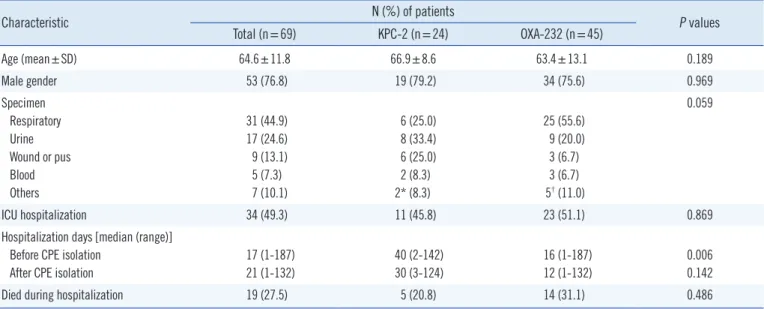
Fifty-three patients (76.8%) were male. The mean age of the patients was 64.6 yr. The following specimens were provided: respiratory secretions (n =31, 44.9%), urine (n =17, 24.6%), wound or pus (n=9, 13.1%), and blood (n=5, 7.3%). No CPE was isolated from outpatients. Forty-nine percent (n=34) of iso-lates were from patients in intensive care units (ICU). All isoiso-lates were collected from patients after more than two days of hospi-talization. The median number of hospitalization days before CPE isolation from the patients with KPC-2 and OXA-232 iso-lates was 40 and 16 days (P =0.006), respectively. Twenty-eight percent (n=19) of patients died during hospitalization (Table 3).
3. Antimicrobial susceptibilities
One-hundred percent and 92% of KPC-2 K. pneumoniae iso-lates were susceptible to tigecycline and colistin, respectively, while 100% were resistant to all cephalosporins, aztreonam, carbapenems, amikacin, and ciprofloxacin. Seventy-eight per-cent and 89% of OXA-232 K. pneumoniae isolates were sus-ceptible to tigecycline and colistin, respectively. More than 90% Table 1.
Ertapenem susceptibility of
Enterobacteriaceae
isolates as determined by commercial broth microdilution systems*
Hospital N (%) of isolates E. coli (n = 8,167) K. pneumoniae (n = 2,946) E. cloacae (n= 639) E. aerogenes (n = 622) S. marcescens (n = 363) C. freundii (n= 268) Total (n = 13,005) S I R S I R S I R S I R S I R S I R S I R A 1,501 (99.9) 0 (0) 2 (0.1) 623 (97.2) 2 (0.3) 16 (2.5) 96 (72.7) 6 (4.6) 30 (22.7) 116 (92.8) 0 (0) 9 (7.2) 101 (81.5) 0 (0) 23 (18.5) 43 (97.7) 0 (0) 1 (2.3) 2,480 (96.5) 8 (0.3) 81 (3.2) B 1,273 (99.4) 5 (0.4) 2 (0.2) 393 (91.8) 7 (1.7) 28 (6.5) 120 (85.7) 13 (9.3) 7 (5.0) 104 (95.4) 2 (1.8) 3 (2.8) 72 (96.0) 0 (0) 3 (4.0) 52 (100) 0 (0) 0 (0) 2,014 (96.6) 27 (1.3) 43 (2.1) C 2,251 (99.6) 0 (0) 9 (0.4) 729 (89.5) 5 (0.6) 81 (9.9) 139 (82.7) 0 (0) 29 (17.3) 159 (98.8) 0 (0) 2 (1.2) 85 (84.2) 0 (0) 16 (15.8) 83 (97.6) 0 (0) 2 (2.4) 3,446 (96.0) 5 (0.1) 139 (3.9) D 1,900 (99.4) 7 (0.4) 4 (0.2) 507 (99.2) 3 (0.6) 1 (0.2) 117 (89.3) 2 (1.5) 12 (9.2) 149 (98.0) 0 (0) 3 (2.0) 41 (93.2) 2 (4.5) 1 (2.3) 40 (97.6) 0 (0) 1 (2.4) 2,754 (98.7) 14 (0.5) 22 (0.8) E 1,206 (99.4) 2 (0.2) 5 (0.4) 517 (93.9) 4 (0.7) 30 (5.4) 59 (86.8) 2 (2.9) 7 (10.3) 73 (97.3) 0 (0) 2 (2.7) 18 (94.7) 0 (0) 1 (5.3) 45 (97.8) 1 (2.2) 0 (0) 1,918 (97.3) 9 (0.4) 45 (2.3) Total 8,131 (99.5) 14 (0.2) 22 (0.3) 2,769 (94.0) 21 (0.7) 156 (5.3) 531 (83.1) 23 (3.6) 85 (13.3) 601 (96.6) 2 (0.3) 19 (3.1) 317 (87.3) 2 (0.6) 44 (12.1) 263 (98.1) 1 (0.4) 4 (1.5) 12,612 (97.0) 63 (0.5) 330 (2.5)
*Isolated from hospital A, C, D, and E were tested with the Vitek 2 system, and those from hospital B were tested with the Micr
oScan system.
of them were resistant to all cephalosporins, aztreonam, ertape-nem, meropeertape-nem, and ciprofloxacin, but the imipenem resis-tance rate was 69% (Table 4).
4. Pulsed-field gel electrophoresis typing
Of the 24 KPC-2 K. pneumoniae and 45 OXA-232 K. pneu-moniae isolates, 61 were available for PFGE. This analysis re-vealed a unique pattern for 20 KPC-2 K. pneumoniae isolates in hospital B (Fig. 1). PFGE of 41 OXA-232 K. pneumoniae iso-lates from hospital C identified seven PTs, of which 21 isoiso-lates belonged to the dominant PT1, and nine were PT2 (Fig. 2).
DISCUSSION
Until now, the carbapenem resistance rate among Enterobacteri-aceae isolates from Korea has been relatively low and stable [11]. The present study showed that the incidence of ertapenem-non-susceptible Enterobacteriaceae is 3% and the incidence of CPE is 0.6% (out of 13,005 isolates) of Enterobacteriaceae and 20.1% (out of 383 isolates) of ertapenem-nonsusceptible En-terobacteriaceae. The most common CPE organism was K. pneumoniae (92.4%). The overall incidence of carbapenem-re-sistant Enterobacteriaceae (CRE) in the USA is estimated to be
Table 2. Distribution of carbapenemase-producing Enterobacteriaceae isolates per hospital
Carbapenemase Organism N of carbapenemase-producing Enterobacteriaceae isolates*
Hospital A Hospital B Hospital C Hospital D Hospital E Total
OXA-232 K. pneumoniae E. coli 0 0 0 0 45 1 0 0 1 0 46 1 KPC-2 K. pneumoniae E. coli E. cloacae 0 1 1 24 0 0 0 0 0 0 0 0 1 0 0 25 1 1 IMP-1 K. pneumoniae E. cloacae 0 0 0 0 0 2 0 0 2 0 2 2 NDM-1 E. coli 0 0 1 0 0 1 Total 2 24 49 0 4 79
*1 KPC-2 E. coli harbored SHV-12 + CTX-M-65, 1 KPC-2 E. cloacae harbored CTX-M-15 (hospital A); 24 KPC-2 K. pneumoniae harbored CTX-M-65
(hospi-tal B); 45 OXA-232 K. pneumoniae harbored 42 CTX-M 15, 1 SHV-2, 1 SHV-12, and 1 SHV-38, respectively, 1 OXA-232 E. coli harbored CTX-M-15, 2 IMP-1 E. cloacae harbored CTX-M-IMP-14, IMP-1 NDM-IMP-1 E. coli harbored CTX-M-IMP-15 (hospital C); IMP-1 OXA-232 K. pneumoniae harbored CTX-M-IMP-15, IMP-1 KPC-2 K. pneumoni-ae harbored SHV-12 + CTX-M-15, 2 IMP-1 K. pneumonipneumoni-ae harbored 1 SHV-12 and 1 SHV-12+CTX-M-15, respectively (hospital E).
Abbreviations: OXA, oxacillinase; KPC, Klebsiella pneumoniae carbapenemase; IMP, imipenemase; NDM, New Delhi metallo-β-lactamase.
Table 3. Clinical characteristics of patients with KPC-2-producing K. pneumoniae and OXA-232-producing K. pneumoniae isolates
Characteristic N (%) of patients P values
Total (n=69) KPC-2 (n=24) OXA-232 (n=45) Age (mean±SD) 64.6±11.8 66.9±8.6 63.4±13.1 0.189 Male gender 53 (76.8) 19 (79.2) 34 (75.6) 0.969 Specimen Respiratory Urine Wound or pus Blood Others 31 (44.9) 17 (24.6) 9 (13.1) 5 (7.3) 7 (10.1) 6 (25.0) 8 (33.4) 6 (25.0) 2 (8.3) 2* (8.3) 25 (55.6) 9 (20.0) 3 (6.7) 3 (6.7) 5† (11.0) 0.059 ICU hospitalization 34 (49.3) 11 (45.8) 23 (51.1) 0.869
Hospitalization days [median (range)] Before CPE isolation
After CPE isolation
17 (1-187) 21 (1-132) 40 (2-142) 30 (3-124) 16 (1-187) 12 (1-132) 0.006 0.142
Died during hospitalization 19 (27.5) 5 (20.8) 14 (31.1) 0.486
*These two isolates were recovered from bile juice; †These five isolates were recovered from catheter tips (n=3), ascites (n=1), and bile juice (n=1).
Table 4. Antimicrobial susceptibility of carbapenemase-producing K. pneumoniae isolates
Antimicrobial agent
KPC-2-producing K. pneumoniae isolates (n=24) OXA-232-producing K. pneumoniae isolates (n=45) MIC (µg/mL)
% R MIC (µg/mL) % R
Range MIC50 MIC90 Range MIC50 MIC90
Cefotetan 128->256 >256 >256 100 1->256 128 256 89 Cefotaxime >32 >32 >32 100 1->32 >32 >32 98 Ceftazidime 128->256 256 >256 100 0.25->256 >256 >256 96 Cefepime 128->256 >256 >256 100 0.25->256 >256 >256 93 Aztreonam >256 >256 >256 100 <0.125->256 >256 >256 93 Ertapenem >32 >32 >32 100 1->32 >32 >32 96 Imipenem 32->32 >32 >32 100 0.5->32 4 16 69 Meropenem >32 >32 >32 100 0.5->32 16 >32 96 Amikacin >256 >256 >256 100 2->256 >256 >256 84 Ciprofloxacin >32 >32 >32 100 <0.125->32 >32 >32 93 Tigecycline 0.25-2 0.5 1 0 0.5-4 2 4 22 Colistin 0.126-16 0.25 0.5 8 0.125-32 0.5 4 11
Abbreviations: KPC, Klebsiella pneumoniae carbapenemase; OXA, oxacillinase; MIC, minimum inhibitory concentration; MIC50, minimum inhibitory
concentration for 50% of isolates; MIC90, minimum inhibitory concentration for 90% of isolates; % R, % of resistance.
Fig. 1. Pulsed-field gel electrophoresis (PFGE) patterns of KPC-2-producing K. pneumoniae isolated in hospital B (n=20). Isolates that
ex-hibited PFGE dendrograms with more than 90% similarity were considered as one pulsotype (PT).
1.4% to 4.2% [12]. CPE have been detected in 81.7% and 20% of CRE isolates in the USA [13] and Taiwan [14], respectively.
Three main carbapenemases are reported worldwide: KPC, NDM, and OXA-48-like. KPC strains are mostly found in the USA, Israel, Greece, and Italy. The Indian subcontinent is rec-ognized as an NDM and like endemic zone. OXA-48-like is often seen in the Mediterranean area and Northern Africa [4]. OXA-162, -163, -181, -204, and -232 were identified as OXA-48 variants [6]. Korea is known for outbreaks of K. pneu-moniae that produce KPC-2, NDM-1, and OXA-232 [15-17]. In the present study, two of five hospitals had an outbreak (hospital B: KPC-2 K. pneumoniae, hospital C: OXA-232 K. pneumoniae), and no CPE were isolated in one hospital. All CPE isolates co-produced ESBLs: mainly CTX-M-65 and CTX-M-15.
Most patients in this study were older male inpatients, and the most common specimens analyzed were respiratory secre-tions and urine. These findings are similar to the results of other
studies [14, 18, 19]. The median number of hospitalization days before CPE isolation among the patients with these isolates was 17 days, and the median number of hospitalization days of patients with KPC-2 isolates was 40 days. Long-term hospital-ization may play an important role in the spread of CPE. This study excluded analysis of infection and colonization with CPE because it was hard to distinguish some cases retrospectively.
In this study, all KPC-2 K. pneumoniae isolates were highly resistant to all cephalosporins, aztreonam, and carbapenems. More than 90% of OXA-232 K. pneumoniae isolates were resis-tant to all cephalosporins, aztreonam, ertapenem, and merope-nem. The likely reason is that all OXA-232 K. pneumoniae iso-lates also produce ESBLs. OXA-48 hydrolyzes penicillins effec-tively, but it only weakly hydrolyzes carbapenems. In addition, this enzyme shows very weak activity toward extended-spectrum cephalosporins [20]. OXA-48-like producers that do not pro-duce any ESBLs are still susceptible to broad-spectrum
cepha-Fig. 2. Pulsed-field gel electrophoresis (PFGE) patterns of OXA-232-producing K. pneumoniae isolated in hospital C (n=41). Isolates that
exhibited PFGE dendrograms with more than 90% similarity were considered as one pulsotype (PT). Black line in dendrogram represents percentage similarity cut-off.
losporins and can be susceptible or resistant to carbapenems [6]. Only tigecycline and colistin remained effective against most, but not all, KPC-2 and OXA-232 K. pneumoniae isolates.
The PFGE analysis revealed a unique pattern for 20 KPC-2 K. pneumoniae and 41 OXA-232 K. pneumoniae isolates, of which 21 isolates belonged to the dominant PT1, and nine were PT2. These findings highlighted the risk of clonal dissemination of KPC-2 K. pneumoniae and OXA-232 K. pneumoniae in certain wards, especially in ICUs.
In summary, CPE strains are present in Korea, with the main K. pneumoniae isolates producing OXA-232 and KPC-2. Inter-estingly, the prevalence and predominant genotypes of CPE in Korea showed hospital-specific differences such as epidemic presence in two hospitals, sporadic presence in two hospitals, and absence in one hospital. These findings indicate that CPE dissemination is at an early stage in Korea. Therefore, greater efforts to control the nosocomial spread of CPE are warranted. Our results were based on isolates from five university hospitals. Among the strains, most were derived from two hospitals. This situation does not reflect the general epidemiology of CPE in Ko-rea; hence, further large-scale research including isolates from acute care and long-term care hospitals is needed.
Authors’ Disclosures of Potential Conflicts of
Interest
No potential conflicts of interest relevant to this article were re-ported.
Acknowledgments
This study was supported by a research grant from the Korean Health Technology R&D Project, Ministry of Health & Welfare, Republic of Korea (HI12C0756).
REFERENCES
1. Tzouvelekis LS, Markogiannakis A, Psichogiou M, Tassios PT, Daikos GL. Carbapenemases in Klebsiella pneumoniae and other Enterobacteriace-ae: an evolving crisis of global dimensions. Clin Microbiol Rev 2012; 25:682-707.
2. Queenan AM and Bush K. Carbapenemases: the versatile β-lactamases. Clin Microbiol Rev 2007;20:440-58.
3. Yigit H, Queenan AM, Anderson GJ, Domenech-Sanchez A, Biddle JW,
Steward CD, et al. Novel carbapenem-hydrolyzing β-lactamase, KPC-1,
from a carbapenem-resistant strain of Klebsiella pneumoniae. Antimi-crob Agents Chemother 2001;45:1151-61.
4. Nordmann P, Naas T, Poirel L. Global spread of Carbapenemase-pro-ducing Enterobacteriaceae. Emerg Infect Dis 2011;17:1791-8. 5. Poirel L, Héritier C, Tolün V, Nordmann P. Emergence of
oxacillinase-mediated resistance to imipenem in Klebsiella pneumoniae. Antimicrob Agents Chemother 2004;48:15-22.
6. Poirel L, Potron A, Nordmann P. OXA-48-like carbapenemases: the phantom menace. J Antimicrob Chemother 2012;67:1597-606. 7. Clinical and Laboratory Standards Institute. Performance standards for
antimicrobial susceptibility testing. Twenty-fourth Informational supple-ment, M100-S24. Wayne, PA: Clinical and Laboratory Standards Insti-tute, 2014.
8. Poirel L, Walsh TR, Cuvillier V, Nordman P. Multiplex PCR for detection of acquired carbapenemase genes. Diagn Microbiol Infect Dis 2011;70: 119-23.
9. Ryoo NH, Kim EC, Hong SG, Park YJ, Lee K, Bae IK, et al. Dissemina-tion of SHV-12 and CTX-M-type extended-spectrum β-lactamases among clinical isolates of Escherichia coli and Klebsiella pneumoniae and emergence of GES-3 in Korea. J Antimicrob Chemother 2005;56: 698-702.
10. Pérez-Pérez FJ and Hanson ND. Detection of plasmid-mediated AmpC β-lactamase genes in clinical isolates by using multiplex PCR. J Clin Mi-crobiol 2002;40:2153-62.
11. Korea Centers for Disease Control and Prevention. Korean Antimicrobial Resistance Monitoring System (KARMS) annual report, 2014. Korea Centers for Disease Control and Prevention, 2015.
12. Centers for Disease Control and Prevention. Vital signs: carbapenem-re-sistant Enterobacteriaceae. MMWR Morb Mortal Wkly Rep 2013;62: 165-70.
13. Pollett S, Miller S, Hindler J, Uslan D, Carvalho M, Humphries RM. Phe-notypic and molecular characteristics of carbapenem-resistant Entero-bacteriaceae in a health care system in Los Angeles, California, from 2011-2013. J Clin Microbiol 2014;52:4003-9.
14. Tseng IL, Liu YM, Wang SJ, Yeh HY, Hsieh CL, Lu HL, et al. Emergence of carbapenemase producing Klebsiella pneumoniae and spread of KPC-2 and KPC-17 in Taiwan: a nationwide study from 2011 to 2013. PLoS One 2015;10:e0138471.
15. Kim MN, Yong D, An D, Chung HS, Woo JH, Lee K, et al. Nosocomial clustering of NDM-1-producing Klebsiella pneumoniae sequence type 340 strains in four patients at a South Korean tertiary care hospital. J Clin Microbiol 2012;50:1433-6.
16. Hong SK, Yong D, Kim K, Hong SS, Hong SG, Khosbayar T, et al. First outbreak of KPC-2-producing Klebsiella pneumoniae sequence type 258 in a hospital in South Korea. J Clin Microbiol 2013;51:3877-9. 17. Jeong SH, Lee KM, Lee J, Bae IK, Kim JS, Kim HS, et al. Clonal and
horizontal spread of the blaOXA-232 gene among Enterobacteriaceae in a
Korean hospital. Diagn Microbiol Infect Dis 2015;82:70-2.
18. Lefebvre B, Lévesque S, Bourgault AM, Mulvey MR, Mataseje L, Boyd D, et al. Carbapenem non-susceptible Enterobacteriaceae in Quebec, Canada: results of a laboratory surveillance program (2010-2012). PLoS One 2015;10:e0125076.
19. Brañas P, Villa J, Viedma E, Mingorance J, Orellana MA, Chaves F. Mo-lecular epidemiology of carbapenemase-producing Klebsiella pneu-moniae in a hospital in Madrid: Successful establishment of an OXA-48 ST11 clone. Int J Antimicrb Agents 2015;46:111-6.
20. Docquier JD, Calderone V, De Luca F, Benvenuti M, Giuliani F, Bellucci L, et al. Crystal structure of the OXA-48 β-lactamase reveals mechanistic diversity among class D carbapenemases. Chem Biol 2009;16:540-7.