Thermal histories of the Cretaceous Pungam and Yeongdong basins, Korea based on apatite and zircon fission track analysis
ABSTRACT: Apatite and zircon fission track (FT) analyses were carried out to reconstruct the thermal histories of the Cretaceous Pungam and Yeongdong basins, Korea. These basins were formed along the sinistral strike-slip faults in the Early Cretaceous and were compressed in the Late Cretaceous by transpressional stresses due to the change in subduction direction of the Kula/Pacific Plate.
In the Pungam and Yeongdong basins, apatite samples have con- sistent FT ages of ca. 50 Ma and ca. 63 Ma, respectively, much younger than their stratigraphic ages. In contrast, the zircon FT ages of both basins show relatively wide ranges, i.e., from 89 to 70 Ma in the Pungam Basin, and from 83 to 64 Ma in the Yeo- ngdong Basin. Zircon single-grain age spectra also show multiple age populations. Co-existence of both the older and younger FT ages in comparison to the depositional age (Pungam Basin: ~70 Ma, Yeongdong Basin: ~100 Ma) indicates that the zircon samples from both basins were partially annealed. The Pungam Basin was heated into the zircon partial annealing zone (ZPAZ) by burial, volcanic activity and associated hydrothermal fluid, then cooled below the apatite closure temperature at ca. 50 Ma. The Yeong- dong Basin was also heated into the ZPAZ after deposition by burial and volcanic activity, then cooled down below the apatite closure temperature at ca. 63 Ma, and was uplifted to the present surface. Comparing these data with those of the Gyeongsang Basin, the response to transpressional stresses seems not to be con- trolled by the distance of the basin from the active continental margin. Further studies are needed to clarify such tectonic inver- sion of the sedimentary basins in the active continental margin.
Key words: fission track analysis, thermal history, Cretaceous, Pun- gam Basin, Yeongdong Basin
1. INTRODUCTION
Sedimentary rocks exposed on the surface have under- gone subsidence and uplift at least once during their evo- lution. Their thermal histories can be evaluated by studies on clay minerals, organic matter diagenesis including vit- rinite reflectance, stable isotopes and fluid inclusions amongst others. However, these geothermometers provide only max- imum burial temperatures. The timing and rate of sedimen- tary basin uplift can be estimated by fission track analysis of the detrital apatite and zircon grains extracted from sed- imentary rocks (e.g., Green et al., 1995; Hill et al., 1995;
Lim, 2003). Recently, apatite (U-Th)/He technique has also
been applied to date the uplift of sedimentary rocks in shal- lower levels (~40-80°C; Farley, 2002) of the crust (e.g., House et al., 2002).
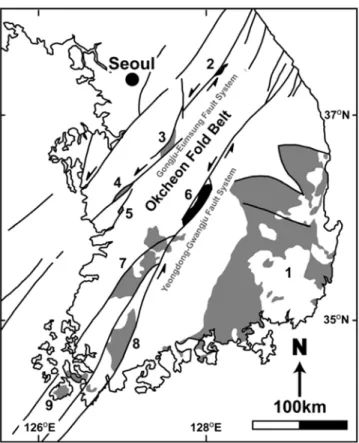
In the Korean Peninsula, several Cretaceous nonmarine sedimentary basins are distributed on Precambrian meta- morphic complex along the NNE-trending strike-slip fault lines (Fig. 1). Studies on these basins, e.g., Eumseong Basin (Cheong, 1987; Choi, 1996), Gongju Basin (Lee, 1986; J.R.
Lee, 1990), Jinan Basin (Lee, 1992) and Haenam Basin (Chun, 1989), reveal that these basins are of pull-apart origin, formed by sinistral strike-slip faults along the northern and southern fault boundaries of the Okcheon Fold Belt (Chun and Chough, 1992; Lee, 1999). Terrestrial sediments filled the basins with intermittent volcanism. Then the basins experienced compressional forces by transpression in the Late Cretaceous.
This study deals with the thermal histories of the Pungam and Yeongdong basins (Fig. 1). These basins are located on the northern and southern boundaries of the Okcheon Fold Belt, respectively. For thermal history reconstruction, apa- tite and zircon fission track analyses were carried out. Ther- mal history of the lowest Gyeongsang Basin (Fig. 1) was studied by Lim et al. (2003). As a preliminary study, these two basins were chosen so as to compare the responses of the basins to the Upper Cretaceous transpressional stresses from the continental margin due to subduction. This study also aims to understand if there exists any difference in the uplift history depending on the distance from the active continental margin by comparing the results of these basins with that of the Gyeongsang Basin.
2. GEOLOGICAL SETTING
During the Early Cretaceous, along the Asian continental margin the northward oblique subduction of the Izanagi Plate induced sinistral shearing in the overriding continental plate resulting in the creation of strike-slip basins (Chun and Chough, 1992; Fig. 1). The Gyeongsang Basin is the largest basin occupying the southeastern part of the penin- sula, whereas the other smaller basins (Pungam, Eumsung, Gongju, Buyeo, Yeongdong, Jinan, Neungju and Haenam) are located along the boundaries of the Okcheon Fold Belt.
Taejin Choi
Yong Il Lee*} School of Earth and Environmental Sciences, Seoul National University, Seoul 151-747, Korea
*Corresponding author: [email protected]
Although the evolution history of the Gyeongsang Basin is not yet fully understood, those of other Cretaceous basins are relatively well recognized (D.W. Lee, 1990; Lee and Paik, 1990; Chun and Chough, 1992; Choi, 1999). Except the Pungam Basin which was formed solely by transpres- sion (Lee, 1998), most Cretaceous basins along the bound- aries of the Okcheon Fold Belt may have similar evolution histories: 1) formation as a pull-apart basin due to the reac- tivation of preexisting mylonite zone; 2) sediment accumu- lation with volcanic activities; and 3) compression by transpression (J.R. Lee, 1990). Sedimentary strata of these Cretaceous pull-apart basins show an en-echelon array of folds and flower structures which may have resulted from compressional tectonic regime (Bulguksa orogeny) between the Late Cretaceous and Early Tertiary (Kim, 1999). Gen- eral geologic settings of the Pungam and Yeongdong basins are described below.
2.1. Pungam Basin
The Pungam Basin is located at 127°55'E~128°15'E and 37°25'N~37°50'N in the eastern central Korean Peninsula.
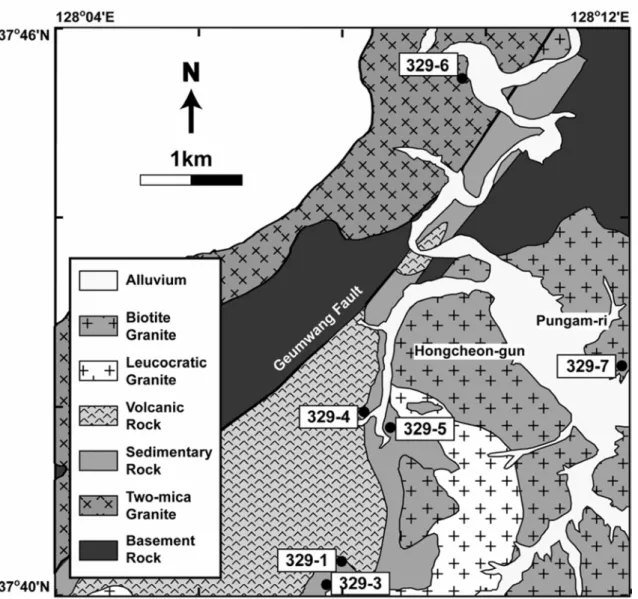
It is ca. 7 km wide and 20 km long in the NE-SW direction, and has sediment thickness of 300~500 m (Fig. 2). The Pun- gam Basin were studied by Kang and Jin (1972), Kim (1998), Lee (1998) and Kim and Cheong (1999). Its evolutionary history is very different from the rest of the basins along the fault system. It is a transpressional basin formed at a gentle restraining bend developed along the Gongju fault system, resulting in the uplift of one margin and the descent of the basin, as one block moves past the restraining bend of the fault zone (Lee, 1998). Alluvial fan, fluvial and lacustrine deposits filled the basin. Then, it underwent deformation process. The upper part of the basin fill is mostly denuded now by uplift (Cheong and Kim, 1999). The Cretaceous sedimentary strata of the Pungam Basin are in contact with Precambrian biotite gneiss and two-mica granite by the Geumwang Fault. The basin fills mainly consist of arkosic, purple sandstone and mudstone, or siltstone and conglom- erate (Cheong and Kim, 1999). The stratigraphy and dep- ositional ages of the Pungam Basin are not yet established.
Radiogenic isotope age data (84-70 Ma) of the intruded andesite and volcaniclastic pebbles from the sedimentary rocks (K-Ar whole-rock dating) indicate that volcanic activ- ities in the Pungam Basin occurred continuously from pre- depositional to post-depositional period (Kim, 1998; Cheong et al., 2002).
2.2. Yeongdong Basin
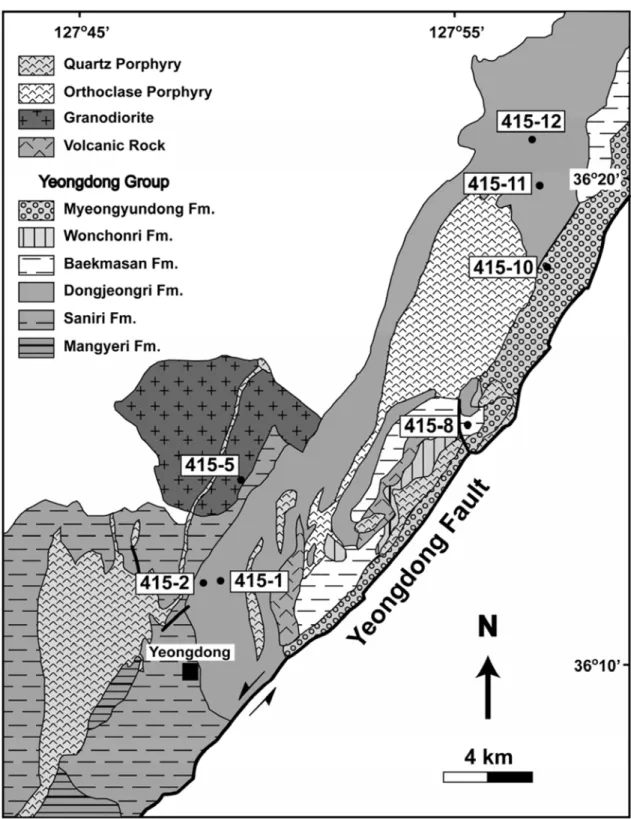
The Yeongdong Basin is located in the central part of the southern Korean Peninsula and occupies an area of ca. 40 km in length and 12 km in width, and has ca. 3,500 m thick sediment (Fig. 3.). The basin is bounded by strike-slip fault in the southeast and is in contact with Precambrian gneiss and schist of the Yeongnam Massif (Shimamura, 1925; Kim and Hwang, 1986). Shimamura (1927) classified the sediment fill, the Yeongdong Group, as belonging to the Sigeumri, Hoedongri and Seonyudong formations, whereas Kim and Hwang (1986) divided it as the Mangyeri, Saniri, Dongjeongri, Baekmasan, Wonchonri and Myeongyundong formations.
Alluvial fan deposits were formed along the southeastern fault, and sediments were supplied from the Precambrian basement around the basin (B.C. Kim, 1996) with some volcaniclastic sediments from contemporaneous volcanism (Choi, 1999). Chun et al. (1993) subdivided the Yeongdong Group into two zones based on the fossil type and forms.
The lower fossil type zone comprises the Mangyeri, Saniri, and lower Dongjeongri formations, suggestive of Neoco- mian age, while the upper fossil type zone consists of the upper Dongjeongri, Baekmasan, Wonchonri, and Myeongyun- dong formations and is considered to be Aptian to Albian in age.
According to several investigators, e.g., Lee and Paik (1990), D.W. Lee, (1990), and Lee et al. (1991), the Yeong- dong Basin is a pull-apart basin. Lateral motions along the two major strike-slip faults were different. The Yeongdong
Fig. 1. The distribution of the Cretaceous basins in the southern Korean Peninsula (modified after Lee, 1999). 1: Gyeongsang Basin, 2: Pungam Basin, 3: Eumseong Basin, 4: Gongju Basin, 5: Buyeo Basin, 6: Yeongdong Basin, 7: Jinan Basin, 8: Neungju Basin, 9:
Haenam Basin. The studied Pungam (2) and Yeongdong basins (6) are marked in black.
Fault acted more intensely than the northwestern fault and has extended the basin towards the northeast, making two depocenters. It produced asymmetric facies distribution and basin depth. The stratal architecture was obviously con- trolled by the fault movements as evidenced by the depo- sition of two different sedimentary sequences, indicating that the basin experienced extensional regime twice. In the lower sequence, alluvial sediments developed along the basin margin and lacustrine sediments in the basin center, whereas alluvial sediments are predominant in the upper sequence.
3. EXPERIMENTAL METHODS
Four sandstone and two granite samples from the Pun- gam Basin and six sandstone and one granodiorite samples from the Yeongdong Basin were collected for apatite and
zircon FT analyses. Their sample locations are shown in Figures 2 and 3, respectively. The apatite and zircon grains were prepared according to the techniques outlined by Tag- ami et al. (1988). Both apatite and zircon were dated by the external detector method counting induced tracks in high- quality muscovite external detectors. The zeta calibration approach was used (Hurford and Green, 1983; Hurford, 1990). The conventional processes were carried out to sep- arate heavy minerals using heavy liquid and magnetic tech- niques. The apatite and zircon grains were handpicked and mounted in epoxy resin and PFA teflon sheet, respectively.
They were polished with diamond paste and etched chem- ically in 0.6% HNO3 at 32.0±0.5°C for apatite, and in KOH:
NaOH eutectic etchant at 230.0°±0.5°C for zircon. Thermal neutron irradiation was carried out at NAA-1 facility in the HANARO reactor of the Korean Atomic Energy Research Institute, and fluences were monitored by track counting in
Fig. 2. Geological map of the Pungam Basin, Korea (modified from Kang and Jin, 1972). Sample locations are marked with numbers.
muscovite external detectors over NIST SRM612 glasses.
This facility has a high Cd ratio of ~250 for Au (Lim and Lee, 2000), which satisfies the criteria recommended by Hurford (1990). After irradiation, the external muscovite detectors were detached and etched in 48% HF at 32°±0.5°C for 4 min.
Fission tracks were counted using a Nikon Optiphot-II microscope with a dry ×100 objective and a total mag- nification of ×1250. A computer-automated microscope stage system was used to translate between sample and detector (Dumitru, 1993). For apatite and zircon we adopted ζ values of 351.4±20.3(2σ) and 336.8±11.5(2σ),
Fig. 3. Geological map of the Yeongdong Basin, Korea (modified from Kim and Hwang, 1986; Doh et al., 1996). Also shown are sample locations.
respectively (Choi, 2005). The conventional pooled age, Pois- sonian error and P(χ2) (Galbraith, 1981; Green, 1981) were calculated using a Zeta Age program (Brandon, 1996).
4. RESULTS 4.1. Pungam Basin
18 apatite and 51 zircon grains were analyzed from two granite and four sandstone samples in the Pungam Basin. The apatite and zircon FT data are presented in Table 1 and the radial plots of the Pungam zircon samples are displayed in Fig. 4. All apatite FT ages are concordant (within 1σ error limits) at ca. 50 Ma with narrow and unimodal population in single-grain age spectra. This apatite FT age is much younger than the depositional age of the Pungam Basin (ca. 70–84 Ma). Although only several grains in individual apatite mounts were counted, all samples pass the χ2 –test at a prob- ability P(χ2) > 5% (Galbraith, 1981; Green, 1981), which means that all age components belong to a single age group.
Zircon FT pooled ages of the Pungam sandstone samples range from ca. 70±6 to 83±7 Ma, all of which are older than the apatite FT ages. Most zircon FT age spectra show wide distribution patterns with multiple peaks. Some single grain ages are younger than the depositional age but other grains show similar or older ages (Fig. 4). However, the granite sample (329-7) has a slightly older age of ca. 89±8 Ma with unimodal population in single-grain age spectra.
4.2. Yeongdong Basin
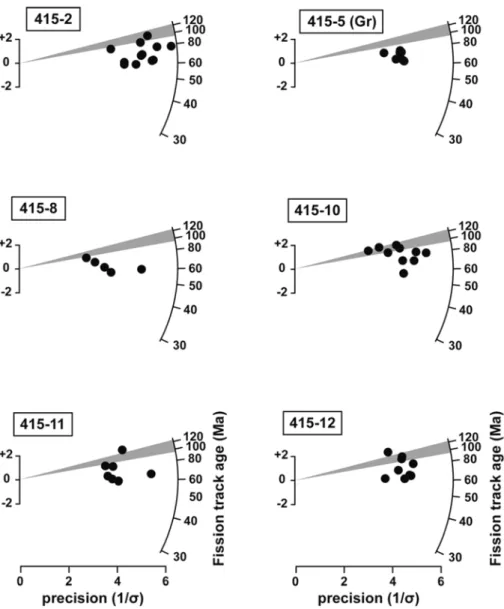
20 apatite and 51 zircon grains were analyzed from one granodiorite (415-5) and six sandstone samples in the Yeo- ngdong Basin. The apatite and zircon FT ages of the Yeo- ngdong Basin are shown in Table 2. The radial plots of the zircon samples are displayed in Fig. 5. The apatite FT ages show a good agreement at around 63 Ma, and all samples pass the χ2–test at the 5% criterion although only several grains in individual apatite mounts were dated. On the con- trary, the zircon grains have relatively wide range of FT sin- gle grain ages. Zircon pooled ages of the sandstones range from ca. 64±9 to 83±7 Ma. Most zircon single-grain ages are similar to or younger than the stratigraphic age of the Yeongdong Basin (Fig. 5). The granodiorite sample has a slightly younger age of ca. 69±7 Ma with high P(χ2).
5. INTERPRETATIONS AND DISCUSSION 5.1. Apatite and Zircon FT Ages
Apatite samples of both the Pungam and Yeongdong basins show much younger FT ages compared to their dep- ositional ages. This indicates that the inherited tracks of the apatite were almost completely annealed during burial.
Thus, the apatite FT ages suggest that the sedimentary rocks of both basins have been heated to temperatures above the apatite partial annealing zone (APAZ), then dropped below
Table 1. Apatite and zircon fission track analytical results of the Pungam Basin.
Samplecode Rock* No. of grains Spontaneous track Induced track Dosimeter glass γ P(χ2)
(%) Age±1σ
Ns ρs Ni ρi Nd ρd (Ma)
Apatite
329-1 Ss 6 89 1.02 512 5.84 6142 1.52 0.91 98.3 46.3±6.0
329-4 Ss 6 160 1.67 808 8.44 6142 1.51 0.92 93.2 52.7 ± 5.5
329-6 Gr 6 56 0.62 275 3.03 6142 1.51 0.96 97.1 54.1 ± 8.5
Zircon
329-1 Ss 6 693 8.90 212 2.72 2208 0.13 0.87 9.6 70.2 ± 6.3
Ss 5 394 5.52 132 1.85 2061 0.13 0.95
329-3 Ss 5 407 5.83 101 1.45 2208 0.13 0.97 9.8 80.1 ± 8.7
Ss 5 363 6.04 109 1.82 2061 0.13 0.27
329-4 Ss 6 615 7.89 163 2.09 2208 0.13 0.92 34.5 83.0 ± 6.9
Ss 5 324 5.87 89 1.61 2061 0.13 0.95
329-5 Ss 4 408 8.11 116 2.31 2208 0.14 0.76 67.1 80.1 ± 7.0
Ss 5 466 9.57 123 2.53 2061 0.13 0.71
329-7 Gr 4 434 7.86 110 1.99 2208 0.14 0.96 100.0 88.8 ± 8.0
Gr 6 445 6.23 106 1.48 2061 0.13 0.98
All analyses by external detector method using 0.5 for the 4π geometry factor. Ns=Number of spontaneous tracks counted to determine ρs;
ρs=Density of spontaneous tracks (×106/cm2); Ni=Numberof induced tracks counted in a muscovite external detector to determine ρi;
ρi=Density of induced tracks in a sample (×106/cm2); Nd=Number of induced tracks counted in a muscovite detector to determine ρd;
ρd=Density of inducedtracks in NIST-SRM612 dosimeter glass (×106/cm2); P(χ2)=the probability of obtaining χ2 value for n degrees offreedom where n= No. of grains -1. *Ss: sandstone, Gr: granite.
Fig. 4. Radial plots (Galbraith, 1990) of the Pungam zircon samples. All ages are central ages with an error of
±1σ. For radial plots, the position on the x-scale records the uncertainty of individual age estimates, whilst each point has the same standard error on the y-scale (illustrated as ±2σ). The age of each grain can be determined by extrapolating a line from the origin on the left through the grains’s x,y co-ordi- nates to intercept the radial age scale.
The further the data point plots from the origin, the more precise the measure- ment. Shaded zone represents the dep- ositional age of the Pungam Basin.
Table 2. Apatite and zircon fission track analytical results of the Yeongdong Basin.
Samplecode Rock No. of
grains Spontaneous track Induced track Dosimeter glass γ P(χ2)
(%) Age±1σ
Ns ρs Ni ρi Nd ρd (Ma)
Apatite
415-1 Ss 6 76 0.81 309 3.28 5735 1.40 0.99 99.8 60.7 ± 8.6
415-5 Gr 7 44 0.27 168 1.04 5735 1.41 0.98 99.9 64.9 ± 11.6
415-12 Ss 7 98 0.91 380 3.55 5735 1.42 0.98 94.6 64.5 ± 8.2
Zircon
415-2 Ss 7 918 9.12 267 2.65 2208 0.14 0.63 60.3 73.9 ± 5.5
5 500 9.06 136 2.46 1765 0.11 1.00
415-5 Ss 2 139 6.12 42 1.85 2208 0.14 1.00 99.4 68.9 ± 6.7
Ss 6 525 8.99 142 2.43 1765 0.11 0.16
415-8 Ss 5 317 6.10 90 1.73 1765 0.11 0.98 82.0 64.1 ± 8.6
Ss 4 422 6.05 101 1.45 2208 0.14 0.97
415-10 Ss 6 618 9.07 147 2.16 1765 0.11 0.89 42.0 83.4 ± 7.2
415-11 Ss 2 253 9.74 62 2.39 2208 0.14 0.23 12.3 78.3 ± 10.1
Ss 5 357 6.47 91 1.65 1765 0.11 0.67
415-13 Gr 4 452 7.96 96 1.69 2208 0.14 0.74 13.1 82.5 ± 8.7
Gr 5 467 9.59 127 2.61 1765 0.11 0.93
the apatite FT closure temperature (ca.100°C; Gleadow et al., 1983; Donelick, 1991) at ca. 50 Ma in the Pungam Basin and at ca. 63 Ma in the Yeongdong Basin.
In contrast, the zircon data of both basins show rela- tively wide FT age ranges. Although some single-grain FT ages are similar to or younger than their stratigraphic ages, other FT ages older than depositional ages are also observed. The coexistence of both the younger and older ages (compared with the depositional age) suggests that the zircon samples from both basins were partially annealed during burial. Considering that the zircon partial annealing zone (ZPAZ) covers the temperature interval from 220 to 350°C (Tagami et al., 1998), the two basins might have been heated to that temperature range. The sediment thickness of the Pungam Basin is ca. 400 m, while that of the Yeongdong Basin is ca. 3,500 m. The heat provided by burial might not be enough for zircon partial annealing. It is therefore suggested that there were other heat sources, such as volcanic activity and hydro-
thermal fluid flow. Continental arc volcanism was active in South Korea during the Late Cretaceous in response to the orthogonal subduction of the Kula/Pacific Plate. The volcanic rocks formed in the Pungam Basin have the K- Ar age of 84-70 Ma (Kim, 1998). Quartz porphyry in the southwestern part of the Yeongdong Basin has 70 Ma (K- Ar whole rock dating) and 75 Ma (zircon FT dating) ages, whereas the orthoclase porphyry in the northeastern part of the basin is 82 Ma (K-Ar whole rock dating; Shin and Jin, 1995). In addition, K-Ar age dating data from several hydrothermal vein deposits of the Pungam area are 79 Ma and 94 Ma from the Dongyang Hongcheon Mine and Munhyun Mine (Shin and Jin, 1995), and 82 Ma from the Byungjibang Mine (So et al., 1999). In the Yeongdong area, however there are no reports of signif- icant hydrothermal alteration of sedimentary rocks, although, some hydrothermal Au-Ag veins (K-Ar age of 145 and 132 Ma; So et al., 1989) are present in Precam- brian metamorphic complex. Thus, the zircon FT ages of
Fig. 5. Radial plots of the Yeongdong zircon samples. Shaded zone repre- sents the depositional age of the Yeo- ngdong Basin.
the two basins might have been affected not only by the burial depth but also by volcanism and/or their associated hydrothermal activities.
5.2. Thermal Histories and Cooling/uplift Rate in the Shallow Crust Level
Brief thermal histories of the two basins can be inferred based on apatite and zircon FT ages (Fig. 6). In the case of the Pungam Basin, the temperature of the basin was similar to the surface temperature during deposition. Depositional period is considered to be at least 84-70 Ma, based on the volcanic pebbles which have radio-isotope ages of 84-70 Ma.
The sedimentary rocks were subsequently buried, with tem- perature increasing up to 220 to 350°C. The increasing tem- perature is brought about by contemporaneous heating by burial, volcanic activity and hydrothermal flow. The fission tracks in the zircon were partially annealed whereas the tracks in the apatite were completely annealed during this time. The basin was then uplifted by transpression, resulting in a temperature dropping below 100°C at ca. 50 Ma.
In the Yeongdong Basin, deposition of the Dongjeongri Formation (the lowermost stratigraphic unit among studied strata) and the overlying formations occurred during the Aptian to Albian (ca. 120-100 Ma). The basin retained near surface temperatures during this period. At 82 Ma and 74 Ma, the temperature of the basin increased to ZPAZ due to basin subsidence and volcanism. At ca. 63 Ma, the Yeongdong Basin was uplifted and its temperature fell below 100 °C.
Cooling rates of the basin can also be calculated from the relationship between closure temperatures and ages of a mineral pair (Wagner et al., 1977; Zeitler et al., 1982). As the mean zircon FT ages do not have direct geological meaning, the recent cooling rates of the studied basins can be estimated using the mean apatite FT ages, their corre- sponding closure temperatures and the assumed present-day surface temperature of 15°C. The cooling rate is calculated by the following equation.
Cooling rate =
where Tc and t are closure temperature and age of each dat- ing method, respectively. The cooling rate of the Pungam and Yeongdong basins are estimated to be ca. 1.70/Ma and ca. 1.36/Ma, respectively. This indicates that the Pungam Basin was cooled more rapidly than the Yeongdong Basin.
As stated above, the apatite FT ages have not been dis- turbed by other heating events during uplift. Thus, it is pos- sible to calculate the recent uplift rates directly from the apatite FT dating data, according to the following equation
uplift rate =
where the average geothermal gradient of 35°C/km was assumed based on the geothermal gradient of the Gyeong- sang Basin in Late Cretaceous to early Tertiary time which is suggested to be higher than the normal geothemal gradient (Lee and Lee, 2001; Lim et al., 2003). Assuming a constant uplift, the uplift rates during the last 50 million years is cal- culated to be ca. 0.049 mm/yr for the Pungam Basin, and ca.
0.039 mm/yr for the Yeongdong Basin during the last 63 million years.
5.3. Comparison among the Pungam, Yeongdong and Gyeongsang basins
In the Early Cretaceous, the proto-Pacific Plate (Izanagi Plate) subducted obliquely northward beneath the Eur- asian continent (Engebretson et al., 1985). No accretion- ary prisms were developed during this period (Okada, 1999). Consequently, several sinistral faults and related sedimentary basins were formed on the East Asian conti- nental margin (Okada, 1999). The Gyeongsang Basin developed as a half-graben basin (Choi, 1986), the Pungam Basin as a transpressional basin (Lee, 1998), and the Yeo- ngdong Basin as a transtensional basin (D.W. Lee, 1990).
Tc2–Tc1
t2–t1
---
cooling rate geothermal gradient
Fig. 6. Brief thermal history of the Pungam and Yeongdong basins. Both basins were heated to zircon partial annealing zone and cooled by uplift.
However, the timing of deposition and cooling is different.
Terrestrial sediments were deposited in these basins until the Late Cretaceous. The Kula/Pacific Plate began to sub- duct in orthogonal direction to the Asian continental mar- gin in the Late Cretaceous to early Tertiary. Hence, such orthogonal subduction of the plate provided compressional stress to these basins. Sedimentary rocks in the basins are characterized by en echelon array of folds and flower struc- tures by transpression (J.H. Kim, 1996), which suggests that the rocks were compressed and underwent uplifting.
The apatite FT is preserved since the ambient temperature drops below 100°C. The apatite FT age data in the present study suggest the response to the transpression, i.e., the tim- ing of uplift of the basin to 2-3 km below the surface.
Accordingly, the sedimentary rocks of the Pungam Basin were uplifted to this depth at ca. 50 Ma and those of the Yeongdong Basin at ca. 63 Ma. Comparing the apatite FT analytical results of the two basins from the FT data of the Gyeongsang Basin (Fig. 7), the apatite FT ages of the Yeongdong Basin are older than those of the Gyeongsang Basin (ca. 60 Ma; Lim et al., 2003). This suggests that the Yeongdong Basin was uplifted to a depth of 2-3 km below the surface slightly earlier than the Gyeongsang Basin by about three million years, whereas the Pungam Basin was uplifted much later than the Gyeongsang Basin. This order of uplift does not follow the distance of the basin from the active continental margin where the transpressional stresses originated. Thus, it is tentatively suggested that the order of uplift among the Cretaceous basins in South Korea was not directly controlled by their distance from the active margin, but probably by other features such as tectonic origin of basins, which needs to be discussed in the future studies.
6. CONCLUSIONS
Apatite and zircon grains in the Cretaceous Pungam and Yeongdong basins were analyzed to reconstruct their cool- ing and uplift history. The apatite and zircon FT ages of the Pungam Basin range from 54 to 46 Ma and from 89 to 70 Ma, respectively, whereas in the Yeongdong Basin apatite and zircon FT ages range from 65 to 61 Ma and from 83 to 64 Ma, respectively. The apatite FT single grain ages of the two basins are totally reset, but the zircon FT ages are consid- ered as partially annealed by heat from burial and volcan- ism and its associated hydrothermal fluid. The Pungam Basin was heated after deposition to the ZPAZ (220-350) then cooled due to uplift to temperatures below 100 at ca.
50 Ma. The cooling rate of the Pungam Basin between 100°C and present surface temperature was ca. 1.70°C/Ma, with a corresponding uplift rate of ca. 0.049 mm/yr. The temperature of the Yeongdong Basin increased to the ZPAZ after deposition due to heating by burial and volcanic activ- ity. The Yeongdong Basin cooled down to 100°C at ca. 63 Ma by uplift during a transpressional event. It was uplifted to present surface as fast as 0.039 mm/yr with a cooling rate of 1.36°C/Ma. Comparison of these data with those of the Cretaceous Gyeongsang Basin reveals that the response to transpressional stress from the active margin seems not to be controlled by the distance of the basin from the conti- nental margin. Rather, more complicated mechanisms were likely involved in the tectonic inversion of the sedimentary basins in the active continental margins, which needs to be clarified by further studies.
ACKNOWLEDGMENTS: We thank Dr. Y.S. Chung at Korea Atomic Energy Research Institute for sample irradiations and Prof.
D.K. Cheong for guidance to the Pungam Basin. We also thank Dr.
H.S. Lim for valuable assistance in the FT analysis and insightful dis- cussions. This research was supported by the Korea Science and Engi- neering Foundation grant (R01-2000-000-00056-0) and partly by the BK21 program through SEES, SNU. This paper benefits from con- structive reviews by Drs. E. Marquez, R.A. Santos and G. Yumul, Jr.
REFERENCES
Brandon, M.T., 1996, Probability density plot for fission-track grain- age samples. Radiation Measurements, 26, 663−676.
Cheong, D.K. and Kim, K.H., 1999, Basin evolution and provenance of sediments of the Cretaceous Poongam sedimentary basin.
Korean Journal of Petroleum Geology, 7, 28−34.
Cheong, D.K., Lee, H.K. and Lee, M.W., 2002, Geology of the Cre- taceous Poongam Basin, Hongcheon, Korea. Geological Society of Korea, Seoul, 85 p.
Cheong, S.W., 1987, The structural analysis of the northern part of the Cretaceous Sedimentary basin in Jeungpyeong-Eumseong area, Korea. M.S. thesis, Seoul National University, Seoul, 68 p.
(in Korean)
Choi, H.I., 1986, Sedimentation and evolution of the Cretaceous Gyeongsang Basin, southeastern Korea. Journal of Geological
Fig. 7. Apatite FT ages among the Pungam, Yeongdong, and Gyeongsang basins. The apatite FT age of the Yeongdong Basin is slightly older than that of the Gyeongsang Basin (Lim et al. 2003), and the Pungam Basin has the youngest age.
Society of London, 143, 29−40.
Choi, H.I., 1999, Chapter 2-4-3 Upper Mesozoic strata. In: Lee, J.H., Won, J.K., Kim, J.H. and Lee, C.Z. (eds.), Geology of Korea.
Sigma Press, Seoul, 233−273.
Choi, T., 2005, Thermal history of the Cretaceous Pungam and Yeo- ngdong basins based on fission track analysis. M.S. thesis, Seoul National University, Seoul, 75 p.
Choi, Y.S., 1996, Structural evolution of the Cretaceous Eumseong basin, Korea. Ph.D. thesis, Seoul National University, Seoul, 158 p.
(in Korean)
Chun, H.Y., Um, S.H., Choi, S.J., Kim, Y.B., Kim, B.C. and Choi, Y.S., 1993, Fossil Floral and Faunal Assemblage and Paleoen- vironmental Modelling Study on the Cretaceous Sedimentary Basins Scattered in/near the Ogcheon Belt (I). Report KR-93(T)- 11, Korea Institute of Geology, Mining and Materials, Daejeon, 122 p.
Chun, S.S., 1989, Sedimentary processes, depositional environments, and tectonic settings of the Cretaceous Uhangri Formation, southwest Korea. Ph.D. thesis, Seoul National University, Seoul, 328 p.
Chun, S.S. and Chough, S.K., 1992, Tectonic history of Cretaceous sedimentary basins in the southwestern Korean Peninsula and Yellow Sea. In: Chough, S.K. (ed.) Sedimentary Basins in the Korean Peninsula and Adjacent Seas. Korean Sedimentology Research Group, 60−76.
Doh, S.-J., Cho, Y.-Y. and Suk, D., 1996, Remagnetization of the Cretaceous sedimentary rocks in the Yeongdong Basin. Eco- nomic and Environmental Geology, 29, 193−206.
Donelick, R.A., 1991, Crystallographic orientation dependence of mean etchable fission track length in apatite: A empirical model and experimental observations. American Mineralogist, 76, 83−91.
Dumitru, T.A., 1993, A new computer-automated microscope stage system for fission track analysis. Nuclear Tracks and Radiation Measurements, 21, 575−580.
Engebretson, D.C., Cox, A. and Gordon, R.C., 1985, Relative motions between oceanic and continental plates in the Pacific basin. Geo- logical Society of America, Special Paper, 206, 59 p.
Farley, K.A., 2002, (U-Th)/He dating: techniques, calibrations and applications. In: Porcelli, C., Ballentine, C. and Wieler, R. (eds.), Noble Gases in Geochemistry and Cosmochemistry. Reviews in Mineralogy and Geochemistry 47, 819−843.
Galbraith, R.F., 1981, On statistical models for fision track counts.
Mathematical Geology, 13, 471−438.
Galbraith, R.F., 1990, The radial plot: graphical assessment of spread in ages. Nuclear Tracks and Radiation Measurements, 17, 207−214.
Gleadow, A.J.W., Duddy, I.R. and Lovering, J.F., 1983, Fission Track Analysis: A New Tool for the Evaluation of Thermal Histories and Hydrocarbon Potential. APEA Journal, 23, 93−102.
Green, P.F., 1981, A new look at statistics in fission track dating.
Nuclear Tracks, 5, 77−86.
Green, P.F., Duddy, I.R. and Bray, R.J., 1995, Applications of thermal history reconstruction in inverted basins. In: Buchanan, J.G. and Buchanan, P.G., (eds.), Basin Inversion, Geological Society of London, Special Publication, 88, 149−165.
Hill, K.C., Hill, K.A., Cooper, G.T., O’Sullivan, A.J., O’Sullivan, P.B.
and Richardson, M.J., 1995, Inversion around the Bass Basin, SE Australia. In: Buchanan, J.G. and Buchanan, P.G., (eds.), Basin Inversion. Geological Society of London, Special Publication, 88, 525−547.
House, M.A., Kohn, B.P., Farley, K.A. and Raza, A., 2002, Evalu- ating thermal history models for the Otway Basin, southeastern
Australia, using (U-Th)/He and fission-track data from borehole apatites. Tectonophysics, 349, 277−295.
Hurford, A.J., 1990, Standardization of fission-track dating calibra- tion: recommendation by the Fission Track Working Group of the I.U.G.S. Subcommission on Geochronology. Chemical Geol- ogy, 80, 171−178.
Hurford, A.J. and Green, P.F., 1983, The zeta age calibration of fis- sion track dating. Isotope Geoscience, 1, 285−317.
Kang, P.J. and Jin, M.S., 1972, Explanatory text of the geological map of Pungam sheet. Geological Survey of Korea, Seoul, 43 p.
Kim, B.C., 1996, Sequential development of depositional systems in a strike-slip basin: Southern part of the Cretaceous Youngdong Basin, Korea. Ph.D. thesis, Yonsei University, Seoul, 336 p.
Kim, J.H., 1996, Mesozoic tectonics of Korea. Journal of Southeast Asian Earth Science, 13, 251−265.
Kim, J.H., 1999, Chapter 3-2 Tectonics and its history. In: Lee, J.H., Won, J.K., Kim, J.H. and Lee, C.Z. (eds.), Geology of Korea. Sigma Press, Seoul, 323−342.
Kim, K.B. and Hwang, J.H., 1986, Geological report of Yongdong sheet (1:50,000). Korea Institute of Energy and Resources, Seoul, 44 p.
Kim, K.H., 1998, Sedimentological study of the Cretaceous sedi- mentary sequence in the Poongam Basin in the Northern Hong- cheon Area, Kangwon-do. M.S. thesis, Kangwon National University, Kangwon-do, 96 p (in Korean).
Kim, K.H. and Cheong, D.K., 1999, Sedimentary facies of the Cre- taceous Poongam sedimentary basin in Hongcheon Area, Kang- won-do, Korea. Journal of the Geological Society of Korea, 35, 279−296.
Lee, D.W., 1990, Sedimentation and tectonic evolution of the Cre- taceous yongdong Basin, Korea. Ph.D. thesis, Korea University, Seoul, 273 p.
Lee, D.W., 1999, Strike-slip fault tectonics and basin formation dur- ing the Cretaceous in the Korean Peninsula. The Island Arc, 8, 218−231.
Lee, D.W. and Paik, K.H., 1990, Evolution of strike-slip fault con- trolled Cretaceous Yongdong Basin, South Korea: Signs of strike- slip tectonics during infilling. Journal of the Geological Society of Korea, 26, 257−276.
Lee, D.W., Chi, J.H. and Lee, K.C., 1991, Stratigraphy of the strike- slip fault controlled Yongdong Basin, Korea: A genetic study in the northern part of the basin. Journal of Geological Society of Korea, 27, 246−258.
Lee, H.K., 1986, Structural analysis of Gong-ju Pull-apart basin, Korea.
M.S. thesis, Seoul National University, Seoul, 80 p. (in Korean) Lee, H.K., 1998, Structural analysis of the Cretaceous Pungam Basin.
Journal of the Geological Society of Korea, 34, 122−136.
Lee, J.I. and Lee, Y.I., 2001, Kübler illite crystallinity index of the Cretaceous Gyeongsang Basin, Korea: southeastern Korea: Implica- tions for basin evolution. Clays and Clay Minerals, 49, 36−43.
Lee, J.R., 1990, Structural evolution of the Gongju Basin. Ph.D. the- sis, Seoul National University, Seoul, 219 p. (in Korean) Lee, Y.Y., 1992, Stratigraphy, depositional environments, and evolu-
tion of the cretaceous Chinan basin. Ph.D. thesis. Seoul National University, Seoul, 287 p. (in Korean)
Lim, H.S., 2003, Fission track thermochronology of the Cretaceous Sindong Group and the Palgongsan granite, Gyeongsang Basin, Korea. Ph.D. thesis, Seoul National University, Seoul, 107 p.
Lim, H.S. and Lee, Y.I., 2000, Fission-track dating calibration of age standards in a Korean reactor, HANARO. Geosciences Journal, 4, 251−254.
Lim, H.S., Lee, Y.I. and Min, K.D., 2003, Thermal history of the Cretaceous Sindong Group, Gyeongsang Basin, Korea based on fission track analysis. Basin Research, 15, 139−152.
Okada, H., 1999, Plume-related sedimentary basins in East Asia dur- ing the Cretaceous. Palaeogeography, Palaeoclimatology, Palae- oecology, 150, 1−11.
Shimamura, S., 1925, Geologic Map of Chosen, Yeongdong and Cheongsan sheet (1:50,000). Geological Survey of Chosen. Seoul.
Shimamura, S., 1927, Geological atlas of Chosen, Ch’ongsan and Yongdong Sheets. Geological Survey of Chosen. Seoul.
Shin, S.-C. and Jin, M.-S., 1995, Isotope age map of volcanic rocks in Korea (1:1,000,000). Korea Institute of Geology, Mining &
Materials (KIGAM), Taejon.
So, C.S., Yun, S.T., Choi, S.H. and Shelton, K.L., 1989, Geochemical studies of hydrothermal gold-silver deposits, Republic of Korea:
Youngdong mining district. Mining Geology, Japan, 39, 9−19.
So, C.S., Yun, S.T., Heo, C.H. and Youm, S.J., 1999, Geochemistry and genesis of metathermal gold deposits in Korea: Base metal- rich gold mineralization of the Byungjibang mine, Hwoingsung area. Journal of Mineralogy, Petrology, and Economic Geology, 94, 65−82.
Tagami, T., Galbraith, R.F., Yamada, R. and Laslett, G.M., 1998, Revised annealing kinetics of fission tracks in zircon and geo- logical implications. In: Van den haute, P. and De Corte, F. (eds.), Advances in Fission-Track Geochronology. Kluwer Academy, Norwell, p. 99−112.
Tagami, T., Lal, N., Sorkhabi, R.B., Ito, H. and Nishimura, S., 1988, Fission track dating using external detector method: a laboratory procedure. Memoirs of the Faculty of Science, Kyoto University.
Series of Geology and Mineralogy, 53, 14−30.
Wagner, G.A., Reimer, G.M. and Jager, E., 1977, Cooling ages derived by apatite fission-track, mica Rb-Sr and K-Ar dating: The uplift and cooling history of the central Alps. Memoirs of Institute of Geology and Mineralogy, University of Padova, 30, 1−27.
Zeitler, P.K., Tahirkheli, R.A.K., Naeser, C.W. and Johnson, N.M., 1982, Unroofing history of a suture zone in the Himalaya of Pakistan by means of fission-track annealing ages. Earth and Planetary Science Letters, 57, 227−240.
Manuscript received August 27, 2005 Manuscript accepted June 19, 2006