• 검색 결과가 없습니다.

Large-scale synthesis of the carbon coils using stainless steel substrate

N/A
N/A
Protected

Academic year: 2021

Share "Large-scale synthesis of the carbon coils using stainless steel substrate"

Copied!
6
0
0

로드 중.... (전체 텍스트 보기)

전체 글

(1)

http://dx.doi.org/10.6111/JKCGCT.2013.23.6.296

Large-scale synthesis of the carbon coils using stainless steel substrate

Young-Chul Jeon and Sung-Hoon Kim

Department of Engineering in Energy & Applied Chemistry, Silla University, Busan 617-736, Korea (Received September 2, 2013)

(Revised November 8, 2013) (Accepted November 15, 2013)

Abstract Carbon coils could be synthesized using C

2

H

2

/H

2

as source gases and SF

6

as an incorporated additive gas under the thermal chemical vapor deposition system. A 304-type stainless steel was used as a substrate with nickel powders as the catalyst. The surface of the substrate was pretreated using a sand paper or a mechanical drill to enhance the production yield of the carbon coils. The characteristics of the deposited carbon nanomaterials on the substrates were investigated according to the surface state on the stainless steel substrate. The protrusion induced by the grooves on the substrate surface could enhance the formation of the carbon nanomaterials having the coils geometries. The cause for the enhancement of the carbon coils formation by the grooves was suggested and discussed with the surface energies for the interaction between as-growing carbon elements. Finally, we could obtain the massive production yield of the carbon coils by the surface pretreatment using SiC sand papers on the several tens grooved stainless steel substrate.

Key words Large-scale synthesis, Carbon coils, Stainless steel substrate, SF

6

incorporation, Thermal chemical vapor deposition

1. Introduction

A particular interest in the synthesis of the carbon nanomaterials with a helical morphology, so called car- bon coils, has risen dramatically in recent year. Because of an unique spring-like geometry and a chirality, the carbon coils have been regarded as the high potential materials for the catalyst and the electromagnetic wave absorbers, nano/micro-sized tactile sensors, actuators, resonators, mechanical springs, and so on [1-4].

The carbon coils have been occasionally found as the low-content byproducts of the vapor preparation of the carbon fibers in the microwave plasma-enhanced chemi- cal vapor deposition or in the thermal chemical vapor deposition [5-8]. In addition, the carbon coils can be divided into the different categories based upon the heli- cal nature of the material: single helix, double helix, tri- ple helix, etc or the geometry size and shape: microcoil, nanocoil, wave-like nanocoil etc [9]. It was understood that the electrical properties of the one dimensional car- bon materials like the carbon nanotubes were varied according to their geometries and sizes [10]. Up to the present, the control over the synthesis of a specific type of the helical carbon material has been met with only

limited success. For the practical application of these materials, therefore, the controlled-characteristics for the coil morphology and geometry (diameter, pitch, length, and turning direction) with the large scale synthesis should be preferentially achieved.

Catalytic chemical vapor deposition (CCVD) has been found to be the reliable method that can produce the carbon coils [11]. However, due to the low yield of the carbon coils, normal CCVD process is not suitable for the scaled-up production of the carbon coils. To enhance the production yield of the carbon coils, various kinds of catalyst, substrate, and additives incorporation tech- niques have been widely investigated up to the present [12-23]. For the catalyst, Ni was known as an effective catalyst for the formation of the elastic carbon coils [12]. Co-silica or Fe-silica catalysts have been served as the substrates for the preparation of the carbon coils by catalytic pyrolysis of acetylene [13]. For the incorpo- rated additives, meanwhile, a trace of the sulfur-related species was regarded as the promising additives for the formation of the carbon coils. The carbon coils were reported to be well-synthesized by adding a trace of hydrogen sulfide (H

2

S) [14], carbon disulfide (CS

2

) [15], thiophene (C

4

H

4

S) as an impurity [16], or using WS

2

as a catalytic material [17]. Previously, we also introduced the SF

6

additive incorporation for the synthesis of the carbon nanofilaments [18-21]. SF

6

was chosen to take the advantage for fluorine species characteristics regard-

Corresponding author

Tel: +82-51-999-5619

Fax: +82-51-999-5335

E-mail: [email protected]

(2)

ing the enhancement of the nucleation sites for the carbon materials formation [22]. Furthermore, in-situ cycling on/

off modulation process for C

2

H

2

/SF

6

flows was also introduced to explore a more effective and reliable CCVD method for the growth of the carbon coils [23].

Here, we introduced the attempt for the massive pro- duction of the carbon coils using a stainless steel sub- strate. Stainless steel is much easier to manufacture and, consequently, applicable to the massive production con- tainer. In addition, several kinds of stainless steel, such as type 304, type 316, and so on, have Ni element. So, the incorporated Ni element may play an assistant role for the essential catalyst for the formation of the carbon coils. Up to the present, merely a couple of works have been reported for the formation of the carbon coils using stainless steel substrate. Chang et al. introduced a simple method for growing carbon nanocoils on 304 stainless steels substrates [24]. The oxidation tempera- ture and concentration of organic Sn solution were opti- mized for the high-yield growth of carbon nanocoils. Su et al. achieved the radial growth of carbon nanocoils on stainless steel wire using thermal chemical vapor deposi- tion from acetylene [25]. Despite these valuable reports, the research on the enhancement of the carbon coils production yield using stainless steel substrate is still required to achieve the massive production yield of the carbon coils.

In this work we introduce a simple mechanical pre- treatment method of the substrate to enhance the pro- duction yield of the carbon coils. Namely, the stainless steel substrates were pretreated by the scratching method using sand papers and/or the grooves formation using a mechanical drill. The characteristics (formation density, morphology, and geometry) of the deposited carbon coils were investigated and discussed according to the surface state on the stainless steel substrate.

2. Experimental

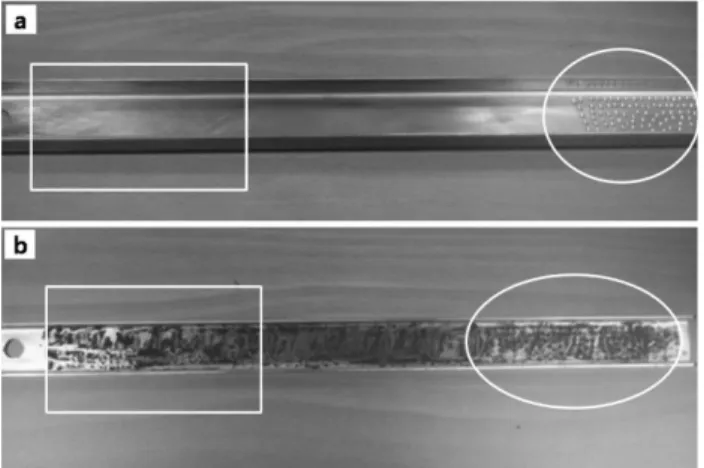
A 304 type stainless steel which has 1.5 m length, 10 cm width, and 1.0 mm thickness was used as the substrate. One side area of the substrate was pretreated

by the unidirectional scratching using a SiC sand paper as shown in the rectangular area in Fig. 1a. Several tens circular-shaped grooves were made on the other side area of the substrate using a mechanical drill (see the circular area in Fig. 1a). About 0.45 g Ni powders which have the diameters in the range of approximately 1~100 µm were spread onto the substrate as shown in Fig. 1b.

For the carbon coils deposition reaction, thermal chemi- cal vapor deposition (TCVD) system was employed. C

2

H

2

and H

2

were used as the source gases. SF

6

, an incorpo- rated additive gas, was injected into the reaction cham- ber during the reaction. The flow rate for C

2

H

2

, H

2

, and SF

6

were fixed at 15, 35, and 35 standard cm

3

per minute (sccm), respectively. The injection times for C

2

H

2

and H

2

flow were fixed at 120 minutes. However the addi- tive gas (SF

6

) flow was adjusted for 20 minutes from the starting point of the deposition reaction. The detailed reaction conditions were shown in Table 1. The morpholo- gies of carbon coils-deposited substrates were investi- gated using field emission scanning electron microscopy (FESEM, Hitach 4500). The qualities of the carbon coils according to the surface state of the substrate were investigated in the range of 800~2000 cm

−1

by a micro- Raman spectrometer (Renishaw 2000) with about 50 µm spot size of Ar-ion laser.

Fig. 1. Photographs of the stainless steel substrate pretreated by the unidirectional scratching using a SiC sand paper at one side area of the substrate (see the rectangular area) and by a mechanical drill (see the circular area) at the other side area of

the substrate (see the circular area).

Table 1

Experimental conditions for the deposition of carbon coils on the substrate C

2

H

2

flow

rate (sccm)

H

2

flow rate (sccm)

SF

6

flow rate (sccm)

Total pressure (torr)

Total deposition time (min)

Source gases flow time (min) Substrate temp. (

o

C)

C

2

H

2

H

2

SF

6

15 35 35 100 90 120 120 20 750

(3)

3. Results and Discussion

Fig. 2 shows the photographs of the as-grown carbon materials on the substrate. As a naked eye, a lot of the carbon materials were formed on the substrate. The measured amount of the deposited carbon materials was about 125 g. As shown in Fig. 2, the center area of the substrate seems to produce a large amount of the car- bon coils as compared with those of the side area of the substrate.

To investigate the effect of the pretreatment on the substrate, we measured the surface morphologies of the deposited carbon nanomaterials according to the loca- tions on the substrate, namely the one side area pre-

treated by the unidirectional scratching using a SiC sand paper (location A), the center area without pretreatment (location B), and the other side area pretreated by sev- eral circular-shaped grooves using a mechanical drill (location C). Fig. 3 shows the microscopic images for the as-grown carbon materials according to the loca- tions on the substrate. For location A, the formation of the linear type carbon nanofilaments was observed as shown in Figs. 3a~d. Indeed, most of the linear type carbon nanofilaments have the board shapes. As shown in the arrow head of Fig. 3d, some of the board-shaped carbon nanofilaments show the wave-like geometries.

For location B, any carbon nanofilament-like material couldn’t be observed as shown in Figs. 3e~h. Even in the high magnified (10k) FESEM images, merely the embryo-like morphologies could be observed (see Fig.

3h). It reveals that the one-dimensional type carbon nanofilaments couldn’t be developed on the substrate without the pretreatment. For location C, several-shaped carbon coils could be observed as shown in Figs. 3i~l.

Indeed, a lot of carbon nanocoils (CNCs) having the various shapes could be observed on the substrate, com- pared with the carbon microcoils (CMCs). Particularly, the drill bit-type CNCs could be well observed (see Fig.

3l). Estimating from Fig. 4, the lengths of CNCs in

Fig. 3. Photographs and FESEM images according to the locations on the pretreated stainless steel substrate. (a) Photograph on the location A, (b) 100 magnified FESEM image on the location A, (c) 1,000 magnified FESEM image on the location A, (d) 10,000 magnified FESEM image on the location A, (e) Photograph on the location B, (f) 100 magnified FESEM image on the location B, (g) 1,500 magnified FESEM image on the location B, (h) 10,000 magnified FESEM image on the location B, (i) Photograph on the location C, (j) 200 magnified FESEM image on the location C, (k) 1,000 magnified FESEM image on the location C, and (l) 10,000

magnified FESEM image on the location C.

Fig. 2. Photograph of the as-grown carbon materials on the

pretreated stainless steel substrate.

(4)

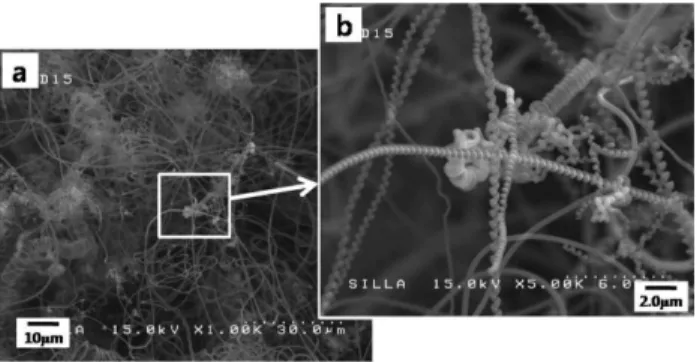
location C seemed to reach almost 1 mm. On the other hand, those of CMCs remained about several microme- ters as shown in Fig. 4. These regular CMCs have con- stant coil pitch of ~500 nm with little coil gap and have coil diameter of ~2.2 µm. The carbon nanofilaments that built up the carbon coil have circular type shape.

The combined results of Figs. 1~4 give rise to the dominant formation of the carbon coils on the location C of the substrate, namely the grooves area. The cause for the formation of the carbon coils mostly on the loca- tion C of the substrate seems mainly due to the protru-

sion induced by the grooves on the substrate surface.

Namely, this protrusion on the substrate might provoke the sufficient surface energies for the interaction with the as-deposited carbon elements. Consequently they seemed to enhance more active sites for the initiation of the carbon coils. So, the location C of the substrate hav- ing the protrusion states would give the dominant for- mation of the carbon coils. Although the location B having a rough surface state may enhance the surface energies for the interaction between the substrate and the as-deposited carbon elements, the absolute magni- tude seems to be lower than that of the location C.

Therefore, the formation of the carbon coils seems to be dominant on the location C, compared with the location B. Meanwhile, the carbon coils are rarely found on the pretreated stainless steel substrate without Ni catalyst particles, as the previous report [24].

To obtain the massive production yield of the carbon coils, we carried out the double pretreatment of the stainless steel substrate. Namely, we first pretreated the substrate by several circular-shaped grooves using a mechanical drill. Next, we pretreated again the same substrate by the unidirectional scratching using a SiC sand paper. As shown in Fig. 5, the formation of the carbon coils could be dramatically enhanced. Although Fig. 4. (a) FESEM images for the as-grown carbon nanomate-

rials on the location C of the pretreated stainless steel substrate under the magnification 1,000 and (b) the 5,000 × magnified

FESEM images for the square area of Fig. 4a.

Fig. 5. Photograph of the as-grown carbon coils on the doubly pretreated (scratching + grooving) stainless steel substrate and FESEM images for the as-grown carbon coils of the circular area of the substrate under magnification (a) 50, (b) 300, and (c) 1,500 and for

the as-grown carbon coils of the square area of the substrate under magnification (a) 50, (b) 300, and (c) 3,000.

(5)

the deposition aspect of the carbon nanomaterials seems to be different according to the locations on the substrate, the percentage of the carbon coils seems to increase up to nearly 35 percent, compared with the nearly 25 per- cent in the location C of the substrate. Noticeably, a massive amount of the well-developed carbon micro- coils could be observed near the center area of the sub- strate (see the square are of the Fig. 5 and Figs. 5d~f).

These well-developed carbon microcoils have the linear- shaped geometries. The coils diameters of the well- developed carbon microcoils were more or less reduced compared with those of the under-developed carbon microcoils (compare the diameters of the carbon micro- coils in Fig. 5c with those of Fig. 5f). So, it is under- stood that the carbon microcoils are developed with reducing the diameters of the coils. The reason for this phenomenon seems to be due to the carbon coils forma- tion mechanism as our previous report [26]. Namely, the precipitating rate of carbon elements according to the different crystal faces of the catalyst would be different.

Therefore, the balance axis of the catalyst would be col- lapsed by the different growth rate of two carbon nanofila- ments from the catalyst. Consequently, it gives rise to the spinning of the catalyst. The spinning rate increases with developing the carbon coils. As a result, the well-

developed carbon coils have the compact and reduced coils diameters, compared with the under-developed car- bon coils.

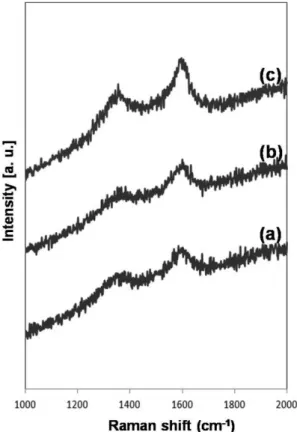
Meanwhile, the qualities of the carbon coils accord- ing to the locations on the substrate were also investi- gated by a micro-Raman spectrometer as shown in Fig.

6. The D and G peaks in all the different locations on the substrate were observed to be around 1350 cm

−1

and 1580 cm

−1

, respectively. Table 2 shows I

D

/I

G

values accord- ing to the locations on the substrate. G band is known to be related with the ordering of graphite layers within the material, while D-band is reported to be associated with the disordered states of sp

2

-hybridized carbon [27, 28].

As shown in Table 2, I

D

/I

G

value for the sample obtained in location C of the substrate, namely the sample domi- nated by the carbon coils, seems to be the lowest among the samples, indicating the largest presence of the ordered carbon phase in this sample. These tendencies indicate that the carbon coils for the samples of loca- tion C, that is, in the case of the pretreated by several circular-shaped grooves using a mechanical drill, have the most polycrystalline development.

4. Conclusions

By several grooves formation on the stainless steel substrate, the large-scale synthesis of the carbon coils could be achieved. The protrusion induced by the grooves on the substrate surface was understood to be the main cause for the dominant formation of the carbon coils.

Doubly pretreatment of the stainless steel substrate, namely scratching and grooving, could dramatically enhance the production yield of the carbon coils. Raman spectra confirm that the sample dominated by the car- bon coils has the most polycrystalline development.

References

[ 1 ] L.J. Pan, T. Hayashida, M. Zhang and Y. Nakayama,

“Field emission properties of carbon tubule nanocoils”, Jpn. J. Appl. Phys. 40 (2001) L235.

[ 2 ] S. Amelinckx, X.B. Zhang, D. Bernaerts, X.F. Zhang, V.

Fig. 6. Micro-Raman spectra of (a) location A, (b) location B, and (c) location C on the stainless steel substrate.

Table 2

The I

D

/I

G

values calculated from the curve fitted Raman spectra

Locations I

D

/I

G

A 2.21

B 2.35

C 1.92

(6)

Ivanov and J.B. Nagy, “A formation mechanism for cat- alytically grown helix-shaped graphite nanotubes”, Sci- ence 265 (1994) 635.

[ 3 ] S. Hokushin, L.J. Pan, Y. Konishi, H. Tanaka and Y.

Nakayama, “Field emission properties and structural changes of a stand-alone carbon nanocoil”, Jpn. J. Appl.

Phys. 46 (2007) L565.

[ 4 ] S. Yang, X. Chen, S. Motojima and H. Iwanaga, “The Phenomenon of changing coiling-chirality in carbon nanocoils obtained by catalytic pyrolysis of acetylene with various catalysts”, J. Nanosci. Nanotechnol. 4 (2007) 167.

[ 5 ] W.R. Davies, R.J. Slawson and G.R. Rigby, “An unusual form of carbon”, Nature 171 (1953) 756.

[ 6 ] R.T.K. Baker, “Catalytic growth of carbon filaments”, Carbon 27 (1989) 315.

[ 7 ] X. Wang, Z. Hu, Q. Wu, X. Chen and Y. Chen, “Syn- thesis of multi-walled carbon nanotubes by microwave plasma-enhanced chemical vapor deposition”, Thin Solid Films 390 (2001) 130.

[ 8 ] A. Huczko, “Synthesis of aligned carbon nanotubes”, Appl. Phys. A 74 (2002) 617.

[ 9 ] J.-H. Eum, S.-H. Kim, S.S. Yi and K. Jang, “Large- scale synthesis of the controlled-geometry carbon coils by the manipulation of the SF

6

gas flow injection time”, J. Nanosci. Nanotechnol. 12 (2012) 4397.

[10] K. Akagi, R. Tamura and M. Tsukada, “Electronic struc- ture of helically coiled cage of graphitic carbon”, Phys.

Rev. Lett. 74 (1995) 2307.

[11] V. Ivanov, J.B. Nagy, Ph. Lambin, A. Lucas, X.B.

Zhang, X.F. Zhang, D. Bernaerts, G.V. Tendeloo, S.

Amelinckx and J.V. Landuyt, “The study of carbon nan- otubules produced by catalytic method”, Chem. Phys.

Lett. 223 (1994) 329.

[12] W. In-Hwang, H. Yanagida and S. Motojima, “Vapor growth of carbon micro-coils by the Ni catalyzed pyrol- ysis of acetylene using rotating substrate”, Mater. Let- ters 43 (2000) 11.

[13] K. Hernadi, A. Fonseca, J.B. Nagy, D. Bernaerts and A.A. Lucas, “Fe-catalyzed carbon nanotube formation”, Carbon 34 (1996) 1249.

[14] S. Motojima, Y. Itoh, S. Asakura and H. Iwanaga,

“Preparation of micro-coiled carbon fibres by metal powder-activated pyrolysis of acetylene containing a small amount of sulphur compounds”, J. Mater. Sci. 30 (1995) 5049.

[15] X. Chen and S. Motojima, “Morphologies of carbon micro-coils grown by chemical vapor deposition”, J.

Mater. Sci. 34 (1999) 5519.

[16] S. Motojima, S. Asakura, T. Kasemura, S. Takeuchi and H. Iwanaga, “Catalytic effects of metal carbides, oxides and Ni single crystal on the vapor growth of micro- coiled carbon fibers”, Carbon 34 (1996) 289.

[17] S. Yang, X. Chen and S. Motojima, “Tactile sensing properties of protein-like single-helix carbon micro- coils”, Carbon 44 (2006) 3352.

[18] K.-D. Kim, S.-H. Kim, N.S. Kim and D.-U. Kim,

“Effect of the on/off cyclic modulation time ratio of C

2

H

2

/H

2

flow on the low temperature deposition of car- bon nanofilaments”, J. Nanosci. Nanotechnol. 7 (2007) 3969.

[19] S.-H. Kim,“The geometry change of carbon nanofila- ments by SF

6

incorporation in a thermal chemical vapor deposition system”, J. Korean Cryst. Growth Cryst.

Technol. 21 (2011) 119.

[20] S.-H. Lee and S.-H. Kim, “Geometry variation for as- grown carbon coils under the minimized sulfur additive condition deposition system”, J. Korean Cryst. Growth Cryst. Technol. 22 (2012) 213.

[21] S.-H. Lee and S.-H. Kim, “Effect of gas phase cycling modulation of C

2

H

2

/SF

6

flows on the formation of car- bon coils”, J. Korean Vac. Soc. 18 (2012) 481.

[22] M. Asmann, J. Heberlein and E. Pfender, “A review of diamond CVD utilizing halogenated precursors”, Dia- mond Relat. Mater. 8 (1999) 1.

[23] Y.-C. Jeon, J.-H. Eum, S.-H. Kim, J.-C. Park and S.I.

Ahn, “Effect of the on/off cycling modulation time ratio of C

2

H

2

/SF

6

flows on the formation of geometrically controlled carbon coils”, Journal of Nanomaterials, vol.

2012, Article ID 908961.

[24] N.-K. Chang and S.-H. Chang, “High-yield synthesis of carbon nanocoils on stainless steel”, Carbon 46 (2008) 1106.

[25] C.-C. Su and S.-H Chang, “Radial growth of carbon nanocoils on stainless wires coated with tin particles using chemical vapor despotion from acetylene”, Mate- rials Letters 65 (2011) 1114.

[26] S. Park, Y.C. Jeon and S.-H. Kim, “Effect of injection stage of SF

6

flow on carbon micro coils formation”, ECS J. Solid State Sci. and Technol. 2 (2013) M56.

[27] J. Robertson, “Diamond-like amorphous carbon,” Mater.

Sci. Eng. R 37 (2002) 129.

[28] E.P. Sajitha, V. Prasad, S.V. Subramanyam, S. Eto, K.

Takai and T. Enoki, “Synthesis and characteristics of

iron nano particles in a carbon matrix along with cata-

lytic graphitization of amorphous carbon”, Carbon 42

(2004) 2815.

수치

Fig. 1. Photographs of the stainless steel substrate pretreated by the unidirectional scratching using a SiC sand paper at one side area of the substrate (see the rectangular area) and by a mechanical drill (see the circular area) at the other side area of
Fig. 3. Photographs and FESEM images according to the locations on the pretreated stainless steel substrate
Fig. 5. Photograph of the as-grown carbon coils on the doubly pretreated (scratching + grooving) stainless steel substrate and FESEM images for the as-grown carbon coils of the circular area of the substrate under magnification (a) 50, (b) 300, and (c) 1,5
Fig. 6. Micro-Raman spectra of (a) location A, (b) location B, and (c) location C on the stainless steel substrate.

참조

관련 문서

In experiment, the butt‐welded stainless steel specimen are extended by tensile testing machine and The strain distribution at right‐angle to welding line is measured

Noorul Haq : Effect of friction welding parameters on mechanical and metallurgical properties of ferritic stainless steel, The international journal of

A Study on the Wireless Power Transmission of magnetic resonance using Superconducting

considered in the design of external corrosion protection of on-grade carbon steel storage tank bottoms without secondary containment that are protected by galvanic

It considers the energy use of the different components that are involved in the distribution and viewing of video content: data centres and content delivery networks

1 John Owen, Justification by Faith Alone, in The Works of John Owen, ed. John Bolt, trans. Scott Clark, "Do This and Live: Christ's Active Obedience as the

This study investigated the effects of process variables on the residual stress distributions of induction heating bended austenitic stainless steel (316 series)

Named for the German metallurgist Adolph Martens, Martensite is the hardened phase of steel that is obtained by cooling Austenite fast enough to trap carbon atoms within