[논 문] 한국재료학회지 DOI: 10.3740/MRSK.2011.21.4.216 Kor. J. Mater. Res.
Vol. 21, No. 4 (2011)
216
†Corresponding author
E-Mail : [email protected] (B. H. Koo)
Electrical and Magnetic Properties in
[La
0.7(Ca
1 − xSr
x)
0.3MnO
3)]
0.99/(BaTiO
3)
0.01Composites
Geun Woo Kim, Jin Long Bian, Yong Jun Seo and Bon Heun Koo
†School of Nano & Advanced Materials Engineering, Changwon National University, Changwon, Korea
(Received January 5, 2011 : Received in revised form March 15, 2011 : Accepted March 16, 2011)
Abstract Perovskite manganites such as RE1−x AxMnO3 (RE = rare earth, A = Ca, Sr, Ba) have been the subject of intense research in the last few years, ever since the discovery that these systems demonstrate colossal magnetoresistance (CMR). The CMR is usually explained with the double-exchange (DE) mechanism, and CMR materials have potential applications for magnetic switching, recording devices, and more. However, the intrinsic CMR effect is usually found under the conditions of a magnetic field of several Teslas and a narrow temperature range near the Curie temperature (Tc). This magnetic field and temperature range make practical applications impossible. Recently, another type of MR, called the low-field magnetoresistance (LFMR), has also been a research focus. This MR is typically found in polycrystalline half-metallic ferromagnets, and is associated with the spin-dependent charge transport across grain boundaries. Composites with compositions [La0.7(Ca1−x Srx)0.3MnO3)]0.99/(BaTiO3)0.01 [(LCSMO)0.99/(BTO)0.01] were prepared with different Sr doping levels x by a standard ceramic technique, and their electrical transport and magnetoresistance (MR) properties were investigated. The structure and morphology of the composites were studied by X-ray diffraction (XRD) and scanning electronic microscopy (SEM). BTO peaks could not be found in the XRD pattern because the amount of BTO in the composites was too small. As the content of x decreased, the crystal structure changed from orthorhombic to rhombohedral. This change can be explained by the fact that the crystal structure of pure LCMO is orthorhombic and the crystal structure of pure LSMO is rhombohedral. The SEM results indicate that LCSMOand BTO coexist in the composites and BTO mostly segregates at the grain boundaries of LCSMO, which are in accordance with the results of the magnetic measurements. The resistivity of all the composites was measured in the range of 90-400K at 0T, 0.5T magnetic field. The result indicates that the MR of the composites increases systematically as the Ca concentration increases, although the transition temperature Tc shifts to a lower range.
Key words [La0.7(CaxSr1 − x)MnO3)]0.99/(BaTiO3)0.01 composites, Ca/Sr ratio, second boundary, Curie temperature (Tc), low- field magnetoresistance (LFMR).
I. Introduction
Perovskite manganites La1 − xAExMnO3(AE = Ca, Sr, Ba)1-3) have been paid lots of attention in the last few years due to their colossal magnetoresistance (CMR) which have potential application in switching and recording devices, etc. The appearance of the ferromagnetic and metallic state in these systems is attributed to the double exchange model between the Mn3+ and Mn4+ ions. The substitution of cations with different sizes at A site results in the lattice distortion that affects the energy bandwidth and the electrical characters of the La1 − xAExMnO3 materials.4,5) Therefore while the Mn3+/Mn4+ratio is fixed, the doped elements and the ratio of the ions at A site change the tolerance factor (t), which usually is expressed as t = (rA+rO)/ 2(rMn+rO), where rA, rO, and rMn are, respect- ively, the empirical radius of the ions at A site, the empirical radius of O ions, and the empirical radius of
Mn ions. Hwang et al.6) have shown Curie temperature was related to the vitiation in the tolerance factor for the bulk CMR samples. However, the these intrinsic CMR effect which is caused by double exchange mechanism7) is usually found during a narrow temperature range near the Curie temperature (Tc)8) and needs several tesla extra magnetic field. This is not very appealing for practical application. Recently another type of magnetoresistance (MR) has been found in polycrystalline manganites. This kind of MR is mainly dependent on the grain boundary properties and the spin-polarized tunneling of conduction electrons,9) and it usually occurs over a wide temperature range and at a low magnetic field. Hence, it’s also called low-field magnetoresistance (LFMR), which associated with the spin-memory contribution to charge transport across the grain boundary (or interface) by modifying the microstructure of the manganites. There are some other extrinsic MR effects, such as grain boundary MR, spin- polarized transport MR.10,11) It could be more useful for practical application. Several groups of manganite-based inorganic composites have been investigated to enhance
Electrical and Magnetic Properties in [La0.7(Ca1 − xSrx)0.3MnO3)]0.99/(BaTiO3)0.01 Composites 217
LFMR, such as La0.7Ca0.3MnO3/YSZ, La0.7Ca0.3MnO3/CeO2, La0.7Ca0.3MnO3/ZrO2, La0.7Ca0.3MnO3/Al2O312-14) and La0.7- Ca0.3MnO3/ZnO15) etc.
In this work, [La0.7(Ca1 − xSrx)0.3MnO3)]0.99/(BaTiO3)0.01 [(LCSMO)0.99/(BTO)0.01] composite prepared by a standard ceramic technique is varied by the replacement of Ca with Sr at fixing Mn3+/Mn4+ ratio and the influences of the variation of Ca/Sr ratio on the crystal structures and the electrical and magnetic properties were studied.
2. Experimental Procedure
The [(LCSMO)0.99/(BTO)0.01] composites were fabricated by following solid state reaction methods. Firstly, calculated powders of La2O3, CaO, SrO and Mn2O3 were mixed with 99% ethanol. After 24h ball-milling the powders were dried at 100oC, the mixture was grinded and then calcination at 1000oC for 12h. Then this procedure was done again and finally the powders were sintered at 1250oC for 24h to crystallize. After this process, a uniform homogeneous LCSMO powder was obtained. Secondly, (LCSMO)0.99/ (BTO)0.01 were mixed. After dried and grinded the powders were pelletized into a rectangular block at the press of 5MPa, and finally sintered at 1250oC for 24hours.
The crystal structure of each (LCSMO)0.99/(BTO)0.01
composite was checked by x-ray diffraction (XRD). The morphology of grain boundaries and surfaces were in- vestigated by scanning electronic microscopy (SEM). The electrical properties and magnetoresistence properties were measured by Physical Property Measured System (PPMS) at 0.5T magnetic field and at the temperature range of 90K-400K.
3. Results and Discussion
In other to compare the Ca and Sr influence of MR property in [(LCSMO)0.99/(BTO)0.01] composite, the MR result of the (La0.7Ca0.3MnO3)1 − x/(BaTiO3)x (LCMO/BTO) and (La0.7Sr0.3MnO3)1 − x/(BaTiO3)x (LSMO/BTO) at an applied magnetic of 0.5T are shown in Fig. 1(a) and (b), re- spectively. The BTO doping in the LCMO and LSMO can also induce the spin disorder at the grain boundaries. When applied a small magnetic field, the disordered spins tend to align with the magnetic field and a large MR effect can be expected. So we can conclude that the grain boundaries and interfaces are mainly responsible for the decrease of the applied magnetic field in MR materials.17) It is observed that the maximum MR value of (LCMO0.99/BTO0.01) reached 24% around Tc (~170K) with 0.5T. On the other hand, in case of LSMO/BTO composites, although all samples have maximum MR value with 0.5T near the room temperature, the value is extremely low below 4%
Fig. 1. Temperature dependence of magnetoresistance (MR%) under a magnetic field of Hdc= 0.5T for (a) (La0.7Ca0.3MnO3)1 − x/(BaTiO3)x and (b) (La0.7Sr0.3MnO3)1 − x/(BaTiO3)x composites with different x.
Fig. 2. SEM micrographs of [La0.7(Ca1 − xSrx)0.3MnO3)]0.99/ (BaTiO3)0.01 composites with different x. (a) pure LCMO and pure LSMO and (b) x = 0.1, 0.2, 0.5 and 0.7.
218 Geun Woo Kim, Jin Long Bian, Yong Jun Seo and Bon Heun Koo
for the application of electronic and magnetic devices.
Therefore, to get high MR at near the room temperature, it is necessary to combine the advantage of LCMO for high MR and LSMO for near room temperature.
In order to confirm the coexistence of both phases in the composites, the [(LCSMO)0.99/(BTO)0.01] (x = 0, 0.1, 0.2, 0.5, 0.7 and 1) samples with the different composition of x were checked by SEM photographs. The BTO added composite dependence of the surface morphology for the (LCSMO)0.99/(BTO)0.01 composites is shown in Fig. 2(a) and (b), which clearly indicate the two different types of crystallites. From the back scattering image of pure LCMO or LSMO in Fig. 2(a), it is clearly seen that the grains have only one phase of LCMO or LSMO. While for the composites with BTO, as shown BTO grains exist separately, secondary phase exists in the LCSMO matrices in the composites [shown in Fig. 2(b)]. It is obvious that
the perovskite structure BTO grains are located between LCSMO grains. For comparison of crystallization of LCSMO and BTO, two phases are clearly discriminated from each other. Moreover, the grain size increased with the increment of Sr ratio, it is due to the higher melting point of CaO(~2700oC) compared with that of SrO(~2500oC).
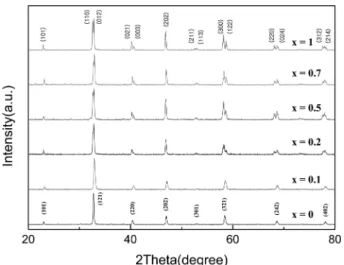
The room temperature XRD patterns of the (LCSMO)0.99/ (BTO)0.01 are shown in Fig. 3. From the XRD pattern, it is found that due to very small amount of BTO in com- posites, the BTO peaks couldn’t be found in the XRD pattern. With decreasing the content of x, the crystal structure changed from othorombic to rhombohedral. This change lies in that the crystal structure of pure LCMO is othorombic, and the crystal structure of pure LSMO is rhombohedral.
In order to compare the Curie temperature (Tc) of (LCSMO)0.99/(BTO)0.01 composites, temperature dependence of magnetization of the (LCSMO)0.99/(BTO)0.01 composites with having different x composition at an applied magnetic of 0.5T are shown in Fig. 4. All samples show the par- amagnetic (PM) to ferromagnetic (FM) transition. It is found that the Curie temperature (Tc) increased from 275K (x = 0.1) to 355K (x = 0.7) for (LCSMO)0.99/(BTO)0.01 com- posites as the x increased. This result can be explained by bond strength between Mn and O ions in the structure.
The bond lengths between Mn and O change with the radius of ions substituted in A site. Mn-O length in more x (Sr riched (LCSMO)0.99/(BTO)0.01 composites) is shorter compared with Ca riched (LCSMO)0.99/(BTO)0.01 compos- ites, because the size of Sr ion is bigger than Ca. Con- sequently, the bond of Mn-O for LSMO is more stable than LCMO and is helpful to the maintenance of ferro- magnetic property around room temperature.16)
Fig. 5 shows temperature dependence of resistivity of the (LCSMO)0.99/(BTO)0.01 composites at zero magnetic
Fig. 5. Temperature dependence of the resistivity under a magnetic field of Hdc= 0T for [La0.7(Ca1 − xSrx)0.3MnO3)]0.99/(BaTiO3)0.01 com- posites with different x.
Fig. 3. θ-2θ x-ray diffraction patterns [La0.7(Ca1 − xSrx) 0.3MnO3)]0.99/ (BaTiO3)0.01 composites with different x.
Fig. 4. Temperature dependence of Magnetization under a magnetic field of Hdc= 0.5T for [La0.7(Ca1 − xSrx)0.3MnO3)]0.99/(BaTiO3)0.01 composites with different x.
Electrical and Magnetic Properties in [La0.7(Ca1 − xSrx)0.3MnO3)]0.99/(BaTiO3)0.01 Composites 219
field. With increasing the concentration of the additional Ca, the metal-insulator transition temperature (TMI) of the composites shifts toward to lower temperature. This phenomenon is also explained by the change of Mn-O-Mn bonding lengths in the LCSMO matrix.17) Moreover, it is clearly seen in Fig. 5 that the resistivity is continuously increasing with decreasing of Ca amount. This is attributed to the increasing content of Sr element, because Ca has more conductivity than Sr element.18)
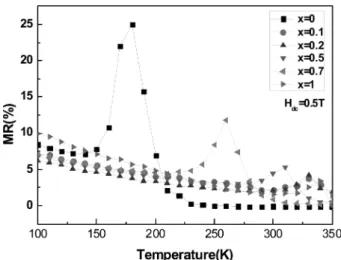
Fig. 6 reveals the temperature dependence of magneto resistance (MR) at a magnetic field of Hdc= 0.5 of (LCSMO)0.99/(BTO)0.01 composites with having different x composition, which was measured in a temperature range of 150K to 400K. MR% is defined as MR = [ρ(0)− ρ(H)]/
ρ(0), where ρ(H) and ρ(0) are the resistivity of the sample in and out of the external applied field. It is found that (see Fig. 5) at a magnetic field of Hdc= 0.5T, the maximum MR value for each sample is indicated from 2.5% at 330K with x = 0.1 to 12.4% at 280K with x = 0.7. This result affected by the two-level model of traditional CMR effect and the spin-polarized and tunneling effect and the MR effect of the sample with x = 0.7 appearing at room temperature is combined with Ca0.3 and Sr0.7 is better than pure LCMO/BTO and pure LSMO/BTO, as the MR value of pure LCMO is high at low temperature, and the MR value of pure LSMO is low at room temperature [(shown.
Fig. 1(a) and (b)].
4. Conclusion
The effect of the variation of Ca/Sr ratio on (LCSMO)0.99/ (BTO)0.01 composites on magnetic and electrical transport behavior was investigated. The results of this paper show that it is possible to control and improve the MR value near
the room temperature by preparing the samples with the increment of BTO for the formation of the secondly phase and the variation of Ca/Sr ratio. As a results, to get high MR at near the room temperature, it is necessary to get second boundary in the composites and to combine the Ca/
Sr ions.
Acknowledgement
This research is financially supported by Changwon National University in 2009-2010.
Rerefences
1. W. H. Jung, Kor. J. Mater. Res., 18, 26 (2008) (in Korean).
2. Y. P. Lee, J. S. Park, C. O. Kim and V. G. Prokhorov, J.
Korean. Phys. Soc., 46(95), S1(2005).
3. V. G. Prokhorov, V. A. Komashko, V. L. Svetchniko, K.
K. Yu, S. Y. Park, J. S. Park, Y. P. Lee and J. -H. Kang, J. Korean. Phys. Soc., 48, 1417 (2006).
4. D. Dai, X. Guangdchen and S. Wu, Progress in Physics(in China), 17, 201 (1997) (in Chinese).
5. M. F. Hundley, J. J. Neumeier, R. H. Heffner, Q. X. Jia, X. D. Wu and J. D. Thompson, J. Appl. Phys., 79, 4535 (1996).
6. H. Y. Hwang, S. W. Cheong, P. G. Radaelli, M. Marezio and B. Batlogg, Phys. Rev. Lett., 75, 914 (1995).
7. C. Zener, Phys. Rev., 82, 403(1951).
8. J. M. D. Coey, M. Viret and S. von Molnar, Adv. Phys., 48, 167 (1999).
9. H. Y. Hwang, S. W. Cheong, N. P. Ong and B. Batlogg, Phys. Rev. Lett., 77, 2041 (1996).
10. LI. Balcells, A. E. Carrillo, B. Martinez and J. Fontcuberta, Appl. Phys. Lett., 74, 4014 (1999).
11. D. K. Petrov, L. Krusin-Elbaum, J. Z. Sun, C. Feild and P. R. Duncombe, Appl. Phys. Lett., 75, 995 (1999).
12. Z. C. Xia, S. L. Yuan, L. J. Zhang, G. H. Zhang, W. Feng, J. Tang, L. Liu, S. Liu, J. Liu, G. Peng, Z. Y. Li, Y. P.
Yang, C. Q. Tang and C. S. Xiong, Solid State Comm., 125, 571 (2003).
13. D. Das, A. Saha, S. E. Russek, R. Raj and D. Bahadur, J.
Appl. Phys., 93, 8301 (2003).
14. L. E. Hueso, J. Rivas, F. Rivadulla and M. A. López- Quintela, J. Appl. Phys., 89, 1746 (2001).
15. P. K. Siwach, P. Srivastava, J. Singh, H. K. Singh and O.
N. Srivastava, J. Alloy. Comp., 481, 17 (2009).
16. Y. H. Xiong, X. C. Bao, J. Zhang, C. L. Sun, W. H.
Huang, X. S. Li, Q. J. Ji, X. W. Cheng, Z. H. Peng, N.
Lin, Y. Zeng, Y. F. Cui and C. S. Xiong, Phys. B Condens.
Matter, 398, 102 (2007).
17. K. X. Jin, C. L. Chen, S. L. Wang, S. G. Zhao, Y. C.
Wang, Z. M. Song, Mater. Sci. Eng. B, 119, 206 (2005).
18. A. Ray and T. K. Dey, Solid State Comm., 126, 147 (2003).
Fig. 6. Temperature dependence of magnetoresistance (MR%) under a magnetic field of Hdc= 0.5T for [La0.7(Ca1 − xSrx)MnO3)]0.99/ (BaTiO3)0.01 composites with different x.
![Fig. 2. SEM micrographs of [La 0.7 (Ca 1 − x Sr x ) 0.3 MnO 3 )] 0.99 / (BaTiO 3 ) 0.01 composites with different x](https://thumb-ap.123doks.com/thumbv2/123dokinfo/5513192.457021/2.892.471.813.674.1077/fig-sem-micrographs-la-mno-batio-composites-different.webp)