Introduction Introduction
Salivary glands are exocrine glands composed of three ma- jor glands (submandibular, parotid, and sublingual glands) that produce and secrete saliva into the oral cavity. Secreted saliva is essential to oral and intestinal health and functions such as food digestion, speech, taste perception, mastication, swallowing, and protection from bacteria [1,2]. Bicarbonate in saliva maintain pH of saliva at 6.5–7.4 and protect teeth from cariogenic pathogens [3]. Glycoproteins included in saliva bind with bacterial receptors and agglutinate oral microorganisms to eliminate overload of bacteria [4]. Saliva secreted from each of the major glands have distinguished constituent due to dif- ferences in secretory cell type [5]. Tenacious saliva from pa- rotid glands by serous acini, mucin-rich saliva from sublingual glands by mucous acini, and mixed saliva from submandibular
glands (SMGs) by both acinar cell types [6].
Xerostomia, a subjective feeling of dry mouth that may or may not be accompanied by hyposalivation, can be caused by radiotherapy for head and neck cancer, Sjögren’s syndrome, or aging [1,2]. Irreversible loss of secretory acinar cells is the major cause of dry mouth [7,8]. Therefore, replacement of the acinar cells is a potential treatment method for dry mouth [9].
Activation of Rho-associated protein kinase (ROCK) signal- ing pathway is related to the development of various diseases such as asthma, erectile dysfunction, glaucoma, cancer, and kidney failure indicating the importance of ROCK signal- ing pathway in homeostasis of various organs [10-14]. In rat SMGs, small Rho GTPases, including RhoA and RhoB and RhoC, was detected in newly regenerated acinar cells [15].
Inhibition of ROCK using Y-27632 increased proacinar cells in salivary gland organoids [16] and delays senescence of salivary Int J Oral Biol 46:81-84, 2021
pISSN: 1226-7155 • eISSN: 2287-6618 https://doi.org/10.11620/IJOB.2021.46.2.81
Expression patterns of Rho-associated protein kinase signaling pathway-related genes in mouse submandibular glands
Ki-Chul Kim and Sangho Roh*
Cellular Reprogramming and Embryo Biotechnology Laboratory, Dental Research Institute, Seoul National University School of Dentistry, Seoul 08826, Republic of Korea
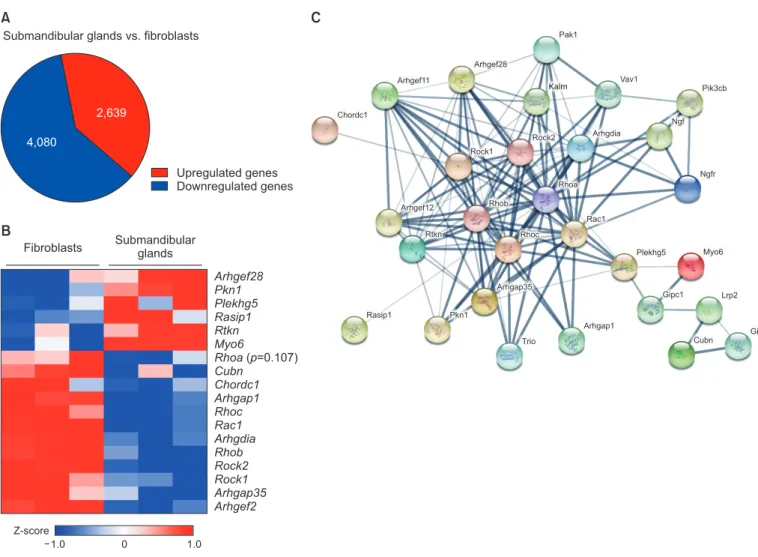
Salivary glands are exocrine glands that secrete saliva into the oral cavity, and secreted saliva plays essential roles in oral health. Therefore, maintaining the salivary glands in an intact state is required for proper production and secretion of saliva. To investigate a specific signaling pathway that might affect the maintenance of mouse submandibular gland (SMGs), RNA sequencing was performed. In SMGs, downregulated expression patterns of Rho-associated protein kinase (ROCK) signaling pathway-related genes, including Rhoa, Rhob, Rhoc, Rock1, and Rock2, were observed.
Gene expression profiling analyses of these genes indicate that the ROCK signaling pathway is a potential signal for SMG maintenance.
Keywords: Submandibular glands, RNA sequencing, ROCK signaling pathway
Received May 21, 2021; Revised June 1, 2021; Accepted June 16, 2021
*Correspondence to: Sangho Roh, E-mail: [email protected] https://orcid.org/0000-0001-8082-6459 Copyright © The Korean Academy of Oral Biology
CC