Copyright © 2016 Korean Stroke Society
This is an Open Access article distributed under the terms of the Creative Commons Attribution Non-Commercial License (http://creativecommons.org/licenses/by-nc/4.0/) which permits unrestricted non-commercial use, distribution, and reproduction in any medium, provided the original work is properly cited.
Prestroke Antiplatelet Effect on Symptomatic
Intracranial Hemorrhage and Functional Outcome in Intravenous Thrombolysis
Jay Chol Choi,
a*Ji Sung Lee,
b*Tai Hwan Park,
cYong-Jin Cho,
dJong-Moo Park,
eKyusik Kang,
eKyung Bok Lee,
fSoo Joo Lee,
gJae Guk Kim,
gJun Lee,
hMan-Seok Park,
iKang-Ho Choi,
iJoon-Tae Kim,
iKyung-Ho Yu,
jByung-Chul Lee,
jMi-Sun Oh,
jJae-Kwan Cha,
kDae-Hyun Kim,
kHyun-Wook Nah,
kDong-Eog Kim,
lWi-Sun Ryu,
lBeom Joon Kim,
mHee-Joon Bae,
mWook-Joo Kim,
nDong-Ick Shin,
oMin-Ju Yeo,
oSung Il Sohn,
pJeong-Ho Hong,
pJuneyoung Lee,
qKeun-Sik Hong
daDepartment of Neurology, Jeju National University, Jeju, Korea
bClinical Research Center, Asan Medical Center, Seoul, Korea
cDepartment of Neurology, Seoul Medical Center, Seoul, Korea
dDepartment of Neurology, Ilsan Paik Hospital, Inje University, Goyang, Korea
eDepartment of Neurology, Eulji General Hospital, Eulji University, Seoul, Korea
fDepartment of Neurology, Soonchunhyang University College of Medicine, Seoul, Korea
gDepartment of Neurology, Eulji University Hospital, Daejeon, Korea
hDepartment of Neurology, Yeungnam University Hospital, Daegu, Korea
iDepartment of Neurology, Chonnam National University Hospital, Gwangju, Korea
jDepartment of Neurology, Hallym University Sacred Heart Hospital, Anyang, Korea
kDepartment of Neurology, Dong-A University College of Medicine, Busan, Korea
lDepartment of Neurology, Dongguk University Ilsan Hospital, Goyang, Korea
mDepartment of Neurology, Seoul National University Bundang Hospital, Seoul National University College of Medicine, Seongnam, Korea
nDepartment of Neurology, Ulsan University Hospital, Ulsan, Korea
oDepartment of Neurology, Chungbuk National University Hospital, Cheongju, Korea
pDepartment of Neurology, Keimyung University Dongsan Medical Center, Daegu, Korea
qDepartment of Biostatistics, Korea University College of Medicine, Seoul, Korea
Correspondence: Keun-Sik Hong Department of Neurology, Ilsan Paik Hospital, Inje University, 170 Juhwa-ro, Ilsanseo-gu, Goyang 10380, Korea Tel: +82-31-910-7680
Fax: +82-31-910-7368 E-mail: [email protected] Received: March 20. 2016 Revised: July 6, 2016 Accepted: July 7, 2016
*Jay Chol Choi and Ji Sung Lee contributed equally to the manuscript as the first author.
This study was supported from the Korea Healthcare Technology R&D Project, Ministry of Health, Republic of Korea (HI10C2020).
The authors have no financial conflicts of interest.
Background and Purpose About 30%-40% of stroke patients are taking antiplatelet at the time of their strokes, which might increase the risk of symptomatic intracranial hemorrhage (SICH) with intravenous tissue plasminogen activator (IV-TPA) therapy. We aimed to assess the effect of pre- stroke antiplatelet on the SICH risk and functional outcome in Koreans treated with IV-TPA.
Methods From a prospective stroke registry, we identified patients treated with IV-TPA between October 2009 and November 2014. Prestroke antiplatelet use was defined as taking antiplatelet within 7 days before the stroke onset. The primary outcome was SICH. Secondary outcomes were discharge modified Rankin Scale (mRS) score and in-hospital mortality.
Results Of 1,715 patients treated with IV-TPA, 441 (25.7%) were on prestroke antiplatelet. Pre- stroke antiplatelet users versus non-users were more likely to be older, to have multiple vascular risk factors. Prestroke antiplatelet use was associated with an increased risk of SICH (5.9% vs. 3.0%;
adjusted odds ratio [OR] 1.79 [1.05-3.04]). However, at discharge, the two groups did not differ in mRS distribution (adjusted OR 0.90 [0.72-1.14]), mRS 0-1 outcome (34.2% vs. 33.7%; adjusted OR 1.27 [0.94-1.72), mRS 0-2 outcome (52.4% vs. 52.9%; adjusted OR 1.21 [0.90-1.63]), and in-hospital mortality (6.1% vs. 4.2%; adjusted OR 1.19 [0.71-2.01]).
Original Article
Introduction
Intravenous tissue plasminogen activator (IV-TPA) improves outcomes of patients with acute ischemic stroke, but has the risk of symptomatic intracranial hemorrhage (SICH). IV-TPA therapy is not recommended in patients with current use of warfarin therapy with internationalized normal range > 1.7 or use of non- vitamin K antagonist oral anticoagulants, but prestroke anti- platelet use is not a formal contraindication despite of potential increased risk of SICH.
In a recent meta-analysis and a large observational study, among patients treated with IV-TPA, prestroke antiplatelet ther- apy was associated with a higher risk of SICH, but the effects on functional outcome had shown conflicting results.1-11 However, the results were largely driven by data from Caucasian popula- tions. Asian populations are likely to have a higher risk of SICH with IV-TPA therapy,12 but there has been limited data on the ef- fect of prestroke antiplatelet use on the SICH risk from Asian populations.13,14
In Korea, among acute ischemic stroke patients, 29.2% were taking antiplatelet therapy within 7 days at the time of stroke onset.15 Currently, the Korean guidelines do not preclude IV-TPA therapy for eligible patients who are taking prestroke antiplatelet agents,16 but no study has systematically explored the effect of prestroke antiplatelet therapy on the risk of SICH among patients treated with IV-TPA. Using data from a large prospective stroke registry, this study aimed to assess the effect of prestroke anti- platelet use on the risk of SICH and functional outcomes in Ko- rean patients treated with IV-TPA.
Methods
Database
In this study, we used data of the Clinical Research Center for Stroke-5 (CRCS-5) registry, which is a prospective registry of pa- tients with acute ischemic stroke admitted to 15 academic cen- ters in Korea. The CRCS-5 prospective registry was approved by the Institutional Review Boards of all participating centers (http://www.stroke-crc.or.kr). Detailed information on the CRCS- 5 registry have been published previously.15,17 Because the pur- poses of the registry were to monitor and improve the quality of
stroke care in Korea and a computer-assisted de-identification system ensured the anonymity of individual patients during en- rollment, the informed consent from individual patients or their legally authorized representatives was waived by the relevant institutional review boards. However, this study was additionally approved by the institutional review board of Inje University Il- san Paik Hospital where the principal investigator of this study is affiliated.
Study population
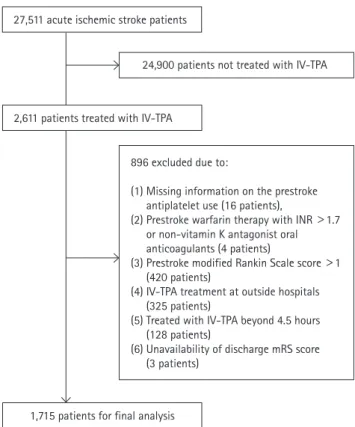
Of 27,511 patients with acute ischemic stroke enrolled in the CRCS-5 registry between October 2009 and November 2014, 2,611 patients were treated with IV-TPA. We excluded the fol- lowing patients; (1) missing information on the prestroke anti- platelet use, (2) prestroke warfarin therapy with international normalized ratio (INR) > 1.7 or non-vitamin K antagonist oral anticoagulants, (3) endovascular recanalization therapy added to IV-TPA therapy, (4) prestroke modified Rankin Scale (mRS) score
> 1, (5) IV-TPA treatment at outside hospital, (6) IV-TPA treat- ment beyond 4.5 hours, and (7) unavailability of discharge mRS score.
Study variables and outcomes
Prestroke antiplatelet use was defined as taking antiplatelet within 7 days before the onset of index ischemic stroke. At the inception of the CRCS-5 registry on April 2008, we prospectively compiled data of the use of prestroke antiplatelet including aspi- rin, clopidogrel, cliostazol, triflusal, dipyridamole, ticlopidine, other antiplatelet, and any combination of antiplatelets. Addi- tionally, we prospectively collected data regarding demographics, vascular risk factors, prestroke medications, initial stroke severity and ischemic stroke subtypes, vital signs, laboratory findings, SICH, and discharge mRS score. The primary safety outcome was SICH, which was defined as any hemorrhagic transformation as- sociated with National Institutes of Health Stroke Scale (NIHSS) score worsening ≥ 4 points. Secondary outcomes were discharge mRS score and in-hospital mortality.
Statistical analysis
For missing variables, variables with missing data of more than 10% of total observation were excluded from the analysis. Sim- Conclusions Despite an increased risk of SICH, prestroke antiplatelet users compared to non-users
had comparable functional outcomes and in-hospital mortality with IV-TPA therapy. Our results sup- port the use of IV-TPA in eligible patients taking antiplatelet therapy before their stroke onset.
Keywords Stroke; Thrombolytic therapy; Platelet aggregation inhibitors; Outcome assessment
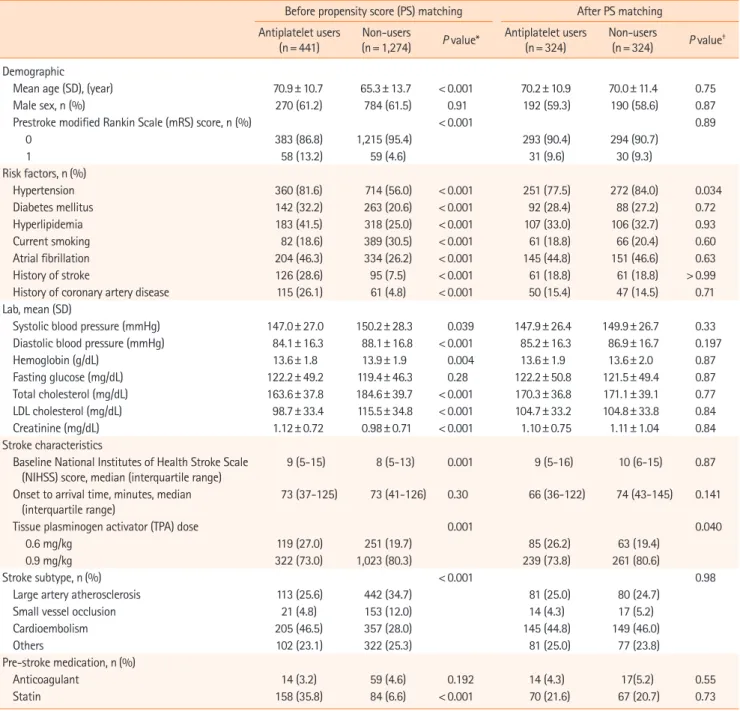
Table 1. Characteristics of patients
Before propensity score (PS) matching After PS matching Antiplatelet users
(n= 441)
Non-users
(n= 1,274) P value* Antiplatelet users (n= 324)
Non-users
(n= 324) P value† Demographic
Mean age (SD), (year) 70.9± 10.7 65.3± 13.7 < 0.001 70.2± 10.9 70.0± 11.4 0.75
Male sex, n (%) 270 (61.2) 784 (61.5) 0.91 192 (59.3) 190 (58.6) 0.87
Prestroke modified Rankin Scale (mRS) score, n (%) < 0.001 0.89
0 383 (86.8) 1,215 (95.4) 293 (90.4) 294 (90.7)
1 58 (13.2) 59 (4.6) 31 (9.6) 30 (9.3)
Risk factors, n (%)
Hypertension 360 (81.6) 714 (56.0) < 0.001 251 (77.5) 272 (84.0) 0.034
Diabetes mellitus 142 (32.2) 263 (20.6) < 0.001 92 (28.4) 88 (27.2) 0.72
Hyperlipidemia 183 (41.5) 318 (25.0) < 0.001 107 (33.0) 106 (32.7) 0.93
Current smoking 82 (18.6) 389 (30.5) < 0.001 61 (18.8) 66 (20.4) 0.60
Atrial fibrillation 204 (46.3) 334 (26.2) < 0.001 145 (44.8) 151 (46.6) 0.63
History of stroke 126 (28.6) 95 (7.5) < 0.001 61 (18.8) 61 (18.8) > 0.99
History of coronary artery disease 115 (26.1) 61 (4.8) < 0.001 50 (15.4) 47 (14.5) 0.71
Lab, mean (SD)
Systolic blood pressure (mmHg) 147.0± 27.0 150.2± 28.3 0.039 147.9± 26.4 149.9± 26.7 0.33
Diastolic blood pressure (mmHg) 84.1± 16.3 88.1± 16.8 < 0.001 85.2± 16.3 86.9± 16.7 0.197
Hemoglobin (g/dL) 13.6± 1.8 13.9± 1.9 0.004 13.6± 1.9 13.6± 2.0 0.87
Fasting glucose (mg/dL) 122.2± 49.2 119.4± 46.3 0.28 122.2± 50.8 121.5± 49.4 0.87
Total cholesterol (mg/dL) 163.6± 37.8 184.6± 39.7 < 0.001 170.3± 36.8 171.1± 39.1 0.77
LDL cholesterol (mg/dL) 98.7± 33.4 115.5± 34.8 < 0.001 104.7± 33.2 104.8± 33.8 0.84
Creatinine (mg/dL) 1.12± 0.72 0.98± 0.71 < 0.001 1.10± 0.75 1.11± 1.04 0.84
Stroke characteristics
Baseline National Institutes of Health Stroke Scale
(NIHSS) score, median (interquartile range) 9 (5-15) 8 (5-13) 0.001 9 (5-16) 10 (6-15) 0.87
Onset to arrival time, minutes, median
(interquartile range) 73 (37-125) 73 (41-126) 0.30 66 (36-122) 74 (43-145) 0.141
Tissue plasminogen activator (TPA) dose 0.001 0.040
0.6 mg/kg 119 (27.0) 251 (19.7) 85 (26.2) 63 (19.4)
0.9 mg/kg 322 (73.0) 1,023 (80.3) 239 (73.8) 261 (80.6)
Stroke subtype, n (%) < 0.001 0.98
Large artery atherosclerosis 113 (25.6) 442 (34.7) 81 (25.0) 80 (24.7)
Small vessel occlusion 21 (4.8) 153 (12.0) 14 (4.3) 17 (5.2)
Cardioembolism 205 (46.5) 357 (28.0) 145 (44.8) 149 (46.0)
Others 102 (23.1) 322 (25.3) 81 (25.0) 77 (23.8)
Pre-stroke medication, n (%)
Anticoagulant 14 (3.2) 59 (4.6) 0.192 14 (4.3) 17(5.2) 0.55
Statin 158 (35.8) 84 (6.6) < 0.001 70 (21.6) 67 (20.7) 0.73
*P values are calculated by Pearson chi-square test, Fisher's exact test, Student's t-test or Wilcoxon rank sum test as appropriate; †P values are calculated by conditional logistic regression.
ple imputation with median values was used for continuous variables with missing data of less than 10% of the total obser- vations. For descriptive statistics, continuous variables were summarized as means (standard deviations) or median (inter- quartile range), and categorical variables as numbers with per- centages. Baseline characteristics between prestroke antiplatelet users and non-users were compared with Student t-test for con- tinuous variables with a normal distribution, Wilcoxon rank-sum test for continuous variables without a normal distribution, or the chi-square test for categorical variables.
To compare the risks of SICH and mortality between the two
groups, we used Chi-square test or Fisher’s exact test for unad- justed analysis and binary logistic regression analysis for covari- ates adjustment. To estimate absolute difference of SICH be- tween two groups after multivariable adjustment, we used the method described by Ciolino et al.18 For mRS outcomes, we com- pared the overall distribution of discharge mRS scores and di- chotomized mRS outcomes (mRS 0-1 vs. 2-6 and mRS 0-2 vs.
3-6) between the two groups. The odds ratio (OR) with 95%
confidence interval (CI) was calculated to estimate the probabili- ty of favorable shift on the mRS score with prestroke antiplatelet use. The Cochran–Mantel–Haenszel test was used for unadjusted
shift analysis, and the ordinal logistic regression analysis was used to adjust covariates.
In addition to multivariable analyses, we performed propensity score (PS)-matched analysis because the baseline characteristics of patients taking prestroke antiplatelet and those without pre- stroke antiplatelet were expected to differ significantly. To esti- mate PS, the binary logistic regression with all relevant charac- teristics related to the prestroke antiplatelet was used. The PS model included all the variables shown in Table 1 except for on- set to arrival time, and TPA dose. Greedy-matching algorithm was employed with width of calipers between 0.2 and 0.6 stan- dard deviations of the logit of the estimated PS. To check the baseline imbalances between the two groups after the PS matching, the absolute standardized difference (ASD) was com- puted for each covariate. We performed outcome analysis using ordinal or logistic regression analysis based on the generalized estimation equation method after the PS matching. Covariates with an ASD > 0.1 were further adjusted in PS-matched analysis.
However, we included age, sex, initial NIHSS score, onset to treatment time, and TPA dose in the final model as clinically im- portant covariates regardless of their ASD values. As a sensitivity test, we repeated the same analyses with mRS outcome at 3 months after the stroke as a dependent variable. In all analyses, a P value < 0.05 was considered statistically significant. SAS computer software (Version 9.3, SAS Institute, Cary, NC, USA) was used for the statistical analyses.
Results
Patients
Of 2,611 patients treated with IV-TPA, we excluded 896 pa- tients in the following order: (1) missing information on the pre- stroke antiplatelet use (16 patients), (2) prestroke warfarin thera- py with INR > 1.7 or non-vitamin K antagonist oral anticoagu- lants (4 patients), (3) prestroke mRS score > 1 (420 patients), (4) IV-TPA treatment at outside hospital (325 patients), (5) treated with IV-TPA beyond 4.5 hours (128 patients), and (6) unavailabil- ity of discharge mRS score (3 patients) (Figure 1). As a result, 1,715 patients were included in this study, and 441 (25.7%) were prestroke antiplatelet users. Of them, 353 patients were taking single antiplatelet therapy (aspirin, 279 patients; clopidogreal, 59 patients; 15 other monotherapy), 87 patients were taking dual antiplatelet therapy (aspirin plus clopidogrel, 69 patients; other dual therapy, 19 patients) and one patient was taking triple anti- platelet therapy. Table 1 presents demographic and clinical char- acteristics of prestroke antiplatelet users and non-users before and after PS matching. Before PS matching, prestroke antiplate- let users versus non-users were more likely to be older, to have
prestroke disability, hypertension, diabetes, dyslipidemia, atrial fi- brillation, prior stroke, and coronary heart disease, to take statins, and to have lower levels of blood pressure, total and low-density lipoprotein (LDL) cholesterol, and hemoglobin. They were also more likely to have higher NIHSS score at baseline, and to have stroke subtype of cardioembolism. After PS matching, except for hypertension and TPA dose, the baseline characteristics were well balanced between the two groups (Supplemental Figure 1).
Among 324 patients treated with prestroke antiplatelet therapy, 273 (84.3%) were taking single antiplatelet therapy and 51 (15.7%) were taking dual antiplatelet therapy.
Symptomatic intracranial hemorrhage
Overall, SICH occurred in 64 patients (3.7%) after IV-TPA ther- apy. Before PS matching, prestroke antiplatelet users versus non- users had a higher rate of SICH before adjustment (5.9% vs.
3.0%; unadjusted OR 2.04 [1.22-3.40]), and the increased risk remained significant after multivariable adjustment (OR 1.79 [1.05-3.04]). The estimated absolute difference after adjustment was 1.8%. In particular, prestroke dual antiplatelet use was as- sociated with a greater risk of SICH (unadjusted OR 3.29 [1.28- 7.48]) compared to single antiplatelet use (unadjusted OR 1.75 [0.93-3.19]).
Figure 1. Flow diagram identifying eligible patients. IV-TPA, intrave- nous tissue plasminogen activator; INR, international normalized ratio;
mRS, modified Rankin Scale.
27,511 acute ischemic stroke patients
1,715 patients for final analysis
24,900 patients not treated with IV-TPA
896 excluded due to:
(1) Missing information on the prestroke antiplatelet use (16 patients),
(2) Prestroke warfarin therapy with INR > 1.7 or non-vitamin K antagonist oral anticoagulants (4 patients)
(3) Prestroke modified Rankin Scale score > 1 (420 patients)
(4) IV-TPA treatment at outside hospitals (325 patients)
(5) Treated with IV-TPA beyond 4.5 hours (128 patients)
(6) Unavailability of discharge mRS score (3 patients)
2,611 patients treated with IV-TPA
In PS matching analysis, there was a trend of increased risk of SICH with prestroke antiplatelet use, but it did not reach statisti- cal significance (OR 1.94 [0.96-3.93]) (Table 2).
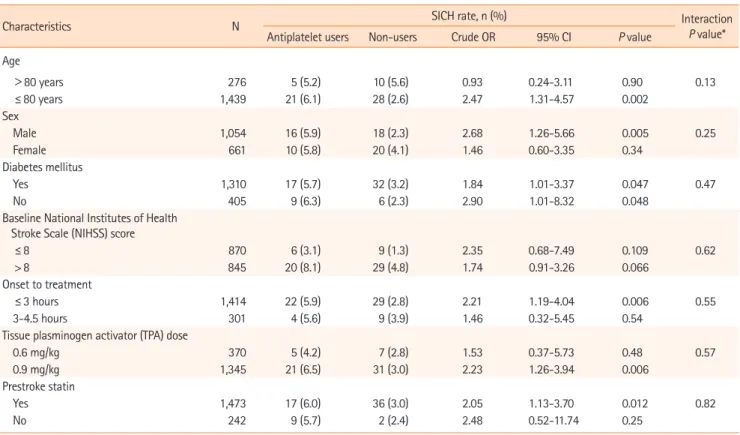
In subgroup analyses, the increased risk of SICH with prestroke antiplatelet use did not differ among subgroups stratified by age, sex, diabetes mellitus, IV-TPA treatment window, TPA dose, base- line NIHSS score, and prestroke statin use (Table 3 and Figure 2).
Disability outcomes
At discharge the two groups did not differ in mRS distribution (adjusted OR 0.90 [0.72-1.14]; adjusted OR after PS matching 0.94 [0.71-1.23]), mRS 0-1 outcome (34.2% vs. 33.7%; adjusted OR 1.27 [0.94-1.14]; adjusted OR after PS matching 1.24 [0.87-
1.79]), mRS 0-2 outcome (52.4% vs. 52.9%; adjusted OR 1.21
Table 2. Risks of symptomatic intracranial hemorrhage (SICH) and in-hospital mortality with prestroke antiplatelet use
SICH In-hospital mortality
OR 95% CI P value OR 95% CI P value
Unadjusted analysis 2.04 1.22-3.40 0.006 1.50 0.93-2.42 0.094
Multivariable analysis* 1.79 1.05-3.04 0.033 1.19 0.71-2.01 0.51
Propensity score (PS) matching† 1.94 0.96-3.93 0.066 1.26 0.60-2.65 0.54
OR, odds ratio; CI, confidence interval.
*Adjusted for age, sex, initial National Institutes of Health Stroke Scale (NIHSS) score, onset to treatment time, history of diabetes, and TPA dose; †PS match- ing samples included 324 pairs and were adjusted for age, sex, initial NIHSS score, onset to treatment time, history of diabetes, diastolic blood pressure and TPA dose.
Table 3. Risks of symptomatic intracranial hemorrhage (SICH) with prestroke antiplatelet therapy
Characteristics N SICH rate, n (%) Interaction
P value*
Antiplatelet users Non-users Crude OR 95% CI P value Age
>80 years 276 5 (5.2) 10 (5.6) 0.93 0.24-3.11 0.90 0.13
≤ 80 years 1,439 21 (6.1) 28 (2.6) 2.47 1.31-4.57 0.002
Sex
Male 1,054 16 (5.9) 18 (2.3) 2.68 1.26-5.66 0.005 0.25
Female 661 10 (5.8) 20 (4.1) 1.46 0.60-3.35 0.34
Diabetes mellitus
Yes 1,310 17 (5.7) 32 (3.2) 1.84 1.01-3.37 0.047 0.47
No 405 9 (6.3) 6 (2.3) 2.90 1.01-8.32 0.048
Baseline National Institutes of Health Stroke Scale (NIHSS) score
≤ 8 870 6 (3.1) 9 (1.3) 2.35 0.68-7.49 0.109 0.62
> 8 845 20 (8.1) 29 (4.8) 1.74 0.91-3.26 0.066
Onset to treatment
≤ 3 hours 1,414 22 (5.9) 29 (2.8) 2.21 1.19-4.04 0.006 0.55
3-4.5 hours 301 4 (5.6) 9 (3.9) 1.46 0.32-5.45 0.54
Tissue plasminogen activator (TPA) dose
0.6 mg/kg 370 5 (4.2) 7 (2.8) 1.53 0.37-5.73 0.48 0.57
0.9 mg/kg 1,345 21 (6.5) 31 (3.0) 2.23 1.26-3.94 0.006
Prestroke statin
Yes 1,473 17 (6.0) 36 (3.0) 2.05 1.13-3.70 0.012 0.82
No 242 9 (5.7) 2 (2.4) 2.48 0.52-11.74 0.25
OR, odds ratio; CI, confidence interval.
*Interaction effect between prestroke antiplatelet use and subgroups.
[0.90-1.63]; adjusted OR after PS matching 1.20 [0.84-1.70]), and in-hospital mortality (6.1% vs. 4.2%; adjusted OR 1.19 [0.71-
2.01]; adjusted OR after PS matching 1.26 [0.60-2.65]) in both multivariable and PS matching analyses (Table 4 and Figure 3).
The mRS score at 3 months after the stroke was available for 1,432 patients (83.5%), and prestroke antiplatelet users versus non-users had comparable mRS distribution or dichotomized mRS outcomes in multivariable and PS matching analysis (Table 5).
Discussion
Using a nationwide prospective stroke registry database, we found that, among patients treated with IV-TPA, the use of pre- stroke antiplatelet was associated with almost two-fold in-
Figure 3. Functional outcomes at discharge by prestroke antiplatelet use before (A) and after propensity score matching (B)
A
B Prestroke
antiplatelet (N = 441)
Prestroke antiplatelet (N = 324) No prestroke antiplatelet (N = 1,274)
No prestroke antiplatelet (N = 324)
0 1 2 3 4 5 6
0 1 2 3 4 5 6
0% 10% 20% 30% 40% 50% 60% 70% 80% 90% 100%
0% 10% 20% 30% 40% 50% 60% 70% 80% 90% 100%
13.2%
16.2%
16.2%
11.4% 16.0% 18.5% 15.1% 15.4% 17.6%
20.1% 17.6% 12.3% 16.7% 14.2%
17.5% 19.2% 15.5% 15.3% 12.1%
21.1% 18.1% 12.5% 13.6% 15.4% 6.1%
4.2%
6.8%
5.9%
Table 4. Effectiveness of prestroke antiplatelet use on discharge modified Rankin Scale (mRS) outcome
Shift analysis mRS 0-1 proportion mRS 0-2 proportion
OR* 95% CI P value OR 95% CI P value OR 95% CI P value
Unadjusted analysis 1.13 0.93-1.37 0.21 1.03 0.82-1.29 0.83 0.98 0.79-1.22 0.85
Multivariable analysis† 0.90 0.72-1.14 0.38 1.27 0.94-1.72 0.118 1.21 0.90-1.63 0.20
Propensity score (PS)-matched analysis‡ 0.94 0.71-1.23 0.64 1.24 0.87-1.79 0.24 1.20 0.84-1.70 0.32 OR, odds ratio; CI, confidence interval.
*Odd ratios for achieving a favorable shifting of one level on the mRS score; †Adjusted for age, sex, initial National Institutes of Health Stroke Scale (NIHSS), onset to treatment time, tissue plasminogen activator (TPA) dose and variables with P< 0.1 in the Table 1; ‡PS matching samples included 324 pairs and were adjusted for age, sex, initial NIHSS score, onset to treatment time, history of diabetes, diastolic blood pressure and TPA dose.
Table 5. Effectiveness of tissue plasminogen activator (TPA) on modified Rankin Scale (mRS) outcomes at 3 months after the stroke
Shift analysis mRS 0-1 proportion mRS 0-2 proportion
OR* 95% CI P value OR 95% CI P value OR 95% CI P value
Unadjusted analysis 1.30 1.06-1.60 0.013 0.82 0.65-1.05 0.110 0.75 0.59-0.95 0.0163
Multivariable analysis† 1.13 0.87-1.46 0.36 0.92 0.66-1.28 0.61 0.83 0.59-1.17 0.28
Propensity score (PS)-matched analysis‡ 1.04 0.76-1.41 0.82 1.07 0.72-1.60 0.74 1.05 0.70-1.56 0.83 OR, odds ratio; CI, confidence interval.
*Odd ratios for achieving a favorable shifting of one level on the mRS score; †Adjusted for age, sex, initial National Institutes of Health Stroke Scale (NIHSS), onset to treatment time, TPA dose and variables with P< 0.1 in the Table 1; ‡PS matching samples included 324 pairs and were adjusted for age, sex, initial NIHSS score, onset to treatment time, history of diabetes, diastolic blood pressure and TPA dose.
Figure 2. Prestroke antiplatelet therapy and risks of symptomatic intra- cranial hemorrhage.
Age > 80 years ≤ 80 years
Favors prestroke antiplatelet therapy
Favors no treatment 0.1 0.2 0.4 0.7 1 2 4 7 10 Prestroke statin
Yes No TPA dose 0.6 mg/kg 0.9 mg/kg Baseline NIHSS score ≤ 8
> 8
Onset to treatment time ≤ 3 hours
3-4.5 hours DM Yes No Sex Male Female
creased risk of SICH compared with no prior antiplatelet use. De- spite the increased risk of SICH with prestroke antiplatelet use, an absolute increase of SICH risk was not substantial and there- fore it did not translate into an increased risk of in-hospital mor- tality nor worsening of functional outcome. These findings strongly support the current stroke guidelines that do not pre- clude patients taking antiplatelet agents from IV-TPA treatment.
Several large observational studies with appropriate adjust- ment methods and recent meta-analyses have largely found an
association between prestroke antiplatelet use and increased risk of SICH.1,2,4,19 Regarding disability and mortality outcomes, ex- ploratory analysis of Safe Implementation of Thrombolysis in Stroke-Monitoring (SITS-MOST) data showed that antiplatelet other than aspirin was associated with increased risk of mortali- ty, but disability outcome was not affected by prestroke anti- platelet use.19 In contrast, a subsequent study analyzing a larger
dataset from Safe Implementation of Treatments in Stroke Inter- national Stroke Thrombolysis Register (SITS-ISTR) showed no in- creased risk in mortality and poor outcome of mRS 3-6 with prestroke antiplatelet use,2 and a meta-analysis involving 19,453 patients also showed no clear association between prestroke an- tiplatelet use and functional outcome.1 However, in a recent ob- servational study of the Get With the Guidelines (GWTG)-Stroke registry enrolling approximately 85,000 patients, despite an in- creased risk of SICH, prestroke antiplatelet use was associated with a better functional outcome and did not increase the mor- tality.6 The absolute increase in the SICH risk with prestroke anti- platelet use was relatively small in prior studies (unadjusted ab- solute increase of 1.4%2 and adjusted absolute increase of 0.68%6) and our study (adjusted absolute increase of 1.8%), which might account for no substantial effect of SICH risk with prestroke antiplatelet use on clinical outcomes across studies.
Earlier studies suggested a greater risk of SICH with dual anti- platelet therapy compared with monotherapy.1,2 The higher risk of SICH with dual antiplatelet use compared to single antiplate- let use was reproduced in a large cohort study of the GWTG- Stroke registry: adjusted OR with any antiplatelet therapy, 1.18 (1.10-1.28), number needed to harm (NNH)147; adjusted OR with dual therapy, 1.47 (1.16-1.86), NNH 60.6 Another Chinese nationwide prospective stroke registry of IV-TPA therapy also re- ported the risk of SICH by prestroke antiplatelet status; among 1,108 patients 157 patients (14.2%) were on antiplatelet thera- py, and only 14 patients had aspirin and clopidogrel dual therapy.
They found a substantial increase in the SICH risk with dual an- tiplatelet therapy (aspirin and clopidogrel) (adjusted OR 5.92;
95% CI 1.29-27.06) but not with any antiplatelet or aspirin monotherapy.13 Our study also showed that patients taking dual antiplatelet therapy seemed to exhibit a higher risk of SICH compared to those with single antiplatelet therapy. Thereby, phy- sicians, patients, and surrogates need to be informed about the possible higher SICH risk of IV-TPA therapy in patients taking dual antiplatelet therapy.
Because of limited data, we were not able to explore the dif- ferential effect of individual antiplatelet regimens on the SICH risk. In a Taiwanese study, the use of clopidogrel or ticlopidine was associated with a greater risk of SICH in univariate analysis (OR 12.56, 95% CI 3.13-50.38), and the increased risk remained significant even after adjustment.14 However, in the GWTG- Stroke registry study, the risk of SICH was not increased with prestroke clopidogrel monotherapy (adjusted OR 0.85 [0.65- 1.12]), but it was increased with prestroke aspirin monotherapy (adjusted OR 1.19 [1.06-1.34]).6 Whether there is a racial dispar- ity in the different antiplatelet effect on the SICH risk would be of interest as future investigation.
Our study has several limitations. First, this is an observational study that is at high risk of bias. To overcome the limitation, we conducted PS matching analysis in addition to multivariable analysis. Although the increased risk of SICH with prestroke an- tiplatelet use was not statistically significant with the PS match- ing analysis, there was a strong trend and the magnitude of OR was similar to that with the multivariable analysis. However, even with the PS matching analysis, unmeasured confounders could potentially affect outcome comparison. Second, limited patient numbers and events did not allow adjusted analysis for effects of different antiplatelet regimens on outcomes. Future studies using collaborative Asian multinational registry would be needed to investigate whether Asians are at greater risk of de- veloping SICH following IV-TPA especially with thienopyridine antiplatelet agents or dual antiplatelet therapy than Caucasians.
Third, prestroke antiplatlet use might affect functional outcome after stroke by enhancing recanalization rate.20 Unfortunately, we do not have information on the recanalization state for ap- proximately 50% of the patients and therefore the effect of pre- stroke antiplatelet on functional outcomes by the recanalization status could not be investigated. Finally, we do not have infor- mation on the last timing and dose of each antiplatelet agent, which might affect the outcome. In addition, we did not central- ly adjudicate SICH for this study and we did not assess systemic bleeding complications other than SICH.
Conclusions
Korean patients with prestroke antiplatelet had an increased risk of SICH, but had comparable functional outcomes and in- hospital mortality following IV-TPA. Our findings along with ear- lier studies indicate that patients taking antiplatelet therapy should not be excluded from IV-TPA therapy given that similar net benefits could be achieved as in patients who are not taking any antiplatelet agent.
References
1. Pan X, Zhu Y, Zheng D, Liu Y, Yu F, Yang J. Prior antiplatelet agent use and outcomes after intravenous thrombolysis with recombinant tissue plasminogen activator in acute ischemic stroke: a meta-analysis of cohort studies and randomized con- trolled trials. Int J Stroke 2015;10:317-323.
2. Diedler J, Ahmed N, Sykora M, Uyttenboogaart M, Overgaard K, Luijckx GJ, et al. Safety of intravenous thrombolysis for acute ischemic stroke in patients receiving antiplatelet therapy at stroke onset. Stroke 2010;41:288-294.
3. Mazya M, Egido JA, Ford GA, Lees KR, Mikulik R, Toni D, et al.
Predicting the risk of symptomatic intracerebral hemorrhage in ischemic stroke treated with intravenous alteplase: safe Im- plementation of Treatments in Stroke (SITS) symptomatic in- tracerebral hemorrhage risk score. Stroke 2012;43:1524-1531.
4. Whiteley WN, Slot KB, Fernandes P, Sandercock P, Wardlaw J.
Risk factors for intracranial hemorrhage in acute ischemic stroke patients treated with recombinant tissue plasminogen activator: a systematic review and meta-analysis of 55 stud- ies. Stroke 2012;43:2904-2909.
5. Whiteley WN, Thompson D, Murray G, Cohen G, Lindley RI, Wardlaw J, et al. Targeting recombinant tissue-type plasmino- gen activator in acute ischemic stroke based on risk of intra- cranial hemorrhage or poor functional outcome: an analysis of the third international stroke trial. Stroke 2014;45:1000-1006.
6. Xian Y, Federspiel JJ, Grau-Sepulveda M, Hernandez AF, Schwamm LH, Bhatt DL, et al. Risks and benefits associated with prestroke antiplatelet therapy among patients with acute ischemic stroke treated with intravenous tissue plasminogen activator. JAMA Neurol 2016;73:50-59.
7. Bluhmki E, Chamorro A, Dávalos A, Machnig T, Sauce C, Wahl- gren N, et al. Stroke treatment with alteplase given 3.0-4.5 h after onset of acute ischaemic stroke (ECASS III): additional outcomes and subgroup analysis of a randomised controlled trial. Lancet Neurol 2009;8:1095-1102.
8. Cucchiara B, Kasner SE, Tanne D, Levine SR, Demchuk A, Messe SR, et al. Factors associated with intracerebral hemorrhage af- ter thrombolytic therapy for ischemic stroke: pooled analysis of placebo data from the Stroke-Acute Ischemic NXY Treat- ment (SAINT) I and SAINT II Trials. Stroke 2009;40:3067-3072.
9. Ibrahim MM, Sebastian J, Hussain M, Al-Hussain F, Uchino K, Molina C, et al. Does current oral antiplatelet agent or sub- therapeutic anticoagulation use have an effect on tissue-plas- minogen-activator-mediated recanalization rate in patients with acute ischemic stroke? Cerebrovasc Dis 2010;30:508-513.
10. Larrue V, von Kummer RR, Müller A, Bluhmki E. Risk factors for severe hemorrhagic transformation in ischemic stroke patients treated with recombinant tissue plasminogen activator: a sec- ondary analysis of the European-Australasian Acute Stroke Study (ECASS II). Stroke 2001;32:438-441.
11. Tanne D, Kasner SE, Demchuk AM, Koren-Morag N, Hanson S, Grond M, et al. Markers of increased risk of intracerebral hem- orrhage after intravenous recombinant tissue plasminogen ac-
tivator therapy for acute ischemic stroke in clinical practice:
the Multicenter rt-PA Stroke Survey. Circulation 2002;105:
1679-1685.
12. Mehta RH, Cox M, Smith EE, Xian Y, Bhatt DL, Fonarow GC, et al. Race/Ethnic differences in the risk of hemorrhagic compli- cations among patients with ischemic stroke receiving throm- bolytic therapy. Stroke 2014;45:2263-2269.
13. Pan Y, Chen Q, Liao X, Zhao X, Wang C, Liu G, et al. Preexisting dual antiplatelet treatment increases the risk of post-throm- bolysis intracranial hemorrhage in Chinese stroke patients.
Neurol Res 2015;37:64-68.
14. Chao AC, Hsu HY, Chung CP, Liu CH, Chen CH, Teng MM, et al.
Outcomes of thrombolytic therapy for acute ischemic stroke in Chinese patients: the Taiwan Thrombolytic Therapy for Acute Ischemic Stroke (TTT-AIS) study. Stroke 2010;41:885-890.
15. Kim BJ, Park JM, Kang K, Lee SJ, Ko Y, Kim JG, et al. Case char- acteristics, hyperacute treatment, and outcome information from the clinical research center for stroke-fifth division regis- try in South Korea. J Stroke 2015;17:38-53.
16. Cho KH, Ko SB, Kim DH, Park HK, Cho AH, Hong KS, et al. Fo- cused update of Korean clinical practice guidelines for the thrombolysis in acute stroke management. Korean J Stroke 2012;14:95-105.
17. Kim BJ, Han MK, Park TH, Park SS, Lee KB, Lee BC, et al. Cur- rent status of acute stroke management in Korea: a report on a multicenter, comprehensive acute stroke registry. Int J Stroke 2014;9:514-518.
18. Ciolino JD, Martin RH, Zhao W, Jauch EC, Hill MD, Palesch YY.
Covariate imbalance and adjustment for logistic regression analysis of clinical trial data. J Biopharm Stat 2013;23:1383- 1402.
19. Wahlgren N, Ahmed N, Eriksson N, Aichner F, Bluhmki E, Dávalos A, et al. Multivariable analysis of outcome predictors and adjustment of main outcome results to baseline data pro- file in randomized controlled trials: Safe Implementation of Thrombolysis in Stroke-MOnitoring STudy (SITS-MOST). Stroke 2008;39:3316-3322.
20. Hallevi H, Grotta JC. Antiplatelet therapy and the risk of intra- cranial hemorrhage after intravenous tissue plasminogen acti- vator therapy for acute ischemic stroke. Arch Neurol 2008;65:
575-576.
Supplementary Figure 1. Absolute standardized difference of covariates before and after propensity score matching. mRS, modified Rankin Scale;
SBP, systolic blood pressure; DBP, diastolic blood pressure; LDL, low-density lipoprotein; NIHSS, National Institutes of Health Stroke Scale; TOAST, Tri- al of Org 10172 in Acute Stroke Treatment; LAA, large-artery atherosclerosis; SVO, small-vessel occlusion; CE, cardioembolism.
0.0 0.1 0.2 0.3 0.4 0.5 0.6 0.7 0.8 0.9 1.0 Absolute standardized difference
Age Male Pre-stroke mRS = 1 Hypertension Diabetes mellitus Hyperlipidemia Current smoking Atrial fibrillation History of stroke History of coronary artery disease SBP DBP Hemoglobin Fasting glucose Total cholesterol LDL cholesterol Creatinine Initial NIHSS TOAST classification = LAA TOAST classification = SVO TOAST classification = CE TOAST classification = Others Prestroke anticoagulant use Prestroke statin use
Before PSM After PSM