감마선 조사에 의한 국화 화색변이체 선발과 식물체 재생
조만현
1
* ・ 함인기1
・ 박하승1
・ 강시용2
・ 최현구1
・ 원미경1
・ 김태일1
・ 박상규1
・ 최병준1
・ 이은모1
1충청남도농업기술원, 2한국원자력연구원 첨단방사선과학연구소
Selection and Plant Regeneration of Flower Color Mutants by Gamma-ray Irradiation in Chrysanthemum
Man Hyun Jo
1
*, In Ki Ham1
, Ha Seung Pak1
, Si-Yong Kang2
, Hyun Gu Choi1
, Mi Kyung Won1
, Tae Il Kim1
, Sang Kyu Park1
, Byung Jun Choi1
, and Eun Mo Lee1
1Future High-Technology Agriculture Research Division, Chungcheongnam-do Agricultural Research and Extension Services, Yesan 340-861, Korea
2Advanced Radiation Technology Institute, Korea Atomic Energy Research Institute, Jeongeup, Jeonbuk 580-185, Korea
Abstract : This study was carried out to investigate the new cultivar production ability of flower color mutants and the optimal plant growth regulator concentration of culture condition for the plant regeneration of 6 Chrysanthemum cultivars using petal culture with flower color mutants induced by 35 Gy of gamma-ray irradiation. The best one was appeared 15.7% of ‘SP-410’, followed by 10.6% of ‘Yes Star’, and 10.3% of ‘Mujigae’ in order at the color mutation rate of petal different from unique cultivar. The flower colors were created such as from bicolor (gold + red) to red in ‘Mujigae’, purple to red-purple in ‘Yes Line’, bicolor (gold + red) to red purple in ‘Yes Star’, white to gold in ‘SP-410’. The flower colors on the center of flower were also created such as from white to light purple in ‘Yes Together’, light green to green yellow in ‘Yes Uri’. The two combinations of MS basal medium supplemented with 1.0 mg/L benzylaminopurine (BA) plus 0.5 mg/L naphthalene acetic acid (NAA) and 2.0 mg/L BA plus 0.5 mg/L NAA were proved the best in forming shoot from petal explants of petal culture with flower color mutants. The shoot formation frequency was different by cultivars, and the highest was 91.6% of ‘Yes Line’. The flower color mutants regenerated from petal culture by gamma-ray irradiation were maintained vegetatively and proved no difference on the flower color and the morphological characteristics of petal for 3 years.
Keywords : Flower color variation, Gamma-ray, Mutants, Petal culture, Spray type chrysanthemum
*Corresponding author (E-mail: [email protected], Tel: +82- 41-635-6088, Fax: +82-41-635-7922)
(Received on July 17, 2013. Revised on October 17, 2013.
Accepted on October 23, 2013.)
Copyright ⓒ 2013 by the Korean Society of Breeding Science 317
This is an Open-Access article distributed under the terms of the Creative Commons Attribution Non-Commercial License (http://creativecommons.org/licenses/by-nc/3.0) which permits unrestricted non-commercial use, distribution, and reproduction in any medium, provided the original work is properly cited.
서 언
국화는 장미, 카네이션과 더불어 세계 3대 절화류 중 하나 로 아주 중요한 화훼작물이다. 국내 재배면적은 2006년 805.1 ha로 정점에 달했다가 경기침체와 유가상승 등 경영악화로 인 해 점차 줄어들면서 2011년에 575 ha인데, 그 중 스탠다드 국화는 474.0 ha, 스프레이 국화가 101.0 ha를 점유하고 있다 (MFAFFK 2012).
영양번식성인 국화의 신품종 개발에는 교배육종법(Jung et al. 2012) 이외에도 방사선 처리에 의한 체세포 변이도 많이 이용되고 있다. 특히, 돌연변이 육종법은 체세포 변이에 의해 기존 유망 품종의 화형은 유지하면서 화색만을 다양하게 변 화시키거나, 화색은 유지하면서 꽃 모양이나 초형을 다양하게 변화시킬 수가 있다. 이러한 기술을 적용하면, 기존 품종의 생 태형과 모양이 유사한 품종으로 다양하게 시리즈화가 가능하 다. 생산자는 하나의 시설에서 생리, 생태형이 비슷한 다양한 형태의 품종을 함께 재배할 수 있어서 생산비를 절감할 수 있 고, 소비자의 기호도도 충족시키는데 기여할 수 있다. 그래서 네덜란드 등 화훼선진국에서는 유망 품종이 개발되면 화색의 돌연변이 육종기술로 품종을 시리즈화시켜 농가에서는 화색
만 다른 동일품종을 대량 재배하여 온실운영의 효율성을 높 이고 시장에서는 다양한 화색을 연출하여 마케팅의 효과를 극 대화 시키는 전략을 많이 구사하고 있다(Yamada et al. 1999).
FAO-IAEA 돌연변이 품종 데이터베이스(http://www-mvd.
iaea.org)에 의하면 세계적으로 돌연변이 육종으로 개발되어 등록된 화훼류는 약 570여종인데, 그 중에서 국화 품종이 40%
이상을 차지하고 있다(Park & Song 2005). 돌연변이 육종은 기존 품종의 형질개량 및 교배육종의 한계를 극복할 수 있다 는 장점이 있어, 화훼류 뿐만 아니라 식량작물, 유료작물, 과 수류 등에서도 돌연변이육종 기술이 많이 이용되고 있다(Lee
& Kim 1996, Schum & Preil 1998). 그러나, 영양번식 식물 의 경우 식물체에 방사선을 조사하여 체세포 변이를 유도하 면, 식물체의 일부에서만 변이가 발생하는 키메라 현상이 발 생한다. 따라서, 변이된 가지나 조직을 분리하여 삽목이나 조 직배양기술을 통하여 키메라를 제거해주어야만 고정된 변이 체를 확보할 수 있다.
조직배양기술은 난류를 비롯한 대부분의 화훼류에서 무병 묘의 육성이나 대량증식의 수단으로만이 아니라 체세포 변이 를 이용하는 돌연변이 육종에서도 중요하게 이용되고 있다.
조직배양으로 조직의 일부를 이용하여 식물체를 재생하는 방 법에는 부정아를 직접 분화시켜서 식물체로 육성하거나, 캘러 스를 유도한 후에 묘조형성을 꾀하고 부정아를 생육시켜 식 물체로 육성하는 방법 등이 있으며, 대량증식을 할 경우에는 후자의 방법이 증식율이 높고 효율도 좋다(Furuya 1992). 국 화의 조직배양에 관한 연구는 경정배양으로 신초유도(Lee et al. 1979, Lee et al. 2008, Song et al. 2011)한 경우와 꽃잎 배양으로 식물체를 재생시켜 안정적으로 배양체계를 확립하 였다(Furuya 1992, Jo et al. 2011).
본 연구는 국산 신품종 국화를 대상으로 감마선 처리에 의 한 돌연변이 유도를 통하여 화색변이체를 선발하고, 실제 화 색변이 꽃잎의 조직을 배양하여 재분화 과정을 거쳐 유용한 화색 변이체를 고정함으로써 효율적인 신품종 육성의 가능성 을 검토하고자 수행하였다.
재료 및 방법
방사선조사 및 변이체 선발
돌연변이체 유기를 위한 실험재료는 예산국화시험장에서 육성한 ‘무지개’, ‘예스라인’, ‘예스스타’, ‘예스투게더’, ‘예스 우리’, ‘SP-410’ 등6개 국화 품종(계통)의 삽수를 이용하였다.
국화모주는 꽃눈분화를 억제하기 위하여 심야전조(22:00~02:00) 를 실시한 후 새순이 7~8 cm 자랐을 때 국화잎 2~3매만 남 기고 채취하였다. 균일한 삽수를 얻기 위하여 길이 5 cm 정 도에 전개엽이 2~3매 붙은 것을 삽수 전용 비닐봉지에 50개 씩 포장하였다. 방사선 조사는 2007년 7월 10일에 한국원자 력연구원 저준위 감마선(60Co) 조사시설을 이용하여 국화 삽 수가 들어있는 봉지를 세워서 35 Gy의 선량으로 24시간 동 안 조사하였다. 방사선을 처리한 국화 삽수를 삽목한 후 8월 2일 예산국화시험장 비가림비닐하우스에 12 cm × 12 cm 간 격으로 정식을 하였고, 4주간 영양생장을 유도하기 위하여 심 야전조(22:00~02:00)를 실시하였다. 8월 30일 이후에는 생 식생장을 유도하기 위하여 심야전조를 중단하였고, 10월 20 일부터 개화된 개체의 화색 변이율을 조사하여 유용한 화색 변이체를 선발하고 꽃잎배양 재료로 이용하였다
화색변이 꽃잎배양
선발된 화색변이체의 꽃잎배양은 sucrose가 30 g/L 첨가된 MS배지(Murashige & Skoog 1962)에 식물생장조절제 NAA (0, 0.1, 0.5 mg/L)와 BA (0, 1.0, 2.0 mg/L)을 조합하여 첨 가하고, 배지의 pH를 5.8으로 조정한 다음 2.5 g/L의 gelrite를 첨가하여 121℃에서 17분간 멸균 하였다. 멸균한 배지는 Ø15 × 90 mm의 페트리디쉬에 25 ml씩 분주하고 Sun Wrap (Samyoung Chemical Co., Ltd.)으로 밀봉하였다.
감마선처리로 화색이 변이된 꽃잎의 설상화변 양쪽 가장자 리를 잘라 버리고, 4등분하여 약 3 mm 정도의 절편체로 조제 하였다. 이 절편체를 8절편씩 배지내에 수평 치상하고, 25℃
의 명배양(40 µmol‧m-2‧s-1)조건에서 4주간 배양한 다음, 첨가 된 식물생장조절제 농도에 따른 신초형성율을 조사하였다.
품종별 처리당 절편체는 ‘무지개’ 36개, ‘예스라인’ 24개,
‘예스스타’ 24개, ‘예스투게더’96개, ‘예스우리’ 48개, ‘SP-410’
16개를 각각 배양하였다.
꽃잎배양으로부터 형성된 신초는 sucrose 15 g/L을 첨가한 MS기본배지로 옮겨 25℃, 40 µmol‧m-2‧s-1, 16시간 일장의 배양실에서 배양하여 유식물체를 유도하였다.
순화 및 재배
화색변이체의 꽃잎배양으로 생성된 유식물체는 배양병에 서 꺼내어 gelrite를 제거하고, 원예용상토가 포함된 128공 플 러그트레이에 심은 다음, 벤레이트수화제 1,000배액을 살포 하고 2주간 순화를 시켰다. 순화된 유식물체는 예산국화시험
Table 1. Survival rate, flowering rate, and flower color variation of 6 spray cultivars by 35 Gy gamma-ray irradiation in chrysanthemum.
Cultivar No. of irradiated plants Survival rate (%) Flowering rate (%) Flower color variation (%)
Mujigae 300 96.7 100 10.3
Yes Line 300 100 100 6.6
Yes Star 300 100 100 10.6
Yes Together 300 100 96.5 2.7
Yes Uri 300 98.3 99.0 0.7
SP-410 100 98.0 100 15.7
Table 2. The effect of by 35 Gy gamma-ray irradiation on plant height and flowering time of 6 cultivars in chrysanthemum.
Cultivar Gamma-ray irradiation (Gy) Plant height (cm) Flowering date
Mujigae 0
35
98.4 ± 6.8
z90.7 ± 5.3
Oct. 19 Oct. 15
Yes Line 0
35
87.9 ± 4.7 85.4 ± 5.2
Oct. 25 Oct. 26
Yes Star 0
35
86.6 ± 5.4 87.4 ± 6.0
Oct. 30 Oct. 28
Yes Together 0
35
84.7 ± 3.5 85.2 ± 4.8
Oct. 23 Oct. 24
Yes Uri 0
35
91.5 ± 7.1 92.2 ± 5.9
Oct. 30 Oct. 28
SP-410 0
35
93.5 ± 3.8 90.8 ± 5.3
Oct. 28 Oct. 25
z
Mean ± standard error of 30 plants.
장 비가림 비닐하우스내에서 2008년 8월상순에 재식거리12 cm
× 12 cm로 정식하였으며, 재배관리는 국화 표준재배법에 준 하여 2008년~2010년에 걸쳐 원품종과 함께 화색변이 식물 체를 재배하고 개화를 유도한 다음 화색을 조사하였다.
결과 및 고찰
감마선 조사에 의한 국화 품종별 효과
삽수에 감마선을 24시간 35 Gy의 선량으로 처리한 국화의 생존율은 ‘예스라인’, ‘예스스타’, ‘예스투게더’가 100% 이었 고, ‘예스우리’, ‘SP-410’, ‘무지개’가 각각 98.3%, 98.0%, 96.7%
로 나타났으며, ‘무지개’, ‘예스라인’, ‘예스스타’, ‘SP-410’의 감 마선조사 개체는 전부 개화 하였으나 ‘예스우리’와 ‘예스투게 더’의 감마선조사구의 개화율은 각각 99.0%, 96.5%이었다.
감마선을 조사한 후 화색변이율은 ‘SP-410’이 가장 높은 15.7%에 달하였으며, ‘예스스타’ 및 ‘예스투게더’가 10%이 상 이었으나, ‘예스우리’의 경우에는 0.7%로 화색변이율이
가장 낮았다(Table 1).
감마선을 조사한 개체의 초장은 무조사구보다 ‘무지개’가 7.7 cm, ‘SP-410’이 2.7 cm, ‘예스라인’이 2.5 cm 작아졌으 나, ‘예스스타’, ‘예스투게더’ 및 ‘예스우리’는 큰 치이를 보이 지 않았다(Table 2). 이러한 결과는 Furuya (1998)가 방사선 조사에 의해 유발한 하추국형 스프레이국화 ‘마가렛트멈’과 돌연변이계통의 촉성재배시 모본의 초장은 125 cm이고 변이 계통은 111 cm로 변이계통이 모본보다 14 cm 작아졌다고 보고한 것과 유사한 경향을 나타내었다.
개화기는 무조사구보다 감마선 조사구에서 ‘무지개’는 4일,
‘SP-410’은 3일, 그리고 ‘예스스타’와 ‘예스우리’는 각각 2일 빨랐으나, ‘예스라인’과 ‘예스투게더’ 는 무조사구보다 각각 1 일 늦었다(Table 2).
돌연변이체나 조직배양시 배양부위에 따른 국화의 개화양 상에 차이가 있다고 알려져 있는데, Furuya (1998)는 하추국 형 스프레이국화 ‘마가렛트멈’을 방사선조사에 의해 유발한 돌연변이계통과 함께 촉성재배하여 개화시를 조사한 결과, 변
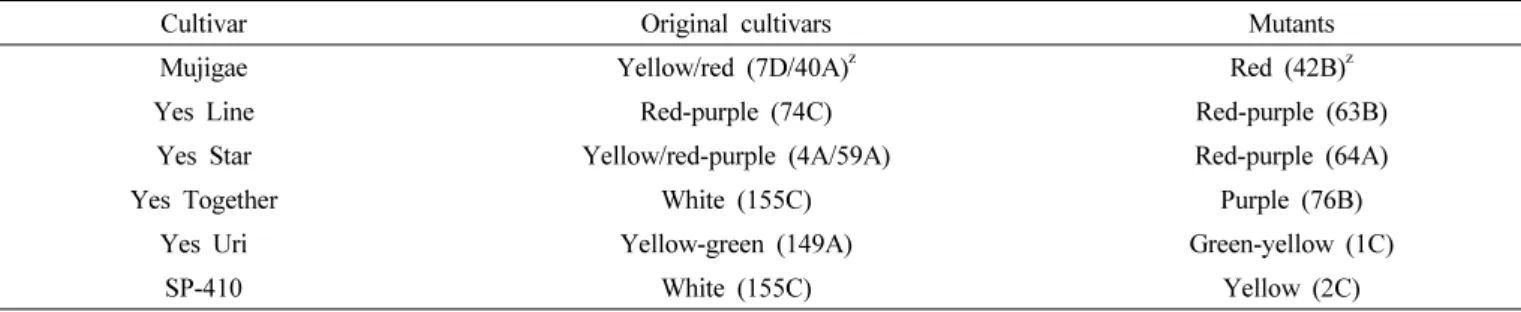
Table 3. Flower color changes of selected mutants at 6 cultivars by 35 Gy gamma-ray irradiation in chrysanthemum.
Cultivar Original cultivars Mutants
Mujigae Yellow/red (7D/40A)
zRed (42B)
zYes Line Red-purple (74C) Red-purple (63B)
Yes Star Yellow/red-purple (4A/59A) Red-purple (64A)
Yes Together White (155C) Purple (76B)
Yes Uri Yellow-green (149A) Green-yellow (1C)
SP-410 White (155C) Yellow (2C)
z
RHS color chart
이계통은 65%가 개화되었지만 모본인 ‘마가렛트멈’은 개화 하지 않았다고 보고하였다. 또한 Endo et al. (1990)에 의하 면 조기개화개체가 줄기 절편체유래는 1.9%, 설상화 절편체 유래는 11.1%로 나타났으나, 만기개화 개체는 줄기 절편체유 래 13.1%, 설상화 절편체유래 22.2%로 각각 출현되었다고 보고하였다. 이와 같이 돌연변이체나 조직배양의 배양부위에 따른 재생개체간에 다양한 개화양상을 보이는 것처럼 본 연 구에서도 품종에 따라 무조사구와 감마선조사구의 개화시기 는 다양한 차이를 보이고 있다.
화색변이체의 선발
감마선조사구에서 화색변이는 주로 ‘무지개’는 꽃잎의 화 색이 황색/적색(Y7D/R40A)의 이중색에서 적색(R42B)의 단 색으로 변한 개체, ‘예스라인’은 꽃잎의 화색이 자주색(RP74C) 에서 진자주색(RP63B)으로 변한 개체를 선발하였다. ‘예스스 타’는 꽃잎의 화색이 황색/적색(Y4A/RP59A)의 이중색에서 적자주색(RP64A)의 단색으로, ‘SP-410’는 백색(W155C)에 서 황색(Y2C)으로, ‘예스투게더’는 백색(W155C)에서 연보라 색(P76B)으로, ‘예스우리’는 연녹색(YG149A)에서 짙은 녹 색(GY1C)으로 화심색의 변이가 나타난 개체를 선발하고(Table 3), 꽃잎배양에 이용하였다.
Goo et al. (1999)은 국화 ‘봉황’외 4품종을 이용하여 기내 배양묘의 감마선에 대한 감수성을 조사한 결과, ‘봉황’ 품종 의 LD50은 40 Gy이었으며, 감마선에 의해 무측지성, 잎, 줄 기 및 꽃 모양과 조기개화 등의 변이체를 선발할 수 있었으며, 조사 감마선량에 따라 발생하는 변이체의 정도가 다르다는 것을 보고하였다. 또한, Park et al. (2007)도 국화 ‘Argus’의 기내배양체에 30~50 Gy의 감마선을 조사한 결과, 화색, 화 형 및 줄기색의 다양한 돌연변이체를 선발하였다고 보고 하 였으며, 국화의 화색변이에 있어서 돌연변이 스팩트럼 뿐만
아니라 빈도는 처리된 재료의 유전적 구조에 매우 의존적이고, 대부분의 화색 돌연변이는 적은 수의 우성유전자에 근거한다고 보고된 바도 있다(Broertjes 1966). 그리고 Park & Song (2005) 은 국화의 돌연변이원으로서 감마선뿐만 아니라 이온빔 등이 이용되기도 하며, 배양재료도 여러 가지 조직이 사용되었으며, 육성된 품종의 77%가 화색변이 이었다고 하였다. Mandal et al. (2000)은 ‘Purnima’ 백색꽃 품종에서 감마선 처리 후 꽃 잎에서 노란 색의 키메라 현상이 나타났고, ‘Colchi Bahar’의 적색꽃에서는 노란색으로 화색변이가 되어 꽃잎 배양으로 다 신초를 얻고 식물체를 재생시켰다고 하였다. 본 연구에서도
‘SP-410’은 백색(W155C)에서 황색(Y2C)으로 화색변이가 나 타나 ‘Purnima’와 유사한 경향을 보였으며, ‘무지개’의 경우 는 이중색(황색/적색, Y7D/R40A) 홑꽃에서 적색(R42B)으로 나타나 ‘Colchi Bahar’와 반대의 경향으로 나타났다.
화색은 안토시아닌의 종류에 따라서 결정되는데, 국화와 osteos- permum에서 안토시아닌 생합성에 관여하는 3MaT, F3H, F3’H 와 F3’5’H유전자가 보고된바 있으며(Kim & Park 2002, Seitz et al. 2006, Suzuki et al. 2004), 안토시아닌의 생합성에 관여 하는 유전자 중 DgLDOX (Chung et al. 2010)와 DgF3’H (Chung et al. 2012)를 분리하여 조사한 결과, 감마선 조사에 의한 화색변이체의 경우에는 이들 유전자의 인트론 부분에서 일부가 결실되거나 삽입되어 있음이 보고된바 있다. 이와 같 은 선행 연구로 미루어, 본 연구결과에서 유도된 화색변이도 감마선 조사에 의하여 안토시아닌 생합성에 관여하는 주요 유전자 부분의 변화에서 기인되는 것으로 추정할 수 있다.
꽃잎배양을 통한 식물체의 재생
감마선조사에 의한 화색변이체의 꽃잎을 이용하여 식물체 를 재생하고자 배지내 식물생장조정제 조합별 신초형성율을 조사한 결과(Table 4), ‘예스라인’의 경우 BA 2.0+NAA 0.5
Table 4. Effect of plant growth regulator on shoot formation of petal culture from flower color mutants at 6 cultivars induced by gamma ray irradiation in chrysanthemum.
Cultivars
BA + NAA (mg/L) Mujigae Yes Line Yes Star Yes Together Yes Uri SP-410
--- No. of explants every treatment ---
36 24 24 96 48 16
--- Shoot formation rate (%) ---
0.0 + 0.0 0.0 0.0 0.0 0.0 0.0 0.0
0.0 + 0.1 0.0 0.0 0.0 0.0 0.0 0.0
0.0 + 0.5 0.0 0.0 0.0 0.0 0.0 0.0
1.0 + 0.0 5.5 0.0 0.0 0.0 0.0 0.0
1.0 + 0.1 83.3 45.8 4.1 0.0 16.6 6.2
1.0 + 0.5 88.8 87.5 25.0 3.3 43.7 12.5
2.0 + 0.0 16.6 0.0 0.0 0.0 0.0 0.0
2.0 + 0.1 69.4 54.1 0.0 5.8 6.2 18.7
2.0 + 0.5 83.3 91.6 0.0 11.6 25.0 25.0
Fig. 1. Mutation breeding process through petal culture of flower color chimeric mutants in chrysanthemum. A: multiple shoot formation from petal culture, B: regenerated a whole plant from shoot, C: plants transferred to a plug tray for acclimatization, D: growing and mutant selection of M1V1 generation in the greenhouse.
mg/L 처리구에서 91.6%로 가장 높았으며, 생장조정제의 농 도가 높을수록 신초형성율도 높았으나, ‘예스스타’는 BA2.0 mg/L 처리구 모두에서 신초가 형성되지 않았고, ‘예스우리’는 BA 2.0 mg/L 처리구가 1 mg/L 처리구보다 신초형성율이 낮 았다. Endo et al.의 보고(1990)에 의하면 신초형성율은 품종 및 배양부위에 따라 다르다고 보고한 바와 같이 본 연구에서 도 품종에 따라 신초형성율이 다르다는 것을 확인 할 수 있었 으므로 효율적인 식물체 재생을 위해서는 품종별 적정 생장 조정제 농도 구명이 필요하다.
국화 꽃잎 배양에 관한 기존의 연구를 보면, 배양에 이용되 는 설상화는 개화초기 꽃잎의 화색이 짙을 때가 재분화율이 높은 것으로 보고 되었다(Shigematsu 1975). 식물생장조절제 NAA와 BA를 각각 5~10 mg/L 첨가한 MS배지에 치상하면 캘러스가 형성되고, 캘러스로 부터 절편당 수 개의 부정아 발 생이 40~50% 이루어지는 것으로 보고되었다(Furuya 1992).
그리고, Mandal et al. (2000)은 감마선이 처리된 국화 품종 의 ‘Purnima’ 백색 꽃잎을 배양하는데 NAA 0.2 mg/L와 BA 0.5 mg/L를 첨가한 MS배지에서 신초형성 및 재생이 가장 좋 았다고 하였는데, 본 연구결과와도 유사한 경향을 보였다.
신초는 sucrose 15 g/L 첨가한 MS 기본배지에 분할하여 옮겨서 완전한 재생식물체를 대부분 얻을 수 있었으나, 유리 화된 신초는 계대배양을 하더라도 정상적인 식물체가 되는데 상당한 기간이 소요되거나 전혀 식물체가 되지 않는 것도 있 었다(데이터 미제시). 감마선처리에 의한 화색변이 꽃잎으로
부터 신초를 유도하고, 이를 식물체로 분화시켜 순화한 다음, 포장에서 정상적인 개화를 유도하였고(Fig. 1), 재생된 화색 변이 꽃잎 유래 식물체는 포장재배에서도 선발개체의 화색과 화형이 그대로 유지되었다(Fig. 2). 식용국화의 꽃잎형태 및
Original cvs.
Mutants
Fig. 2. Comparison of original cultivars and their mutants generated by gamma-ray irradiation (35 Gy) and tissue culture in 6 spray cultivars of chrysanthemum. Upper row from left to right (Original cultivars, A ~F), A: ‘Mujigae’, B: ‘Yes Line’, C: ‘Yes Star’, D: ‘Yes Together’, E: ‘Yes Uri’, F: ‘SP-410’. Lower row from left to right (Mutant lines, A` ~F`), A`: ‘Mujigae-M’, B`: ‘Yes Line-M’, C`: ‘Yes star-M’, D`: ‘Yes Together-M’, E`: ‘Yes Uri-M’, F`: ‘SP-410-M’.
화색변이는 조직배양에 의해 식물체를 재생시킨 후 4~5년간 영양번식으로 유지하고 관찰해보면 각각의 특성에는 재생 초년 도와 거의 변화가 확인되지 않았다는 보고(Endo et al. 1990)와 같이 본 연구에서도 꽃잎배양으로 식물체를 재생시켜 3 년간 유지하면서 관찰한 결과 차이가 없다는 것을 확인할 수 있어 서, 감마선처리를 이용하여 화색변이체를 유도하고 선발한 다 음 식물체로 재생하면 고유식물의 특성이 크게 바뀌지 않고 화색만 다른 변이체의 창출이 가능함을 알 수 있었다.
이러한 연구결과는 감마선처리와 조직배양기술을 이용한 돌연변이 육종법으로 우수한 특성을 그대로 유지하면서도 다 양한 화색 및 화형의 국화를 육종을 할 수 있다는 것을 보여 주고 있으며, 이와 같은 방법은 기존 전통육종으로는 도저히 얻을 수 없는 새로운 품종개발이 가능하여 화훼산업 발전에 많은 기여를 할 수 있을 것으로 판단된다.
적 요
국화 6 품종을 대상으로 감마선(35 Gy) 조사에 의해 유기 된 화색변이체를 선발하고, 식물체 재생을 위한 배지내 식물생 장조절제 적정농도를 구명하여 신품종 육성 가능성을 검토하고 자 수행하였다. 고유품종과 다른 꽃잎의 화색변이율은 ‘SP-410’
이 15.7%로 가장 높았으며, ‘예스스타’가 10.6%, ‘무지개’가 10.3%순 이었다. ‘무지개’는 이중색(황색/적색, Y7D/R40A) 에서 적색(R42B)으로, ‘예스라인’은 자주색(RP74C)에서 진자 주색(RP63B)으로, ‘예스스타’는 황색/적색(Y4A/RP59A) 이 중색에서 적자주색(RP64A)으로, ‘SP-410’은 백색(W155C)에
서 황색(Y2C)으로, ‘예스투게더’의 화심색은 백색(W155C)에서 연보라색(P76B)로, ‘예스우리’의 화심색은 연녹색(YG149A)에 서 짙은 녹색(GY1C)으로 화색이 변한 변이체를 선발하였다.
화색변이체 꽃잎의 신초형성을 위한 배지내 식물생장조정제 의 최적조합은 BA 1.0 mg/L와 NAA 0.5 mg/L, BA 2.0 mg/L 와 NAA 0.5 mg/L의 2조합이였으며, 신초형성율은 품종간에 차이가 있어 ‘예스라인’이 91.6%로 가장 높았다. 감마선 조 사에 의한 화색 변이체의 꽃잎배양 유래 재생식물체는 영양 번식으로 유지되었으며, 3년동안 재배한 결과 화색과 꽃잎의 형태적 특성 차이가 없었다.
References