Abstract
BACKGROUND: Bumblebees have been shown to be very effective pollinators for most greenhouse tomatoes.
Neonicotinoid insecticides are one of the most widely used pesticides in tomato crops in Korea.
METHODS AND RESULTS: This study was carried out to investigate the toxicity of four neonicotinoid insecticides (clothianidin, dinotefuran, imidacloprid and thiamethoxam) to bumblebees based on the OECD guidelines (No.246, 247). The 48 hr LD 50 (μg a.i. /bumblebee) values in the
acute contact toxicity tests were determined as follows:
clothianidin, 0.467; dinotefuran, 3.741; imidacloprid, 3.967;
and thiamethoxam, 0.747. The 48 hr LD 50 values in the acute oral toxicity tests were determined as follows:
clothianidin, 0.005; dinotefuran, 0.056; imidacloprid, 0.325; and thiamethoxam, 0.018. The acute contact and oral toxicity of the test insecticides to bumblebees from most to least toxic was clothianidin > thiamethoxam > dinotefuran
> imidacloprid.
CONCLUSION: This study provided the basic toxicological data of neonicotinoid insecticides for bumblebees. In the near future, acute toxicity and mixture toxicity of other pesticides to bumblebees could be determined using this method.
*Corresponding author: Kyongmi Chon Phone: +82-63-238-3252; Fax: +82-55-772-3837;
E-mail: [email protected]
Korean J Environ Agric. 2020;39(2):106-113. Korean Online ISSN: 2233-4173
Published online 2020 June 16. https://doi.org/10.5338/KJEA.2020.39.2.14 Print ISSN: 1225-3537
네오니코티노이드계 4종 농약의 서양뒤영벌 급성 접촉 및 섭식 독성평가
김아름누리
1
, 김보선1
, 전경미1*
, 이환1
, 박연기1
, 유아선1
, 박홍현1
, 윤형주2
1
농촌진흥청 국립농업과학원 농산물안전성부 화학물질안전과,
2농촌진흥청 국립농업과학원 농업생물부 곤충산업과
Assessment of Contact and Oral Toxicity of Four Neonicotinoid Insecticides to Bumblebees ( Bombus terrestris )
Areumnuri Kim
1, Boseon Kim
1, Kyongmi Chon
1*, Hwan Lee
1, Yeon-Ki Park
1, Are-Sun You
1, Hong-Hyun Park
1and Hyeong-Ju Yun
2(
1Chemical Safety division, Department of Agro-food Safety and Crop Protection, National Institute of Agricultural Sciences, Rural Development Administration, Wanju 55365, Korea,
2Industrial Insect Division, Department of Agricultural Biology, National Institute of Agricultural Sciences, Rural Development Administration, Wanju 55365, Korea)
Received: 9 May 2020/ Revised: 29 May 2020/ Accepted: 9 June 2020 Copyright ⓒ 2020 The Korean Society of Environmental Agriculture
This is an Open-Access article distributed under the terms of the Creative Commons Attribution Non-Commercial License (http://creativecommons.org/licenses/by-nc/3.0) which permits unrestricted non-commercial use, distribution, and reproduction in any medium, provided the original work is properly cited.
ORCID Areumnuri Kim
https://orcid.org/0000-0003-2622-3520
Kyongmi Chon
https://orcid.org/0000-0003-2143-2614 Yeon-Ki Park
https://orcid.org/0000-0002-1870-794X
Hong-Hyun Park
https://orcid.org/0000-0003-1213-0665
Boseon Kim
https://orcid.org/0000-0001-6053-6366
Hwan Lee
https://orcid.org/0000-0002-4487-8929 Are-Sun You
https://orcid.org/0000-0001-7258-2626
Hyeong-Ju Yun
https://orcid.org/0000-0002-1797-4974
106
Research Article Open Access
Key words: Acute Toxicity, Bumblebees, Neonicotinoid Insecticides
서 론
뒤영벌( Bombus sp. )은 진동수분형 벌로서 꿀이 나지 않 고 진동에 의해서 수분되는 토마토나 가지 등 가지과 식물에 서 수정능력이 뛰어나며 시설재배와 같은 좁은 공간 및 저온 조건에서도 화분매개활동이 활발하다[1-3]. 국내 토마토 총 재배 면적(약 7,000 ha) 중 64%가 화분매개곤충을 사용하고 있으며, 그 중 뒤영벌의 사용량(약 8000 봉군)이 99% 이상을 차지하고 있다[4]. 농가에서 뒤영벌의 사용량은 노동력 절감 및 수정률 증대 효과로 점차 증가될 전망이다[2].
네오니코티노이드계 농약은 국내에서 많이 사용되고 있는 농약 중 하나로 nicotinic acetylcholine receptor와 결합하 여 신경전달물질인 acetylcholine을 저해하여 신경독성을 일 으키며[5] 침투이행성이 높아 토양에 처리된 농약이 잎과 꽃으로 흡수 이행되어 흡즙성 해충의 방제에 효과적이다[6]. 대표적으로 clothianidin, dinotefuran, imidacloprid, thiamethoxam 등 이 있으며 토마토 작물의 해충 약제로 등록되어 뿌리혹선충, 아메리카잎굴파리, 온실가루이, 담배가루이 등의 방제에 사용 되고 있다[7].
뒤영벌은 농약 살포시 직접노출, 농약이 잔류된 식물 표면 (잎, 꽃, 꽃가루 및 화밀)과의 접촉 또는 농약에 오염된 꽃가 루 또는 화밀의 섭취를 통해 노출될 수 있다(USEPA 2014).
농약에 노출된 뒤영벌은 방화활동이 저해되며 이는 작물의 생산량 및 품질 저하로 이어진다[8, 9].
최근 연구에 의하면 imidacloprid는 봉군 안에서 뒤영벌 일벌의 행동에 광범위한 영향을 끼쳐 봉군의 성장을 저해하고 새로 출현한 여왕벌의 수가 무처리군에 비해 85% 감소되는 것 으로 나타났다[10, 11]. Thiamethoxam이 서양뒤영벌의 봉군 형성 및 산란에 미치는 영향에 관한 연구 결과에 의하면 환경 중 평균노출수준(1 μg/kg)에서는 산란율에 대한 영향이 없었 지만 최대 노출수준(10 μg/kg)에서는 봉군 생성이 초기에 지 연되었고, 산란율이 저하되고 유충이 생성되지 않았다[12].
국내 관련 연구로는 clothianidin 액상수화제, dinotefuran 수화제, imidacloprid 액상수화제, thiamethoxam 입상수화 제 등을 추천농도로 약액을 살포하여 급성 접촉독성시험을 수 행한 바 있으며 시험결과 꿀벌과 서양뒤영벌 모두 100%에 가 까운 치사율을 나타내었다[8]. 국내 뒤영벌을 이용한 연구는 화 학적 적화/적과제로 이용되는 화합물에 대한 엽상잔류 독성 및 섭식독성연구가 있으며[13, 14], 네오니코티노이드계 농약의 원제에 대한 독성 연구는 전무한 실정이다.
꿀벌( Apis mellifera )과 뒤영벌은 행동적, 생리적, 생태적 으로 현저한 차이를 나타내며, 농약에 따라 LD
50값이 0.01- 25.88배의 차이가 있다고 보고되었다[15]. 국내에서는 농약에 대한 화분매개충의 위해성평가를 꿀벌에 국한하고 있지만 최 근 유럽 및 미국에서는 꿀벌뿐만 아니라 뒤영벌과 단독벌에 대한 위해성평가를 실시하고 있으며 다양한 시험법을 개발하
고 있다(EFSA, 2012; USEPA, 2014). 2017년OECD에서 뒤 영벌에 대한 급성 접촉 및 섭식독성시험법 가이드라인을 제 시하였으며(OECD No.246, 247) 최근 이를 바탕으로 농촌 진흥청 국립농업과학원에서 서양뒤영벌 급성독성시험법 국내 확립에 대한 연구결과를 발표하였다[16].
따라서 본 연구에서는 OECD 가이드라인에 따라 서양 뒤영벌에 대한 네오니코티노이드계 농약 4종(clothianidin, dinotefuran, imidacloprid, thiamethoxam)의 급성 접촉 및 섭식 독성을 평가하였다.
재료 및 방법
시험곤충
본 시험에 사용한 서양뒤영벌( Bombus terrestris )은 무작 위 선발한 건강한 일벌로 국립농업과학원 곤충산업과에서 사 양 관리되고 있는 3개 이상의 건강한 봉군에서 제공받아 시 험을 진행하였다.
시험약제
서양뒤영벌의 급성 접촉 및 섭식 독성시험에 사용된 시험 물질은 네오니코티노이드계 농약의 원제로 clothianidin (99.0%), dinotefuran(98.0%), imidacloprid(99.0%) 및 thiamethoxam(99.0%)이며 모두 Dr. Ehrenstorfer (Augsburg, Germany)에서 구입하여 사용하였다. 양성 대조 군으로는 dimethoate(98.5%, Dr. Ehrenstorfer)을 사용 하였다.
시험조건
시험 진행 및 관찰 기간 동안 암실조건에서 온도는 25±
2℃, 상대습도는 60±20%를 유지하였다.
시험 전처리
시험 전 서양뒤영벌은 적색 조명하에서 무작위로 선발되었으 며 개별 체중을 잰 뒤 너무 작거나(<150 mg) 큰 것(>300 mg) 은 시험에서 제외하였다. 한 처리군당 1마리씩 30반복으로 시 험을 수행하였다. 선별된 서양뒤영벌은 15 cm
3크기의 환기 가 가능한 플라스틱 개별 시험용기(roller queen cage, 메인 양봉원)에 한 마리씩 넣어 시험용기 거치대에 15개씩 나란히 배열하였으며 최소 8시간동안 시험조건에 순응시켰다. 순응 기간 동안 50% w/v 자당용액을 팁이 제거된 2 mL 주사기 에 주입하여 먹이로 제공하였다. 섭식독성시험의 경우 약제 처리 4시간 전부터 먹이공급을 차단하였다. 약제 처리 후 뒤 영벌은 자유롭게 먹이를 섭취할 수 있도록 하였다.
급성 접촉독성시험
급성 접촉독성시험의 양성대조군은 dimethoate(10 μg a.i./
bumblebee)를 사용하였다. 네오니코티노이드계 4종 약제 처리
군은 clothianidin(0.15-2.4 μg a.i./bumblebee), dinotefuran
(0.625-10.0 μg a.i./bumblebee), imidacloprid(0.5-8.0 μg
a.i./bumblebee), thiamethoxam(0.3-4.8 μg a.i./bumblebee) 의 처리량 범위에서 공비 2로 하여 5단계로 설정하였다.
Clothianidin, imidacloprid, thiamethxam의 경우 아세톤 을 용매로 사용하였으며 시험용액 중 함량은 4%로 하였다.
Dinotefuran은 증류수를 용매로 사용하였다. 시험용액 제조 에 사용된 아세톤 또는 증류수는 각 약제 처리군의 용매대조 군으로 사용하였다. 시험용액의 균일한 도포를 위해 계면활성 제인 triton-X 100 (Sigma Aldrich, USA)를 시험용액 중 0.1%로 첨가하였으며, CO
2로 마취시킨 후 multipette M4 pipette(Eppendorf, Germany)를 사용하여 서양뒤영벌 흉 부에 5 μL씩 처리하였다. 약제 처리군별 농도 수준당 30반복 으로 시험하였다. 약제 처리 4, 24, 48시간 후의 이상증상 및 사망개체 수를 기록하였으며, 24시간과 48시간의 사망률 차 이가 10% 이상 일 경우 72시간 및 96시간까지 연장하여 관 찰하였다.
급성 섭식독성시험
급성 섭식독성시험의 양성대조군은 dimethoate(4 μg a.i./
bumblebee)를 사용하였다. 네오니코티노이드계 4종 약제 처리군 은 clothianidin(0.001-0.016 μg a.i./bumblebee), dinotefuran (0.02-0.32 μg a.i./bumblebee), imidacloprid(0.04-0.64 μg a.i./bumblebee), thiamethoxam(0.005-0.08 μg a.i./
bumblebee)의 처리량 범위에서 공비 2로 하여 5단계로 설정하 였다. 시험약제는 50% 자당용액을 혼합하여 제조하였으며 약제 용 주사기의 팁에 40 μL씩 주입하여 4시간 동안 급여하였다. 급 성 섭식독성시험은 제공 먹이를 80% 미만으로 섭취한 개체 (non-feeder)를 제외해야 하기 때문에, 처리군당 45마리 이상 처리하고 이 중 non-feeder를 제외하여 30마리를 선별하여 시험 하였다.
아세톤 또는 증류수는 각 약제 처리군의 용매대조군으로 사 용하였다. 약제 처리 4, 24, 48시간 후의 이상증상 및 사망개체 수를 기록하였으며, 24시간과 48시간의 사망률 차이가 10% 이 상일 경우 72시간 및 96시간까지 연장하여 관찰하였다.
사망률 및 이상증상 확인
약제 노출 후 4시간, 24시간, 48시간의 사망개체 및 이상 증상을 관찰하였으며 약제 처리군에서 24시간과 48시간 사이
의 사망률이 10% 이상 증가할 경우 96시간까지 관찰한 후 시험을 종료하였다. 약제 노출 후 이상증상이 나타나지 않는 상태(unaffected, U), 움직임은 있지만 신체 조정력이 감소된 상태(affected, A), 다리와 더듬이의 움직임이 매우 약하고, 자 극에 대한 반응이 매우 적으며 걷지 못하는 상태(moribund, M), 죽어서 아무런 움직임을 보이지 않는 상태(dead, D)로 구 분하여 관찰한 뒤 기록하였다.
통계처리
각 시험군의 체중값은 평균±표준편차로 표시하였으며, 약 제 처리군간의 통계적 유의한 차이가 있는지 확인하기 위해 SPSS ver 20(IBM, Chicago, IL, USA)을 사용하여 비모수 검정인 Kruskal-Wallis tests를 실시하였다. 통계학적 유의 성은 P <0.05로 하였다. 시험물질의 독성 시험 결과는 EPA probit analysis program (ver 1.5)을 사용하여 LD
50및 95% 신뢰한계를 산출하였다.
결과 및 고찰
급성 접촉독성시험
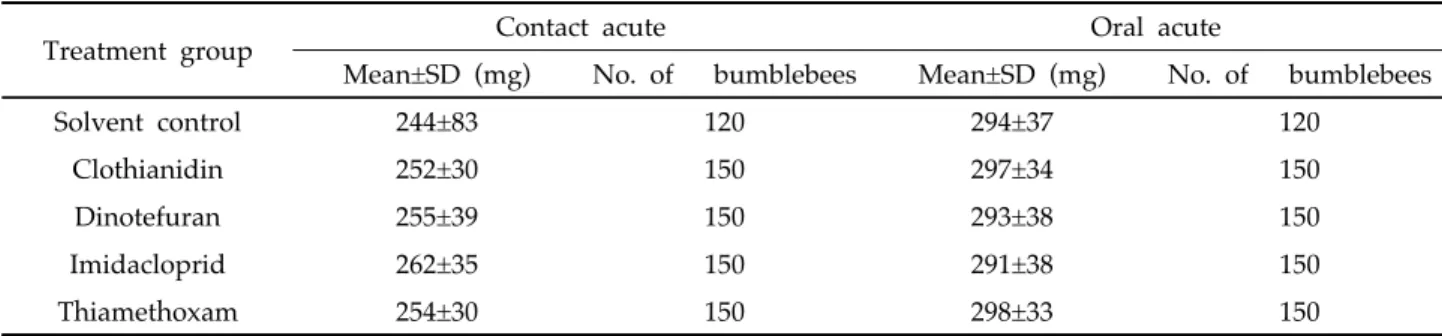
급성 접촉독성시험에 사용된 용매대조군의 서양뒤영벌 평 균 무게는 244±83 mg이었으며 약제 처리군의 경우 252±30- 262±35 mg이었다. 약제 처리군간 뒤영벌 무게는 통계적으로 유의한 차이가 없었다(Table 1).
OECD TG 246(OECD, 2017)의 시험 유효성 기준에 따 르면 관찰 종료시 용매대조군의 사망률이 10% 미만, 양성대 조군의 사망률이 50% 이상 나타나야 한다. 용매대조군에서 시험기간 동안 사망 개체는 관찰되지 않았으며, 양성대조군에 서는 노출 48시간 후 사망률은 70%로 나타나(Table 2) OECD 시험기준에 적합하였다.
네오니코티노이드계 농약 4종의 접촉을 통한 서양뒤영벌의 독성은 사망개체수를 통해 확인하였으며 그 결과는 Table 3과 같다. Clothianidin, dinotefuran, thiamethoxam 처리군의 경우 약제 처리 후 24시간과 48시간 뒤의 사망개체수가 동일 하여 48시간까지 관찰하였으며, imidacloprid 처리군의 경우 1.0-8.0 μg a.i./bumblebee의 처리량 범위에서 사망률이 10% 이상 증가했기 때문에 96시간까지 연장 관찰하였다.
Treatment group Contact acute Oral acute
Mean±SD (mg) No. of bumblebees Mean±SD (mg) No. of bumblebees
Solvent control 244±83 120 294±37 120
Clothianidin 252±30 150 297±34 150
Dinotefuran 255±39 150 293±38 150
Imidacloprid 262±35 150 291±38 150
Thiamethoxam 254±30 150 298±33 150
Table 1. The mean weight of B. terrestris used in this acute toxicity tests
Treatment route Treatment group Symptom Number of affected bumblebees
4h 24h 48h 72h 96h
Contact
Dimethoate (10 μg a.i. / bumblebee )
Dead (D) 0 10 21 22 22
Unaffected (U) 21 8 4 2 2
Affected (A) 9 12 5 6 6
Moribund (M) 0 0 0 0 0
Total 30 30 30 30 30
Control
Dead (D) 0 0 0 0 0
Unaffected (U) 29 30 29 30 30
Affected (A) 1 0 1 0 0
Moribund (M) 0 0 0 0 0
Total 30 30 30 30 30
Oral
Dimethoate (4 μg a.i. / bumblebee )
Dead (D) 6 28 28 - -
Unaffected (U) 2 2 2 - -
Affected (A) 5 0 0 - -
Moribund (M) 17 0 0 - -
Total 30 30 30 - -
Control
Dead (D) 0 0 0 - -
Unaffected (U) 30 30 30 - -
Affected (A) 0 0 0 - -
Moribund (M) 0 0 0 - -
Total 30 30 30 - -
Table 2. The number of affected B. terrestris in acute toxicity tests for positive and negative control groups
Treatment groups μg a.i. / bumblebee 4 h 24 h 48 h 72 h 96 h
Clothianidin
Control (acetone) 0 0 0
0.15 1 4 4
0.3 2 6 6
0.6 7 17 17
1.2 5 29 29
2.4 9 29 29
Dinotefuran
Control 0 0 0
0.625 0 3 3
1.25 0 6 6
2.5 5 11 11
5.0 10 17 18
10.0 11 23 23
Imidacloprid
Control (acetone) 0 0 0 1 1
0.5 3 3 4 4 8
1.0 3 4 7 8 10
2.0 3 8 12 13 21
4.0 2 10 16 18 21
8.0 1 13 18 20 23
Thiamethoxam
Control (acetone) 0 0 0
0.3 2 3 3
0.6 4 11 12
1.2 7 20 21
2.4 8 29 29
4.8 9 30 30
Table 3. The number of dead B. terrestris in acute contact toxicity tests
약제 처리 후 24시간 뒤에 clothianidin, dinotefuran, thiamethoxam 처리군은 각각 0.6, 5.0, 1.2 μg a.i./
bumblebee 이상의 처리량에서 56.7%~100%의 사망률을 나 타냈다(Table 3). Imidacloprid 처리군의 경우, 약제 처리 후 48시간뒤 4.0, 8.0 μg a.i./bumblebee 처리량에서 각각 53.3, 60%의 사망률을 나타냈으며 시간에 따라 사망개체수가 점차 증가하여 96시간 뒤 사망률이 각각 70%, 76.7% 이었 다. 4.0, 8.0 μg a.i./bumblebee 처리량에서 약제 처리 후 4 시간뒤에 90% 이상이 이미 빈사(moribund)상태였으며 시 간이 경과함에 따라 점차 사망상태로 나타난 것으로 판단된 다. 본 시험의 경우 접촉 후 초기 4시간에서는 소량 0.5 μg /bumblebee 처리군에서 다량 8 μg /bumblebee 처리군 보다 사망률이 높게 나타났지만 24시간 이후부터는 다량처리 군에서 사망개체수가 점차 증가하여 96시간 후에 사망률이 70% 이상 나타났다. Imidacloprid 꿀벌 급성 접촉독성시험 에 관한 연구에 따르면 접촉 후 10시간 이내에서는 2.0 μg /bee 처리군의 사망률이 0.05, 0.01, 0.005 μg /bee 처리군 보다 사망률이 낮게 나타났지만 24시간 이후에는 사망률이 지속적으로 증가하여 고용량 처리군에서 치사율이 높게 나타 났다[17]. 이는 imidacloprid 처리용량이 증가함에 따라 꿀
벌 독성 증상이 지연되는 현상으로 뒤영벌 독성시험에서도 비슷한 현상이 나타났음을 알 수 있다.
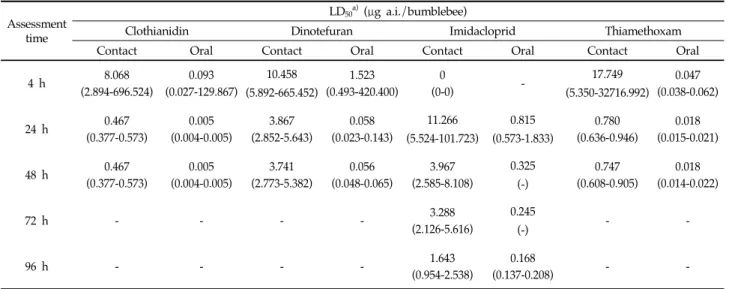
각 농약의 접촉 노출 48시간 후 사망수를 토대로 LD
50값 (μg a.i./bumblebee)을 산출한 결과 clothianidin(0.467) >
thiamethoxam (0.747) > dinotefuran(3.741) > imidacloprid (3.967) 순으로 뒤영벌에 독성이 있음을 나타냈다. 하지만 imidacloprid 경우 약제 처리 후 시간이 경과함에 따라 사망률 이 높아지는 경향을 보였으며 약제 처리 96시간 후 LD
50값(1.64) 은 48시간 후 값(3.97)에 비해 2.41배 더 큰 독성을 나타냈다 (Table 5).
선행 연구들을 통해서 꿀벌 및 뒤영벌의 네오니코티노이드 계 농약에 대한 급성 접촉 독성값(LD
50)을 얻을 수 있었으며 Table 6과 같이 본 시험결과와 비교 하였다. 일반적으로 벌의 크기가 작을수록 체표면적의 비가 높아지기 때문에 농약에 대 한 민감도가 더 큰 것으로 알려져 있으며(EFSA, 2012), 뒤영 벌의 크기에 따른 비교에서 크기가 큰 그룹(0.297 g) 보다 작 은 그룹(0.162 g)에서 dimethoate 접촉 독성 값이 2.36배 작 게 나타나 크기가 작을수록 dimethoate에 민감하다는 연구 결과도 있다[18].
Treatment groups μg a.i./bumblebee 4 h 24 h 48 h 72 h 96 h
Clothianidin
Control (acetone) 0 0 0
0.001 0 0 0
0.002 0 1 1
0.004 5 14 14
0.008 3 25 25
0.016 5 30 30
Dinotefuran
Control 0 0 0
0.02 0 0 0
0.04 1 4 5
0.08 4 27 27
0.16 6 29 29
0.32 5 30 30
Imidacloprid
Control (acetone) 0 0 0 0 0
0.04 0 0 0 2 2
0.08 1 1 1 3 6
0.16 0 0 0 2 9
0.32 0 4 15 21 26
0.64 0 13 28 28 29
Thiamethoxam
Control (acetone) 0 0 1
0.005 0 0 1
0.01 0 6 6
0.02 5 19 19
0.04 16 27 27
0.08 20 29 29
Table 4. The number of dead B. terrestris in acute oral toxicity tests
Assessment time
LD
50a)(μg a.i./bumblebee)
Clothianidin Dinotefuran Imidacloprid Thiamethoxam
Contact Oral Contact Oral Contact Oral Contact Oral
4 h 8.068
(2.894-696.524)
0.093 (0.027-129.867)
10.458 (5.892-665.452)
1.523 (0.493-420.400)
0
(0-0) - 17.749
(5.350-32716.992)
0.047 (0.038-0.062)
24 h 0.467
(0.377-0.573)
0.005 (0.004-0.005)
3.867 (2.852-5.643)
0.058 (0.023-0.143)
11.266 (5.524-101.723)
0.815 (0.573-1.833)
0.780 (0.636-0.946)
0.018 (0.015-0.021)
48 h 0.467
(0.377-0.573)
0.005 (0.004-0.005)
3.741 (2.773-5.382)
0.056 (0.048-0.065)
3.967 (2.585-8.108)
0.325 (-)
0.747 (0.608-0.905)
0.018 (0.014-0.022)
72 h - - - - 3.288
(2.126-5.616)
0.245
(-) - -
96 h - - - - 1.643
(0.954-2.538)
0.168
(0.137-0.208) - -
a)
The LD
50values were calculated by log-probit analysis. In B. terrestris contact and oral application, LD
50values were determined from the two ascending parts of the dose–effect curve. Values in brackets represented 95 confidence limits.
Table 5. The acute toxicity (LD
50) values of four neonicotinoids to B. terrestris
Pesticides
Contact LD
50(μg a.i./bee)
Oral LD
50(μg a.i./bee) Apis spp. Bombus spp. This study
c)( B.terrestris ) Apis spp. Bombus spp. This study
c)
( B.terrestris )
Clothianidin 0.039
a)0.016
a), 0.39
b)0.467 0.0035
a)- 0.005
Dinotefuran 0.049
a)- 3.741 0.022
a)- 0.056
Imidacloprid 0.061
a)0.007(48 h)
d)0.02
a), 3.22
b)3.967(48 h), 1.64(96 h)
0.005(48 h)
d)0.057(48 h)
e)0.037(96 h)
e)0.027
a)0.325(48 h) 0.168(96 h)
Thiamethoxam 0.025
a)- 0.747 0.005
a)- 0.018
a)
Sources: [19],
b)Sources: [21]; lethal concentrations (LC
50) are expressed as percentage of solution (wt:vol) (x 10
-3),
c)
Toxicological endpoint at 48 h,
d)Sources: [22],
e)Sources: [17].
Table 6. The comparison of the LD
50values of four neonicotinoid insecticides for B. terrestris from this study and published values for Apis spp. and Bombus spp.
미국의 ECOTOX 및 문헌 데이터 중 꿀벌과 뒤영벌에 대 한 급성 독성수치값(LD
50)을 비교한 선행연구에 따르면 clothianidin과 imidacloprid의 꿀벌과 뒤영벌 간 LD
50값 비율은 각 2.4와 3.0으로 뒤영벌이 더 민감한 것으로 나타났 다[19]. 그러나 potter spray tower를 이용한 두 약제의 접 촉독성시험에서는 LD
50값 비율은 0.51과 0.68로 반대의 결과 를 나타냈다[20, 21]. 본 시험의 결과와 문헌에 보고된 꿀벌 독성치를 비교해 보면, LD
50값 비율이 0.004-0.084로 꿀벌이 훨씬 더 민감한 것으로 판단된다.
본 시험에서 clothianidin과 imidacloprid의 48시간 LD
50값은 각각 0.467, 3.967 μg a.i./bumblebee로 clothianidin 이 독성이 약 8.5배 강하게 나타났으며, 선행 연구 결과에서도 clothianidin과 imidacloprid의 LC
50(%solutionⅹ10
-3)값이 각각 0.39, 3.22로 clothianidin의 독성 값이 약 8배 강하게 나타나 본 시험과 비슷한 결과를 보여주었다[21].
급성 섭식독성시험
급성 섭식독성시험에 사용된 용매대조군의 서양뒤영벌 평 균 무게는 294±37 mg이었으며 약제 처리군의 경우 291±38- 298±33 mg이었다. 용매대조군 및 약제 처리군간 뒤영벌 무게 는 통계적으로 유의한 차이가 없었다(Table 1).본 시험의 무처 리군 및 양성대조군인 dimethoate 4 μg a.i./bumblebee 처 리군은 약제 노출 48시간 후 사망률이 각각 0%, 93.3%로 나 타나 OECD TG 247(OECD, 2017)시험 기준에 적합하였다 (Table 2).
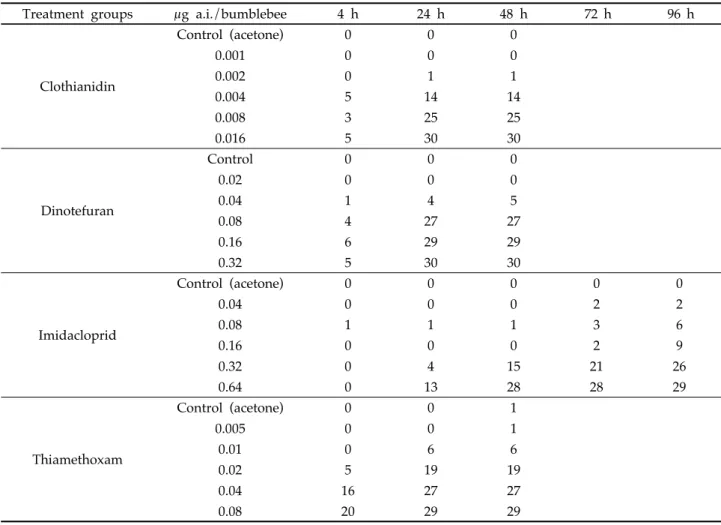
Table 4는 네오니코티노이드계 농약 4종의 섭식 노출에
따른 사망개체수를 나타낸다. Clothianidin, dinotefuran,
thiamethoxam 처리군은 약제 처리 후 24시간과 48시간 사
이의 사망개체수 차이가 10% 미만으로 나타나 48시간에서
관찰을 종료하였다. Imidacloprid 처리군의 경우 0.32, 0.64
μg a.i./bumblebee의 처리량에서 약제 처리 후 24시간 및
48시간 사이의 치사개체 수가 각각 11, 15 마리씩 증가하여
96시간까지 관찰하였다.
Imidacloprid 처리군에서는 접촉독성시험 결과와 같이 약제처리 후 시간 경과에 따라 사망개체수가 점점 증가하는 경향을 나타냈다. 이러한 경향은 꿀벌에서 선행 연구한 결과 에서도 관찰되었다. Imidacloprid 섭식 노출 후 4시간부터 빠르게 독성 증상이 나타났으며 100시간 동안 점진적으로 사 망률이 증가하였다. 이와 같은 지연효과(delayed action)는 imidacloprid가 대사되어 생성되는 olefin 등과 같은 대사체 들이 더 큰 독성을 나타내며 장기간 잔류 독성(long-term residual effectiveness)을 유발하는 것으로 판단된다[17].
각 농약의 48시간 섭식 LD
50값(μg a.i./bumblebee)을 산출한 결과 clothianidin(0.005), thiamethoxam(0.018), dinotefuran(0.056), imidacloprid(0.325) 순으로 서양뒤영 벌에 대한 독성이 큰 것으로 나타났다(Table 5).
네오니코티노이드계 농약 4종에 대한 섭식독성시험 결과 꿀벌과 뒤영벌간의 독성 민감도 비(꿀벌 LD
50/뒤영벌 LD
50) 는 0.12-0.7로 꿀벌이 더 민감한 것으로 나타났다(Table 6).
이러한 결과는 사회성 벌과 단독벌간에 먹이방식(그룹 및 개 별 먹이방식)의 차이가 하나의 요인이 될 수 있다[15].
네오니코티노이드계 농약 4종의 48시간 기준 독성영향 은 clothianidin > thiamethoxam > dinotefuran >
imidacloprid의 순서로 급성 접촉 및 섭식 독성 시험에서 모 두 같은 경향을 보였다. 하지만 imidacloprid는 접촉 및 섭 식독성시험에서 독성 지연효과가 있기 때문에 약제 처리 후 96시간의 LD
50값은 48시간 LD
50값보다 더 낮았다. 본 시험 96시간 기준 독성영향을 보면 imidacloprid의 접촉 및 섭식 LD
50값이 각각 1.643, 0.168 μg a.i./bee로 clothianidin 다 음으로 높은 독성을 나타냈다.
본 연구에서는 뒤영벌에 대한 네오니코티노이드계 농약 독성을 접촉과 섭식 두 가지 노출경로로 평가하였으며 섭식 독성이 더 큰 것으로 나타났다. 반면 선행연구결과에 의하면 유기인계 농약인 chlorpyrifos(contact LD
50=0.072 μg a.i./
bee,oral LD
50=0.24 μg a.i./bee)와 피레스로이드계 농약 인 deltamethrin(contact LD
50=0.024 μg a.i./bee,oral LD
50=0.27 μg a.i./bee)의 경우 꿀벌 접촉독성이 섭식독성 보다 더 큰 것으로 나타났다[19, 22].
섭식 노출의 경우 소화관 내에서 농약의 대사를 유도할 가 능성이 있는 반면, 접촉 노출은 외피를 통한 농약의 이동 및 곤충의 체내 대사경로를 필요로 한다[23]. 또한 실제로 꿀벌 의 외피를 통한 흡수는 농약의 물리 화학적 특성 및 특히 농 약의 제형에 따라 크게 차이를 보인다[24]. 따라서 농약에 따 라 물성의 차이 및 노출 경로의 차이로 인해 다른 독성을 나 타나게 된다고 사료된다.
본 연구에서는 최근 발표된 OECD 뒤영벌 급성독성시험 법을 따라 네오니코티노이드계 농약에 대한 서양뒤영벌 급성 독성을 평가하였다. 본 시험결과는 네오니코티노이드계 농약 에 대한 서양뒤영벌의 기초 독성자료로 활용될 수 있을 것이 다. 향 후 본 시험법을 활용하여 네오니코티노이드계 농약뿐 만 아니라 화분매개충에 위해가능성이 있는 농약에 대한 서
양뒤영벌 독성 정보를 제공할 수 있을 것이라고 생각된다.
Note
The authors declare no conflict of interest.
Acknowledgement
This study was carried out with the support of
“Research Program for Agricultural Science & Technol- ogy Development (Project No. PJ013516)”, National Institute of Agricultural Sciences, Rural Development Administration, Republic of Korea.
References