320
©The Korean Society of Food Science and Technology
공액리놀레산 함유 디글리세라이드 식용유지 조성물의 rat에 대한 단회 경구투여독성 및 항비만 효과
홍순기·박채규·이미자·정신교1·이영호2·현선희*
KT&G 중앙연구원, 1경북대학교 농업생명과학대학, 2(주)일신웰스
Acute Oral Toxicity and Anti-obesity Effect of Diglyceride Preparation Containing Conjugated Linoleic Acid in Rat
Soon Gi Hong, Chae-Kyu Park, Mi-Ja Lee, Shin Gyo Chung1, Young Ho Lee2, and Sun Hee Hyun*
KT&G Central Research Institute
1College of Agriculture & Life Sciences, KyungPook National University
2Ilshinwells Co., Ltd.
Abstract The present study was carried out to investigate the acute oral toxicity and anti-obesity effects of a diglyceride preparation containing conjugated linoleic acid (DG+CLA). To test its acute oral toxicity, the DG+CLA was injected into 30 rats (15 males and 15 females) at dosage of 2,000 mg/kg and 5,000 mg/kg. Mortality rates, clinical signs, and body weight changes were monitored for 14 days following administration. According to the results, the lethal dose (LD50) of DG+CLA was determined as >5,000 mg/kg in both sexes. There were no significant changes in general conditions, clinical signs, body weight, and gross lesions between the vehicle control and DG+CLA groups. For the anti-obesity studies, obese Zucker rats were randomly divided into 4 groups and fed saline, soybean oil, diglyceride, and DG+CLA, respectively, for 8 weeks. The DG+CLA groups presented significant differences in body weight, food efficiency ratio, serum lipid levels, and fat weight.
Overall, the results showed that the DG+CLA did not have acute oral toxicity and reduced body weight, serum lipid levels, and fat gain.
Key words: diglyceride preparation containing conjugated linoleic acid, acute oral toxicity, anti-obesity, serum lipid levels, fat weight
서 론
Conjugated linoleic acid(CLA)는자연적으로유제품이나쇠고기 에존재하며, n-6계필수지방산인 linoleic acid(C18:2n-6)로부터생 성된공여 이중결합을 갖는이성체이다(1-4).CLA는 1987년 Ha
등(5)이 c9, c11-, t9, c11-, t9, t11-, c10, c12-, t10, c12- 및 t10, t12-CLA 등 8개이성체 혼합물을 종합적으로 CLA라명명하였 다. 화학적으로 linoleic acid로부터 합성한 CLA는 c9, t11-CLA
이성체와 t10, c12-CLA 이성체가각각 48% 정도로합성되며, 나 머지는미량으로함유되어있다. 합성된 CLA는동맥경화증의발
생저하(6), 면역기능 향상(7), 항암작용(5,8), 성장촉진(9), 항산화 및고혈당등의증상에대해우수한효과를나타내며, 체지방감 소(10)를통해비만을억제한다고도 알려져있다. Balb/C mice을 대상으로 CLA(0.5 g CLA/100 g of diet)를 42일간공급한 후체
지방양이감소되었으며(11), Sprague-Dawley rats(SD rats)에게 3
주동안 CLA 투여 시 liver TG, serum NEFA, liver NEFA이유 의적으로 감소함을 보고하였다(12). 사람을 대상으로 한 임상실
험에서 CLA 1.8-4.2 g/d를 12주(3개월) 이상복용하였을 때체지 방 감소효과가 유의적으로 나타나는 것으로 보고하고 있다(13-
19). 이러한특성으로인해 CLA는기능성식품및의약품의 유
효성분으로 유용하게이용될수있다. 디글리세라이드(DG)는지 방산과 글리세린의 에스테르 교환반응으로 제 1, 제 2 또는 제
1 및 제 3 위치의 글리세린에 지방산이 결합된 유지조성물로
‘트리글리세라이드’라고 불리는일반유지와 특별히 구분하여 취 급하고 있다. 최근에는 디글리세라이드가중성유지와 비교시소 화, 흡수되는과정은 같으나, 중성지방으로 거의 재합성되지 않 음으로써섭취하더라도혈중중성지방함량이상승되지않고체 지방을 축적시키지 않는생리효과가 있다는것이 밝혀져있으 며(20), 이에대한연구가계속진행되고있다.
현재까지 CLA와 DG의안전성에대한 연구결과는많이보고 되어있다. 40마리 수컷 rat에게 1.5% CLA 함유 식이를 36주간
투여한 결과, CLA 투여군에서 조직형태학적 변화와 여러기관
의중량변화에차이가없었으며(21), 5종의 histidine-의존성 Sal- monella typhimurium의돌연변이원성 실험결과, 돌연변이를유발
하지않았다(22). CLA 섭취군이대조군보다 LPS-stimulated TNF-
α와 nitric oxide의발현을억제하였으며, 또한 CLA의섭취가면 역학적으로 안전함을 밝혔다(23). Bontempo V 등(24)은 CLA가 임신한암컷돼지들과이들로부터태어난새끼돼지들에게면역 학적으로 미치는 영향을 알아본 결과, CLA 섭취군(어미돼지)의 경우 대조군에비하여 IgG와 lysozyme이상승하였으며, 이들로부 터태어난 새끼돼지들역시 IgG serum lysozyme이유의적으로
*Corresponding author: Sun Hee Hyun, KT&G Central Research Institute, Daejeon 305-805, Korea
Tel: 82-42-866-5676 Fax: 82-42-861-1949 E-mail: [email protected]
Received December 31, 2008; revised March 3, 2009;
accepted March 9, 2009
상승하였다고보고하였다.
DG에대한급성독성 결과독성이나타나지않았으며, 흰쥐에
게 2년동안(25), 비글견에게 1년동안 DG를급여한 후에도어 떤부작용도 없었으며(26), 유전독성(27), 인체에대한독성도없 었다(28-34).
그러나 DG+CLA에관한 안전성시험으로서단회 경구투여독성
시험은전혀수행되지않았다. 따라서 본연구는 제조방법이간 단하고생산성이우수할뿐만아니라, 동시에항암, 인체체지방 감소, 면역증강, 또는당뇨병예방 및치료의효과를 가지는공
액리놀레산 또는이의이성체를 결합시켜 기능성을 부여할수 있는공액 리놀레산을 포함하는 고순도 디글리세라이드 식용유 지조성물에대한 LD50(lethal dose of 50%)값을통한안전성자
료를확보하기위하여단회경구투여독성시험을식품의약품안전 청고시제 2005-60호(2005. 10. 21.) “의약품등의 독성시험기 준” 및식품의약품안전청고시제 2005-79호(2005. 12. 21.) “비임 상시험 관리기준”에준하여 GLP 수준에서수행하였다. 또한안
전성시험과 예비실험을 통하여얻은 용량으로항비만 효과를 알아보았다.
재료 및 방법
재료
시험물질인 공액리놀렌산이 함유된 디글리세라이드 식용유지 조성물(DG+CLA)은 (주)일신웰스로부터 공급받아본 실험에사
용하였다. DG+CLA는 86.6% 디글리세라이드, 0.87% 모노글리세 라이드, 12.53% 트리글리세라이드가 함유된 유지(100%)에 지방 산조성물로서 공액리놀렌산이 60% 이상이며, 비중이 0.87인유 지로써 heating mantle을 이용하여 interesterification 방법으로 합
성하였다.
설치류 단회경구투여 독성시험
실험동물은 5주령 Sprague-Dawley rats를 (주)오리엔트(Orient Bio Inc, 성남, 한국)로부터구입하여 24±2oC, 습도 60%의항온,
항습장치가되어있는실험실환경에서고형사료로 1주간순응 시킨후사용하였다. 실험군은총 3군(n=30, 암컷 15, 수컷 15)으 로각각의시험물질을 단회경구투여 한후 14일동안 관찰하였
다. 본시험물질의예비실험을 근거로설치류에서 고전적인단회 경구투여한계용량으로 사용되는 5,000 mg/kg을최고용량으로하 고그다음 용량으로현재많이사용되는 2,000 mg/kg과부형제 대조군을 설정하였다. 경구투여는 시험물질 투여 전 약 16시간
동안음수는자유섭취하면서 시험계를절식시킨후위관이부착 된일회용 주사기를이용하여 위내에 단회강제경구 투여하였 다. 투여후약 4시간후에사료를급여하였다. 시험군은다음과 같다.
Vehicle: Olive oil(5 mL/kg/day) 투여군
DG+CLA 2000:Diglyceride preparation containing conjugated linoleic acid(2,000 mg/kg/day) 투여군
DG+CLA 5000:Diglyceride preparation containing conjugated linoleic acid(5,000 mg/kg/day) 투여군
모든동물에대한임상적일반증상관찰은매일최소 1회씩부
검당일까지(15일간) 관찰하였다. 투여 개시를 1일로 하여, 투여
1일에는투여후 0.5, 1, 2, 4 및 6시간째에일반상태, 운동성자 율신경기능및배설물등일반증상을관찰하였고, 그다음날부터
는매일 1회이상관찰하면서, 빈사나사망동물의유무를 확인하
였다. 체중은투여당일, 투여 4, 8일및 15일(부검당일)에측정 하였다. 부검을위해 실험종료시모든생존동물은 외관검사를 실시한 후 ether로마취시켜방혈치사시킨 후체표면, 두부, 흉 부및복부를포함한 전신의장기·조직에 대해서상세한육안 검사를실시하였다.
수컷 대조군한마리에서 고환, 부고환및정낭에대하여 소견 이 관찰되어 조직병리학적 검사를 실시하였다. 적출한 장기는
10% 중성포르말린용액에고정하여일정한두께(3 mm)로삭정
한후일반적인조직처리 과정을거쳐파라핀포매하여 3µm의 조직 절편을제작하였다. 이후일반적인염색방법인 Hematoxylin
& Eosin 염색(H&E stain)을하여광학현미경으로관찰하였다.
동물의사망이관찰되지않아치사량을구하는통계는실시하 지않았다. 모든시험결과는평균치와 표준편차를사용하여 나타 내었으며, 대조군과 시험군과의 비교는 Student’s t-test를사용하 여, 대조군과 비교하여 p값이 5% 미만일 때를통계학적으로 유
의성이있다고판정하였다.
항비만 효과 시험
실험동물은 5주령수컷 Obese Zucker rats을중앙실험동물(주)
에서구입하여 온도 20.7-21.2oC, 상대습도 49.9-54.2%, 환기횟수 10-15회/hr, 조명시간 12시간(오전 8시-오후 8시), 조도 200-300 Lux
의동물사육실에서방사선으로멸균된실험동물용쥐사료를 (주)
퓨리나코리아(평택, 한국)에서공급받아음용수와함께급여하였
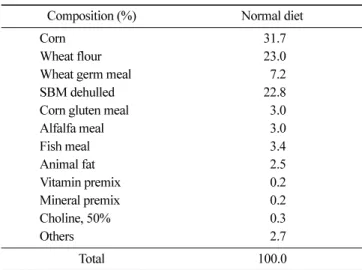
으며 그 조성은 Table 1과 같다. 14일 동안 동물사육실의 환경 하에서검역및순화시키면서 비만이유도됨을외견상으로확인 한후시험에사용하였다.
실험군은 총 4군(n=8)으로 8주간각각의 시료를 매일경구투
여하였다. 실험군과투여용량은다음과같다. Control: Saline(5 mL/kg/day) 투여군
Soybean oil: Soybean oil(5 mL/kg/day) 투여군 DG: Diglyceride(5 mL/kg/day) 투여군
DG+CLA:Diglyceride preparation containing conjugated linoleic acid(5 mL/kg/day) 투여군
체중및식이섭취량은 시험물질투여 개시직전, 투여개시후 주 1회, 8주간측정하였다. 조직의지방량측정을위해부검동물 로부터신장주위지방(좌/우), 내장지방, 갈색지방및부고환주위
Table 1. Composition of normal diet (Unit: %)
Composition (%) Normal diet
Corn 31.7
Wheat flour 23.0
Wheat germ meal 7.2
SBM dehulled 22.8
Corn gluten meal 3.0
Alfalfa meal 3.0
Fish meal 3.4
Animal fat 2.5
Vitamin premix 0.2
Mineral premix 0.2
Choline, 50% 0.3
Others 2.7
Total 100.0
지방(좌/우)을적출하여중량을측정하였다.
혈청학적검사로서 시험동물을부검전일 18시간동안절식시 킨후 ether 마취하에 복대동맥으로부터채혈하여 3,000 rpm에서
10분간원심분리후혈청을 분리하였으며, 혈액생화학 자동분석 기(Hitachi 7060, Tokyo, Japan)를이용하여 총콜레스테롤과중성
지방함량을분석하였다.
모든시험결과는평균치와표준편차를사용하여나타내었으며,
대조군과 시험군과의 비교는 Student’s t-test 또는 Fisher’s exact test를사용하였으며, 대조군과 비교하여 p값이 5% 미만일 때를
통계학적으로유의성이 있다고판정하였다. 결과 및 고찰
설치류 단회경구투여 독성시험
본실험에서 시험물질 DG+CLA 2,000 mg/kg과 5,000 mg/kg을
rat에단회 경구투여한결과, 관찰기간(14일) 동안암컷 대조군 및 시험물질 투여군에서 사망례는 관찰되지 않았다. 관찰기간
동안 수컷 대조군 및 수컷 시험물질 투여군, 암컷 시험물질
5,000 mg/kg 투여군에서는시험물질로기인한외견상의일반증상
은관찰되지않았다(Table 2). 그러나 암컷대조군에서투여후 1
시간째에연변(soft stool) 2례및점액변(mucous stool) 1례가관
찰되었고, 투여후 4시간째에점액변 1례가관찰되었다. 암컷시 험물질 2,000 mg/kg 투여군에서 투여 후 1시간째에 연변 1례를,
투여후 6시간째에점액변 1례가관찰되었으나, 투여 2일부터암
컷대조군 및시험물질 2,000 mg/kg 투여군에서특이한일반증상 은관찰되지 않았다.
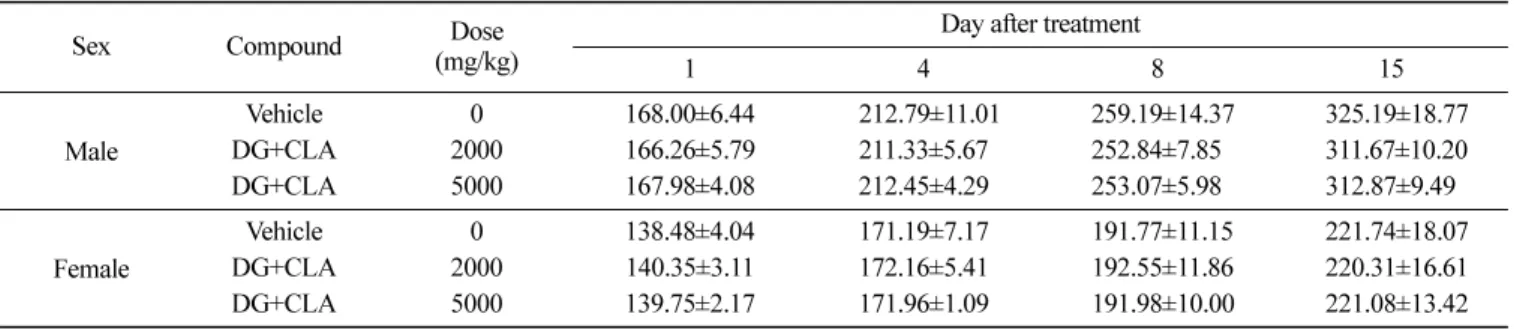
체중변화 측면에서시험물질 투여당일(1일째), 4, 8, 15일째
체중을 측정한 결과, 암·수컷시험물질 투여군모두에서 대조 군과비교하여뚜렷한차이가 없었으며순조로운체중 증가가관 찰되었다(Table 3). 실험완료후부검하여뇌, 신장, 심장, 폐, 간,
위, 장, 정소, 난소등의장기를관찰한결과, 암컷대조군및암·
수 시험물질 투여군 모두에서 특이한 소견은 관찰되지 않았다
(Table 4). 수컷 대조군 1례에서 부고환(epididymis), 정낭(seminal vesicle) 및고환(testis)에서 소형(small) 소견이 관찰되어조직병리 학적 검사를실시하였다. 조직병리학적 검사결과, 수컷대조군 1례에서부고환, 정낭및 고환의위축(atrophy) 소견이 관찰되었 으나, 이는자연발생적인소견으로사료되어진다.
따라서 SD rat을이용한 DG+CLA의단회경구투여독성시험결
과, 사망동물및일반증상, 체중변화, 육안적해부소견, 조직병리학
적검사결과에따라 최고농도 5,000mg/kg body weight에서어떠 한이상변화도나타나지않아본실험에서는 LD50값을 5,000mg/kg body weight 이상으로산출하였다.
항비만 효과 시험
DG+CLA의체지방축적억제효과를 알아보기위하여유전적
으로비만이 유도된 obese fa/fa male Zucker rats를대조군, soy- bean oil 투여군, DG 투여군및 DG+CLA 투여군으로 분류하였
다. 그런다음, 일반식이를 섭취시키고대조군은멸균생리식염수 를, 투여군은각각의물질을 5 mL/kg의용량으로 8주간 1일 1회 경구투여 하였다. 체지방의억제효과를관찰하기 위한지표로 체
중의 변화, 식이효율, 혈청지질함량 및 지방조직무게 등을측정 하였다.
Table 2. Clinical signs of acute oral toxicity study in SD rats(n=5)
Sex Compound Dose(mg/kg) Clinical sign
Day after treatment
1 2 3 4 5 6 7 8 9 10 11 12 13 14 15
0.5 hr 1 hr 2 hr 4 hr 6 hr
Male Vehicle 0 NAD1) 5 5 5 5 5 5 5 5 5 5 5 5 5 5 5 5 5 5 5
DG+CLA2) 2000 NAD 5 5 5 5 5 5 5 5 5 5 5 5 5 5 5 5 5 5 5
DG+CLA 5000 NAD 5 5 5 5 5 5 5 5 5 5 5 5 5 5 5 5 5 5 5
Female
Vehicle 0 NAD 5 3 5 4 5 5 5 5 5 5 5 5 5 5 5 5 5 5 5
Soft stool - 2 - - - -
Mucous stool - 1 - 1 - - - -
DG+CLA 2000 NAD 5 4 5 5 4 5 5 5 5 5 5 5 5 5 5 5 5 5 5
Soft stool - 1 - - - -
Mucous stool - - - - 1 - - - -
DG+CLA 5000 NAD 5 5 5 5 5 5 5 5 5 5 5 5 5 5 5 5 5 5 5
1)NAD: No abnormalities detected
2)DG+CLA: Diglyceride preparation of containing conjugated linoleic acid
Table 3. Body weights of acute oral toxicity study in SD rats (n=5)
Sex Compound Dose
(mg/kg) Day after treatment
1 4 8 15
Male Vehicle 0 168.00±6.44 0212.79±11.01 259.19±14.37 325.19±18.77
DG+CLA 2000 166.26±5.79 211.33±5.67 252.84±7.85 311.67±10.20
DG+CLA 5000 167.98±4.08 212.45±4.29 253.07±5.98 312.87±9.49
Female Vehicle 0 138.48±4.04 171.19±7.17 191.77±11.15 221.74±18.07
DG+CLA 2000 140.35±3.11 172.16±5.41 192.55±11.86 220.31±16.61
DG+CLA 5000 139.75±2.17 171.96±1.09 191.98±10.00 221.08±13.42
Each value represents the mean±SD
체중 변화 및 식이효율
8주동안시험물질을 투여하면서체중변화와식이효율을조사 한결과는 Table 5와같다. 대조군과 soybean oil 투여군 및 DG
투여군은각각 313.4±12.4, 307.4± 12.4, 307.2±11.0 g으로유의할
만한체중증가를 나타내지 않았다. 반면에 DG+CLA 투여군은
대조군과비교하여 3주째부터통계학적으로유의성있게체중이 감소하였다. CLA의 항비만효과는 CLA의 주요 이성질체인 c9, t11-CLA와 t10, c12-CLA가 hormone sensitive lipase와 carnitine palmitoyl transferase의 활성을 증가시켜 체지방을 감소시킨다는
연구 결과(35)와 같이 DG+CLA도 obese Zucker 랫드에서 hor- mone sensitive lipase와 carnitine palmitoyl transferase의 활성을 증가시켜체중의감소를유도하는것으로 사료되어진다.
체중의감소가 식이섭취량에 의해 영향을 받는지를 알아보기 위해총시험기간 동안의 1일체중증가량을 1일식이섭취량으 로나누어 1일식이효율을계산한결과, soybean oil 투여군, DG
투여군및 DG+CLA 투여군의 1일식이효율은각각 0.220±0.009, 0.213±0.014, 0.226±0.017 g으로 대조군(0.185±0.007 g)과 비교해
통계학적으로유의성있게 식이효율이증가하였다. Obese Zucker rats는 유전적으로 leptin수용체에 이상을 가진 hyperleptinemia이 나타나는 동물모델인데 DG+CLA 투여가 obese Zucker rat에서
leptin수용체 역할을 하여 식이섭취량을 억제한것으로 사료되며
이는향후에더많은연구가필요하다고 사료되어진다.
혈중 지질 측정
DG+CLA의혈청중콜레스테롤및중성지질에미치는영향을
평가하기 위하여시험 종료후혈액을 채취하여 혈청지질을 분 석하였다(Table 6). 총콜레스테롤은대조군이 142.0±11.4 mg/dL로 나타났고, soybean oil, DG 및 DG+CLA 투여군은 각각 119.3±
8.5, 120.0±6.3 및 100.8±15.4 mg/dL로나타나대조군에비하여유 의성있는 총콜레스테롤의감소를나타냈다. 중성지방은대조군
이 383.8±75.4 mg/dL로나타났고, soybean oil, 및 DG 투여군은 각각 235.5±53.7 mg/dL와 246.5±34.2 mg/dL로 나타나 대조군에 비하여유의성있는중성지방의감소를나타냈다. 그러나 DG+CLA
투여군은 중성지방이 296.3±86.1 mg/dL로대조군에비하여유의
성있는변화를나타내지는 못했지만현저한감소효과를나타냈 다. 대두유는일반적으로 65 mg/100 g 식물성스테롤류를함유하 고 있으며, 이식물성스테롤은 콜레스테롤구조와 매우 비슷한
데, 일반적으로콜레스테롤과 중성지방저하 효과가있는 것으로
알려져있다(36). 식물성스테롤이혈중콜레스테롤을 낮추는효
과는 식물성스테롤이 동물성 콜레스테롤보다지방유화액(미셀)
에대한 친화력이 더높아콜레스테롤 흡수를 저하시키기때문
으로보인다(37). DG 또한인체시험과동물실험결과혈중콜레
스테롤과 중성지방의 농도를저하한다고 알려져있다(38,39). 본 연구에서도대조군에비해 soybean oil과 DG 투여군이콜레스테 롤과중성지방이저하효과가나타났다. 이는적절한용량의 soybean oil, DG 및 DG+CLA가비만으로인한고지혈현상을억제할뿐
만 아니라 관상동맥경화증을비롯한 각종 동맥경화증을 예방할 수있는가능성을보여주는것으로사료된다.
지방조직의 무게측정
DG+CLA가지방축적에 미치는영향을알아보기 위하여실험
종료 후신장주위지방, 부고환주위지방, 내장지방및갈색지방무 게를 측정하였다(Table 7). 신장주위지방 무게는대조군이 21.6±
1.9 g으로 나타났다. Soybean oil, DG 및 DG+CLA 투여군은 각 각 20.8±1.9, 21.2±1.3 및 18.7±1.3 g으로나타나통계학적유의성
은인정되지않았지만, DG+CLA 투여군에서신장주위지방무게
는대조군에비해 현저한감소를 나타냈다. 또한, 부고환지방, 갈
색지방및내장지방무게는 soybean oil 및 DG 투여군을제외한
DG+CLA 투여군에서 대조군(17.7±1.8, 1.8±0.3 및 13.8±1.1 g)과 비교해각각 12.3±1.0, 0.9±0.3 및 11.6±0.7 g으로유의성있는감
Table 4. Histopathological findings of acute oral toxicity study in SD rats
Organs
Sex Male
Compound Vehicle
Dose (mg/kg) 0
No. of examined animals 5
Epididymis
No. of examined 1
Not remarkable 0
Remarkable 1
Atrophy 1
Seminal vesicle
No. of examined 1
Not remarkable 0
Remarkable 1
Atrophy 1
Testis
No. of examined 1
Not remarkable 0
Remarkable 1
Atrophy 1
Table 5. Effect of DG + CLA on food effciency ratio in Zucker rats for 8 weeks (n=8)
Group Dose (mL/kg) 56 days (g)Body weight gainsg/day Food intake (g/day) FER1)
Control 5 313.4±12.4 5.60±0.22 30.23±0.09 0.185±0.007
Soybean oil 5 307.4±12.4 5.49±0.22 24.97±0.06** 0.220±0.009**
DG 5 307.2±11.0 5.49±0.20 25.81±1.41** 0.213±0.014*
DG+CLA 5 225.8±8.4** 4.03±0.15** 17.85±0.66** 0.226±0.017**
1)FER (Food efficiency ratio): body weight/food take Each value represents the mean±SD (*p< 0.05, **p< 0.01).
Table 6. Effect of DG+CLA on serum lipid level in Zucker rats for 8 weeks (n=8)
Group Dose
(mL/kg) Total cholesterol
(mg/dL) Triglyceride (mg/dL)
Control 5 142.0±11.4 383.8±75.4
Soybean oil 5 119.3±8.5* 235.5±53.7*
DG 5 120.0±6.3* 246.5±34.2*
DG+CLA 5 100.8±15.4** 296.3±86.1
Each value represents the mean±SD (*p< 0.05, **p< 0.01).
소를나타냈다.
따라서, obese Zucker rats에서 DG+CLA의투여가 DG와 soy-
bean oil의투여보다월등한지방축적의억제를보이면서항비만
효과가 인정되는 것으로 판단되었고, 이에 대한 명확한 기전은
혈장중의렙틴등의분석을통해최종적으로확증할수있을것 으로사료된다.
요 약
단회경구투여독성평가를위해암·수 rat을이용하여시험 물질 2,000 mg/kg과 5,000 mg/kg을투여한 후 14일동안 관찰한 결과, 투여에기인한사망례및체중변화, 특이한일반증상은관
찰되지 않았다. 암컷 대조군및 시험물질 2,000 mg/kg 투여군에 서투여 1일에연변외 점액변이관찰되었으나, 이는 투여에기인 한일시적인 변화로사료된다. 투여 2일부터는암컷 대조군과시
험물질투여군에서특이한일반증상이관찰되지않았다. 부검시
암컷대조군및암·수시험물질 투여군에서투여에 기인한것 으로판단되는육안소견은 관찰되지않았다. 수컷대조군 1례의 부검결과, 부고환, 정낭 및양측 고환에서 소형 소견 관찰되어,
조직병리학적검사를실시한결과, 부고환, 정낭및고환의위축
소견이관찰되었으나, 이는자연발생적인소견으로사료된다. 이 상으로공액리놀렌산이함유된디글리세라이드 식용유지조성물 을 rat에단회경구투여한결과, LD50값이 rat kg당 5,000 mg 이
상으로판단되며, 단회경구투여에 대한독성을 나타내지않는
것으로판단된다. 항비만효과를조사하기위해 obese Zucker rat
에 saline, soybean oil, DG, DG+CLA를 8주간투여한후효과를 비교하였다. 체중변화의경우 DG+CLA 투여군은대조군에비하
여투여후 3주째부터통계학적으로유의성있게체중감소를나 타냈다. 1일식이효율측정의결과, soybean oil, DG 및 DG+CLA
투여군이 대조군에비하여 통계학적으로 유의성 있는 1일식이 효율의증가를나타냈다. 혈중지질분석의결과, 총콜레스테롤수
치에서 soybean oil, DG 및 DG+CLA 투여군모두 대조군에비 하여통계학적으로 유의성 있게총콜레스테롤 함량이 감소되었 으며, 중성지방수치는 soybean oil 및 DG 투여군에서만 대조군 에비하여통계학적으로 유의성있게 감소되었다. 지방조직무게
측정결과, DG+CLA 투여군은신장주위지방무게를제외한부고
환주위지방, 갈색지방 및 내장지방무게에서 대조군과 비교하여 통계학적으로 유의성 있게 지방조직무게가 감소되었다. 이상의 결과로 obese Zucker rat에대한 5 mL/kg의 DG+CLA 경구투여는 CLA의주요이성질체인 c9, t11-CLA와 t10, c12-CLA가 hormone sensitive lipase와 carnitine palmitoyl transferase의활성을증가시켜 지방분해를촉진시켜체내지방의 축적을막으며, 중성지방콜 레스테롤과 같은지질대사에 영향을 주어항비만효과를 나타 내는것으로사료되어진다.
참고문헌
1. Kelly GS. Conjugated linoleic acid: A review. Altern. Med. Rev.
6: 367-384 (2001)
2. Nakamura MT, Nara TY. Structure, function, and dietary regula- tion of ∆6, ∆5, and ∆9 desaturases. Annu. Rev. Nutr. 24: 345-376 (2004)
3. Joseph AS, Miller GD. Potential health benefits of conjugated linoleic acid. J. Nutr. 19: 470S-471S (2000)
4. Lin TY. Conjugated linoleic acid concentration as affected by lac- tic cultures and added linoleic acid. Food Chem. 67: 1-3 (1999) 5. Ha YL, Grimm NK, Pariza MW. Anticarcinogens from fried
ground beer: Heat-altered derivatives of linoleic acid. Carcinogen- esis 8: 1881-1887 (1987)
6. Gniwotta C, Morrow JD, Roberts LJ, Kuhn H. Prostaglandin F2- like compounds, F2-isoprostanes, are present in increased amounts in human atherosclerotic lesions. Arterioscl. Throm. Vas. 17: 3236- 3241 (1997)
7. Pariza MW, Ha YL, Benjamin H, Sword JT, Gruter A, Chin SF, Storkson J, Faith N, Albright K. Formation and action of anticar- cinogenic fatty acids. Adv. Exp. Med. Biol.289: 269-272 (1991) 8. Macdonald HB. Conjugated linoleic acid and disease prevention:
A review of current knowledge. J. Nutr. 19: 111S-118S (2000) 9. Sugano M, Tsujita A, Yamasaki M, Yamada K, Ikeda I, Kritchev-
sky D. Lymphaticrecovery, tissue distribution and metabolic effects of conjugated linoleic acid in rats. J. Nutr. Biochem. 8: 38-43 (1997)
10. Yurawecz MP, Hood JK, Pariza MW. Conjugated linoleic acid and atherosclerosis in rabbits. Atherosclerosis 108: 19-25 (1995) 11. Terpstra AH, Javadi M, Beynen AC, Kocsis S, Lankhorst AE,
Lemmens AG, Mohede IC. Dietary conjugated linoleic acids as free fatty acids and triacyglycerols similarly affect body composi- tion and energy balance in mice. J. Nutr. 133: 3181-3186 (2003) 12. Yamasaki M, Mansho K, Mishima H, Kasai M, Sugano M,
Tachibana H, Yamada K. Dietary effect of conjugated linoleic acid on lipid levels in white adipose tissue of sprague-dawley rats. Biosci. Biotechnol. Biochem. 63: 1104-1106 (1999)
13. Gaullier JM, Halse J, Hφye K, Kristiansen K, Fagertun H, Vik H, Gudmundsen O. Supplementation with conjugated linoleic acid for 24 months is well tolerated by and reduces body fat mass in healthy, overweight humans. J. Nutr. 135: 778-784 (2005)
14. Riserus U, Berglund L, Vessby B. Conjugated linoleic acid (CLA) reduced abdominal adipose tissue in obese middle-aged men with signs of the metabolic syndrom: A randomised con- trolled trial. Int. J. Obesity 25: 1129-1135 (2001)
15. Gaullier JM, Halse J, Hφivik HO, Hφye K, Syvertsen C, Nurmin- iemi M, Hassfeld C, Einerhand A, O’Shea M, Gudmundsen O.
Six months supplementation with conjugated linoleic acid induces regional-specific fat mass decreases in overweight and obese.
Brit. J. Nutr. 97: 550-560 (2007)
16. Kamphuis MM, Lejeune MP, Saris WH, Westerterp-Plantenga MS. The effect of conjugated linoleic acid supplementation after weight loss on body weight regain, body composition, and resting metabolic rate in overweight subjects. Int. J. Obesity 27: 840-847 (2003)
17. Smedman A, Vessby B. Conjugated linoleic acid supplementation in humans-metabolic effects. Lipids 36: 773-781 (2001)
Table 7. Effect of DG+CLA on serum lipid level in Zucker rats for 8 weeks (n=8)
Group Dose (mL/kg) Kidney fat (g) Epididymal fat (g) Brown fat (g) Visceral fat (g)
Control 5 21.6±1.9 17.7±1.8 1.8±0.3 13.8±1.1
Soybean oil 5 20.8±1.9 17.9±0.7 1.7±0.2 13.4±1.0
DG 5 21.2±1.3 18.9±1.4 1.7±0.2 13.3±2.7
DG+CLA 5 18.7±1.3 12.3±1.0** 0.9±0.3* 11.6±0.7*
Each value represents the mean±SD (*p< 0.05, **p< 0.01).
18. Thom E, Wadstein J, Gudmundsen O. Conjugated linoleic acid reduces body fat in healthy exercising humans. J. Int. Med. Res.
29: 392-396 (2001)
19. Mougios V, Matsakas A, Petridou A, Ring S, Sagredos A, Melis- sopoulou A, Tsigilis N, Nikolaidis M. Effect of supplementation with conjugted linoleic acid on human serum lipids and body fat.
J. Nutr. Biochem. 12: 585-594 (2001)
20. Nagao K, Wang YM, Inoue N, Han SY, Buang Y, Noda T, Kouda N, OKamatsu H, Yanagita T. The 10-trans, 12-cis isomer of conjugated linoleic acid promotes energy metabolism in OLETF rats. Nutrition 19: 652-656 (2003)
21. Scimeca JA. Toxicological evaluation of dietary conjugated linoleic acid in male fischer 344 Rats. Food Chem. Toxicol. 36:
391-395 (1998)
22. O'Hagan S, Menzel A. A subchronic 90-day oral rat toxicity study and in vitro genotoxicity studies with a conjugated linoleic acid product. Food Chem. Toxicol. 41: 1749-1760 (2003)
23. Yang M, Cook ME. Dietary conjugated linoleic acid decreased cachexia, macrophage tumor necrosis factor-a production, and modifies splenocyte cytokines production. Exp. Biol. Med. 228:
51-58 (2003)
24. Bontempo V, Sciannimanico D, Pastorelli G, Rossi R, Rosi F, Corino C. Dietary conjugated linoleic acid positively affects immunologic variables in lactating sows and piglets. J. Nutr. 134:
817-824 (2004)
25. Soni MG, Kimura H, Burdock GA. Chronic study of diacylglyc- erol oil in rats. Food Chem. Toxicol. 39: 317-329 (2001)
26. Chengelis CP, Kirkpatrick JB, Marit GB, Morita O, Tamaki Y, Suzuki H. A chronic dietary toxicity study of DAG (diacylglyc- erol) in Beagle dogs. Food Chem. Toxicol. 44: 81-97 (2006) 27. Kasamatsu T, Ogura R, Ikeda N, Morita O, Saigo K, Watabe H,
Saito Y, Suzuki H. Genotoxicity studies on dietary diacylglycerol (DAG) oil. Food Chem. Toxicol. 43: 253-260 (2005)
28. Takei A, Toi T, Takahashi H, Takeda Y, Moriwaki J, Takase H, Katsuragi Y. Effects of diacylgcerol-containing mayonnaise on lipid metabolism and body fat in human. Jpn. Nutr. Food 4: 89- 94 (2001)
29. Watanabe H, Tokimitsu I. Digestion and absorption of diacylglyc- erol. p.30. In: Diacylglycerol Oil, Katsuragi Y, Yasukawa T, Mat- suo N, Flickinger BD, Toimitsu I, Matlok MG (eds). American Oil Chemistsí Society, Champaign, IL, USA (2004)
30. Matsuyama T, Shoji K, Watanabe H, Shimizu M, Saotome Y,
Nagao T, Matsuo N, Hase T, Tokimitsu I, Nakaya N. Effects of diacylglycerol oil on adiposity in obese children: Initial communi- cation. J. Pediatr. Endoc. Met. 19: 795-804 (2006)
31. Teramoto T, Watanabe H, Ito K, Omata Y, Furukawa T, Shimoda K, Hoshino M, Nagao T, Naito S. Significant effects of diacylg- lycerol on body fat and lipid metabolism in patients on hemodial- ysis. Clin. Nutr. 23: 1122-1126 (2004)
32. Maki KC, Davidson MH, Tsushima R, Matsuo N, Tokimitsu I, Umporowicz DM, Dicklin MR, Foster GS, Ingram KA, Anderson BD, Frost SD, Bell M. Consumption of diacylglycerol oil as part of a reduced-energy diet enhances loss of body weight and fat in comparison with consumption of a triacylglycerol control oil.
Am. J. Clin. Nutr. 76: 1230-1236 (2002)
33. Nagao T, Watanabe H, Goto N, Onizawa K, Taguchi H, Matsuo N, Yasukawa T, Tsushima R, Shimasaki H, Itakura H. Dietary diacylglycerol suppresses accumulation of body fat compared to triacylglycerol in men in a double-blind controlled trial. J. Nutr.
130: 792-797 (2002)
34. Yasunaga K, Glinsmann WH, Seo Y, Katsuragi Y, Kobayashi S, Flickinger B, Kennepohl E, Yasukawa T, Borzelleca JF. Safety aspects regarding the consumption of high-dose dietary diacylg- lycerol oil in men and women in a double-blind controlled trial in comparison with consumption of a triacylglycerol control oil.
Food Chem. Toxicol. 42: 1419-1429 (2004)
35. Moon HS, Lee HG, Seo JH, Chung CS, Kim TG, Kim IY, Lim KW, Seo SJ, Choi YJ, Cho CS. Down-regulation of PPARgamma2- induced adipogenesis by PEGylated conjugated linoleic acid as the pro-drug: Attenuation of lipid accumulation and reduction of apoptosis. Arch. Biochem. Biophys. 456:19-29 (2006)
36. Normen L, Dutta P, Lia A, Andersson H. Soy sterol esters and beta-sitostanol ester as inhibitors of cholesterol absorption in human small bowel. Am. J. Clin. Nutr. 71: 908-913 (2000) 37. Becker M, Staab D, von Bergman K. Long-term treatment of
severe familial hypercholesterolemia in childhood with sitosterol and sitostanol. J. Pediatr. 122: 292-296 (1993)
38. Watanabe H, Onizawa K, Taguchi H, Kobori M, Chiba H, Naito S, Matsuo N, Yasukawa T, Hattori M, Shimasaki H. Nutritional characterization of diacylglycerols in rats. J. Jpn. Oil Chem. 46:
301-307(1997)
39. Yasukawa T, Yasunaga K. Nutritional functions of dietary dia- cylglycerols. J. Oleo Sci. 50: 427-432 (2001)