Print ISSN: 2288-4637 / Online ISSN 2288-4645 doi:10.13106/jafeb.2021.vol8.no8.0399
A Prediction of Stock Price Movements Using Support Vector Machines in Indonesia
Ervandio Irzky ARDYANTA
1, Hasrini SARI
2Received: April 20, 2021 Revised: July 04, 2021 Accepted: July 15, 2021
Abstract
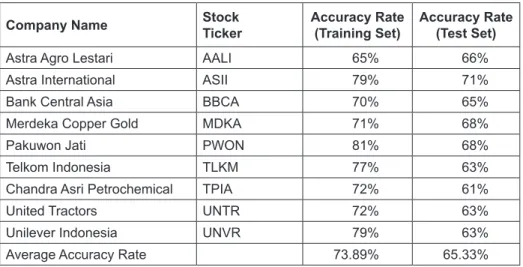
Stock movement is difficult to predict because it has dynamic characteristics and is influenced by many factors. Even so, there are some approaches to predict stock price movements, namely technical analysis, fundamental analysis, and sentiment analysis. Many researches have tried to predict stock price movement by utilizing these analysis techniques. However, the results obtained are varied and inconsistent depending on the variables and object used. This is because stock price movement is influenced by a variety of factors, and it is likely that those studies did not cover all of them. One of which is that no research considers the use of fundamental analysis in terms of currency exchange rates and the use of foreign stock price index movement related to the technical analysis. This research aims to predict stock price movements in Indonesia based on sentiment analysis, technical analysis, and fundamental analysis using Support Vector Machine. The result obtained has a prediction accuracy rate of 65,33% on an average. The inclusion of currency exchange rate and foreign stock price index movement as a predictor in this research which can increase average prediction accuracy rate by 11.78% compared to the prediction without using these two variables which only results in average prediction accuracy rate of 53.55%.
Keywords: Fundamental Analysis, Sentiment Analysis, Stock Prediction, Support Vector Machine, Technical Analysis JEL Classification Code: E44, E47, G11, G17
and quantitative measurement based on the company’s profile and financial condition, market condition, political, business, and economic climate (Hur et al., 2006). But with the development of informational technology and social media, there is also the third technique known as sentiment analysis (Derakhshan & Beigy, 2019; Sert et al., 2020). The sentiment is defined as perspective or opinion of a person – in this case, an investor – on information (Hu et al., 2012). Several researches have attempted to determine the relationship between sentiment and stock prices. Nguyen and Pham (2018) found that sentiment has significant effect on the stock market. Tetlock (2007) observed that adverse news reported in the Wall Street Journal might lead to a drop in the share price. Then, Tetlock et al. (2008) revealed that stock price movements in the United States are influenced by news sentiment which is provided by news media outlets such as Wall Street Journal and Dow Jones News Service.
Baker and Wurgler (2007) argued that, with the rapid development of computer capabilities, the concern now is how to assess investor sentiment and measure its impact through stock price prediction, rather than whether or not it impacts stock price. Artificial intelligence has been used by many studies to evaluate the effects of sentiment on the
1
First Author and Corresponding Author. Researcher, Department of Industrial Engineering and Management, Faculty of Industrial Technology, Institut Teknologi Bandung, Indonesia [Postal Address:
Jl. Ganesa 10, Coblong, Bandung, West Java, 40132, Indonesia]
Email: [email protected]
2
Researcher and Lecturer, Department of Industrial Engineering and Management, Faculty of Industrial Technology, Institut Teknologi Bandung, Indonesia. Email: [email protected]
© Copyright: The Author(s)
This is an Open Access article distributed under the terms of the Creative Commons Attribution Non-Commercial License (https://creativecommons.org/licenses/by-nc/4.0/) which permits unrestricted non-commercial use, distribution, and reproduction in any medium, provided the original work is properly cited.
1. Introduction
Stock is difficult to predict because its movement is affected by many factors and has dynamic characteristic.
Even so, several techniques for predicting stock price
movement have been developed (Masoud, 2017). There
are two traditional techniques that are commonly used by
investors. It forecasts stock price movements using past
data such as opening and closing prices, transaction volume,
average stock price, and so on. The second technique
that is known as fundamental analysis uses qualitative
stock price movements through prediction as computer capabilities have improved. Artificial intelligence-based stock price prediction can identify relationships and patterns in the variables, offering better results than traditional statistics (Maqsood, et al., 2020). The results of previous studies, on the other hand, varied depending on the object and variables analyzed. These inconsistencies are linked to the fact that each country’s investor behaviour and capital market conditions are different (Corredor et al., 2015). Many factors can influence stock price changes, and the factors employed in those studies are thought to be insufficient to reflect all of them. As a result, to predict stock price movements, it is important to combine analysis techniques such as sentiment analysis with both technical and fundamental analysis.
According to Wu et al. (2012) combining multiple analysis techniques can enhance stock price prediction abilities. There is, however, no research that attempts to consider the use of fundamental analysis, such as currency exchange rates, and technical analysis in terms of stock price index movements in other countries to predict price fluctuations in the stock market, particularly in Indonesia.
Several research on Indonesian stocks, such as by Afrianto et al. (2013), Rizkiana et al. (2017), as well as Yasin et al.
(2014), only consider one aspect of the analysis into account, despite the fact that several factors might affect stock price movements. The use of just one aspect is considered to be insufficient to describe all available factors. Based on the preceding description, it is apparent that no research has been done to try to predict stock price movements in Indonesia using the three types of analysis discussed earlier, namely sentiment analysis, technical analysis, and fundamental analysis. So, the problem statement in this research is how to predict stock price movements in Indonesia based on sentiment analysis, technical analysis, and fundamental analysis using Support Vector Machine (SVM).
There are two objectives in this research. The first objective is to predict stock price movements in Indonesia based on sentiment analysis, technical analysis, and fundamental analysis using Support Vector Machine (SVM), and the second objective ought to measure the impact of sentiment analysis, technical analysis, and fundamental analysis on the stock price movement’s prediction result.
2. Literature Review
According to Vijh et al. (2020), stock price prediction employing an artificial intelligence-based approach can enhance forecast accuracy by 60% to 86% when compared to traditional statistics. Li et al. (2020) used artificial intelligence approaches such as LSTM based on sentiment analysis to predict stock price movement in China, with prediction accuracy ranging from 40% to 80%. Even though
in previous research it was found that investor sentiment affects stock prices, however Rizkiana et al. (2018) discovered that investor sentiment does not affect stock prices; rather, stock prices affect investor sentiment. This is because the study’s data comes from an investor’s forum, which contains discussion based on information as a type of reaction, rather than a response trigger that will generate sentiment, such as news. Rizkiana et al. (2019) investigated the effects of sentiment on stock price movements using news as one of their data sources. Nevertheless, this research yielded an insignificant result. This is due to the fact that the amount of news used in this study is very limited, and it only examines news linked to the object of study, thus it cannot represent all information or news on the stock market circulating in Indonesia. As a result, according to Rizkiana et al. (2019), the data sources utilized to examine the effect of sentiment must be carefully selected because not all data on the internet can be utilized to reflect investor sentiment.
Some studies, such as those conducted by Alshammari et al. (2020), rely only on historical closing prices to forecast stock market volatility. Meanwhile, another study such as by Picasso et al. (2019) attempted to predict stock price movement by combining investor sentiment analysis gathered from the news with technical analysis such as historical price, with forecast accuracy ranging from 50%
to 68%. The result obtained by Picasso et al. (2019) is in line with a theory proposed by Wu et al. (2012) that stated combining various analysis techniques can enhance stock price prediction capabilities. So, to predict stock price movements, it is important to combine analysis techniques such as sentiment analysis with both technical and fundamental analysis. However, no research has been done to investigate the use of fundamental analysis in terms of USD-IDR exchange rates and technical analysis in terms of stock price index movements in other countries to predict the movement of stock prices, particularly in Indonesia.
According to Wong (2017), one of the most important variables impacting stock fluctuations is the currency exchange rate. According to Delgado et al. (2018), the strengthening of a country’s currency exchange rate will affect the strengthening of that country’s stock price index.
Goh et al. (2021) mentioned that the exchange rate has a significant effect on the Indonesian stock market index.
Dong and Yoon (2019) also mentioned that in emerging economies such as Indonesia, there is a linkage between stock price movement and exchange rate of currencies.
Furthermore, besides currency exchange rate, previous
studies have also not taken into account the use of stock
price index movement in other countries, even though that
Mensi et al. (2014) and Lee and Chou (2020) found that
stock price index movement in one country, particularly in
the United States, can influence the stock price movements
in other countries, including Indonesia. There are several
contributions in this research. First, unlike prior studies that used comments and opinions from social media to assess sentiment analysis, this study employs news about the economy, business, and politics that circulates in Indonesia as a data source. Furthermore, the amount of news data used in this study is larger than that used in Rizkiana et al. (2019), and it is viewed from a broader perspective, including both microeconomic and macroeconomic perspectives, so it should be able to represent overall investor sentiment toward news circulating in Indonesia. The next novelty is that this study attempts to use fundamental analysis in terms of USD- IDR exchange rate and technical analysis in terms of foreign stock price index movement as predictors in the prediction model. Finally, as far as we know, this is the first research to use Support Vector Machine (SVM) to forecast stock price changes in Indonesia based on sentiment analysis, technical analysis, and fundamental analysis.
3. Methodology
The dependent variable is a variable that is the primary focus of research (Situmorang, 2010). The stock price movements of nine firms listed on the Indonesia Stock Exchange with the largest market capitalization in each sector are the dependent variable in this study. These companies are Astra Agro Lestari (AALI) from the Agriculture sector, Astra International (ASII) from the Miscellaneous Industry sector, Bank Central Asia (BBCA) from the Finance sector, Merdeka Copper Gold (MDKA) from the Mining sector, Pakuwon Jati (PWON) from the Property, Real Estate, and Building Construction sector, Telekomunikasi Indonesia (TLKM) from the Infrastructure, Utilities, and Transportation sector, Chandra Asri Petrochemical (TPIA) from the Basic Industry and Chemicals sector, United Tractors (UNTR) from the Trade, Service, and Investment sector, as well as Unilever Indonesia (UNVR) from the Consumer Goods Industry sector. Meanwhile, predictor variable is defined as a variable that is used to predict another variable or the outcome. (Salkind, 2010; Williams & Levitas, 2019).
The first predictor variable in this study is sentiment analysis, which is news sentiment collected from online news media Twitter accounts like CNBC Indonesia. This news will be analyzed to determine whether it contains positive information that can increase stock prices or negative information that can decrease stock prices. The historical price of stocks, which includes the opening price, closing price, and transaction volume, with technical indicators such as the Moving Average 5-Period which is abbreviated as MA5, Money Flow Index which is abbreviated as MFI, and Relative Strength Index which is abbreviated as RSI is the second and third variable that associated with technical analysis. Technical indicators are calculated using historical price data with a certain formula. The fourth variable which
is also related to the technical analysis consists of foreign stock price index movements comprised of DJI Index (Dow Jones Industrial Average from USA), FTSE (FTSE 100 Index from UK), GSPC (S&P 500 Index from USA), HSI (Hang Seng Index from Hong Kong), IXIC (NASDAQ from USA), N225 (Nikkei 225 Index from Japan), and SSEC (Shanghai Composite Index from Shanghai). The fifth variables cover aspects of fundamental analysis consisting of USD-IDR exchange rate data. Data regarding nine company’s stock price movements, historical prices, currency exchange rates, and foreign stock price index movements are obtained from Yahoo Finance website. Furthermore, using the Python programming language, data processing is carried out to predict stock price movements in Indonesia based on sentiment analysis, technical analysis, and fundamental analysis.
3.1. Historical Stock Prices
The historical price data for each company consists of opening price, closing price, and transaction volume. The data is collected from 6 July 2020 to 11 January 2021 or equal to 124 Indonesia Stock Exchange’s transaction days. The most recent historical price data, particularly historical prices at time t – 1, is utilized to predict stock price movements at time t.
3.2. Foreign Stock Price Index Movements
Foreign stock price index movement data used in this research were taken from several countries. Foreign stock price index movements are defined as 1 if today’s closing price (t) closes higher than the closing price on the previous day (t – 1) or in other words the index price rises. Meanwhile, index movements are defined as 0 if the index’s closing price today (t) is less than or equal to the previous day’s closing price (t – 1), or if the index has decreased or remained unchanged from the previous day’s closing price. The most recent foreign stock price index movement data, specifically the index price at time t – 1, is utilized to anticipate the movement of stock prices at time t.
3.3. Natural Language Processing (NLP)
One of the branches of Artificial Intelligence (AI) is
Natural language processing (NLP) that is used in sentiment
analysis to identify and process human language through
computers. In this study, NLP is used to classify news
related to economics, business, and politics taken from
news media based on the sentiment category, whether the
news contains positive information that can increase stock
prices or contains negative information that can decrease
stock prices. News is collected from CNBC Indonesia’s
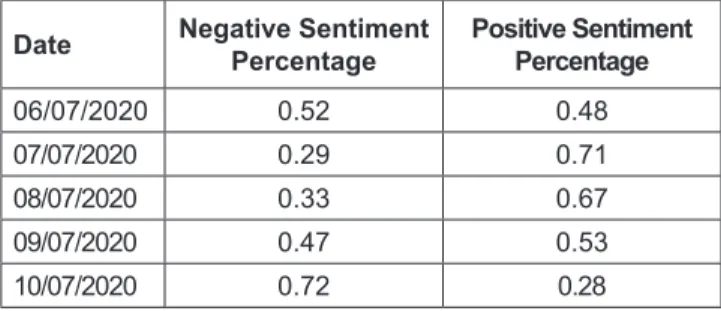
Twitter account from 6 July 2020 to 11 January 2021 or equal to 124 transaction days of the Indonesia Stock Exchange. 33.990 news items are collected over a period of 124 days. After the news is collected it is grouped per day to determine the daily sentiment. Indonesia Stock Exchange’s trading hours start at 09.00 WIB until 15.00 WIB, so news published after 15.00 WIB will be categorized as news for the next day (t + 1) because sentiment towards news that is published after trading hours for that day is closed (t) will be responded during trading hours on the next day (t + 1). The same applies to the news that published on stock market holidays (Saturday, Sunday, and national holidays), where news that is published on holidays will be categorized as news for the next transaction days after the holiday ends. Furthermore, news that has been grouped per day then will be processed with an NLP algorithm using Python programming language to find out the sentiment for each news, whether it is positive or negative. Neutral sentiment will not be used because it does not affect stock price movements. After each news sentiment is known, the amount of news for each sentiment category will be calculated using percentage.
Table 1 is an example of news data that has been grouped per day and the percentage calculated for each sentiment category.
3.4. Technical Indicators
In addition to historical prices, technical analysis in this research also considers the use of technical indicators.
The calculation of technical indicators consists of MA5, MFI, and RSI. The data used in the calculation of technical indicators come from historical prices such as opening prices, closing prices, transaction volumes, and so on which are then calculated using a certain formula to produce a number that shows the trend towards the movement of a stock. For example, an RSI value above 70 indicates overbought, so there is a tendency that the price will move down. The calculation of technical indicators is as follows.
3.4.1. MA5 (Moving Average 5-Period)
A moving average is a variety of technical indicator derived by averaging a stock’s closing price across time.
The 5-period used in this research shows that the average calculation is carried out on the closing price of a stock for the past 5 days. The Moving Average 5-Period formula is as follows (Chakrabarti, 2004).
4 3 2 1