INTRODUCTION
Phylogenetic researches of cyanobacteria have established that phylogenetic relationships sometimes conflict with the morphological classification (Rajaniemi et al. 2005). The comparison of morphological and phylogenetical data is hin- dered by the lack of cultures of several cyanobacterial mor- phospecies and inadequate morphological properties of sequ- enced strains. Furthermore, it is not common for the names of cultured strains to be corrected or updated based on sub- sequent studies, or misidentifications of cultured strains to
be corrected in collection list and databases. Phylogenetic analyses derived from molecular analyses of misidentified cultured strains thus may not reflect new results from morph- ological studies.
Anabaena and Trichormus belong to subsection IV. I based on a bacteriological classification (Rippka et al. 2001), and the order Nostocales and family Nostocaceae according to traditional classification (Komárek and Anagnostidis 1989), with Anabaena variabilis Kützing, Anabaena flos-aquae (Lyngb.) De Brébisson and Trichormus variabilis (Kützing ex Bornet et Flahault) Komárek et Anagnostidis as the type species, respectively (AlgaeBase 2007). The genus Anabaena is characterized by unbranched trichomes that possess inter- calary heterocysts (Whitton 2002), and includes 34 species (NCBI 2011).
─
─ 54 ──
Morphological and Molecular Analyses of Anabaena variabilis and Trichormus variabilis (Cyanobacteria) from Korea
Gang-Guk Choi, Sook-Kyung Yoon
1, Hee-Sik Kim
2, Chi-Yong Ahn
2and Hee-Mock Oh
2,*
Biological Resource Center, Korea Research Institute of Bioscience and Biotechnology, Daejeon 305-806, Korea
1
Department of Life Science, The Catholic University of Korea, Bucheon 420-743, Korea
2
Environmental Biotechnology Research Center, Korea Research Institute of Bioscience and Biotechnology, Daejeon 305-806, Korea
Abstract - - This study characterizes three Anabaena strains and 5 Trichormus strains isolated from Korean waters and 3 Anabaena flos-aquae strains procured from the UTEX based on mor- phological features and molecular analyses. The Anabaena and Trichormus isolates were morpho- logically assigned to A. variabilis Kützing and T. variabilis (Kützing ex Bornet et Flahault) Komárek et Anagnostidis, respectively. The Anabaena and Trichormus strains differed significantly in the mean length of their vegetative cells. The 16S rRNA genes from the Anabaena strains showed a 100% identity to that from A. variabilis ATCC 29413, while the 16S rRNA genes from the Trich- ormus strains showed a 99.9% identity to that from T. variabilis GREIFSWALD. The overall topology was in agreement for the 16S rRNA gene and cpcBA-IGS trees in the both tree-construc- ting methods. In a neighbor-joining tree based on the 16S rRNA gene, the 3 Anabaena strains were asso-ciated with A. variabilis, the 5 Trichormus strains with T. variabilis, and the 3 Anabaena (UTEX) strains were with Nostoc. To date, this is the first report on A. variabilis and T. variabilis strains originating from Korea.
Key words : 16S rRNA, Anabaena, cpcBA-IGS, cyanobacteria, morphological analysis, Trichormus
* Corresponding author: Hee-Mock Oh, Tel. 042-860-4321, Fax. 042-879-8103, E-mail. [email protected]
To examine morphological variations among Korea Ana- baena and Trichormus strains, we collected many samples from different localities throughout Korea, obtaining more than ten strains. This study focused on the combined mole- cular and morphological relationships of the two genera Tri- chormus and Anabaena. Five Trichormus and 3 Anabaena strains isolated from Korea and 3 A. flos-aquae strains from UTEX (Texas, USA) were identified based on their morphol- ogy and molecular analyses.
MATERIALS AND METHODS
1. Isolation and culture of Trichormus and Anabaena strains
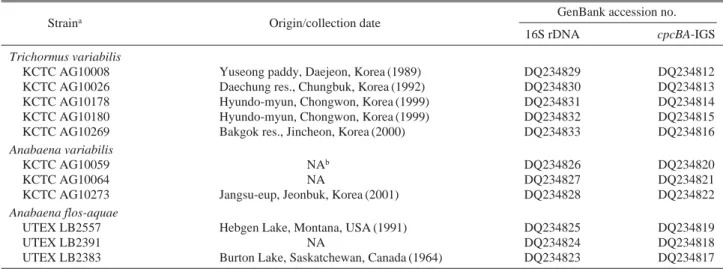
Single trichomes of cyanobacteria were isolated from six surface-water samples from rivers and reservoirs in Korea (Table 1). The isolated strains were identified as Trichormus and Anabaena using a light microscope. Meanwhile, three A. flos-aquae strains were obtained from UTEX Culture Col- lection of Algae. The isolation and culturing of these strains were carried out using standard procedures. The purified unialgal filaments were plated on 1.2% (w/v) agarose (QA- Agarose TM, Qbiogene Inc., OH, USA) plates prepared in a BG-11 medium (Rippka 1988). All the strains were derived from a single trichome using a modified micromanipulator method (Oh and Rhee 1990). The purified filaments growing on the plate were then inoculated into a liquid BG-11 medi- um and cultured at 26±1� C at a photosynthetic photon flux
density of 100 μmol photons m
-2s
-1with cool white light fluorescent lamps (HYG-FPL36W, Heat Engineering Co., Korea) and continuous illumination.
2. Morphological analysis
Strains were indentified according to Komárek and Ana- gnostidis (1989). Morphological and morphometrical studies were measured based on 30 individuals per strain using a light microscope (Microphoto-FXA, Nikon Co., Japan). Mic- rographs were taken with a Nikon CCD camera system (Di- gital Sight DS-5Mc, Nikon Co., Japan). The parameters of isolated strains examined in this study were length and width of vegetative cells, heterocysts, and akinetes and shape of apices under the microscope using 400 times objective lenses.
3. DNA Extraction, PCR amplification, and sequencing
The cells were harvested in the late exponential phase by centrifugation for 10 min at 15,000 xg (4� C) and stored at -20� C. The DNA was extracted using an YGB100 Genomic DNA extraction kit (Real Biotech Co., Taiwan). The 16S rRNA gene was then amplified using the universal primer 27F (5 ′ AGA GTT TGA TCM TGG CTC AG) and 1522R (5 ′ AAG GAG GTG WTC CAR CC) (Cho and Giovannoni 2003), while the cpcBA-IGS was amplified using CPC1F (5 ′ GGC KGC YTG YYT RCG YGA CAT GGA 3′) and CPC1R (5 ′ AAR CGN CCT TGR GWA TCD GC 3′) (Kim et al. 2006). The amplification was carried out in 50 μL of a
Table 1. Cyanobacterial strains used for morphological and phylogenetic analyses in this study
Straina Origin/collection date
GenBank accession no.
16S rDNA cpcBA-IGS
Trichormus variabilis
KCTC AG10008 Yuseong paddy, Daejeon, Korea (1989) DQ234829 DQ234812
KCTC AG10026 Daechung res., Chungbuk, Korea (1992) DQ234830 DQ234813
KCTC AG10178 Hyundo-myun, Chongwon, Korea (1999) DQ234831 DQ234814
KCTC AG10180 Hyundo-myun, Chongwon, Korea (1999) DQ234832 DQ234815
KCTC AG10269 Bakgok res., Jincheon, Korea (2000) DQ234833 DQ234816
Anabaena variabilis
KCTC AG10059 NAb DQ234826 DQ234820
KCTC AG10064 NA DQ234827 DQ234821
KCTC AG10273 Jangsu-eup, Jeonbuk, Korea (2001) DQ234828 DQ234822
Anabaena flos-aquae
UTEX LB2557 Hebgen Lake, Montana, USA (1991) DQ234825 DQ234819
UTEX LB2391 NA DQ234824 DQ234818
UTEX LB2383 Burton Lake, Saskatchewan, Canada (1964) DQ234823 DQ234817
aKCTC, Korea Collection for Type Cultures, Daejeon, Korea; UTEX, Culture Collection of Algae at the University of Texas at Austin, Austin, TX, USA.
bNot available
1x nTaq buffer, 0.2 mM of each dNTP, 10 pmol of each pri- mer, 2.5 U of nTaq polymerase (Biostream Ltd., Korea), and 1 μL (ca. 20 ng) of the isolated DNA. The amplification para- meters for the 16S rRNA gene were 94� C for 4 min, follow- ed by 30 cycles of 94� C for 1 min, 55� C for 1 min, and 72� C for 1.5 min, plus an extension at 72� C for 7 min. For the cpcBA-IGS, the amplification parameters were 94� C for 4 min, followed by 30 cycles of 94� C for 30 sec, 55� C for 30 sec, and 72� C for 45 sec, plus an extension at 72� C for 7 min.
The presence of a PCR product was confirmed on a 0.8%
LF agarose gel (VentechBio Ltd., Korea) run at 100 V with 2 μL of the PCR product and 100 ng of a 1 Kb ladder mole- cular size marker (Fermentor Ltd., Korea).
The PCR products were purified using a Hiyield Gel/PCR DNA fragment Extraction Kit (Real Biotech, Taiwan), then cloned with a p-Drive T-cloning vector (Qiagene Co., Japan).
The plasmids were transferred to Escherichia coli DH-5 α (Real Biotech Co., Taiwan) and isolated using a Hiyield plasmid mini kit (Real Biotech Co., Taiwan). The plasmids were then sequenced (Cosmogen Ltd., Korea) bidirection- ally with SP6, T7, and internal sequencing primers 1100R (5 ′ GGG TTG CGC TCG TTG-3′) for the 16S rRNA gene sequences, and SP6 and T7 for the cpcBA-IGS sequences.
The GenBank accession numbers for the 16S rDNA and cpcBA-IGS are as follows: DQ234812-DQ234833.
4. Sequence alignment and phylogenetic analyses
CLUSTAL-X was used to produce working alignments of the 16S rRNA gene and cpcBA-IGS sequences for the target strains. The final alignments were obtained by manual refine- ment, and ambiguous bases and hypervariable regions re- moved using PHYDIT 3.0 (Chun and Goodfellow 1995). As the highly variable intergenic spacer (IGS) region between the cpcB and cpcA genes did not allow a reliable alignment, these regions were excluded from the analysis. The align- ments used in the phylogenetic analyses consisted of 1,302 bp (16S rRNA gene sequences) and 297 bp (cpcBA-IGS sequ- ences). Phylogenetic trees were constructed using the neigh- bor-joining (NJ) and maximum-parsimony (MP) method from the TREECON software package (Van de Peer and De Wachter 1994). The statistical significance of the branches was estimated by a bootstrap analysis of the tree programs, involving the generation of 1,000 trees. The distances for the NJ tree were estimated using the algorithm of Kimura
(Kimura 1980).
RESULTS
1. Morphological analysis
The trichomes and cells in the preserved samples exhibit- ed typical morphological features of species of Trichormus and Anabaena, respectively (Fig. 1). According to traditional morphological criteria, among the examined 11 strains, 5 were benthic and identified as Trichormus variabilis, while 6 were planktonic and identified as Anabaena variabilis and A.
flos-aquae. The trichomes of the isolated Trichormus strains were entangled and sank to the bottom of the culture flasks.
Under the light microscope, the trichomes were observed as unsheathed, generally immobile, straight, and sometimes bent. The trichomes of the isolated Anabaena strains were solitary. Under the light microscope, the trichomes of the A.
variabilis were single and straight formed. But the trichomes of the A. flos-aquae were coiled forming a solitary irregular spiral fashion.
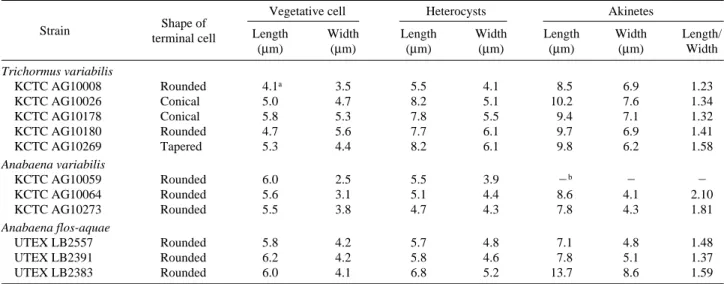
The morphological characteristics of the strains are sum- marized in Table 2. The shapes of the terminal cells were rounded in the case of 8 strains, conical in 2 strains, and tapered in 1 strain. The cells of T. variabilis were 4.1 to 5.8 μm long and 3.5 to 5.6 wide, plus the cell length to width ratio varied from 0.85 to 1.19. The trichomes divided trans- versely and intercellularly, and were composed of cylindri- cal cells. The cells of A. variabilis were 5.5 to 6.0 μm long and 2.5 to 3.8 μm wide, plus the cell length to width ratio varied from 1.45 to 2.40. The trichomes divided transversely and intercellularly, and were composed of cylindrical cells.
The apical cells were generally rounded or long-pointed after a trichome breakage and had no calyptra. Meanwhile, the cells of A. flos-aquae were 5.8 to 6.2 μm long and 4.1 to 4.2 μm wide, plus the cell length to width ratio varied from 1.38 to 1.48.
The Trichormus and Anabaena strains differed significant-
ly in the length to width ratio of the vegetative cell and aki-
netes, where the A. variabilis strains showed wider vegeta-
tive cell and akinetes in comparison to the T. variabilis str-
ains, indicating that the length of the heterocyst was a taxo-
nomic character. Plus, the morphology of the end cells of the
trichomes in the Trichormus strains was rounded, conical,
and tapered, while that in the Anabaena strains was rounded.
2. Sequence of the 16S rRNA and cpcBA-IGS
Near-full-length 16S rRNA gene sequences (1,444 bp) were determined for the 3 A. variabilis strains and 5 T. variabilis strains isolated from Korea and the 3 A. flos-aquae strains from UTEX. GenBank accession numbers are given in Table 1. The overall similarity of the 3 A. variabilis strains (KCTC
AG10059, KCTC AG10064, and KCTC AG10273) was ¤ 99.9%, and among these 3 strains, the similarity with A. var- iabilis ATCC 29413 was 99% (Table 3). Meanwhile, the 5 T. variabilis strains (KCTC AG10008, KCTC AG10026, KCTC AG10178, KCTC AG10180, and KCTC AG10269) shared high similarity values of at least 99.9%, and the simi- larity between 5 strains and T. variabilis GREIFSWALD was
Fig. 1. Light microphotoimages of 5 Trichormus variabilis strains (A), 3 Anabaena variabilis strains (B), and 3 Anabaena flos-aquae strains (C). Magnification==400, Scale Bars==20μm(A: akinete, H: heterocyst).(A) Trichormus variabilis
(B) Anabaena variabilis
(C) Anabaena flos-aquae
99% (Table 3). The 3 A. flos-aquae strains (UTEX LB2557, LB2391, and LB2383) shared similarity values of ¤99.7%, and the similarity with Nostoc entophytum IAM M-267 and N. linckia was 99% and 98%, respectively (Table 3).
The less conserved IGS between cpcB and cpcA, and cor- responding flanking regions (henceforth referred to as cpcBA -IGS) were also sequenced for the strains examined in this study. The region covered the end of the cpcB gene (259 bp), an intergenic spacer (IGS, 90~104 bp), and the end of the cpcA gene (33 bp). The overall similarity of the 3 A. variabilis
strains (KCTC AG10059, KCTC AG10064, and KCTC AG 10273) was up to ¤99.5%, and among these 3 strains, the similarity with Nostoc sp. PCC 7120 was 99% (Table 3). The 5 T. variabilis strains (KCTC AG10008, KCTC AG10026, KCTC AG10178, KCTC AG10180, and KCTC AG10269) shared high similarity values up to at least 99.5% and the similarity between 5 strains and A. compacta 1403/24 was 93~94% (Table 3). The 3 A. flos-aquae strains (UTEX LB 2557, LB2391, and LB2383) shared similarity values of ¤ 99.0%, and the similarity with Aphanizomenon flos-aquae
Table 2. Selected morphological characteristics of cyanobacterial strains studiedShape of
Vegetative cell Heterocysts Akinetes
Strain
terminal cell Length Width Length Width Length Width Length/
(μm) (μm) (μm) (μm) (μm) (μm) Width
Trichormus variabilis
KCTC AG10008 Rounded 4.1a 3.5 5.5 4.1 8.5 6.9 1.23
KCTC AG10026 Conical 5.0 4.7 8.2 5.1 10.2 7.6 1.34
KCTC AG10178 Conical 5.8 5.3 7.8 5.5 9.4 7.1 1.32
KCTC AG10180 Rounded 4.7 5.6 7.7 6.1 9.7 6.9 1.41
KCTC AG10269 Tapered 5.3 4.4 8.2 6.1 9.8 6.2 1.58
Anabaena variabilis
KCTC AG10059 Rounded 6.0 2.5 5.5 3.9 -b - -
KCTC AG10064 Rounded 5.6 3.1 5.1 4.4 8.6 4.1 2.10
KCTC AG10273 Rounded 5.5 3.8 4.7 4.3 7.8 4.3 1.81
Anabaena flos-aquae
UTEX LB2557 Rounded 5.8 4.2 5.7 4.8 7.1 4.8 1.48
UTEX LB2391 Rounded 6.2 4.2 5.8 4.6 7.8 5.1 1.37
UTEX LB2383 Rounded 6.0 4.1 6.8 5.2 13.7 8.6 1.59
aNumbers are means (n==30)
bNot found the heterocysts and akinetes
Table 3. Sequence identities of cyanobacterial strains in this study based on nucleotide-nucleotide BLAST (blastn) of the National Center for Biotechnology Information (NCBI)
GenBank accession no.
Strain 16S rRNAa cpcBA-IGSb
Best match in NCBI database Similarity (%) Best match in NCBI database Similarity (%) Trichormus variabilis
KCTC AG10008 T. variabilis GREIFSWALD 99 A. compacta 1403/24 94
KCTC AG10026 T. variabilis GREIFSWALD 99 A. compacta 1403/24 93
KCTC AG10178 T. variabilis GREIFSWALD 99 A. compacta 1403/24 94
KCTC AG10180 T. variabilis GREIFSWALD 99 A. compacta 1403/24 94
KCTC AG10269 T. variabilis GREIFSWALD 99 A. compacta 1403/24 93
Anabaena variabilis
KCTC AG10059 A. variabilis ATCC 29413 99 Nostoc sp. PCC7120 99
KCTC AG10064 A. variabilis ATCC 29413 99 Nostoc sp. PCC7120 100
KCTC AG10273 A. variabilis ATCC 29413 99 Nostoc sp. PCC7120 100
Anabaena flos-aquae
UTEX LB2557 Nostoc entophytum IAM M-267 99 Aphanizomenon flos-aquae CCAP 1401/1 97 UTEX LB2391 Nostoc entophytum IAM M-267 99 Aphanizomenon flos-aquae CCAP 1401/1 97 UTEX LB2383 Nostoc entophytum IAM M-267 99 Aphanizomenon flos-aquae CCAP 1401/1 97
aAnalysis of 1444 bases of 16S rRNA gene sequences.
bAnalysis of 384 bases of cpcBA-IGS sequences.
Anabaena viguieri TAC433 (AY701559) Anabaena ucrainica TAC448 (AY701565) Anabaena planktonica TAC421 (AY701542) Anabaena solitaria NIES 78 (AY701551)
Anabaena ellipsoides AnaAB (AY701560) Anabaena affinis NIES 40 (AY701541)
Anabaena flos-aquae 1tu35s12 (AJ630423)
Anabaena lemmermannii var. minor NIVA CYA 83/2 (AJ133158) Anabaena circinalis NIVA 82 (AY701572)
Trichormus variabilis HINDAK (AJ630456) Trichormus variabilis KCTC AG10180
Trichormus variabilis GREIFSWALD (AJ630457) Trichormus variabilis KCTC AG10008
Trichormus variabilis KCTC AG10178 Trichormus variabilis KCTC AG10026 Trichormus variabilis KCTC AG10269
Anabaena flos-aquae UTEX LB2557 Anabaena flos-aquae UTEX LB2391
Nostoc entophytum IAM M-267 (AB093940) Anabaena flos-aquae UTEX LB2383 Nostoc linckia IAM M-251 (AB074503)
Nostoc punctiforme PCC 73102 (AF027655) Trichormus azollae Kom BAI./1983 (AJ630454) Anabaena variabilis NIES 23 (AF247593)
Anabaena variabilis KCTC AG10273 Anabaena variabilis ATCC 29413 (AY768387) Anabaena variabilis KCTC AG10064 Anabaena variabilis KCTC AG10059
Anabaena flos-aquae UTCC 64 (AY218829) Nodularia sphaerocarpa PCC 7804 (AJ133181) Anabaena augstumalis SCHMIDKE JAHNKE/4 (AJ630458)
Anabaena flos-aquae LMECYA 165 (EU078523) Anabaena flos-aquae NIES 73 (AY701573)
Anabaena kisseleviana NIES 74 (AY701557) Trichormus doliolum doliolum 1 (AJ630455)
Oscillatoria sancta PCC 7515 (AB039015) Lyngbya aestuarii PCC 7419 (AB039013) Arthrospira fusiformis AB2002/01(AY575923) Arthrospira indica PD1997/ram (AY575931)
Microcystis aeruginosa NIES 98 (U40337) Synechocystis sp. PCC 6803 (AB001339)
Synechococcus sp. PCC 7942 (AF132930) Synechococcus sp. PCC 7943 (AF216949)
Escherichia coli K-12 (AE000460) 100/100
100/100 99/99
97/98
100/100
98/100
100/100
60/76 86/89
98/99 100/100
84/91 55/53
85/94 99/99
99/100 100/100
59/65 60/51 100/100 100/100
57/58 65/66 100/100 60/60
100/100 64/50
99/96
99/99
77/50
0.02
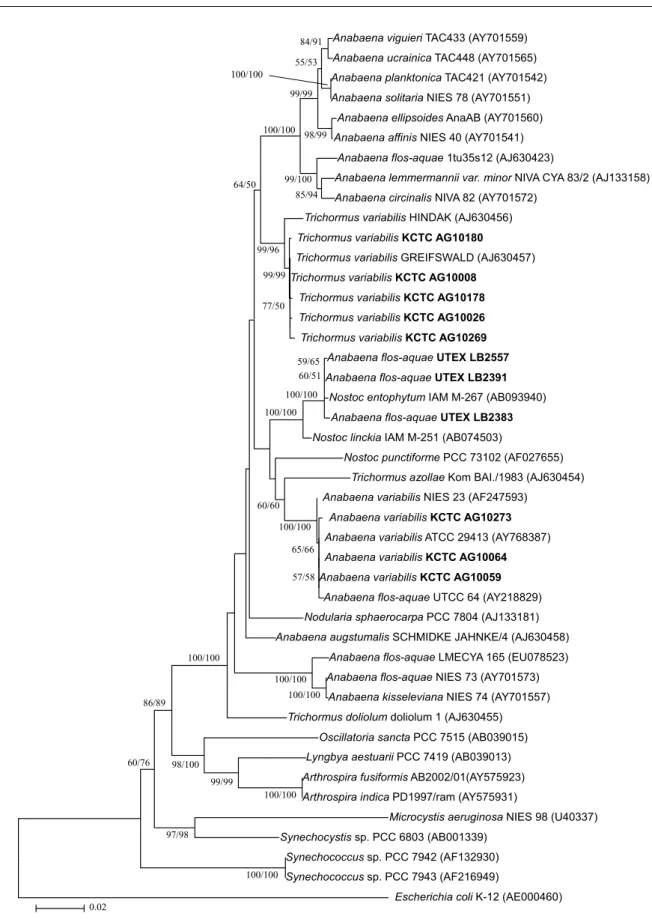
Fig. 2. Phylogenetic tree generated via the neighbor-joining method showing the phylogenetic relationships of the Anabaena and Trichormus strains based on the analysis of ca. 1300 bases of aligned 16S rRNA gene sequences. Sequences obtained during the present study are indicated in bold. Numbers near nodes indicate bootstrap values over or equal to 50% for NJ and MP analyses. Sequences from GenBank are indicated by accession numbers. Outgroup was Escherichia coli K-12 (AE000460). The scale bar represents 0.02 changes per nucleotide.
CCAP 1401/1 was 97% (Table 3).
3. Genetic relationships of the studied strains Since the neighbor-joining (NJ) and maximum-parsimony
(MP) trees were similar, only the NJ tree is presented to show the phylogenetic relationship of the cyanobacterial strains for each gene (Figs. 2 and 3). The GenBank accession num- bers are shown Table 1. A phylogenetic 16S rRNA gene trees were reconstructed from an alignment of 43 sequences, in-
Cyanidium caldarium (S77125)
Anabaena solitaria NIES 78 (AY702221) Anabaena planktonica TAC421 (AY702212) Anabaena viguieri TAC433 (AY702229) Anabaena smithii TAC450 (AY702226) Anabaena ucrainica TAC448 (AY702236) Anabaena spiroides NIES 79 (AY702234) Anabaena ellipsoides AnaHB (AY702230) Anabaena affinis NIES 40 (AY702211)
Anabaena mendotae TAC437 (AY702240) Anabaena circinalis NIVA 82 (AY702242)
Aphanizomenon flos-aquae CCAP 1401/1 (AJ243971) Anabaena flos-aquae UTEX LB2391
Anabaena flos-aquae UTEX LB2557 Anabaena flos-aquae UTEX LB2383 Anabaena compacta CCAP 1403/24 (AY702239)
Trichormus variabilis KCTC AG10026 Trichormus variabilis KCTC AG10178 Trichormus variabilis KCTC AG10008 Trichormus variabilis KCTC AG10269 Trichormus variabilis KCTC AG10180 Anabaena flos-aquae NIES 73 (AY702243) Anabaena kisseleviana NIES 74 (AY702227)
Nodularia sphaerocarpa PCC 7804 (AF367142) Nodularia spumigena PCC 9336 (AF101453) Nostoc sp. PCC 7120 (AF178757)
Anabaena variabilis KCTC AG10059 Anabaena variabilis ATCC 29413 (CP000117) Anabaena variabilis KCTC AG10064 Anabaena variabilis KCTC AG10273
Arthrospira indica PD1997/ram (AY575945) Arthrospira fusiformis AB2002/01 (AY575937) Lyngbya aestuarii PCC 7419 (AJ401187) Oscillatoria sancta PCC 7515 (AJ10185)
Synechocystis sp. PCC 6803 (U34930) Microcystis aeruginosa NIES 98 (AY568685)
100 100/100
94/99
55/55 99/99
55/60 97/99
99/99 61/83
70/74 62/ - - /54 53/60 78/75
60/63 100/99
81/67
99/96 94/95
- /53 51/ - 57/54 78/94
85/87
99/99
0.05
Synechococcus sp. PCC 7942 (AB008546) Synechococcus sp. PCC 7943 (AF223464)
Fig. 3. Phylogenetic tree based on cpcBA-IGS sequences (297 bp), showing clustering of examined Anabaena and Trichormus strains.
Sequences obtained during the present study are indicated in bold. Numbers near nodes indicate bootstrap values over or equal to 50%
for NJ and MP analyses. Sequences from GenBank are indicated by accession numbers. Outgroup was chloroplast Cyanidium caldarium (S77125). The scale bar represents 0.05 changes per nucleotide.
cluding 6 Anabaena and 5 Trichormus isolates, representing the major lineage of cyanobacteria with Escherichia coli as the outgroup (Fig. 2). The cyanobacteria studied here were divided into three main groups, where the first consisted of filamentous cyanobacteria, Anabaena and Nodularia, capa- ble of forming heterocysts and akinetes, the second contain- ed non-heterocystous, filamentous Oscillatoria, Lyngbya, and Arthrospira strains, and the third contained unicellular Microcystis, Synechocystis, and Synechococcus strains. The 5 T. variabilis strains (KCTC AG10008, KCTC AG10026, KCTC AG10178, KCTC AG10180, and KCTC AG10269) clustered with T. variabilis GREIFSWALD. These six sequ- ences shared greater than 99.8% sequence similarity and were supported by 99% bootstrap resamplings in both NJ and MP analysis. Trichormus strains, which were separated morphologically from Anabaena strains, were divided into 3 well-separated clusters and were not monophyletic. The 3 A. variabilis strains (KCTC AG10059, KCTC AG10064, and KCTC AG10273), sequenced in this study, clustered with A.
variabilis ATCC 29413, A. variabilis NIES 23, and A. flos- aquae UTCC 64 and supported by 100% bootstrap resam- plings in both analysis. The 3 A. flos-aquae strains (UTEX LB2557, LB2391, and LB2383), which classified with A.
flos-aquae by morphological analysis, clustered with N. en- tophytum IAM M-267 with high bootstrap support and might actually belong to the genus Nostoc rather than to Trichormus or Anabaena. A. flos-aquae strains (1tu35s12, UTCC 64, and NIES 73) were dispersed in Anabaena subclusters.
The 37 sequences of cpcBA-IGS, including 6 Anabaena and 5 Trichormus isolates, were used in the both (NJ and MP) phylogenetic analysis (Fig. 3). To compare the congru- ence between the 16S rRNA gene and cpcBA-IGS sequences based on the phylogenies of Nostocaceae, 17 strains with both 16S rRNA and cpcBA-IGS sequences were selected from the NCBI database. Unfortunately, the cpcBA-IGS se- quence of T. variabilis was not found in the NCBI database.
A phylogenetic tree was constructed based on an unambigu- ous alignment of 297 bp (Fig. 3). Due to the highly variable nature of the IGS sequence and the resulting alignment diffi- culties, these 297 bp originated almost exclusively from with- in the coding regions of cpcB and cpcA flanking the IGS. The division of the more distantly related groups was in agree- ment with the previously determined 16S rRNA gene-based phylogeny. The Synechococcus strains were the deepest branching group in the 16S rRNA gene tree. Similarly, the
Arthrospira strains associated with Lyngbya aestuarii PCC 7419 in both the cpcBA-IGS and 16S rRNA gene-based tree.
The two sequences were supported by 100% bootstrap values in both NJ and MP analysis. Although Oscillatoria sancta PCC 7515 was associated with L. aestuarii PCC 7419 in the 16S rRNA gene tree, O. sancta PCC 7515 was interestingly associated with M. aeruginosa NIES 98 according to the cpcBA-IGS trees. The A. flos-aquae strains (UTEX LB2557, LB2391, and LB2383) were associated with the A. variabilis strains in the 16S rRNA gene tree. However, according to the cpcBA-IGS sequence tree, the A. flos-aquae strains were associated with the T. variabilis strains.
DISCUSSION
Analyses of the 16S rRNA gene and cpcBA-IGS sequences of the Anabaena and Trichormus strains showed a high simi- larity between the A. variabilis and T. variabilis strains and did not confirm the taxonomic validity of these two genera.
Phylogenetic analyses based on 16S rDNA sequences have already been widely used. However, the 16S rRNA gene is often ineffective for resolving bacterial strains, due to its slow rate of evolution. In addition to analyzing the 16S rDNA sequences (Neilan et al. 1997; Otsuka et al. 1998; Honda et al. 1999), the genes encoding the major light-harvesting acce- ssory pigment proteins, particularly the phycocyanin oper- on (cpc), including the intergenic spacer (IGS) between cpcB and cpcA and the corresponding flanking regions (cpcBA- IGS), have been targeted for phylogenetic studies of cyano- bacteria (Barker et al. 1999). Phycocyanins are specific acce- ssory pigments in Cyanophyta, Rhodophyta, Glaucophyta, and Cryptophyta. In a previous report (Teneva et al. 2005), the length of the IGS separating cpcB and cpcA was found to exhibit a strong relationship with the phylogenetic groups.
However, there were generally lower in the cpcBA-IGS tree than in the 16S rRNA gene tree, due to a smaller number of cpcBA-IGS data bases.
Moreover, to define and delimit the genus Anabaena and
Trichormus, this study also included other cyanobacteria,
and a further goal was to identify specific molecular markers
to fingerprint different strains of Anabaena and Trichormus
and enable the development of tools for strain-specific iden-
tification. The phylogenetic analysis of the 16S rDNA sequ-
ences further reinforced the polyphyletic nature of this taxon.
The difference between the molecular and morphological results may have reflected the existence of species-variant populations or ecotypes adapted to different environmental conditions.
Recently, Baker et al. (2001, 2002) employed a PCR ampli- fication method for the analysis of cpcBA from environmen- tal samples using a primer set previously designed by Neilan et al. (1997) and found a limited cyanobacterial diversity.
Although the primer set was originally designed with 6 cpcBA sequences to study the genetic diversity of several pure cul- ture strains, cpcBA sequence information from various other cyanobacteria has also been deposited in public databases for potential enhanced primer design. Furthermore, since the IGS length of each group of cyanobacteria is different, the cpcBA gene amplification protocol could be directly coupl- ed to length polymorphism analysis techniques, such as T- RFLP, to facilitate rapid monitoring of the cyanobacterial community.
In conclusion, Trichormus and Anabaena strains, which were isolated from Korean waters, were separated by morph- ological and phylogenetic analyses. However, the difference remained between morphology and phylogeny of Trichormus and Anabaena strains. The phylogenetic relationship of the studied strains did not follow the current taxonomic classifi- cation and therefore a revision of the taxonomy of these anabaenoid strains is needed.
ACKNOWLEDGMENT
This study was supported by grants from the Carbon Dio- xide Reduction and Sequestration Research Center (CDRS), a 21st Century Frontier Program and the Advanced Biomass R&D Center (ABC), a Global Frontier Program funded by the Korean Ministry of Education, Science & Technology (MEST).
REFERENCES
AlgaeBase. 2007. AlgaeBase. http://www.algaebase.org, Cited 9 July 2007.
Baker JA, B Entsch, BA Neilan and DB McKay. 2002. Monitor- ing changing toxigenicity of a cyanobacterial bloom by mol- ecular methods. Appl. Environ. Microbiol. 68:6070-6076.
Baker JA, BA Neilan, B Entsch and DB McKay. 2001. Identi-
fication of cyanobacteria and their toxigenicity in environ- mental samples by rapid molecular analysis. Environ. Toxi- col. 16:472-482.
Barker GL, PK Hayes, SL O’Mahony, P Vacharapiyasophon and AE Walsby. 1999. A molecular and phenotypic analy- sis of Nodularia (cyanobacteria) from the Baltic sea. J. Phy- col. 35:931-937.
Cho JC and SJ Giovannoni. 2003. Parvularcula bermudensis gen. nov., sp. nov., a marine bacterium that forms a deep branch in the alpha-Proteobacteria. Int. J. Syst. Evol. Micro- biol. 53:1031-1036.
Chun J and M Goodfellow. 1995. A phylogenetic analysis of the genus Nocardia with 16S rRNA gene sequences. Int. J.
Syst. Bacteriol. 45:240-245.
Honda D, A Yokota and J Sugiyama. 1999. Detection of seven major evolutionary lineages in cyanobacteria based on the 16S rRNA gene sequence analysis with new sequences of five marine Synechococcus strains. J. Mol. Evol. 48:723- 739.
Kim S-G, S-K Rhee, C-Y Ahn, S-R Ko, G-g Choi, J-W Bae, Y -H Park and H-M Oh. 2006. Cyanobacterial diversity based on analysis of cpcBA-IGS during algal blooms in Daechung Reservoir, Korea. Appl. Environ. Microbiol. 72:3252-3258.
Kimura M. 1980. A simple method for estimating evolutionary rates of base substitutions through comparative studies of nucleotide sequences. J. Mol. Evol. 16:111-120.
Komárek J and K Anagnostidis. 1989. Modern approach to the classification system of Cyanophytes. 4. Nostocales. Arch.
Hydrobiol. Suppl. 82:247-345.
NCBI. 2011. National Center for Biotechnology Information HomePage. http://www.ncbi.nlm.nih.gov/.
Neilan BA, D Jacobs, T Del Dot, LL Blackall, PR Hawkins, PT Cox and AE Goodman. 1997. rRNA sequences and evolu- tionary relationships among toxic and nontoxic cyanobac- teria of the genus Microcystis. Int. J. Syst. Bacteriol. 47:693- 697.
Oh H-M and G-Y Rhee. 1990. Preparation of unialgal cultures from natural waters by a micropipette technique. Kor. J.
Phycol. 5:131-136.
Otsuka S, S Suda, R Li, M Watanabe, H Oyaizu, S Matsumoto and MM Watanabe. 1998. 16S rDNA sequences and phy- logenetic analyses of Microcystis strains with and without phycoerythrin. FEMS Microbiol. Lett. 164:119-124.
Rajaniemi P, P Hrouzek, K Kastovska, R Willame, A Rantala, L Hoffmann, J Komarek and K Sivonen. 2005. Phylogene- tic and morphological evaluation of the genera Anabaena,
Aphanizomenon, Trichormus and Nostoc (Nostocales, Cya-nobacteria). Int. J. Syst. Evol. Microbiol. 55:11-26.
Rippka R. 1988. Isolation and purification of cyanobacteria.
Methods Enzymol. 167:3-27.
Rippka R, RW Castenholz and M Herdman. 2001. Subsection IV (formerly Nostocales Castenholz 1989b sensu Rippka, Deruelles, Herdman and Stanier 1979) pp. 562-566. In Ber- gey’s Manual of Systematic Bacteriology, 2nd (Boone DR, RW Castenholz and GM Garrity eds.). Spring-Verlag, New York.
Teneva I, B Dzhambazov, R Mladenov and K Schirmer. 2005.
Molecular and phylogenetic characterization of Phormidi-
um species (Cyanoprokaryota) using the cpcB-IGS-cpcAlocus. J. Phycol. 41:188-194.
Van de Peer Y and R De Wachter. 1994. TREECON for Win-
dows: a software package for the construction and drawing of evolutionary trees for the Microsoft Windows environ- ment. Comput Appl. Biosci. 10:569-570.
Whitton BA. 2002. Cyanophyta (Cyanobacteria). pp. 25-122.
In The Freshwater Algal Flora of the British Isles (John DM, BA Whitton and AJ Brook eds.). Cambridge University press, Cambridge.
Received: 19 January 2012 Revised: 27 February 2012 Revision accepted: 29 February 2012