Print ISSN: 2288-4637 / Online ISSN 2288-4645 doi:10.13106/jafeb.2021.vol8.no9.0301
Determinant Factors for Fourth Industrial Revolution (4IR) Leadership Attributes: An Empirical Study from Malaysia*
Salina DAUD
1, Wan Noordiana WAN HANAFI
2, Nurhidayah MOHAMED OTHMAN
3Received: May 30, 2021 Revised: August 08, 2021 Accepted: August 15, 2021
Abstract
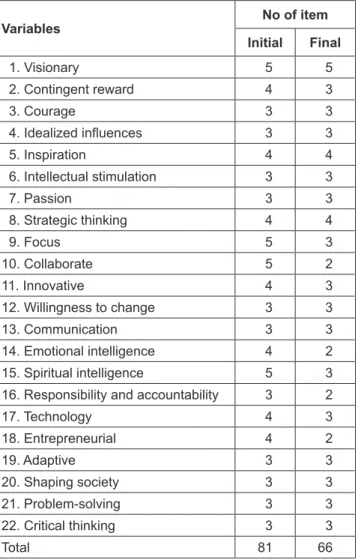
Most leadership styles are generally designed to enhance the cognitive and behavioral skills of leaders with the implicit assumption that this would ultimately translate into high performance. As we are moving towards Industry 4.0, organizations must employ leadership styles that will help the organization succeed. Thus, the objective of this paper is to confirm the determinant factors for Fourth Industrial Revolution (4IR) leadership attributes in Malaysian manufacturing companies. Stratified sampling was used to select the sample. Data was collected using the online survey method, where the response rate was 43 percent. The respondents consisted of respondents aged from 31–40 years old, with 69 respondents. In terms of race, the highest number of respondents are the Malays. Questionnaires were distributed to middle and top-level managers from manufacturing companies which were listed in the Federation of Malaysian Manufacturers (FMM). Confirmatory Factor Analysis (CFA) was used to confirm the reliability and validity of the construct. Based on the analysis, 66 items could be used to measure the 4IR leadership attributes. The validation of 4IR leadership can also provide predictive implications on improving leaders’ performance, given the different attributes confirmed by the findings.
Keywords: Fourth Industrial Revolution, Leadership, Manufacturing, CFA, PLS-SEM JEL Classification Code: M10, M12, M14
of these shifts on how people operate and how companies create value will be experienced in all sectors, economies, and cultures. It will also reshape the future of work. 4IR not only brings along disruptive changes in production and information processing but also revolutionizes employees’
daily work on all hierarchical levels. Due to 4IR, the market process has recently undergone a re-design and transformation. Businesses and governments will need to adjust to these developments while assisting workforce transition.
The 4IR is a new stage of technical development that necessitates organizational change. 4IR is characterized by growing digitization, value chains, distribution models, business models, and product and service interconnection.
Industry 4.0 holds the promise of a new era of globalization.
With the 4IR reshaping how the world lives and works, global leaders face the pressures of preparing their businesses and their workforces for this new era. Many senior executives are less prepared to move towards Industry 4.0, even though the organization has successfully implemented Industry 4.0 technologies.
As widely acknowledged, digitization affects all organizations, including small and medium-sized enterprises (SMEs) in a variety of sectors or industries, including
*Acknowledgments:
Special thanks to the Ministry of Higher Education (MOHE), Malaysia, for funding this research through the Fundamental Research Grant Scheme (FRGS).
1
First Author. Professor, College of Business Management and Accounting, Universiti Tenaga Nasional, Malaysia [Postal Address:
Universiti Tenaga Nasional, Kampus Sultan Haji Ahmad Shah, Muadzam Shah, Pahang, 26700, Malaysia]
Email: [email protected]
2
Corresponding Author. Post-Doctoral, College of Business Management and Accounting, Universiti Tenaga Nasional, Malaysia [Postal Address: Universiti Tenaga Nasional, Kampus Sultan Haji Ahmad Shah, Muadzam Shah, Pahang, 26700, Malaysia]
Email: [email protected]
3
Researcher, College of Graduate Studies, Universiti Tenaga Nasional, Malaysia. Email: [email protected]
© Copyright: The Author(s)
This is an Open Access article distributed under the terms of the Creative Commons Attribution Non-Commercial License (https://creativecommons.org/licenses/by-nc/4.0/) which permits unrestricted non-commercial use, distribution, and reproduction in any medium, provided the original work is properly cited.