Print ISSN: 1738-3110 / Online ISSN 2093-7717 http://dx.doi.org/10.15722/jds.18.6.202006.83
Distribution information safety and factors affecting the intention to use digital banking in Vietnam
Dat Ngoc NGUYEN1, Dat Dinh NGUYEN2, Duy Van NGUYEN3
Received: April 18, 2020. Revised: May 07, 2020. Accepted: June 05, 2020
Abstract
Purpose: Research on the behavior of using digital banking services plays an important role for banks in the context of increasingly competitive banks, not only for domestic banks but also for foreign banks. Along with the development of science and technology brings new approaches to banking industry, digital banking increases the effectiveness of banking activities. Besides, information safety brings different feeling about digital banking system. Therefore, this research evaluates the relationship between Information safety and Intention to use banking services in Vietnam. Research design, data and methodology: With 329 Vietnamese customers using digital banking, reliability test, and structural equation model (SEM) analysis method. Results: the research shows that information safety has directly effects on perceived ease of use (PU), perceived risk (RIS) of customers to digital banking services. Perceived trust (TRU) has a negative impact on RIS. Perceived of usefulness (PEU) has a positive impact on attitude towards service (ATT), and RIS has a negative impact on ATT. RIS, PEU, ATT, convenience and enterprise image have positive effects on intention to use digital banking service.
Conclusions: From the research results, the authors also propose some recommendations to enhance the intention to use digital banking services in Vietnam.
Keywords : Distribution information safety, intention to use, digital banking JEL Classification Code : C38, D70, M2
1. Introduction1718
Services and industry have been positively affected by the development of science and technology (Nguyen, Nguyen, Dang, & Nguyen, 2016; Werthner & Klein, 1999).
That banking services and financial intermediaries operating based on digital platform has been popular in recent years. The digital banking system has brought positive signals to banks with the return over 43%
1 First Author. Doctor, Foreign Trade University, Vietnam. Email:
2 Second Author. Doctor, Faculty of Banking and Finance, Foreign Trade University, Vietnam. Email: [email protected]
3 Corresponding Author, QAGlobal, Hanoi, Vietnam. Email:
ⓒ Copyright: The Author(s)
This is an Open Access article distributed under the terms of the Creative Commons Attribution Non-Commercial License (http://Creativecommons.org/licenses/by-nc/4.0/) which permits unrestricted noncommercial use, distribution, and reproduction in any medium, provided the original work is properly cited.
(Statebank, 2019). Also, technological innovation makes changes in management, marketing when applying the digital banking (Mbama & Ezepue, 2018). Therefore, a research on digital banking services is very important because of continuous changes in technology. New electronic services should be studied and applied to enhance the competition among banks.
The digital banking utility has increased the customers’
satisfaction and loyalty. According to Guru, Shanmugam, Alam, and Perera (2003), about 80% of customers will continue using services if banks use the digital banking services. Therefore, a research to develop the digital banking services will have significant effects in retaining customer loyalty. In fact, there are many researches on developing digital banking services in the world using the theory of reasoned action TRA, Technology Acceptance Model of Davis (1989).
Digital banks in Vietnam are on the rise quite quickly. In their development strategy, many banks also set the goal of developing digital banking, even some banks consider it as
a core business, a key development goal. According to State bank Vietnam's survey, by April 2018, 94% of domestic banks are conducting digital transformation, of which about 42% of credit institutions consider digital banking as a business strategy. Over the past 5 years, payment via mobile banking has grown very strongly, reaching 144 /year.
Meanwhile, other traditional payment methods grew by only 40%.
Vietnam has had studies on its intention using the digital banking services in Vietnam (Dam & Bui, 2017; Wang &
Pho, 2009) using TRA and TAM models with consideration of risk factors and enterprise images. With electric services, customers have concerned information safety during process of using services (Nguyen et al., 2016).
However, most of the research have not considered information safety factor yet. Hence, this research will analyse information safety and factors affecting the intention to use digital banking in Vietnam.
2. Literature review
Digital banking is a banking service when information as well as activities are digitized in transactions.
Manipulations or transactions are based on digital platform using electric equipments as mobile phones, computers. In other words, customers will have not to go to banks to perform transactions vice versa, banks will have not to meet customers directly to complete the transactions between two sides.
Information safety is defined as control or security ability of customers’ information when using services
(Fortes & Rita, 2016; Westin, 1970). Information safety is customers’personal information which is protected in the system (Smith, Milberg, & Burke, 1996). Customers are always worried that their private information may exploited and used in different purposes which they are not informed, and the information believed to come from supplier information sharing or be stolen on the system (Fortes &
Rita, 2016).
Intention using service is considered as customers’
perception or intention on using services in the future (Davis, 1993; Venkatesh, 2000). It is not accidental that the customer leads the intention to use the services of a certain supplier, customers are influenced by many factors in making decision. With TAM model, intention using service are influenced from: (1) Perceived ease of use, (2) Perceived usefulness, (3) Perceived risk, (4) Perceived trust, (5) Convenience; and (6) Attitude toward service. Besides, convenience and enterprise images factors are also shown by some research to influence intention using service of customers.(Chang & Polonsky, 2012; Kang & James, 2004).
3. Research Methodology
3.1. Model and research hypotheses
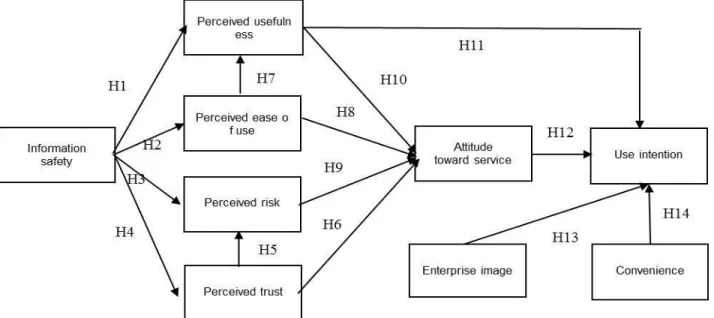
Base on the previous research on using customer behavior, we proposed a model researching on Information safety, Enterprise images, convenience and customer behavior using digital banking services in Vietnam as following figure 1.
Figure 1: Research model
3.2. Research hypotheses
Information safety is concerned by customers in controlling the personal information when conducting online transactions (Fortes & Rita, 2016; Nguyen et al., 2016). That the customers highly appreciate the information safety making the increasing of Perceived usefulness, Perceived ease of use of the product/service (Nguyen et al., 2016; Venkatesh, Morris, Davis, & Davis, 2003). At the same time, when feeling safe, customers will try to get used to and realize easily in use (Venkatesh et al., 2003), Perceived risk also decreases (Van Slyke, Shim, Johnson, & Jiang, 2006) and Perceived trust increases (Eastlick, Lotz, & Warrington, 2006). Therefore, this research proposes the following hypotheses:
H1: Information safety positively affects the Perceived usefulness
H2: Information safety positively affects the Perceived ease of use
H3: Information safety positively affects the Perceived risk H4: Information safety positively affects the Perceived trust
Trust is considered as customer’s belief in the product/service they used (Nguyen et al., 2016). Trust makes Perceived risk decrease in online transactions and creates positive attitude toward the product/service (Ha &
Stoel, 2009; Pavlou, 2003). Therefore, this research proposes the following hypotheses:
H5: Trust positively affects the Perceived risk
H6: Trust positively affects the attitude towards service
Perceived ease of use is customers’ perception in believing that using technology service does not require much effort and bring freedom, comfort (Davis, 1989;
Nguyen et al., 2016). Ease of use helps users save resources, makes them feel useful service (Ha & Stoel, 2009) and have positive attitudes toward the service.
Therefore, this research proposes the following hypotheses:
H7: Perceived ease of use positively affects the Perceived usefulness
H8: Perceived ease of use positively affects the attitude toward service
Perceived risk is customers’ perception in risks such as abuse of customer privacy information, waste of customers’
time (Glover & Benbasat, 2010; Nguyen et al., 2016).
Increase in Perceived risk makes decrease in customers’
positive attitude toward service. Therefore, this research proposes the following hypothesis:
H9: Perceived risk positively affects the attitude toward service
Perceived usefulness is customers’ perception in product/service, the effectiveness in working. The usefulness is expressed by time saving, economic expectation and various utilities (Davis, 1993; Erkan &
Evans, 2016). The Perceived usefulness will increase positive attitude toward service and raise intention using service/purchase intention (Fortes & Rita, 2016). Therefore, this research proposes the following hypotheses:
H10: Perceived usefulness positively affects the attitude toward service
H11: Perceived usefulness positively affects the intention using service
Attitude toward service is customer’s assessment on positive or negative meaning in applying service (Ajzen &
Fishbein, 1975; Nguyen et al., 2016). The customers’
positive attitude toward service will enhance their intention using service (Davis, 1989; Fortes & Rita, 2016). Hence, this research proposes the following hypothesis:
H12: Attitude toward service positively affects the intention using service
Enterprise image is customers’ awareness or perception in a brand name of a supplier, prestige level of an enterprise and it has positively effects on customers’
intention using service when the enterprise receives goodwill from the customers (Kang & James, 2004). The hypothesis as following:
H13: Enterprise image has positive effects on intention to use service/ purchase intention Convenience is the ability to easily access and use the service anytime, anywhere when having the internet supports (Chen, Hsu, & Lin, 2010). The more convenient the service will be, the more likely it will be for customers to use it when traditional service could not be available in many different circumstances. Hence, the hypothesis is:
H14: Convenience has positive effects on intention to use service/ purchase intention
3.3. Research design
Through reference to previous studies, we conducted to build a questionnaire as well as ways to measure the factors in the model. Initially, a pilot will be distributed to customers to review the intelligibility of the questionnaire.
The questionnaire was edited through customer
contributions. After consulting customers on the content of the questionnaire, the questionnaire continued to be distributed to 50 customers and collected for preliminary analysis. The results of the preliminary analysis based on the evaluation of reliability showed that the questionnaire
was reliable and the items reflected the factors for the factors. We then proceeded to distribute the survey on a large scale to ensure the reliability of the questionnaire as well as minimize errors for the analysis in the study.
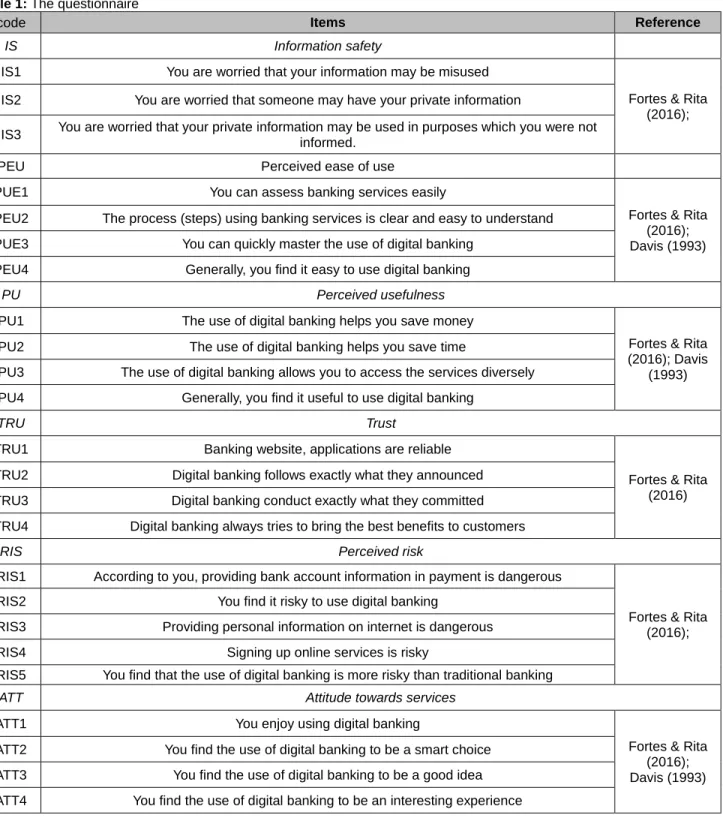
Table 1: The questionnaire
code Items Reference
IS Information safety
IS1 You are worried that your information may be misused
Fortes & Rita (2016);
IS2 You are worried that someone may have your private information
IS3 You are worried that your private information may be used in purposes which you were not informed.
PEU Perceived ease of use
PUE1 You can assess banking services easily
Fortes & Rita (2016);
Davis (1993) PEU2 The process (steps) using banking services is clear and easy to understand
PUE3 You can quickly master the use of digital banking
PEU4 Generally, you find it easy to use digital banking
PU Perceived usefulness
PU1 The use of digital banking helps you save money
Fortes & Rita (2016); Davis
(1993)
PU2 The use of digital banking helps you save time
PU3 The use of digital banking allows you to access the services diversely PU4 Generally, you find it useful to use digital banking
TRU Trust
TRU1 Banking website, applications are reliable
Fortes & Rita (2016) TRU2 Digital banking follows exactly what they announced
TRU3 Digital banking conduct exactly what they committed TRU4 Digital banking always tries to bring the best benefits to customers
RIS Perceived risk
RIS1 According to you, providing bank account information in payment is dangerous
Fortes & Rita (2016);
RIS2 You find it risky to use digital banking
RIS3 Providing personal information on internet is dangerous
RIS4 Signing up online services is risky
RIS5 You find that the use of digital banking is more risky than traditional banking
ATT Attitude towards services
ATT1 You enjoy using digital banking
Fortes & Rita (2016);
Davis (1993) ATT2 You find the use of digital banking to be a smart choice
ATT3 You find the use of digital banking to be a good idea ATT4 You find the use of digital banking to be an interesting experience
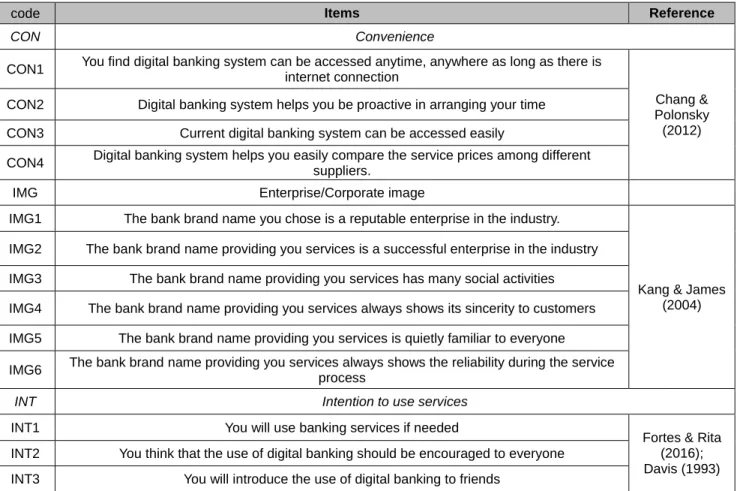
code Items Reference
CON Convenience
CON1 You find digital banking system can be accessed anytime, anywhere as long as there is internet connection
Chang &
Polonsky (2012) CON2 Digital banking system helps you be proactive in arranging your time
CON3 Current digital banking system can be accessed easily
CON4 Digital banking system helps you easily compare the service prices among different suppliers.
IMG Enterprise/Corporate image
IMG1 The bank brand name you chose is a reputable enterprise in the industry.
Kang & James (2004) IMG2 The bank brand name providing you services is a successful enterprise in the industry
IMG3 The bank brand name providing you services has many social activities IMG4 The bank brand name providing you services always shows its sincerity to customers IMG5 The bank brand name providing you services is quietly familiar to everyone IMG6 The bank brand name providing you services always shows the reliability during the service
process
INT Intention to use services
INT1 You will use banking services if needed
Fortes & Rita (2016);
Davis (1993) INT2 You think that the use of digital banking should be encouraged to everyone
INT3 You will introduce the use of digital banking to friends
3.3. Data collection
With the designed questionnaire, we delivered the questionnaires to customers who have used the digital banking service in Vietnam. Form of direct or online coupons by convenience method combined with data collection based on snowball principle. The survey period is from December 2019 to January 2020. The results collected 329 valid questionnaires in analysis. The 329 collected questionnaires are appropriate and reliable enough for multivariate analysis in the study (Hair, Black, Babin, Anderson, & Tatham, 2006; Tabachnick & Fidell, 2006).
4. Result
4.1. Descriptive statistics for surveyed subjects
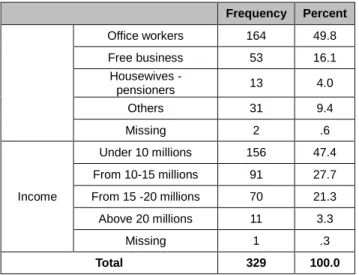
The statistic describes the survey data with 111 men accounting for 33.7% and 218 women accounting for 66.3%. In terms of degree level, most of customers are university-educated (271 people account for 82.4%);
followed by customers with postgraduate qualification (50 people accounted for 15.2%);
high school education accounted for the least proportion with 8 people, accounting for 2.4%. The surveyed customers are mostly office workers (164 people accounting for 49.8%); The group of customers in the group of free and other businesses accounted for the least proportion (the proportion of housewives - pensioners accounted for 4%; other occupations accounted for 9.4%).
Income of the main survey subjects is less than 10 million (156 people accounting for 47.4%); The lowest rate of income is over 20 million (11 customers account for 3.3%).
Table 2: Customer characteristic description
Frequency Percent
Gender Male 111 33.7
Female 218 66.3
Education
High school 8 2.4
Under Graduated 271 82.4
Post Graduated 50 15.2
Job Students 66 20.1
Frequency Percent
Office workers 164 49.8
Free business 53 16.1
Housewives -
pensioners 13 4.0
Others 31 9.4
Missing 2 .6
Income
Under 10 millions 156 47.4 From 10-15 millions 91 27.7 From 15 -20 millions 70 21.3
Above 20 millions 11 3.3
Missing 1 .3
Total 329 100.0
4.2.Evaluating the scale reliability and validity
Two criteria to evaluate a factor that is reliable when measuring through observed variables are Cronbach’s Alpha coefficient greater than 0.6 and the item-total correlation greater than 0.3. Observed variables with a total correlation coefficient less than 0.3 will be excluded from the factor and considered as garbage variables. After elimination, this observed variable will not be included and in subsequent analyzes.
Table 3: The reliability test Contructs
(Items) AVE (%) Composite
Reliability
Cronbach' s Alpha
IS(3) 0.781 0.824 0.822
PEU(4) 0.739 0.825 0.820
PU(3) 0.700 0.741 0.738
TRU(4) 0.686 0.779 0.775
RIS(5) 0.706 0.832 0.828
ATT(4) 0.814 0.887 0.886
CON(4) 0.760 0.804 0.773
IMG(6) 0.646 0.808 0.819
INT(3) 0.746 0.790 0.787
IS: Information safety; PEU: Perceived ease of use; PU:
Perceived usefulness; TRU: Trust; RIS: Perceived risk;
ATT: attitude toward; CON: Convenience; IMG: Corporate image; INT: Intention to use.
The results confirmatory the factor analysis that: Chi- square / df = 1.842 is less than 3, CFI = 0.914; TLI = 0.902;
IFI = 0.915 are greater than 0.9, RMSEA = 0.051 is less than 0.08. This shows that the theoretical model is
compatible with real data. The factor loading of items are greater than 0.5 (after remove CON4 because the factor loading of CON4 =0.486 is less than 0.5), so it is possible to see the model of convergence validity.
The results of the general reliability analysis and the extracted variance show that the factors are the scales with load factor greater than 0.5, reaching the convergence validity. The composite reliability of the factors above 0.7 and the Average Variance Extracted (AVE) are greater than 50%. This shows that the factor scales in the formal sample have achieved the necessary reliability (Table 3).
Factor loading greater than 0.5 in each factor are considered to have convergence validity and the square root of the variance greater than the correlation between research concepts are concepts with discriminant validity (see table 4)
Table 4: Discriminant validity
PEU PU TRU RIS ATT CON IMG PRI PEU 0.85
PU 0.60 0.83 TRU 0.46 0.48 0.83
RIS -0.03 -0.03 0.13 0.84 ATT 0.39 0.57 0.18 -0.20 0.90 CON 0.50 0.74 0.43 -0.01 0.53 0.87 IMG 0.44 0.55 0.54 0.24 0.27 0.64 0.80
PRI -0.13 0.04 -0.06 0.46 -0.04 0.05 0.22 0.88
4.3. SEM analysis
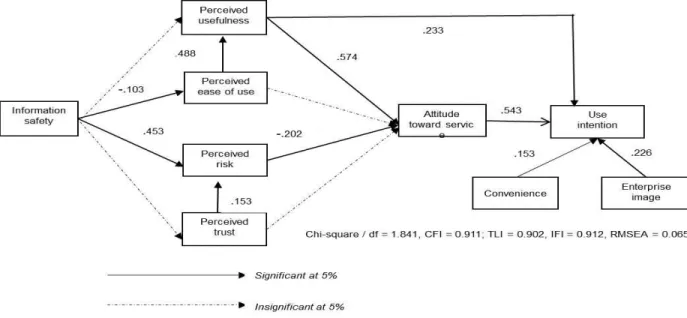
The analysis results using structure model show that the model is suitable for market data (Chi-square / df = 1.841 is less than 3, CFI = 0.911; TLI = 0.902, IFI = 0.912 is greater than 0.9, RMSEA) = 0.065 less than 0.08). With the representative factors obtained from analysis of structural models, the author conducted structural analysis to find out the factors affecting the intention to use digital banking services. With the selected significance level of 5%, the p- value values will be compared with 0.05 to see which factors have an impact and have no impact on the dependent variable. The combined results are presented in the following Figure 2:
The results of SEM model show that Information safety factor (IS) has a negative effect on Perceived ease of use (PEU) and a positive impact on Perceived risk (RIS). In other words, the hypotheses H3 and H4 are accepted. That Information safety has a negative effect on Perceived ease of use means the higher level of information safety customers feel, the more difficult they will find in the service features.
This result shows that the information safety is concerned excessively by the customers when they think that the
greater information safety with digital banking services, the more necessary features to design more secure access, making it difficult to use. Customers need better control in their private information when using the utilities of the service. Hence, the secured information is tightened with the utilities to ensure the information security leading to
limitations in ease of use (Lee, 2009; Sayar & Wolfe, 2007).
The utilities will be limited if information security is put on top and information safety becomes barriers in developing the utilities of service (Yoon & Barker Steege, 2013).
Meanwhile, when customers pay more attention into the information safety, their perceived risk also increases.
Figure 2: The result of SEM
That Information safety does not affect Perceived usefulness (PU) and TRU shows the hypotheses H1 and H4 are rejected. Information security is considered imperative in online utility services. Customers are well aware that the importance of information safety is not the factor which reflects the usefulness of the service. Although the service has further improved information safety, the customers still feel the Perceived usefulness has not changed (the usefulness of digital banking has been confirmed to customers). At the same time, Information safety does not affect Perceived trust, which indicates that the more customers pay attention to information safety, the less they pay attention or care about trust in digital banking services.
Trust (TRU) has positive effects on Perceived risk, so the hypothesis H5 is accepted. Besides, that TRU does not affect the Attitude towards service (ATT) shows that the hypothesis H6 is rejected. The customers trust in digital banking makes good attitude towards services (Pavlou, 2003). Good services bring customers comfort and make them satisfied then have good reviews on the service.
Perceived ease of use has positive effects on Perceived usefulness of digital banking services, which indicates that the hypothesis H7 is accepted. That PEU does not have impacts on ATT shows the hypothesis H8 is rejected. The Perceived ease of use helps users save resources, or make them feel the useful service (Ha & Stoel, 2009). However,
the Perceived ease of use does not have impacts on ATT, indicating that customers have been able to adapt well to electronic applications. Therefore, the access to electronic applications is not a barrier for customers.
In addition, the Perceived usefulness has positive effects on ATT and Perceived Risk has negative effects on ATT.
Hence, two hypotheses H8 and H9 are accepted. The more useful customers feel about digital banking, the more they think it is deserved and experienced. The utilities help customers conduct many transactions on online system (Ha
& Stoel, 2009; Nguyen et al., 2016). Consequently, the customers have good attitude towards digital banking services. The Perceived risk has negative effects on the attitude towards services, showing that in order to have a good Attitude towards services, besides the Perceived usefulness factor, customers need to feel less risky in using digital banking services (Glover & Benbasat, 2010).
For the dependent variable is the intention to use the service (INT): The perceived usefulness has a positive impact on the intention to use digital banking services (βPU=.233). Therefore, the hypothesis H11 is accepted. The attitude towards services also positively influences the intention to use the service (βATT= .543); In other words, the hypothesis H12 is accepted. It is the fact that the Perceived usefulness factors help customers have a good feeling or good attitude towards services, leading to increase the
Intention to use services (Fortes & Rita, 2016). The corporate image factor also affects the Intention to use (βIMG= .226), the hypothesis H13 is accepted. At the same time, the image of enterprises (banks) will help increase the intention to use when the image of banks is highly appreciated (Kang & James, 2004). The Convenience factor also have positive effects on the Intention to use (βCON=.153), the hypothesis H14 is accepted. Finally, the service convenience also brings significant meanings in increasing the customers’ intention to use when they can make transactions anytime, anywhere (Chen et al., 2010).
5. Conclusion
The research results through the structure model show that the factors of Perceived usefulness, Attitude towards services, Convenience and Enterprise image have positive effects on the intention to use digital banking services.
Therefore, to raise the intention to use digital banking services, banks must enhance the usefulness of the services through creating many service utilities. The banks need to build an information technology system which ensures 24/24-hour transaction to increase good reviews on the convenience of digital banking services. In addition, banks should develop their reputation to create a good image in the customers’ awareness.
Meanwhile, the information safety factor has directly impacted on the Perceived ease of use and the Perceive risk of customers in using digital banking services. From the research results, banks should build a strict customer information management system. The customer information should be secured. Confusion in transactions will reduce the perceived security, the Perceived high risk from the customers will have negative effects on the attitude towards services, leading to a decrease in customers’ intention to use digital banking services.
Although the study has achieved the set goals, there are still some limitations regarding the differences between state and non-state banks (Due to the limited number of samples collected, the grouping for analysis was difficult.) Therefore, the proposed study for further studies could collect larger samples and divide them by the types of customers using state and non-state banks.
References
Ajzen, I., & Fishbein, M. (1975). A Bayesian analysis of attribution processes. Psychological Bulletin, 82(2), 261–277.
https://doi.org/10.1037/h0076477
Chang, Y.-W., & Polonsky, M. J. (2012). The influence of multiple types of service convenience on behavioral intentions: The mediating role of consumer satisfaction in a Taiwanese leisure
setting. International Journal of Hospitality Management, 31(1), 107–118. https://doi.org/10.1016/j.ijhm.2011.05.003 Chen, Y.-H., Hsu, I.-C., & Lin, C.-C. (2010). Website attributes
that increase consumer purchase intention: A conjoint analysis.
Journal of Business Research, 63(9), 1007–1014.
https://doi.org/10.1016/j.jbusres.2009.01.023
Dam, V. H., & Bui, T. T. D. (2017). Researching customers’
intention to use electronic banking services at Vietnamese commercial banks. 242, 69–79.
Davis, F. D. (1989). Perceived Usefulness, Perceived Ease of Use, and User Acceptance of Information Technology. MIS
Quarterly, 13(3), 319–340. JSTOR.
https://doi.org/10.2307/249008
Davis, F. D. (1993). User acceptance of information technology:
System characteristics, user perceptions and behavioral impacts. International Journal of Man-Machine Studies, 38(3), 475–487. https://doi.org/10.1006/imms.1993.1022
Eastlick, M. A., Lotz, S. L., & Warrington, P. (2006).
Understanding online B-to-C relationships: An integrated model of privacy concerns, trust, and commitment. Journal of
Business Research, 59(8), 877–886.
https://doi.org/10.1016/j.jbusres.2006.02.006
Erkan, I., & Evans, C. (2016). The influence of eWOM in social media on consumers’ purchase intentions: An extended approach to information adoption. Computers in Human
Behavior, 61, 47–55.
https://doi.org/10.1016/j.chb.2016.03.003
Fortes, N., & Rita, P. (2016). Privacy concerns and online purchasing behaviour: Towards an integrated model. European Research on Management and Business Economics, 22(3), 167–176. https://doi.org/10.1016/j.iedeen.2016.04.002 Glover, S., & Benbasat, I. (2010). A Comprehensive Model of
Perceived Risk of E-Commerce Transactions. International Journal of Electronic Commerce, 15(2), 47–78.
https://doi.org/10.2753/JEC1086-4415150202
Guru, B., Shanmugam, B., Alam, N., & Perera, J. (2003). An Evaluation Of Internet Banking Sites In Islamic Countries.
Journal of Internet Banking and Commerce, 8, 1–11.
Ha, S., & Stoel, L. (2009). Consumer e-shopping acceptance:
Antecedents in a technology acceptance model. Journal of
Business Research, 62(5), 565–571.
https://doi.org/10.1016/j.jbusres.2008.06.016
Hair, J. F., Black, W. C., Babin, B. J., Anderson, R. E., & Tatham, R. L. (2006). Multivariate data analysis 6th Edition. Critique and Reformulation. Journal of Abnormal Psychology, 87, 49–
74.
Hooper, D., Coughlan, J., & Mullen, M. R. (2008). Structural Equation Modelling: Guidelines for Determining Model Fit.
Electronic Journal of Business Research Methods, 6(1), 53–60.
Kang, G., & James, J. (2004). Service quality dimensions: An examination of Grönroos’s service quality model. Managing Service Quality: An International Journal, 14(4), 266–277.
https://doi.org/10.1108/09604520410546806
Kline, R. B. (2015). Principles and Practice of Structural Equation Modeling, Fourth Edition. New York, NY: Guilford Publications.
Lee, M.-C. (2009). Factors influencing the adoption of internet banking: An integration of TAM and TPB with perceived risk and perceived benefit. Electronic Commerce Research and
Applications, 8(3), 130–141.
https://doi.org/10.1016/j.elerap.2008.11.006
Mbama, C. I., & Ezepue, P. O. (2018). Digital banking, customer experience and bank financial performance: UK customers’
perceptions. International Journal of Bank Marketing, 36(2), 230–255. https://doi.org/10.1108/IJBM-11-2016-0181 Nguyen, N. D., Nguyen, T. H., Dang, B. N., & Nguyen, V. D.
(2016). Factors affecting consumer’s buying behaviour toward tourism products on internet: An empirical investigation of Hanoi Consumers. Journal of Economics and Development, 245, 77–88.
Pavlou, P. A. (2003). Consumer Acceptance of Electronic Commerce: Integrating Trust and Risk with the Technology Acceptance Model. International Journal of Electronic
Commerce, 7(3), 101–134.
https://doi.org/10.1080/10864415.2003.11044275
Sayar, C., & Wolfe, S. (2007). Internet banking market performance: Turkey versus the UK. International Journal of
Bank Marketing, 25(3), 122–141.
https://doi.org/10.1108/02652320710739841
Smith, H. J., Milberg, S. J., & Burke, S. J. (1996). Information Privacy: Measuring Individuals’ Concerns about Organizational Practices. MIS Quarterly, 20(2), 167–196.
JSTOR. https://doi.org/10.2307/249477
Tabachnick, B. G., & Fidell, L. S. (2006). Multivariate analysis of grouped data (Palm Springs). In Invited workshop presented to the meeting of the Western Psychological Association.
Van Slyke, C., Shim, J. T., Johnson, R., & Jiang, J. J. (2006).
Concern for Information Privacy and Online Consumer Purchasing. Journal of the Association for Information Systems, 7(6). https://doi.org/10.17705/1jais.00092
Venkatesh, V. (2000). Determinants of Perceived Ease of Use:
Integrating Control, Intrinsic Motivation, and Emotion into the Technology Acceptance Model. Information Systems Research, 11(4), 342–365. https://doi.org/10.1287/isre.11.4.342.11872 Venkatesh, V., & Davis, F. D. (2000). A Theoretical Extension of
the Technology Acceptance Model: Four Longitudinal Field Studies. Management Science, 46(2), 186–204.
https://doi.org/10.1287/mnsc.46.2.186.11926
Venkatesh, V., Morris, M. G., Davis, G. B., & Davis, F. D. (2003).
User Acceptance of Information Technology: Toward a Unified View. MIS Quarterly, 27(3), 425–478. JSTOR.
https://doi.org/10.2307/30036540
Wang, J.-S., & Pho, T. S. (2009). Drivers of customer intention to use online banking: An empirical study in Vietnam. African Journal of Business Management, 3(11), 669–677.
Werthner, H., & Klein, S. (1999). ICT and the Changing Landscape of Global Tourism Distribution. Electronic Markets, 9(4), 256–262. https://doi.org/10.1080/101967899358941 Westin, A. F. (1970). Privacy and Freedom. Science and Society,
34(3), 360–363.
Yoon, H. S., & Barker Steege, L. M. (2013). Development of a quantitative model of the impact of customers’ personality and perceptions on Internet banking use. Computers in Human Behavior, 29(3), 1133–1141.
https://doi.org/10.1016/j.chb.2012.10.005