Vol. 23, No. 10 (2013)
562
Improvement of Hydrogen Storage Properties of
Mg by Addition of NbF
5via Mechanical Milling under H
2Young Jun Kwak 1† , Jiyoung Song 2 and Daniel R. Mumm 3
1Department of Materials Engineering, Graduate School, Chonbuk National University, 567 Baekje-daero Deokjin-gu Jeonju 561-756, Korea
2Woodbridge High School, 2 Meadowbrook Irvine, CA 92604, USA
3Department of Chemical Engineering and Materials Science, University of California Irvine, Irvine, CA 92697-2575, USA
(Received August 18, 2013 : Received in revised form September 13, 2013 : Accepted September 13, 2013)
Abstract
A 90 wt% Mg-10 wt% NbF5 sample was prepared by mechanical milling under H2 (reactive mechanical grinding).Its hydriding and dehydriding properties were then examined. Activation of the 90 wt% Mg-10 wt% NbF5 sample was not required. At n = 1, the sample absorbed 3.11 wt% H for 2.5 min, 3.55 wt% H for 5 min, 3.86 wt% H for 10 min, and 4.23 wt%
H for 30 min at 593K under 12 bar H2. At n = 1, the sample desorbed 0.17 wt% H for 5 min, 0.74 wt% H for 10 min, 2.03 wt%
H for 30 min, and 2.81 wt% H for 60 min at 593K under 1.0 bar H2. The XRD pattern of the 90 wt% Mg-10 wt% NbF5 after reactive mechanical grinding showed Mg, β-MgH2 and small amounts of γ-MgH2, NbH2, MgF2 and NbF3. The XRD pattern of the 90 wt% Mg-10 wt% NbF5 dehydrided at n = 3 revealed Mg, β-MgH2, a small amount of MgO and very small amounts of MgF2 and NbH2. The 90 wt% Mg-10 wt% NbF5 had a higher initial hydriding rate and a larger quantity of hydrogen absorbed for 60 min than the 90 wt% Mg-10 wt% MnO and the 90 wt% Mg-10 wt% Fe2O3, which were reported to have quite high hydriding rates and/or dehydriding rates. The 90 wt% Mg-10 wt% NbF5 had a higher initial dehydriding rate (after an incubation period) and a larger quantity of hydrogen desorbed for 60 min than the 90 wt% Mg-10 wt% MnO and the 90 wt%
Mg-10 wt% Fe2O3.
Key words
hydrogen absorbing materials, reactive mechanical grinding, microstructure, X-ray diffraction pattern, 90 wt%Mg-10 wt% NbF5.
1. Introduction
Metal hydride storage has several advantages over other hydrogen storage methods such as pressure, cryogenic, and carbon nanotube storage; metal hydrides have a higher hydrogen storage capacity on a per unit volume basis and are safer to store than pressure or cryogenic storage methods. To evolve hydrogen from the hydride, waste heat can be used. In addition, metal hydrides absorb and desorb hydrogen selectively, and thus hydrogen with high purity can be produced.
1)Magnesium has a high hydrogen storage capacity(7.6 wt%), is inexpensive, and is abundant in the earth’s crust.
However, its reaction rate with H
2is very low. A lot of work to improve the hydriding and dehydriding rates of
magnesium has been performed by alloying with magne- sium certain metals
2,3)such as Cu,
4)Ni,
5,6)and Ni and Y,
7)by synthesizing compounds such as CeMg
128)and Mg
76Ti
12Fe
12-xNi
x(x = 4, 8),
9)and by making composites such as Mg-20 wt% Fe
23Y
8.
10)Aminorroaya et al.
11)added Nb and multi-walled carbon nanotubes to Mg-Ni alloys and Cho et al.
12)added transition metals to cast Mg-Ni alloys to improve the reaction rate of Mg with H
2. Milanese et al.
13)mixed Ni and Cu with Mg, Tanguy et al.
14)mixed metal additives with magnesium, and Eisenberg et al.
15)plated nickel on the surface of magnesium to improve the hydriding-dehydriding kinetics of MgH
2.
Yavari et al.
16)developed nanostructured MgH
2com- posites in which fluorine and transition metal catalysts were introduced through the addition of transition metal
†
Corresponding author
E-Mail : [email protected] (Y. J. Kwak, Chonbuk Nat'l Univ.)
© Materials Research Society of Korea, All rights reserved.
This is an Open-Access article distributed under the terms of the Creative Commons Attribution Non-Commercial License (http://creative-
commons.org/licenses/by-nc/3.0) which permits unrestricted non-commercial use, distribution, and reproduction in any medium, provided the
original work is properly cited.
fluorides such as FeF
3. A fluorine transfer reaction then occurred to generate protective MgF
2plus Fe nanopar- ticles catalyst. The powders showed sharply accelerated H-sorption kinetics at 573 K. They reported that H-sorption at rates acceptable for applications could be obtained at temperatures much lower than those reported for MgH
2with other catalysts without significant loss of capacity.
The effect of transition metal fluorides on the dehydro- genation and hydrogenation of MgH
2has been investi- gated by Jin et al.
17)Many of the fluorides showed a considerable catalytic effect on both the dehydrogenation temperature and hydrogenation kinetics of MgH
2.
Among them, NbF
5and TiF
3enhanced the hydrogena- tion kinetics of MgH
2most significantly. The researchers suggested that hydride phases formed by the reaction between MgH
2and these transition metal fluorides during milling and/or hydrogenation play a key role in improving the hydrogenation kinetics of MgH
2.
Malka et al.
18)studied the influence of various halide additives milled with magnesium hydride(MgH
2) on its de- composition temperature. The optimum amount of halide additive and milling conditions were evaluated. The MgH
2decomposition temperature and energy of activation re- duction were measured by temperature programmed de- sorption(TPD) and differential scanning calorimetry(DSC).
The difference in catalytic efficiency between chlorides and fluorides of the various metals studied was pre- sented. The effects of oxidation state, valence and position in the periodic table for selected halides on MgH
2de- composition temperature were also studied. They reported that the best catalysts, of the halides studied, for magne- sium hydride decomposition were ZrF
4, TaF
5, NbF
5, VCl
3and TiCl
3.
Malka et al.
19)reported that it has been shown that addition of transition metal halides(or halides of other metals showing strong catalytic effects) reduces signifi- cantly temperature of efficient hydrogen desorption.
Magnesium prepared by mechanical milling under H
2(reactive mechanical grinding, RMG) with transition elem- ents or oxides showed relatively high hydriding and de- hydriding rates when the content of additives was about 10 wt%.
In this work, NbF
5was chosen as an additive to enhance the hydriding and dehydriding rates of Mg. A sample with a composition of 90 wt% Mg-10 wt% NbF
5, which has the content of additives of 10 wt%, was prepared by reactive mechanical grinding. Its hydriding and dehydriding properties were then examined. We notate 90 wt% Mg- 10 wt% NbF
5as Mg-10NbF
5.
2. Experimental details
Pure Mg powder(particle size 74-149 µm, purity 99.6 %,
Alfa Aesar), and NbF
5(purity 98 %, Aldrich) were used as starting materials.
Reactive mechanical grinding was performed in a plan- etary ball mill(Planetary Mono Mill; Pulverisette 6, Fritsch).
A mixture with the desired composition(total weight = 8 g) was mixed in a stainless steel container(with 105 hardened steel balls, total weight = 360 g) sealed hermeti- cally. The sample to ball weight ratio was 1/45. All sample handling was performed in a glove box under Ar in order to prevent oxidation. The disc revolution speed was 250 rpm. The mill container(volume of 250 ml) was then filled with high purity hydrogen gas( ≈ 12 bar). The reactive mechanical grinding was performed for 6 h by repeating 15 min milling and 5 min rest. Hydrogen was refilled every two hour.
The absorbed or desorbed hydrogen quantity was mea- sured as a function of time by a volumetric method, using a Sivert’s type hydriding and dehydriding apparatus described previously.
20)0.5 g of the samples was used for the measurement of the absorbed or desorbed hydrogen quantity as a function of time. Samples after reactive mechanical grinding and after hydriding-dehydriding cyc- ling were characterized by X-ray diffraction(XRD) with Cu K α radiation, using a Rigaku D/MAX 2500 powder diffractometer. The microstructures of the powders were observed by a JSM-6400 scanning electron microscope (SEM) operated at 20 kV.
3. Results and discussions
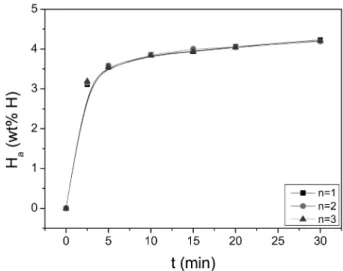
The percentage of absorbed hydrogen, H
a, is expressed with respect to sample weight. Fig. 1 shows the variation of the H
aversus t curve with the number of cycles, n, for Mg-10NbF
5at 593 K under 12 bar H
2. The initial hy- driding rate is quite high from the first cycle. At the
Fig. 1. Variation of the H
aversus t curve with the number of cycles
for as-milled Mg-10NbF
5at 593 K under 12 bar H
2.
beginning of the hydriding reaction,the hydriding rate is quite high and becomes low after approximately 5 min.
The initial hydriding rate and the quantity of hydrogen absorbed for 30 min, H
a(30 min), are very similar from n = 1 to n = 3. At n = 1, the sample absorbs 3.11 wt% H for 2.5 min, 3.55 wt% H for 5 min, 3.86 wt% H for 10 min, and 4.23 wt% H for 30 min. At n = 3, the sample absorbs 3.19 wt% H for 2.5 min, 3.54 wt% H for 5 min, 3.83 wt% H for 10 min, and 4.21 wt% H for 30 min.
The percentage of desorbed hydrogen, H
d, is also ex- pressed with respect to the sample weight. The variation of the H
dversus t curve with the number of cycles for Mg-10NbF
5at 593 K under 1.0 bar H
2is shown in Fig.
2. At n = 1-3, the curves exhibit incubation periods of approximately 2.5 min. The incubation periods are be- lieved to appear since the driving force for dehydriding reaction, which is the difference between the equilibrium plateau pressure at 593 K and the applied hydrogen pressure(1.0 bar H
2), is small. The equilibrium plateau pressure at 593 K for Mg-H
2system is 2.87 bar.
14)After incubation period, the initial dehydriding rate increases from n = 1 to n = 3. The quantity of hydrogen desorbed for 60 min, H
d(60 min), decreases from n = 1 to n = 2, and increases from n = 2 to n = 3. At n = 1, the sample desorbs 0.17 wt% H for 5 min, 0.74 wt% H for 10 min, 2.03 wt% H for 30 min, and 2.81 wt% H for 60 min. At n = 3, the sample desorbs 0.42 wt% H for 5 min, 1.03 wt% H for 10 min, 2.34 wt% H for 30 min, and 3.08 wt% H for 60 min.
Taken together, the hydrogen absorption and desorption behavior shown in Fig. 1 and Fig. 2 indicate that the activation of Mg-10NbF
5is not required.
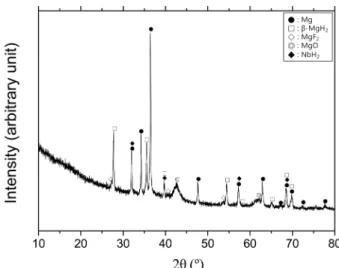
Fig. 3 presents the XRD pattern of Mg-10NbF
5after reactive mechanical grinding. The sample contains Mg, β-MgH
2, and small amounts of γ-MgH
2, NbH
2, MgF
2and NbF
3. β-MgH
2and γ-MgH
2are formed by the reaction of
Mg with hydrogen during reactive mechanical grinding.
β-MgH
2is a low-pressure form of MgH
2with a tetrago- nal structure. γ-MgH
2is one of the high-pressure forms of MgH
2with an orthorhombic structure. The reaction among Mg, NbF
5, and H
2produces MgF
2, NbH
2, and NbF
3by the following reaction:
10Mg + 7NbF
5+ 2H
2→ 10MgF
2+ 2NbH
2+ 5NbF
3(1) The XRD pattern of Mg-10NbF
5dehydrided at n = 3 is shown in Fig. 4. The sample contains Mg, β-MgH
2, a small amount of MgO, and very small amounts of MgF
2and NbH
2. MgF
2and NbH
2remain after dehydriding re- action. Quite high background in the XRD pattern of Mg-10NbF
5after reactive mechanical grinding shown in Fig. 3, compared with that of the XRD pattern of Mg- 10NbF
5dehydrided at n = 3 shown in Fig. 4, suggests that
Fig. 2. Variation of the H
dversus t curve with the number of cycles for as-milled Mg-10NbF
5at 593 K under 1.0 bar H
2.
Fig. 3. XRD pattern of Mg-10NbF
5after reactive mechanical grinding.
Fig. 4. XRD pattern of Mg-10NbF
5dehydrided at 593 K under 1.0
bar H
2at n = 3.
Mg-10NbF
5after reactive mechanical grinding is quite noncrystalline.
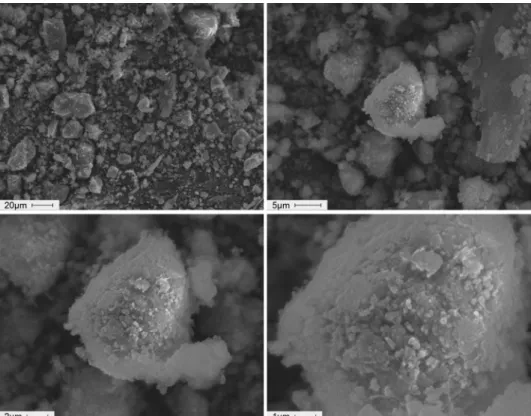
Fig. 5 shows SEM micrographs of Mg-10NbF
5after
reactive mechanical grinding at different magnifications.
The sample has small particles and large particles with fine particles on their surfaces. Some large particles have Fig. 5. SEM micrographs of Mg-10NbF
5after reactive mechanical grinding at various magnifications.
Fig. 6. SEM micrographs of Mg-10NbF
5dehydrided at 593 K under 1.0 bar H
2at n = 3 at various magnifications.
flat surfaces.
SEM micrographs of Mg-10NbF
5dehydrided at the 3
rdhydriding-dehydriding cycle are shown in Fig. 6. The sample also has small particles and large particles with fine particles on their surfaces. The fine particles on the small particles and large particles are finer than before cycling. Expansion and contraction of the lattice due to the hydriding and dehydriding reactions are believed to lead to this phenomenon.
In our previous work,
21)the hydriding and dehydriding properties were studied for 90 wt% Mg-10 wt% Fe
2O
3(hereafter referred to as Mg-10Fe
2O
3), 90 wt% Mg-10 wt%
Fe
2O
3prepared by spray conversion, 90 wt% Mg-10 wt%
MnO(hereafter referred to as Mg-10MnO), and 90 wt%
Mg-10 wt% SiO
2samples, which were was prepared by reactive mechanical grinding under the conditions similar to those for the preparation of Mg-10NbF
5. Of the mater- ials studied, Mg-10MnO and Mg-10Fe
2O
3had relatively high hydriding and/or dehydriding rates. Fig. 7 shows the H
aversus t curves at n = 1 at 593 K under 12 bar H
2for Mg after RMG, Mg-10NbF
5, Mg-10Fe
2O
3,
21)and Mg- 10MnO.
21)Mg after RMG absorbs hydrogen very slowly.
Mg-10NbF
5has a higher initial hydriding rate and a larger quantity of hydrogen absorbed for 60 min than Mg-10MnO and Mg-10Fe
2O
3. Mg after RMG absorbs 0.08 wt% H for 2.5 min, and 0.14 wt% H for 60 min.
Mg-10NbF
5absorbs 3.11 wt% H for 2.5 min, 3.55 wt%
H for 5 min, 3.86 wt% H for 10 min, and 4.23 wt% H for 30 min. Mg-10Fe
2O
3absorbs 1.74 wt% H for 5 min, 2.15 wt% H for 10 min, 2.90 wt% H for 30 min, and 3.43 wt% H for 60 min.
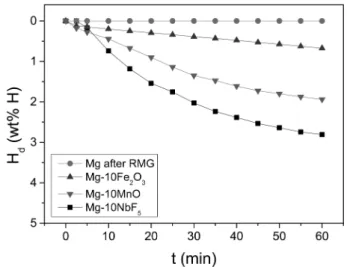
The H
dversus t curves at 593 K under 1.0 bar H
2for Mg after RMG, Mg-10NbF
5, and Mg-10MnO
21)at n = 1, and for activated Mg-10Fe
2O
3(at n = 3)
21)are shown in Fig.
8. The activation of Mg-10 Fe
2O
3was not required.
21)Mg after RMG does not release hydrogen. The H
dfor Mg-10Fe
2O
3varies nearly linearly with time. The curve for Mg-10NbF
5exhibits an incubation period of about 2.5 min. After the incubation period, Mg-10NbF
5has higher dehydriding rate than Mg-10MnO and Mg-10Fe
2O
3. Mg- 10Fe
2O
3desorbs 0.12 wt% H for 2.5 min, 0.15 wt% H for 5 min, 0.20 wt% H for 10 min, 0.39 wt% H for 30 min, and 0.68 wt% H for 60 min. Mg-10MnO desorbs 0.18 wt% H for 2.5 min, 0.28 wt% H for 5 min, 0.45 wt% H for 10 min, 1.35 wt% H for 30 min, and 1.94 wt% H for 60 min. Mg-10NbF
5desorbs 0.17 wt% H for 5 min, 0.74 wt% H for 10 min, 2.03 wt% H for 30 min, and 2.81 wt% H for 60 min. The higher dehydriding rate, after the incubation period, of Mg-10NbF
5than Mg- 10MnO and Mg-10Fe
2O
3shows that addition of NbF
5reduces significantly temperature of efficient hydrogen desorption.
The reactive mechanical grinding of Mg with NbF
5, which forms MgF
2, NbH
2, and NbF
3by the reaction 10Mg + 7NbF
5+ 2H
2→ 10MgF
2+ 2NbH
2+ 5NbF
3, is be- lieved to create defects both on the surface and in the interior of Mg and to reduce the particle size of Mg. The former effect leads to facilitation of nucleation, and the latter effect leads to diminution of diffusion distances for hydrogen atoms. These two effects increase the hydriding and dehydriding rates of Mg. The formed MgF
2, NbH
2, and NbF
3are considered to enhance both of these effects.
4. Conclusions
Activation of a 90 wt% Mg-10 wt% NbF
5sample was not required. At n = 1, the sample absorbed 3.11 wt% H for 2.5 min, 3.55 wt% H for 5 min, 3.86 wt% H for 10 min, and 4.23 wt% H for 30 min at 593 K under 12 bar Fig. 7. H
aversus t curves at n = 1 at 593 K under 12 bar H
2for
Mg after RMG, Mg-10NbF
5, Mg-10Fe
2O
3, and Mg-10MnO.
Fig. 8. H
dversus t curves at 593 K under 1.0 bar H
2for Mg after
RMG, Mg-10NbF
5, and Mg-10MnO at n = 1, and for activated Mg-
10Fe
2O
3(at n = 3).
H
2. At n = 1, the sample desorbed 0.17 wt% H for 5 min, 0.74 wt% H for 10 min, 2.03 wt% H for 30 min, and 2.81 wt% H for 60 min at 593 K under 1.0 bar H
2. 90 wt% Mg-10 wt% NbF
5after reactive mechanical grinding contained Mg, β-MgH
2, and small amounts of γ-MgH
2, NbH
2, MgF
2and NbF
3. The XRD pattern of 90 wt% Mg- 10 wt% NbF
5dehydrided at n = 3 revealed Mg, β-MgH
2, a small amount of MgO, and very small amounts of MgF
2and NbH
2. 90 wt% Mg-10 wt% MnO and 90 wt%
Mg-10 wt% Fe
2O
3were reported to have quite high hy- driding rate and/or dehydriding rate. 90 wt% Mg-10 wt%
NbF
5had a higher initial hydriding rate and a larger quantity of hydrogen absorbed for 60 min than 90 wt%
Mg-10 wt% MnO and 90 wt% Mg-10 wt% Fe
2O
3. 90 wt% Mg-10 wt% NbF
5had a higher initial dehydriding rate(after the incubation period) and a larger quantity of hydrogen desorbed for 60 min than 90 wt% Mg-10 wt%
MnO and 90 wt% Mg-10 wt% Fe
2O
3. References
1. Y. J. Kwak, H. R.Park, and M. Y. Song, Kor. J. Met.
Mater., 50(11), 855 (2012).
2. S. H. Hong, S. N. Kwon, and M. Y. Song, Kor, J. Met.
Mater., 49(4), 298 (2011).
3. K. I. Kim and T. W. Hong, Kor. J. Met. Mater., 49(3), 264 (2011).
4. J. J. Reilly and R. H. Wiswall, Inorg. Chem., 6(12), 2220 (1967).
5. J. J. Reilly and R. H. Wiswall Jr, Inorg. Chem., 7(11), 2254 (1968).
6. E. Akiba, K. Nomura, S. Ono and S. Suda, Int. J.
Hydrogen Energy, 7(10), 787 (1982).
7. Z. Li, X. Liu, L. Jiang, S. Wang, Int. J. Hydrogen Energy, 32(12), 1869 (2007).
8. J. M. Boulet and N. Gerard, J. Less-Common Met., 89, 151 (1983).
9. M. Lucaci, A. R. Biris, R. L. Orban, G. B. Sbarcea, V.
Tsakiris, J. Alloys Compd., 488(1), 163 (2009).
10. Z. Li, X. Liu, Z. Huang, L. Jiang, S. Wang, Rare Metals, 25(6)(Supplement 1), 247 (2006).
11. S. Aminorroaya, A. Ranjbar, Y. H. Cho, H. K. Liu, A.
K. Dahle, Int. J. Hydrogen Energy, 36(1), 571 (2011).
12. Y. H. Cho, S. Aminorroaya, H. K. Liu, A. K. Dahle, Int.
J. Hydrogen Energy, 36(8), 4984 (2011).
13. C. Milanese, A. Girella, G. Bruni, P. Cofrancesco, V.
Berbenni, P. Matteazzi, A. Marini, Intermetallics, 18(2), 203 (2010).
14. B. Tanguy, J. L. Soubeyroux, M. Pezat, J. Portier and P.
Hagenmuller, Mater. Res. Bull., 11, 1441 (1976).
15. F. G. Eisenberg, D. A. Zagnoli and J. J. Sheridan III, J.
Less-Common Met., 74, 323 (1980).
16. A. R. Yavari, A. LeMoulec, F. R. de Castro, S. Deledda, O. Friedrichs, W. J. Botta, G. Vaughan, T. Klassen, A.
Fernandez, A. Kvick, Scripta Materialia, 52(8), 719 (2005).
17. S. A. Jin, J. P. Ahn, J. H. Shim, Y. W. Cho, K. W. Yi, J. Power Sources, 172, 859 (2007).
18. I. E. Malka, T. Czujko, J. Bystrzycki, Int. J. Hydrogen Energy, 35, 1706 (2010).
19. I. E. Malka, A. B achowski, K. Ruebenbauer, J.
Przewoznik, J. Zukrowski, T. Czujko, J. Bystrzycki, J.
Alloys Compd., 509, 5368 (2011).
20. M. Y. Song, S. H. Baek, J. -L. Bobet, J. Song and S.
H. Hong, Int. J. Hydrogen Energy, 35, 10366 (2010).
21. M. Y. Song, I. H. Kwon, S. N. Kwon, C. G. Park, S. H.
Hong, J. S. Bae and D. R. Mumm, J. Alloys Compd., 415, 266 (2006).