Antioxidant Effect of Edaravone on the Development of Preimplantation Porcine Embryos against Hydrogen Peroxide-Induced Oxidative Stress
Geon-Yeop Do, Jin-Woo Kim, Sung-Kyu Chae, Jae-Hyun Ahn, Hyo-Jin Park, Jae-Young Park, Seul-Gi Yang and Deog-Bon Koo
†Dept. of Biotechnology, College of Engineering, Daegu University, Gyeongsan 38453, Korea
ABSTRACT
Edaravone (Eda) is a potent scavenger of inhibiting free radicals including hydroxyl radicals (H
2O
2). Reactive oxygen species (ROS) such as H
2O
2can alter most kinds of cellular molecules such as lipids, proteins and nucleic acids, cellular apoptosis. In addition, oxidative stress from over-production of ROS is involved in the defective embryo development of porcine. Previous study reported that Eda has protective effects against oxidative stress-like cellular damage. However, the effect of Eda on the preimplantation porcine embryos development under oxidative stress is unclear. Therefore, in this study, the effects of Eda on blastocyst development, expression levels of ROS, and apoptotic index were first investigated in preimplantation porcine embryos. After in vitro fertilization, porcine embryos were cultured for 6 days in PZM medium with Eda (10 μM), H
2O
2(200 μM), and Eda+H
2O
2treated group, respectively.
Rate of blastocyst development was significantly increased (P<0.05) in the Eda treated group compared with only H
2O
2treated group. And, we measured intracellular levels of ROS by DCF-DA staining methods and investigated numbers of apoptotic nuclei by TUNEL assay analysis is in porcine blastocyst, respectively. Both intracellular ROS levels and the numbers of apoptotic nucleic were significantly decreased (P<0.05) in porcine blastocysts cultured with Eda (10 μM). More over, the total cell number of blastocysts were significantly increased (P<0.05) in the Eda-treated group compared with untreated group and the only H
2O
2treated group. Based on the results, Eda was related to regulate as antioxidant-like function according to the reducing ROS levels during preimplantation periods. Also, Eda is beneficial for developmental competence and preimplantation quality of porcine embryos. Therefore, we concluded that Eda has protective effect to ROS derived apoptotic stress in preimplantation porcine embryos.
(Key words: edaravone (Eda), antioxidants, porcine embryo, reactive oxygen species (ROS), apoptosis)
This work was supported by grants from the Next-Generation BioGreen 21 Program (PJ01117604) and the Bio-Industry Technology Development Program (112130031HD030) through the Rural Development Administration and the Ministry of Agriculture, Food and Rural Affairs, Republic of Korea.
†
Correspondence : [email protected]
INTRODUCTION
In vitro production (IVP) of porcine embryos has been extensively studied for improving embryonic development and reproductive technologies (Choi et al., 2013). IVP embryos are very susceptible to oxidative damage because their defense mechanisms are insufficient to protect their delicate cellular structure (Rocha-Frigoni et al., 2015). Therefore, many resear- chers are investigating ways to optimize the condition of in vitro maturation (IVM) of oocytes or in vitro culture (IVC) of embryos, including temperature, gas tension, composition of media, etc. (Booth et al., 2005; Jin et al., 2007). It is well known that one of the problems that impair IVP of porcine embryos is the oxidative stress that is mainly caused by reac-
tive oxygen species (ROS) production from highly reactive molecules such as hydrogen peroxide (H
2O
2), hydroxyl radicals ( ․OH), superoxide anions (O
2․
—) and nitric oxide (NO). In particular, oocytes and early stage embryos are more vulner- able to oxidative stress, and the developmental competence of embryos is impaired by the resulting damage (Harvey et al., 2002).
Edaravone (Eda) is a potent free radical scavenger which
has been shown to provide neuroprotection against cerebral
ischemia-reperfusion injuries in experimental animal models
(Yan et al., 2012). Eda is a potent and novel synthetic sca-
venger of free radicals inhibiting not only hydroxyl radicals
but also iron-induced peroxidative injuries. In addition, Eda
has been prescribed clinically in Japan, since 2001 to treat
patients with cerebral ischemia (Tsuji et al., 2005). Eda has been used as a free novel radical scavenger to inhibit oxidative stress and apoptosis. Also, Eda has antioxidant effects and decreases hydroxyl radicals and superoxide radical production (Cheng et al., 2014). Eda has been reported to exert antioxidant effects because it can quench hydroxyl radicals and hydroxyl radical-dependent lipid peroxidation (Kikuchi et al., 2013).
Most of all, the generation and production of intracellular level ROS are involved in several signaling mechanisms. ROS can alter most kinds of cellular molecules such as lipids, pro- teins and nucleic acids, which results in mitochondrial damage, embryo cell block, ATP depletion, and apoptosis (Guerin et al., 2001; Gualtieri et al., 2014). The level of ROS production in mammalian embryos is particularly important during various stages of preimplantation development in vitro. Furthermore, during in vitro culture periods, embryos are exposed to relatively high oxidative stress compared to the environment of in vivo, thus the production of ROS within embryos is increased (Choi et al., 2008). Therefore, low rate of preimplantation embryo development is one of the main problems due to elevation of ROS during in vitro procedures (Dehghani-Mohammadabadi et al., 2014). Oxidative stress, depending on its severity, can lead to either cell necrosis or apoptosis. Also, apoptosis is charac- terized by cell shrinkage and chromatin condensation (Liu et al., 2000). Then, apoptosis, in response to inappropriate cultural conditions and stress, is a common physiological process in in vitro embryo development (Choi et al., 2008). And, cellular apoptosis has been assayed in mammalian blastocysts stage using TUNEL staining, which is influenced by suboptimal developmental conditions and stress, but mainly in in vitro fer- tilized (IVF) and parthenogenetic embryos (Isom et al., 2007;
Neuber et al., 2002).
Although an antioxidant effect of Eda has been reported in some mammalian cell models, there is currently no research regarding the effect of Eda on porcine embryo development.
Therefore, in this study, we evaluated the effects of Eda on the developmental competence of preimplantation porcine embryos cultured under oxidative-stress conditions. In addition, the ex- pression levels of ROS and the apoptotic index in blastocyst stage embryos derived from Eda treatment were measured.
MATERIALS AND METHODS
1. Chemicals
All chemical used in this study were purchased from Sigma Chemical Co. (St. Louis, Mo, USA) unless otherwise indicated.
2. In Vitro Maturation
Porcine ovaries were collected from a local slaughterhouse and transported to the laboratory at 30 ∼35℃ in 0.9% saline supplemented with 75 μg/ml potassium penicillin G. Cumulus oocyte complexes (COCs) were aspirated through an 18 gauge needle into a disposable 10 ml syringe from follicles of 3 to 6 mm in diameter (Funahashi et al., 1994). After washing three times with Tyrode’s lactate (TL)-N-2-hydroxyenthylpipera- zine-N'-2-ethanesulfoic acid (HEPES) medium, approximately immature 50 COCs were matured in 500 μl of IVM medium in a four-well multidish (Nunc, Roskilde, Denmark) at 38.5 ℃, 5% CO
2in air. The medium used for oocyte maturation was North Carolina State University (NCSU) 23 medium (Petters and Wells, 1993) supplemented with 10% follicular fluid, 0.57 mM cysteine,10 ng/ml β-mercaptoethanol, 10 ng/ml epidermal growth factor, 10 IU/ml pregnant mare's serum gonadotropin (PMSG) and 10 IU/ml human chorionic gonadotropin (hCG).
After 22 h of culture, oocytes were washed three times and then further cultured in maturation medium without hormones supplement (PMSG and/or hCG) for 22 h.
3. In Vitro Fertilization
After IVM stage, the oocytes were subjected to IVF as des- cribed by Abeydeera and Day (1997). This medium was desig- nated as modified Tris-buffered medium (mTBM). Fresh semen was kindly supplied twice a week by artificial insemination company (Darby Pig AI Center, Anseong, Korea) and kept at 17 ℃ for 4 days. Semen was washed three times by centrifugation with Dulbecco's phosphate buffered saline (DPBS; Gibco-BRL, Grand Island, NY, USA) supplemented with 1 mg/ml bovine serum albumin (BSA; Fraction V), 100 mg/ml penicillin G and 75 mg/ml streptomycin sulfate. After washing, the spermatozoa were suspended in mTBM at pH 7.8. Oocytes were washed three times in mTBM with 2.5 mM caffeine sodium benzoate and 1 mg/ml BSA (fatty acid free) and placed into 48 μl of mTBM under paraffin oil. Diluted spermatozoa (2 μl) were added to 48 μl drop of the medium containing 20 oocytes to give a final concentration of 1.5×10
5sperms/ml. The oocytes were co- incubated with the spermatozoa for 6 h at 38.5 ℃, 5% CO
2in air.
4. In Vitro Culture and Chemical Treatment
For all experiments the embryos were cultured in 50 μl drops of porcine zygote medium 3 (PZM-3) medium with 3 mg/ml BSA at 38.5 ℃ under 5% CO
2in air. After 48 h of culture, cleaved embryos were further cultured in a 50 μl drop of PZM-3 medium supplemented with 3 mg/ml BSA at 38.5 ℃ under 5% CO
2in air for 4 days. To investigate oxidative stress, fertilized embryos were treated with oxidative inducer H
2O
2(200 μM) or antioxidant Eda (1, 10 or 20 μM) by direct addition to the culture medium. In addition, porcine embryos were cultured for 6 days in IVC medium with or without Eda (10 μM) under oxidative stress condition though H
2O
2200 μM treatment. Blastocyst formation was evaluated by stereomicro- scopic observation at Day 6 after insemination.
5. Measurement of Reactive Oxygen Species Levels
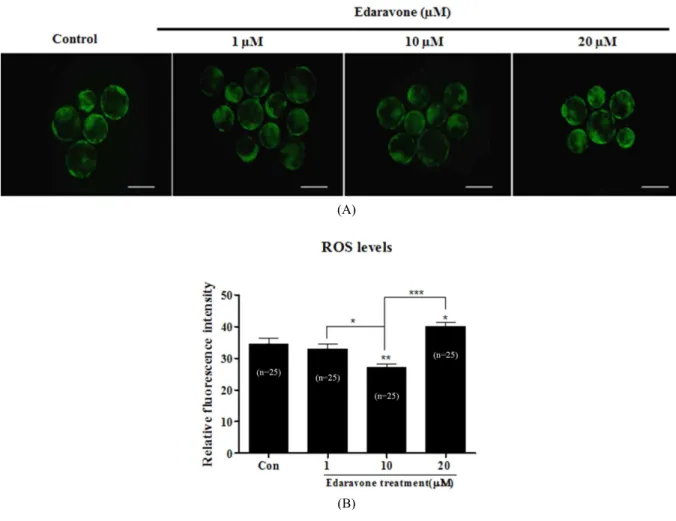
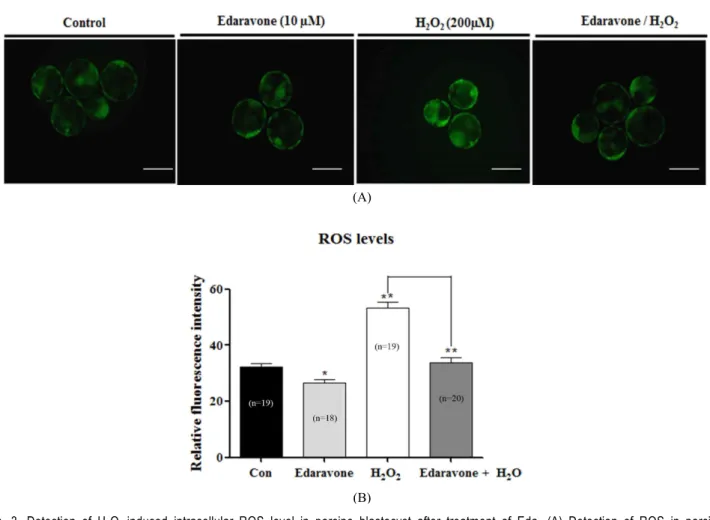
The level of H
2O
2in each embryo was measured using the dichlorofluorescin diacetate method (DCF-DA; Molecular Pro- bes, Eugene, OR, USA) described previously (Choi et al., 2008). At Day 6, in vitro produced blastocysts were recovered and used for the experiment. After three time washes in IVC medium, blastocysts were transferred into IVC medium con- taining 5 μM DCF-DA for 20 min at 38.5 ℃, 5% CO
2in air.
A stock solution of DCF-DA dissolved in dimethylsulfoxide (DMSO) was then diluted in IVC medium, after which the permeabilised blastocysts in DCF-DA were washed three times with 0.1% polyvinylalcohol PVA in DPBS and placed in to a 50 μl drop covered with mineral oil. The fluorescent emissions from the embryos were recorded with a fluorescent microscope (Olympus) equipped with a cooled charge coupled device (CCD) camera where filters at 488 and 520 nm were used for excitation and emission, respectively. The recorded fluorescent images were analyzed by subtracting background and measuring inte- grated density with Image J software Version 1.38 (National Institutes of Health, Bethesda, MD, USA).
6. TUNEL Assay Analysis
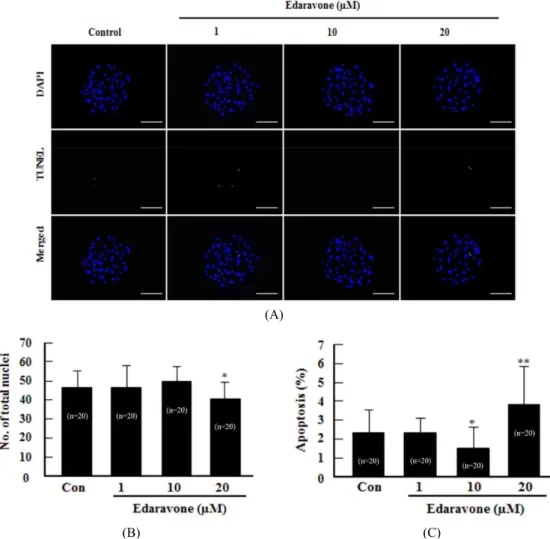
Apoptotic cells in blastocysts were detected using the in situ Cell Death Detection Kit (Roche diagnostics GmbH, Mannheim, Germany). The blastocysts were recovered from fixed in 4%
(v/v) formaldehyde diluted in DPBS for 1 h at 4 ℃. For mem- brane permeabilization, the fixed embryos were incubated in DPBS containing 0.1% (v/v) Triton X-100 for 30 min at 4 ℃.
The fixed embryos were incubated in terminal deoxynucleotidyl transferase-mediated dUTP nick-end labeling (TUNEL) reac-
tion medium for 1 h at 38.5 ℃ in the dark and then washed and transferred into 2 mg/ml of DAPI and mounted on slides.
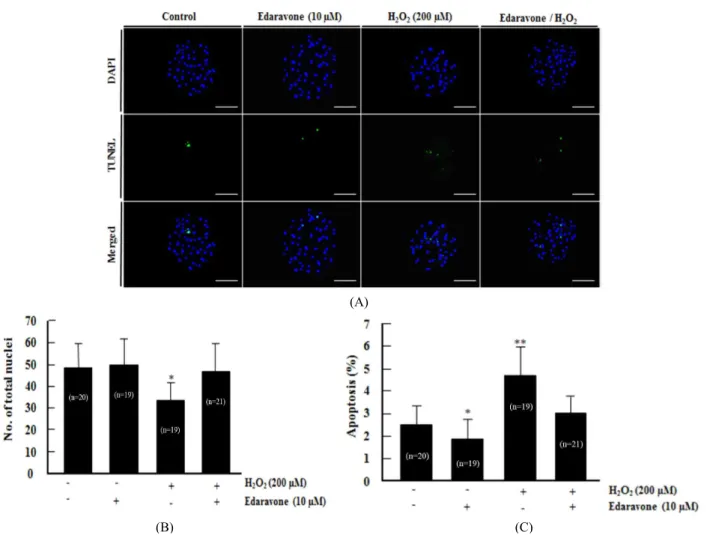
After TUNEL and DAPI staining, whole-mount embryos were examined under an epifluorescence microscope (Olympus) to determine the number of apoptotic nuclei and total number of nuclei.
7. Statistical Analysis
All experiments were repeated more than three times. All percentage data and data sets obtained in the present study are presented as the mean±standard deviation (SD) and mean±
standard error of the mean (SEM). The results were analyzed using a one-way ANOVA followed by Dunnett’s multiple Com- parison Test and the Student’s t-test. All calculations were per- formed using the GraphPad Prism 5.0 software package (San Diego, CA). Differences were considered significant at
*P<
0.05,
**P<0.01, and
***P<0.001.
RESULTS
1. Effects of Eda on Developmental Competence and Fertilization Rate of Porcine Embryos
To investigate the effect of Eda on embryonic development,
we confirmed the blastocyst development and fertilization rate
in embryo of porcine after Eda treatment. First, the effect of Eda
on embryonic development was investigated. We investigated
the optimal Eda concentration of culture medium in development
competence of porcine embryos. After IVM and IVF, porcine
embryos were cultured in IVC medium supplemented with va-
rious concentrations (1, 10 or 20 μM) during full-time culture
periods at 38.5 ℃ and under 5% CO
2. Table 1 showed that the
proportion of blastocysts development was significantly increased
(P<0.05) in culture media supplemented with Eda at a con-
centration of 10 μM. Based on the results, we proceeded in a
following set of experiments the concentration of 10 μM. Next,
we investigated the effects of Eda on development of porcine
embryos against oxidative stress induced by H
2O
2. Presumptive
zygotes were cultured in the presence or absence of Eda and
H
2O
2for 6 days at 38.5 ℃ and under 5% CO
2in air. These re-
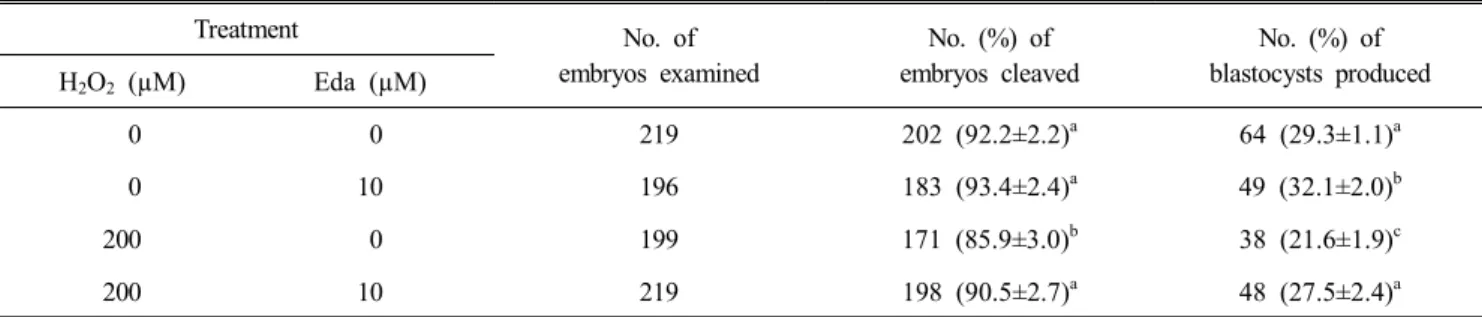
sults showed that the rates of cleavage and blastocyst formation
under H
2O
2-induced oxidative stress were significantly improved
in the presence of Eda group when compared with absence of
the only Eda treatement group (Table 2), suggesting that de-
velopment competence improved due to Eda treatment.
Table 2. Effect of Eda treatment on the development of porcine embryos against oxidative stress induced by H
2O
2Treatment No. of
embryos examined
No. (%) of embryos cleaved
No. (%) of blastocysts produced H
2O
2(µM) Eda (µM)
0 0 219 202 (92.2±2.2)
a64 (29.3±1.1)
a0 10 196 183 (93.4±2.4)
a49 (32.1±2.0)
b200 0 199 171 (85.9±3.0)
b38 (21.6±1.9)
c200 10 219 198 (90.5±2.7)
a48 (27.5±2.4)
aData are the mean±SD.
a∼c
Values from ten replicates with different superscripts denote a significant difference relative to other groups (P<0.05).
Table 1. Effect of Eda treatment on the developmental competence in porcine embryos
Groups (µM)
No. of embryos examined
No.(%) of embryos cleaved
No.(%) of blastocysts produced 0 285 257 (90.1±3.8) 79 (27.6±2.1)
a1 265 239 (90.2±2.8) 79 (29.8±1.1)
a10 265 241 (91.9±2.9) 84 (31.7±2.7)
b20 265 234 (88.2±2.7) 65 (24.3±2.6)
cData are the mean±SD.
a∼c