한국컴퓨터정보학회 하계학술대회 논문집 제22권 제2호 (2014. 7)
95
정보시스템 평가를 위한 제약 기반 영향평가 모형 설계
이상원○, 김성현*, 박승범*, 안현섭**
○원광대학교 정보전자상거래학부(융복합창의연구소)
*한국정보화진흥원 빅데이터전략센터
**브라운슈바이크공과대학 경영정보학과
e-mail: [email protected]○, {kimcon, parksb}@nia.or.kr*, [email protected]**
Effect Evaluation Model on the Basis of Restriction to Evaluate Information Systems
Sangwon Lee○, Sunghyun Kim*, Sungbum Park*, Hyunsup Ahn**
○Division of Information and Electronic Commerce (Institute of Convergence and Creativity), Wonkwang University
*Big Data Strategy Center, National Information Society Agency
**Department of Wirtschaftsinformatik, Technische Universität Braunschweig
● Abstract ●
These information systems projects have unique characteristics such as technology sensitiveness, network effectiveness, embeddedness, and externality, these investment projects have been not taken care of in the field of administration and evaluation. Furthermore, it is not easy to evaluate the results of projects under the circumstances where the conditions for evaluation of budget, time, and data leave much to be desired. But the efficient monitoring and effective analysis of information systems are surely needed for beneficient results of investment in information systems. We propose an effect evaluation model on the basis of restriction to evaluate information systems.
키워드: Information Systems; Evaluation; Management Model; Monitoring
I. Introduction
The investment projects for information systems have been not taken care of in the field of administration and evaluation.
It is so because these information systems projects have unique characteristics such as technology sensitiveness, network effectiveness, embeddedness, and externality. Furthermore, it is not easy to evaluate the results of projects under the circumstances where the conditions for evaluation of budget, time, and data leave much to be desired. But the efficient monitoring and effective analysis of information systems are surely needed for beneficient results of investment in information systems. We propose an effect evaluation model on the basis of restriction to evaluate information systems.
II. Conditions for High-Quality Effect Evaluation
For high-quality effect evaluation, sequential indices should be prepared to meaningfully and trustworthily regulate and measure input factors, action procedure, outputs, intended results, and effects of a project. And the discovered changes of outcome indicators after project invention should provide counterfactuals that are logically appropriate and are affected not by other unrelated factors but by the project. And, according to available and statistical procedures, the decision on whether the project would contribute to the intended results or not and whether it would offer benefits to target population.
한국컴퓨터정보학회 하계학술대회 논문집 제22권 제2호 (2014. 7)
96
III. Effect Evaluation Model on the Basis of Restriction
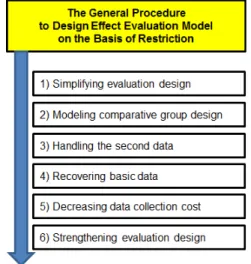
The general process to establish an effect evaluation model on the basis of restriction is performed as the following process; simplifying evaluation design, modeling comparative group design, handling the second data, recovering basic data, decreasing data collection cost, and strengthening evaluation design (Figure 1).
Fig. 1. The General Procedure to Design Effect Evaluation Model on the Basis of Restriction
IV. Methods to Control Restrictions
There are several methods to control restrictions, that is to say, decreasing effects of budgets, time, and data. Firstly, the general quality to design evaluation should be strengthened.
Secondly, It should be intensified to design samples and analyze them statistically. Thirdly, Theoretical frame and the efficiency of counterfactuals should be reinforced. Lastly. the possibility of conclusions generalization should be tightened up.
V. Conclusions
This effect evaluation model on the basis of restriction would certainly improve the trustworthiness of project result through optimized design and evaluation audit with considering characteristics of in-depth evaluation for information systems projects.
References
[1] S. Hamilton and Norman L. Chervany, "Evaluating Information System Effectiveness - Part I: Comparing Evaluation Approaches," MIS Quarterly, Vol. 5, No. 3, pp.
55-69, 1981.
[2] G. Premkumar and W. R. Kingb, "The evaluation of strategic information system planning," Information & Management, Vol. 26, Iss. 6, pp. 327–340, 1994.
[3] J. W. Lee and S. H. Kim, "Using analytic network process and goal programming for interdependent information system project selection," Computers & Operations Research, Vol.
27, Iss. 4, pp. 367–382, 2000.
[4] W. D. Penniman and W. D. Dominick, "Monitoring and evaluation of on-line information system usage," Information Processing & Management, Vol. 16, Iss. 1, pp. 17–35, 1980.
[5] E. Turban, L. Volonino and G. R. Wood, Information Technology for Management, Pearson, 2014.