• 검색 결과가 없습니다.

A Study on Non Destructive Evaluation of the Steam Turbine L-0 Blades

N/A
N/A
Protected

Academic year: 2021

Share "A Study on Non Destructive Evaluation of the Steam Turbine L-0 Blades"

Copied!
13
0
0

로드 중.... (전체 텍스트 보기)

전체 글

(1)

A Study on Non Destructive Evaluation of the Steam Turbine L-0 Blades

Rahman Md. Mizanur, Osama Rezk, Victor Otieno Ouma, Saidov Vaysidin, M. Abdullatif Gomaa, JaeCheon Jung, YongKwan Lee

*

KEPCO International Nuclear Graduate School (KINGS), Ulsan, South Korea

Abstract : The Nuclear and Fossil Steam Turbines record a considerable number of failures annually. Some of these failures reported are as result of blade failure. The failure of the L-0 blade in a Steam Turbine is one of the most reported blade failure in Nuclear and Fossil steam turbines. This paper seeks to identify the best Non Destructive Evaluation (NDE) method or methods to be used in the steam turbine L-0 blades inspection process. The development of systems engineering processes presents an opportunity to apply NDE inspection to the L-0 blades. This process apply computer modelling of the L-0 using ANSYS and by simulating the stresses experienced by the L-0 blade during operation it is possible to identify the most susceptible areas for crack formation and growth. The results from these models compared to industry data for validation. The analysis of these results used to predict the most probable failure location and failure modes. Therefore NDE inspection can be applied to these areas with greater degree of accuracy. This would be beneficial in the increasing the accuracy in the detection of cracks and hence save inspection time and the overall inspection cost. Furthermore, not only the location for crack formation and NDE inspection determined but also best the NDE inspection technique/techniques to be applied appropriately on the L-0 blade are prescribed.

Key Words : Steam Turbine, NDE, Systems Engineering, L-0 Blade, PAUT

Received: February 3, 2016 / Revised: June 20, 2016 / Accepted: June 22, 2016

* 교신저자 : YongKwan Lee, [email protected]

This is an Open-Access article distributed under the terms of the Creative Commons Attribution Non-Commercial

License(http://creativecommons.org/licenses/by-nc/3.0) which permits unrestricted non-commercial use, distribution,

and reproduction in any medium, provided the original work is properly cited.

(2)

1. Introduction

The Nuclear and Fossil power industry reports a considerable number of failures annually associated with the steam turbine. Blade failure is usually reported in the nuclear steam turbine even though a lot of resources are spent on many researches trying to investigating the best methodologies to mitigate the same. The failure of the L-0 blade (last stage blade) in a steam turbine is one of the most reported in Nuclear and Fossil steam turbines.

Blades of steam turbine are critical com- ponents in power plants which convert the linear motion of high temperature and high pressure steam flowing down a pressure gradient into a rotary motion of the turbine shaft. If blades of turbine fail, power plants will shut down. This case can cause long plant shutdown and huge economic loss. Therefore, it is necessary to settle the failure analysis of turbine blades in order to increase the reliability of turbine systems. The low pressure turbine blades, de- signed to extract the final remnants of energy from the passing steam flow, are relatively large scale rotating airfoils due to the significant cen- trifugal forces experienced during normal operation.

According to EPRI report-68% problems are related to cracks, low pressure tur-bine ex- perience 72% of the reported problem and erosion is the 2nd most reported problem [1].

Non-Destructive Evaluation (NDE) is the exam- ination of an object or material with technology that does not affect its future usefulness. NDE can be used without destroying or damaging a product or material. As it allows inspection without interfering with a product's final use, NDE provides an excellent balance of quality

control and cost effectiveness.

A large variety of NDE methods are available for the condition assessment of steam turbine com-opponents. The common NDE techniques used to inspect steam turbine blades are Ultrasonic Test (UT), Eddy Current Testing (EDT), Magnetic Particle Testing (MPT), Dye Penetrant Testing (DPT), Radiographic Testing (RT) and Visual Inspection (VI). Selecting the most appropriate one depends upon: the type of component, the type of defect and the specific situation, such as the accessibility or cleanliness of the surface.

However, the precedent study on the turbine blade inspection is mainly focused on the tech- nology itself [2][3] rather than specifying the inspection processes. The importance of well- defined process must be emphasized so that the inspection time and the overall inspection cost will be minimized.

The brief discussion about each NDE technique is given below: Ultrasonic: This method used the technique of change in acoustic impedance caused by cracks, non-bonds, inclusion, or inter- faces. The advantages are, it can penetrate thick materials, excellent for crack detection, automated and the disadvantage is the limitation to surface detection.

Radiography: It involves the changes in density from voids, inclusions, material variations, place- ment of internal parts etc. RT can be used to inspect wide range of materials and thickness, versatile, film provides record for inspection.

The limitation of this method is the radiation hazard.

Eddy current: ECT is the very efficient method

for surface detection. This technique used the

method of changes in material conductivity caused

by material variations, cracks, voids, or inclusion.

(3)

[Figure 1] Process steps: Schematic of the blade model development process [5]

This technique is limited to electrical conducting material and surface detection.

Dye penetrant testing: DPT use fluorescent dye to detect surface openings due to cracks, porosity, seams, or folds. DPT is inexpensive, easy to use, readily portable, and sensitive to small surface flaws.

Magnetic particle testing: This method used the technique of leakage magnetic flux caused by surface or near surface cracks, voids, in- clusions, or material or geometry change. MPT is inexpensive or moderate cost, sensitive both to sur-face and near surface flaws and limited to ferromagnetic material.

1.1 Theory of Steam Turbine Blades

A rotating turbine blade is the component, which converts the energy of the flowing fluid into mechanical energy. Thus the reliability of these blades is very important for the successful operation of a turbine. Metallurgical examinations of failed blades show that almost all the failures can be attributed to the fatigue of metal. Blade failures due to fatigue are predominately vibration related. Turbine vibration is known to be caused by several mechanisms, but sometimes failures of blade occur which cannot be explained by these mechanisms [4]. A good design of turbine blade thus consists of the following steps:

∙ Determination of natural frequencies and mode shapes.

∙ Determination of non-steady forces due to stage flow interaction.

∙ Evaluation of damping and generating ap- propriate models.

∙ Modal analysis and determination of dynamic stresses.

∙ Life estimation based on cumulative damage

fatigue theories

1.2 Turbine Blade Design Fundamentals Turbine blade design involves blade solid model development, thermo-aerodynamics, and structural mechanics disciplines. The process of reverse engineering begins with determining the function of the machine part (referred to as “capturing design intent”). The accuracy of reverse en- gineering is limited by the applied measurement and computer-aided modeling techniques. A few of the major limitations are wear of the part;

numerical, sensing, and approximation errors;

and manufacturing methods. In order to ensure

and enhance blade efficiency, optimizing of the

shape design of rotating and stationary blades

is essential. The necessary steps for turbine

blade reverse engineering are similar to those

used in a new-product development practice

Figure 1 shows the Schematic of the blade model

development process.

(4)

2. Objective of the study

Blade failure is usually reported in the nuclear steam turbine even though a lot of resources are spent on many researches trying to inves- tigating the best methodologies to mitigate the failure. The failure of the L-0 blade in a steam turbine is one of the most reported in Nuclear and Fossil steam turbines, the objectives of this study include:

∙ This study through a systems engineering approach determines the best NDE inspection techniques to be applied appropriately to the L-0 blade. This would be beneficial in the increasing the accuracy in the detection of cracks and hence save inspection time and the overall inspection cost.

∙ Determine the most probable regions for crack initiation through computer modelling to ease on crack identification.

∙ Identifies the most common failure modes in the steam turbines L-0 blades and recommends the mitigation measures required to be put in place to prevent these failures from occurring or even prevent the initial crack initiation.

∙ A maintenance plan is also developed to assist in the maintenance of steam turbines.

3. Methodology

3.1 Systems Engineering

In this study, systems engineering focuses on defining customer needs and required func- tionality early in the development cycle, docu- menting requirements, and then proceeding with design synthesis and system validation while considering the complete problem” [6].

Economical operation of steam turbine plant is essentially determined by the thermal efficiency and availability of the unit. In the past, a thorough inspection of the steam turbine-generator has proved to be an important tool for ensuring optimum and reliable operation. To permit an overall assessment of the condition of a steam turbine and its auxiliaries, an examination of the unit after disassembly is required in addition to the usual running routines and special tests.

Special problems, e.g. crack initiation on highly stressed components, can normally be detected only during a major inspection i.e. after disas- sembly of the components. These recommendations contain guidelines for inspection scheduling which vary according to the type of turbine, mode of operation, application and life expenditure of the unit.

The reliability of the nuclear steam turbine system directly depends on its equivalent op- erating hours. Using well-known and well or- ganized systems engineering methodology in nuclear steam turbine blades inspection can be achieve significant success. Because the inspection of nuclear steam turbine is required high qualified specialists and it is very costly procedures.

Systems engineering approach allows to define and choose appropriate effectiveness NDE in- spection method for nuclear steam turbine blade.

3.2 Requirement Traceability Analysis

The requirements must be traced to a higher-

tier requirement or stakeholder need. The rela-

tionship to a parent requirement or need must

exist and be documented and also the rationale

for the requirement be documented. This assists

with understanding the genesis of the require-

ments in the process. Therefore a CONOPS

(5)

<Table 1> Concept of operation and needs analysis matrix CO

NEEDS UT VI MP PAUT ECT LPT RT SM*

L-0 crack detection L-0 Crack depth detection L-0 Crack size detection L-0 Multiple crack detection L-0 Failure probability Analysis

<Table 2> Concept of Operation and Needs Analysis Matrix Requirement

CO Procedure Equipment Codes Standards Schedules Calibration Critical

Personnel Mainnance Reports

UT

VI MP PAUT ECT LPT RT SM

[Figure 2] Attachment Analysis

(Concept of Operations) and needs analysis matrix developed to relate the requirement and the needs with CONOPS. The defined CONOPS and the needs analysis matrix are shown in Table 1 and Table 2.

3.3 V- Model

Many different process models have been de- veloped over the years that specify a series of steps that make up the systems engineering approach.

Among these models, the “V” model, shown in Figure 3, is merging as the de facto standard way to represent systems engineering for in- spection of L-0 blades for nuclear steam turbine.

For this study the V model consists of following steps:

∙ Concept Exploration/ Feasibility Study

∙ Concept of Operations: Inspection of L-0

blades and maintenance

∙ Systems Requirements: Requirements to per-form inspections and maintenance

∙ Concept Basic Design of Methodology:

System design criteria, design specification

∙ Detail Design: Modeling, Mechanical model, Safety design

∙ Application of Methodology: L-0 blade inspection methodology

∙ Methodology Testing: Methodology function-

al/performance testing

(6)

[Figure 3] V-Model Diagram for L-0 blade inspection

∙ Subsystem Verification: Subsystem verification plan

∙ System Verification: System/methodology verification plan (Acceptance phase)

∙ System Validation: Installation and verification of inspection method

∙ Operation and Maintenance of Procedure:

Stem turbine L-0 blade inspection, using NDE (UT)

3.4 Attachment Inspection, Analysis, and Installation

Quality inspection of the turbine shaft assembly extends to the wheel steeple and the blade in order to collect information about the parts’

structural integrity and to draw a conclusion about the repair process, which can include actual repair or redesign. In this case, nonde- structive testing of the blade’s Attachment revealed that a crack had initiated at the root of the tendon radius area Figure 2 shows Attachment Analysis.

The crack in the area of the Attachment root at the base of the existing blade probably was caused by an improper size root radius, which could initiate cracking after the riveting process. The cracks appear to propagate after every cycle of the turbine operation sequence.

Analysis was needed to determine the crack initiation mechanism at the root of the tendon or attachment. Low ductility may create serious problems during the peening process, including cracks and even fractures in the attachments.

The most critical process is riveting the at- tachment. The accepted refurbishment technique for blade attachment assembly is to reattach or re-secure the cover band. Weld repair for blades where the crack was detected is one technique that was applied. Additional use of under-cover-band brazing further increased security of the attachment.

3.5 The Project Team Model

CATIA V-5 & ANSYS Workbench 15 are a

(7)

[Figure 4] Shows L-0 blade model

[Figure 5] Simple Torsional Vibration Spring Inertia Model

[Figure 6] Mode Shapes for a Simple Torsional System

powerful tools to assist in identifying and elim- inating the fatigue problem. In this study, FEA was used to investigate turbine blade responses under running conditions. Finite-element modelling can be used to predict vibratory natural fre- quencies and mode shapes. The rotor speed at which significant forced vibration may occur is predicted with frequency speed. The natural frequency of each blade vibration mode predicted by modelling and the forcing frequencies as the function of the rotor speed can be displayed.

In our model the blade length is 40 in, or 1016 mm. And the material is stainless steel. The model shape, figure 4 shows L-0 blade model.

3.5.1 Mode Shapes

When a mechanical system is responding purely at one natural frequency in the steady-state, its- deflection pattern will have a unique shape that is called the mode shape. The mode shapes just define the deflection patterns for which the inertia and stiffness forces are com- pletely in balance. Knowledge of the torsional vibration mode shapes is useful for the following reasons:

∙ For helping define regions in the turbine generator that are most vulnerable to fatigue duty.

∙ For estimating which modes are likely to be the steady-state stimuli.

∙ For use in torsional vibration monitoring and machine protection software.

∙ For guiding optimum locations for installing vibration sensors for use in testing and monitoring programs.

∙ For helping identify the most effective lo- cations for modifying the inertia or stiffness of a machine, if torsional modes need to

be detuned based on service experience.

For example, for the very simple, 3 node torsional system shown in Fig. 5, which has three equal point polar moments of inertia connected by two springs of equal stiffness (the springs having zero inertia), the shapes of its only 3 modes are shown in Figure 5. The nodes and point inertias are represented by the black dots in Figure 6.

The mode shapes show the relative rotational

displacements on the vertical axis with the

node number on the horizontal axis. This simple

system has 3 nodes at which the inertias are

lumped and hence has 3 vibration degrees of

freedom and a total of 3 vibration modes.

(8)

[Figure 7] Turbine blade damage from torsional resonance

[Figure 8] Pressure distribution]

[Figure 9] The velocity distribution

3.5.2 Consequences of Torsional Resonance and Mitigating Risk

A torsional natural frequency that is too close to twice the operating frequency and can cause fatigue damage of a turbine blade (bucket) or shaft section possibly until failure. Figure 7 shows damage caused by a torsional resonance to steam turbine buckets after approximately 10 months of operation. Last stage steam turbine buckets are particularly susceptible to this type of failure. Additionally, flexible buckets increase the complexity of a torsional analysis by adding an additional degree of freedom.

The buckets act as flexible elements along with the flexible turbine shaft sections, creating what is called a “branched system.” Local bucket modes couple together with the rotor modes, creating complex mode shapes. The flexibility of the buckets is a critically important factor for determining the overall powertrain behavior.

Mixed trains with multiple OEMs, can be particularly complex to analyze. Some details necessary to perform torsional analysis are considered proprietary, making it difficult for OEMs to share information.

Modifications of a turbine, generator, or rotating exciter in a rotor train can potentially shift

resonant frequencies closer to operating fre- quencies. Even seemingly small modifications can significantly increase the torsional duty due to a resonance [7].

3.5.3 ANSYS Workbench 15

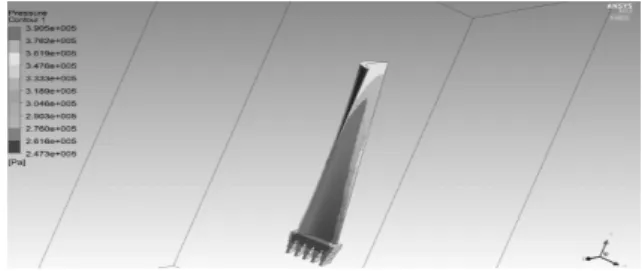
The major input data applied for this model (40 in blade) are pressure (52 psi), temperature (115°C), and velocity (1800 rpm). After importing the blade model form CATIA file to ANSYS and apply the input, the pressure and velocity distribution as shows in figure 8 and 9 re- spectively. The rotational direction is represented by the yellow arrow in Figure 10.

Figure 11 shows the vibration of L-0 blade according to mode shapes.

The total deformation as shown in the max-

imum principle stress and sheer stress will

have great effects on the root attachment and

the connection between blade and the attachment

(9)

[Figure 10] The velocity direction

[Figure 11] Mode shapes

[Figure 12] Maximum principle stress

[Figure 13] Sheer stress

as shown in figure 12 and 13 respectively.

4. Phased array ultrasonic technique (PAUT)

The most widely used NDE technique for turbine blade inspection is UT due to its volumetric capability of testing and low time for inspection.

In the field of nondestructive testing, conventional

manual ultrasonic testing techniques are in- creasingly being replaced by automated ultrasonic inspection systems. The availability of economically priced and powerful micro-electronic and com- puter components is driving this investment in ultrasonic Phased Array systems.

A phased array system is a multi-channel

(10)

ultrasonic system, which uses the principle of a time-delayed triggering of the transmitting transducer elements, combined with a time cor- rected receiving of detected signals. The main advantage of the phased array systems is their ability to vary the angle of insonification in the inspection object (sweeping and focusing of the sound beam) [8]. PAUT is constrained by the same physical limitations as conventional pulse echo UT but offers superior control over ultrasound transduction; having the ability to steer the ultrasonic beam over many angles of trajectory, many times per second, enables sectorial images to be built up, offering the inspector a clear view within the volume of the material. PAUT also offers the ability to focus the ultrasonic beam at distances shorter than the natural focal depth of the transducer by introducing time delays into the firing sequence of the individual elements. This produces nar- rower beam profiles and higher sound intensities at the critical areas and thus improving sensitivity and resolution. The sampling phased array (SPA) principle which is more advanced UT technique, make use of the measurement of elementary waves generated by individual elements of sensor array to reconstruct the composite phased array signal for any arbitrary angle or focus depth [9]. The SPA technique, a novel Phased Array technology was developed in the Fraunhofer Institute for non-destructive testing (IZFP) and subsequently patented. SPA permits the meaningful reconstruction of defects at high inspection speeds and facilitates the inspection of anisotropic materials. The technique provides higher sensitivity for the inspection of heavy-wall components and along with corresponding high resolution enables quantitative NDE.

4.1 Inspection of Turbine Blade Roots using PAUT

The most challenging blade root design to inspect by NDE is the axial entry design. The blade root hooks of the axial entry design are largely concealed, with only the end faces ex- posed. Although nondestructive surface exam- inations can be effective for in situ inspection of the end faces, the balance of the blade root is best inspected with a volumetric ultrasonic technique. Inspection of the axial entry blade root is challenging because of the complex geometry of the blade platform and airfoil that are used for placement of the inspection probe.

Many axial entry blade designs use a curved blade root, which can add complexity to the design of the ultrasonic inspection plan. Often, multiple probe configurations may be needed to provide adequate coverage of the blade root area of a single blade. The complexity of the blade and blade root geometry has made mathematical modeling a valuable aid in the design and selection of ultrasonic probes and wedges. In the case of phased array probes, mathematical modeling can be used to determine the size and configuration of the probe most appropriate for the inspection application and it also provide the details for the manufacturing of wedges. Modeling is also important for determining the probe position on the blade platform or airfoil in order to most effectively and efficiently inspection of the blade root.

Moreover, modeling can be used to determine

the inspection limitations of the blade root due

to geometry configurations. Additional efforts

for the development of models will improve

understanding of the effects of parameters

such as blade size, root platform configuration,

(11)

[Figure 14] Root inspection from concave aerofoil [10]

[Figure 15] Root inspection from platform [10]

<Table 3> Overall comparison of different NDE technique

Station Defect

present Total defects detected

PAUT MPI LPI ECT

A 2 2 0 2 2

B 15 12 9* 7* 15

C 21 7 16 (20) 16 21

* Optimized techniques in laboratory conditions are not available

* Within parenthesis- After extensive surface preparation beyond international standard

blade material, and orientation of hooks and fillets relative to accessible areas for the inspection probe.

A recent investigation for last stage turbine blade inspection by RWE Npower Pic, UK, shows that the ECT is more sensitive and accurate method. Their result of inspection for three units is shown in table 3.

The results from table 3 shows that no single NDE technique can make sure defect free blades.

Properly designed ECT should give greatest confidence to detect small defects, but may lead to falls calls. However, this can only be applied to blades which have been removed from the rotor; it also requires bespoke arrays to inspect a full set of blades in a timely duration with sufficient probability of detection.

5. Analysis and results

From the RWE Npower Pic study, we found that no single NDE technique can insure defect free blades. A properly designed ECT should give the greatest confidence to detect the smallest defects, but this may lead also to falls calls.

For in-situ techniques PAUT can give max- imum confidence above a certain size of cracks (approximately 5 mm long by 1 mm depth). If the crack size and rate of growth are known, turbine can be run with reduced risk until suitable outage before de-blading. Since DPT and MPT methods use surface of the inspecting material, surface roughness can affect the inspection result.

We will use the UT for L-0 blades inspection,

furthermore, to be able to apply Non Destructive

Testing in Turbine inspection we have to model

the L-0 blade and identify the regions that are

highly stressed. In this study, FEA (Finite Element

Analysis) was used to investigate turbine blade

responses under running conditions. Finite-

element modelling can be used to predict vibratory

natural frequencies and mode shapes. The rotor

speed at which significant forced vibration may

occur is predicted with frequency speed. The

natural frequency of each blade vibration mode

predicted by modelling and the forcing fre-

(12)

quencies as the function of the rotor speed can be displayed.

We can reduce the time and efforts of applying the NDE inspection methods for detecting the L-0 blade crack, by using system engineering and modelling and analysis (FEA). From this evaluation we can predict the most susceptible areas to get a crack (high stressed areas). By modelling of L-0 blade the main finding are as follow:

∙ All the serious mode shape appears at frequencies below the resonance frequency (but it is highly recommended to model all the turbine generator set including the rotor and all blades, to have an accurate predictions).

∙ The most prospected area to have a crack or the most stressed points are the root attachment and the joint between the blade and root attachment.

These results can be used as indications for the NDE inspections for the nuclear steam turbine blade, but combine these results with more studies are recommended to get more accurate indications.

6. Conclusions

The aim of this work was to reduce the time and efforts of applying the NDE inspection methods for detecting the L-0 blade crack, by using system engineering and modelling by (FEA). Systems engineering focuses on defining customer needs and required functionality early in the development cycle in this work. Moreover, a CONOPS and needs were analyzed using traceability analysis matrix For this study the

V model consists of ten (10) steps were applied from concept exploration/ feasibility study to validation work inspection method.

From the case study, we found that no single NDE technique can insure defect free blades.

A properly designed ECT should give the greatest confidence to detect the smallest defects However, this may also lead also to falls calls. For in-situ techniques PAUT can give maximum confidence above a certain size of cracks. If the crack size and rate of growth are known, turbine can be run with reduced risk until suitable outage before de-blading.

7. Recommendations

Efficient, properly trained and experienced personnel is very important for reliable inspection.

Since the all presently available techniques have some limitations, update technology should be use for better performance. Further holistic development is required for using the systems engineering approach to L-0 using NDE

References

1. EPRI report, Steam Turbine Disk Blade Attachment Inspection Using Linear Phased Array Ultrasonic Technology, 1999.

2. R. Raišutis, et el., “The review of non- destructive testing techniques suitable for inspection of the wind turbine blades”, ULTRAGARSAS (ULTRASOUND), Vol.63, No.1, 2008.

3. H.C. Chang, “Automatic Inspection of Turbine

Blades using 3-axis CMM together with a

2-axis dividing head”, International Journal

of Advanced Manufacturing Technology,

(13)

Vol. 26. 2006.

4. Krishna, T.S.S.R., Lakshmana Kishore, T,

“3D Modeling and Dynamic Characterization of Steam Turbine Packet Blade and Cyclic Symmetric Analysis”, International Journal of Research in Engineering and Technology, 2319-1163, Nov, 2012.

5. Eugene A. Chisley, Steam Turbine Blade Reverse Engineering, Upgrade, and Structural Design, 2013.

6. http://www.powermag.com/steam-turbine- blade-reverse-engineering-upgrade-and -structural-design/

7. Steam Turbine-Generator Torsional Vibration Interaction with the Electrical Network:

Tutorial, Technical Report Number 1011679, EPRI, Nov. 2005.

8. Eric Buskirk, “Torsional Dynamics Large 2-pole and 4-pole Steam Turbine Power- trains”, GE Power & Water, May. 2013.

9. Seunghan Yang, Byungsik Yoon, Yongsik Kim. Using phased array ultrasonic technique for the inspection of straddle mount-type low-pressure turbine disc. NDT&E International, Vol. 42, 128–132, 2009.

10. Bernus1 L v. et. al. Sampling Phased Array A New Technique for Signal Processing and Ultrasonic Imaging, Fraunhofer Institute Nondestructive Testing IZFP, Saarbrücken/

Dresden, Germany.

수치

Figure 11 shows the vibration of L-0 blade  according  to  mode  shapes.

참조

관련 문서

Secondary beginning teachers' views of scientific inquiry: with the view of Hands-on, Minds-on, and Hearts-on.. Introducing teaching STEAM as a practical

Throughout reviewing the unplaned efficiency reduction factor, the study reviews to have effects on the turbine steam cycle and tries to find the

A study on the safety analysis of steam generator tube plugging level upward in Hanbit Unit #5,6..

Therefore, this study investigated the interest, satisfaction and participation in STEAM of middle school students centering on programs where music education

Secondary beginning teachers' views of scientific inquiry: with the view of Hands-on, Minds-on, and Hearts-on.. Introducing teaching STEAM as a practical

Secondary beginning teachers' views of scientific inquiry: with the view of Hands-on, Minds-on, and Hearts-on. Introducing teaching STEAM as a practical

In nuclear power plants, the water level is maintained by controlling the water supply when the steam generator's water level deviation occurs. During

region above the central cavity in KSNP steam generator, and the main