한국추진공학회 2010년도 춘계학술대회 논문집 pp.85~88 2010 KSPE Spring Conference
- 85 -
* 한국항공우주연구원 ** 과학기술연합대학원대학교 전재형, E-mail: [email protected]
분무특성 파악을 위한 이미지 프로세싱 기법 연구
전재형* ․ 김태영** ․ 홍문근* ․ 이수용*
A study on the Image processing method for the Measurements of Spray characteristics
JaeHyoung Jeon* ․ TaeYoung Kim** ․ Moongeun Hong* ․ Soo Yong Lee*
ABSTRACT
It is essential to understand the spray characteristics of injectors for the development of liquid rocket engine systems. In this study, the image processing methods for the measurement of the spray characteristics such as spray angle, breakup length and drop size of Gas-Centered Swirl Coaxial(GCSC) injectors have been investigated. The charge-coupled device (CCD) camera with a stroboscope was used to capture the spray images. It is to be hoped that this methods could contribute to acquisition of reliable and worthwhile data for the design of injectors. Moreover, this image processing method will be verified by comparison with other experimental results.
초 록
액체 추진기관을 개발하는데 있어 분사기의 분무특성 파악은 필수적이다. 본 연구에서는 디지털 이 미지 프로세싱 기법을 이용하여 Gas-Centered Swirl Coaxial(GCSC) 분사기의 분무특성들 중 분무각도, 분열길이, 액적크기를 측정하는 방법에 대하여 알아본다. 스트로보스코프와 CCD 카메라를 이용한 직 접사진기법으로 분무 이미지를 저장하였고, 그 결과를 처리하기 위한 이미지 처리방법과 알고리듬의 검토가 이루어졌다. 이 방법이 아직 확실한 검증이 필요하고 한계성을 지니지만, 분사기 개발에 정확하 고 더 많은 데이터를 제공할 수 있기를 기대한다.
Key Words: Liquid Rocket Engine(액체로켓엔진), Injector(분사기), Spray Characteristic(분무특성), Image Processing Method(이미지 프로세싱 기법)
1. Introduction
An injector is a critical component which influences mainly the performance and the
stability of combustion in the development of liquid rocket engine systems. Notably, a successful injector design must provide high quality of atomization needed to ensure the efficient combustion. For liquid rocket engine systems, several injectors are being currently employed and the most commonly used ones are the impinging type and the coaxial type[1].
- 86 -
Fig. 1 Experimental setup Fig. 2 Schematic of a GCSC injector [2]
Gas-centered swirl coaxial (GCSC) injectors have become one of important subjects to study for staged combustion cycle with liquid hydrocarbon rocket engine[2]. Unfortunately, the detailed mechanism of spray formation and the influence of operating parameters on the atomization characteristics are still not clear and it is very rare to get the related research results. In this study, the digital image processing methods have been investigated for the measurement of the spray characteristics such as spray angle, breakup length and drop size from the captured images by using photographic techniques. The image processing methods are expected to be helpful in providing worthwhile data for the understanding of the atomization phenomena of the GCSC injectors.
2. Methodology
2.1 Experimental setup and Injector
The experimental setup for image processing typically consists of a CCD camera, a strobe light source and a computer with a frame grabber as shown in Fig. 1. To get the strobe light source uniformly and effectively, a CCD camera is used with a Nikon AF Micro-Nikkon 60mm F2.8D lens. Sixteen digital images are taken for one experimental analysis and are stored in the computer with 1008×1018 pixels with an 8-bit grayscale resolution. The camera is computer-controlled to change setting parameters and to acquire images remotely during experiments.
Figure 2. shows a schematic of the GCSC injector.
Gaseous oxidizer enters directly through the center of the injector with a swirled liquid propellant film injected along the periphery of the injection element.
The spray characteristics seem to be affected mainly by the momentum flux ratio and Jeon et al.[2] have introduced the critical momentum flux ratio which
classifies the flow patterns as the internal or the external mixing.
2.2 Algorithms
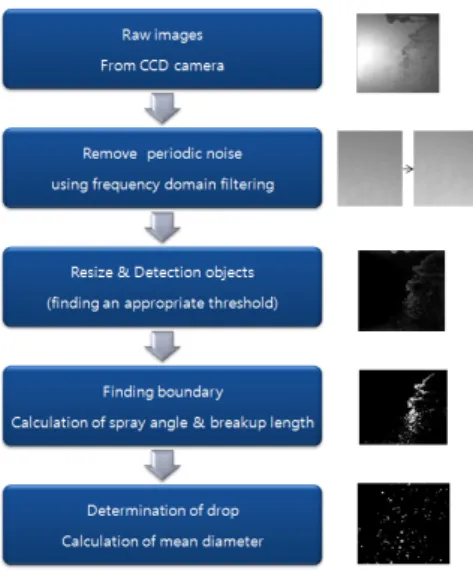
The overall procedure of image processing is shown in Fig. 3. The first step is to remove periodic noises which are unwanted variations in pixel values because the process of converting light to pixel values in a CCD images is governed by some fundamental physical laws and other factors. The periodic noise can be removed easily from a conversion from the spatial to frequency domain via FFT (Fast Fourier Transform). Frequency space collects the noise into a few spots which can be marked and eliminated. After running a FFT, a power spectrum is generated and marked the spots, these are inverted to produce a mask. Then an IFFT (Inverse Fast Fourier Transform) is run to remove the noise[3].
- 87 - Fig. 3 Overall algorithm of image processing
Fig. 4 Spray image In order to distinguish objects from
non-uniform background, the appropriate threshold value is required. A morphological opening technique can be used to compensate non-uniform problem[4]. The opening block performs an erosion operation followed by a dilation operation using a predefined neighborhood or structuring element. If the structuring element is large enough, the background of image could be estimated. And subtracting the estimated background image in the original image, the result of a relatively uniform background can be obtained.
Alternatively, the local processing concept is adopted in addition to the global processing technique to take account of non-uniformity of the illumination intensity. This approach has an advantage because the problem of uneven brightness of image frames can be eliminated[5].
To find the exact edges of the objects could reduce the error. There are many methods used to detect the edges. But generally, most of them can be grouped into two categories;
gradient and Laplacian based. The gradient
methods such as Sobel, Prewitt and Roberts detect the edges by looking for the maximum and minimum in the first-order derivative of the image. The Laplacian method searches for zero crossings in the second-derivative of the image to find edges. The Laplacian methods are very sensitive to noise, because these masks are obtained by the approximation of a second derivative measurement. In contrast, the Sobel operator has distinct advantages. It is less sensitive to isolated high intensity point variations since the local averaging over sets of pixels tends to reduce noise. The larger the width of the mask, the lower its sensitivity to noise and the operator also produces considerably higher output values for similar edges[5,6].
2.3 Spray characteristics
The spray characteristics such as spray angle, breakup length and drop size are defined according to injector types and
physical phenomena. In this study, the breakup length could be defined as the distance between the injector tip and the horizontal plan where the film breakup first occurs. The spray angle is defined the
- 88 - averaged angle of spray edges obtained by this image processing. The common method to measure the drop size is to find the equivalent diameter × of a circle having the same projected area regardless of its original shape. However, due to overlap or odd-shaped foreign results, all drops can not be included in the calculation. For these reasons, several ways have been proposed such as the concept of shape factor[5].
Generally, the shape factor determines the circular shape by using the perimeter, circularity, convexity or eccentricity. In this study, drops have been identified by eccentricity which is the ratio of the distance between the foci of the ellipse and the major axis length. An ellipse whose the eccentricity is '0' is actually a circle, while an ellipse with an eccentricity of '1' is a line segment.
Because the overall results are affected by a value of eccentricity, it is needed to set a appropriate value.
3. Conclusion
In this study, the digital image processing methods for measurements of spray characteristics have been investigated. To obtain reliable results, the various image processing techniques were studied. Although the verification on the accuracy of the image processing technique should be performed in the actual application and further studies are
required, it is to be hoped that the image processing method in study could contribute to acquisition of useful data for the effective design of injectors.
Reference
1. V. Kulkarni, D. Sivakumar, C. Oommen and T.J. Tharakan, "Liquid Sheet Breakup in Gas-Centered Swirl Coaxial Atomizers,"
Journal of Fluids Engineering, Vol. 132, January 2010, 011303
2. Jae-Hyoung Jeon, Moongeun Hong, Yeoung-Min Han, Soo Yong Lee, "Spray Characteristics in Gas-Centered Swirl Coaxial injectors," Asian Joint Conference on Propulsion and Power 2010, pp.690-694 3. Gonzalez, Woods, Eddins, Digital Image
Precessing Using MATLAB, Prentice-Hall Inc. 2004
4. Frank Y.SHih, IMAGE PROCESSING and
MATHEMATICAL MORPHOLOGY
Fundamentals and Applications, CRC Press Taylor & Francis Group, 2009
5. Sang Yong Lee, Yu Dong Kim, "Sizing of Spray Particles Using Image Processing Technique," KSME International Journal, Vol. 18 No. 6, 2004, pp.879-894
6. O.R.Vincent, O.Folorunso, "A Descriptive Algorithm for Sobel Image Edge Detection," Proceedings of Informing Science & IT Education Conference (InSITE) 2009, pp.97-107
![Fig. 1 Experimental setup Fig. 2 Schematic of a GCSC injector [2]](https://thumb-ap.123doks.com/thumbv2/123dokinfo/5356036.400145/2.808.425.712.237.592/fig-experimental-setup-fig-schematic-gcsc-injector.webp)