• 검색 결과가 없습니다.

The Protective and Inhibitory Effect of Antioxidants Found in Broussonetia kazinoki Siebold against Oxidative DNA Damage

N/A
N/A
Protected

Academic year: 2021

Share "The Protective and Inhibitory Effect of Antioxidants Found in Broussonetia kazinoki Siebold against Oxidative DNA Damage"

Copied!
9
0
0

로드 중.... (전체 텍스트 보기)

전체 글

(1)

Introduction

These days, research is being actively conducted to develop pharmaceuticals and cosmetics from natural materials-that have anti-tumor, antioxidant, and anti-aging properties-for the treatment and alleviation of various diseases (Yoo et al., 2005). Antioxidants are crucial for protecting against oxidative damage that can lead to conditions, such as Alzheimer’s disease, cancer, and chronic inflammation (Dinstel et al., 2013; Hussain et al., 2003; Sen et al., 2010). Antioxidants can regulate the levels of various radicals by converting them into stable forms with paired electrons, to maintain redox balance

and to prevent reactive oxygen species (ROS) from causing serious damage to biomolecules (Circu and Aw, 2010).

Plant-sourced natural antioxidants such as vitamin C, vitamin E, carotenes, phenolics, flavonoids, phytates, and phytoe- strogens play a critical role by interfering with the oxidation process by reacting with free radicals, chelating catalytic metals and scavenging oxygen in biological systems (Pisoschi et al., 2009; Prasad et al., 2010). Therefore, there is a growing interest in searching for alternative, natural, and safer sources of antioxidants. Additionally, ROS plays an important role in tumor initiation by mediating DNA damage through oxidative stress (Han et al., 2016), and the damaged cells activate complex signaling networks, to either reverse DNA damage or promote cell death in response to DNA

The Protective and Inhibitory Effect of Antioxidants Found in Broussonetia kazinoki Siebold against Oxidative DNA Damage

Tae-Won Jang

1

, Ji-Soo Choi

2

, Hoi-Ki Kim

3

, Eun-Ja Lee

3

, Ki-Beom Lee

4

, Tae-Hyung Kwon

5

, Do-Wan Kim

6

, Jeong-Jwa Ahn

6

and Jae-Ho Park

7

*

1

Graduate Student, Department of Medicinal Plant Resources, Andong National University, Andong 36729, Korea

2

Graduate Student, Department of Medicinal Plant Science, Jungwon University, Goesan 28024, Korea

3

Researcher, Fanipinkorea Co., Ltd, Cheongju 28162, Korea

4

Senior Researcher, Incheon Business Information Technopark. Biotechnology & Business Center, Incheon 21999, Korea

5

Senior Researcher, Department of Research and Development, Chuncheon Bioindustry Foundation, Chuncheon 24232, Korea

6

Professor, Department of Food Science and Industry, Jungwon University, Goesan 28024, Korea

7

Professor, Department of Pharmaceutical Science, Jungwon University, Goesan 28024, Korea

Abstract - Oxidative DNA damage negatively affects humans and the research is currently ongoing to find ways to reduce oxidative stress. Oxidative stress has been identified as a key factor in triggering various diseases. Thus, its alleviation is important for human health. Broussonetia kazinoki (B. kazinoki) has been used in traditional Korean medicine as a dermatological therapy to treat burns, pruritus, and acne. B. kazinoki is generally segregated into peeled root (PR), root bark (RB), peeled stem (PS), and stem bark (SB). To assess these components for their antioxidant activity and protection against DNA damage, their ethyl acetate fractions were examined by 1,1-diphenyl-2-picryl hydrazyl (DPPH) and 2,2'-Azino-bis (3-ethylbenzothiazoline-6-sulfonic acid) diammonium salt (ABTS) radical scavenging assay. As a result of confirming the expression of factors involved in attenuating DNA damage, the protective effect of SB on oxidative stress suppressed the expression of p-p53 and γ-H2AX. Additionally, the levels of p53 and H2AX mRNA were significantly downregulated. In conclusion, these results indicated that the SB component of B. kazinoki had the potential to be used as an effective natural antioxidant compared to the other parts of the plant.

Key words – Broussonetia kazinoki Siebold, DNA Damage, p53, γ-H2AX

*Corresponding author. E-mail : [email protected] Tel. +82-43-830-8614

ⓒ 2019 by The Plant Resources Society of Korea

Original Research Article

(2)

damage (Roos et al., 2016). p53-induced DNA damage through an activated kinase plays a pivotal role in activating the DNA repair proteins (Shibata and Jeggo, 2014).

Kinase-activated γ-H2AX plays an important role in DNA damage because it aggregates other genes that repair DNA damage in response to oxidative stress in cells (Paull et al., 2000). Broussonetia kazinoki Siebold (B. kazinoki) is a deciduous shrub that belongs to the family Moraceae (Lee, 2003). B. kazinoki have been used for manufacturing Korean paper for a long time in the East, and have been used as a medicine for the treatment of burns and acne (Lee et al., 2014). Methanol extracts of B. kazinoki have been found to possess tyrosinase inhibitory activity (Baek et al., 2009) and anti-inflammatory effects (Bae et al., 2011). Especially, the anticancer effects of the methanol extract of the root bark of B. kazinoki have been studied in A549 cell lines (Kim et al., 2016). In many previous studies, valuable functions of use have been examined in derives of B. kazinoki. The purpose of this study was to investigate the protective effect of DNA damage based on antioxidant activity.

Materials and Methods

Experimental materials

Peeled root (PR), Root bark (RB), Peeled stem (PS), and Stem bark (SB) of B. kazinoki Siebold (voucher number:

JWU-042) were obtained from the Goesan Korean paper Experience Museum, 233, Wonpung-ro, Yeonpung-myeon, Goesan-gun, Chungcheongbuk-do, Republic of Korea. All other chemicals were purchased from Sigma-Aldrich (St.

Louis, MO, USA) unless otherwise specified.

DPPH radical scavenging activity

DPPH radical scavenging activity was measured in accordance with the Bondet method (Bondet et al., 1997), with minor modifications. Absorbance was measured using a UV/Visible spectrophotometer (Xma-3000PC, HumanCorp, Seoul, Korea) at 515 ㎚.

ABTS radical scavenging activity

ABTS radical scavenging activity was measured as described by Van den Berg et al. (1999) with some modifications.

Absorbance was measured using a UV/Visible spectro- photometer at 732 ㎚.

Analysis of total phenolic compounds

Total phenolic compounds were analyzed in accordance with the Folin-Denis method (AOAC, 1995). The supernatants were measured at 725 nm using a UV/Visible spectro- photometer. Total phenolic compounds were expressed as ㎎ tannic acid equivalents (g/ ㎎ TAE).

Cell culture

NIH/3T3 cells were purchased from American Type Culture Collection (ATCC, Manassas, VA, USA) and cultured in DMEM media supplemented with 10% (v/v) bovine calf serum, 100 U/mL penicillin, and 100 ㎍/mL streptomycin.

The cells were maintained at 37℃ under conditions of humidified atmosphere containing 5% CO

2

.

Cell viability

Cell viability was measured by CellTiter 96

®

AQueous One solution, cell proliferation assay (Promega, Madison, WI, USA) and the manufacturer's protocols were followed. After the experiment, the absorbance was measured at 490 ㎚ to determine cell viability.

Immunoblotting

The cells were lysed in radioimmunoprecipitation assay buffer (Thermo Scientific, Waltham, MA, USA) supplemented with protease inhibitor cocktail (Sigma-Aldrich). The protein concentration in the sample was determined using the Bradford protein assay (Bio-Rad, Hercules, CA, USA). The proteins were then separated on a 10% SDS-PAGE gel and transferred to a polyvinylidene fluoride membrane (Bio-Rad).

The membranes were blocked with 5% bovine serum albumin (BSA) in Tris-buffered saline (TBS) containing 1% Tween 20 (TBS-T) and then incubated with specific primary antibodies in 3% BSA at 4 ℃ overnight. Subsequently, the blots were washed three times with TBS-T and incubated with horse- radish peroxidase-conjugated immunoglobulin G for 1 h.

Chemiluminescence was detected using the ECL Western

blotting substrate (Bio-Rad) and visualized using Chemi-Doc

(Bio-rad, Hercules, CA, USA).

(3)

Reverse transcription-Polymerase chain reaction (RT-PCR) The total RNA was extracted from B16F10 cells using Nucleo Spin

®

RNA Plus (Macherey-Nagel, Düren, Germany), and cDNA was synthesized using Rever Tra Ace - α- (Toyobo, Osaka, Japan) in accordance with the manufacturer’s protocol.

PCR was carried out using Quick Taq

®

HS Dye Mix (Toyobo).

Quantitative PCR Analysis

The cDNAs was then used as a template for quantitative polymerase chain reaction (qPCR) using Quanti Tect

®

SYBR Green PCR Kit (Qiagen) as per the manufacturer’s instruc- tions. To quantify the mRNA expression, qPCR analysis was performed on a 7500 Real-Time PCR system (Applied Biosystems, CA, USA). qPCR primers were designed using the Primer 3 program (Table 1). Datasets were analyzed using ABI 7500 Software 2.3 (Applied Biosystems).

Statistical analysis

Statistical analysis was carried out using SPSS 18.0 (SPSS, Inc., Chicago, IL, USA). All experiments were performed at least three times. The data obtained from experiments carried out in triplicates are shown as the mean ± SD. Differences were considered statistically significant when the P-value was < 0.05.

Results and Discussion

Reactive oxygen species (ROS) can damage DNA either

directly or indirectly (Wiseman and Halliwell, 1996; Yu et al., 2016). Indirect damage is caused by the reaction of ROS with biomolecules such as proteins and lipids, and other components in the cell. Direct damage occurs through one of the following routes: single electron transfer (SET), hydrogen atom transfer (HAT), or radical adduct formation (RAF) (Minko et al., 2009). In particular, ROS can produce not only single, but multiple lesions, defects, and mutations in DNA molecules, which may lead to the formation of cross-linked products (Bellon et al., 2002; Box et al., 1997; Crean et al., 2008; Leinisch et al., 2017; Uvaydov et al., 2014; Zeng and Wang, 2007; Zhang and Wang, 2003). Phenolic compounds present in plants have electron-donating potential due to their resonance structure, and their antioxidant potential can relatively reduce the ROS levels (Valko et al., 2005). For quantifying the antioxidant activity, DPPH and ABTS radicals scavenging activity assays were conducted. These radicals are reactive and react with nucleotides or whole DNA molecules (Reiter et al., 2010). Increased antioxidant capacity can protect against DNA damage, thereby leading to the prevention of carcinogenesis, mutagenesis, and various genetic disorders (Galano et al., 2015; Reiter et al., 2014).

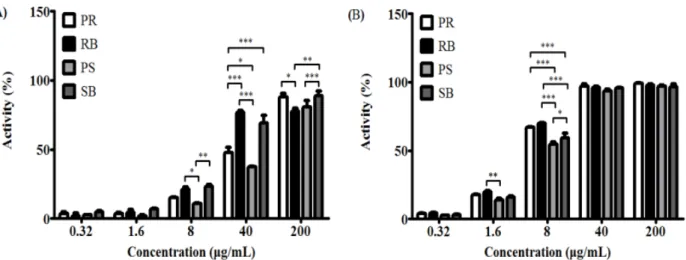
Scavenging activity against DPPH and ABTS radicals were confirmed by measuring the antioxidant activity of each part of B. kazinoki separately (Fig. 1). DPPH and ABTS radicals are the most widely used and stable chromogen compounds to measure the antioxidant activity of biological material (Que et al., 2006). DPPH is a free radical and ABTS is a cationic Table 1. Primer sequences

Gene Primer sequences (5’-3’)

H2AX

PCR Forward : TTGCTTCAGCTTGGTGCTTAG

Reverse : AACTGGTATGAGGCCAGCAAC

qPCR Forward : GCGTCTTTGCTTCAGCTTG

Reverse : CACACTGGCCTACGAATGG

p53

PCR Forward : CGGATAGTATTTCACCCTCAAGATCCG

Reverse : AGCCCTGCTGTCTCCAGACTC

qPCR Forward : GATGTTCCGGGAGCTGAAT

Reverse : GCCCCACTTTCTTGACCAT

GAPDH

PCR Forward : AACTTTGGCATTGTGGAAGG

Reverse : ATGCAGGGATGATGTTCTGG

qPCR Forward : CCTCCAAGGAGTAAGAAACC

Reverse :5CTAGGCCCCTCCTGTTATTA

(4)

radical complex with potassium persulfate. There is a difference in the reaction between each radical and the antioxidant (Meir et al., 1995). The inhibitory concentration 50 (IC

50

) values of DPPH for each extract were, 33.3 ± 9.6 ㎍ /mL (PR), 20.1 ± 2.3 ㎍/mL (RB), 60.0 ± 19.6 ㎍/mL (PS), and 18.8 ± 6.6 ㎍/mL (SB). The IC

50

values of ABTS were 5.3

± 0.0 ㎍/mL (PR), 4.4 ± 1.2 ㎍/mL (RB), 7.0 ± 0.4 ㎍/mL (PS), and 6.2 ± 0.6 ㎍/mL (SB). Analysis of the total phenolic compounds from the different parts from B. kazinoki (Fig. 2)

revealed that the amount of total phenolic compounds in PR, RB, PS, and SB was 7.4 ± 0.2, 5.2 ± 0.1, 5.6 ± 0.1, and 8.1 ± 0.2

㎎/g TAE, respectively.

Medicinal plants reportedly protect biomolecules, and their various bioactivities are attributed to the presence of phenolic compounds. Phenolic compounds are involved in deactivating ROS or inhibiting their formation (Alvarez- Idaboy and Galano, 2012). Phenolic compounds play an important role in inhibiting ROS-induced DNA damage (Attaguile et al., 2000). The cytotoxicity of B. kazinoki was

Fig. 1. DPPH radical (A) and ABTS radical (B) scavenging activity of different parts from Broussonetia kazinoki Siebold. Values are expressed as the means ± SD of three independent experiments. PR; peeled root, RB; root bark, PS; peeled stem, and SB; stem bark.

*
p < 0.05,

**

p < 0.01,

***

p < 0.001 as compared to each group.

Fig. 3. Cell viability of different parts from Broussonetia kazinoki Siebold in NIH/3T3 cells. Values are expressed as the means ± SD of three independent experiments.

*

p < 0.05,

**

p <

0.01,

***

p < 0.001 as compared to non-treated group. PR;

peeled root, RB; root bark, PS; peeled stem, and SB; stem bark.

Fig. 2. Total phenolic compounds of different parts from Broussonetia kazinoki Siebold. Values are expressed as the means ± SD of three independent experiments. PR; peeled root, RB; root bark, PS; peeled stem, and SB; stem bark.

*
p <

0.05,

**

p < 0.01,

***

p < 0.001 as compared to each group.

(5)

observed at 77.7-138.2% at 25 and 50 ㎍/mL. There were no statistically significant, but high cytotoxicity was seen at 25.7-40.6% at 100 ㎍/mL and 9.0-22.3% at 200 ㎍/mL (Fig.

3). ROS plays an important role in carcinogenesis through oxidative stress-induced DNA damage (Kong et al., 2001), and is directly related to apoptosis of cells (Simon et al., 2000). H2AX, the most important factor in the DNA damage pathway (Fernandez-Capetillo et al., 2004), and p53, a tumor suppressor, are closely related to DNA damage caused by high ROS levels (Sablina et al., 2005). Oxidative stress caused by elevated ROS causes phosphorylation of ATM/

ATR kinases, cell cycle checkpoint kinases (Chk2 / Chk1), tumor suppressor p53, and phosphorylated histone γ-H2AX foci. Thus, the expression of H2AX and p53 is used as an indicator of DNA damage (Maréchal and Zou, 2013).

Therefore, alleviation of ROS is very important, and anti- oxidants offer protection from these radicals in the body (Maxwell, 1995). To evaluate the expression of p-p53,

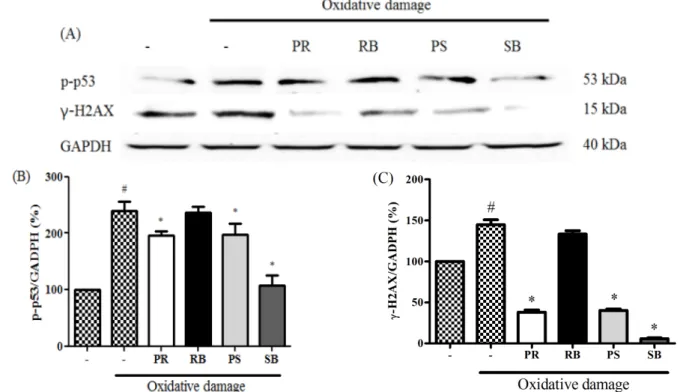
NIH/3T3 cells were pre-treated with each extract and oxidative damage was measured. The expression of p-p53 was increased in the treated cells compared to that in the untreated group. As a result, the ROS inhibitory effects of extracts from different parts of B. kazinoki in the context of DNA damage were assessed. In oxidative stress-induced NIH/3T3 cells, it was observed that PR, RB, PS, and SB inhibited the expression of p-p53 gene, as seen by immunoblotting (Fig. 4), RT-PCR, and qPCR analyses (Fig. 5). Compared to the basal level, oxidative damage significantly increased the p-p53 expression by 239.7 ± 16.0%. However, PR, RB, PS, and SB inhibited the expression of p-p53 (195.6 ± 8.1%, 236.2 ± 11.1%, 198.0

± 19.5%, and 107.6 ± 18.1% at 50 ㎍/mL, respectively). A similar pattern was observed when p53 mRNA levels were quantified thereby confirming the results (Fig. 5D). Further, compared to the basal level, oxidative damage significantly increased the mRNA levels of p53 by 128.3 ± 2.8%.

However, PR, RB, PS, and SB inhibited the mRNA levels of

Fig. 4. The inhibitory effect of different parts from Broussonetia kazinoki Siebold on the expression of p-p53, γ-H2AX (A), p-p53 (B), and γ-H2AX (C) normalization graphs in NIH/3T3 cells. Relative ratio was quantified after normalization to GAPDH. Values are expressed as the means ± SD of three independent experiments.

*

P < 0.05 vs. oxidative damage-induced group;

#

P < 0.05 vs.

untreated group. PR; peeled root, RB; root bark, PS; peeled stem, and SB; stem bark. Oxidative damage; 150 μM FeCl

2

+ 500 μM

H

2

O

2

.

(6)

p53 (85.4 ± 2.7%, 102.1 ± 4.6%, 65.8 ± 5.1%, and 64.1 ± 6.5% at 50 ㎍/mL, respectively). Moreover, qPCR analysis revealed that the mRNA levels of p53 were upregulated by 1.77 ± 0.08-fold in oxidative damage-induced NIH/3T3 cells relative to those in the untreated group. The mRNA levels of p53 were downregulated by treatment with PR, RB, PS, and SB by 1.13 ± 0.06-fold, 1.40 ± 0.08-fold, 0.65 ± 0.04-fold, and 0.54 ± 0.03-fold at 50 ㎍/mL, respectively. To evaluate γ

-H2AX expression, NIH/3T3 cells were pre-treated with each

extract and oxidative damage. The expression of γ-H2AX

increased compared to that in the untreated group. As a result

of the inhibitory effect of the extracts from different parts

from B. kazinoki on DNA damage, PR, RB, PS, and SB

inhibited the γ-H2AX expression in oxidative stress-induced

NIH/3T3 cells, as seen by immunoblotting (Fig. 4), RT-PCR

and qPCR analyses (Fig. 5). Compared to the basal level,

Fig. 5. The inhibitory effect of different parts from Broussonetia kazinoki Siebold on the expression of p53, H2AX (A), p53 (B),

H2AX (C) normalization graphs, qPCR analysis of p53 (D), H2AX (E) in NIH/3T3 cells. Relative ratio was quantified after

normalization to GAPDH. Values are expressed as the means ± SD of three independent experiments.

*

P < 0.05 vs. oxidative

damage-induced group;

#

P < 0.05 vs. untreated group. PR; peeled root, RB; root bark, PS; peeled stem, and SB; stem bark. Oxidative

damage; 150 μM FeCl

2

+ 500 μM H

2

O

2

..

(7)

oxidative damage significantly increased γ-H2AX expression by 144.7 ± 6.1%. However, PR, RB, PS, and SB inhibited the expression of γ-H2AX (38.1 ± 2.8%, 133.3 ± 4.2%, 40.3 ± 1.8%, and 5.8 ± 1.0% at 50 ㎍/mL, respectively). Compared to the basal level, oxidative damage significantly increased the mRNA levels of H2AX by 127.0 ± 8.0%. However, PR, RB, PS, and SB inhibited the expression of H2AX at mRNA level (92.6 ± 6.0%, 120.0 ± 7.6%, 68.1 ± 4.1%, and 59.4 ± 2.6% at 50 ㎍/mL, respectively). Further, oxidative damage- induced NIH/3T3 cells exhibited upregulation in the H2AX mRNA levels by 2.17 ± 0.08-fold, compared to that in the untreated group, as seen by qPCR analysis. The levels of H2AX mRNA were downregulated by PR, RB, PS, and SB treatments by 1.23 ± 0.06-fold, 1.90 ± 0.08-fold, 0.98 ± 0.04-fold, and 0.89 ± 0.03-fold, respectively at 50 ㎍/mL.

The effect of antioxidant activities on various radicals in addition to their inhibitory effects on oxidative DNA damage indicates the significant potential it has towards positively impacting human health. These bioactivities were related to flavonoids and phenolic compounds, as many studies have reported a direct or indirect correlation between these compounds (Jang and Park, 2018; Mustafa et al., 2010). SB showed the highest inhibitory activity with respect to expression of γ-H2AX and p53 at protein and mRNA levels.

The antioxidant activity of kazinol A and kazinol E from the root bark of B. kazinoki (Lee et al., 1997) has previously been reported. In this study, the stem bark of B. kazinoki Siebold showed the highest inhibitory activity against oxidative stress at the cellular level. Based on our study we identified SB as having a high antioxidant value, and therefore suggest that it can be used in pharmaceutical, cosmetics and food additives to alleviate and treat various diseases. Additionally, these promising results warrant further investigation into additional beneficial biological properties of this extract.

Acknowledgments

This research was supported by the Ministry of Trade, Industry & Energy (MOTIE), Korea Institute for Advanc- ement of Technology (KIAT) through the Encouragement Program for The Industries of Enconomic Cooperation Region (P0001037).

References

Alvarez-Idaboy, J.R. and A. Galano. 2012. A. On the chemical repair of DNA radicals by glutathione: Hydrogen vs.

electron transfer. J. Phys. Chem. B. 116(31):9316-9325.

AOAC. 1995. Official Methods of Analysis. 14th ed, Association of Official Analytical Chemists, Washington DC, USA. pp.

8-35.

Attaguile, G., A. Russo, A. Campisi, F. Savoca, R. Acquaviva, N. Ragusa and A. Vanella. 2000. Antioxidant activity and protective effect on DNA cleavage of extracts from Cistus incanus L. and Cistus monspeliensis L. Cell Biol Toxicol.

16(2):83-90.

Bae, U.J., Y.L. Da, M.Y. Song, S.M. Lee, J.W. Park, J.H. Ryu and B.H. Park. 2011. A prenylated flavan from Broussonetia kazinoki prevents cytokine-induced β-cell death through suppression of nuclear factor- κB activity. Biol. Pharm. Bull.

34(7):1026-1031.

Baek, Y.S., Y.B. Ryu, M.J. Curtis-Long, T.J. Ha, R.

Rengasamy, M.S. Yang and K.H. Park. 2009. Tyrosinase inhibitory effects of 1, 3-diphenylpropanes from Broussonetia kazinoki. Bioorg. Med. Chem. 17(1):35-41.

Bellon, S., J.L. Ravanat, D. Gasparutto and J. Cadet. 2002.

Cross-linked thymine-purine base tandem lesions: Synthesis, characterization, and measurement in γ-irradiated isolated DNA. Chem. Res. Toxicol. 15(4):598-606.

Bondet, V., W. Brand-Williams and C. Berset. 1997. Kinetics and mechanisms of antioxidant activity using the DPPH free radical method. LWT Food Sci. Technol. 30(6):609-615.

Box, H.C., E.E. Budzinski, J.B. Dawidzik, J.S. Gobey and H.G.

Freund. 1997. Free radical-induced tandem base damage in DNA oligomers. Free Radic. Biol. Med. 23(7):1021-1030.

Circu, M.L. and T.Y. Aw. 2010. Reactive oxygen species, cellular redox systems, and apoptosis. Free Radic. Biol.

Med. 48(6):749-762.

Crean, C., Y. Uvaydov, N.E. Geacintov and V. Shafirovich.

2008. Oxidation of single-stranded oligonucleotides by carbonate radical anions: Generating intrastrand cross-links between guanine and thymine bases separated by cytosines.

Nucleic Acids Res. 36(3):742-755.

Dinstel, R.R., J. Cascio and S. Koukel. 2013. The antioxidant level of Alaska’s wild berries: High, higher and highest. Int.

J. Circumpolar Health. 72.

Fernandez-Capetillo, O., A. Lee, M. Nussenzweig and A.

(8)

Nussenzweig. 2004. H2AX: the histone guardian of the genome. DNA Repair 3(8-9):959-967.

Galano, A., M.E. Medina, D.X. Tan and R.J. Reiter. 2015.

Melatonin and its metabolites as copper chelating agents and their role in inhibiting oxidative stress: a physicochemical analysis. J. Pineal Res. 58(1):107-116.

Han, H.M., Y.S. Kwon and M.J. Kim. 2016. Antioxidant and antiproliferative activity of extracts from water chestnut (Trapa japonica Flerow). Kor. J. Med. Crop Sci. 24(1):

14-20.

Jang, T.W. and J.H. Park. 2018. Antioxidant activity and inhibitory effects on oxidative DNA damage of callus from Abeliophyllum distichum Nakai. Korean J. Plant Res. 31(3):

228-236.

Kim, T.H., D.H. Kim, Y.J. Mun, K.S. Lim and W.H. Woo.

2016. Extract of Broussometia kazinoki Induces Apoptosis Through the Mitochondria/Caspase Pathway in A549 Lung Cancer Cells. J Physiol & Pathol Korean Med. 30(3):150-156.

Kong, Y.J., B.K. Park and D.H. Oh. 2001. Antimicrobial activity of Quercus mongolica leaf ethanol extract and organic acids against food-borne microorganisms. Kor. J.

Food Sci. Technol. 33(2):178-183.

Lee, H., H. Ha, J.K. Lee, S.J. Park, S.I. Jeong and H.K. Shin.

2014. The leaves of Broussonetia kazinoki siebold inhibit atopic dermatitis-like response on mite allergen-treated Nc/

Nga mice. Biomol. Ther. 22(5):438-444.

Lee, H.J., J.H. Park, D.I. Jang and J.H. Ryu. 1997. Antioxidant components from Broussonetia kazinoki. J. Pharm. Soc.

Kor. 41(4):439-443.

Lee, T.B. 2003. Coloured Flora of Korea. Hayangmunsa.

Seoul, Korea. pp. 223-223.

Leinisch, F., M. Mariotti, M. Rykaer, C. Lopez-Alarcon, P.

Hägglund and M.J. Davies. 2017. Peroxyl radical-and photo-oxidation of glucose 6-phosphate dehydrogenase generates cross-links and functional changes via oxidation of tyrosine and tryptophan residues. Free Radic. Biol. Med.

112:240-252.

Maréchal, A. and L. Zou. 2013. DNA damage sensing by the ATM and ATR kinases. Cold Spring Harb. Perspect. Biol.

5(9):a012716.

Maxwell, S.R.J. 1995. Prospects for the use of antioxidant therapies. Drugs 49(3):345-361.

Meir, S., J. Kanner, B. Akiri and S. Philosoph-Hadas. 1995.

Determination and involvement of aqueous reducing com- pounds in oxidative defense systems of various senescing

leaves. J. Agric. Food Chem. 43(7):1813-1819.

Minko, I.G., I.D. Kozekov, T.M. Harris, C.J. Rizzo, R.S. Lloyd and M.P. Stone. 2009. Chemistry and biology of DNA containing 1, N 2-deoxyguanosine adducts of the α, β- unsaturated aldehydes acrolein, crotonaldehyde, and 4- hydroxynonenal. Chem. Res. Toxicol. 22(5):759-778.

Mustafa, R., A.A. Hamid, S. Mohamed and F.A. Bakar. 2010.

Total phenolic compounds, flavonoids, and radical scaven- ging activity of 21 selected tropical plants. J. Food Sci.

75(1):C28-C35.

Paull, T.T., E.P. Rogakou, V. Yamazaki, C.U. Kirchgessner, M. Gellert and W.M. Bonner. 2000. A critical role for histone H2AX in recruitment of repair factors to nuclear foci after DNA damage. Curr. Biol. 10(15):886-895.

Pisoschi, A.M., M.C. Cheregi and A.F. Danet. 2009. Total antioxidant capacity of some commercial fruit juices: elec- trochemical and spectrophotometrical approaches. Molecules 14(1):480-493.

Prasad, K.N., L.Y. Chew, H.E. Khoo, K.W. Kong, A. Azlan and A. Ismail. 2010. Antioxidant capacities of peel, pulp, and seed fractions of Canarium odontophyllum Miq. fruit. J.

Biomed. Biotechnol. 2010:8.

Que, F., L. Mao and X. Pan. 2006. Antioxidant activities of five Chinese rice wines and the involvement of phenolic com- pounds. Food Res. Int. 39(5):581-587.

Reiter, R.J., L.C. Manchester and D.X. Tan. 2010. Neuro- toxins: free radical mechanisms and melatonin protection.

Curr. Neuropharmacol. 8(3):194-210.

Reiter, R.J., D.X. Tan and A. Galano. 2014. Melatonin: excee- ding expectations. Physiology 29(5):325-333.

Roos, W.P., A.D. Thomas and B. Kaina. 2016. DNA damage and the balance between survival and death in cancer biology. Nat. Rev. Cancer. 16(1):20-33.

Sablina, A.A., A.V. Budanov, G.V. Ilyinskaya, L.S. Agapova, J.E. Kravchenko and P.M. Chumakov. 2005. The anti- oxidant function of the p53 tumor suppressor. Nat. Med.

11(12):1306-1313.

Sen, S., R. Chakraborty, C. Sridhar, Y. Reddy and B. De. 2010.

Free radicals, antioxidants, diseases and phytomedicines:

current status and future prospect. Int, J. Pharm. Sci. Rev.

Res. 3(1):91-100.

Shibata, A. and P. Jeggo. 2014. DNA double-strand break repair in a cellular context. Clin. Oncol. 26(5):243-249.

Uvaydov, Y., N.E. Geacintov and V. Shafirovich. 2014.

Generation of guanine-amino acid cross-links by a free

(9)

radical combination mechanism. PCCP. 16(23):11729-11736.

Van den Berg, R., G.R. Haenen, H. van den Berg and A. Bast.

1999. Applicability of an improved Trolox equivalent anti- oxidant capacity (TEAC) assay for evaluation of antioxidant capacity measurements of mixtures. Food Chem. 66(4):511- 517.

Valko, M., H. Morris and M. Cronin. 2005. Metals, toxicity and oxidative stress. Curr. Med. Chem. 12(10):1161-1208.

Wiseman, H. and B. Halliwell. 1996. Damage to DNA by reactive oxygen and nitrogen species: role in inflammatory disease and progression to cancer. Biochem. J. 313(1):17-29.

Yoo, I.D., J.P. Kim, W.G. Kim, B.S. Yun and I.J. Ryoo. 2005.

Development of new natural antioxidants for cosmeceuticals.

J. Soc. Cosmet. Sci. Kor. 31(4):349-357.

Yu, Y., Y. Cui, L.J. Niedernhofer and Y. Wang. 2016.

Occurrence, biological consequences, and human health relevance of oxidative stress-induced DNA damage. Chem.

Res. Toxicol. 29(12):2008-2039.

Zhang, Q. and Y. Wang. 2003. Independent generation of 5-(2’-deoxycytidinyl) methyl radical and the formation of a novel cross-link lesion between 5-methylcytosine and guanine. J. Am. Chem. Soc. 125(42):12795-12802.

Zeng, Y. and Y. Wang. 2007. UVB-induced formation of intrastrand cross-link products of DNA in MCF-7 cells treated with 5-bromo-2’-deoxyuridine. Biochemistry 46(27):

8189-8195.

(Received 22 October 2019 ; Revised 3 December 2019 ; Accepted 13 December 2019)

수치

Fig. 1. DPPH radical (A) and ABTS radical (B) scavenging activity of different parts from  Broussonetia kazinoki Siebold
Fig. 4. The inhibitory effect of different parts from  Broussonetia kazinoki Siebold on the expression of p-p53, γ-H2AX (A), p-p53  (B), and  γ-H2AX (C) normalization graphs in NIH/3T3 cells

참조

관련 문서

The purpose of this research was to identify the mediating effect of unconditional self-acceptance and the moderated mediating effect of emotional

Inhibitory effects of classified methanol extracts of Smilax china L on the COX-2 and iNOS expression of human colorectal cancer cell lines... Inhibitory

The results show that the green seed extracts are only shown as antioxidants, but the others are shown as a prooxidants against DNA damage and Escherichia coli

Frequency and clinical significance of the expression of the multidrug resistance proteins MDR1/P-glycoprotein, MRP1, and LRP in acute myeloid leukemia: a

Activated H-Ras expression in human fibroblast cell lines increases the activity of Ku80 to bind injuried DNA, reduces γ-H2AX expression by UV irradiation,

Fig 4 : Inhibitory effects of classified methanol extracts of Acalypha australis the COX-2 protein expression of the human oral cavity carcinoma KB cells....

PI3K inhibition decreased antioxidants/GD-induced apoptosis in A549 cells, and PI3K inhibitor LY294002 had inhibitory effect on antioxidants/GD-induced caspase-3

Activated Foxo3a can inhibit the activation of p53 by DNA damage [46] and Resulted in a significant down-regulation of both p21 and p53 expression in Foxo3a- siRNA U2OS cells