http://dx.doi.org/10.7840/kics.2016.41.8.843
신경망 기반 차량 이미지센서 시스템을 위한 플리커 프리 공간-PSK 변조 기법
Flicker-Free Spatial-PSK Modulation for Vehicular Image-Sensor Systems Based on Neural Networks
Trang Nguyen, Chang Hyun Hong*, Amirul Islam*, Nam Tuan Le*, Yeong Min Jang°
ABSTRACT
This paper introduces a novel modulation scheme for vehicular communication in taking advantage of existing LED lights available on a car. Our proposed 2-Phase Shift Keying (2-PSK) is a spatial modulation approach in which a pair of LED light sources in a car (either rear LEDs or front LEDs) is used as a transmitter. A typical camera (i.e. low frame rate at no greater than 30fps) that either a global shutter camera or a rolling shutter camera can be used as a receiver. The modulation scheme is a part of our Image Sensor Communication proposal submitted to IEEE 802.15.7r1 (TG7r1) recently. Also, a neural network approach is applied to improve the performance of LEDs detection and decoding under the noisy situation. Later, some analysis and experiment results are presented to indicate the performance of our system
Key Words : Optical Wireless Communications, OWC, Image Sensor Communications, ISC, IEEE 802.15.7r1 Task Group, TG7r1, Image sensors compatibility, Frame rate variation, Flicker-free modulation, Global shutter, Rolling shutter, 2-PSK, S2-PSK, Neural Network.
※ This research was supported by Basic Science Research Program through the National Research Foundation of Korea (NRF) funded by the Ministry of Education (No. 2013057922).
First Author : Kookmin University, School of Electronics Engineering, [email protected], 학생회원
° Corresponding Author : Kookmin University, School of Electronics Engineering, [email protected], 종신회원
* Kookmin University School of Electronics Engineering, [email protected], [email protected], 학생회원 [email protected], 정회원
논문번호:KICS2016-06-118, Received June 9, 2016; Revised August 1, 2016; Accepted August 2, 2016
Ⅰ. Introduction
Research trend on intelligent traffic system has taken a major attraction for automotive companies and researchers who are contributing for safe driving. The autonomous car is a specific example of an intelligent traffic system in which the cooperative driving and collision avoidance, as well as in traffic navigation are critically considered.
Notably, an efficient car-2-car communication technology is indispensable to support those
requirements. A traditional solution such as Radio Frequency (RF) based communication in a traffic environment has shown tremendous growth and advantages; however, it still preserves some unmitigated challenges of interference and mobility.
The difficulty in identifying where a signal is coming from in heavy traffic is also problematic.
Fortunately, there is an ‘out-of-box’ solution which operates the communications on the visible light band can resolve difficulties. The benefits of visible light communications have been presented[1,2].
Fig. 1. Neural Network based Vehicular ISC System employing a proposed Spatial 2-PSK Modulation Moreover, the reality of a new light to car-to-car
communication in the not-too-distant future also discussed recently[3].
Operating in the visible light band, sometimes extension into Ir and UV band is considered, Optical Wireless Communication (OWC) technology is a service-oriented technology. After the first IEEE Visible Light Communications (VLC) standard was published in 2011[4], the revision IEEE 802.15.7r1 OWC is on-going and calling for technical and application proposal[5,6]. On this paper, consideration on OWC technology applying into the vehicular environment, an Image Sensor Communications (ISC) system is of interest. Different from a VLC system, a camera is used as a receiver in our ISC system. The advantages of ISC applying into the vehicular environment can be highlighted as: (i) The use of existing infrastructures (i.e. LED lights on the car as a transmitter, and an existing camera on a car as a receiver). The matter of hardware co-existence to a car is even a realistic rather than just an economic issue when vehicles are going to be installed with full cameras as indispensable safety sensors[3]. (ii) The technical standardization of related technologies (i.e. OWC technologies) is attractive. The IEEE 802.15.7r1 (TG7r1) has witnessed a considerable success on proposal submissions as the May 2016 meeting minutes concluded[7,8]. For further information, the TG7r1 meeting schedule and the minutes of the latest
meeting are available at [6] and [7], respectively.
A spatial modulation scheme based on 2-PSK is our contribution on the content of this paper. The main idea of the proposed spatial scheme is a mechanism of error avoidance in decoding caused by additional noise during image samplings. A noisy environment is a critical issue in vehicular communication. Moreover, the significant purposes of the proposed system are (i) to mitigate flicker, (ii) to support image sensors compatibilities, which include being compatible with both global shutter/
rolling shutter camera, (iii) and being compatible with a wide varying-frame-rate camera. The TG7r1 committee has agreed technical considerations through the series versions of Technical Consideration Document (TCD) of TG7r1 [9-10].
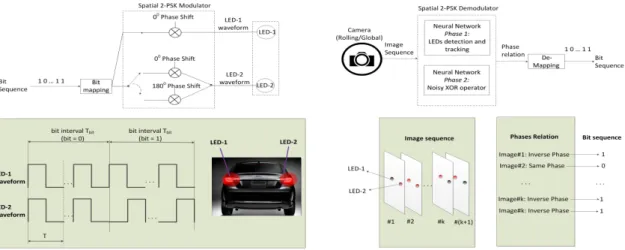
Fig. 1 indicates our vehicular ISC system. In the Fig. 1, a pair of rear LEDs (or a pair of front LEDs) acts as a transmitter and a camera on car operates as a receiver. On the transmitter side, a bit is mapped to output a relation between phases of waveforms to be modulated to LEDs. On the receiver side, a bit is demodulated by checking the relationship between captured states of LEDs (similarity or difference). Either a global shutter camera or a rolling shutter camera having a wide-varying frame-rate can be used as a receiver of our vehicular ISC system. Noticeably, two-phase Neural Network is employed in the receiver side to achieve a high performance.
The remainders of the paper are organized as following. A brief overview of our contributions is introduced in Section II. After that, details on spatial 2-PSK (S2-PSK) technology are described in the following section. The encoding, decoding procedure and neural network are presented. Later, Section IV analyzes the performance of the communication scheme as well as the performance of the neural network approach. And finally, Section V encloses our paper with some open discussion.
Ⅱ. Related Works and Our Contribution
A temporal approach transmits a data packet sequentially over time[11,13-15], while a spatial approach transmits a data packet spatially and sequentially[16-20]. Regarding a flicker mitigation, a rolling shutter based ISC systems[11-13] take advantage of the rolling shutter operation which sequentially exposes pixel lines to the incoming light employing a temporal approach. In contrast, a spatial approach is applied by using a high-speed camera to mitigate flicker such as in vehicular communication systems[20]. At the same operation principle at which a speed of the camera is higher than the transmission rate, the other papers related to the spatial transmission using screen/display without considering flicker mitigation[16-18] are also remarkable.
In addition to the flicker-free requirement regarding a communication approach, a compatibility support to different types of the shutter (i.e. global shutter and rolling shutter) for numerous image sensors available on the market is indispensable.
There are a countable number of works those support both types of shutter because of its challenging. The first scheme, proposed by Rick Robert, Intel corp., suggests an Undersampled-Frequency-Shift On-Off-Keying (UFSOOK) system based on 2-FSK modulation[14]. Later, a proposed undersampled scheme based on 2-PSK, an Undersampled Phase-Shift On-Off-Keying UPSOOK, was introduced by Luo et al.[15]. Both of them belong to the temporal approach that a both-shutter support is employed by
comparing two adjacent samplings captured at adjacent sampling times. Whereas, our idea related to a spatial approach which decodes data by comparing states of LEDs captured on the same image was presented as a sub-proposal to TG7r1 recently[10]. Especially on this paper, the spatial approach is employed through a XOR decoding. A movement of targeted vehicle at a greater than 1/3 meter between two image samplings generates a high possibility of change in noises acquired by those two samplings. This is reasonable for a spatial approach proposed to be used.
Ⅲ. Proposed Vehicular Communication Scheme
3.1 Spatial 2-PSK Encoding
The principle of 2-PSK is well-known. For ISC system, the square signal is employed to modulate any LED. The spatial approach is employed by modulating the phase’s relation between signals driving two LEDs on a transmitter. Some benefits of our spatial approach have been presented in the earlier section. Each time of transmission, the transmitter which consists of a couple of LEDs can transmit a bit. The encoding is proposed as shown in Table I in which bit 0 is transmitted by driving two square signals at the same phase, whereas bit 1 is transmitted through two inverse-phase signals.
Each time of transmission, a segment of signal at interval T is modulated to LED-1, s1(t), is expressed by
≤
≤ (1)
where k is an unsigned integer; i=0,1,…,N.
T is the signal interval (i.e. a cycle).
Note that the LED-1 signal consists of multiple duty cycles of the same length in time, T, (i.e. =NT) in order to support a camera, which has frame rate below 30 fps, doing under-sampling (i.e. > camera frame rate). The bit interval of signal to LED-1, , is hence expressed by the sum of multiple duty cycles,
Fig. 2. Flowchart of the proposed decoding procedure using NN
≤ ≤
(2)
where is the cycle #k among N cycles of the bit-interval signal to LED-1.
In our experiment, 125Hz optical clock is used to modulate the LED light being able to mitigate flickering. Consequently, the value of signal cycle, T, is 1/125 second; and the interval of a bit, , is a multiple times repetition of T to support a low frame rate camera (i.e. 30fps or less). The times of repetition is customized according to the lowest frame rate value of a camera receiver. For example, N=5 is applied to support a 25fps camera, or N= 25 is applied to support a super low frame rate camera (i.e. 10fps or less).
The modulated bit interval to LED-2, , is expressed as a relation to the modulated bit interval to LED-1:
(3)
where
is the cycle #k among N cycles of the bit interval of LED-2;
is the cycle #k among N cycles of the bit interval of LED-1.
is the inverse form of
bit 0 bit 1
Phase relationship
(between two LEDs) Same phase Inverse phase Table 1. Parameters for simulation purpose
3.2 Spatial 2-PSK Decoding
From the encoding table, the relation between two phases of those two LEDs is maintained throughout the bit interval, . Consequently, at any sampling time on the bit interval #i (∀ ≤ ≤ ), the bit #i is completely decodable by checking the
relation between two captured states of those two LEDs. Bit 1 data is recovered from the similarity of the states between the LED-1 and LED-2; in contrast, bit 0 data is recovered from the difference of the states between those two LEDs. Fortunately, our proposed decoding recovers a transmitted bit by comparing those two states of two LEDs on the image instead of considering them individually. The decoding output is independent of from the individual state of each LED. Hence, any presence of mismatched frame rates between the LEDs-transmitter and the camera receiver due to a variation of camera frame rate is resolved.
At the moment of sampling , the information bit is decoded depending on the relation between captured states of those two LEDs. Let denote representing the captured state of LED-1 and representing the captured state of LED-2, the data bit is expressed as a function of a LED-states XOR operator:
(4)
where is the sampling time;
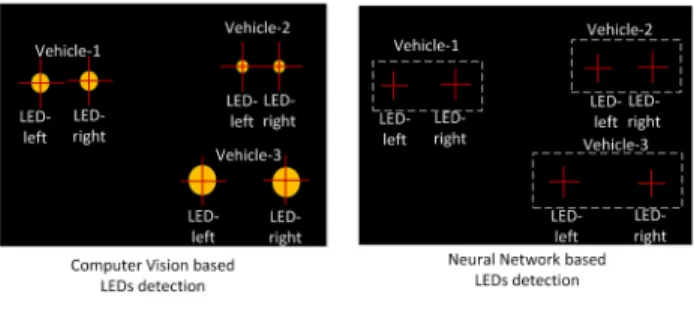
(a) A Neural Network approach has advantage in comparing to a Computer Vision approach in determining which LEDs belong to a car.
(b) Simulated performance of NN compared to Computer Vision approach in detecting LED, re-draw from our previous work[21].
Fig. 3. Principle and Performance of NN based Vehicle-LEDs detection
(a) Principle comparison between a linear XOR decision and NN learning based nonlinear XOR decision.
(b) Simulated performance of 2-layer NN for XOR nonlinear-decoding, re-simulated from [22]
Fig. 4. Principle and Performance of NN based XOR decoding
and are states of tow LEDs at sampling time ts.
3.3 Neural Network
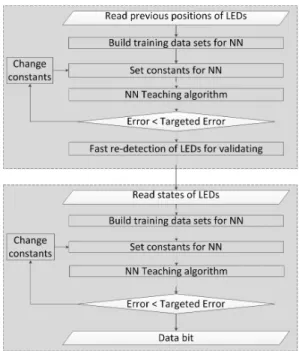
Under a high level of noise experienced in the vehicular environment, we propose a Neural Network (NN) algorithm on the receiver side to support a vehicular camera in demodulating the light signal efficiently. Two-phase NN algorithm is proposed for demodulating data from images as shown in Fig. 2. The purposes of phases of NN demodulator are as follow:
(i) Phase 1: LEDs detection and tracking using NN
Due to a considerable movement of cars within the short time of sampling interval (i.e. over 1/3 meter), a real-time accurate detection/tracking of LEDs is necessary. The NN takes the previous positions of LEDs on the captured images for estimating the current position of LEDs. Later, after
NN is performed through training, a validation from the processing of every image is through.
(ii) Phase 2: S2-PSK decoding using NN A fast detection of LEDs in the previous phase (Phase 1) is helpful to determine the states (ON/OFF) of those LEDs as inputs in this phase 2.
The decoding procedure is as a XOR operator that belongs to the determined states of LEDs. However, the situation that states of LEDs are affected by noise is considered here. A pair of noisy inputs requires an efficient noisy XOR operator and NN is therefore proposed.
Ⅳ. Performance Evaluation and Results 4.1 Communication Performance Analysis
4.1.1 Error rate estimation
The effect of environmental noise is mitigated by using two-phase NN on the next subsection and not
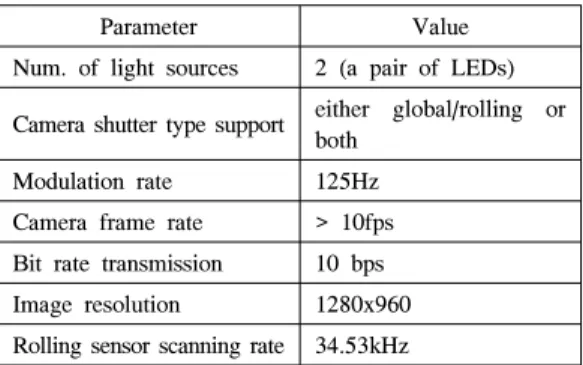
Parameter Value Num. of light sources 2 (a pair of LEDs) Camera shutter type support either global/rolling or
both
Modulation rate 125Hz
Camera frame rate > 10fps Bit rate transmission 10 bps Image resolution 1280x960 Rolling sensor scanning rate 34.53kHz Table 2. Comparison of simulation results
considered here. This estimation gives a probability view of error caused by camera sampling (i.e. long exposure time, rolling effect and rotation). From decoding procedure given, the S2-PSK scheme works well under a non-rotated camera. However, under a rotating angle that causes to a sampling time difference between two LEDs, ∆t, an error happens when two LEDs on an image are captured at different sampling times due to rolling effect. In this case, the probability of a bad-sampling that generates error, ′
, is estimated as:
∆
≈
∆
(5)
where
is the switching time (ON/OFF) of signal spread;
is the exposure time of camera capturing
∆t is the sampling time difference between two LEDs.
Assume that the sampling is a random process.
The mean error rate is hence estimated by:
∆ ∆ (6)
The mean error rate in Eq. (6) is applied to a rotation angle at less than 14 degree and our ISC system parameters are given in table II. The error rate is helpful in suggesting an error correction with a proper code rate. A simple error correction, such
as a spatial or a temporal repetition code, can moderate the final error rate as being suggested by our previous work[19].
4.1.2 Implemental performance
Table II indicates parameters being used in our ISC system and resulting achievements.
4.2 Neural Network Performance Evaluation
4.2.1 Phase 1-LED detection NN performance Fig. 3 gives a performance comparison of LEDs detection between Computer Vision and our Neural Network approach. From Fig. 3a, a Computer Vision approach processes the entire image to track LED-positions while the NN approach estimates possible positions of LEDs from previous learning and validates the correct positions from post-processing. The advantage of NN is that the grouping of LEDs those belong to a car is simple.
Also, if LEDs are captured as OFF states, a Computer Vision is not able to detect the exact positions of LEDs but NN can perform through estimation.
The accuracy of detection belongs to the distance linearly because the resolution of the image is constant. Fig. 3b compares the performance of accuracy of NN versus Computer Vision via distance. Simulated parameters for moving vehicles (a transmitter and a receiver) were given in our previous work [21] and the outstanding result of our NN is shown in the Fig. 3b.
4.2.2 Phase 2-XOR decoding NN performance A multi-layer NN is implemented and trained by using the two-layer network. A hidden layer helps NN to learn the nonlinear categorization criterion effectively as principle shown in Fig. 4a. Without using the NN, inputs of XOR operator must be clearly ‘1’ or ‘0’. A linear classification of LED-states ON/OFF is affected by the exposure time of the camera and an environmental noise considerably; hence the error rate is higher than our NN. Our NN can learn nonlinear characteristic of XOR classification satisfying Mean Square Error
(MSE) of and within 50 and 100 iterations respectively, as shown in Fig. 4b.
Ⅴ. Conclusion
The paper has introduced a part of our Image Sensor Communication proposal at the IEEE TG7r1 standardization meeting. Compared to other related works, our proposed modulation scheme has some novelty including: (i) flicker-free modulation scheme with a complete compatibility with different shutter types (both global shutter and rolling shutter are working well); (ii) a support to cameras those have a wide frame rate variation (i.e. down to 10fps); and (iii) correction of error caused by bad-sampling and rotation of a rolling shutter receiver. For vehicular communication, our spatial scheme has designed in using a pair of LEDs light and camera existing on a car. Artificial Neural Network has shown its outstanding performance in various areas and it has been proposed properly to bring a good achievement in our communication system.
References
[1] P. H. Pathak, X. Feng, P. Hu, and P.
Mohapatra, “Visible light communication, networking, and sensing: A survey, potential and challenges,” IEEE Commun. Surveys &
Tuts., vol. 17, no. 4, 2015.
[2] The potential of Li-Fi, Available at http://
purelifi.com/potential-of-li-fi/
[3] S. Lewin, LEDs Bring New Light to Car-to-Car Communication, http://spectrum.ieee.
org/transportation/advanced-cars/leds-bring-new- light-to-car-to-car-communication.
[4] The VLC specification, IEEE standard for local and metropolitan area networks – Part 15.7: Short-Range wireless optical communication using visible light, IEEE standards association, Sept. 2011. Available:
http://standards.ieee.org/findstds/standard/802.1 5.7-2011.html
[5] IEEE 802.15.7r1 official link. http://www. ieee
802.org/15/pub/IEEE% 20802_15%20WPAN%
2015_7%20Revision1%20Task%20Group.htm [6] TG7r1 Milestones and Schedule. https://mento
r.ieee.org/802.15/dcn/ 15/15-15-0274-03-007a-s uggested-15-7r1-milestones-and-schedule.pptx [7] TG7r1 January Meeting Minutes: https://mento
r.ieee.org/802.15/dcn /16/15-16-0133-00-007a-j anuary-2016-minutes.docx
[8] ISC/L-PD PHY Modes Classification for Draft Document D0 https://mentor.ieee.org/802.15/
dcn/16/15-16-0311-00-007a-isc-lr-pd-phy-mode s-classification-for-draft-document-d0.pptx [9] The Technical Consideration Document (TCD)
for IEEE TG7r1. Available at: https://mentor.i eee.org/802.15/dcn/15/15-15-0492-05-007a-tec hnical-considerations-document.docx
[10] TG7r1 January meeting minutes: https://mento r.ieee.org/802.15/documents?is_dcn=minu&is_
group=007a
[11] P. Ji, H.-M. Tsai, C. Wang, and F. Liu,
“Vehicular visible light communications with LED taillight and rolling shutter camera,”
IEEE Veh. Technol. Conf., pp. 1-6, May 2014.
[12] C. Danakis, M. Afgani, G. Povey, I.
Underwood, and H. Haas, “Using a CMOS camera sensor for visible light communication,” in Proc. IEEE Globecom Wksp., pp. 1244-1248, Anaheim, California, USA, Dec. 2012.
[13] T. Nguyen, M. A. Hossain, and Y. M. Jang,
“Design and implementation of a novel compatible encoding scheme in the time domain for image sensor communication,”
Sensors, vol. 16, no. 5, May 2016.
[14] R. D. Roberts, “Space-time forward error correction for dimmable undersampled frequency shift ONN_OFF keying camera communications (CamCom),” ICUFN, pp.
459-164, Jul. 2013.
[15] P. Luo, Z. Ghassemlooy, H. L. Minh, X.
Tang, and H.-M. Tsai, “Undersampled phase shift ON-OFF keying for camera communication,” Int. Conf. WCSP, pp. 1-6, Oct. 2014.
[16] T. Hao, R. Zhou, and G. Xing, “COBRA:
Color barcode streaming for smartphone systems,” MobiSys ’12, pp. 85-98, 2012.
[17] T. Nguyen, M. A. Hossain, C. H. Hong, N. T.
Le, and Y. M. Jang, “Color transmission in image sensor communications using display and camera,” IEEE Int. Conf. ICTC, pp.
383-387, 2015.
[18] N. T. Le, M. A. Hossain, C. H. Hong, T.
Nguyen, T. Le, and Y. M. Jang, “Effect of blur Gaussian in MIMO optical camera communications,” IEEE Int. Conf. ICTC, pp.
1371-1374, 2015.
[19] T. Nguyen, N. T. Le, and Y. M. Jang,
“Practical design of screen-to-camera based optical camera communication,” 2015 ICOIN, pp. 369-374, Jan. 2015.
[20] T. Nguyen, N. T. Le, and Y. M. Jang,
“Asynchronous scheme for optical camera communication based infrastructure-2-vehicle,”
IJDSN, vol. 2015, 2015.
[21] M. S. Ifthekhar, N. Saha, and Y. M. Jang,
“Stereo-vision-based cooperative-vehicle position- ing using OCC and neural networks,” Optics Communications 352(2015), pp. 166-180. http:
//dx.doi.org/10.1016/j.optcom.2015.04.067 [22] Agentle Introduction to Artificial Neural N
etworks, https://theclevermachine.wordpress.co m/2014/09/11/a-gentle-introduction-to-artificial -neural-networks/
Trang Nguyen
2013년 7월 : Hanoi University of Science and Technology 졸업
2015년 8월 : 국민대학교 전자 공학과 석사
2015년 9월~현재 : 국민대학교 전자공학과 박사과정
<관심분야> Optical Camera Communications (OCC), Localization, Digital Signage, and Augmented Reality services.
Chang Hyun Hong
2015년 2월 : 국민대학교 전자 공학부 졸업
2015년 3월~현재 : 국민대학교 전자공학과 석사과정
<관심분야> Optical Wireless Communication, Image processing
Amirul Islam
2014년 9월:Khulna University of Engineering and Technology in Electrical and Electronic Engineering 졸업
2015년 9월~현재:국민대학교 전자공학과 석사과정
<관심분야> Localization, SDN, Optical and Camera Communications
Nam Taum Le
2005년 2월:HaNoi University of Science and Technology 졸업
2011년 8월:국민대학교 전자 공학과 석사
2014년 2월 : 국민대학교 전자 공학과 박사
2014년 3월~현재: 국민대학교 조교수
<관심분야> Sensor Network, Visible Light Communication
Yeong Min Jang
1985년 2월 : 경북대학교 전자 공학부 학사
1997년 2월 : 경북대학교 전자 공학부 석사
1999년 8월 : Univ. of Mass- achusetts Computer Science 박사
2002년 3월~현재 : 국민대학교 교수
<관심분야> OWC, WPAN, IoT, 5G Mobile communications