Nampo Group, Korea
Jong-Heon Kim*
Department of Earth Science Education, Kongju National University, Chungnam 314-701, Korea
Abstract: Since 1984, the author has been studying the Daedong flora and has collected a large number of fossil plants from the Amisan Formation of Nampo Group distributed in Chungnam Coal-Field. One of the fossil plants was bennettitalean male flower, which was collected in 1986. The author described it as Weltrichia sp. The occurrence of Weltrichia sp. is the first record in the Early Mesozoic Daedong flora of Korea.
Keywords: Amisan Formation, bennettitalean male flower, Weltrichia
Introduction
Bennettitales are well represented in the Mesozoic fossil floras of Europe, Asia and North and South America by vegetative and reproductive remains of extinct genera (Oishi, 1940; Harris, 1969; Watson and Sincock, 1992; Barboni and Dutra, 2013). The plants included in the Bennettitales extend from the Triassic to the Cretaceous and occur in both hemispheres (Talyor et al., 2009). However, recently McLoughlin et al. (2011) reported Ptilophyllum muelleri (Ettingshan) comb nov. from the Oligocene of Australia as a last of the Bennettitales. The presence of bennettitalean leaves in the Cenozoic beds of Australia indicates that they were a few survivors from the Mesozoic flora in the Gondwana land as a relic. If the result of study of McLoughlin et al. (2011) is accepted here, the stratigraphic range of Bennettitales extends from the Triassic to the Oligocene of Cenozoic.
The reproductive organs of the Bennettitales include both monosporangiate and biosporangiate forms as mentioned by Taylor et al. (2009), The former
includes male reproductive organs of Weltrichia Braun and female reproductive organs of Williamsonia Carruthers, and the latter are grouped in Williamsoniella Thomas (Harris, 1969; Barboni and Dutra, 2013).
Weltrichia is the name assigned to pollen bearing organs of the Williamsiniaceae belonging to Cycadeoidales or Bennettitales (Delevoryas, 1991; Talyor et al., 2009). They were originally included within the genus Williamsonia, but Harris (1969) transferred these pollen bearing organs to the genus Weltrichia Braun (Delevoryas, 1991).
So far as is known twenty one species of Weltrichia have been described from the Upper Triassic to the Lower Cretaceous beds in the Northern and Southern Hemispheres (Li et al., 2004; Pineda et al., 2011).
In Asia the occurrence of Weltrichia was very rare, three species has been known in the Upper Triassic to the Jurassic strata (Li et al., 2004). Despite the large number of bennettitalean leaves from the Daedong Supergroup of Korea (Oishi, 1940; Kim, 1993, 2001), the fossil record of Weltrichia have not been known.
Since Kawasaki’s (1925, 1926, 1939) monographs were published, some short papers on the plant fossils of the Nampo Group have been published by several authors (Kim, 1989, 1990, 2001; Kim and Kimura, 1988; Kim et al., 2004, 2005; Kim and Roh, 2008;
Kimura et al., 1982; Kimura and Kim, 1988, 1989).
This paper deals with the description of Weltrichia sp. first found in the Amisan Formation of Nampo Group. The specimen here examined will be kept at
*Corresponding author: [email protected]
*Tel: +82-41-850-8298
*Fax: +82-41-850-8299
This is an Open-Access article distributed under the terms of the Creative Commons Attribution Non-Commercial License (http://
creativecommons.org/licenses/by-nc/3.0) which permits unrestricted non-commercial use, distribution, and reproduction in any medium, provided the original work is properly cited.
the Department of Earth Science, Kongju National University.
Stratigraphy
The Nampo Group is distributed in the Chungnam Sedimentary Basin of southwestern part of the Chungcheongnam-do, and consists of a 3,000 m thick sequence of terrestrial sediments (Reedman and Um, 1975).
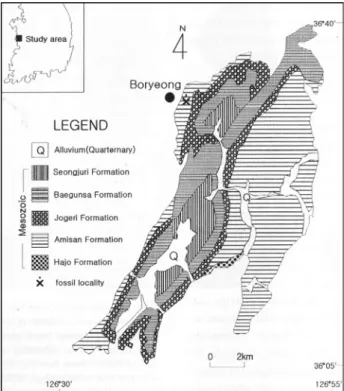
Since Shimamura’s (1931) geological investigation on the Chungnam Sedimentary Basin, some geological studies were carried out by Korean geologists. The correlation of stratigraphic sequence of the Nampo Group was made by Suh et al. (1980). According to Suh et al. (1980), the Nampo Group is subdivided into five formations, i.e., the Hajo, Amisan, Jogyeri, Baegunsa and Seongjuri Formations in ascending order. The main fossil locality is shown in Fig. 1.
Recently, facies analysis of the Hajo Fotmation was made by Lee and Chung (2010). According to them, the Hajo Formation is interpreted to have been
deposited at the talus/upper fan delta environment in early stage; it might have been deposited in the alternating environments of upper and middle fan delta in middle stage, and it seems to have been deposited in alternating environments of middle and lower fan delta in late stage.
The geological age of the Amisan Formation based on the fossil plants and conchostracans has been considered to be the Late Triassic (Kimura and Kim, 1984, 1988, 1989; Kobayashi, 1975; Kim, 1993).
However, recently Egawa and Lee (2011) mentioned that the age of the Nampo Group is middle Jurassic (157-140 Ma) which is based on the K-Ar dating of illites collected from the Amisan Formation. Accordingly, both the results of palaeontological study and K-Ar dating do not correspond with each other.
Systematic description
Genus: Weltrichia Braun 1847 emended Harris 1969 Type species: Welterichia mirabilis Braun 1849
Weltrichia sp.
Fig. 1. Geological map of study area (after Suh et al., 1980, modified in part) and fossil locality.
Description: Specimen is preserved as impression state. The specimen consists of a massive cup more or less obliquely compressed, 2.9 cm in diameter dividing above into equal lobes; the depth of cup is uncertain, because the basal part of cup is missing. Preserved lobes are 10 in number, but originally they are supposed to be 14 in number, exceeding 1.2 cm in length and 4 mm in width. Apex of lobe is not known. Margins are entire. No appendages are recognized.
Material: Reg. no. AM-431.
Locality: Inkstone quarry of Myeongam, Dongdae- dong, Boryong-si, Chungcheongnam-do, Korea (36o20'08"N, 120o37'40"E).
Distribution and occurrence: In the Nampo Group, a single specimen was obtained from one locality of the Amisan Formation.
Remarks: The general features of this flower are safely referable to the male flower of Weltrichia redescribed by Harris (1969) from the Jurassic Yorkshire beds. According to Harris (1969), bennettitalean male flower consists of a massive cup dividing above into numerous lobes. Inner side of cup bearing pollen sacs, pollen sacs where are known consisting of two equal valves, each valve with a single row of microsporangia opening on to inner face. However, The present flower is represented by its reverse side, So that the auther could not observe such appendage as pollen sacs supposed to be seen on the adaxial side of their
Accordingly the author regard it as Weltrichia sp.
This flower closely resembles in number of lobe and size that of Weltrichia sp. described by Kimura and Ohana (1989) from the Upper Jurassic Oginohama Formation of Japan.
Discussion
As mentioned by Watson and Sincock (1992), Harris (1969) revived the use of the neglected genus Weltrichia for bennettitalean male flowers, at the same time restricting use of the genus Williamsonia to female flowers. The taxonomic diversity of Weltrichia has been recognized in the Triassic to the Cretaceous, but it appears to be more abundant to the Jurassic (Stewart and Rothwell, 1993).
According to Li et al. (2004), and Pineda et al.
(2011), seventeen species of Weltrichia have been found in the Jurassic Yorkshire beds of England, Rajmahal beds of India, and the Jurassic beds of Mexico. Among them, Williamsonia mexicana was originally described by Wieland (1914-16) from the Jurassic of Mexico, and later it has been transferred to the Weltrichia mexicana by Harris (1969). Delevoryas and Gould (1973) reexamined the specimen of Weltrichia mexicana, and mentioned that W. mexicana is not a cone. At any rate most species have been known in the Jurassic beds. However, the fossil record of Weltrichia from the Triassic beds is generally very rare, and four species are listed in Table 1 of Li et al.
(2004).
Flower is very difficult to be preserved as a fossil to compare with leaves and stems of plants, due to its relatively rare in quantity as well as its lower solidity.
Also, the condition of flower being preserved as a fossil is considered the same throughout all the time.
Judging from the abundant occurrence of Weltrichia in the Jurassic age than the Triassic age, it is inferred that the bennettitaleans might have been quite flourished in the Jurassic age than the Triassic age under warm humid tropical to subtropical climate Fig. 2. Fossil male flower of Weltrichia sp. (Reg. no. AM-
431) occurred from the Amisan Formation.
around the world. As already mentioned by McLoughlin and Pott (2009b), and Barboni and Dutra (2013), the abundant occurrence of Bennettitales in the Jurassic means it is more correct to call it “the age of Bennettitales”, instead of the age of cycads.
Weltrichia is often associated with bennettitalean leave. For example, Weltrichia pecten is associated with Ptilophyllum pecten leaves. The Korean Weltrichia sp. herein described is associated with various types of Pterophyllum leaves. However, none of them have been found in organic connection with Weltrichia sp.
Acknowledgments
I would like to express my sincere thanks to Professor Gong Soo Chung of the Chungnam National University and to a anonymous reviewer for their critical reading and valuable comments.
References
Barboni, R. and Dutra, T.L., 2013, New “flower” and leaves of Bennettitales from southern Brazil and their implication in the age of the Lower Mesozoic deposits.
Ameghiniana, 50, 14-32.
Delevoryas, T., 1991, Investigation of North American cycadeoids: Weltrichia and Williamsonia from the Jurassic of Oaxaca, Mexico. American Journal of Botany, 78, 177-182.
Delevoryas, T. and Gould, R.E., 1973, Investigation of North American cycadeoids: williamsonian cones from the Jurassic of Oaxaca, Mexico. Review of Palaeobotony and Palynology, 15, 27-42.
Egawa, K. and Lee, Y.L., 2011, K-Ar dating of illites for time constraint on tectonic burial metamorphism of the Jurassic Nampo Group (West Korea). Geosciences Journal, 15, 131-135.
Harris, T.M., 1969; The Yorkshire Jurassic flora . British Museum (Natural History), 186 p.
Kawasaki, S., 1925, Some older Mesozoic plants in Korea.
Bulletin Geological Survey of Chosen (Korea). 4, 1-71, pls. 1-47.
Kawasaki, S., 1926, Addition to the older Mesozoic plants in Korea. Bulletin Geological Survey of Chosen (Korea), 4, 1-35, pls. 1-11.
Kawasaki, S., 1939, Second addition to the older Mesozoic plants in Korea. Bulletin Geological Survey of Chosen
(Korea), 4, 1-69, pls. 1-16.
Kim, J.H., 1989, Sphenophyllum sp. (Sphenophyllales) newly found from Upper Triassic Baegunsa Formation, Nampo Group, Korea. Bulletin of the National Museum Series C (Geology and Paleontology) 15, 93-96.
Kim, J.H., 1990, Three new Equisetites species found from the Upper Triassic Amisan Formation, Nampo Group, Korea. Journal of Palaeontological Society of Korea, 6, 91-99.
Kim, J.H., 1993, Fossil plants from the Lower Mesozoic Daedong Supergroup in the Korean Peninsula and their phytogeographical and paleogeographical significance in East and Southeast Asia. Unpublished Ph D. dissertation, Kyushu University, Japan, 315 p., 36 pls.
Kim, J.H., 2001, New fossil plants from the Nampo Group (Lower Mesozoic), Korea. Geosciences Journal, 5, 173- 180.
Kim, J.H., Kim, H.S., Lee, B.J., Kim, J.M., and Lee, H.W., 2002, A new species of Leptostrobus from the Upper Triassic Amisan Formation of the Nampo Group in Korea. Journal of the Korean Earth Science Society, 23, 30-37.
Kim, J.H. and Kimura, T., 1988, Lobatannularia nampoensis (Kawasaki) Kawasaki from the Upper Triassic Baegunsa Formation, Nampo Group, Korea. Proceedings of the Japan Academy, 64(B), 221-224.
Kim, J.H., Lee, W.K., Kim, Y.S., Kim, C.Y., and Kim, H.S., 2004, a revision of Mesozoic Equisetales Annulariopsis bunkeiensis Kimura et Kim from the Amisan Formation of Nampo Group, Korea. Journal of the Korean Earth Science Society, 2532-38.
Kim, J.H. and Roh, H.S., 2008, Organ fossils of Neocalamites carrerei from the Amisan Formation of the Nampo Group, Korea. Journal of the Korean Earth Science Society, 29, 466-473.
Kim, K.S., Jeong, E.K., Kim, J.H., Paek, S.D, Suzuki, S., and Philippe, M., 2005, Coniferous fossil woods from the Jogyeri Formation (Upper Triassic) of the Nampo Group, Korea. IAWA Journal, 26, 253-265.
Kimura, T. and Kim, B.K., 1984, General review on the Daedong flora, Korea. Bulletin Tokyo Gakugei University, 36, 201-236 (in Japanese with English abstract).
Kimura, T. and Kim, B.K., 1988, New taxa in the Late Triassic Daedong flora, South Korea. Part 1.
Transactions and Proceeding of Palaeontological Society of Japan, N. S., 152, 603-624.
Kimura, T. and Kim, B.K., 1989, New taxa in the Late Triassic Daedong flora, South Korea. Part 2, Transactions and Proceeding of Palaeontological Society of Japan, N. S., 155, 141-158.
Kimura, T., Kim, B.K., Ohana, T., 1982, Neocalamites carrerei (Zeiller) Halle (Equisetales), found in situ from
Series B, 58, 156-159.
Kimura, T. and Ohana, T., 1989, Late Jurassic plants from the Oginohama Formation, Oshika Group in the Outer Zone of Northeast Japan (II), Bulletin of the National Science Museum, Series C, 15, 53-70.
Kobayashi, T., 1975, Upper Triassic esterids in Thailand and the conchostracan development in Asia in the Mesozoic Era. Geology and Palaeontology of SE-Asia, 16, 57-90.
Lee, S.W. and Chung, G.S., 2010, Gacies analysis of the Mesozoic Hajo Formation in the Chungnam Basin, Boryeong, Korea. Journal of the Korean Earth Science Society, 31, 18-35 (in Korean with English abstract).
Li, N., Li, Y.W., Li, X., Zheng, S.L., and Zhang, W., 2004, A new species of Weltrichia Braun in North China with a special bennettitalea male reproductive organ. Acta Botanica Sinica, 46, 1269-1275.
McLoughlin, S., Carpenter, R.J., and Pott, C., 2011, Ptilophyllum muelleri (Ettingshan) Comb. nov. from the Oligocene of Australia: last of the Bennettitales?
International Journal of Plant Science, 172, 574-585.
McLoughlin, S. and Pott, C., 2009b, Harvesting the extince Bennettitales. Deposits Magazine, 19, 16-20.
Oishi, S., 1940, The Mesozoic floras of Japan. Journal of Faculty Science, Hokkaido Imperial University, Ser. 4, 5(2-4), 123-480, pls. 1-48.
Jurassic of the Tecomazuchil Formation (Ozxaca, Mexico), Geobois, 44, 519-525.
Reedman, A. J. and Um, S. H., 1975, Geology of Korea.
Korea Institute of Energy and Resources, 139 p.
Shimamura, S., 1931, Geological Atlas of Chosen (1:50,000), Cheongyang, Daecheon, Buyeo and Nampo sheets and the explanatory text. Geological Survey of Chosen (Korea), 11 p. (in Japanese and English).
Stewart, W.N. and Rothwell, G.W., 1993, Paleobotany and the evolution of plants. Second edition, Cambridge University, USA, 521 p.
Suh, H.G., Kim, D.S., Park, S.H., Lim, S.B., Jo, M.J., Bae, D.J., Lee, D.Y., Rhy, R.S., Park, J.S., and Chang, Y.H., 1980, Four sheets of geological maps of the Seongju area (1:10,000) and the explanatory text. Korea Institute of Energy Resources.
Taylor, T.N., Taylor, E.L., and Krings, M., 2009, Paleobotany. The biology and evolution of fossil plants.
Second edition, Elsevier, 1230 p.
Watson, J. and Sincock, C.A., 1992, Bennettitales of the English Wealden. Palaeontographical Society, London, 228 p.
Wieland, G.R., 1914-16, La flora Liásica de la Mixteca Alta. Boletín del Instituto Geológico de México, 31, 1- 165.
Manuscript received: August 9, 2013 Revised manuscript received: August 23, 2013 Manuscript accepted: August 24, 2013